Tasks 09-06 - Final Recap: Calculus & Curve Sketching
Section 09: Exam Preparation
Work on these problems as in the exam: write down every step. The points show what each part is worth. Round results to two decimal places and keep intermediate results unrounded, unless a problem says otherwise.
FSP Problem 1: Sales of a New Fitness Tracker [34 pts. total]
A start-up launches a new fitness tracker. The function \(f\) given by
\[f(t) = 40 + 8t \cdot e^{-0.125t}\]
describes the monthly sales volume in QU (quantity units), where \(t\) is the time in months after the market introduction.
Part a)
Determine the first, second and third derivative of \(f\).
[3 pts.]
(for verification: \(f'(t) = 8e^{-0.125t}(1 - 0.125t)\), \(f''(t) = -e^{-0.125t}(2 - 0.125t)\), \(f'''(t) = 0.125e^{-0.125t}(3 - 0.125t)\))
CautionSolution
First derivative (product rule on \(8t \cdot e^{-0.125t}\)):
\[f'(t) = 8e^{-0.125t} + 8t \cdot (-0.125)e^{-0.125t} = 8e^{-0.125t}(1 - 0.125t)\]
Second derivative:
\[f''(t) = 8 \cdot (-0.125)e^{-0.125t}(1 - 0.125t) + 8e^{-0.125t}(-0.125) = -e^{-0.125t}\left[(1 - 0.125t) + 1\right] = -e^{-0.125t}(2 - 0.125t)\]
Third derivative:
\[f'''(t) = -(-0.125)e^{-0.125t}(2 - 0.125t) - e^{-0.125t}(-0.125) = 0.125e^{-0.125t}\left[(2 - 0.125t) + 1\right] = 0.125e^{-0.125t}(3 - 0.125t)\]
Grading: 1 Pt. \(f'(t)\) with product and chain rule, 1 Pt. \(f''(t)\), 1 Pt. \(f'''(t)\).
Part b)
Determine the nature and the coordinates of all stationary points of \(f\). Interpret the result for the sales volume.
[7 pts.]
CautionSolution
Necessary condition: \(f'(t) = 0\). Since \(e^{-0.125t} > 0\) for all \(t\):
\[1 - 0.125t = 0 \implies t = 8\]
So \(t = 8\) is the only stationary point.
Sufficient condition:
\[f''(8) = -e^{-1}(2 - 1) = -e^{-1} \approx -0.368 < 0 \quad \checkmark \text{ (maximum)}\]
Maximum sales volume:
\[f(8) = 40 + 64e^{-1} \approx 40 + 23.544 = 63.54\]
\[\boxed{\text{Maximum of } \approx 63.54 \text{ QU per month, reached in month } t = 8}\]
The monthly sales volume rises after the launch, reaches its highest value of about 63.54 QU in month 8 and falls afterwards.
Grading: 1 Pt. \(f'(t) = 0\) with \(e^{-0.125t} > 0\), 1 Pt. \(t = 8\) as the only stationary point, 2 Pts. \(f''(8) < 0\), so a maximum, 2 Pts. coordinates \((8, 63.54)\), 1 Pt. interpretation.
Part c)
Determine the inflection point of \(f\). Explain the economical significance of this inflection point.
[7 pts.]
CautionSolution
Necessary condition: \(f''(t) = 0\). Since \(e^{-0.125t} > 0\):
\[2 - 0.125t = 0 \implies t = 16\]
Sufficient condition:
\[f'''(16) = 0.125e^{-2}(3 - 2) = 0.125e^{-2} \approx 0.017 \neq 0 \quad \checkmark \text{ (inflection point)}\]
Function value:
\[f(16) = 40 + 128e^{-2} \approx 40 + 17.323 = 57.32\]
\[\boxed{\text{Inflection point } W(16 \,|\, 57.32)}\]
Economic meaning: After the maximum in month 8 the sales volume declines. Since \(f'''(16) > 0\), the graph changes from concave down to concave up at \(t = 16\): the decline is steepest in month 16 (the slope \(f'(16) = -8e^{-2} \approx -1.08\) QU per month is the most negative value of \(f'\)). Afterwards the decrease slows down and the sales volume levels off towards the long-run level.
Grading: 1 Pt. \(f''(t) = 0\) gives \(t = 16\), 2 Pts. \(f'''(16) \neq 0\), 1 Pt. coordinates \((16, 57.32)\), 3 Pts. meaning (steepest decline in month 16, slowing decline afterwards).
Part d)
Compute the limit of \(f(t)\) at positive infinity and interpret its significance. Determine the tangent of \(f(t)\) at \(t = 16\) (inflectional tangent) and explain its meaning.
[6 pts.]
CautionSolution
Limit: Since the exponential decay dominates the linear factor, \(t \cdot e^{-0.125t} \to 0\) for \(t \to \infty\):
\[\lim_{t \to \infty} f(t) = 40 + 8 \cdot 0 = \boxed{40}\]
Interpretation: In the long run the monthly sales volume stabilizes at 40 QU. The launch effect fades out completely, and \(y = 40\) is a horizontal asymptote of the graph.
Inflectional tangent at \(t = 16\) with \(f(16) = 40 + 128e^{-2}\) and slope \(f'(16) = 8e^{-2}(1 - 2) = -8e^{-2}\):
\[g(t) = f'(16)(t - 16) + f(16) = -8e^{-2}(t - 16) + 40 + 128e^{-2} = -8e^{-2}t + 40 + 256e^{-2}\]
\[\boxed{g(t) = -8e^{-2}t + 40 + 256e^{-2} \approx -1.08t + 74.65}\]
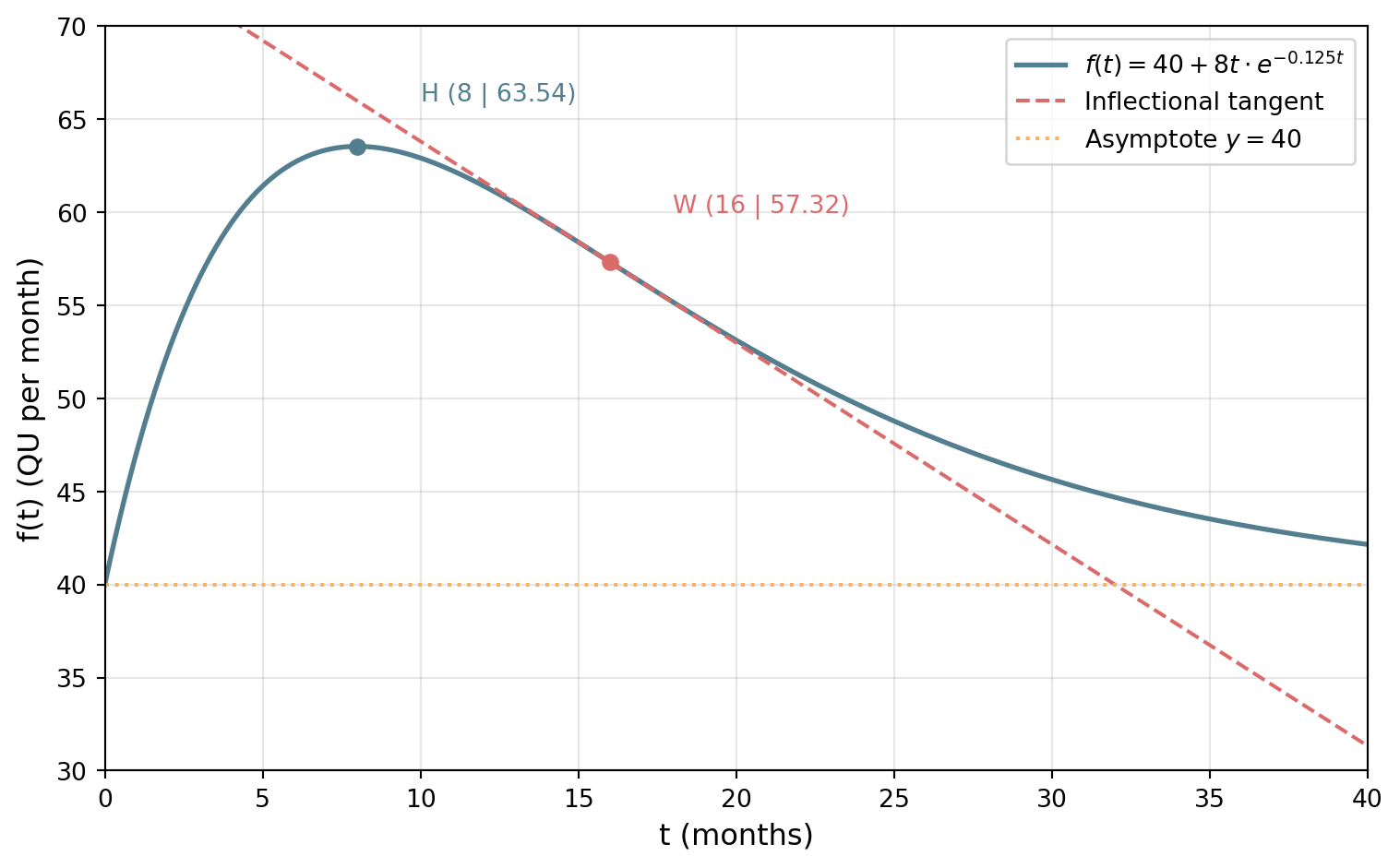
Meaning: The inflectional tangent shows the strongest rate of decline: at the inflection point the sales volume falls by about \(1.08\) QU per month, faster than at any other time. If sales continued to shrink at this rate, the long-run level of 40 QU would already be reached in month \(t = \frac{256e^{-2}}{8e^{-2}} = 32\) (from \(g(t) = 40\)). In reality the decline slows down after month 16, so the graph stays above the tangent.
Grading: 1 Pt. limit 40, 1 Pt. interpretation, 1 Pt. \(f(16)\) and \(f'(16)\), 2 Pts. tangent \(g(t) \approx -1.08t + 74.65\), 1 Pt. meaning.
Part e)
Sketch the graph \(G_f\) in the interval \([0; 40]\).
[4 pts.]
CautionSolution
Value table:
| \(t\) | 0 | 5 | 10 | 15 | 20 | 30 | 40 |
|---|---|---|---|---|---|---|---|
| \(f(t)\) | 40.00 | 61.41 | 62.92 | 58.40 | 53.13 | 45.64 | 42.16 |
Key features to include: starting value \(f(0) = 40\), maximum \(H(8 \,|\, 63.54)\), inflection point \(W(16 \,|\, 57.32)\) with the inflectional tangent, and the horizontal asymptote \(y = 40\).
Grading: 1 Pt. start at \((0, 40)\), 1 Pt. maximum \((8, 63.54)\), 1 Pt. inflection point \((16, 57.32)\) with the inflectional tangent, 1 Pt. approach to the asymptote \(y = 40\) from above.
Part f)
Prove that \(F(t) = 40t - 64e^{-0.125t}(t + 8) + C\) is an antiderivative of \(f\). Compute the average monthly sales volume within the first 24 months.
[7 pts.]
CautionSolution
Proof by differentiation (product rule on \(-64e^{-0.125t}(t + 8)\)):
\[F'(t) = 40 - 64 \cdot (-0.125)e^{-0.125t}(t + 8) - 64e^{-0.125t} \cdot 1 = 40 + 8e^{-0.125t}(t + 8) - 64e^{-0.125t}\]
\[F'(t) = 40 + 8te^{-0.125t} + 64e^{-0.125t} - 64e^{-0.125t} = 40 + 8te^{-0.125t} = f(t) \quad \checkmark\]
Average sales volume over \([0; 24]\):
\[\bar{f} = \frac{1}{24} \int_0^{24} f(t) \, dt = \frac{1}{24}\left[F(24) - F(0)\right]\]
\[F(24) = 960 - 64e^{-3} \cdot 32 = 960 - 2048e^{-3} \approx 960 - 101.96 = 858.04\]
\[F(0) = 0 - 64 \cdot 1 \cdot 8 = -512\]
\[\bar{f} = \frac{858.04 + 512}{24} = \frac{1370.04}{24} \approx 57.08\]
\[\boxed{\text{Average monthly sales volume} \approx 57.08 \text{ QU}}\]
The exact value is \(\bar{f} = \frac{1472 - 2048e^{-3}}{24} = \frac{184}{3} - \frac{256}{3}e^{-3}\).
Grading: 2 Pts. \(F'(t)\) with product and chain rule, 1 Pt. \(F'(t) = f(t)\), 1 Pt. average value formula, 2 Pts. \(F(24)\) and \(F(0)\), 1 Pt. average \(\approx 57.08\) QU.
FSP Problem 2: Insulated Lunch Boxes [40 pts. total]
A producer of insulated lunch boxes models its costs using a third-degree polynomial function. The fixed costs amount to 432 monetary units (MU). At a production level of 2 quantity units (QU), total costs are 656 MU. The marginal costs are 30 MU at a production level of 10 QU. The lowest increase in costs occurs at 7 QU.
Since the company is the sole supplier in this market segment, a linear price-demand function is assumed. Market research shows that at a sales volume of 3 QU, revenue amounts to 720 MU. The slope of the revenue function at this point is 186 MU.
(1 QU = 100 lunch boxes, 1 MU = 100 Euro)
Part a)
Determine the cost function assuming it is a polynomial of third degree.
[12 pts.]
(for verification: \(C(x) = x^3 - 21x^2 + 150x + 432\))
CautionSolution
Let \(C(x) = ax^3 + bx^2 + cx + d\) with \(C'(x) = 3ax^2 + 2bx + c\) and \(C''(x) = 6ax + 2b\).
| Condition | Equation |
|---|---|
| Fixed costs 432 | \(C(0) = d = 432\) |
| Total costs at 2 QU are 656 | \(C(2) = 8a + 4b + 2c + 432 = 656\) |
| Marginal costs at 10 QU are 30 | \(C'(10) = 300a + 20b + c = 30\) |
| Lowest increase in costs at 7 QU | \(C''(7) = 42a + 2b = 0\) |
From \(C''(7) = 0\): \(b = -21a \quad (III)\)
From \(C(2) = 656\): \(8a + 4b + 2c = 224 \Rightarrow 4a + 2b + c = 112\). With \((III)\): \(4a - 42a + c = 112 \Rightarrow c = 112 + 38a \quad (I)\)
From \(C'(10) = 30\): \(300a + 20b + c = 30\). With \((III)\): \(300a - 420a + c = 30 \Rightarrow c = 30 + 120a \quad (II)\)
Equate \((I)\) and \((II)\): \(112 + 38a = 30 + 120a \Rightarrow 82a = 82 \Rightarrow a = 1\), so \(b = -21\), \(c = 150\).
\[\boxed{C(x) = x^3 - 21x^2 + 150x + 432}\]
Check: \(C(2) = 8 - 84 + 300 + 432 = 656 \; \checkmark\), \(C'(10) = 300 - 420 + 150 = 30 \; \checkmark\), \(C''(7) = 42 - 42 = 0 \; \checkmark\)
Grading: 1 Pt. general form with \(C'\) and \(C''\), 4 Pts. one equation per condition, 6 Pts. solving the system (\(b = -21a\), \(c\) twice, \(a = 1\), \(b\), \(c\)), 1 Pt. \(C(x)\) with the check.
Part b)
Determine the price-demand function \(p(x)\) and the revenue function \(R(x)\).
[5 pts.]
(for verification: \(p(x) = 294 - 18x\))
CautionSolution
With \(p(x) = n - mx\) the revenue is \(R(x) = x \cdot p(x) = nx - mx^2\) and \(R'(x) = n - 2mx\).
Conditions at \(x = 3\):
\[R(3) = 3n - 9m = 720 \Rightarrow n - 3m = 240 \quad (I)\]
\[R'(3) = n - 6m = 186 \quad (II)\]
\((I) - (II)\): \(3m = 54 \Rightarrow m = 18\), and from \((I)\): \(n = 240 + 54 = 294\).
\[\boxed{p(x) = 294 - 18x, \qquad R(x) = 294x - 18x^2}\]
Grading: 1 Pt. \(R(x) = x \cdot p(x)\) with \(R'(x)\), 2 Pts. both equations, 1 Pt. \(m = 18\) and \(n = 294\), 1 Pt. \(p(x)\) and \(R(x)\).
Part c)
Give a term for the profit function \(P(x)\). Determine the (lower) break-even point and the profit limit (upper break-even point).
Hint: Find a first zero by testing whole numbers (or with the polynomial solver, MENU → A → 2, degree 3). Then divide by the matching linear factor. If a power cancels completely during the division, write its coefficient as 0 and continue with the next term.
[7 pts.]
CautionSolution
Profit function:
\[P(x) = R(x) - C(x) = 294x - 18x^2 - x^3 + 21x^2 - 150x - 432\]
\[\boxed{P(x) = -x^3 + 3x^2 + 144x - 432}\]
Break-even points: \(P(x) = 0\). Testing small integers:
- \(P(1) = -1 + 3 + 144 - 432 = -286 \neq 0\)
- \(P(2) = -8 + 12 + 288 - 432 = -140 \neq 0\)
- \(P(3) = -27 + 27 + 432 - 432 = 0 \; \checkmark\)
Polynomial division by \((x - 3)\):
\[\begin{array}{l} (-x^3 + 3x^2 + 144x - 432) : (x - 3) = -x^2 + 144 \\ \underline{-(-x^3 + 3x^2)} \\ \phantom{-(-x^3 + 3x^2}\;\; 144x - 432 \\ \phantom{-(-x^3 + 3x^2}\;\; \underline{-(144x - 432)} \\ \phantom{-(-x^3 + 3x^2 + 144x - 43}\;\; 0 \end{array}\]
The \(x^2\) term cancels completely, so the next term of the quotient is \(0 \cdot x\), and the division goes straight on with \(144x : x = 144\).
Remaining quadratic: \(-x^2 + 144 = 0 \Rightarrow x^2 = 144 \Rightarrow x = 12\) or \(x = -12\) (rejected).
\[\boxed{\text{Break-even point: } x = 3 \text{ QU}, \qquad \text{profit limit: } x = 12 \text{ QU}}\]
Between 3 QU and 12 QU the company operates at a profit.
Grading: 1 Pt. \(P(x) = -x^3 + 3x^2 + 144x - 432\), 1 Pt. zero \(x = 3\) found, 2 Pts. polynomial division, 2 Pts. \(x = 12\) (\(x = -12\) rejected), 1 Pt. break-even point 3 QU and profit limit 12 QU.
Part d)
Compute the maximum profit and prove it really is a maximum. Calculate the price the company must ask for at this output volume.
[7 pts.]
CautionSolution
Necessary condition: \(P'(x) = 0\)
\[P'(x) = -3x^2 + 6x + 144 = 0 \Rightarrow x^2 - 2x - 48 = 0\]
\[x = \frac{2 \pm \sqrt{4 + 192}}{2} = \frac{2 \pm 14}{2} \Rightarrow x = 8 \quad \text{or} \quad x = -6 \; \text{(rejected)}\]
Sufficient condition: \(P''(x) = -6x + 6\), so \(P''(8) = -42 < 0 \; \checkmark\) (maximum)
Maximum profit:
\[P(8) = -512 + 192 + 1152 - 432 = 400\]
\[\boxed{P_{\max} = 400 \text{ MU at } x = 8 \text{ QU}}\]
Price at the profit-maximizing volume:
\[p(8) = 294 - 18 \cdot 8 = 294 - 144 = \boxed{150 \text{ MU}}\]
Grading: 1 Pt. \(P'(x) = 0\), 1 Pt. \(x = 8\) (\(x = -6\) rejected), 2 Pts. \(P''(8) < 0\), so a maximum, 2 Pts. \(P(8) = 400\) MU, 1 Pt. price \(150\) MU.
Part e)
Calculate the number of sold lunch boxes and the profit in EUR if the company asks for a price of 186 MU.
[3 pts.]
CautionSolution
Sales volume: \(p(x) = 186\)
\[294 - 18x = 186 \Rightarrow 18x = 108 \Rightarrow x = 6 \text{ QU} = 600 \text{ lunch boxes}\]
Profit:
\[P(6) = -216 + 108 + 864 - 432 = 324 \text{ MU} = 324 \cdot 100 \text{ EUR}\]
\[\boxed{600 \text{ lunch boxes}, \qquad \text{profit} = 32{,}400 \text{ EUR}}\]
Grading: 1 Pt. \(x = 6\) QU from \(p(x) = 186\), 1 Pt. \(P(6) = 324\) MU, 1 Pt. 600 lunch boxes and 32,400 EUR.
Part f)
Compute the output volume with the lowest unit costs (average total cost). Also, determine the long term price floor (the long-term lower limit price).
Hint: Multiply the equation \(\overline{C}'(x) = 0\) by \(x^2\). Solve the cubic equation by testing whole numbers (or with the polynomial solver). Write the missing power with the coefficient 0.
[6 pts.]
CautionSolution
Unit costs (average costs):
\[\overline{C}(x) = \frac{C(x)}{x} = x^2 - 21x + 150 + \frac{432}{x}\]
Necessary condition: \(\overline{C}'(x) = 0\)
\[\overline{C}'(x) = 2x - 21 - \frac{432}{x^2} = 0 \quad \Big| \cdot x^2 \Rightarrow 2x^3 - 21x^2 - 432 = 0\]
Testing \(x = 12\): \(2 \cdot 1728 - 21 \cdot 144 - 432 = 3456 - 3024 - 432 = 0 \; \checkmark\)
Polynomial division: \((2x^3 - 21x^2 + 0x - 432) : (x - 12) = 2x^2 + 3x + 36\), whose discriminant \(9 - 288 < 0\) gives no further real roots. So \(x = 12\) is the only candidate.
Sufficient condition:
\[\overline{C}''(x) = 2 + \frac{864}{x^3} > 0 \quad \text{for all } x > 0 \; \checkmark \text{ (minimum)}\]
Lowest unit costs:
\[\overline{C}(12) = 144 - 252 + 150 + 36 = 78\]
\[\boxed{\text{Lowest unit costs at } x = 12 \text{ QU}, \qquad \text{long term price floor} = 78 \text{ MU}}\]
Below a price of 78 MU per QU the company cannot cover its total costs in the long run.
Check: \(C'(12) = 432 - 504 + 150 = 78 = \overline{C}(12)\), i.e. marginal costs equal unit costs at the minimum of the unit cost curve.
Grading: 1 Pt. \(\overline{C}(x)\), 1 Pt. \(\overline{C}'(x) = 0\) as a cubic equation, 1 Pt. \(x = 12\) as the only solution, 1 Pt. \(\overline{C}''(12) > 0\), so a minimum, 2 Pts. lowest unit costs at 12 QU and long term price floor 78 MU.
FSP Problem 3: Break-Even Points and Maximum Profit [13 pts. total]
A company has the cost function \(C(x) = x^3 - 18x^2 + 120x + 324\) and faces the price-demand function \(p(x) = 192 - 3x\) (both in MU, \(x\) in QU).
Part a)
Set up the profit function \(P(x)\) and determine the break-even point and the profit limit using polynomial division.
[7 pts.]
(for verification: \(P(x) = -x^3 + 15x^2 + 72x - 324\))
CautionSolution
Revenue: \(R(x) = x \cdot p(x) = 192x - 3x^2\).
\[P(x) = R(x) - C(x) = 192x - 3x^2 - x^3 + 18x^2 - 120x - 324 = -x^3 + 15x^2 + 72x - 324\]
Testing small integers: \(P(1) = -238\), \(P(2) = -128\), \(P(3) = -27 + 135 + 216 - 324 = 0 \; \checkmark\)
\[\begin{array}{l} (-x^3 + 15x^2 + 72x - 324) : (x - 3) = -x^2 + 12x + 108 \\ \underline{-(-x^3 + 3x^2)} \\ \phantom{-(-x^3}\;\; 12x^2 + 72x \\ \phantom{-(-x^3}\;\; \underline{-(12x^2 - 36x)} \\ \phantom{-(-x^3 + 12x^2}\;\; 108x - 324 \\ \phantom{-(-x^3 + 12x^2}\;\; \underline{-(108x - 324)} \\ \phantom{-(-x^3 + 12x^2 + 108x - 32}\;\; 0 \end{array}\]
\[-x^2 + 12x + 108 = 0 \Rightarrow x^2 - 12x - 108 = 0 \Rightarrow x = \frac{12 \pm \sqrt{144 + 432}}{2} = \frac{12 \pm 24}{2}\]
\(x = 18\) or \(x = -6\) (rejected).
\[\boxed{\text{Break-even point: } 3 \text{ QU}, \qquad \text{profit limit: } 18 \text{ QU}}\]
Grading: 1 Pt. \(R(x)\), 1 Pt. \(P(x)\), 1 Pt. zero \(x = 3\) found, 2 Pts. polynomial division, 1 Pt. quadratic formula with \(x = 18\) (\(x = -6\) rejected), 1 Pt. break-even point 3 QU and profit limit 18 QU.
Part b)
Determine the profit-maximizing output, the maximum profit and the price the company should charge.
[6 pts.]
CautionSolution
\(P'(x) = -3x^2 + 30x + 72 = 0 \Rightarrow x^2 - 10x - 24 = 0 \Rightarrow x = \frac{10 \pm \sqrt{100 + 96}}{2} = \frac{10 \pm 14}{2}\)
\(x = 12\) or \(x = -2\) (rejected). \(P''(x) = -6x + 30\), \(P''(12) = -42 < 0 \; \checkmark\) (maximum)
\[P(12) = -1728 + 2160 + 864 - 324 = 972, \qquad p(12) = 192 - 36 = 156\]
\[\boxed{x^* = 12 \text{ QU}, \qquad P_{\max} = 972 \text{ MU}, \qquad \text{price } 156 \text{ MU}}\]
Grading: 1 Pt. \(P'(x) = 0\), 1 Pt. \(x = 12\) (\(x = -2\) rejected), 2 Pts. \(P''(12) < 0\), so a maximum, 1 Pt. \(P(12) = 972\) MU, 1 Pt. price 156 MU.
FSP Problem 4: Lowest Unit Costs and the Long Term Price Floor [9 pts. total]
A company’s total costs are given by \(C(x) = 0.5x^3 - 4x^2 + 30x + 256\) (in MU, \(x\) in QU).
Part a)
Set up the unit cost function \(\overline{C}(x)\) and determine the output volume with the lowest unit costs.
Hint: Solve the cubic equation by testing whole numbers (or with the polynomial solver). Write the missing power with the coefficient 0.
[6 pts.]
CautionSolution
Unit costs are total costs per QU:
\[\overline{C}(x) = \frac{C(x)}{x} = 0.5x^2 - 4x + 30 + \frac{256}{x}\]
Necessary condition: \(\overline{C}'(x) = 0\)
\[\overline{C}'(x) = x - 4 - \frac{256}{x^2} = 0 \quad \Big| \cdot x^2 \Rightarrow x^3 - 4x^2 - 256 = 0\]
Testing \(x = 8\): \(512 - 256 - 256 = 0 \; \checkmark\)
Polynomial division: \((x^3 - 4x^2 + 0x - 256) : (x - 8) = x^2 + 4x + 32\), whose discriminant \(16 - 128 < 0\) gives no further real roots.
Sufficient condition: \(\overline{C}''(x) = 1 + \dfrac{512}{x^3} > 0\) for all \(x > 0 \; \checkmark\) (minimum)
\[\boxed{\text{Lowest unit costs at } x = 8 \text{ QU}}\]
Grading: 1 Pt. \(\overline{C}(x)\), 1 Pt. \(\overline{C}'(x) = 0\) as a cubic equation, 1 Pt. \(x = 8\) found, 1 Pt. no further solution (division and discriminant), 2 Pts. \(\overline{C}''(8) > 0\), so a minimum at 8 QU.
Part b)
Determine the long term price floor and explain what it means for the company.
[3 pts.]
CautionSolution
The long term price floor is the minimum of the unit costs:
\[\overline{C}(8) = 32 - 32 + 30 + 32 = \boxed{62 \text{ MU per QU}}\]
Check: \(C'(8) = 96 - 64 + 30 = 62 = \overline{C}(8)\). At the minimum of the unit costs, marginal costs equal unit costs.
62 MU is the lowest price at which the company can still cover its total costs (fixed and variable). Below this price the firm cannot cover its costs in the long run, even if it produces at its most efficient output of 8 QU, and would have to leave the market.
Grading: 2 Pts. long term price floor 62 MU per QU, 1 Pt. meaning.
FSP Problem 5: Derivative, Antiderivative and Tangent from a Graph [21 pts. total]
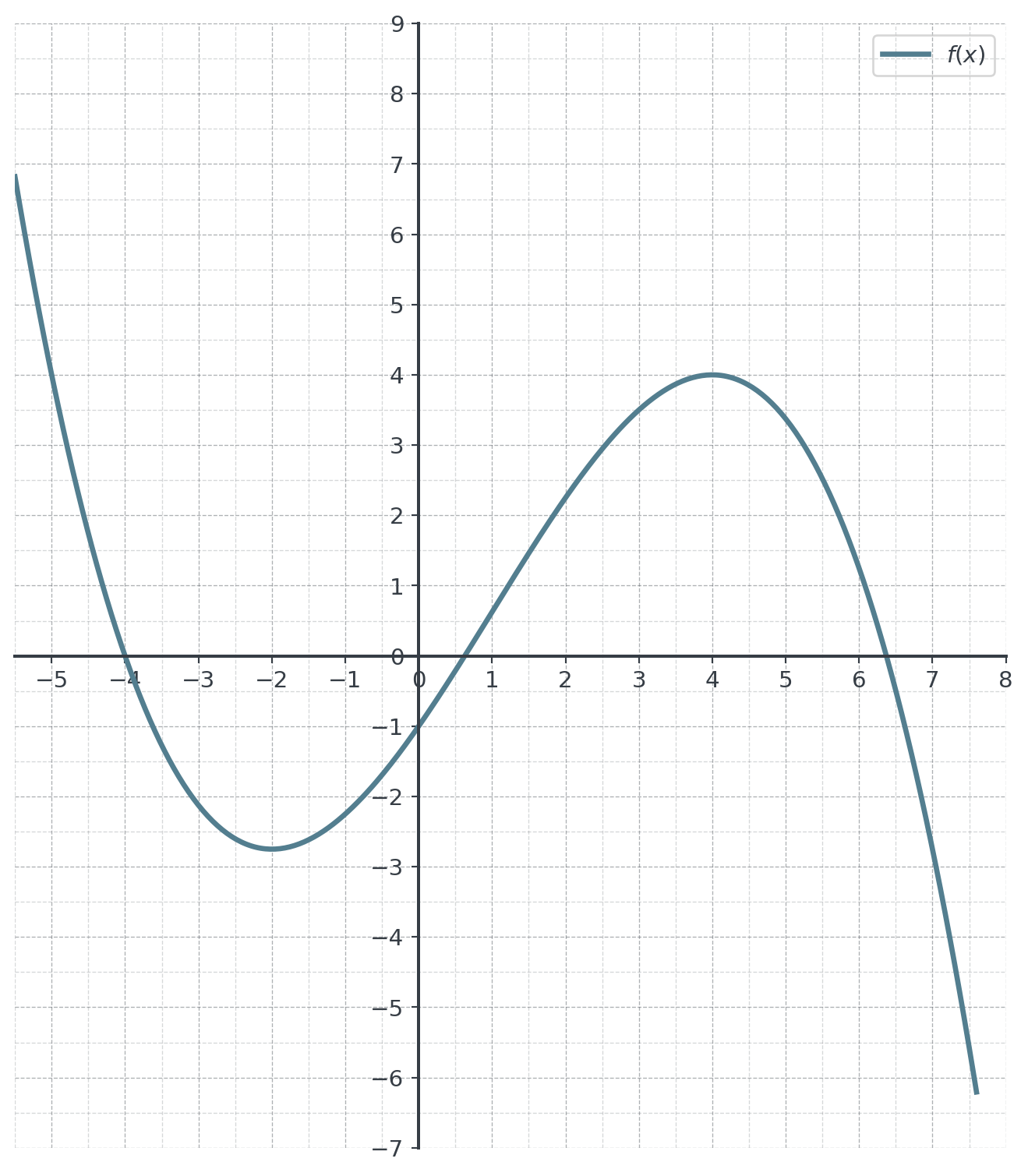
The figure shows the graph of a polynomial function \(f\) of degree 3. Its local maximum, its \(y\)-intercept and its smallest zero lie on grid points.
Note: Print the page or copy the figure onto squared paper. In the exam, you draw directly into the printed figure.
Part a)
Graph the derivative \(f'(x)\) of the function depicted above directly into the figure.
[4 pts.]
CautionSolution
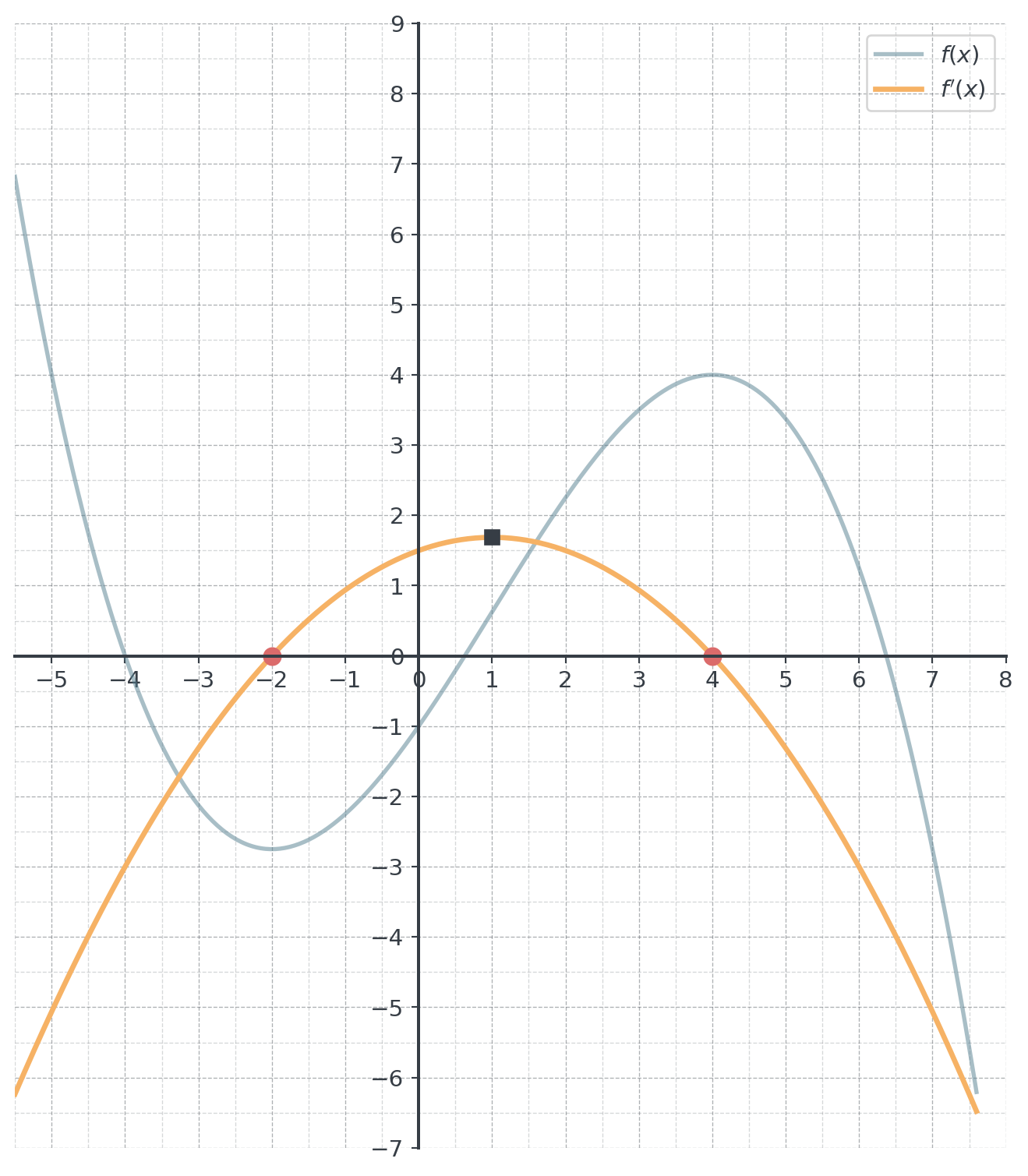
The graph of \(f\) has horizontal tangents at its local minimum at \(x = -2\) (about \((-2, -2.75)\)) and at its local maximum \((4, 4)\). So \(f'(-2) = 0\) and \(f'(4) = 0\): these are the zeros of \(f'\).
- \(x < -2\): \(f\) decreases, so \(f' < 0\).
- \(-2 < x < 4\): \(f\) increases, so \(f' > 0\).
- \(x > 4\): \(f\) decreases, so \(f' < 0\), and the graph of \(f\) gets steeper and steeper.
\(f'\) is a parabola with the zeros \(-2\) and \(4\). A parabola that opens downward has its vertex halfway between the zeros (Session 03-03), so \(f'\) has its highest point at \(x = 1\): there \(f\) is steepest and changes from concave up to concave down. From the graph, \(f\) rises from \(-1\) at \(x = 0\) to about \(2.25\) at \(x = 2\), i.e. by about 1.6 per unit. The graph of \(f'\) is a parabola that opens downward, with the zeros \(-2\) and \(4\) and its vertex at about \((1, 1.7)\):
Grading: 1 Pt. zeros of \(f'\) at \(x = -2\) and \(x = 4\), 1 Pt. signs of \(f'\) on the three intervals, 1 Pt. highest point of \(f'\) at \(x = 1\), 1 Pt. shape of a parabola that opens downward.
Part b)
Graph the antiderivative \(F(x)\) of the function depicted above directly into the figure and interpret its relation to \(f(x)\). Use the antiderivative with \(F(0) = -6\).
Hint: Because \(F' = f\), the rules from Session 05-05 apply to \(F\): \(F\) increases where \(f\) is positive, \(F\) has a local extremum where \(f\) changes sign, and \(F\) has an inflection point where \(f\) has a local extremum. To estimate the heights, \(F(b) - F(a)\) is the signed area between the graph of \(f\) and the \(x\)-axis (Session 06-02), which you can count in grid squares.
[5 pts.]
CautionSolution
The graph of \(f\) crosses the \(x\)-axis at \(x = -4\), at about \(x \approx 0.6\) and at about \(x \approx 6.4\). Since \(F' = f\), the sign of \(f\) is the sign of the slope of \(F\):
| \(x\) | \(x < -4\) | \(-4 < x < 0.6\) | \(0.6 < x < 6.4\) | \(x > 6.4\) |
|---|---|---|---|---|
| \(f(x) = F'(x)\) | \(+\) | \(-\) | \(+\) | \(-\) |
| \(F\) | increasing | decreasing | increasing | decreasing |
- \(x = -4\) and \(x \approx 6.4\): \(f\) changes from \(+\) to \(-\), local maxima of \(F\)
- \(x \approx 0.6\): \(f\) changes from \(-\) to \(+\), local minimum of \(F\)
- \(x = -2\) and \(x = 4\): \(f\) has its extrema, so the slope of \(F\) is smallest or largest there: inflection points of \(F\)
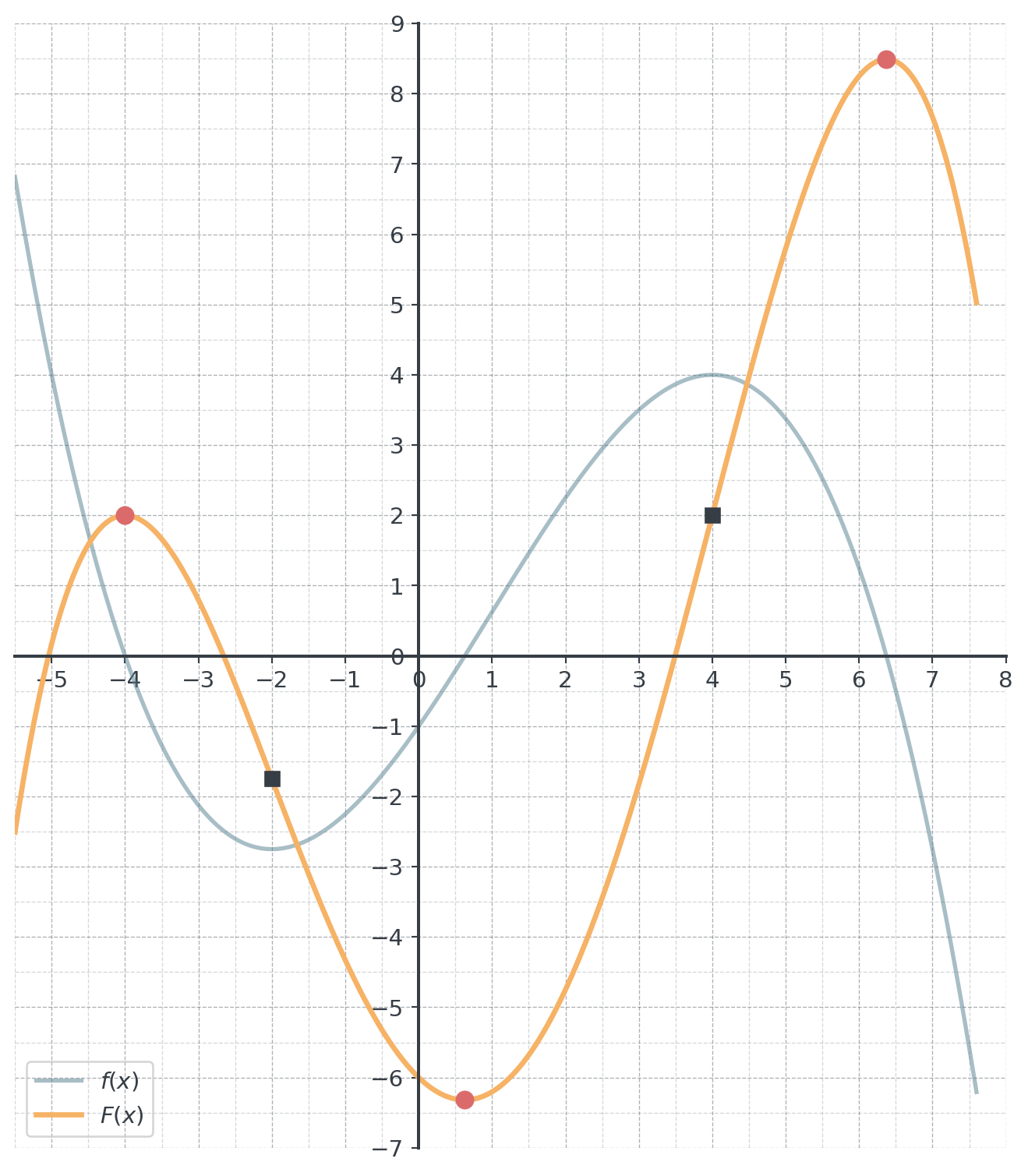
Start at \((0, -6)\). Going left, \(F\) rises up to \(x = -4\): counting the grid squares, the region between \(f\) and the \(x\)-axis on \([-4; 0]\) covers about 8 squares, so \(F(-4) \approx -6 + 8 = 2\). On \([0; 0.6]\), the region below the \(x\)-axis is tiny, so the minimum lies just below \(-6\). From \(x \approx 0.6\) to \(x \approx 6.4\), the region above the \(x\)-axis covers about 15 squares, so \(F\) rises to about \(8.5\) and falls again after \(x \approx 6.4\).
Relation: the value of \(f\) at \(x\) is the slope of \(F\) at \(x\), and \(F(x) - F(0)\) is the integral of \(f\) from 0 to \(x\). The zeros of \(f\) with a sign change become extrema of \(F\), and the extrema of \(f\) become inflection points of \(F\). The figure shows the exact antiderivative for comparison (circles: extrema, squares: inflection points). Your sketch only needs this shape.
Typical mistake: putting the extrema of \(F\) at the extrema of \(f\). That is the rule for \(f'\). For \(F\), the extrema lie at the zeros of \(f\) with a sign change.
Grading: 1 Pt. extrema of \(F\) at the zeros of \(f\), 1 Pt. intervals where \(F\) increases and decreases, 1 Pt. inflection points of \(F\) at \(x = -2\) and \(x = 4\), 1 Pt. graph through \((0, -6)\) with a fitting shape, 1 Pt. relation between \(F\) and \(f\).
Part c)
The function has the form \(f(x) = ax^3 + bx^2 + cx + d\). Set up a system of linear equations from the points that lie on grid points and determine \(a\), \(b\), \(c\) and \(d\).
[7 pts.]
(for verification: \(f(x) = -\frac{1}{16}x^3 + \frac{3}{16}x^2 + \frac{3}{2}x - 1\))
CautionSolution
Reading from the graph:
- \(y\)-intercept \((0, -1)\): \(f(0) = d = -1\)
- local maximum \((4, 4)\): \(f(4) = 4\) and \(f'(4) = 0\)
- smallest zero \((-4, 0)\): \(f(-4) = 0\)
With \(f'(x) = 3ax^2 + 2bx + c\) and \(d = -1\):
\[f(4) = 64a + 16b + 4c - 1 = 4 \iff 64a + 16b + 4c = 5 \quad (I)\]
\[f'(4) = 48a + 8b + c = 0 \quad (II)\]
\[f(-4) = -64a + 16b - 4c - 1 = 0 \iff -64a + 16b - 4c = 1 \quad (III)\]
\((I) + (III)\): \(32b = 6\), so \(b = \frac{3}{16}\).
\((I) - (III)\): \(128a + 8c = 4 \iff 32a + 2c = 1 \quad (IV)\)
From \((II)\) with \(b = \frac{3}{16}\): \(48a + \frac{3}{2} + c = 0 \iff c = -\frac{3}{2} - 48a \quad (V)\)
\((V)\) in \((IV)\): \(32a - 3 - 96a = 1 \iff -64a = 4 \iff a = -\frac{1}{16}\), so \(c = -\frac{3}{2} + 3 = \frac{3}{2}\).
\[\boxed{f(x) = -\frac{1}{16}x^3 + \frac{3}{16}x^2 + \frac{3}{2}x - 1}\]
Check with a point that was not used: the local minimum lies at \(x = -2\), and \(f(-2) = \frac{8}{16} + \frac{12}{16} - 3 - 1 = -2.75\), which matches the graph ✓.
Grading: 1 Pt. \(d = -1\) from the \(y\)-intercept, 2 Pts. equations from the maximum (\(f(4) = 4\) and \(f'(4) = 0\)), 1 Pt. equation \(f(-4) = 0\), 2 Pts. solving the system, 1 Pt. \(f(x)\) with a check.
Part d)
Determine the tangent of \(f\) at \(x = 3\).
[3 pts.]
CautionSolution
Use \(f(x) = -\frac{1}{16}x^3 + \frac{3}{16}x^2 + \frac{3}{2}x - 1\) from c).
Point: \(f(3) = -\frac{27}{16} + \frac{27}{16} + \frac{9}{2} - 1 = 3.5\)
Slope: \(f'(x) = -\frac{3}{16}x^2 + \frac{3}{8}x + \frac{3}{2}\), so \(f'(3) = -\frac{27}{16} + \frac{18}{16} + \frac{24}{16} = \frac{15}{16} = 0.9375\)
Tangent (point-slope form):
\[t(x) = \frac{15}{16}(x - 3) + 3.5 = \frac{15}{16}x + \frac{11}{16} \approx 0.94x + 0.69\]
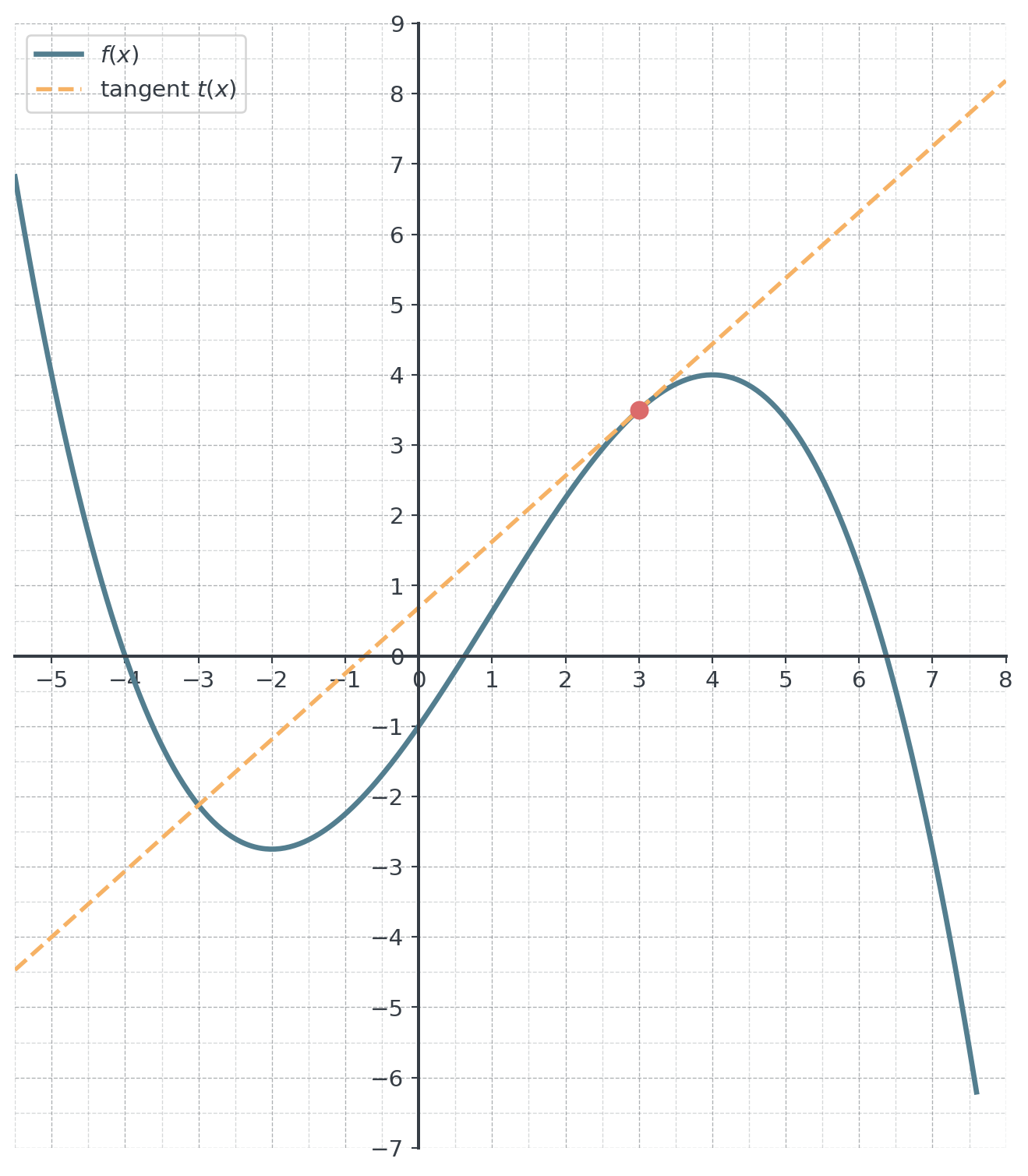
Grading: 1 Pt. \(f(3) = 3.5\), 1 Pt. \(f'(3) = \frac{15}{16}\), 1 Pt. tangent \(t(x) = \frac{15}{16}x + \frac{11}{16}\).
Part e)
Compute the angle of intersection \(\alpha\) between the tangent and the \(x\)-axis.
Hint: The indicator D must show. SHIFT + tan gives \(\arctan\).
[2 pts.]
CautionSolution
A line with slope \(m\) meets the \(x\)-axis at the angle \(\alpha\) with \(\tan(\alpha) = m\). The tangent from d) has the slope \(m = \frac{15}{16} = 0.9375\):
\[\alpha = \arctan(0.9375) \approx 43.15°\]
Grading: 1 Pt. \(\tan(\alpha) = m\) with \(m = \frac{15}{16}\), 1 Pt. \(\alpha \approx 43.15°\).