Session 05-05 - Graphical Calculus Mastery
Section 05: Differential Calculus
Entry Quiz
Quick Review from Session 05-04
Test your understanding of chain rule and implicit differentiation
Differentiate \(f(x) = (2x^3 - 5)^4\) using the chain rule.
Find \(\frac{dy}{dx}\) if \(x^2 + xy = 10\).
If \(f'(3) = 0\), what does this tell about the graph of \(f(x)\) at \(x = 3\)?
Homework Discussion
Your questions from Session 05-04
What questions do you have regarding the previous session?
Learning Objectives
What You’ll Master Today
- Sketch \(f'(x)\) from the graph of \(f(x)\) by analyzing slopes
- Determine properties of \(f(x)\) from the graph of \(f'(x)\)
- Understand concavity through second derivatives \(f''(x)\)
- Identify critical points and their classification
- Find inflection points where concavity changes
- Master visual analysis - a heavily tested exam skill!
NoteKey Insight
Being able to translate between graphs of \(f\), \(f'\), and \(f''\) is one of the most important visual skills in calculus and frequently tested!
Function to Derivative
Reading the Derivative Graph
The graph of \(f'(x)\) shows the slope of \(f(x)\) at each point.
What to look for in \(f(x)\):
- Where \(f\) is increasing → \(f'(x) > 0\) (derivative is positive)
- Where \(f\) is decreasing → \(f'(x) < 0\) (derivative is negative)
- Where \(f\) has a horizontal tangent → \(f'(x) = 0\) (crosses x-axis)
- Where \(f\) is steep → \(|f'(x)|\) is large
- Where \(f\) is flat → \(|f'(x)|\) is small
This shouldn’t be too complicated, right?
Sketching \(f'\) from \(f\)
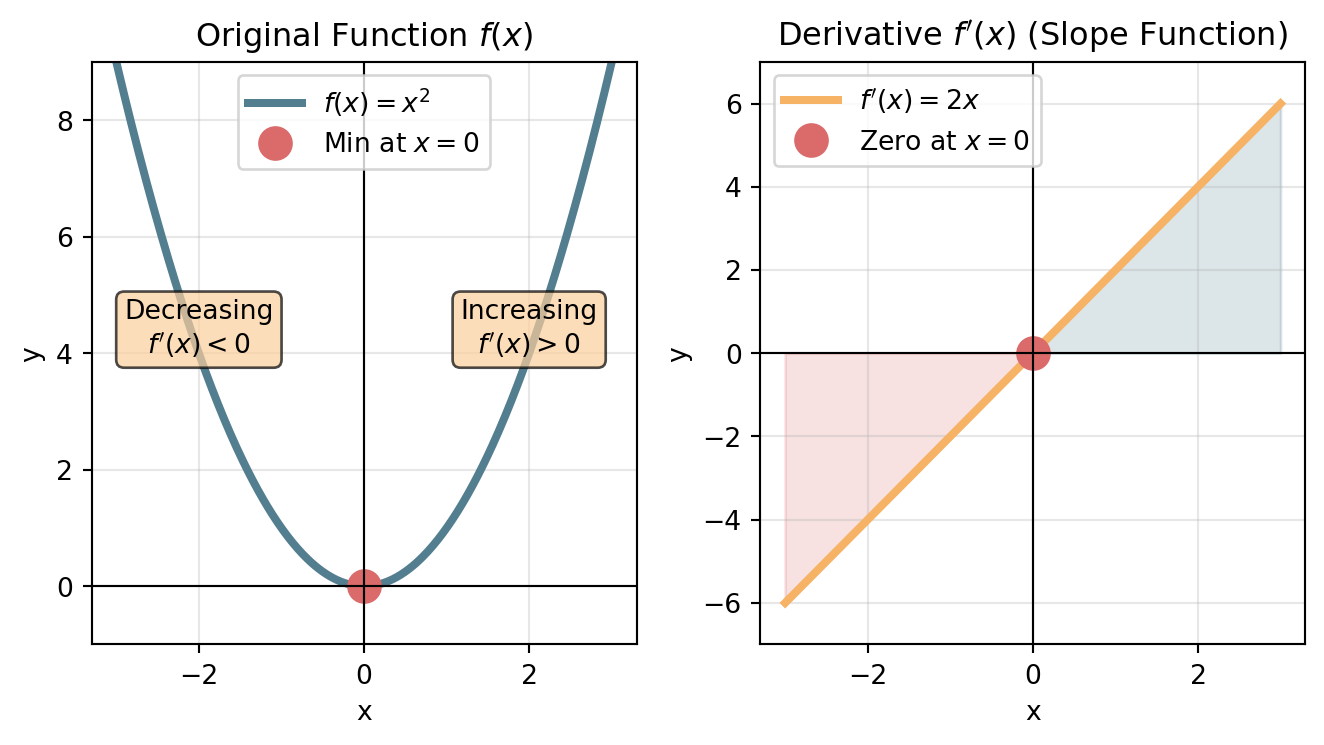
A parabola and its derivative: \(f(x) = x^2\)
\(f\) has minimum at \(x = 0\) → \(f'\) crosses zero
Steps: Sketching the Derivative
Identify critical points: Where does \(f\) have horizontal tangents? Mark these as zeros of \(f'\)
Determine sign: Where is \(f\) increasing/decreasing? Make \(f'\) positive/negative accordingly
Consider steepness:
- Where is \(f\) very steep? Make \(|f'|\) large.
- Where is \(f\) nearly flat? Make \(|f'|\) small.
Check concavity: Is \(f'\) increasing or decreasing? This tells you about the concavity of \(f\)
Complex Example
A cubic function and its derivative.
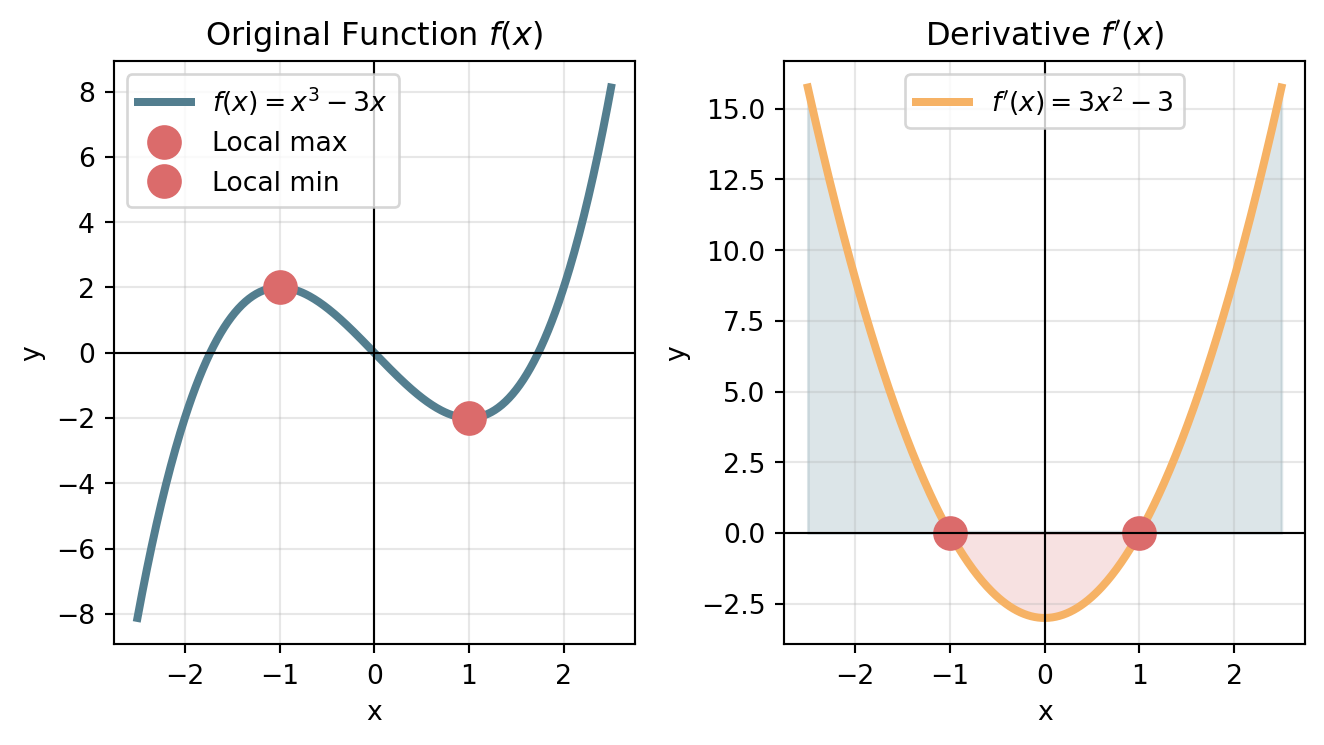
\(f\) increasing, then decreasing, then increasing → \(f'\) crosses zero twice
Critical Points
A point \(x = c\) where either:
- \(f'(c) = 0\) (horizontal tangent), or
- \(f'(c)\) does not exist (corner, cusp, vertical tangent)
TipClassification of Critical Points
- Local maximum: \(f'\) changes from positive to negative
- Local minimum: \(f'\) changes from negative to positive
- Saddle point (stationary point without extremum): \(f'\) doesn’t change sign (e.g., \(f(x) = x^3\) at \(x = 0\))
Derivative to Function
Reading Information from \(f'(x)\)
Given the graph of \(f'(x)\), we can determine:
Where \(f\) is increasing/decreasing:
- \(f'(x) > 0\) → \(f\) is increasing
- \(f'(x) < 0\) → \(f\) is decreasing
Where \(f\) has local extrema: \(f'\) crosses zero
- Sign change determines type!
Where \(f\) is steepest: Where \(|f'(x)|\) is largest
Relative heights: Cannot determine absolute \(y\)-values!
- Can determine relative changes!
Example: Reading from \(f'(x)\)
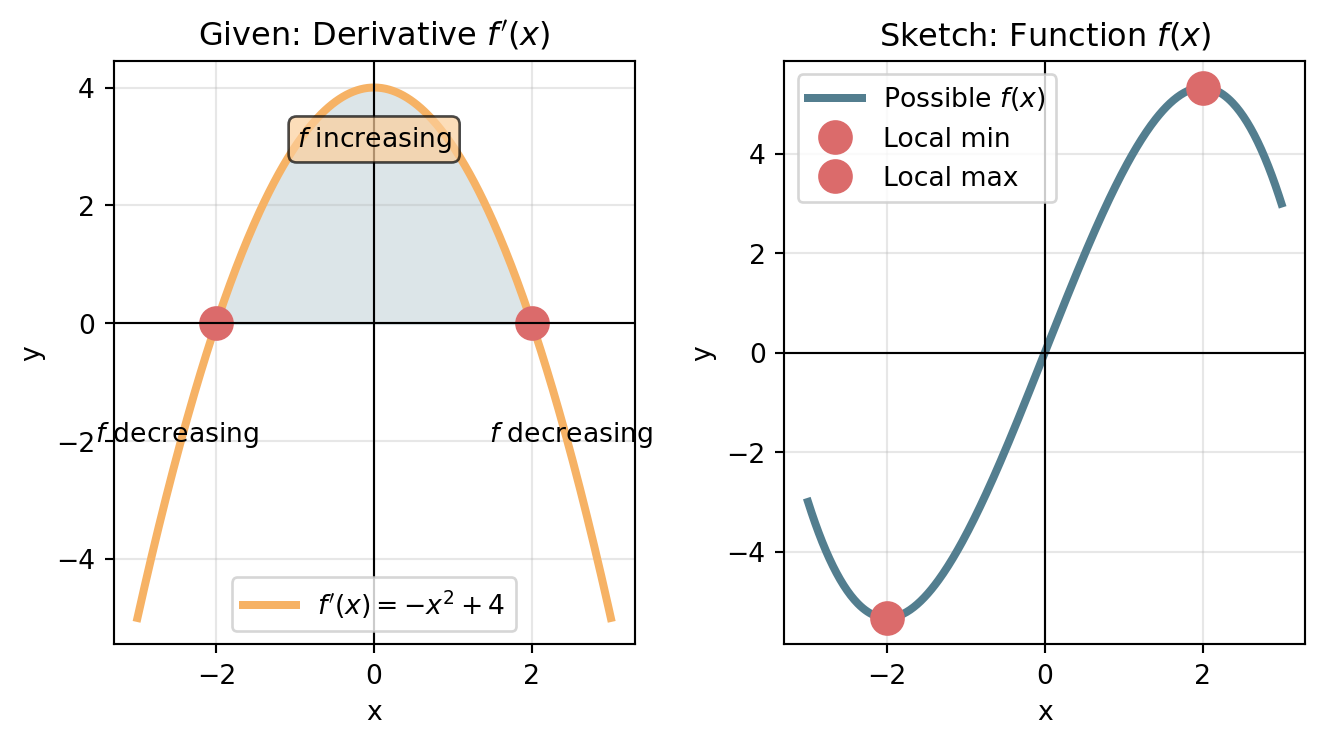
- \(f' > 0\) on \((-2; 2)\) → \(f\) increasing, \(f' < 0\) for \(|x| > 2\) → \(f\) decreasing
- \(f'\) changes at \(x = -2, 2\) → \(f\) has local extrema
Quick Practice
Individual Exercise I
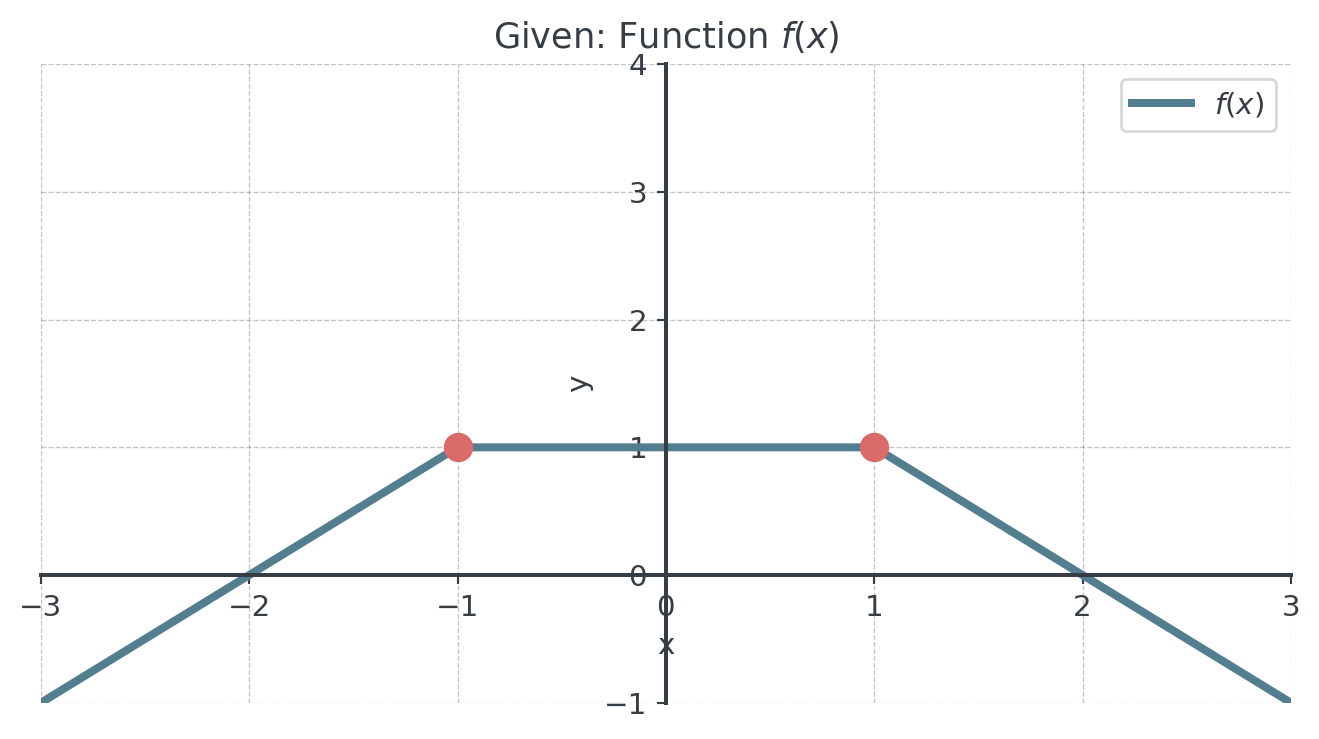
Sketch the derivative of this function!
Individual Exercise II
The Questions:
Where is \(f'(x) > 0\), \(f'(x) < 0\), and \(f'(x) = 0\)?
Sketch the graph of \(f'(x)\).
At what points does \(f'(x)\) not exist?
Break
Concavity
Understanding Concavity
Describes the curving behavior of a function.
- Concave up (⌣): Curves upward like a smile (“holds water”)
- \(f''(x) > 0\)
- The slope \(f'(x)\) is increasing
- Concave down (⌢): Curves downward like a frown (“spills water”)
- \(f''(x) < 0\)
- The slope \(f'(x)\) is decreasing
Visualizing Concavity
Concave up vs. concave down
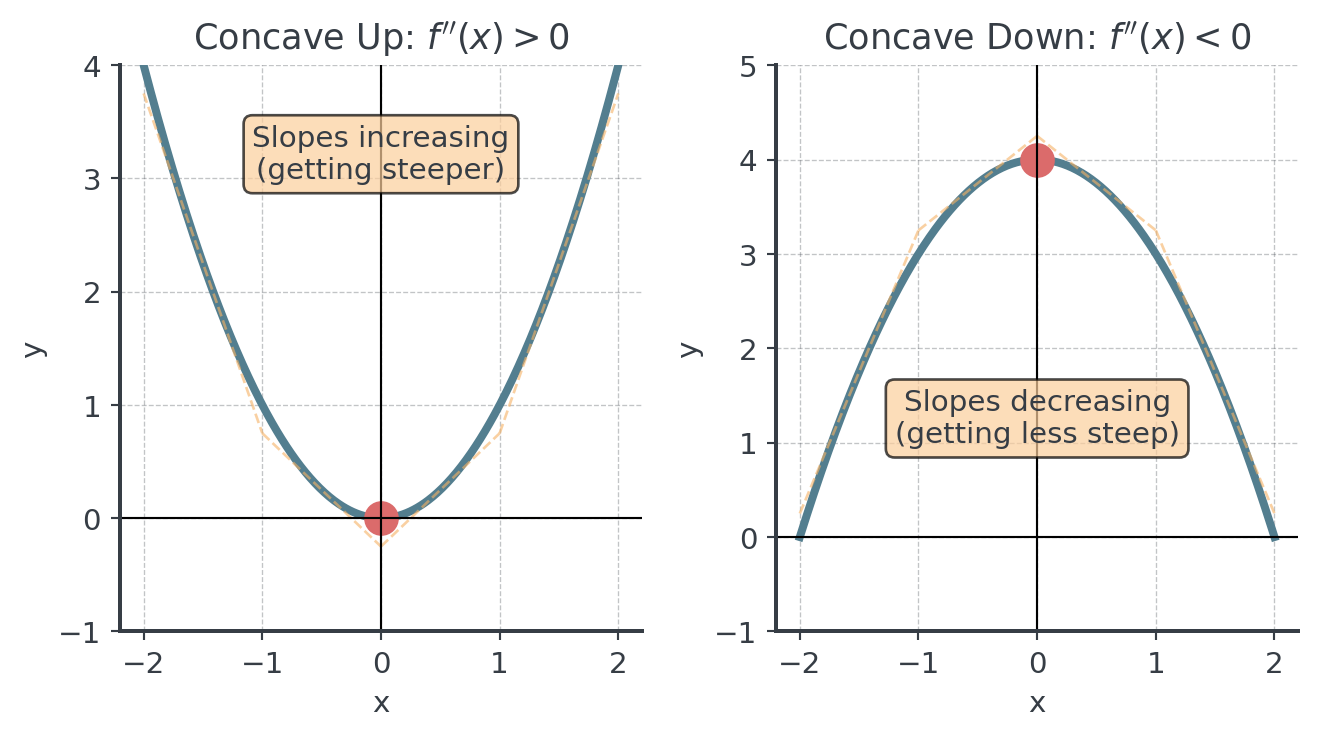
\(f''(x)\) tells us how \(f'(x)\) is changing, which determines the shape of \(f(x)\).
Inflection Points
A point where the curvature (concavity) changes sign!
- \(f''(x) = 0\) or \(f''(x)\) does not exist
- Concavity changes (from ⌣ to ⌢ or vice versa)
Example: \(f(x) = x^3\)
- \(f'(x) = 3x^2\)
- \(f''(x) = 6x\)
- \(f''(0) = 0\) and concavity changes at \(x = 0\)
- So \((0, 0)\) is an inflection point
Relationships Between \(f\), \(f'\), and \(f''\)
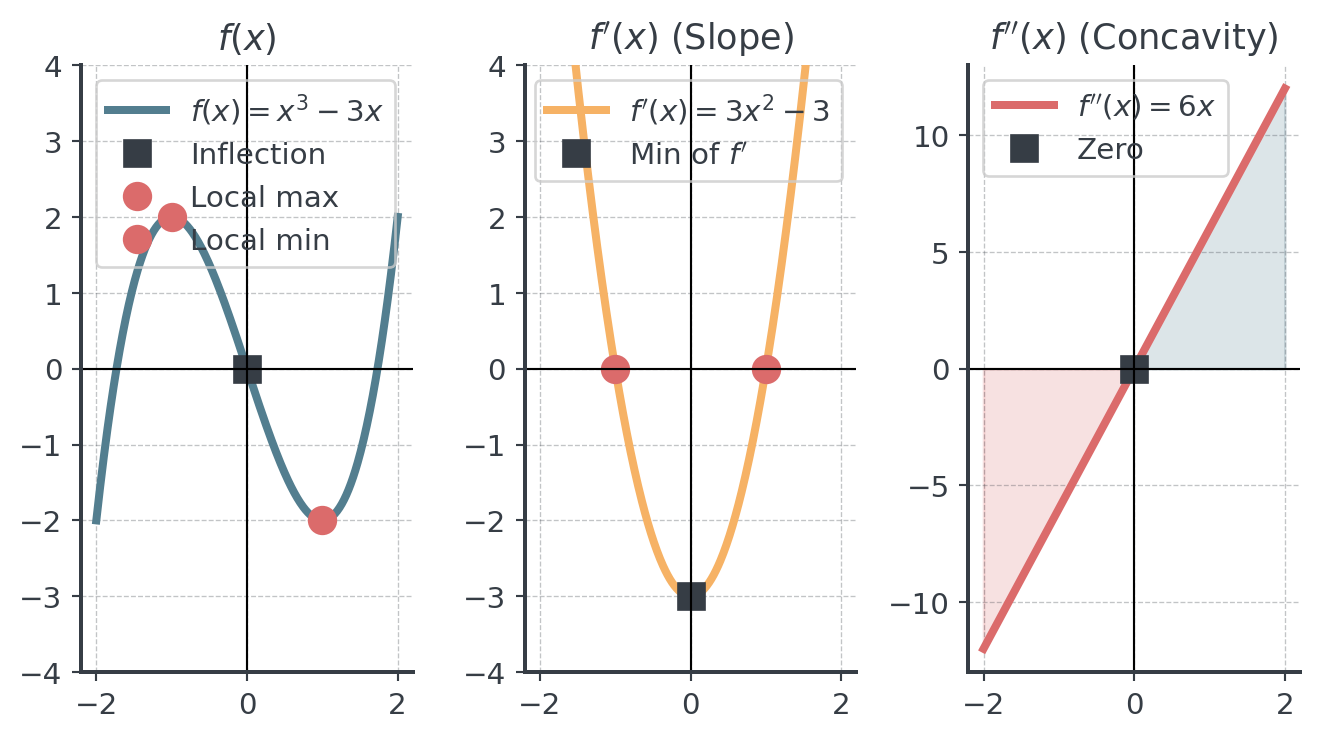
- Where \(f'' < 0\): \(f\) concave down, \(f'\) decreasing, where \(f'' > 0\): \(f\) concave up, \(f'\) increasing
- Where \(f'' = 0\): Inflection point in \(f\), extremum in \(f'\)
Complete Analysis
The Complete Picture
Given a function \(f(x)\), complete analysis involves:
- Critical points: Solve \(f'(x) = 0\)
- First derivative test: Check sign changes of \(f'\) to classify extrema
- Inflection points: Solve \(f''(x) = 0\) and check for concavity change
- Intervals: Determine where \(f\) is increasing/decreasing and where concave up/down
- Key points: Evaluate \(f\) at critical points and inflection points
Example: Complete Analysis
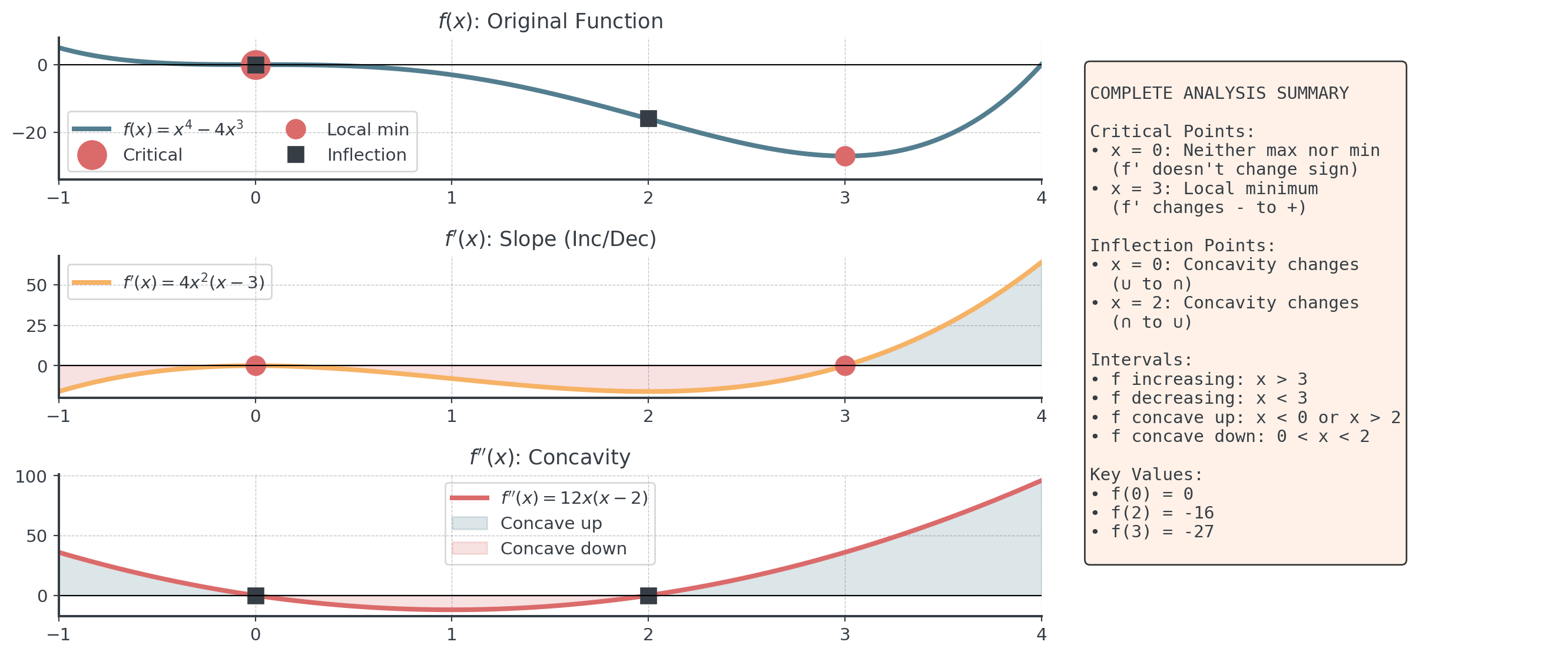
Analyze \(f(x) = x^4 - 4x^3\)
First derivative:
\[f'(x) = 4x^3 - 12x^2 = 4x^2(x - 3)\]
Critical points: \(x = 0, 3\)
Second derivative:
\[f''(x) = 12x^2 - 24x = 12x(x - 2)\]
Inflection points: \(x = 0, 2\)
Analysis Visualization
Guided Practice
Practice Set A: Derivative Sketches
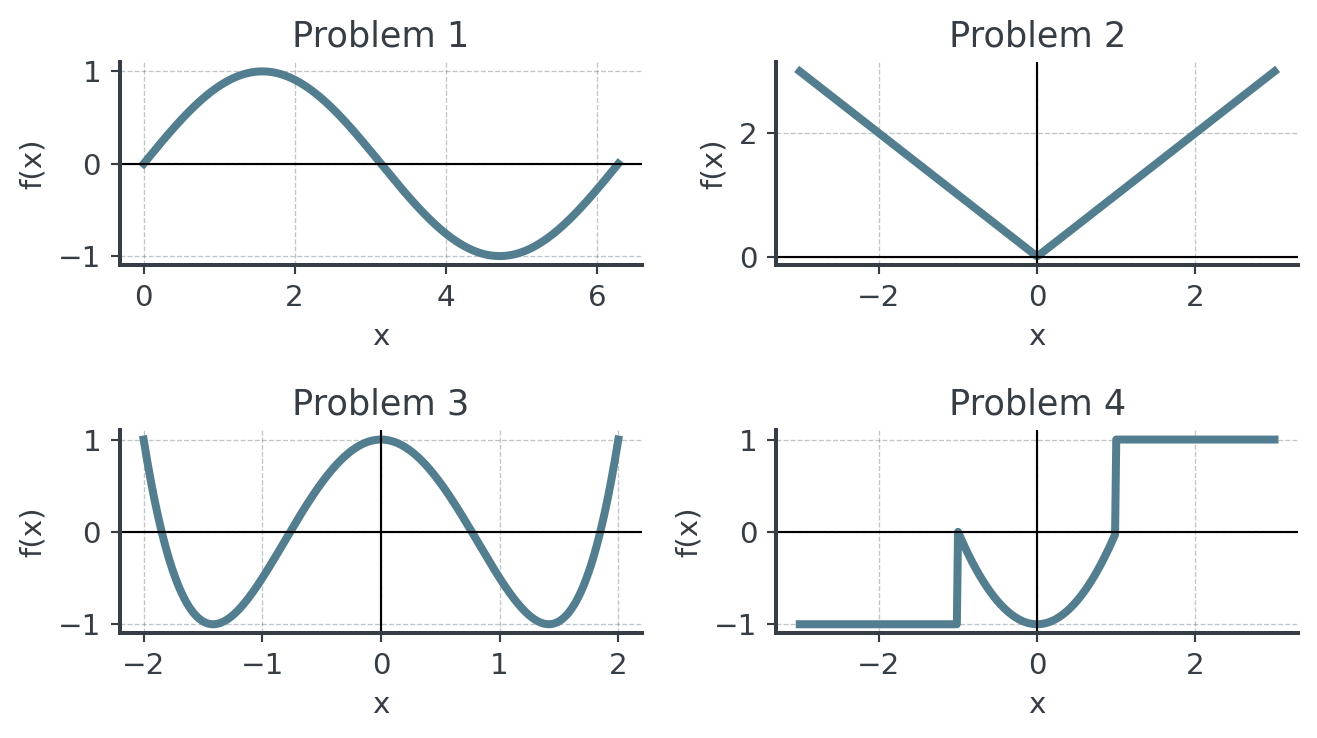
For each function graphed below, sketch \(f'(x)\) and identify:
- Where \(f'(x) > 0, < 0, = 0\) and any points where \(f'\) does not exist
Practice B: From Derivative I
Continue working for 10 minutes
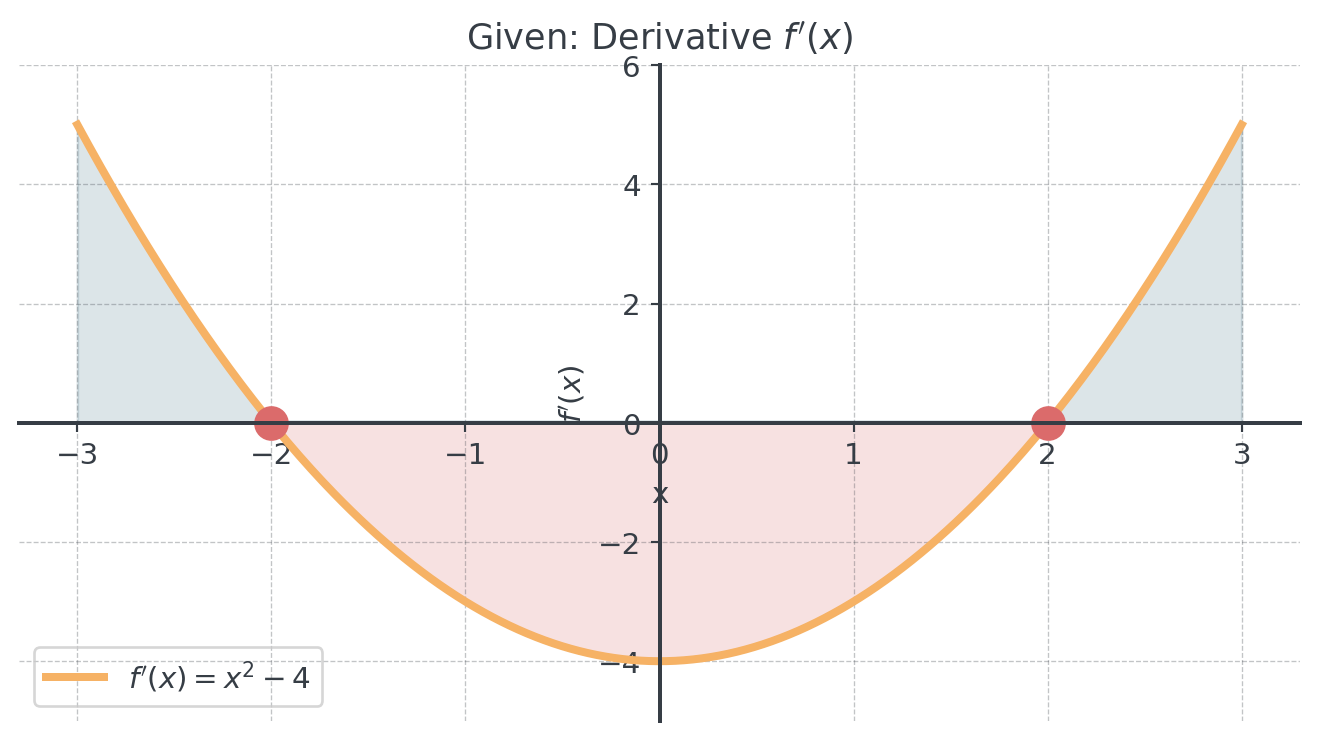
Given the graph of \(f'(x)\), answer:
- Where is \(f(x)\) increasing/decreasing?
- Where does \(f(x)\) have local extrema? Classify them.
- Sketch a possible graph of \(f(x)\).
Practice B: From Derivative II
Quick Practice: Derivative Sketch
Work individually for 5 minutes
For each function described, sketch both \(f(x)\) and \(f'(x)\):
\(f(x) = x^3 - 3x\) (cubic with local max and min)
\(f(x) = |x - 2|\) (V-shape shifted right)
\(f(x)\) is constant for \(x < 0\), then increases linearly for \(x \geq 0\)
\(f(x)\) has \(f'(x) > 0\) everywhere but \(f'(x) \to 0\) as \(x \to \infty\)
Coffee Break
Business Applications
Profit Function Analysis
Business Context: A company’s monthly profit (in thousands EUR) is modeled by: \[P(t) = -t^3 + 12t^2 - 36t + 50\] where \(t\) is months since product launch.
Questions:
- When is profit increasing/decreasing?
- When does profit reach local extrema?
- When is the rate of profit change accelerating/decelerating?
Profit Analysis Solution
First derivative (profit rate of change): \[P'(t) = -3t^2 + 24t - 36 = -3(t^2 - 8t + 12) = -3(t - 2)(t - 6)\]
Critical points: \(t = 2, 6\) months
Second derivative (acceleration of profit change): \[P''(t) = -6t + 24 = -6(t - 4)\]
Inflection point: \(t = 4\) months
Profit Visualization
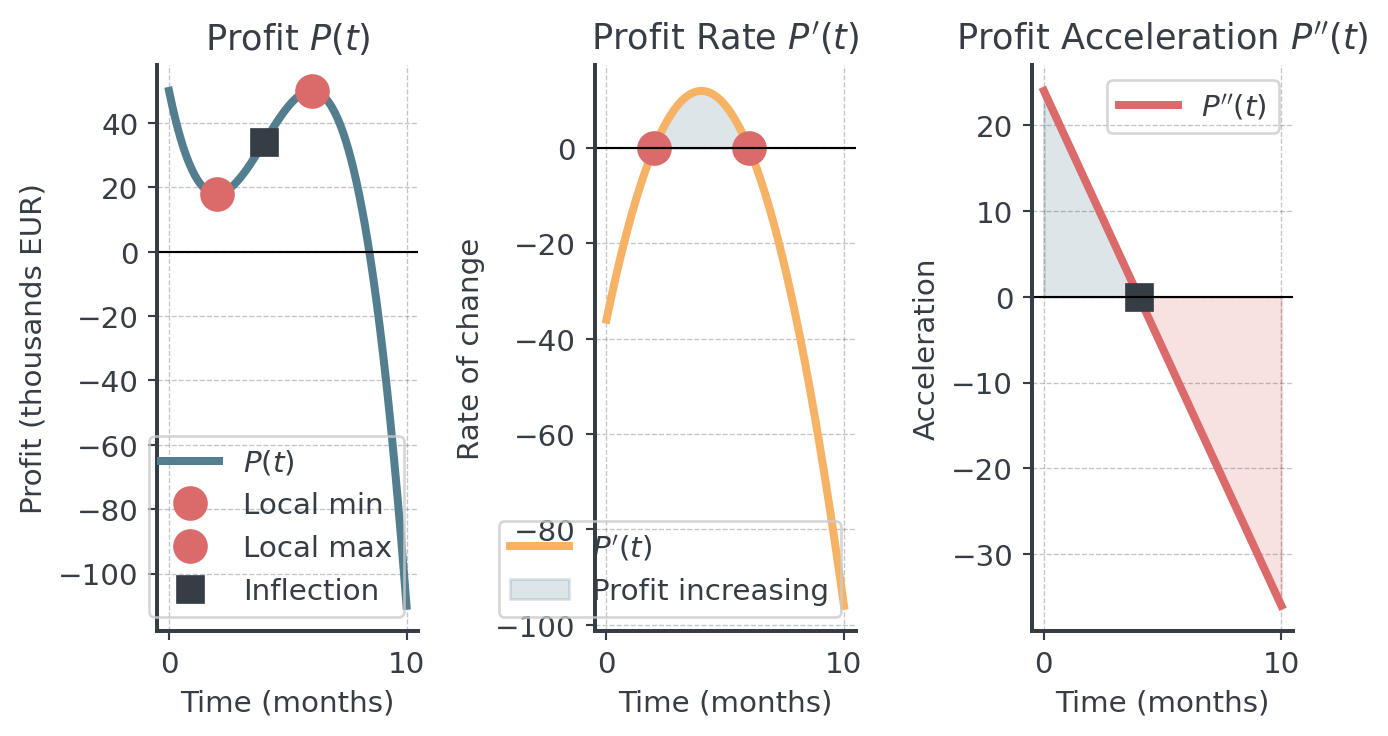
Question: How would you describe the behaviour?
Profit Interpretation
TipReading Business Graphs: Quick Rules
- \(P'(t) > 0\) → Profit is growing (good news!)
- \(P'(t) < 0\) → Profit is shrinking (warning sign)
- \(P'(t) = 0\) → Profit has reached a turning point (decision time)
The sign of the derivative tells you the direction of change!
NoteInflection Points in Business
The inflection point (\(P''(t) = 0\) at month 4) marks where:
- Before: Profit is accelerating (growth speeding up)
- After: Profit is decelerating (growth slowing down)
Business insight: Month 4 is when the company should start planning for the eventual peak. Growth is still positive but momentum is fading!
Team Problem-Solving
Challenge: Full Function Analysis
Scenario: A manufacturing company models their weekly profit (in thousands EUR) as a function of production quantity:
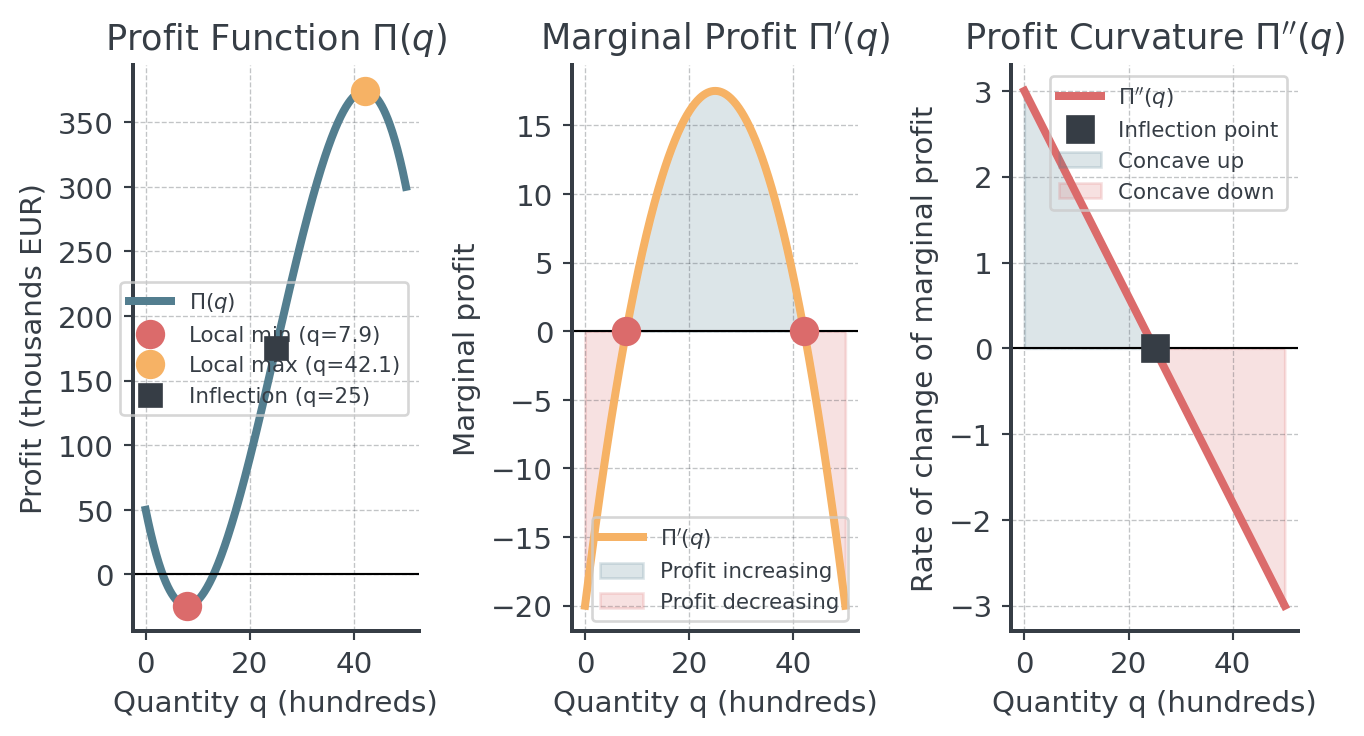
\[\Pi(q) = -0.02q^3 + 1.5q^2 - 20q + 50\]
where \(q\) is quantity produced (in hundreds of units), with \(q \in [0; 50]\).
Tasks
Work in groups of 3-4
Find \(\Pi'(q)\) and determine where profit is increasing vs. decreasing. Interpret economically.
Find \(\Pi''(q)\) and locate any inflection points - what do they say about profit growth?
Sketch the graphs of \(\Pi(q)\), \(\Pi'(q)\), and \(\Pi''(q)\) on \(q \in [0; 50]\).
Find all critical points and classify them as local maxima or minima using the sign change of \(\Pi'(q)\).
Business question: Current production is 1,500 units (\(q = 15\)) - raise or lower it, and by how much? Justify with calculus.
Wrap-Up & Takeaways
The Derivative Overview
| If you know… | You can determine… |
|---|---|
| \(f' > 0\) | \(f\) is increasing |
| \(f' < 0\) | \(f\) is decreasing |
| \(f' = 0\) | Possible local extremum |
| \(f'' > 0\) | \(f\) concave up, \(f'\) increasing |
| \(f'' < 0\) | \(f\) concave down, \(f'\) decreasing |
| \(f'' = 0\) | Possible inflection point |
These are heavily Tested Skills in FSP!!!
Final Assessment
Quick Check I
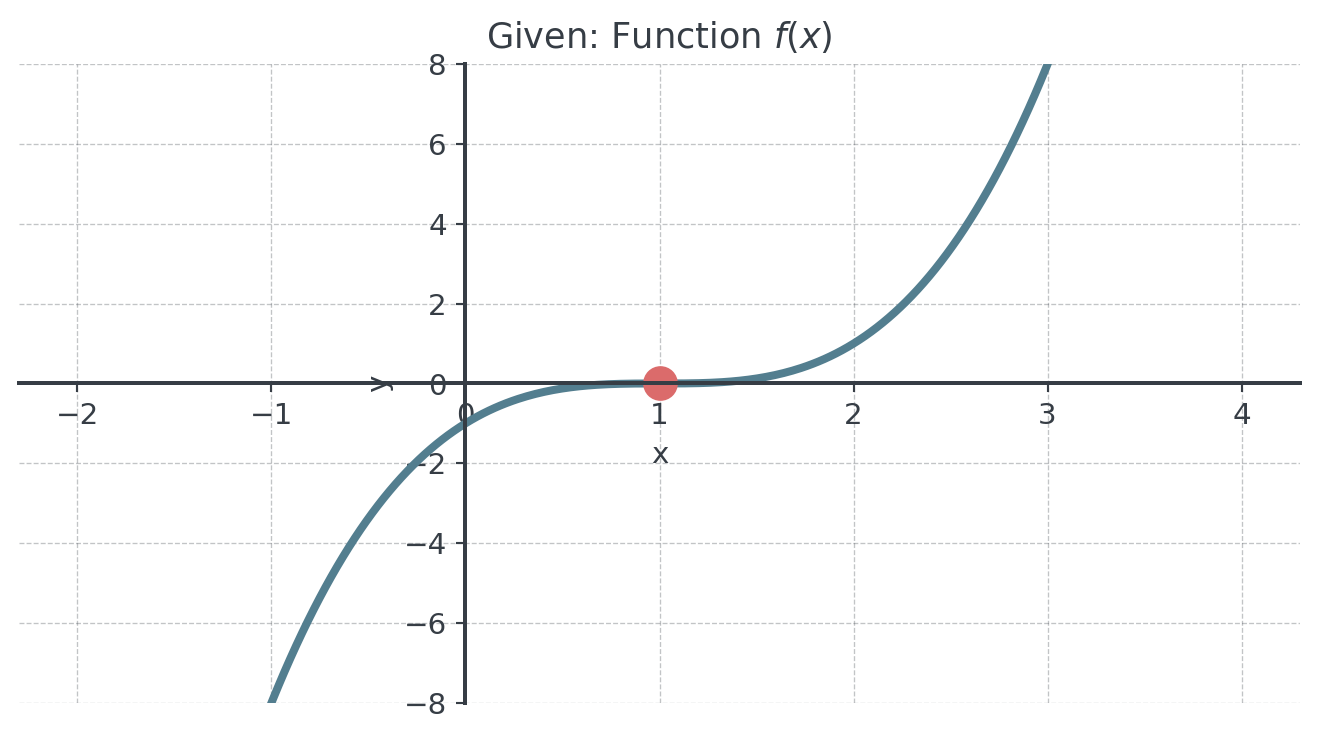
Consider this function:
Quick Check II
Work individually, then we compare
Where is \(f'(x) > 0\)?
At \(x = 1\), is this a local max, local min, or neither?
Where is \(f(x)\) concave up?
True or False: If \(f'(c) = 0\), then \(f\) must have a local extremum at \(x = c\).
Next Session Preview
Session 05-06
Optimization & Curve Sketching
- First and second derivative tests for extrema classification
- Global maxima/minima on closed intervals
- Complete curve sketching algorithm (6 steps)
- Business optimization: profit maximization, cost minimization
- Interpreting results in real-world context
Complete Tasks 05-05!
Appendix