Session 05-03 - Differentiation Rules & Tangent Lines
Section 05: Differential Calculus
Entry Quiz
Quick Review from Session 05-02
Test your understanding of derivatives as rate of change
Using the limit definition, find \(f'(x)\) if \(f(x) = 3x^2\).
What is the derivative of \(g(x) = 5x\) using the limit definition?
For the cost function \(C(x) = 100 + 20x\), what is \(C'(x)\) and what does it mean in business terms?
If the slope of the tangent line to \(f(x)\) at \(x = 2\) is 5, what is \(f'(2)\)?
Homework Discussion
Your questions from Session 05-02
What questions do you have regarding the tasks?
Learning Objectives
What You’ll Master Today
- Master differentiation rules to avoid tedious limit calculations
- Apply product and quotient rules correctly and efficiently
- Find equations of tangent lines at specific points on curves
- Use linear approximation for estimation in business contexts
- Choose optimal strategies for differentiating complex functions
NoteKey Insight
Today we develop shortcuts that make differentiation fast and efficient, no more slow limit algebra!
Basic Rules
Why We Need Rules
The Problem: Computing derivatives from limit definition is tedious!
- For \(f(x) = x^{10}\), the binomial expansion has 11 terms
- For \(f(x) = (x^2 + 3x + 1)^{50}\), it’s essentially impossible
- We need shortcuts that give the same answer faster
The Solution: Differentiation rules, formulas that work every time!
The Power Rule
Power Rule (where \(n\) is any real number): \[\frac{d}{dx}[x^n] = nx^{n-1}\]
Examples:
- \(\frac{d}{dx}[x^5] = 5x^4\)
- \(\frac{d}{dx}[\sqrt{x}] = \frac{d}{dx}[x^{1/2}] = \frac{1}{2}x^{-1/2} = \frac{1}{2\sqrt{x}}\)
- \(\frac{d}{dx}\left[\frac{1}{x^3}\right] = \frac{d}{dx}[x^{-3}] = -3x^{-4} = -\frac{3}{x^4}\)
Visualizing the Power Rule
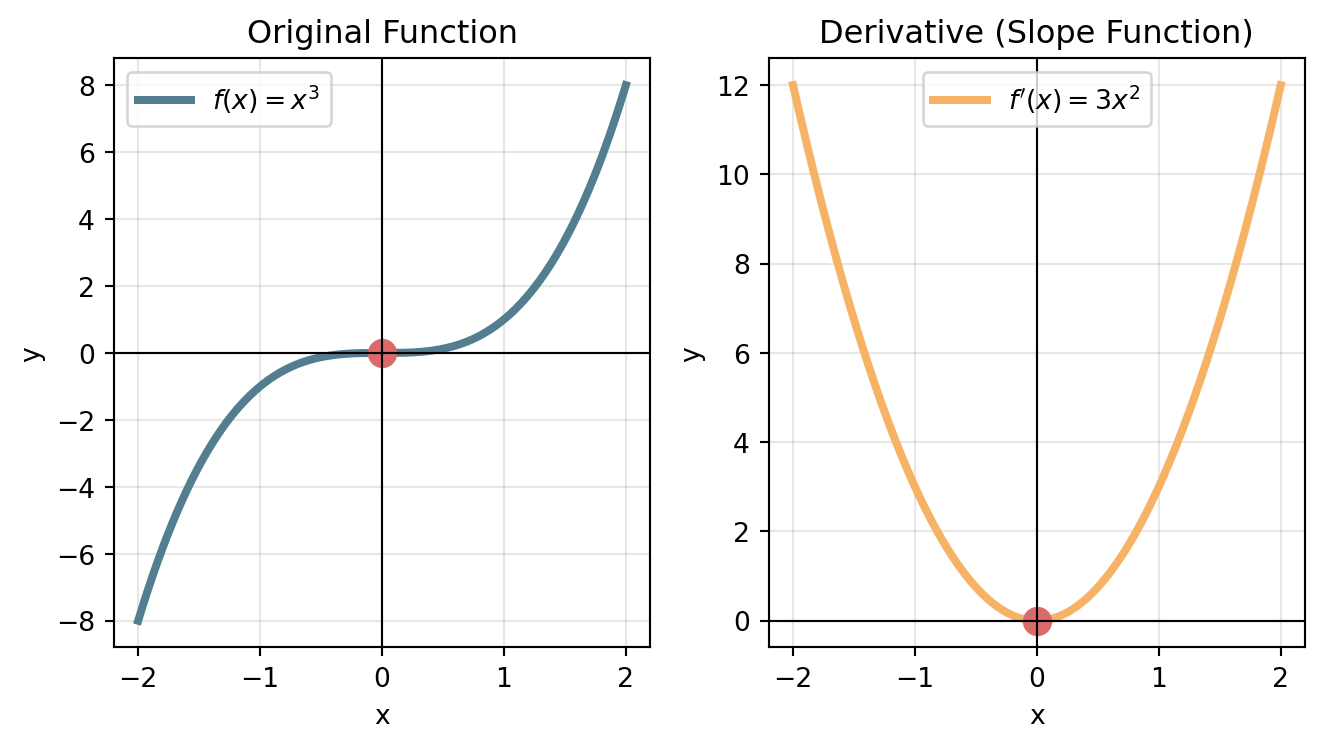
- Where \(f(x) = x^3\) is increasing, \(f'(x) = 3x^2 > 0\)
- At \(x = 0\), \(f\) has a horizontal tangent, so \(f'(0) = 0\)
Constant Rules
Constant Rule: \[\frac{d}{dx}[c] = 0\]
where \(c\) is any constant.
- Constants don’t change, so their rate of change is zero!
- Examples: \(\frac{d}{dx}[7] = 0\), \(\frac{d}{dx}[\pi] = 0\), \(\frac{d}{dx}[-42] = 0\)
This is one is very easy, right?
Constant Multiple Rules
Constant Multiple Rule: \[\frac{d}{dx}[c \cdot f(x)] = c \cdot f'(x)\]
- Pull constants out front!
- Examples: \(\frac{d}{dx}[5x^3] = 5(3x^2) = 15x^2\)
- \(\frac{d}{dx}\left[\frac{3}{x^2}\right] = 3 \cdot \frac{d}{dx}[x^{-2}] = 3(-2x^{-3}) = -\frac{6}{x^3}\)
Do you get the idea? Essentially, we just keep the constant if multiplied with a variable.
The Sum Rule
Sum Rule: \[\frac{d}{dx}[f(x) + g(x)] = f'(x) + g'(x)\]
Also works for differences: \(\frac{d}{dx}[f(x) - g(x)] = f'(x) - g'(x)\)
Differentiate term by term!
- \(\frac{d}{dx}[x^3 + x^2] = 3x^2 + 2x\)
- \(\frac{d}{dx}[4x^5 - 2x^3 + 7] = 20x^4 - 6x^2 + 0 = 20x^4 - 6x^2\)
- \(\frac{d}{dx}\left[\sqrt{x} + \frac{1}{x}\right] = \frac{1}{2\sqrt{x}} - \frac{1}{x^2}\)
Combining the Basic Rules
Example: Differentiate \(f(x) = 3x^4 - 2x^2 + 5x - 7\)
\[f'(x) = 3(4x^3) - 2(2x) + 5(1) - 0 = 12x^3 - 4x + 5\]
Example: Differentiate \(g(x) = \frac{2}{x^3} + 4\sqrt{x} - 3\)
\[g(x) = 2x^{-3} + 4x^{1/2} - 3\]
\[g'(x) = 2(-3x^{-4}) + 4\left(\frac{1}{2}x^{-1/2}\right) - 0 = -\frac{6}{x^4} + \frac{2}{\sqrt{x}}\]
The Product Rule
The Product Rule
Product Rule: \[\frac{d}{dx}[u(x) \cdot v(x)] = u'(x) \cdot v(x) + u(x) \cdot v'(x)\]
“First times derivative of second, plus second times derivative of first”
The Product Rule II
WarningCommon Product Rule Mistakes
- Wrong: \((fg)' = f' \cdot g'\) (The product of derivatives)
- Wrong: Forgetting one of the two terms
- Right: \((fg)' = f'g + fg'\) (Both terms, both factors in each)
If in doubt, check by expanding first when possible!
Product Rule Example
Example: Differentiate \(f(x) = x^3(2x + 5)\)
Let \(u = x^3\) and \(v = 2x + 5\)
- \(u' = 3x^2\)
- \(v' = 2\)
- \(f'(x) = (3x^2)(2x + 5) + (x^3)(2)\)
- \(f'(x) = 6x^3 + 15x^2 + 2x^3 = 8x^3 + 15x^2\)
TipCheck by expanding first
- \(f(x) = 2x^4 + 5x^3 \Rightarrow f'(x) = 8x^3 + 15x^2\)
When to Use Product Rule?
Some rules of thumb to remember:
- Use it when: Expanding would be tedious: \((x^2 + 1)^{10}(x^3 - 2)^5\)
- Skip it when: Easy to expand: \(x(x + 1) = x^2 + x\)
- Remember: One factor is constant? Use constant multiple rule instead!
Let’s practice these rules!
Quick Practice
Individual Exercise
Work individually for 10 minutes
Differentiate the following:
\(f(x) = x^7 - 3x^4 + 2x - 5\)
\(g(x) = 4\sqrt{x} + \frac{2}{x} - 3\)
\(h(x) = (x^2 + 1)(3x - 2)\)
\(k(x) = x^4(x^2 - 5x + 1)\)
Break
The Quotient Rule
Differentiating Quotients
The Quotient Rule: \[\frac{d}{dx}\left[\frac{u(x)}{v(x)}\right] = \frac{u'(x) \cdot v(x) - u(x) \cdot v'(x)}{[v(x)]^2}\]
“Low d-High minus High d-Low, over Low squared”
WarningCommon Mistake
\(\left(\frac{f}{g}\right)' \neq \frac{f'}{g'}\) Always use the full quotient rule formula!
Quotient Rule Example
Example: Differentiate \(f(x) = \frac{x^2 + 1}{x - 3}\)
Let \(u = x^2 + 1\) and \(v = x - 3\)
- \(u' = 2x\)
- \(v' = 1\)
- \(f'(x) = \frac{(2x)(x - 3) - (x^2 + 1)(1)}{(x - 3)^2}\)
- \(= \frac{2x^2 - 6x - x^2 - 1}{(x - 3)^2}\)
- \(= \frac{x^2 - 6x - 1}{(x - 3)^2}\)
More Examples
Example: Differentiate \(g(x) = \frac{2x}{x + 1}\)
\[g'(x) = \frac{2(x + 1) - 2x(1)}{(x + 1)^2} = \frac{2x + 2 - 2x}{(x + 1)^2} = \frac{2}{(x + 1)^2}\]
Example: Differentiate \(h(x) = \frac{x^2 - 4}{x^2 + 4}\)
\[h'(x) = \frac{2x(x^2 + 4) - (x^2 - 4)(2x)}{(x^2 + 4)^2}\] \[= \frac{2x^3 + 8x - 2x^3 + 8x}{(x^2 + 4)^2} = \frac{16x}{(x^2 + 4)^2}\]
Calculator: Calculus Functions
Access via template keys:
In Math mode, calculus templates are available via SHIFT + specific keys:
| Function | Access |
|---|---|
| Derivative | SHIFT + ∫ (d/dx template) |
| Summation | SHIFT + x (Σ template) |
| Product | ALPHA + x (Π template) |
This can sometimes be really helpful!
Calculator: Numerical Derivatives
Syntax: \(\frac{d}{dx}(f(x))\Big|_{x=a}\)
The calculator computes the derivative at a specific point.
Example: Find \(f'(\frac{\pi}{2})\) for \(f(x) = \sin(x)\)
- Enter: SHIFT + ∫ (d/dx) → enter
sin(x)→ set x = π/2 → press = - Result: 0 (indicator R): \(\sin(x)\) has its maximum at \(\frac{\pi}{2}\), so the tangent is horizontal
Let’s try this together with the proper function.
Calculator: Derivatives Step by Step
To find \(f'(2)\) for \(f(x) = x^3 - 3x^2 + 2\):
- Press SHIFT + ∫ to access the d/dx template \(\frac{d}{dx}(\Box)\Big|_{x=\Box}\)
- Enter the function:
x^3 - 3x^2 + 2 - Move cursor to the x-value field, enter 2, press =
Result: \(f'(2) = 0\)
This confirms \(x = 2\) is a critical point (a point with a horizontal tangent, \(f'(2) = 0\))!
Calculator: Verifying Critical Points
Use derivatives to check if \(f'(c) = 0\):
Example: For \(f(x) = x^3 - 6x^2 + 9x\)
| Point | \(f'(x)\) value | Interpretation |
|---|---|---|
| \(x = 1\) | 0 | Critical point! |
| \(x = 2\) | -3 | Decreasing |
| \(x = 3\) | 0 | Critical point! |
\(f'(c) = 0\) means critical point, but not always a max or min: Sessions 05-05 and 05-06 show how to decide!
It cannot determine the derivative function for you. It only computes specific values!
Tangent Lines
Finding Tangent Lines (TL)
TL to \(y = f(x)\) at \(x = a\) has slope \(f'(a)\) and passes \((a, f(a))\).
Equation of Tangent Line (point-slope form): \[y - f(a) = f'(a)(x - a)\]
- Find the point: Compute \(f(a)\)
- Find the slope: Compute \(f'(a)\)
- Write the equation using point-slope form
Tangent Line Example
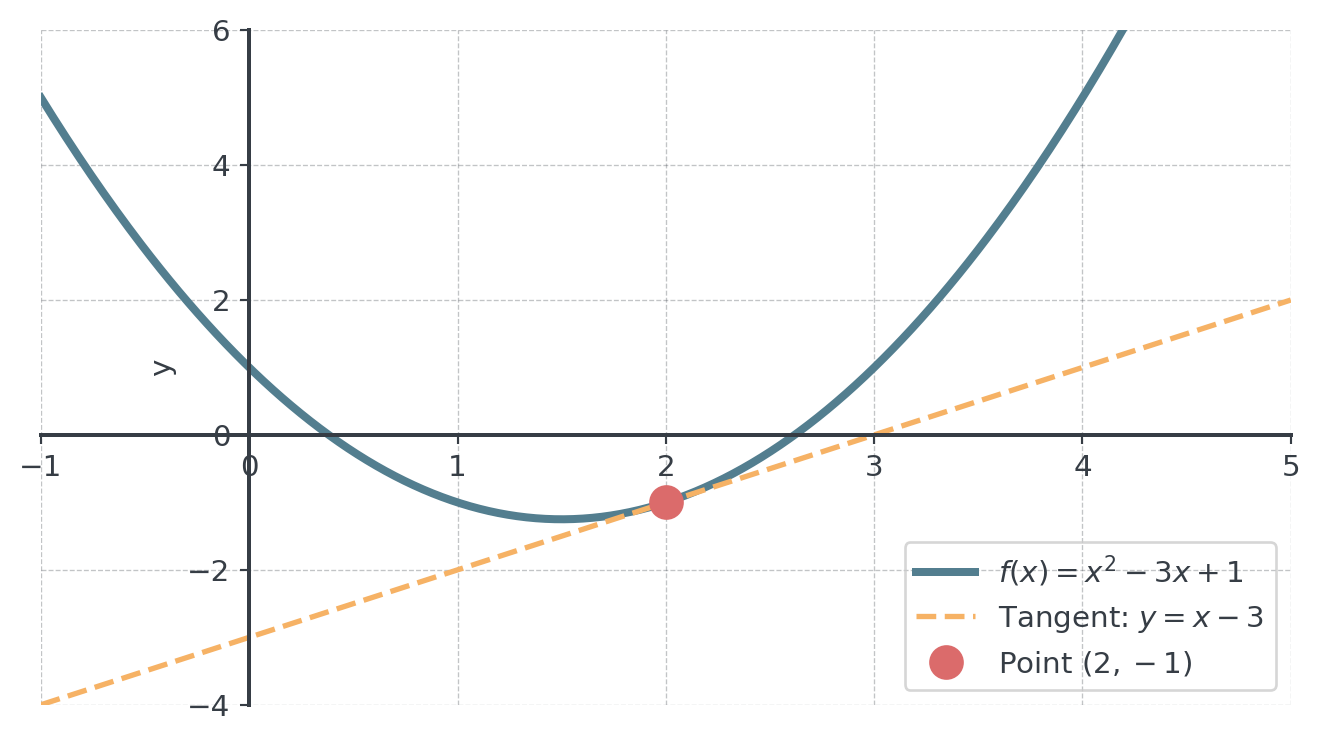
Example: Find the tangent line to \(f(x) = x^2 - 3x + 1\) at \(x = 2\).
Step 1: Find the point
- \(f(2) = 4 - 6 + 1 = -1\), Point: \((2, -1)\)
Step 2: Find the slope
- \(f'(x) = 2x - 3\), \(f'(2) = 4 - 3 = 1\)
Step 3: Equation
- \(y - (-1) = 1(x - 2)\), \(y = x - 3\)
Visualizing the Tangent Line
Not too complicated, right?
Linear Approximation
Linear Approximation: For \(x\) near \(a\): \[f(x) \approx f(a) + f'(a)(x - a)\]
This uses the tangent line to estimate function values!
TipBusiness Application
When \(x\) changes slightly from \(a\), the change in \(f(x)\) is approximately: \[\Delta f \approx f'(a) \cdot \Delta x\]
This is the basis of sensitivity analysis in economics!
Approximation Example
Example: A company’s profit is
\[P(x) = -0.1x^2 + 5x - 10\]
(in thousands EUR) where \(x\) is production in thousands of units.
- Currently producing \(x = 20\) thousand units
- Estimate profit if production increases to 21 thousand.
Question: How would you estimate the profit change?
Guided Practice
Practice Set A: Quotient Rule
Work in pairs for 15 minutes
Differentiate the following using the quotient rule:
\(f(x) = \frac{x^2 + 3}{x - 1}\)
\(g(x) = \frac{2x - 5}{3x + 2}\)
\(h(x) = \frac{x^3}{x^2 + 1}\)
Practice Set B: Tangent Lines
Continue working in pairs for 10 minutes
A company’s revenue function is \(R(x) = 50x - 0.5x^2\) where \(x\) is the number of units sold (in hundreds).
Find \(R'(x)\) and interpret its meaning.
Find the equation of the tangent line to \(R(x)\) at \(x = 30\).
Use the tangent line to estimate \(R(31)\).
Compare your estimate to the actual value \(R(31)\).
Coffee Break
Business Applications
Marginal Analysis with Derivatives
A manufacturer has:
- Cost: \(C(x) = 1000 + 50x + 0.5x^2\)
- Revenue: \(R(x) = 200x - 0.5x^2\) (\(x\) in hundreds of units)
Marginal functions:
- \(MC(x) = C'(x) = 50 + x\)
- \(MR(x) = R'(x) = 200 - x\)
- Profit: \(P(x) = R(x) - C(x) = -x^2 + 150x - 1000\)
- \(MP(x) = P'(x) = -2x + 150\)
Profit Maximization
Question: At what production level is profit maximized?
Set \(MR = MC\): \[200 - x = 50 + x \rightarrow 150 = 2x\] \[x = 75 \text{ (hundreds of units)}\]
Optimal profit: \[P(75) = -(75)^2 + 150(75) - 1000 = 4625 \text{ hundred EUR}\]
The maximum profit is 462,500 EUR at 7,500 units.
Visualizing Marginal Analysis
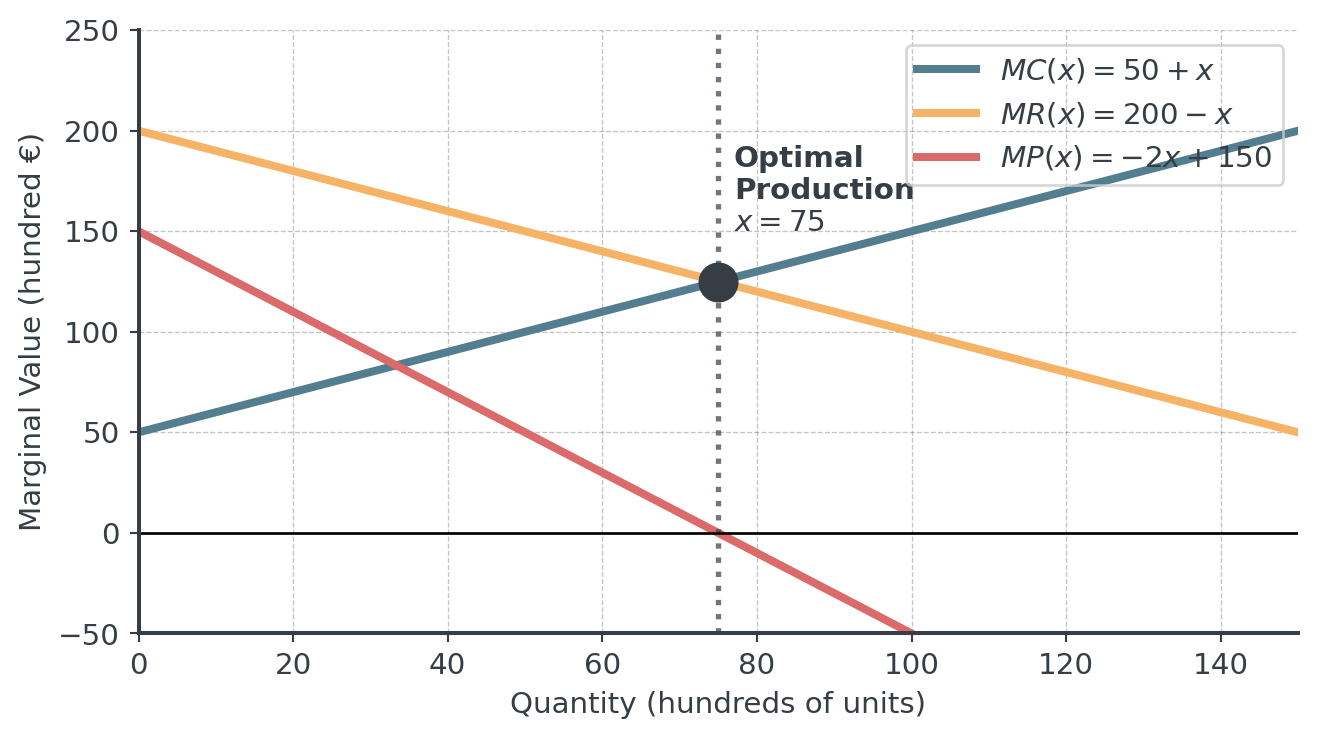
- For \(x < 75\): \(MR > MC\), so increasing production increases profit
- For \(x > 75\): \(MR < MC\), so increasing production decreases profit
Sensitivity Analysis Example
A software company’s monthly user base \(U(t)\) (in thousands) follows: \[U(t) = 10 + 2t + 0.1t^2\] where \(t\) is months since launch.
Revenue per user decreases with scale: \(r(u) = 20 - 0.05u\)
Total revenue: \(R(t) = U(t) \cdot r(U(t))\)
Question: How sensitive is revenue to time at \(t = 10\) months?
Sensitivity Analysis: Solution I
Step 1: Express \(R(t)\) explicitly
\(R(t) = U(t) \cdot r(U(t)) = U(t) \cdot (20 - 0.05U(t))\)
\(R(t) = (10 + 2t + 0.1t^2)(20 - 0.05(10 + 2t + 0.1t^2))\)
\(R(t) = (10 + 2t + 0.1t^2)(19.5 - 0.1t - 0.005t^2)\)
Expanding: \(R(t) = 195 + 38t + 1.7t^2 - 0.02t^3 - 0.0005t^4\)
Step 2: Find \(\frac{dR}{dt}\) (sensitivity)
\(\frac{dR}{dt} = 38 + 3.4t - 0.06t^2 - 0.002t^3\)
Step 3: Evaluate at \(t = 10\)
\(\frac{dR}{dt}\bigg|_{t=10} = 38 + 34 - 6 - 2 = 64\)
Sensitivity Analysis: Solution II
Preview of Session 05-04: the chain rule gives the same result without expanding. You will learn it next session.
At \(t = 10\): \(\;U(10) = 40\) thousand users, \(\;U'(10) = 4\), \(\;r(40) = 18\), \(\;r'(u) = -0.05\)
\(\frac{dR}{dt} = U'(t)[r(U(t)) + U(t) \cdot r'(U(t))]\)
\(\frac{dR}{dt} = 4[18 + 40(-0.05)] = 4 \times 16 = 64\)
Interpretation: Revenue is increasing at 64,000 EUR per month at \(t = 10\) months.
Team Problem-Solving
Challenge: Production Optimization
You’re consulting for a manufacturing company. They produce specialty components with:
- Total Cost: \(C(q) = 2000 + 40q + 0.2q^2\) (in EUR)
- Market Price: \(p = 100 - 0.1q\) (price decreases as quantity increases)
- Revenue: \(R(q) = q \cdot p = q(100 - 0.1q) = 100q - 0.1q^2\)
where \(q\) is quantity in units.
Tasks
Work in groups of 3-4
Find marginal cost \(MC(q)\) and marginal revenue \(MR(q)\) functions.
Determine profit-maximizing production level.
Calculate the actual maximum profit at this level.
Find the tangent line to the profit function at the optimal point.
Tasks II
The company is considering increasing production by 10 from the optimum. Use linear approximation to estimate the change in profit.
Discuss: Why is \(MR = MC\) the condition for profit maximization? What happens if \(MR > MC\) or \(MR < MC\)?
Wrap-Up & Takeaways
Today’s Essential Rules
We covered quite some rules today:
| Rule | Formula | When to Use |
|---|---|---|
| Power Rule | \(\frac{d}{dx}[x^n] = nx^{n-1}\) | Any power of \(x\) |
| Constant Rule | \(\frac{d}{dx}[c] = 0\) | Constants |
| Sum Rule | \((f + g)' = f' + g'\) | Sums/differences |
| Constant Multiple | \((cf)' = cf'\) | Constants times functions |
| Product Rule | \((uv)' = u'v + uv'\) | Products of functions |
| Quotient Rule | \(\left(\frac{u}{v}\right)' = \frac{u'v - uv'}{v^2}\) | Quotients of functions |
Rule Selection Strategy
Before differentiating, ask:
- Can I simplify first? → Expand products, simplify fractions
- Is it a sum/difference? → Differentiate term by term
- Is it a simple power? → Use power rule
- Is it a product that can’t simplify? → Product rule
- Is it a quotient? → Quotient rule (or rewrite as negative power)
- Marginal analysis: Derivatives give marginal cost, revenue, profit
- Optimization: Set \(MR = MC\) to maximize profit
- Sensitivity analysis: \(f'(a)\) shows how sensitive output is to input changes
Final Assessment
Quick Check
Work individually then we discuss
Find \(\frac{d}{dx}[x^4 - 2x^2 + 7]\).
Differentiate \(f(x) = x^2(3x + 1)\) using the product rule.
What is the equation of the tangent line to \(f(x) = x^3\) at \(x = 1\)?
True or False: The derivative of a quotient equals the quotient of derivatives.
Next Session Preview
Session 05-04
Chain Rule & Implicit Differentiation
- The Chain Rule: How to differentiate composite functions
- Combining techniques: Chain rule with product and quotient rules
- Implicit differentiation: Finding \(\frac{dy}{dx}\) when you can’t solve for \(y\)
- Related rates: How rates of change in different quantities are connected
- Business: Nested economic functions, inflation adjustments
Complete Tasks 05-03!