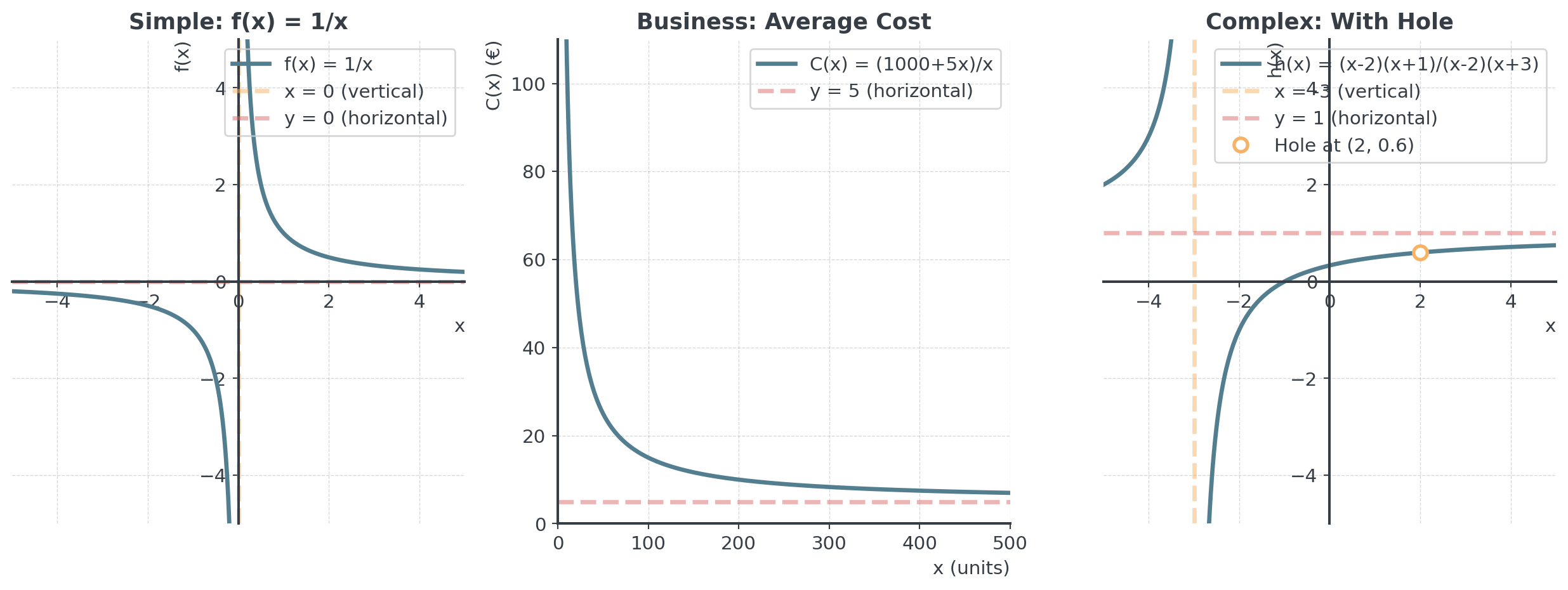
Rational & Logarithmic Functions
Session 04-05: Advanced Function Analysis
Entry Quiz - 10 Minutes
Review from Session 04-04
Work individually for 5 minutes, then we discuss
Transformations: If \(g(x) = 2f(x-3) + 1\), describe all transformations from \(f(x)\).
Logarithms: Simplify \(\log_2(8x)\) using logarithm properties.
Rational Behavior: What happens to \(\frac{1}{x}\) as \(x \to 0^+\)? As \(x \to 0^-\)?
Exponential Equation: Solve \(2^{x-1} = 16\).
Homework Discussion - 15 Minutes
Your Questions from Tasks 04-04
Let’s discuss the problems you found challenging
Learning Objectives
Today’s Goals
By the end of this session, you will be able to:
- Analyze rational functions completely (asymptotes, holes, intercepts)
- Understand logarithmic properties and transformations
- Master semi-log and log-log scales
- Model business scenarios with average cost functions
- Interpret exponential growth using logarithmic scales
- Solve complex equations involving logs and rationals
. . .
This session connects algebra with real business applications!
Rational Functions Deep Dive
Structure of Rational Functions
A rational function has the form:
\[f(x) = \frac{P(x)}{Q(x)}\]
where \(P(x)\) and \(Q(x)\) are polynomials and \(Q(x) \neq 0\)
- Domain: All real numbers except where \(Q(x) = 0\)
- Zeros: Where \(P(x) = 0\) (and \(Q(x) \neq 0\))
- Vertical Asymptotes: Where \(Q(x) = 0\) (canceling common factors)
- Holes: Where both \(P(x) = 0\) and \(Q(x) = 0\) (canceled factors)
- Horizontal/Oblique Asymptotes: Determined by degree comparison
What Are Asymptotes?
An asymptote is a line a function approaches
- Think of it like a boundary the graph gets infinitely close to
- Vertical asymptotes: Never crossed or touched (undefined there)
- Horizontal/oblique asymptotes: Can be crossed at finite x-values, but approached as \(x \to \pm\infty\)
- Three types: vertical, horizontal, and oblique (slanted)
Vertical Asymptotes
Occur where the denominator equals zero (and numerator doesn’t)
Mathematical definition: \[\lim_{x \to a^-} f(x) = \pm\infty \quad \text{or} \quad \lim_{x \to a^+} f(x) = \pm\infty\]
- The function “blows up” (goes to \(\infty\) or \(-\infty\))
- Graph has a vertical line at \(x = a\)
- Function is undefined at this point
- Example: \(f(x) = \frac{1}{x}\) has vertical asymptote at \(x = 0\)
Horizontal Asymptotes
Describe the end behavior as \(x \to \pm\infty\)
Three cases based on degrees of \(P(x)\) and \(Q(x)\):
\[f(x) = \frac{2x + 1}{x^3 - 5}\]
- Denominator grows faster
- Horizontal asymptote: \(y = 0\)
- The function approaches zero
\[f(x) = \frac{3x^2 + 2x - 1}{2x^2 + 5}\]
- Both grow at same rate
- Horizontal asymptote: \(y = \frac{3}{2}\) (ratio of leading coefficients)
\[f(x) = \frac{x^3 + 2x}{x^2 - 1}\]
- Numerator grows faster
- No horizontal asymptote
- May have an oblique (slanted) asymptote instead
Oblique (Slanted) Asymptotes
When degree of P exceeds degree of Q by exactly 1
- Perform polynomial long division1: \(\frac{P(x)}{Q(x)} = L(x) + \frac{R(x)}{Q(x)}\)
- The quotient \(L(x)\) (a linear function) is the oblique asymptote
- As \(x \to \pm\infty\), the remainder term \(\frac{R(x)}{Q(x)} \to 0\)
. . .
Example: \(f(x) = \frac{x^2 + 1}{x - 1} = \frac{x^2 + 1}{x - 1} = x + 1 + \frac{2}{x-1}\)
. . .
Oblique asymptote: \(y = x + 1\)
Holes vs. Asymptotes
Critical distinction when factors cancel!
- Factor appears in both numerator and denominator
- Example: \(f(x) = \frac{(x-2)(x+1)}{(x-2)(x+3)}\)
- Factor \((x-2)\) cancels
- Hole at \(x = 2\), not an asymptote!
- Simplified: \(f(x) = \frac{x+1}{x+3}\), \(x \neq 2\)
- Factor appears only in denominator
- \(f(x) = \frac{x+1}{x+3}\)
- Factor \((x+3)\) doesn’t cancel
- Vertical asymptote at \(x = -3\)
- Function undefined, goes to \(\pm\infty\)
. . .
Always factor completely and cancel common factors before identifying asymptotes!
Examples for Rational Functions
Asymptote Rules
Systematic Approach for Finding Asymptotes
Step 1: Factor completely \[f(x) = \frac{P(x)}{Q(x)} = \frac{\text{factored form}}{\text{factored form}}\]
Step 2: Cancel common factors → These create holes
Step 3: Vertical asymptotes → Remaining factors in denominator
Step 4: Horizontal/Oblique asymptotes → Compare degrees
Asymptote Analysis Challenge
3 minutes individual, 2 minutes pair discussion, 2 minutes class share
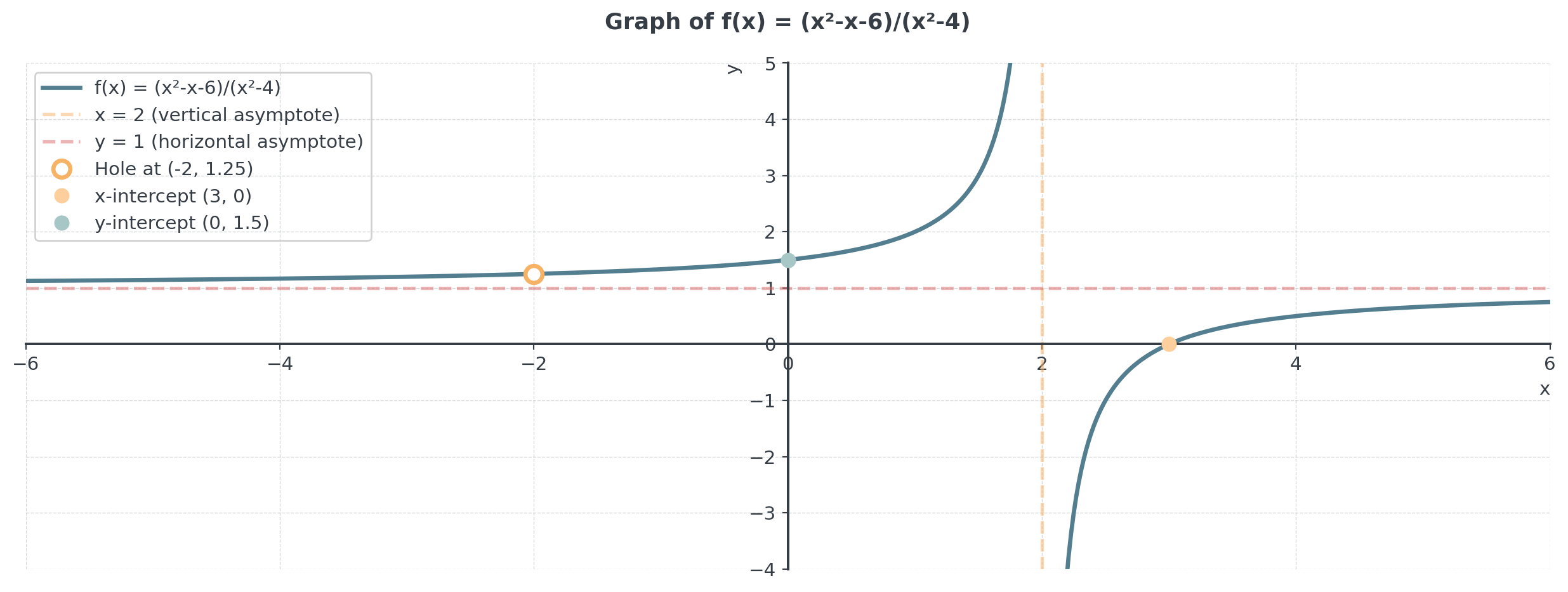
Analyze the function: \(f(x) = \frac{x^2 - x - 6}{x^2 - 4}\)
Your tasks:
- Factor numerator and denominator
- Identify any holes
- Find all asymptotes
- Determine x and y intercepts
- Sketch a rough graph
Asymptote Analysis
Break - 10 Minutes
Business Application - Average Cost
Average Cost Functions
In business, the average cost per unit is:
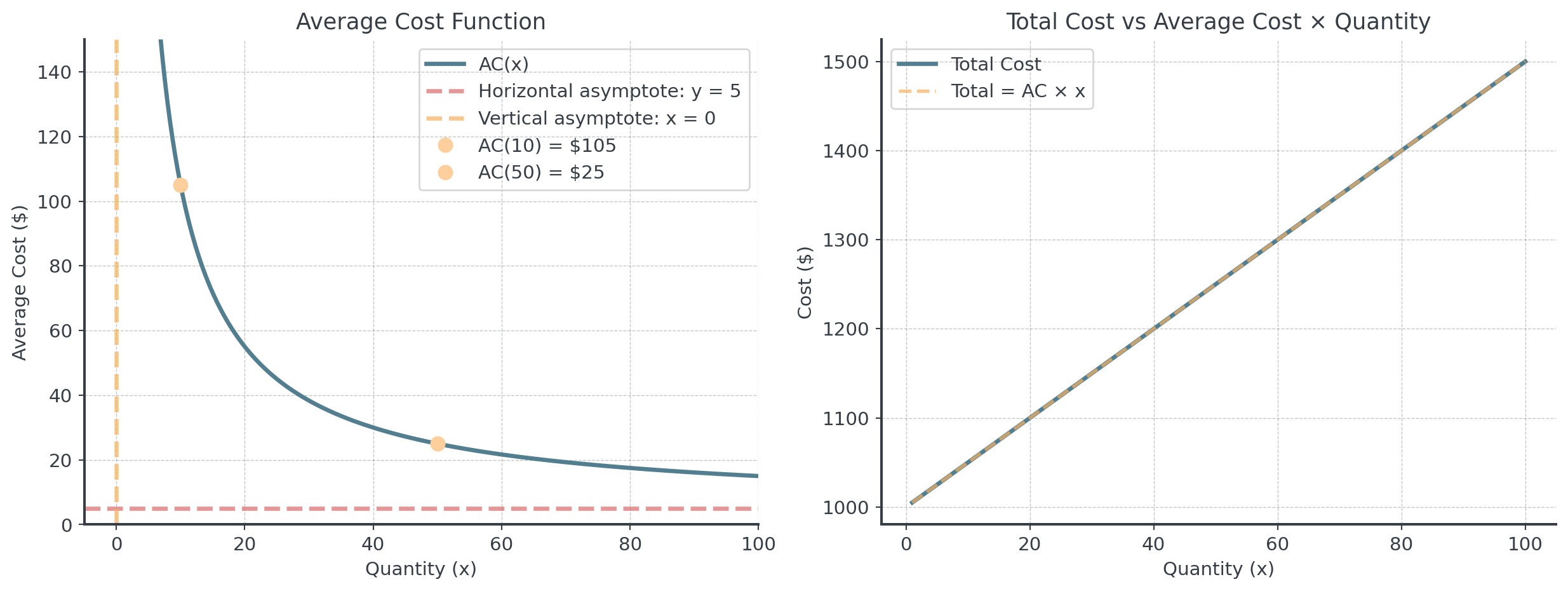
\[AC(x) = \frac{\text{Total Cost}}{\text{Quantity}} = \frac{C(x)}{x} = \frac{F + vx}{x} = \frac{F}{x} + v\]
- \(F\) = Fixed costs
- \(v\) = Variable cost per unit
- \(x\) = Number of units
. . .
Do you get the idea here?
Key Properties
These functions often have the same properties:
- Vertical asymptote at \(x = 0\)
- Horizontal asymptote at \(y = v\)
- Always decreasing for \(x > 0\) (economies of scale)
- Minimum average cost approaches \(v\) as \(x \to \infty\)
. . .
Let’s see an example!
Visualization of Average Cost
Manufacturing Analysis
Work through this business scenario and then we compare
A company has fixed costs of $5000 per month and variable costs of $20 per unit.
- Write the average cost function
- Find the horizontal asymptote and interpret it
- How many units minimize average cost to within $5 of the minimum?
- Graph the function
Logarithmic Functions
Recap: Logarithm Properties
The Big Three Rules for Logarithms
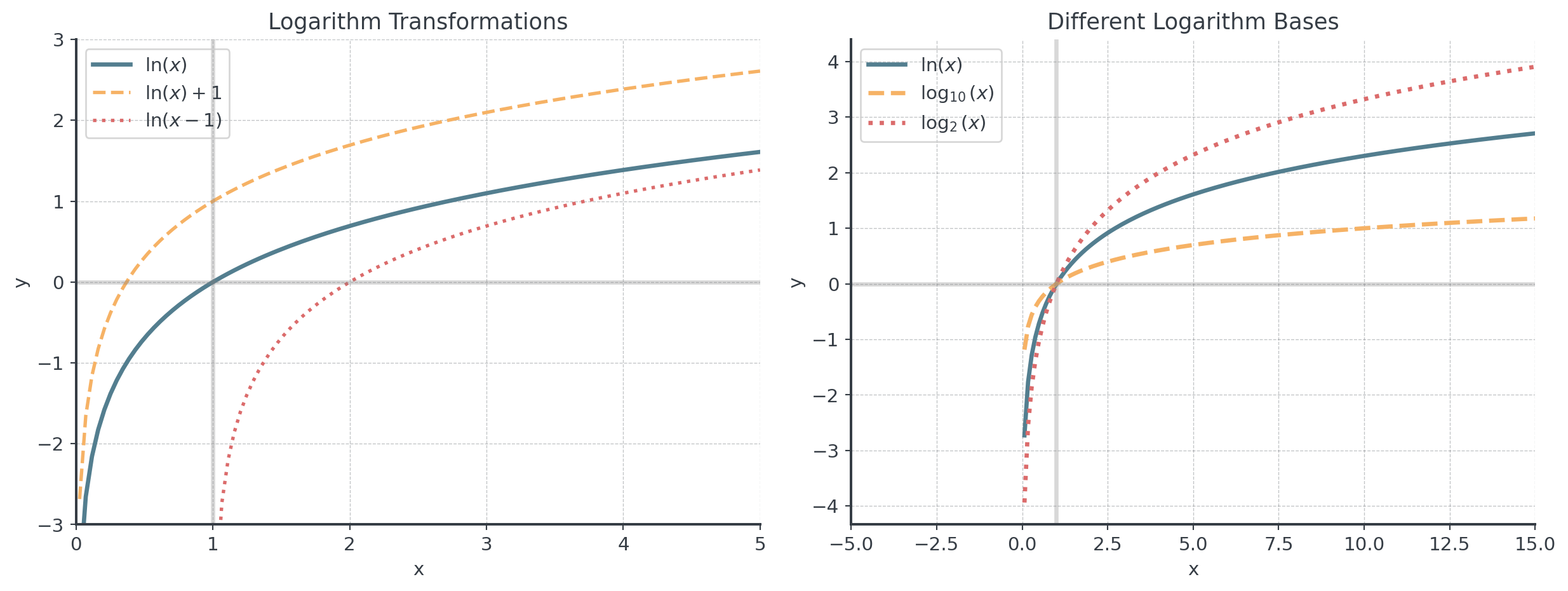
- Product Rule: \(\log_b(xy) = \log_b(x) + \log_b(y)\)
- Quotient Rule: \(\log_b(\frac{x}{y}) = \log_b(x) - \log_b(y)\)
- Power Rule: \(\log_b(x^n) = n \cdot \log_b(x)\)
. . .
Special Values
- \(\log_b(1) = 0\) for any base \(b\)
- \(\log_b(b) = 1\)
- \(\log_b(b^n) = n\)
- \(b^{\log_b(x)} = x\)
Logarithmic Transformations
Spot the Error: Logarithm Mistakes
Find and fix the errors!
Problem: Solve \(\log_2(x) + \log_2(x - 2) = 3\)
. . .
Student Solution:
“\(\log_2(x) + \log_2(x - 2) = 3\)
\(\log_2(x + x - 2) = 3\)
\(\log_2(2x - 2) = 3\)
\(2x - 2 = 8\)
\(x = 5\)”
Semi-log and Log-log Plots
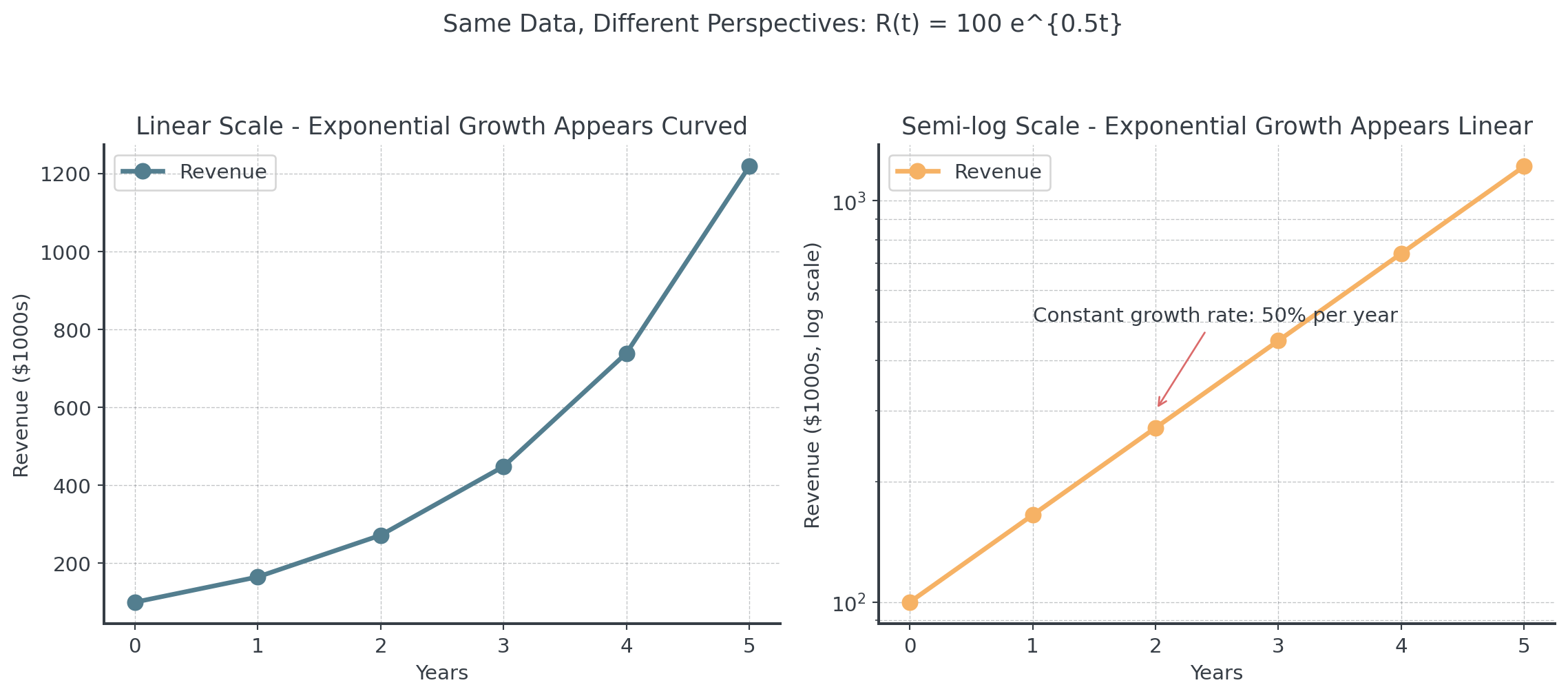
Semi-log Plot (y-axis log)
When data spans several orders of magnitude:
- Exponential growth/decay patterns
- Compound interest, population growth
. . .
Recognition:
- Exponential functions appear as straight lines
- Slope represents growth rate
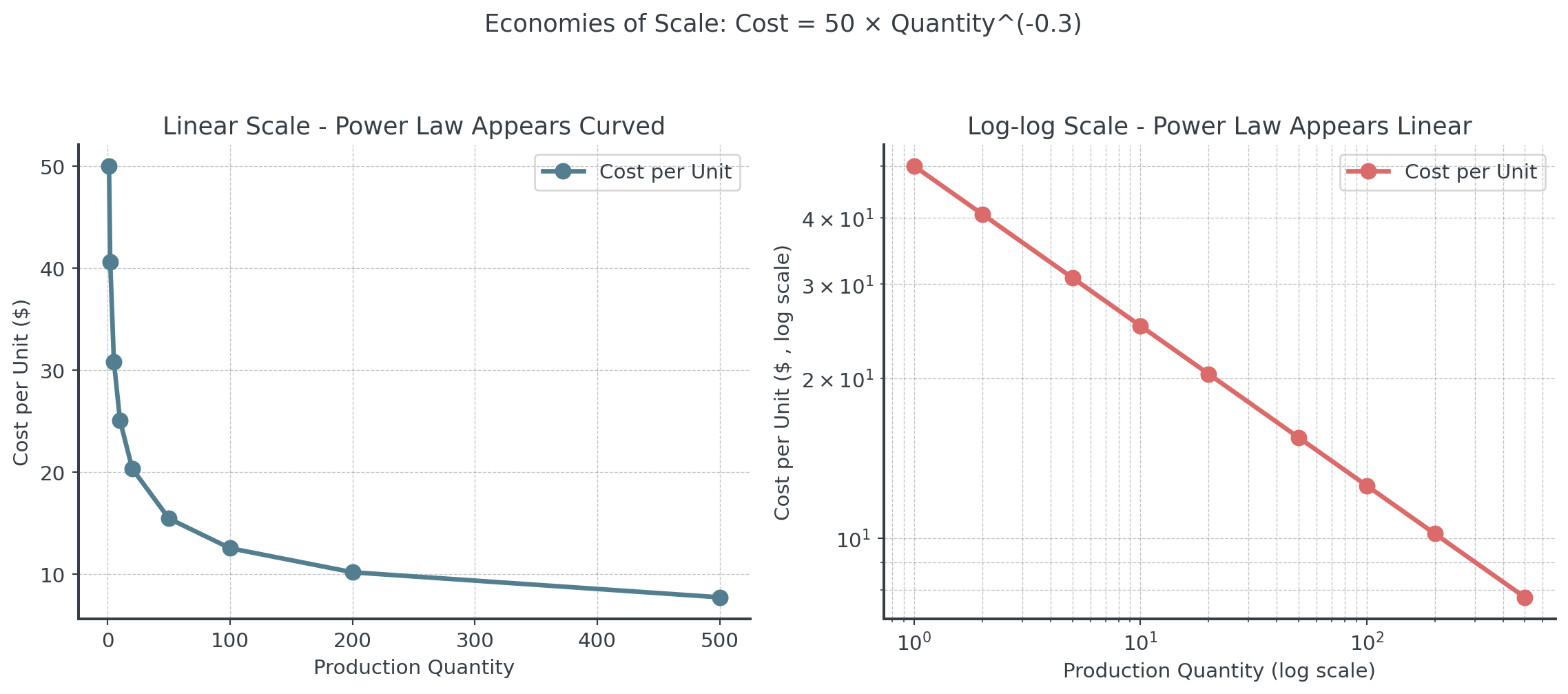
Log-log Plot (both axes log)
When working with power law relationships:
- Power law relationships
- Allometric scaling
- Economic relationships (supply/demand curves)
. . .
Recognition:
- Power functions \(y = ax^b\) appear as straight lines
- Slope equals the exponent \(b\)
. . .
Let’s viusalize both!
Business Application: Market Analysis
Power Law Example: Production Costs
. . .
On the log-log plot, the straight line confirms a power law relationship. The slope of -0.3 means that doubling production reduces per-unit cost by about 19% (2^(-0.3) ≈ 0.81).
Guided Practice - 20 Minutes
Complex Problems
Work individually, then check with class
Rational Function: Analyze completely \(f(x) = \frac{2x^2 - 8}{x^2 - x - 2}\)
Logarithmic Equation: Solve \(\ln(x + 3) - \ln(x - 1) = \ln(2)\)
Multi-Step Challenge: A factory’s efficiency rating (as %) depends on production volume \(x\) (in thousands of units per month, \(x > 0\)). \[E(x) = \frac{100(x^2 - 4x)}{x^2 - 8x + 20}\]
- Factor the numerator and find all zeros
- Find all asymptotes and interpret their meaning
Coffee Break - 15 Minutes
Synthesis & Applications
Real-World Application: pH Scale
Where logarithmic properties are important:
\[\text{pH} = -\log_{10}[\text{H}^+]\]
where \([\text{H}^+]\) is hydrogen ion concentration in mol/L
- Domain: \((0, \infty)\) for concentration
- Range: Typically 0-14 for pH
- Each unit change = 10× concentration change
- pH 7 is neutral (\([\text{H}^+] = 10^{-7}\))
Orange Juice
If orange juice has pH = 3.5:
. . .
Question: How much more acidic is orange juice compared to neutral water?
. . .
\[3.5 = -\log_{10}[\text{H}^+]\] \[[\text{H}^+] = 10^{-3.5} \approx 3.16 \times 10^{-4} \text{ mol/L}\]
. . .
This is 1000 times more acidic than neutral water!
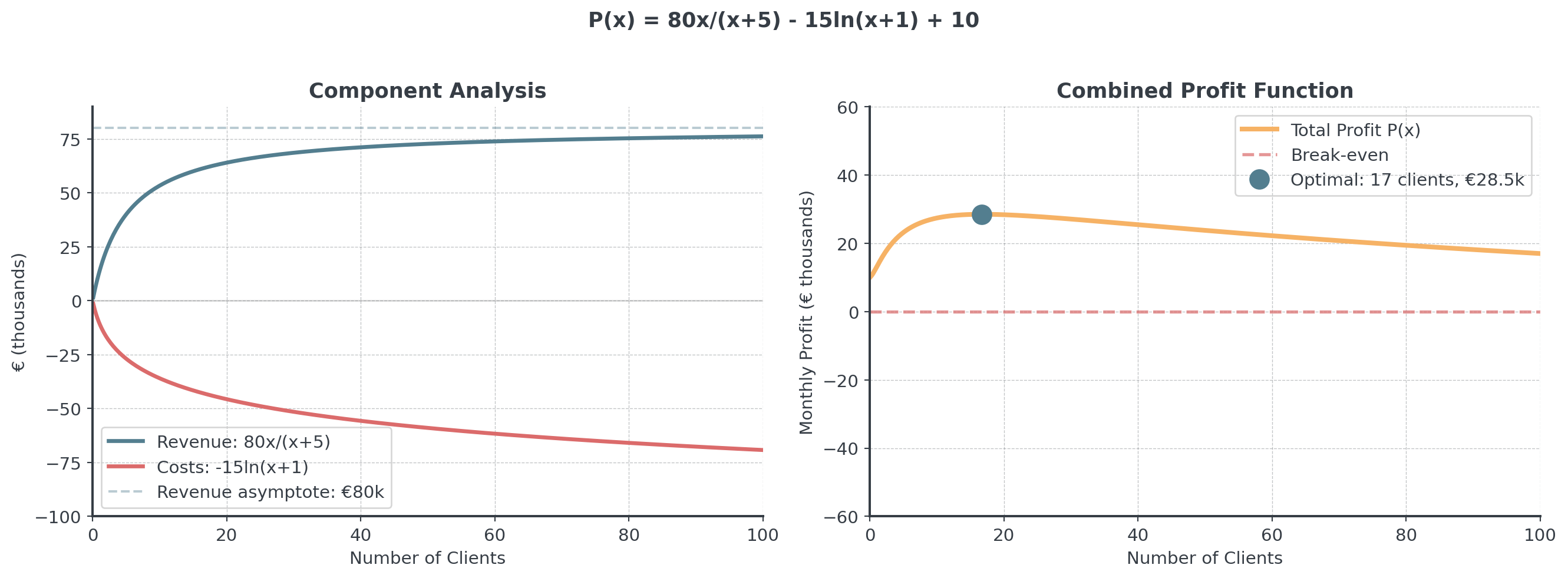
Profit with Components I
A firm’s profit depends on portfolio size \(x\) (number of clients):
\[P(x) = \frac{80x}{x + 5} - 15\ln(x + 1) + 10\]
- Rational term \(\frac{80x}{x+5}\): Revenue per client (approaches 80k asymptote)
- Logarithmic term \(-15\ln(x+1)\): Overhead & complexity costs
- Fixed term \(+10\): Base profit offset
- Key insight: Logarithmic costs eventually erode the revenue gains
- Critical question: What’s the optimal client portfolio size?
Profit with Components II
. . .
Initially, revenue growth outpaces cost growth → profits increase. Eventually, costs catch up and overtake revenue → profits decline!
Tasks - 15 Minutes
Function Investigation
Analyzes function types and then we dicuss
- \(f(x) = \frac{x^2 - 9}{x - 3}\)
- \(AC(x) = \frac{2000 + 15x + 0.01x^2}{x}\)
- \(g(t) = 50\ln(t + 2) - 100\)
- \(h(x) = \frac{100}{x + 5} + \ln(x)\)
. . .
- Find domain and range
- Identify all asymptotes/discontinuities
- Describe a business application
Session Wrap-Up
Key Takeaways
- Systematic asymptote finding through factoring
- Distinguishing holes from vertical asymptotes
- Business applications with average cost functions
- Semi-log and log-log plots for data analysis
- Rational functions model constrained optimization
- Logarithms linearize exponential and power relationships
- Combined functions capture complex business scenarios
Final Assessment - 10 Minutes
Quick Check
Work individually to test your understanding
Rational Function: Find all asymptotes and holes for: \(f(x) = \frac{x^2 - 1}{x^2 + x - 2}\)
Logarithmic Equation: Solve: \(2\ln(x) - \ln(x + 6) = \ln(4)\)
Homework Preview
Tasks 04-06
You’ll practice:
- Complete rational function analysis (find all features)
- Logarithmic equation solving using properties
- Business optimization with average cost
- Data interpretation with different scales
- Synthesis problems combining both function types
. . .
Success Strategy: Always factor rational functions first as it reveals everything!
Mock Exam Strategies
What’s important for the Mock Exam
- Read carefully: Every word and number matters
- Show all work: Partial credit is available for clear methodology
- Label everything: Variables, units, and graph features
- Check domains: Especially for logarithmic and rational functions
- Verify solutions: Substitute back when possible
. . .
This exam tests your mastery functions. Apply the systematic methods we’ve practiced!
Footnotes
No worries, no need to learn long division. This is just for the sake of completeness.↩︎