Session 01-04 - Advanced Factorization & Radicals
Section 01: Mathematical Foundations & Algebra
Entry Quiz
Quick Review from Last Session
Complete individually, then we review as group
Simplify: \(\frac{(2x^3)^2 \cdot x^{-5}}{4x^2}\)
Factor: \(9x^2 - 25\)
Solve: \(|2x - 4| > 6\)
Express in scientific notation: \(0.0000234 \times 10^3\)
Factor: \(3x^2 - 12\)
Ok, lets talk about your solutions together!
Homework Discussion
Homework Showcase
15 minutes for discussing your solutions
- Present and discuss your solutions from Tasks 01-03
- Focus on the most challenging aspects or tasks
- Share any challenging aspects or alternative approaches
Today we build on basic factorization with advanced techniques and introduce radicals!
Learning Objectives
Today
By the end of this session, you will be able to:
- Factor quadratics with any leading coefficient using the AC method
- Check factorability instantly with the discriminant
- Apply the grouping method and the cube formulas
- Simplify radicals by extracting perfect powers
- Rationalize denominators, including with conjugates
- Combine all techniques in complex algebraic expressions
Advanced Factoring
Repetition: What is Factorization?
Breaking expressions into products of simpler factors
Factorization writes an expression as a product of its factors.
- Example: \(12 = 3 \times 4\) (factoring numbers)
- Algebra: \(x^2 + 5x + 6 = (x + 2)(x + 3)\) (factoring polynomials)
- Reverse of expansion: \((x + 2)(x + 3) \rightarrow x^2 + 5x + 6\)
NoteWhy Factor?
- Solve equations with the zero-product rule from last session
- Find break-even points as zeros of a factored profit and read off the sign between them
- Cancel common factors in fractions and help to simplify expressions
Seeing It: Difference of Squares
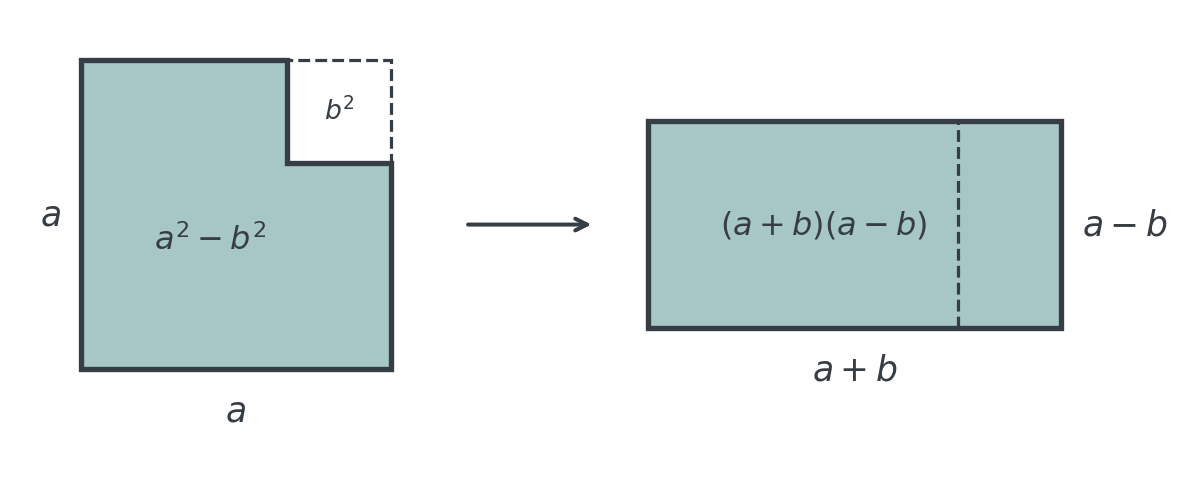
Cut the \(b \times b\) corner from the \(a \times a\) square and rearrange - the same area becomes an \((a+b)(a-b)\) rectangle. That is why \(a^2 - b^2 = (a+b)(a-b)\).
Factoring Quadratics: \(ax^2 + bx + c\)
When \(a = 1\): Find factors of c that sum to b
Factor \(x^2 + 7x + 12\)
- Need factors of 12 that add to 7
- Pairs: (1,12), (2,6), (3,4)
- Check: \(3 + 4 = 7\) ✓
- Result: \((x + 3)(x + 4)\)
Factor \(x^2 - 5x - 14\)
- Need factors of -14 that add to -5
- Pairs: (-1,14), (1,-14), (-2,7), (2,-7)
- Check: \(2 + (-7) = -5\) ✓
- Result: \((x + 2)(x - 7)\)
The AC Method for \(ax^2 + bx + c\)
When the leading coefficient \(a \neq 1\)
Factor: \(6x^2 + 13x + 5\)
- Step 1: Find \(ac = 6 \times 5 = 30\)
- Step 2: Find factors of 30 that sum to 13, e.g. (3,10)
- Step 3: Rewrite: \(6x^2 + 3x + 10x + 5\)
- Step 4: Group: \(3x(2x + 1) + 5(2x + 1)\)
- Step 5: Factor: \((3x + 5)(2x + 1)\)
Check your solution by expanding: \((3x + 5)(2x + 1) = 6x^2 + 13x + 5\) ✓
The AC Method When \(ac < 0\)
When \(ac\) is negative, factors have opposite signs
Factor: \(6x^2 + 7x - 5\)
- Step 1: Find \(ac = 6 \times (-5) = -30\) (negative!)
- Step 2: Find opposite-sign factors of -30 that sum to 7, e.g. (10, -3)
- Step 3: Rewrite: \(6x^2 + 10x - 3x - 5\)
- Step 4: Group: \(2x(3x + 5) - 1(3x + 5)\)
- Step 5: Factor: \((2x - 1)(3x + 5)\)
When \(ac < 0\): Look for factor pairs with opposite signs that sum to \(b\)
The Discriminant: Can We Factor?
How do we know if factoring is even possible?
The discriminant \(\Delta = b^2 - 4ac\) tells us instantly:
- Step 1: Identify \(a\), \(b\), \(c\) from \(ax^2 + bx + c\)
- Step 2: Calculate \(b^2 - 4ac\)
- Step 3: If the result is a perfect square, factoring will work!
A perfect square is a number whose square root is a whole number: \(1, 4, 9, 16, 25, 36, 49, 64, 81, ...\)
Applying the Discriminant
The rule: \(ax^2 + bx + c\) factors over integers iff \(\Delta = b^2 - 4ac\) is a perfect square.
Example: Factor \(2x^2 + 13x + 15\)
- Check: \(\Delta = 13^2 - 4(2)(15) = 169 - 120 = 49 = 7^2\) ✓
- Since it’s a perfect square, factoring will work: \((2x + 3)(x + 5)\)
Counter-example: For \(x^2 + 3x - 3\): \(\Delta = 9 + 12 = 21\) (not perfect) → Don’t waste time trying to factor!
Always check the discriminant first: it saves you from trial and error!
Factoring by Grouping
Group terms with common factors
Factor \(x^3 + 2x^2 - 3x - 6\)
- Group: \((x^3 + 2x^2) + (-3x - 6)\)
- Factor each: \(x^2(x + 2) - 3(x + 2)\)
- Common factor: \((x + 2)(x^2 - 3)\)
Factor \(2x^3 - x^2 - 8x + 4\)
- Group: \((2x^3 - x^2) + (-8x + 4)\)
- Factor: \(x^2(2x - 1) - 4(2x - 1)\)
- Result: \((2x - 1)(x^2 - 4)\)
- Even further: \((2x - 1)(x + 2)(x - 2)\)
Sum and Difference of Cubes
These patterns are worth memorizing!
| Pattern | Formula |
|---|---|
| Sum of Cubes | \(a^3 + b^3 = (a+b)(a^2-ab+b^2)\) |
| Difference of Cubes | \(a^3 - b^3 = (a-b)(a^2+ab+b^2)\) |
Examples:
- \(x^3 + 8 = x^3 + 2^3 = (x + 2)(x^2 - 2x + 4)\)
- \(x^3 - 27 = x^3 - 3^3 = (x - 3)(x^2 + 3x + 9)\)
- \(8x^3 + 125 = (2x)^3 + 5^3 = (2x + 5)(4x^2 - 10x + 25)\)
Individual Exercise 01
Work individually for 8 minutes
\(3x^2 + 10x + 8\)
\(x^3 - 64\)
\(2x^3 + 3x^2 - 8x - 12\)
\(4x^2 - 11x - 3\)
\(27x^3 + 8\)
Break
Roots and Radicals
Understanding Roots
Roots ask: “What number gives me this when raised to a power?”
- \(\sqrt{25} = 5\) because \(5^2 = 25\)
- \(\sqrt[3]{8} = 2\) because \(2^3 = 8\)
- \(\sqrt[4]{81} = 3\) because \(3^4 = 81\)
NoteThe Sign Rules
- Square roots (and even roots): Always positive by convention
- \(\sqrt{9} = 3\) (not \(-3\), even though \((-3)^2 = 9\))
- Cube roots (and odd roots): Keep the original sign
- \(\sqrt[3]{-8} = -2\) because \((-2)^3 = -8\)
Even vs. Odd Roots on a Graph
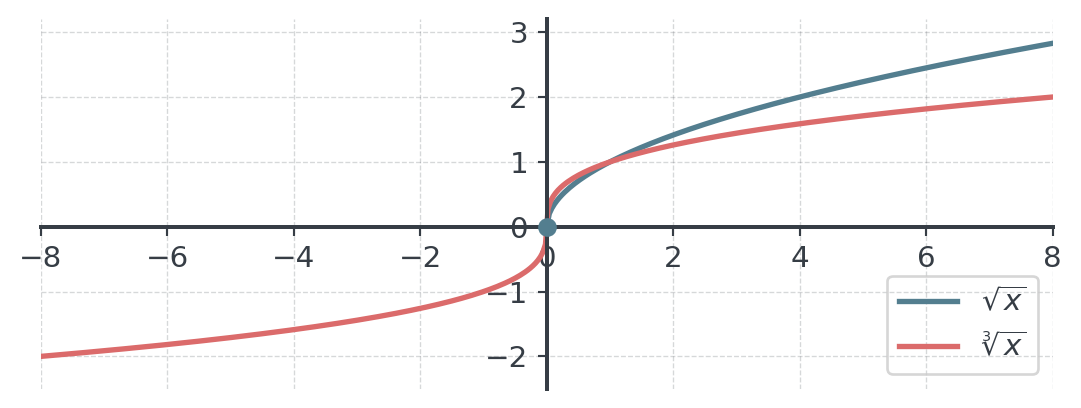
- \(\sqrt{x}\) only exists for \(x \ge 0\) - the even-root curve starts at the origin
- \(\sqrt[3]{x}\) is defined for all \(x\) and keeps the sign of its input
Properties of Radicals
These properties allow us to simplify
| Property | Formula | Example |
|---|---|---|
| Product | \(\sqrt[n]{ab} = \sqrt[n]{a} \cdot \sqrt[n]{b}\) | \(\sqrt{12} = \sqrt{4 \times 3} = 2\sqrt{3}\) |
| Quotient | \(\sqrt[n]{\frac{a}{b}} = \frac{\sqrt[n]{a}}{\sqrt[n]{b}}\) | \(\sqrt{\frac{16}{4}} = \frac{\sqrt{16}}{\sqrt{4}} = 2\) |
| Power | \(\sqrt[n]{a^m} = a^{m/n}\) | \(\sqrt[3]{x^6} = x^2\) |
Key idea: Look for perfect squares, cubes, etc. that you can “pull out” of the radical!
Simplifying Radicals
Strategy: Extract perfect powers from under the radical
Simplify \(\sqrt{72}\)
- Factor: \(72 = 36 \times 2 = 6^2 \times 2\)
- Extract: \(\sqrt{36 \times 2} = \sqrt{36} \times \sqrt{2}\)
- Result: \(6\sqrt{2}\)
Simplify \(\sqrt{50x^5y^3}\)
- Factor: \(50 = 25 \times 2\), \(x^5 = x^4 \cdot x\), \(y^3 = y^2 \cdot y\)
- Extract: \(\sqrt{25x^4y^2 \cdot 2xy}\)
- Result: \(5x^2y\sqrt{2xy}\)
Operations with Radicals
Can only combine like radicals!
Example: Simplify \(3\sqrt{12} + 2\sqrt{27} - \sqrt{48}\)
- Simplify each term:
- \(3\sqrt{12} = 3 \cdot 2\sqrt{3} = 6\sqrt{3}\)
- \(2\sqrt{27} = 2 \cdot 3\sqrt{3} = 6\sqrt{3}\)
- \(\sqrt{48} = 4\sqrt{3}\)
- Combine: \(6\sqrt{3} + 6\sqrt{3} - 4\sqrt{3} = 8\sqrt{3}\)
Always simplify radicals first before combining!
Rationalizing
What is Rationalizing?
Removing radicals from denominators
- Rationalize means to rewrite a fraction
- We want no square roots (or other radicals) in the denominator.
- Before: \(\frac{1}{\sqrt{2}}\) (radical in denominator)
- After: \(\frac{\sqrt{2}}{2}\) (no radical in denominator)
TipWhy Rationalize?
Easier calculation before calculators, standard form for mathematical expressions, and often simplifies further operations.
Simple Radical Denominators
Basic principle: Multiply by a form of 1 that eliminates the radical
Rationalize \(\frac{3}{\sqrt{5}}\)
- Multiply by \(\frac{\sqrt{5}}{\sqrt{5}}\)
- \(\frac{3}{\sqrt{5}} \cdot \frac{\sqrt{5}}{\sqrt{5}} = \frac{3\sqrt{5}}{5}\)
Rationalize \(\frac{3}{\sqrt[3]{2}}\)
- We could make the denominator a perfect cube
- Multiply by \(\frac{\sqrt[3]{4}}{\sqrt[3]{4}}\) (since \(2 \times 4 = 8 = 2^3\))
- Result: \(\frac{3\sqrt[3]{4}}{2}\)
Using Conjugates
A conjugate flips the sign between terms
Definition: The conjugate of \(a + b\sqrt{c}\) is \(a - b\sqrt{c}\)
- Example: Conjugate of \(\sqrt{3} + 1\) is \(\sqrt{3} - 1\)
- Key property: \((a + b)(a - b) = a^2 - b^2\) (difference of squares)
- Why it works: The radical terms cancel out when multiplied!
Conjugates
Use the conjugate to eliminate radicals
Example: Rationalize \(\frac{2}{\sqrt{3} + 1}\)
- Multiply by conjugate: \(\frac{\sqrt{3} - 1}{\sqrt{3} - 1}\)
- Numerator: \(2(\sqrt{3} - 1) = 2\sqrt{3} - 2\)
- Denominator: \((\sqrt{3})^2 - 1^2 = 3 - 1 = 2\)
- Result: \(\frac{2\sqrt{3} - 2}{2} = \sqrt{3} - 1\)
Pair Exercise 01
Work in pairs for 8 minutes
Simplify: \(\sqrt{72} + \sqrt{50} - \sqrt{98}\)
Rationalize: \(\frac{4}{\sqrt{6} - \sqrt{2}}\)
Simplify: \(\sqrt[3]{54x^7y^5}\)
Simplify: \(\frac{\sqrt{45x^3}}{\sqrt{5x}}\)
Coffee Break
Combining Techniques
Combining All Techniques
Use factorization, exponents, and radicals together
Example: Simplify \(\frac{x^2 - 4}{x^2 - x - 6} \cdot \frac{x^2 - 9}{x + 2}\)
- Factor everything:
- \(x^2 - 4 = (x + 2)(x - 2)\)
- \(x^2 - x - 6 = (x - 3)(x + 2)\)
- \(x^2 - 9 = (x + 3)(x - 3)\)
- Rewrite: \(\frac{(x + 2)(x - 2)}{(x - 3)(x + 2)} \cdot \frac{(x + 3)(x - 3)}{x + 2}\)
- Result: \(\frac{(x - 2)(x + 3)}{x + 2}\)
Complex Fractions
Simplify: \(\frac{\frac{x}{3}}{\frac{2}{x}}\)
- Remember: Dividing by a fraction means multiply by its reciprocal
- \(\frac{\frac{x}{3}}{\frac{2}{x}} = \frac{x}{3} \times \frac{x}{2}\)
- Multiply: \(\frac{x \times x}{3 \times 2} = \frac{x^2}{6}\)
Spot the Error
Can you find the errors? Work with your neighbor
Time allocation: 5 minutes to find errors, 5 minutes to discuss
Student work:
“\(\sqrt{x^2 + 25} = x + 5\), because \(\sqrt{x^2} = x\) and \(\sqrt{25} = 5\)”
“To factor \(6x^2 + 7x - 5\): since \(ac = -30\) is negative, both factors of \(-30\) must be negative”
“To rationalize \(\frac{2}{\sqrt{5} - \sqrt{3}}\), I multiply by \(\frac{\sqrt{5} - \sqrt{3}}{\sqrt{5} - \sqrt{3}}\) and the denominator becomes \(5 - 3 = 2\)”
Why This Matters for the FSP
Factorization is the engine behind almost everything ahead
- Solving equations: \(x^2 - x - 6 = 0\) factors to \((x - 3)(x + 2) = 0\), so by the zero-product rule \(x = 3\) or \(x = -2\)
- Break-even analysis: the break-even points of a profit function are exactly the zeros of its factored form
- Curve sketching: zeros of functions and their derivatives come from factoring
- Simplifying: cancelling common factors keeps later calculus manageable
Practice
Individual Exercise 02
Work individually for 10 minutes
Factor completely: \(8x^3 - 125\)
Simplify: \(\sqrt{75x^3} - x\sqrt{12x} + 2\sqrt{27x^3}\)
Rationalize: \(\frac{3}{2 - \sqrt{3}}\)
Simplify: \(\frac{x^3 - 8}{x^2 - 4} \div \frac{x^2 + 2x + 4}{x + 2}\)
Pair Exercise 02
Work in pairs for 8 minutes
Rationalize and simplify: \(\frac{\sqrt{7} + \sqrt{2}}{\sqrt{7} - \sqrt{2}}\)
Simplify the complex fraction: \(\frac{\frac{1}{x} + \frac{1}{y}}{\frac{x + y}{xy}}\)
Factor completely and simplify: \(\frac{x^3 + 27}{x^2 - 9}\)
Individual Exercise 03
Work individually for 10 minutes
Factor completely: \(2x^4 - 32\)
Rationalize: \(\frac{1}{\sqrt{5} + \sqrt{3} + \sqrt{2}}\)
Hint: Treat \(\sqrt{3} + \sqrt{2}\) as one term and use a conjugate twice.
Wrap-Up & Takeaways
Key Takeaways
- AC method handles quadratics with \(a \neq 1\)
- Grouping can work for four-term polynomials
- Cube formulas follow specific patterns
- Radicals simplify by extracting perfect powers
- Rationalization uses conjugates for binomials
Final Assessment
Quick Check
Work individually then we discuss
Factor: \(4x^2 + 4x - 15\)
Simplify: \(\sqrt{45} + \sqrt{20}\)
Rationalize: \(\frac{6}{\sqrt{3}}\)
True or False: \(\sqrt{a + b} = \sqrt{a} + \sqrt{b}\) for all \(a, b \ge 0\).
Next Session Preview
Session 01-05
Logarithms & Substitution
- Substitution: factoring biquadratic-style expressions
- Logarithms: definition, properties, and laws
- Applications: sound intensity, earthquakes, and doubling times
- Binomial powers: Pascal’s triangle and expansion
Complete Tasks 01-04!