Session 04-03 - Exponential & Logarithmic Functions
Section 04: Advanced Functions
Entry Quiz
Review from Session 04-02
Work individually for 5 minutes, then we discuss
Simplify: \(\sqrt[3]{8x^6}\)
What is the domain of \(f(x) = \sqrt{x - 4}\)?
Compare the growth rates: Which grows faster for large \(x\): \(x^3\) or \(x^{3.1}\)?
Homework Discussion
Your questions from Tasks 04-02
Focus on power functions and economic applications
- Challenges with fractional and negative exponents
- Domain determination strategies
- Growth rate comparison problems
Exponential functions will show dramatically different growth behavior!
Learning Objectives
Today’s Goals
By the end of this session, you will be able to:
- Understand exponential functions and their unique properties
- Distinguish between exponential growth and decay
- Work with the natural exponential function \(e^x\)
- Apply compound interest formulas in finance
- Model real-world growth and decay processes
- Compare exponential vs. polynomial growth rates
- Analyze logarithmic functions, their graphs and transformations
- Read semi-log and log-log plots for business data
Exponential Functions
From Powers to Exponentials
A fundamental shift in perspective
Power Functions: \(f(x) = x^n\) → variable base, fixed exponent
Exponential Functions: \(f(x) = a^x\) → fixed base, variable exponent
Power: \(x^2\)
- Input: \(2\) → Output: \(4\)
- Input: \(3\) → Output: \(9\)
- Input: \(4\) → Output: \(16\)
Exponential: \(2^x\)
- Input: \(2\) → Output: \(4\)
- Input: \(3\) → Output: \(8\)
- Input: \(4\) → Output: \(16\)
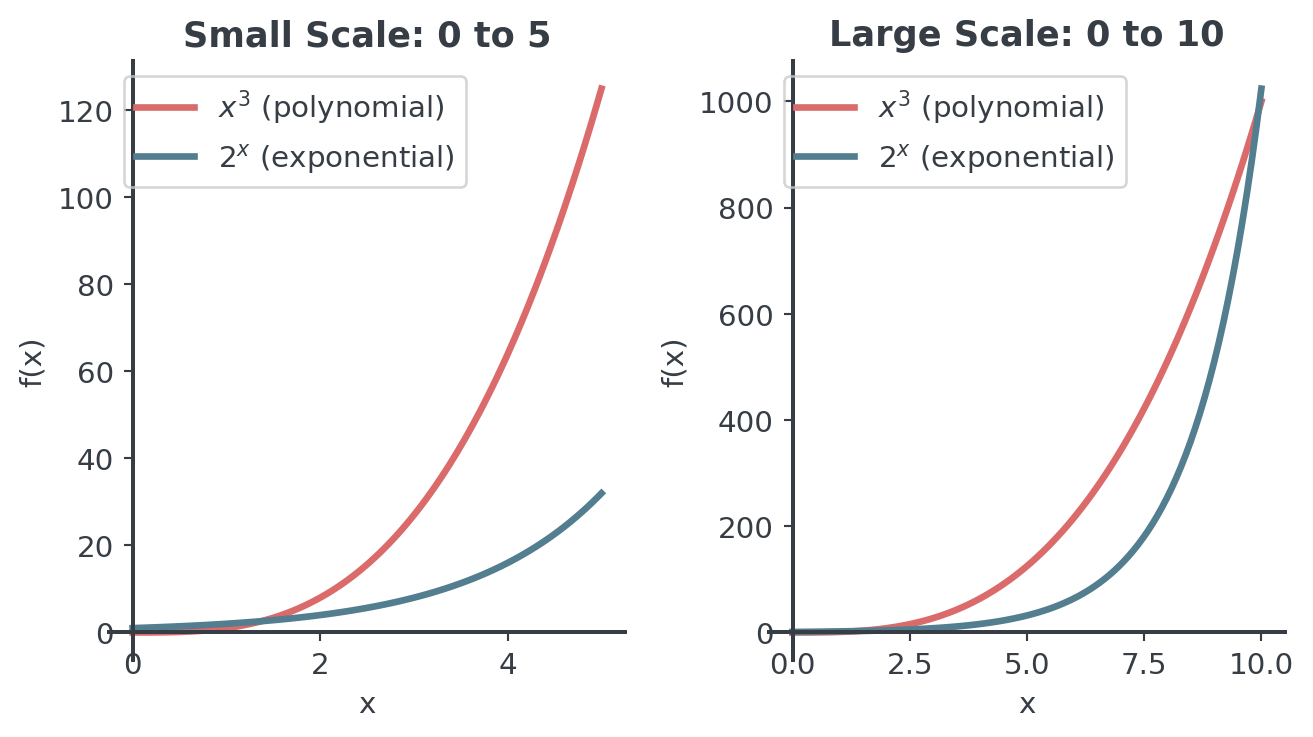
Key Difference: Exponentials grow MUCH faster than any polynomial!
Definition and Properties
The exponential function family
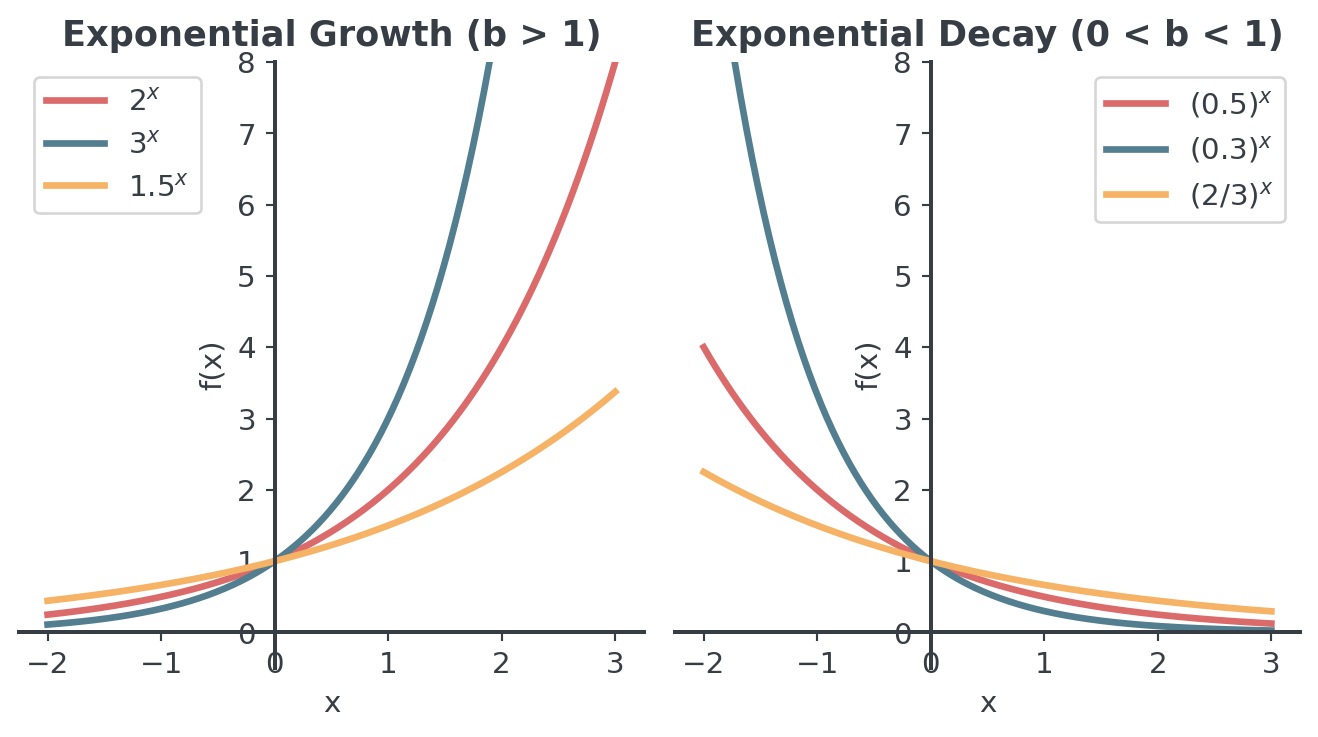
An exponential function has the form \(f(x) = a \cdot b^x\):
- \(a \neq 0\) is the initial value (vertical stretch/reflection)
- \(b > 0, b \neq 1\) is the base
Essential Properties:
- Domain: All real numbers, Range: \((0; \infty)\) when \(a > 0\)
- Always passes through \((0, a)\) and has an inverse
Graphical Behavior
Growth vs. Decay patterns
Exponential Growth
The Natural Base e
The most important number in continuous growth
The number \(e ≈ 2.71828...\) is called Euler’s number
- Arises naturally in countless real-world processes
- Foundation for calculus and differential equations
- Base of the natural exponential function \(f(x) = e^x\)
\[e = \lim_{n \to \infty} \left(1 + \frac{1}{n}\right)^n\]
Properties of \(e^x\)
What makes e special
The function \(f(x) = e^x\) has unique mathematical properties:
- Self-similarity: Rate of change equals value (derivative equals itself)
- Series representation: \(e^x = 1 + x + \frac{x^2}{2!} + \frac{x^3}{3!} + ...\)
- Natural growth: Models any continuous growth or decay process
- Perfect inverse: Has as inverse function the natural logarithm
Whenever you see continuous processes in nature, business, or science, \(e\) appears!
Visualizing \(e^x\)
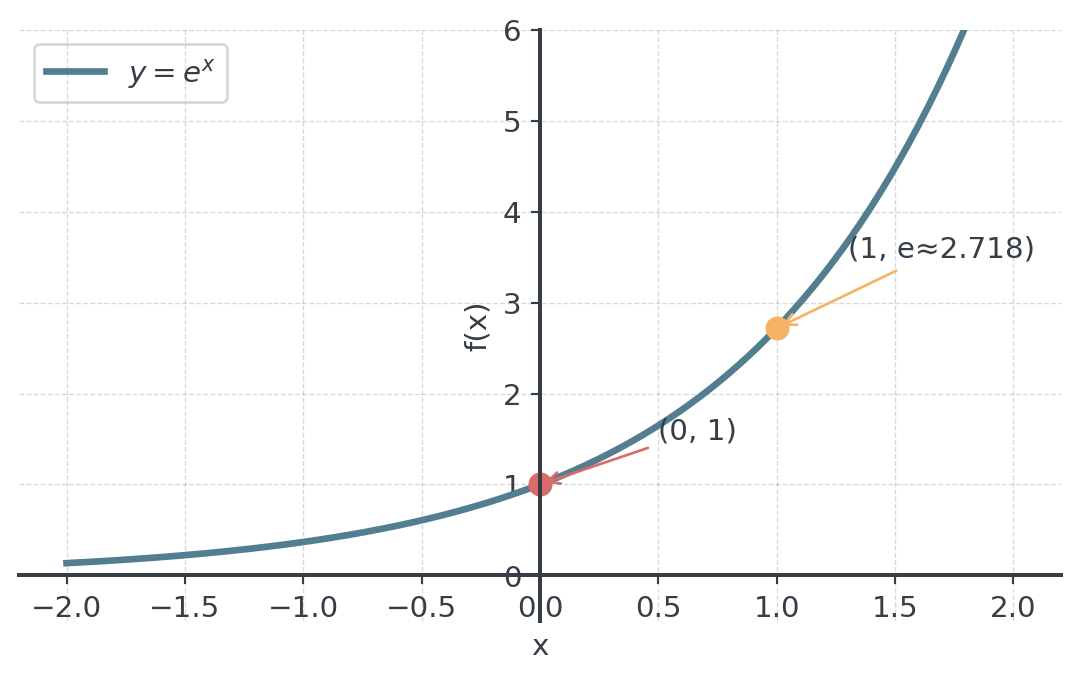
Always positive, passes through \((0, 1)\), grows faster as \(x\) increases
General Growth Formula
Two equivalent ways to model growth
The general exponential growth model can be written as:
Discrete form: \(A(t) = A_0 \cdot b^t\) where \(b > 1\)
Continuous form: \(A(t) = A_0 \cdot e^{kt}\) where \(k > 0\)
- \(A_0\) = initial amount
- \(b\) = growth factor (how much it multiplies per period)
- \(k\) = continuous growth rate
- \(t\) = time
These forms are equivalent! Relationship: \(b = e^k\) or \(k = \ln(b)\)
Application: Market Growth
User adoption example
A new app has 1,000 users and grows by 30% monthly.
Discrete model: \(U(t) = 1000 \cdot 1.3^t\) where \(t\) is months
Continuous model: \(U(t) = 1000 \cdot e^{0.2624t}\) (since \(\ln(1.3) ≈ 0.2624\))
Calculations:
- After 6 months: \(U(6) = 1000 \cdot 1.3^6 ≈ 4,826\) users
- After 12 months: \(U(12) = 1000 \cdot 1.3^{12} ≈ 23,298\) users
Question: Why might the continuous form be more realistic here?
Exponential Decay
Decay Processes
When things decrease exponentially
The exponential decay model:
\(A(t) = A_0 \cdot b^t\) where \(0 < b < 1\)
or: \(A(t) = A_0 \cdot e^{-kt}\) where \(k > 0\)
Question: Any idea where we find this in the real world?
- Radioactive decay
- Drug concentration in body
- Depreciation of assets
- Cooling processes
Business Example: Depreciation
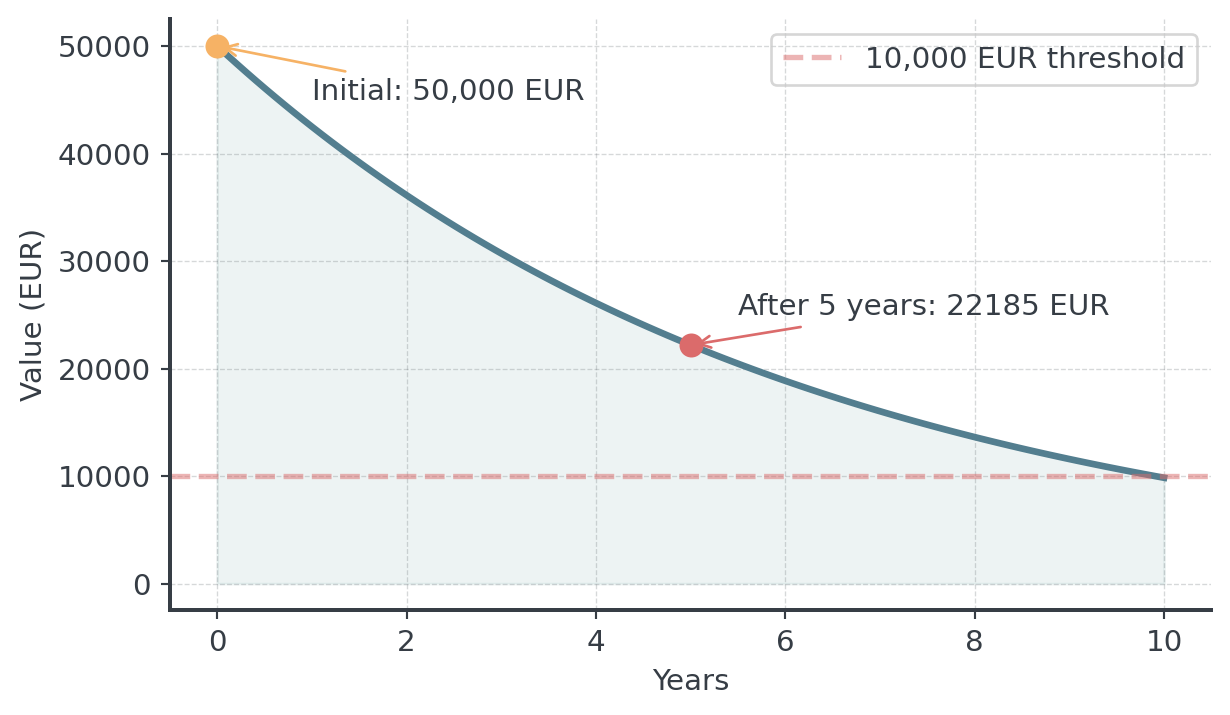
A machine costs 50,000 EUR and depreciates 15% annually.
Model: \(V(t) = 50000 \cdot 0.85^t\)
Compound Interest
From Simple to Compound Interest
The power of reinvesting earnings
Simple interest: Only the principal earns interest \[A = P(1 + rt)\]
Compound interest: Interest earns interest \[A = P\left(1 + \frac{r}{n}\right)^{nt}\]
- \(P\) = principal (initial investment), \(r\) = annual interest rate
- \(n\) = compounding frequency per year, \(t\) = time in years
Discovering e by Compounding
Compound 1 EUR at 100% interest for 1 year (\(P=1, r=1, t=1\)):
\[A = \left(1 + \frac{1}{n}\right)^n\]
- Annually: \((1 + 1)^1 = 2.000\)
- Semi: \((1 + 0.5)^2 = 2.250\)
- Quarterly: \((1 + 0.25)^4 = 2.441\)
- Monthly: \((1.0833...)^{12} = 2.613\)
- Daily: \((1.00274...)^{365} = 2.7146\)
- Hourly: \(≈ 2.7181\)
- Every second: \(≈ 2.71827\)
- As \(n \to \infty\): \(e ≈ 2.71828...\)
This limit gives us Euler’s number \(e\), the foundation of continuous growth!
Continuous Compounding
The mathematical limit of frequent compounding
As compounding becomes instantaneous (\(n \to \infty\)): \[A = P \cdot e^{rt}\]
When to use continuous compounding:
- Theoretical maximum return calculations
- Natural growth processes (populations, investments, …)
Continuous vs. daily compounding differs by under 0.01% in practice. Compounding frequencies and the Effective Annual Rate follow in Session 08-01.
Calculator: Exponential Functions
Key buttons for exponential functions:
| Operation | Keys |
|---|---|
| \(e^x\) | SHIFT + ln |
| \(10^x\) | SHIFT + log |
| \(x^n\) | Use x^ key |
Examples: \(e^2 = 7.389...\), \(10^{1.5} = 31.62...\), \(2^{10} = 1024\)
Spot the Error
Can you identify the errors? Work with your neighbor
Time allocation: 5 minutes to find errors, 5 minutes to discuss
Student work:
“Since \(2^3 = 8\), then \(2^{3x} = 8x\)”
“The function \(f(x) = -2^x\) represents exponential decay”
“If inflation is 3% annually, prices double in \(\frac{100}{3} ≈ 33\) years”
“\((e^2)^3 = e^5\)”
Comparing Growth
Exponential vs. Polynomial
Which wins in the long run?
Comparing Different Bases
How base affects growth rate
For exponential growth (\(b > 1\)):
- Larger base → faster growth
- \(e^x\) grows faster than \(2^x\) but slower than \(3^x\)
For exponential decay (\(0 < b < 1\)):
- Smaller base → faster decay
- \((0.3)^x\) decays faster than \((0.5)^x\)
Remember: The base determines the rate of growth/decay!
The Power of Exponentials
Small changes, dramatic effects
A cent doubled daily for 30 days:
- Day 1: 0.01 EUR
- Day 10: 5.12 EUR
- Day 20: 5,243 EUR
- Day 30: 5,368,709 EUR
“The greatest shortcoming of the human race is our inability to understand the exponential function.” - Albert Bartlett
Break
Quick Challenge Question
An investment grows from 1,000 EUR to 1,500 EUR in 5 years.
Question: What was the annual growth rate if compounded continuously?
Guided Practice
Individual Exercise Block I
Work alone for 5 minutes, then discuss for 5 minutes
Problem 1: Population Growth
A bacteria colony starts with 100 cells and triples every 4 hours.
- Write the exponential model \(N(t)\) where \(t\) is hours
- How many bacteria after 12 hours?
- How many bacteria after 16 hours?
- When will the population reach 100,000 cells? (Express as an equation!)
Individual Exercise Block II
Work alone for 5 minutes, then discuss for 5 minutes
Problem 2: Investment Comparison
You have 5,000 EUR to invest for 8 years. Compare:
- Option A: 6% annual rate compounded quarterly
- Option B: 5.9% annual rate compounded continuously
- Calculate the final amount for each option
- Which option is better and by how much?
- What would the continuous rate need to be to match Option A?
Individual Exercise Block III
Work alone for 5 minutes, then discuss for 5 minutes
Problem 3: Half-Life & Medication
A medication has a half-life of 6 hours (every 6 hours, the amount in the body halves). You take 200mg.
- Write the decay model \(A(t)\) where \(t\) is hours
- How much remains after 12 hours?
- How much remains after 24 hours?
- After how many half-lives will less than 10mg remain?
Applications
COVID-19 Spread Model
Early pandemic growth (before interventions, approximation):
Cases doubled every 3 days, starting from 100 cases
Model: \(C(t) = 100 \cdot 2^{t/3}\)
Without intervention:
- Day 9: \(100 \cdot 2^3 = 800\) cases
- Day 18: \(100 \cdot 2^6 = 6,400\) cases
- Day 30: \(100 \cdot 2^{10} = 102,400\) cases
This demonstrates why an early intervention is crucial and “Flattening the curve” was essential as exponential growth is deceptive initially!
Moore’s Law
Technology advancement
“Computing power doubles every 2 years”
If a processor has 1 billion transistors today:
\[T(t) = 10^9 \cdot 2^{t/2}\]
Predictions:
- In 10 years: \(10^9 \cdot 2^5 = 32\) billion transistors
- In 20 years: \(10^9 \cdot 2^{10} = 1.024\) trillion transistors
This exponential growth has driven the smartphone revolution and AI advancement.
Special Topics
The Rule of 70
Quick doubling time estimation
For growth rate \(r\)% per period: \[\text{Doubling time} ≈ \frac{70}{r}\]
- 7% growth → doubles in \(\frac{70}{7} = 10\) periods
- 2% inflation → prices double in \(\frac{70}{2} = 35\) years
- 10% return → investment doubles in \(\frac{70}{10} = 7\) years
Why 70? It’s a mathematical approximation that works well for small growth rates!
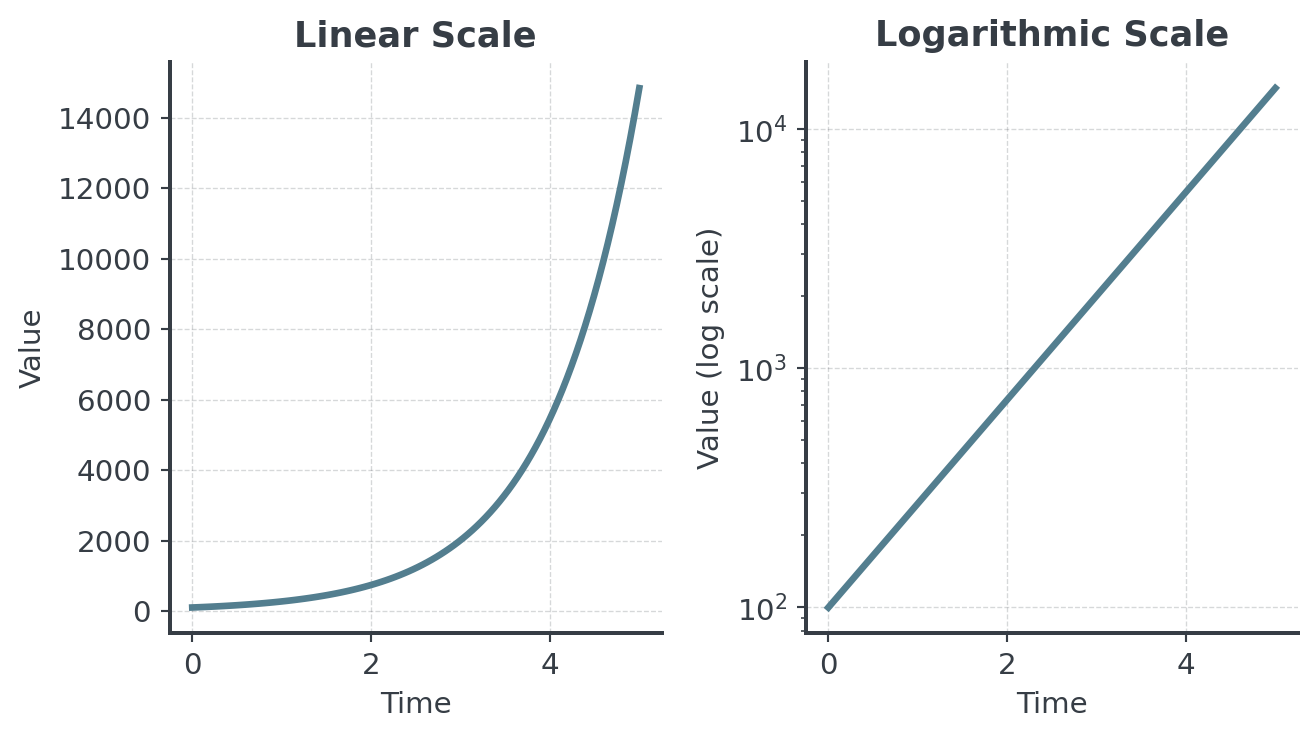
Logarithmic Scales
When exponentials look linear (be careful!)
Logarithmic Functions
Logarithmic Functions as Inverses
The logarithm undoes the exponential
\[y = \log_b(x) \quad \Longleftrightarrow \quad b^y = x\]
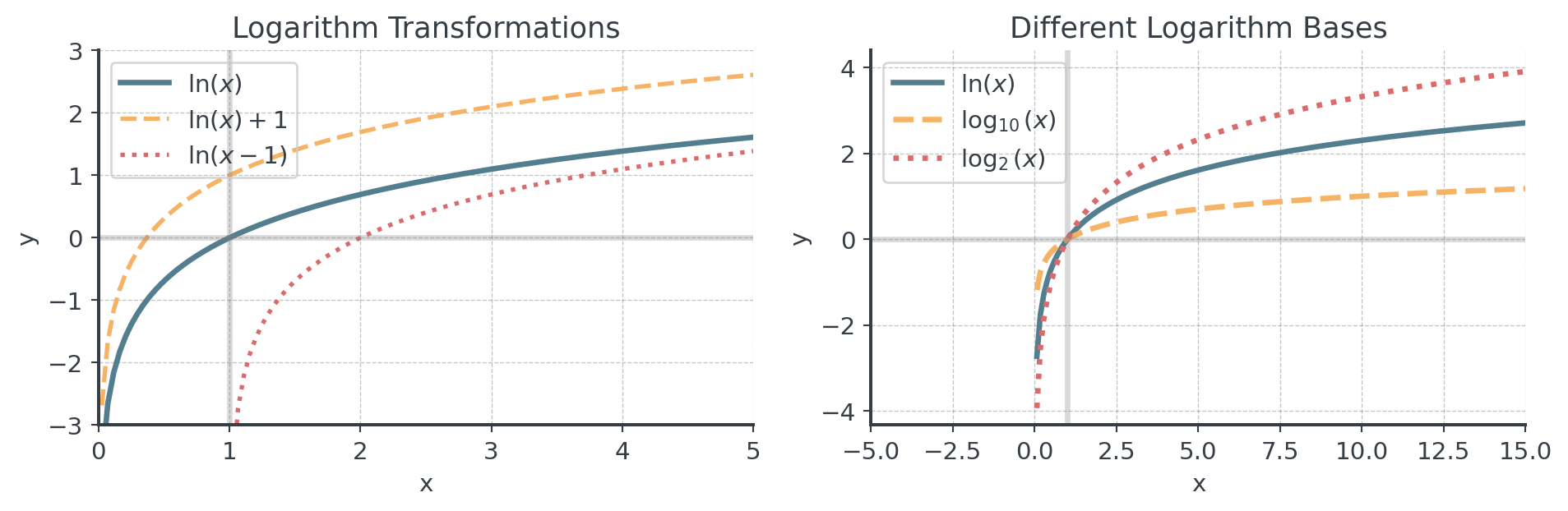
- Domain: \((0; \infty)\) - you can only take logs of positive numbers
- Range: all real numbers
- The graph of \(\log_b(x)\) is the mirror image of \(b^x\) across \(y = x\)
- Passes through \((1, 0)\) since \(\log_b(1) = 0\)
The logarithm laws themselves were covered in Session 01-05 - today we study the function and its graph.
Logarithmic Transformations
Spot the Error: Logarithm Mistakes
Find and fix the errors!
Problem: Solve \(\log_2(x) + \log_2(x - 2) = 3\)
Student Solution:
“\(\log_2(x) + \log_2(x - 2) = 3\)
\(\log_2(x + x - 2) = 3\)
\(\log_2(2x - 2) = 3\)
\(2x - 2 = 8\)
\(x = 5\)”
Semi-log & Log-log
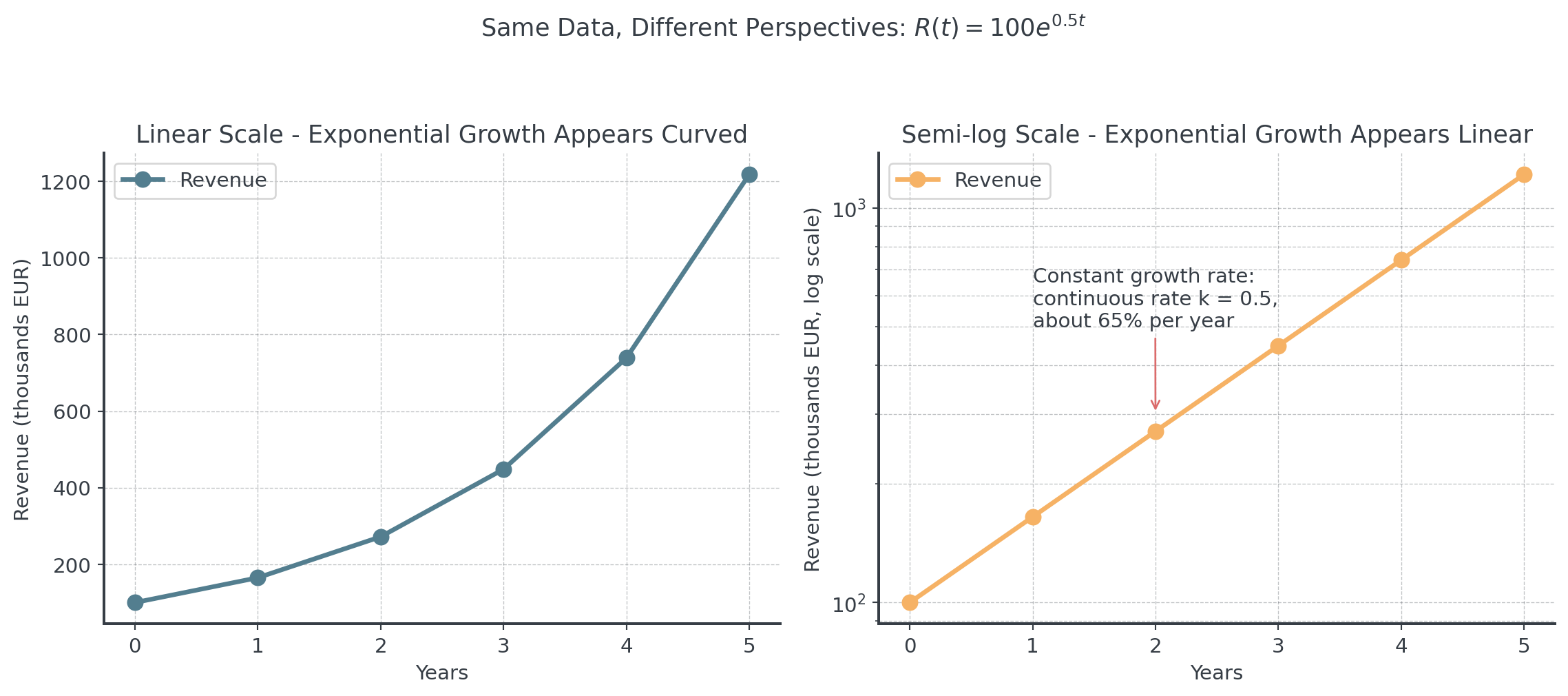
Semi-log Plot (y-axis log)
When data spans several orders of magnitude:
- Exponential growth/decay patterns
- Compound interest, population growth
Recognition:
- Exponential functions appear as straight lines
- Slope represents growth rate
Log-log Plot (both axes log)
When working with power law relationships:
- Power law relationships
- Allometric scaling
- Economic relationships (supply/demand curves)
Recognition:
- Power functions \(y = ax^b\) appear as straight lines
- Slope equals the exponent \(b\)
Let’s visualize both!
Application: Market Analysis
Power Law: Production Costs
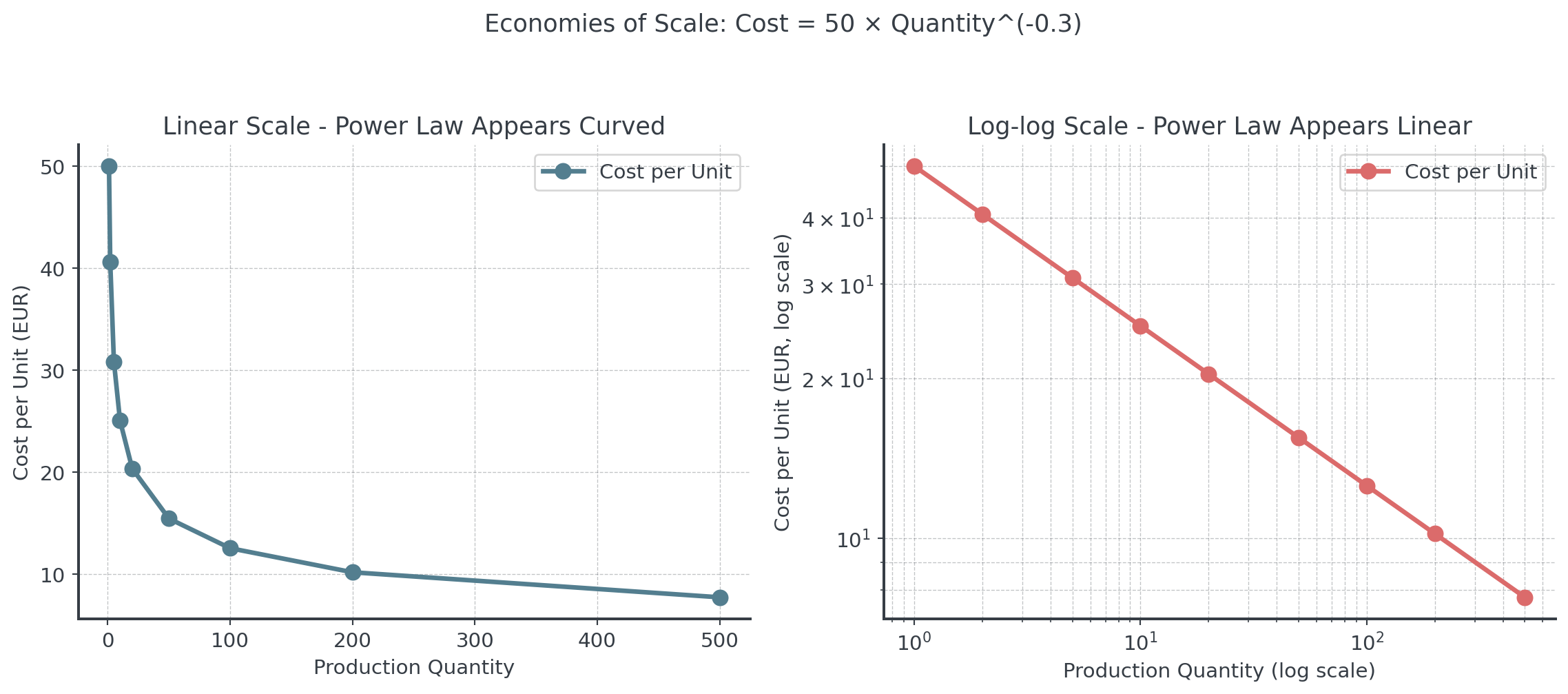
On the log-log plot, the straight line confirms a power law relationship. The slope of -0.3 means that doubling production reduces per-unit cost by about 19% (2^(-0.3) ≈ 0.81).
Mixed Growth Models
Logistic Growth
When exponential growth has limits
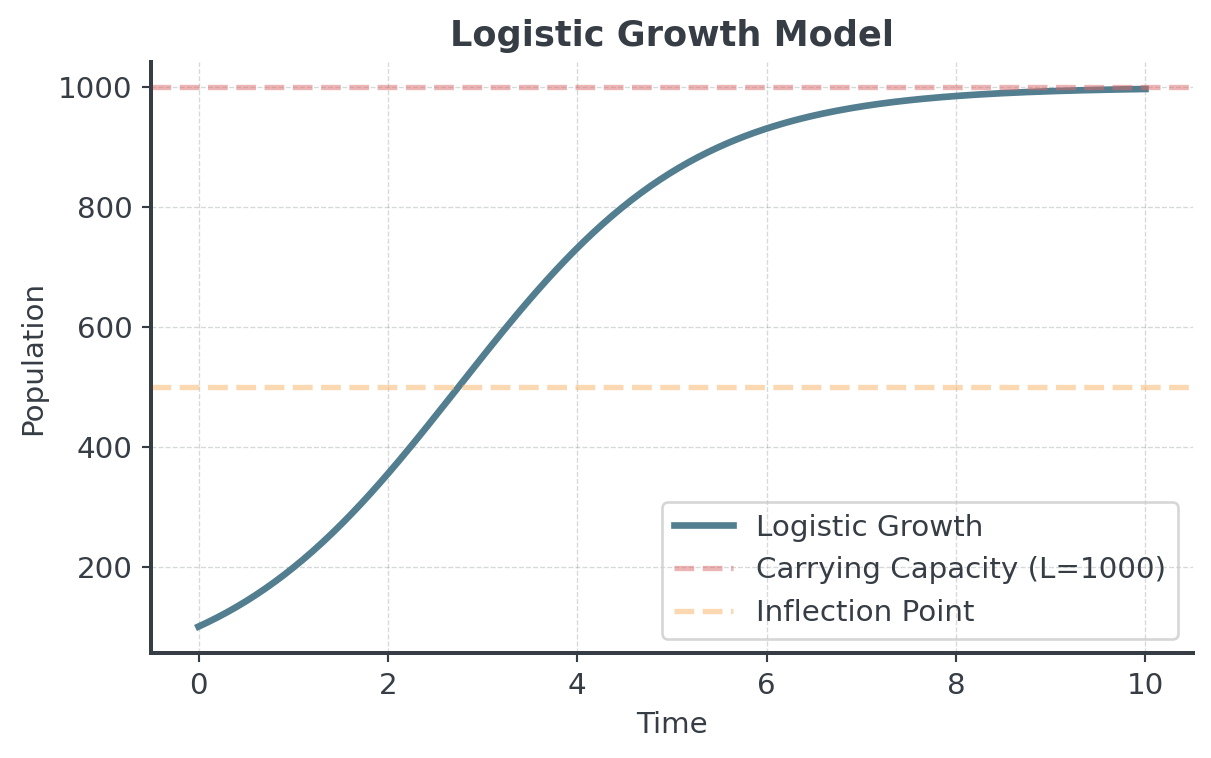
Real populations can’t grow forever. The logistic model:
\[P(t) = \frac{L}{1 + Ae^{-kt}}\]
- \(L\) = carrying capacity (maximum sustainable population)
- \(A\) = related to initial population: \(P(0) = \frac{L}{1+A}\)
- \(k\) = growth rate (how fast it approaches capacity)
- \(t\) = time
Three Phases of Logistic Growth
Phase 1: Slow Start (Lag Phase)
- Population small, resources abundant
- Growth rate increasing but total growth still slow
Phase 2: Rapid Growth (Exponential-like Phase)
- Population reaches \(\frac{L}{2}\) (inflection point, maximum growth rate)
Phase 3: Saturation (Plateau Phase)
- Approaching carrying capacity \(L\) as resources become scarce
Logistic Growth Visualization
Real-World Logistic Examples
Where you encounter S-curves in practice
Business & Technology:
- Product adoption: Smartphones, social media platforms
- Market penetration: New products reaching saturation
Biology & Social:
- Population ecology: Species limited by food/space
- Rumor/news spreading: Reaches everyone who will hear it
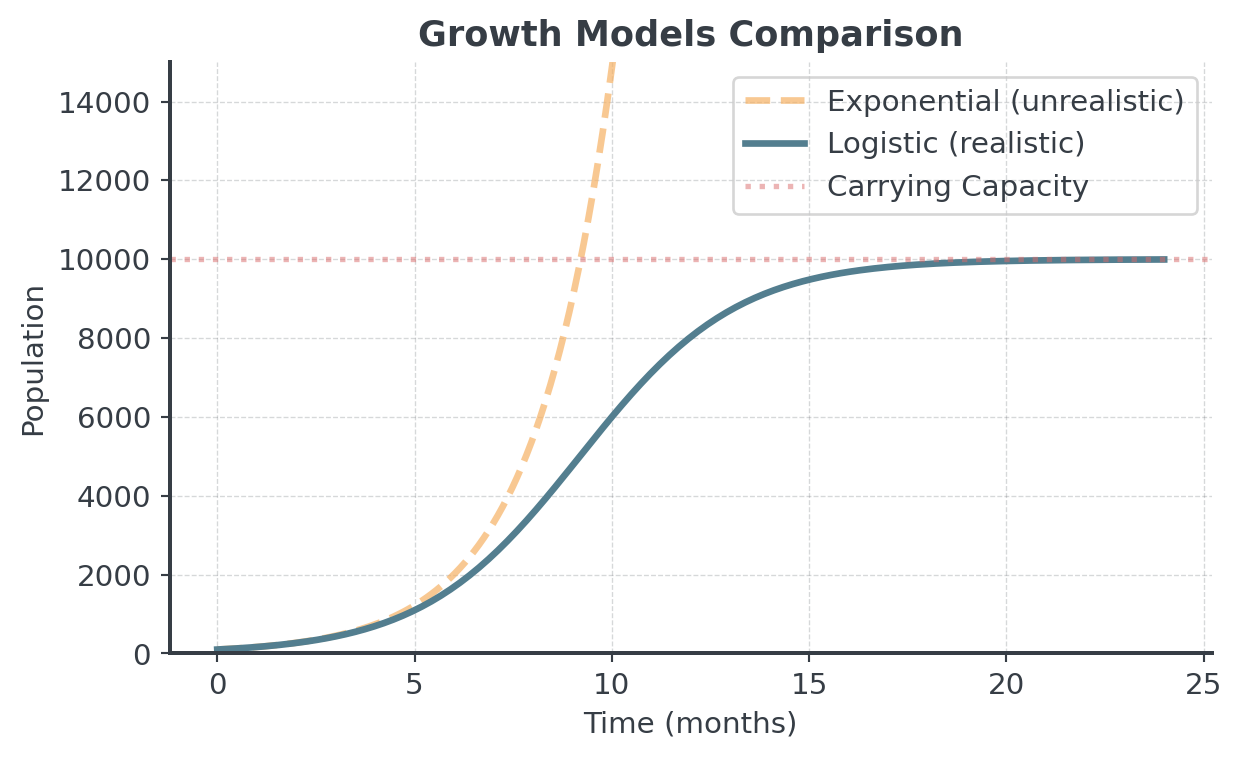
Exponential growth is unsustainable, logistic is realistic. Every real system has limits!
Practice: Logistic Growth
Work individually for 5 minutes, then discuss
A new social media platform launches with 100 users. The market can support a maximum of 10,000 users (carrying capacity). The growth follows a logistic model where \(t\) is in months.
\[P(t) = \frac{10000}{1 + 99e^{-0.5t}}\]
- Verify that \(P(0) = 100\) (initial population)
- Calculate the population after 6 months
- After 12 months? What happens as \(t \to \infty\)?
Comparing Growth Models
Exponential vs. Logistic - A visual comparison
Synthesis
Real-World Application: pH Scale
Where logarithmic properties are important:
\[\text{pH} = -\log_{10}[\text{H}^+]\]
where \([\text{H}^+]\) is hydrogen ion concentration in mol/L
- Domain: \((0; \infty)\) for concentration
- Range: Typically 0-14 for pH
- Each unit change = 10× concentration change
- pH 7 is neutral (\([\text{H}^+] = 10^{-7}\))
Orange Juice
If orange juice has pH = 3.5:
Question: How much more acidic is orange juice compared to neutral water?
\[3.5 = -\log_{10}[\text{H}^+]\] \[[\text{H}^+] = 10^{-3.5} \approx 3.16 \times 10^{-4} \text{ mol/L}\]
This is \(10^{3.5} \approx 3{,}162\) times more acidic than neutral water!
Profit with Components I
A firm’s profit depends on portfolio size \(x\) (number of clients):
\[P(x) = \frac{80x}{x + 5} - 15\ln(x + 1) + 10\]
- Rational term \(\frac{80x}{x+5}\): Revenue (approaches 80k EUR asymptote)
- Logarithmic term \(-15\ln(x+1)\): Overhead & complexity costs
- Fixed term \(+10\): Base profit offset
- Key insight: Logarithmic costs eventually erode the revenue gains
- Critical question: What’s the optimal client portfolio size?
Profit with Components II
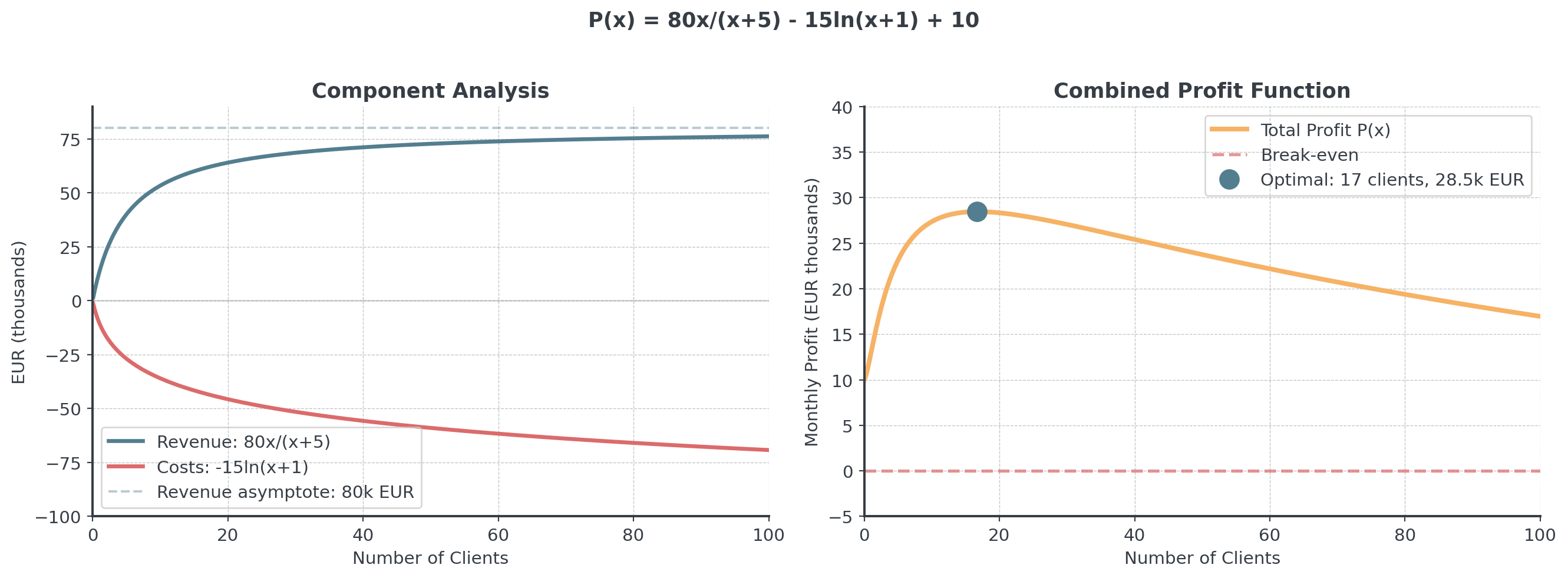
Initially, revenue growth outpaces cost growth → profits increase. Beyond the profit peak, costs grow faster than revenue → profits decline!
Coffee Break
FSP Workshop
Problem 1: A Payment App
A start-up runs a payment app for small shops such as cafés and market stalls. For every payment made with the app, the shop pays a fee. In 2026, the app handles 2 million payments, and the fee is 0.15 EUR per payment. The number of payments is expected to grow by 40 % per year. Because of competition, the fee falls by 25 % per year. Let \(t\) be the time in years since 2026.
- Give the number of payments \(N(t)\) and the fee \(F(t)\) as exponential functions. Show that the yearly fee revenue is \(R(t) = 300000 \cdot 1.05^t\) EUR. [4 pts.]
Payment App: Growth Rates
- A board member says: “The payments grow by 40 % and the fee falls by 25 %, so the revenue grows by 15 % per year.” Assess this statement. Write \(R(t)\) with the continuous growth rate and explain why the continuous rates of \(N\) and \(F\) simply add up. [4 pts.]
Payment App: A Fee Floor
The fee cannot fall below 0.05 EUR, the network costs that the app itself pays for each payment.
- Determine the first year in which the fee \(F(t)\) of the model falls below 0.05 EUR, and check this year and the year before. Compute the fee revenue in that year if the app charges 0.05 EUR per payment instead. [5 pts.]
Hint: The larger of two positive numbers has the larger logarithm.
(for verification: \(F(t) = 0.15 \cdot 0.75^t\))
Payment App: Fee Cuts
The app wants its fee revenue never to shrink, even if competition forces larger fee cuts. The payments still grow by 40 % per year.
- Determine the largest yearly fee cut in % (rounded to two decimal places) for which the revenue does not shrink. Check your rounded value. [3 pts.]
Wrap-Up & Takeaways
Key Takeaways
Today’s essential concepts
- Exponentials grow faster than any polynomial eventually
- The base determines the rate of growth or decay
- Natural exponential \(e\) appears in continuous processes
- Compound interest shows the power of exponential growth
- Rule of 70 provides quick intuition for doubling/halving
Final Assessment
5 minutes - Individual work
A new technology startup’s user base is growing exponentially. They started with 1,000 users and now have 4,000 users after 2 years.
Write the exponential growth model \(N(t) = N_0 \cdot b^t\) (find \(b\))
How many users will they have after 5 years?
Is this discrete or continuous growth? What would the continuous model be?
Using the Rule of 70, approximately when will their user base double from the current 4,000?
Next Session Preview
Session 04-04: Introduction to Trigonometric Functions
Modeling periodic phenomena
- Angles in degrees and radians
- The unit circle
- Sine, cosine, and tangent functions
- Amplitude, period, and transformations
- Seasonal business cycles and periodic models
Complete Tasks 04-03!