Session 03-05 - Composition, Inverses & Advanced Graphing
Section 03: Functions as Business Models
Entry Quiz - 10 Minutes
Review from Session 03-04
Work individually, then exchange with your neighbor for peer review
Given \(f(x) = 2x^2 - 8x + 6\):
- Write the function shifted left 3 units
- Write the function stretched vertically by factor 1.5
A cost function \(C(x) = 100 + 5x\) increases fixed costs by €50 and variable costs by 20%. Write the new function.
Identify the transformations needed to go from \(f(x) = x^2\) to \(g(x) = -2(x + 1)^2 + 4\)
If a profit function’s graph shifts right by 10 units, what does this mean for the business?
Homework Discussion - 20 Minutes
Your questions from Tasks 03-04
Focus on transformation interpretations
- Problem 4: Seasonal business model
- How did season reversal affect profits?
- Problem 5: Graph interpretation
- Identifying cost-effective production ranges
- Problem 7: Multi-location analysis
- Which transformations most impacted profitability?
. . .
Composition and inverses will help us model even more complex business relationships!
Function Composition
Understanding Composition
Composition models sequential processes
Definition: \((f \circ g)(x) = f(g(x))\)
- Read as “f composed with g”
- Apply g first, then f
- Output of g becomes input of f
- Order matters! \((f \circ g) \neq (g \circ f)\) usually
- Business meaning: Multi-step processes
Composition Example: Supply Chain
Imagine a company manufacturing products from raw materials.
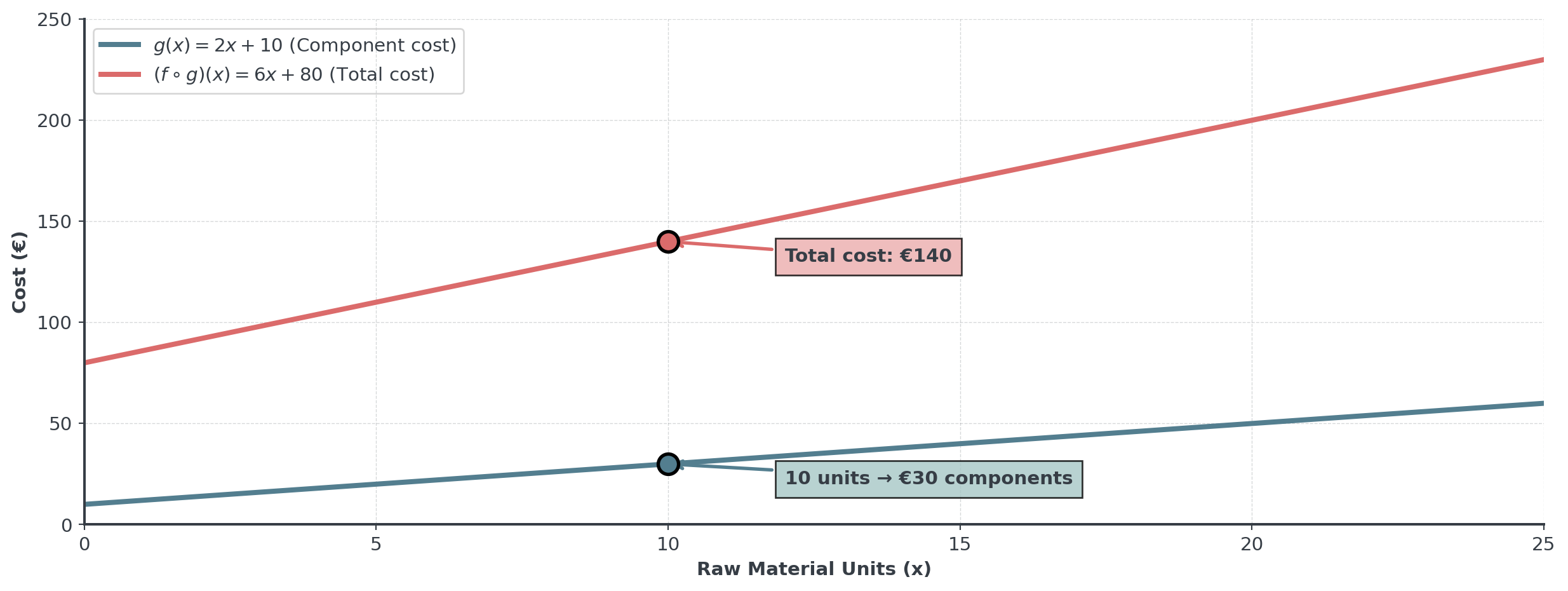
- Raw materials to components: \(g(x) = 2x + 10\) (cost in €)
- Components to products: \(f(y) = 3y + 50\) (cost in €)
- \((f \circ g)(x) = f(g(x)) = f(2x + 10)\)
- \(= 3(2x + 10) + 50\)
- \(= 6x + 30 + 50\)
- \(= 6x + 80\)
- For 10 units raw material: Cost = €140
Supply Chain Visualization
Domain Considerations
Domain of composition can be restricted
For \((f \circ g)(x)\):
- Start with domain of \(g\)
- Find range of \(g\)
- Intersect with domain of \(f\)
- Track back to valid \(x\) values
. . .
This is not too complicated, right? Here we just need to be careful.
Example: Weight-Based Dosage and Safe Maximum
Calculate dosage based on body weight, then check safety limit
- Dosage from weight: \(g(x) = 5x\) mg (5mg per kg body weight)
- Safe processing: \(f(x) = \sqrt{500 - x}\) (requires total dose \(\leq 500\) mg)
- Composition requires: \(5x \leq 500\), so \(x \leq 100\) kg body weight
. . .
Therefore, we cannot process a patient weighing more than 100kg, as this would be unsafe!
Quick Practice - 10 Minutes
Work individually, then we discuss
A food delivery service has the following cost structure:
- Restaurant to warehouse: \(g(x) = 1.5x + 5\) (€ per order, where \(x\) is number of orders)
- Warehouse to customer: \(f(y) = 2y + 8\) (€ delivery cost)
Find the composition \((f \circ g)(x)\) representing total delivery cost.
Calculate the total cost for 20 orders.
If the domain of \(g\) is \([0, 100]\) orders, what is the range of \(g\)?
Break - 10 Minutes
Inverse Functions
What is an Inverse Function?
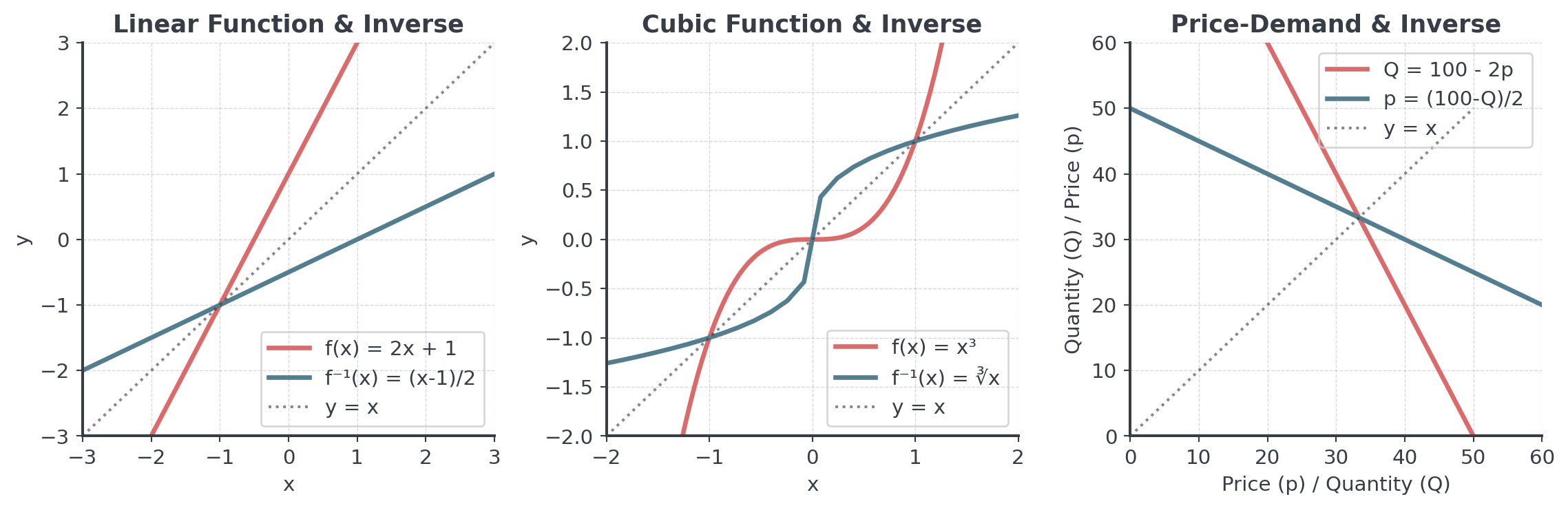
An inverse function reverses the original function
. . .
If \(f(a) = b\), then \(f^{-1}(b) = a\). The inverse “undoes” what the original function does.
Testing for Invertibility
A function has an inverse if it’s one-to-one
- Each output comes from exactly one input
- Horizontal line test: Each horizontal line hits graph at most once
- For continuous functions: Always increasing or always decreasing
. . .
Question: Which of the following two fulfill the one-to-one condition?
- \(f(x) = 2x + 5\)
- \(g(x) = x^2\)
. . .
Just make sure, you don’t use the vertical line test here!
Finding Inverse Functions
Step-by-step process
- Replace \(f(x)\) with \(y\)
- Swap \(x\) and \(y\)
- Solve for \(y\)
- Replace \(y\) with \(f^{-1}(x)\)
- Verify domain and range
. . .
Looks complicated? It is actually rather easy!
Example: Simple Linear Function
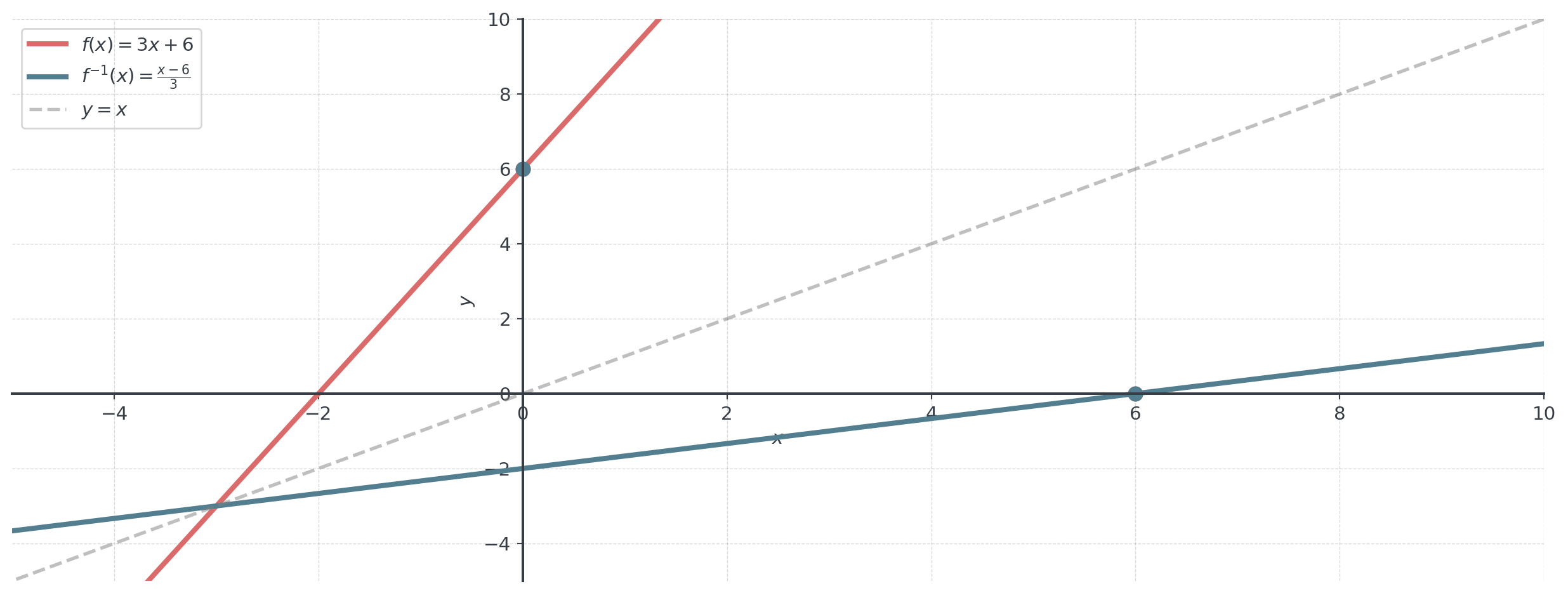
Find the inverse of \(f(x) = 3x + 6\)
- \(y = 3x + 6\)
- \(x = 3y + 6\) (swap \(x\) and \(y\))
- \(3y = x - 6\) (solve for \(y\))
- \(y = \frac{x - 6}{3}\)
- Inverse: \(f^{-1}(x) = \frac{x - 6}{3}\)
. . .
Verify: \(f(f^{-1}(x)) = f\left(\frac{x-6}{3}\right) = 3 \cdot \frac{x-6}{3} + 6 = x - 6 + 6 = x\) ✓
Visualizing the Inverse
Example: Price-Demand Inverse
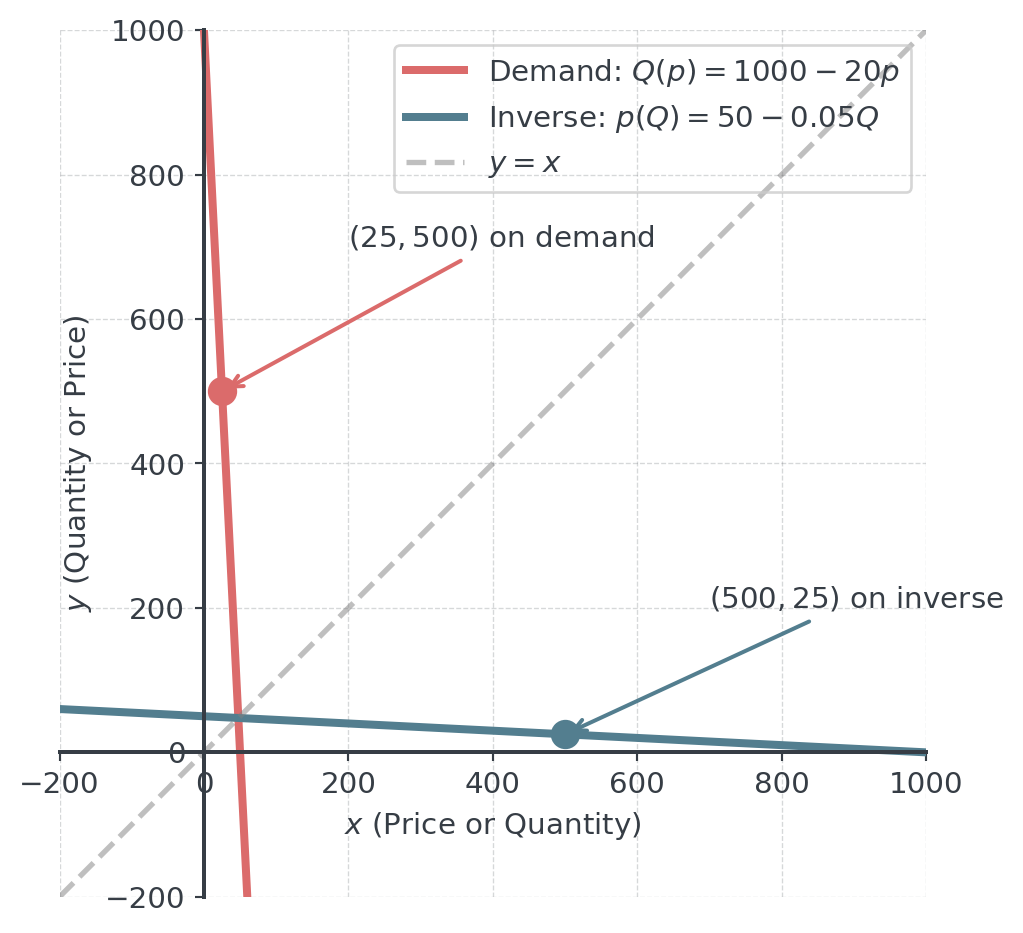
Demand function: \(Q = 1000 - 20p\)
- \(y = 1000 - 20p\)
- \(x = 1000 - 20p\) (swap)
- \(x - 1000 = -20p\)
- \(p = 50 - 0.05x\)
- Inverse: \(p(Q) = 50 - 0.05Q\)
. . .
What does this mean? It gives the price needed for specific quantity!
Visualizing Price-Demand Relationship
Advanced Graphing Techniques
Graphing Composed Functions
Build graphs step by step
. . .
Strategy for graphing \((f \circ g)(x)\):
- Graph \(g(x)\) first
- For key points, find \(g(x)\) values
- Apply \(f\) to those values
- Plot resulting points
- Consider domain restrictions
Graphing Inverse Functions
Use reflection property
. . .
To graph \(f^{-1}(x)\) from \(f(x)\):
- Plot original function \(f(x)\)
- Draw line \(y = x\)
- Reflect \(f(x)\) over this line
- Key points: \((a, b)\) on \(f\) → \((b, a)\) on \(f^{-1}\)
- Domain of \(f\) = Range of \(f^{-1}\)
- Range of \(f\) = Domain of \(f^{-1}\)
Guided Practice - 25 Minutes
Individual Exercise Block
Work alone for 15 minutes, then discuss for 10 minutes
Given \(f(x) = 2x + 3\) and \(g(x) = x^2 - 1\):
- Find \((f \circ g)(x)\) and evaluate \((f \circ g)(2)\)
- Find \((g \circ f)(x)\) and evaluate \((g \circ f)(2)\)
A company converts raw materials through two stages:
- Stage 1: \(C_1(x) = 50x + 200\) (process cost in €)
- Stage 2: \(C_2(y) = 2y + 500\) (assembly cost in €)
- Find the total cost function and cost of 100 units of material.
Find the inverse of \(f(x) = \frac{2x + 3}{5}\) and verify your answer.
Coffee Break - 15 Minutes
Business Process Modeling
Multi-Step Processes
Complex business operations as function chains
. . .
Question: Does you have any example that involves multiple stages?
. . .
Examples of composition in business:
- Manufacturing: Raw materials → Components → Products
- Finance: Local currency → Foreign currency → Investment
- Retail: Wholesale price → Retail price → After-tax price
- Marketing: Leads → Conversions → Revenue
Supply Chain Example
Three-Stage Production from Cost to Price
- Supplier: Raw materials at \(p_r = 10 + 0.5x\) (€ per kg)
- Processor: Converts at 80% efficiency, adds €20/kg
- Retailer: Marks up 50%, adds €15 flat fee
. . .
Let’s build the final price function together:
- After supplier: Cost = \(x(10 + 0.5x) = 10x + 0.5x^2\)
- After processor: Cost = \(0.8(10x + 0.5x^2) + 20x\)
- After retailer: Price = \(1.5[(10x + 0.5x^2) + 20x] + 15\)
Inverse Functions in Business
Common business inverses
- Demand ↔︎ Price: Know one, find the other
- Cost ↔︎ Quantity: Determine production from budget
- Profit ↔︎ Sales: Find required sales for target profit
- Break-even analysis: Reverse engineer requirements
. . .
Also, it could just be a task you are given.
Problem-Solving - 30 Minutes
International Business Model I
The Scenario: Global E-Commerce Platform
An e-commerce company operates internationally with these functions:
Pricing Model:
- Base price in USD: \(P(x) = 50 + 0.8x\) where \(x\) is quantity
- EUR conversion: \(E(p) = 0.85p\)
- UK markup: \(U(p) = 1.2p + 10\)
International Business Model II
The Scenario: Global E-Commerce Platform
Shipping Costs:
- Weight calculation: \(W(x) = 0.5x + 2\) (kg)
- Shipping cost: \(S(w) = 15w + 25\) (€)
Customer Demand:
- At total price \(T\): \(D(T) = 5000 - 20T\) units per month
Your Tasks
If you like, you can work in groups
Find the total price function for EU customers (product + shipping) as a function of quantity \(x\).
Find the inverse of the demand function. What does it represent?
Create a composite function that gives monthly demand based on quantity ordered.
If the company wants exactly 2000 units demanded per month, what should the quantity per order be?
The company can only process orders where total price leads to positive demand. Find the maximum viable order quantity.
Section 03 Synthesis
Your Function Toolkit
Complete arsenal for business modeling
- Function basics: Notation, domain, range
- Linear functions: Constant rates, equilibrium
- Quadratic functions: Optimization, vertex
- Transformations: Adapting to change
- Composition: Multi-step processes
- Inverses: Reversing calculations
Key Business Applications
From this section, you can now:
- Model costs, revenue, and profit
- Find market equilibrium
- Optimize prices and quantities
- Adapt models for new conditions
- Chain processes together
- Reverse-engineer requirements
Wrap-Up
Key Takeaways
- Composition models sequential processes
- Order matters: \((f \circ g) \neq (g \circ f)\)
- Inverses reverse calculations
- One-to-one functions are invertible
- Graphical tools reveal function relationships
- Business processes often involve multiple functions
Final Assessment
5 minutes - Individual work
A retailer has:
- Cost function: \(C(x) = 20x + 500\)
- Price function: \(P(x) = 50 - 0.5x\)
- Revenue: \(R(x) = x \cdot P(x)\)
- Express revenue as a function of \(x\) explicitly
- Find the inverse of the cost function
- If the retailer has a budget of €2,500, how many units can they stock?
Next Session Preview
Session 03-06: Mock Exam 02
Key concepts you should master
- Function fundamentals: Domain, range, notation
- Linear functions: Supply/demand, equilibrium, CVP analysis
- Quadratic functions: Vertex, optimization, profit maximization
- Transformations: Shifts, stretches, business interpretations
- Composition & Inverses: Multi-step processes, reversing calculations
- Graphical analysis: Reading and interpreting business graphs
Exam Preparation Tips
Function Problem Strategies
Systematic approaches for success
- Start with domain: Always check restrictions first
- Identify function type: Linear, quadratic, or composed?
- Business context: What does each variable represent?
- Optimization: Remember vertex formula \(x = -\frac{b}{2a}\)
- Verify results: Do answers make business sense?
Common Pitfalls to Avoid
Learn from typical mistakes
- Not follwing the instructions: Read the tasks carefully!
- Composition order: Remember \((f \circ g) \neq (g \circ f)\)
- Units confusion: Track currency vs. quantity units
- Graph interpretation: Missing key features
- Business meaning: Failing to interpret mathematical results
. . .
Homework Assignment: Complete Tasks 03-05!