Tasks 06-03 - Area Problems & Basic Applications
Section 06: Integral Calculus
A: Skills
Problem 1: Area Under a Curve (x)
If \(f(x) \geq 0\) on \([a; b]\), the area between the graph of \(f\) and the \(x\)-axis on \([a; b]\) is \(\int_a^b f(x) \, dx\). Show that \(f\) is non-negative on the interval. Then compute the area.
\(f(x) = 7 - 1.5x\) from \(x = 0\) to \(x = 4\)
\(f(x) = 2x^2 - 13x + 24\) from \(x = 1\) to \(x = 4\)
\(f(x) = \frac{8}{x^2}\) from \(x = 1\) to \(x = 4\)
\(f(x) = 2\sqrt{x} + 1\) from \(x = 0\) to \(x = 4\)
CautionSolution
\(f\) decreases, so on \([0; 4]\) its smallest value is \(f(4) = 7 - 6 = 1 > 0\).
\[\text{Area} = \int_0^4 (7 - 1.5x) \, dx = \left[7x - 0.75x^2\right]_0^4 = 28 - 12 = 16\]
Discriminant: \((-13)^2 - 4 \cdot 2 \cdot 24 = 169 - 192 = -23 < 0\). So \(f\) has no zeros, and the parabola opens upward (\(2 > 0\)): \(f(x) > 0\) for all \(x\).
\[\text{Area} = \int_1^4 (2x^2 - 13x + 24) \, dx = \left[\frac{2x^3}{3} - 6.5x^2 + 24x\right]_1^4 = \left(\frac{128}{3} - 104 + 96\right) - \left(\frac{2}{3} - 6.5 + 24\right) = \frac{104}{3} - \frac{109}{6} = \frac{99}{6} = 16.5\]
\(x^2 > 0\) for \(x \neq 0\), so \(\frac{8}{x^2} > 0\) on \([1; 4]\). With \(\frac{8}{x^2} = 8x^{-2}\):
\[\text{Area} = \int_1^4 8x^{-2} \, dx = \left[\frac{8x^{-1}}{-1}\right]_1^4 = \left[-\frac{8}{x}\right]_1^4 = -2 - (-8) = 6\]
\(\sqrt{x} \geq 0\), so \(2\sqrt{x} + 1 \geq 1 > 0\) on \([0; 4]\). With \(2\sqrt{x} = 2x^{1/2}\) and \(4^{3/2} = 8\):
\[\text{Area} = \int_0^4 \left(2x^{1/2} + 1\right) dx = \left[\frac{4}{3}x^{3/2} + x\right]_0^4 = \frac{32}{3} + 4 = \frac{44}{3} \approx 14.67\]
Typical mistake: in c), writing \(-2 - 8 = -10\). The value at the lower limit is \(-\frac{8}{1} = -8\), and subtracting it gives \(+8\). An area can never be negative, so a negative result always points to a sign error.
Problem 2: Total Area with Sign Changes (xx)
Compute the total area between the graph of \(f\) and the \(x\)-axis on the given interval. Use the total area strategy from the lecture: find the zeros, determine the signs, integrate each piece and add the absolute values.
\(f(x) = 2x^2 - 15x + 18\) from \(x = 0\) to \(x = 3\)
\(f(x) = x^3 + x^2 - 12x\) from \(x = -2\) to \(x = 4\). Compare the total area with \(\int_{-2}^{4} f(x) \, dx\).
\(f(x) = \sqrt{x} - 1\) from \(x = 0\) to \(x = 4\)
CautionSolution
Zeros with the quadratic formula:
\[x = \frac{15 \pm \sqrt{225 - 144}}{4} = \frac{15 \pm 9}{4}, \qquad x = 6 \text{ or } x = 1.5\]
Only \(x = 1.5\) lies in \([0; 3]\). Signs: \(f(0) = 18 > 0\) and \(f(3) = 18 - 45 + 18 = -9 < 0\). Antiderivative \(F(x) = \frac{2x^3}{3} - 7.5x^2 + 18x\) with \(F(0) = 0\), \(F(1.5) = 2.25 - 16.875 + 27 = 12.375\) and \(F(3) = 18 - 67.5 + 54 = 4.5\).
Pieces: \(\int_0^{1.5} f(x) \, dx = 12.375\) (above the \(x\)-axis) and \(\int_{1.5}^{3} f(x) \, dx = 4.5 - 12.375 = -7.875\) (below the \(x\)-axis).
Total area: \(12.375 + |-7.875| = 20.25\)
Zeros: \(x^3 + x^2 - 12x = x(x^2 + x - 12) = x(x + 4)(x - 3)\). In \([-2; 4]\) lie \(x = 0\) and \(x = 3\), while \(x = -4\) lies outside. Signs: \(f(-1) = 12 > 0\), \(f(1) = -10 < 0\) and \(f(4) = 32 > 0\).
Antiderivative \(F(x) = \frac{x^4}{4} + \frac{x^3}{3} - 6x^2\) with \(F(-2) = 4 - \frac{8}{3} - 24 = -\frac{68}{3}\), \(F(0) = 0\), \(F(3) = \frac{81}{4} + 9 - 54 = -\frac{99}{4}\) and \(F(4) = 64 + \frac{64}{3} - 96 = -\frac{32}{3}\).
Pieces: \(\int_{-2}^{0} f(x) \, dx = \frac{68}{3}\), \(\int_0^3 f(x) \, dx = -\frac{99}{4}\) and \(\int_3^4 f(x) \, dx = -\frac{32}{3} + \frac{99}{4} = \frac{169}{12}\).
Total area: \(\frac{68}{3} + \frac{99}{4} + \frac{169}{12} = \frac{272 + 297 + 169}{12} = \frac{738}{12} = 61.5\)
Comparison: \(\int_{-2}^{4} f(x) \, dx = F(4) - F(-2) = -\frac{32}{3} + \frac{68}{3} = 12\). In the integral, the piece below the \(x\)-axis counts negative and cancels most of the two pieces above it. That is why \(12\) is much smaller than the total area \(61.5\).
Zero: \(\sqrt{x} - 1 = 0 \iff x = 1\). Signs: \(f(0) = -1 < 0\) and \(f(4) = 1 > 0\). Antiderivative \(F(x) = \frac{2}{3}x^{3/2} - x\) with \(F(0) = 0\), \(F(1) = -\frac{1}{3}\) and \(F(4) = \frac{16}{3} - 4 = \frac{4}{3}\).
Pieces: \(\int_0^1 f(x) \, dx = -\frac{1}{3}\) and \(\int_1^4 f(x) \, dx = \frac{4}{3} + \frac{1}{3} = \frac{5}{3}\).
Total area: \(\frac{1}{3} + \frac{5}{3} = 2\)
Typical mistake: splitting at a zero that lies outside the interval. In a), the zero \(x = 6\) does not belong to \([0; 3]\). An integral from \(1.5\) to \(6\) would add a region that the task does not ask for.
Problem 3: Exponential Integrals (x)
Compute the integrals with \(\int e^{ax} \, dx = \frac{1}{a} e^{ax} + C\). For the definite integrals, give the exact value and a decimal rounded to two decimal places.
\(\int e^{6x} \, dx\)
\(\int 10e^{-5x} \, dx\)
\(\int \left(3x^2 + e^{0.5x}\right) dx\)
\(\int_0^2 6e^{1.5x} \, dx\)
\(\int_0^{\ln 3} 2e^{2x} \, dx\)
\(\int_{-2}^{0} 4e^{-0.5x} \, dx\)
CautionSolution
\(\int e^{6x} \, dx = \frac{1}{6}e^{6x} + C\)
\(\int 10e^{-5x} \, dx = 10 \cdot \frac{1}{-5}e^{-5x} + C = -2e^{-5x} + C\)
\(\int \left(3x^2 + e^{0.5x}\right) dx = x^3 + \frac{1}{0.5}e^{0.5x} + C = x^3 + 2e^{0.5x} + C\)
\(\int_0^2 6e^{1.5x} \, dx = \left[6 \cdot \frac{1}{1.5}e^{1.5x}\right]_0^2 = \left[4e^{1.5x}\right]_0^2 = 4e^3 - 4 = 4(e^3 - 1) \approx 76.34\)
\(\int_0^{\ln 3} 2e^{2x} \, dx = \left[e^{2x}\right]_0^{\ln 3} = e^{2\ln 3} - e^0 = e^{\ln 9} - 1 = 9 - 1 = 8\)
(With the power rule for logarithms, \(2\ln 3 = \ln 3^2 = \ln 9\), and \(e^{\ln 9} = 9\).)
\(\int_{-2}^{0} 4e^{-0.5x} \, dx = \left[4 \cdot \frac{1}{-0.5}e^{-0.5x}\right]_{-2}^{0} = \left[-8e^{-0.5x}\right]_{-2}^{0} = -8 - (-8e^{1}) = 8e - 8 = 8(e - 1) \approx 13.75\)
Typical mistake: multiplying by \(a\) instead of dividing by it. In b), \(10 \cdot (-5)e^{-5x} = -50e^{-5x}\) is the derivative of \(10e^{-5x}\), not an antiderivative. Check by differentiating: \(\frac{d}{dx}\left[-2e^{-5x}\right] = -2 \cdot (-5)e^{-5x} = 10e^{-5x}\) ✓.
Problem 4: Logarithmic Integrals (x)
Compute the integrals with \(\int \frac{1}{x} \, dx = \ln|x| + C\). For the definite integrals, give the exact value and a decimal rounded to two decimal places.
\(\int_1^{e^3} \frac{1}{x} \, dx\)
\(\int_2^{10} \frac{4}{x} \, dx\)
\(\int_{-6}^{-2} \frac{3}{x} \, dx\)
\(\int \frac{x^2 + 5}{x} \, dx\)
\(\int_1^4 \frac{x - 2}{x^2} \, dx\)
\(\int_0^2 \frac{6}{3x + 2} \, dx\)
Hint: For f), use the entry \(\int \frac{1}{ax + b} \, dx = \frac{1}{a} \ln|ax + b| + C\) from the summary table of Session 06-03.
CautionSolution
\(\int_1^{e^3} \frac{1}{x} \, dx = \left[\ln|x|\right]_1^{e^3} = \ln\left(e^3\right) - \ln 1 = 3 - 0 = 3\)
\(\int_2^{10} \frac{4}{x} \, dx = \left[4\ln|x|\right]_2^{10} = 4(\ln 10 - \ln 2) = 4\ln\frac{10}{2} = 4\ln 5 \approx 6.44\)
Both limits are negative, so the absolute value matters: \(|-2| = 2\) and \(|-6| = 6\).
\[\int_{-6}^{-2} \frac{3}{x} \, dx = \left[3\ln|x|\right]_{-6}^{-2} = 3(\ln 2 - \ln 6) = 3\ln\frac{2}{6} = -3\ln 3 \approx -3.30\]
The result is negative because \(\frac{3}{x} < 0\) for \(x < 0\): the graph lies below the \(x\)-axis.
Divide each term by \(x\): \(\frac{x^2 + 5}{x} = x + \frac{5}{x}\).
\[\int \left(x + \frac{5}{x}\right) dx = \frac{x^2}{2} + 5\ln|x| + C\]
Divide each term by \(x^2\): \(\frac{x - 2}{x^2} = \frac{1}{x} - 2x^{-2}\).
\[\int_1^4 \left(\frac{1}{x} - 2x^{-2}\right) dx = \left[\ln|x| + \frac{2}{x}\right]_1^4 = (\ln 4 + 0.5) - (0 + 2) = \ln 4 - 1.5 \approx -0.11\]
Table entry with \(a = 3\) and \(b = 2\):
\[\int_0^2 \frac{6}{3x + 2} \, dx = \left[6 \cdot \frac{1}{3}\ln|3x + 2|\right]_0^2 = 2(\ln 8 - \ln 2) = 2\ln 4 \approx 2.77\]
Typical mistake: writing \(\ln x\) instead of \(\ln|x|\) in c). Then you would need \(\ln(-2)\) and \(\ln(-6)\), which do not exist. The antiderivative \(\ln|x|\) works on both sides of \(x = 0\) (lecture: “Why the Absolute Value?”).
Problem 5: Mixed Integrals and Areas (xx)
Give exact values and decimals rounded to two decimal places.
Compute the total area between the graph of \(f(x) = e^x - 3\) and the \(x\)-axis from \(x = 0\) to \(x = 2\).
Compute the total area between the graph of \(g(x) = 2 - \frac{4}{x}\) and the \(x\)-axis from \(x = 1\) to \(x = 4\).
Compute \(\int_0^1 e^{2x + 1} \, dx\).
Hint: \(e^{2x + 1} = e^1 \cdot e^{2x}\), and \(e\) is a constant factor.
- Compute \(\int_1^e \frac{(x + 1)^2}{x} \, dx\).
CautionSolution
Zero: \(e^x - 3 = 0 \iff e^x = 3 \iff x = \ln 3 \approx 1.10\). Signs: \(f(0) = -2 < 0\) and \(f(2) = e^2 - 3 \approx 4.39 > 0\). Antiderivative \(F(x) = e^x - 3x\) with \(F(0) = 1\), \(F(\ln 3) = 3 - 3\ln 3\) and \(F(2) = e^2 - 6\).
- \(\int_0^{\ln 3} f(x) \, dx = (3 - 3\ln 3) - 1 = 2 - 3\ln 3 \approx -1.30\) (below the \(x\)-axis)
- \(\int_{\ln 3}^{2} f(x) \, dx = (e^2 - 6) - (3 - 3\ln 3) = e^2 - 9 + 3\ln 3 \approx 1.68\) (above the \(x\)-axis)
Total area: \((3\ln 3 - 2) + (e^2 - 9 + 3\ln 3) = e^2 + 6\ln 3 - 11 \approx 2.98\)
Zero: \(2 - \frac{4}{x} = 0 \iff 2x = 4 \iff x = 2\). Signs: \(g(1) = -2 < 0\) and \(g(4) = 1 > 0\). Antiderivative \(G(x) = 2x - 4\ln|x|\) with \(G(1) = 2\), \(G(2) = 4 - 4\ln 2\) and \(G(4) = 8 - 4\ln 4 = 8 - 8\ln 2\).
- \(\int_1^2 g(x) \, dx = 4 - 4\ln 2 - 2 = 2 - 4\ln 2 \approx -0.77\)
- \(\int_2^4 g(x) \, dx = (8 - 8\ln 2) - (4 - 4\ln 2) = 4 - 4\ln 2 \approx 1.23\)
Total area: \((4\ln 2 - 2) + (4 - 4\ln 2) = 2\)
With the hint:
\[\int_0^1 e \cdot e^{2x} \, dx = \left[e \cdot \frac{1}{2}e^{2x}\right]_0^1 = \frac{e}{2}\left(e^2 - 1\right) = \frac{e^3 - e}{2} \approx 8.68\]
Expand and divide by \(x\): \(\frac{(x + 1)^2}{x} = \frac{x^2 + 2x + 1}{x} = x + 2 + \frac{1}{x}\).
\[\int_1^e \left(x + 2 + \frac{1}{x}\right) dx = \left[\frac{x^2}{2} + 2x + \ln|x|\right]_1^e = \left(\frac{e^2}{2} + 2e + 1\right) - \left(\frac{1}{2} + 2 + 0\right) = \frac{e^2}{2} + 2e - 1.5 \approx 7.63\]
Typical mistake: in c), writing \(\frac{1}{2x + 1}e^{2x + 1}\). The rule \(\frac{1}{a}e^{ax}\) divides by the number in front of \(x\), never by the whole exponent. Split off the constant \(e\) first, as in the hint.
B: Set Up & Check
Problem 6: From Words to Integrals (xx)
Translate each statement into one or more integrals. Then answer the check question: it tells you whether your translation works.
“Determine the area between the graph of \(f(x) = 2x^2 - 17x + 30\) and the \(x\)-axis on the interval \([1; 4]\).” Write the area as a sum of integrals and compute it.
Check: A classmate computes \(\int_1^4 f(x) \, dx = 4.5\) and gives this as the area. Explain what the number 4.5 measures.
A toy shop sells a trend toy: “Right after a TV report, the shop sells 250 toys per day. From then on, the daily sales fall continuously by 8 % per day.” Write the sales rate \(s(t)\) in toys per day, \(t\) days after the report, and the sales of the first 10 days as a definite integral. Compute the sales.
Check: Differentiate your antiderivative. Do you get \(s(t)\) back?
A company launches a smart thermostat (a heating control that you set with an app): “\(t\) days after the launch, the company sells \(q(t) = 40e^{0.02t}\) thermostats per day.” Write the sales in the second month as a definite integral and compute them. Count a month as 30 days.
Check: A classmate writes \(\int_1^2 q(t) \, dt\), “because the second month runs from month 1 to month 2”. Compute the classmate’s value. Can it be right?
“The graph of \(h(x) = x^3 - 3x^2 - x + 3\) and the \(x\)-axis enclose two regions. Show computationally that both regions have equal size.” Write each of the two areas as an integral with its limits. Then show the statement.
Hint: Factor \(h(x)\) by grouping.
Check: A classmate computes \(\int_{-1}^{3} h(x) \, dx = 0\) and writes: “So both regions have the size 0.” Correct the classmate.
An electronics company launches an e-reader (a device for reading e-books): “\(t\) days after the launch, orders come in at a rate of \(r(t) = 1080e^{-0.18t}\) orders per day.” Write the condition “the total number of orders reaches 5,000” as an equation and solve it. Round to two decimal places.
Check: Can the total ever reach 6,500 orders? Use your equation to decide.
CautionSolution
Zeros first, with the quadratic formula:
\[x = \frac{17 \pm \sqrt{289 - 240}}{4} = \frac{17 \pm 7}{4}, \qquad x = 6 \text{ or } x = 2.5\]
Only \(x = 2.5\) lies in \([1; 4]\). Signs: \(f(1) = 15 > 0\) and \(f(4) = -6 < 0\). So the area is
\[A = \int_1^{2.5} f(x) \, dx + \left|\int_{2.5}^{4} f(x) \, dx\right|\]
With \(F(x) = \frac{2x^3}{3} - 8.5x^2 + 30x\): \(\int_1^{2.5} f(x) \, dx = 10.125\) and \(\int_{2.5}^{4} f(x) \, dx = -5.625\). So \(A = 10.125 + 5.625 = 15.75\).
Check: \(4.5 = 10.125 - 5.625\) is the signed area. The piece below the \(x\)-axis counts negative and cancels part of the piece above it.
Typical mistake: integrating over the whole interval without looking for zeros. An area is never negative, so every piece enters with its absolute value.
“Falls continuously by 8 % per day” means \(s(t) = 250e^{-0.08t}\) (continuous decay, Session 04-03). With \(\frac{1}{a} = \frac{1}{-0.08} = -12.5\):
\[\int_0^{10} 250e^{-0.08t} \, dt = \left[-3125e^{-0.08t}\right]_0^{10} = -3125e^{-0.8} + 3125 = 3125\left(1 - e^{-0.8}\right) \approx 1720.85\]
In the first 10 days, the shop sells about 1,721 toys.
Check: \(\frac{d}{dt}\left[-3125e^{-0.08t}\right] = -3125 \cdot (-0.08)e^{-0.08t} = 250e^{-0.08t} = s(t)\) ✓
Typical mistake: multiplying by \(-0.08\) instead of dividing by it. The derivative of \(-20e^{-0.08t}\) is \(1.6e^{-0.08t}\), not \(s(t)\).
The variable \(t\) counts days, so the second month runs from \(t = 30\) to \(t = 60\). With \(\frac{40}{0.02} = 2000\):
\[\int_{30}^{60} 40e^{0.02t} \, dt = \left[2000e^{0.02t}\right]_{30}^{60} = 2000\left(e^{1.2} - e^{0.6}\right) \approx 2996.00\]
In the second month, the company sells about 2,996 thermostats.
Check: \(\int_1^2 q(t) \, dt = 2000\left(e^{0.04} - e^{0.02}\right) \approx 41.22\). That is about as much as the company sells in a single day (\(q(0) = 40\)). The classmate integrates over the second day, not the second month.
Typical mistake: taking the limits in a different unit than the variable. Translate “month 2” into the unit of \(t\) first.
Grouping: \(h(x) = x^2(x - 3) - (x - 3) = (x - 3)(x^2 - 1) = (x + 1)(x - 1)(x - 3)\). Zeros \(-1\), \(1\) and \(3\). The two regions lie between neighbouring zeros:
\[A_1 = \left|\int_{-1}^{1} h(x) \, dx\right|, \qquad A_2 = \left|\int_{1}^{3} h(x) \, dx\right|, \qquad \text{show: } A_1 = A_2\]
With \(H(x) = \frac{x^4}{4} - x^3 - \frac{x^2}{2} + 3x\): \(H(-1) = -\frac{9}{4}\), \(H(1) = \frac{7}{4}\) and \(H(3) = -\frac{9}{4}\).
\[A_1 = \left|\frac{7}{4} + \frac{9}{4}\right| = 4, \qquad A_2 = \left|-\frac{9}{4} - \frac{7}{4}\right| = |-4| = 4\]
So \(A_1 = A_2 = 4\) ✓.
Check: the integral \(0\) is a signed area. The first region lies above the \(x\)-axis (\(h(0) = 3 > 0\)), the second below it (\(h(2) = -3 < 0\)), and their signed areas cancel. Each region has the size 4, together 8.
Typical mistake: answering with one integral over \([-1; 3]\). The task asks for the size of both regions, so compute each area on its own and compare them.
The total orders from \(t = 0\) to \(t = T\) are an integral. With \(\frac{1080}{-0.18} = -6000\):
\[\int_0^T 1080e^{-0.18t} \, dt = \left[-6000e^{-0.18t}\right]_0^T = 6000\left(1 - e^{-0.18T}\right)\]
Condition and solution (logarithm, Session 04-03):
\[6000\left(1 - e^{-0.18T}\right) = 5000 \iff e^{-0.18T} = \frac{1}{6} \iff -0.18T = \ln\frac{1}{6} = -\ln 6 \iff T = \frac{\ln 6}{0.18} \approx 9.95\]
The total reaches 5,000 orders about 9.95 days after the launch, i.e. on day 10.
Check: \(6000\left(1 - e^{-0.18T}\right) = 6500\) would need \(e^{-0.18T} = -\frac{1}{12}\). That is impossible, because \(e^{-0.18T} > 0\). The total always stays below 6,000 orders: for \(T \to \infty\), \(e^{-0.18T} \to 0\) and the total approaches 6,000.
Typical mistake: setting the rate equal to 5,000, i.e. \(1080e^{-0.18T} = 5000\). The rate counts orders per day. “The total reaches” needs the integral.
Problem 7: One Paragraph, All Conditions (xx)
A theme park opens a new water slide at the start of a summer season of 40 days. The number of visitors per day on the slide, \(v(t)\), \(t\) days after the opening, is modelled by a polynomial of degree 3. On the opening day, 200 visitors per day use the slide. After 20 days, the number of visitors per day reaches its highest value of 1,000. In the whole season, the slide has 30,000 visitors. The park manager wants to know on which days more than 800 visitors use the slide and how many visitors come in the last 10 days of the season.
List every condition and every quantity in this paragraph as a mathematical statement. Do not solve anything.
Check: A colleague writes the information about the whole season as \(v(40) = 30000\). Explain what \(v(40)\) measures. Give the correct condition as a linear equation in the coefficients of \(v\).
CautionSolution
- Model: \(v(t) = at^3 + bt^2 + ct + d\) for \(0 \leq t \leq 40\), with \(v'(t) = 3at^2 + 2bt + c\)
- Opening day: \(v(0) = 200\), so \(d = 200\)
- Highest value after 20 days: \(v(20) = 1000\)
- The highest value is a stationary point: \(v'(20) = 0\)
- Whole season: \(\int_0^{40} v(t) \, dt = 30000\)
- More than 800 visitors per day: all \(t\) in \([0; 40]\) with \(v(t) > 800\)
- Last 10 days of the season: \(\int_{30}^{40} v(t) \, dt\)
Conditions 2 to 5 give four equations for the four unknowns \(a\), \(b\), \(c\) and \(d\).
Check: \(v(40)\) is the number of visitors per day at the end of the season, a rate. The 30,000 visitors are a total, so they belong to the integral of the rate:
\[\int_0^{40} v(t) \, dt = \left[\frac{a}{4}t^4 + \frac{b}{3}t^3 + \frac{c}{2}t^2 + dt\right]_0^{40} = 640000a + \frac{64000}{3}b + 800c + 40d = 30000\]
Typical mistake: forgetting condition 4. “Reaches its highest value of 1,000 after 20 days” gives two equations, the value \(v(20) = 1000\) and the stationary point \(v'(20) = 0\).
C: Applied
Problem 8: Power Banks from an Electronics Company (xx)
A company assembles power banks (portable batteries that charge mobile phones) and sells them to electronics shops. Round to whole power banks and to two decimal places in EUR.
- The assembly line runs for 10 hours on a production day. \(t\) hours after the start of the production day, it assembles
\[p(t) = 120 + 36t - 3.75t^2\]
power banks per hour. Compute the output of one production day and explain why the result is a number of power banks and not a rate.
(for verification: the line assembles 1,750 power banks per production day)
At an output of \(x\) power banks per day, the marginal profit is \(MP(x) = 8 - 0.002x\) EUR per power bank. A second assembly line of the same kind would double the daily output. Renting and staffing it costs 4,500 EUR per day, which is not included in \(MP\). Compute the extra profit of the second assembly line with a definite integral and decide whether the second assembly line pays off.
The company still has 11,000 power banks of an older model in stock and produces no more of them. Since the launch of the new model, the shops order fewer old power banks: at the launch, they order 2,000 per week, and from then on, the orders fall continuously by 12 % per week. Write the order rate \(o(t)\), \(t\) weeks after the launch. Compute the orders in weeks 1 to 10 and explain your choice of the limits. Decide whether the stock lasts for these 10 weeks.
CautionSolution
a) The integral of the rate gives the output of the production day (net change theorem):
\[\int_0^{10} \left(120 + 36t - 3.75t^2\right) dt = \left[120t + 18t^2 - 1.25t^3\right]_0^{10} = 1200 + 1800 - 1250 = 1750\]
The line assembles 1,750 power banks per production day. Unit: power banks per hour times hours gives power banks. The integral adds up the rate over the 10 hours of the production day.
b) The second assembly line raises the daily output from 1,750 to \(2 \cdot 1750 = 3500\) power banks. The integral of the marginal profit is the change in profit:
\[\int_{1750}^{3500} (8 - 0.002x) \, dx = \left[8x - 0.001x^2\right]_{1750}^{3500} = (28000 - 12250) - (14000 - 3062.5) = 15750 - 10937.5 = 4812.50 \text{ EUR}\]
After the extra costs: \(4812.50 - 4500 = 312.50\) EUR per day. The second assembly line pays off, by 312.50 EUR per day.
Note: \(MP(x) > 0\) for \(x < 4000\), so every extra power bank up to 4,000 per day still raises the profit. But each one brings less than the one before, because \(MP\) falls.
c) “Fall continuously by 12 % per week” (continuous decay, Session 04-03):
\[o(t) = 2000e^{-0.12t} \text{ power banks per week}\]
Week 1 is the interval \([0; 1]\) and week 10 is the interval \([9; 10]\), so the limits are \(0\) and \(10\). With \(\frac{2000}{-0.12} = -\frac{50000}{3}\):
\[\int_0^{10} 2000e^{-0.12t} \, dt = \left[-\frac{50000}{3}e^{-0.12t}\right]_0^{10} = \frac{50000}{3}\left(1 - e^{-1.2}\right) \approx 11646.76\]
In weeks 1 to 10, the shops order about 11,647 old power banks. That is more than the 11,000 in stock: the stock does not last for the 10 weeks.
Typical mistake: using the limits 1 and 10 for “weeks 1 to 10”. Then week 1, the week with the most orders, is missing: \(\int_1^{10} o(t) \, dt \approx 9762\), and the stock would seem to last.
Problem 9: Vinyl Records from a Small Record Label (xx)
A small record label releases the new album of a band on vinyl records. \(t\) days after the release, it sells
\[S(t) = 480e^{-0.06t}\]
records per day. Round to whole records, days to two decimal places and percentages to one decimal place.
- Compute the sales within the first month (30 days after the release).
(for verification: about 6,678 records)
Compute the sales in the second month (days 30 to 60). Give them as a percentage of the sales in the first month. Show that this percentage is exactly \(e^{-1.8}\) and explain with \(S(t + 30)\) why.
Determine after how many days the total sales reach 7,500 records.
The label has pressed 9,000 records. Compute the limit of the total sales \(\int_0^T S(t) \, dt\) for \(T \to \infty\). Decide whether the label will sell all records without new advertising.
CautionSolution
Antiderivative with \(\frac{480}{-0.06} = -8000\): \(\int 480e^{-0.06t} \, dt = -8000e^{-0.06t} + C\).
a) \[\int_0^{30} 480e^{-0.06t} \, dt = \left[-8000e^{-0.06t}\right]_0^{30} = 8000\left(1 - e^{-1.8}\right) \approx 6677.61\]
In the first month, the label sells about 6,678 records.
b) \[\int_{30}^{60} 480e^{-0.06t} \, dt = \left[-8000e^{-0.06t}\right]_{30}^{60} = 8000\left(e^{-1.8} - e^{-3.6}\right) \approx 1103.80\]
In the second month, it sells about 1,104 records, i.e. \(\frac{1103.80}{6677.61} \approx 16.5\) % of the first month.
Exactly: with \(e^{-3.6} = e^{-1.8} \cdot e^{-1.8}\),
\[\frac{8000\left(e^{-1.8} - e^{-3.6}\right)}{8000\left(1 - e^{-1.8}\right)} = \frac{e^{-1.8}\left(1 - e^{-1.8}\right)}{1 - e^{-1.8}} = e^{-1.8} \approx 0.165\]
Why: \(S(t + 30) = 480e^{-0.06t - 1.8} = e^{-1.8} \cdot S(t)\). On every day of the second month, the label sells \(e^{-1.8}\) times as many records as on the same day of the first month. So the whole month also brings \(e^{-1.8}\) times as much.
c) Total sales after \(T\) days:
\[\int_0^T 480e^{-0.06t} \, dt = 8000\left(1 - e^{-0.06T}\right)\]
\[8000\left(1 - e^{-0.06T}\right) = 7500 \iff e^{-0.06T} = \frac{500}{8000} = \frac{1}{16} \iff -0.06T = \ln\frac{1}{16} = -\ln 16 \iff T = \frac{\ln 16}{0.06} \approx 46.21\]
The total sales reach 7,500 records about 46.21 days after the release, i.e. on day 47.
d) For \(T \to \infty\), \(e^{-0.06T} \to 0\):
\[\lim_{T \to \infty} 8000\left(1 - e^{-0.06T}\right) = 8000\]
The total sales always stay below 8,000 records. Without new advertising, at least \(9000 - 8000 = 1000\) records remain unsold.
Typical mistake: in c), setting the daily sales equal to 7,500, i.e. \(480e^{-0.06T} = 7500\). The equation has no solution for \(T \geq 0\), because the rate is never larger than 480. “The total sales reach” needs the integral.
Problem 10: Contact Lens Subscriptions (xxx)
An online shop sells contact lenses in a monthly subscription: every month, each subscriber receives a new pack of lenses and pays 25 EUR. \(t\) months after the start of the service, new subscribers sign up at a rate of \(N(t) = 420 - 6t\) subscribers per month, and subscribers cancel at a rate of \(K(t) = 60 + 4t\) subscribers per month (\(0 \leq t \leq 60\)). At the start, the shop already has 800 subscribers from a test phase.
Determine the net growth rate \(G(t) = N(t) - K(t)\). Determine the time at which the net growth is zero and explain what happens to the number of subscribers before and after this time.
Compute the number of sign-ups, the number of cancellations and the net change of the number of subscribers in the first year.
Determine the number of subscribers \(S(t)\) after \(t\) months.
(for verification: \(S(t) = 800 + 360t - 5t^2\))
Explain why the shop’s revenue in the first year is \(25 \cdot \int_0^{12} S(t) \, dt\) EUR. Compute it.
Determine the time with the most subscribers within the 60 months and prove that no other time has more subscribers. Give this number of subscribers.
Advertising costs the shop 12 EUR per sign-up. Compute the advertising costs of the first year and give them as a percentage of the revenue from d), rounded to one decimal place.
CautionSolution
a) \(G(t) = (420 - 6t) - (60 + 4t) = 360 - 10t\) subscribers per month.
\(G(t) = 0 \iff 360 = 10t \iff t = 36\). For \(t < 36\), \(G(t) > 0\): more people sign up than cancel, so the number of subscribers grows. For \(t > 36\), \(G(t) < 0\): more people cancel than sign up, so the number falls. At \(t = 36\), the rate of change of the number of subscribers is zero.
b) Each total is the integral of its rate (net change theorem):
\[\int_0^{12} (420 - 6t) \, dt = \left[420t - 3t^2\right]_0^{12} = 5040 - 432 = 4608 \text{ sign-ups}\]
\[\int_0^{12} (60 + 4t) \, dt = \left[60t + 2t^2\right]_0^{12} = 720 + 288 = 1008 \text{ cancellations}\]
\[\int_0^{12} (360 - 10t) \, dt = \left[360t - 5t^2\right]_0^{12} = 4320 - 720 = 3600\]
In the first year, the number of subscribers grows by 3,600 (\(4608 - 1008 = 3600\) ✓).
c) \(S'(t) = G(t)\) and \(S(0) = 800\). Antiderivative with the initial condition:
\[S(t) = \int (360 - 10t) \, dt = 360t - 5t^2 + k, \qquad S(0) = k = 800\]
\[S(t) = 800 + 360t - 5t^2\]
(Also: \(S(t) = S(0) + \int_0^t G(u) \, du\).)
d) In month \(t\), \(S(t)\) subscribers each pay 25 EUR per month, so the revenue comes in at a rate of \(25 \cdot S(t)\) EUR per month. The integral of this rate over the first year is the revenue:
\[\int_0^{12} \left(800 + 360t - 5t^2\right) dt = \left[800t + 180t^2 - \frac{5}{3}t^3\right]_0^{12} = 9600 + 25920 - 2880 = 32640\]
Revenue: \(25 \cdot 32640 = 816000\) EUR, i.e. 816,000 EUR in the first year. (The value 32,640 counts “subscriber-months”: one subscriber for one month counts as 1.)
e) Necessary condition: \(S'(t) = G(t) = 360 - 10t = 0 \iff t = 36\).
Sufficient condition: by a), \(S'\) changes its sign from \(+\) to \(-\) at \(t = 36\), so \(S\) has a maximum there (also: \(S''(t) = -10 < 0\)).
Global: \(t = 36\) is the only critical point in \([0; 60]\). Compare with the ends of the interval:
\[S(0) = 800, \qquad S(36) = 800 + 12960 - 6480 = 7280, \qquad S(60) = 800 + 21600 - 18000 = 4400\]
The shop has the most subscribers 36 months after the start: 7,280 subscribers. No other time in the 60 months has more.
f) Advertising costs: \(12 \cdot 4608 = 55296\) EUR in the first year (the sign-ups from b), not the net change). As a percentage of the revenue: \(\frac{55296}{816000} \approx 6.8\) %.
Typical mistake: in f), paying the advertising for the net change of 3,600. The shop pays for every sign-up, also for those who cancel later.
D: FSP Problem
Work on this problem as in the exam: write down every step. The points show what each part is worth.
FSP Problem: A Polynomial and Its Regions [21 pts. total]
Consider the function
\[f(x) = \frac{1}{4}\left(x^2 - 1\right)\left(x^2 - 8x + 16\right), \qquad x \in \mathbb{R}.\]
Round to two decimal places.
Part a)
Determine the zeros of \(f\) and the \(y\)-intercept of its graph \(G_f\). Decide at which zeros \(G_f\) crosses the \(x\)-axis and at which zero it only touches the \(x\)-axis. Give a reason. [4 pts.]
CautionSolution
Factor both brackets (difference of squares and perfect square trinomial):
\[x^2 - 1 = (x + 1)(x - 1), \qquad x^2 - 8x + 16 = (x - 4)^2\]
So \(f(x) = \frac{1}{4}(x + 1)(x - 1)(x - 4)^2\). Zero-product rule: the zeros are \(x = -1\) and \(x = 1\), each with multiplicity 1, and \(x = 4\) with multiplicity 2 (the factor \((x - 4)\) appears twice).
\(y\)-intercept: \(f(0) = \frac{1}{4} \cdot (-1) \cdot 16 = -4\), point \((0, -4)\).
Crossing or touching (multiplicity, Session 04-01):
- \(x = -1\) and \(x = 1\) have an odd multiplicity: \(G_f\) crosses the \(x\)-axis there.
- \(x = 4\) has an even multiplicity: \(G_f\) touches the \(x\)-axis there. Indeed, \(f(3) = \frac{1}{4} \cdot 8 \cdot 1 = 2 > 0\) and \(f(5) = \frac{1}{4} \cdot 24 \cdot 1 = 6 > 0\): the graph stays above the \(x\)-axis on both sides.
Grading: 1 Pt. factoring with the difference of squares and the perfect square trinomial, 1 Pt. zeros \(-1\), \(1\) and \(4\), 1 Pt. \(y\)-intercept \((0, -4)\), 1 Pt. crossing at \(\pm 1\) and touching at \(4\) with the multiplicity as reason.
Part b)
Determine the nature and the coordinates of all stationary points of \(f\). [6 pts.]
(for verification: \(f(x) = 0.25x^4 - 2x^3 + 3.75x^2 + 2x - 4\))
Hint: \(G_f\) only touches the \(x\)-axis at \(x = 4\), so the tangent there is horizontal and \(f'(4) = 0\). Use this zero to factor \(f'(x)\) with polynomial long division.
CautionSolution
Expand: \(\left(x^2 - 1\right)\left(x^2 - 8x + 16\right) = x^4 - 8x^3 + 16x^2 - x^2 + 8x - 16 = x^4 - 8x^3 + 15x^2 + 8x - 16\), so
\[f(x) = 0.25x^4 - 2x^3 + 3.75x^2 + 2x - 4\]
Derivatives:
\[f'(x) = x^3 - 6x^2 + 7.5x + 2, \qquad f''(x) = 3x^2 - 12x + 7.5\]
Necessary condition: \(f'(x) = 0\). By the hint, \(f'(4) = 64 - 96 + 30 + 2 = 0\) ✓. Polynomial long division by \((x - 4)\):
\[\begin{array}{l} (x^3 - 6x^2 + 7.5x + 2) : (x - 4) = x^2 - 2x - 0.5 \\ \underline{-(x^3 - 4x^2)} \\ \phantom{(x^3}\;\; -2x^2 + 7.5x \\ \phantom{(x^3}\;\; \underline{-(-2x^2 + 8x)} \\ \phantom{(x^3 - 6x^2}\;\; -0.5x + 2 \\ \phantom{(x^3 - 6x^2}\;\; \underline{-(-0.5x + 2)} \\ \phantom{(x^3 - 6x^2 + 7.5x}\;\; 0 \end{array}\]
Quadratic formula for \(x^2 - 2x - 0.5 = 0\):
\[x = \frac{2 \pm \sqrt{4 + 2}}{2} = 1 \pm \frac{\sqrt{6}}{2}, \qquad x \approx -0.22 \quad \text{or} \quad x \approx 2.22\]
(The polynomial solver, MENU → A → 2 with degree 3, gives the same three solutions.)
Sufficient condition with \(f''\):
- \(f''(-0.22) \approx 10.35 > 0\): local minimum, \(f(-0.22) \approx -4.24\)
- \(f''(2.22) \approx -4.35 < 0\): local maximum, \(f(2.22) \approx 3.11\)
- \(f''(4) = 48 - 48 + 7.5 = 7.5 > 0\): local minimum, \(f(4) = 0\)
Stationary points: local minimum \((-0.22, -4.24)\), local maximum \((2.22, 3.11)\) and local minimum \((4, 0)\).
Grading: 1 Pt. \(f'(x)\), 1 Pt. \(f''(x)\), 1 Pt. long division by \((x - 4)\), 1 Pt. \(x \approx -0.22\) and \(x \approx 2.22\), 1 Pt. nature of all three points with \(f''\), 1 Pt. coordinates.
Part c)
Sketch the graph \(G_f\) in the interval \([-1.5; 4.5]\). Mark the zeros and the stationary points. [4 pts.]
CautionSolution
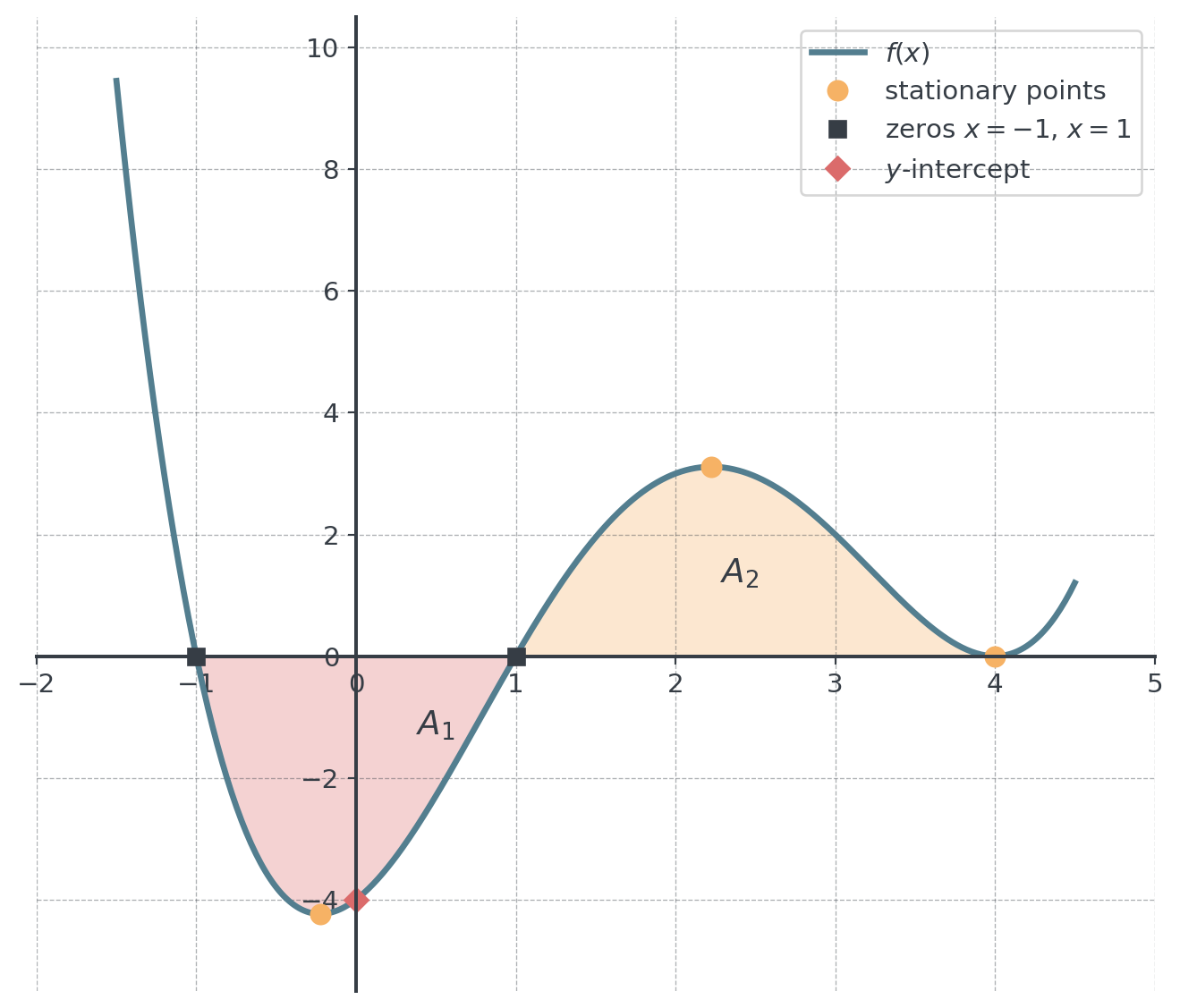
Values at the ends of the interval: \(f(-1.5) \approx 9.45\) and \(f(4.5) \approx 1.20\).
Shape: coming from \(f(-1.5) \approx 9.45\), \(G_f\) falls through the zero \(x = -1\) to the local minimum \((-0.22, -4.24)\). It rises through the \(y\)-intercept \((0, -4)\) and the zero \(x = 1\) to the local maximum \((2.22, 3.11)\), falls to the local minimum \((4, 0)\), touches the \(x\)-axis there, and rises again to \(f(4.5) \approx 1.20\).
The figure also shades the two regions from part d).
Grading: 1 Pt. values at the ends of the interval, 1 Pt. zeros with crossing at \(\pm 1\) and touching at \(4\), 1 Pt. stationary points, 1 Pt. shape of the curve (falls and rises between the extrema, smooth).
Part d)
The graph \(G_f\) and the \(x\)-axis enclose two regions. Show computationally that both regions have equal size. [5 pts.]
CautionSolution
Regions: the regions lie between neighbouring zeros. For \(x < -1\) and for \(x > 4\), \(G_f\) lies above the \(x\)-axis and does not return to it, and at \(x = 4\) it only touches the \(x\)-axis. So the two regions are
- region 1 on \([-1; 1]\), below the \(x\)-axis (\(f(0) = -4 < 0\)),
- region 2 on \([1; 4]\), above the \(x\)-axis (\(f(2) = \frac{1}{4} \cdot 3 \cdot 4 = 3 > 0\)).
Antiderivative (power rule, from the expanded form in part b)):
\[F(x) = 0.05x^5 - 0.5x^4 + 1.25x^3 + x^2 - 4x\]
with \(F(-1) = -0.05 - 0.5 - 1.25 + 1 + 4 = 3.2\), \(F(1) = 0.05 - 0.5 + 1.25 + 1 - 4 = -2.2\) and \(F(4) = 51.2 - 128 + 80 + 16 - 16 = 3.2\).
Region 1:
\[A_1 = \left|\int_{-1}^{1} f(x) \, dx\right| = |F(1) - F(-1)| = |-2.2 - 3.2| = |-5.4| = 5.4\]
Region 2:
\[A_2 = \int_{1}^{4} f(x) \, dx = F(4) - F(1) = 3.2 + 2.2 = 5.4\]
So \(A_1 = A_2 = 5.4\): both regions have equal size ✓.
Grading: 1 Pt. regions with the limits \(-1\), \(1\) and \(1\), \(4\), 1 Pt. antiderivative, 1 Pt. \(A_1 = |-5.4| = 5.4\), 1 Pt. \(A_2 = 5.4\), 1 Pt. conclusion.
Part e)
Give \(\int_{-1}^{4} f(x) \, dx\) without integrating again. A classmate says: “The integral is 0, so \(G_f\) and the \(x\)-axis enclose no area between \(x = -1\) and \(x = 4\).” Decide whether the classmate is right. [2 pts.]
CautionSolution
Splitting the interval at \(x = 1\):
\[\int_{-1}^{4} f(x) \, dx = \int_{-1}^{1} f(x) \, dx + \int_{1}^{4} f(x) \, dx = -5.4 + 5.4 = 0\]
The classmate is wrong. The integral is a signed area: region 1 counts negative, region 2 counts positive, and both cancel because they have equal size. The enclosed area is \(A_1 + A_2 = 5.4 + 5.4 = 10.8\).
Grading: 1 Pt. integral 0 with the splitting property, 1 Pt. decision with the area 10.8.