Session 03-01 - Function Concepts & Business Modeling
Section 03: Functions as Business Models
Welcome to Functions!
Introduction
- From equations to functions: A powerful generalization
- We’ve solved equations; now we’ll model relationships
- Functions as business tools
- Cost, revenue, and profit modeling
- Mathematical used to model real-world applications
- Essential for business decision-making
Entry Quiz
Quick Review from Section 02
Work individually, then we compare together
\[\begin{cases} 2x + 3y = 18 \\ x - y = 1 \end{cases}\]
A company’s costs increase exponentially according to \(C = 1000 \cdot 1.05^t\). After how many years will costs double?
Solve for \(x\): \(\log_2(x+3) + \log_2(x-1) = 3\)
Translate: “The profit equals revenue minus costs, where revenue is 50 euros per unit and costs include a fixed cost of 1000 euros plus 30 euros per unit.”
Homework Discussion
Solution from Tasks 02-03
15 minutes - presentation and discussion
- Present difficult problems
- Discuss your potential problems
- Share strategies for your solutions
Your open questions
Let’s discuss Mock Exam 03 and the past sections!
- Which problem from Mock Exam 03 did you find hardest?
- Is there something you are not feeling comfortable with?
- Is there any topic you would like to have repeated?
This is your chance to have something repeated!
Learning Objectives
Learning Objectives
By the end of this session, you can:
- Explain what makes a relation a function and apply the vertical line test
- Use function notation to evaluate cost, revenue, and profit functions
- Determine domain and range - both mathematical and business restrictions
- Translate between verbal, algebraic, numerical, and graphical representations
Introducing Functions
What is a Function?
A function is a rule that assigns to each input exactly one output
- Equation perspective: \(y = 2x + 5\) (a relationship)
- We’ve been solving these for specific values
- Function perspective: \(f(x) = 2x + 5\) (a machine)
- Input any \(x\), get exactly one output \(f(x)\)
- Business perspective: A model of cause and effect
- Input: production quantity → Output: total cost
Question: Does this make sense for you?
Function Notation
Symbolic language for modeling
\(f(x) = 2x^2 - 3x + 1\)
- \(f\) is the function name (like naming a business model)
- \(x\) is the input variable (independent variable)
- \(f(x)\) is the output value (dependent variable)
Read as: “f of x equals…”
To find \(f(3)\): \(f(3) = 2(3)^2 - 3(3) + 1 = 18 - 9 + 1 = 10\)
Multiple Function Names
Different functions model different business aspects
- Cost function: \(C(x)\) = total cost for \(x\) units
- Revenue function: \(R(x)\) = total revenue from \(x\) units
- Profit function: \(P(x) = R(x) - C(x)\)
- Demand function: \(D(p)\) = quantity demanded at price \(p\)
So far not too difficult, right?
Business Example
A bakery has:
- Fixed costs: 500 EUR per day
- Variable costs: 2 EUR per pastry
- Selling price: 5 EUR per pastry
Question: What is the cost, the revenue and the profit function?
Calculator: Defining f(x) and g(x)
Register a function for repeated use:
- Press MENU → 9 (Tabellen)
- Enter your function expression for \(f(x)\)
- You can also define a second function \(g(x)\)
- Press = to continue to table settings
Once defined in Tabellen mode, the function is stored for evaluation.
Calculator: Evaluating Functions
Once f(x) is defined in Tabellen mode:
The calculator generates a table showing function values:
- Set Start, Ende, and Inkre to define x-values
- The table displays both x and f(x) values
Example: \(f(x) = x^2 - 4x + 3\)
- Try to compute f(x) from x=0 to x=3 with step 1
- What can you see?
This helps verify zeros and critical points!
Quick Practice
Function Evaluation Practice
Work individually for 5 minutes, then we discuss
Given the functions:
- \(f(x) = 3x^2 - 2x + 1\)
- \(g(x) = \frac{x+4}{x-2}\)
Calculate:
- \(f(0)\), \(f(2)\), and \(f(-3)\)
- \(g(5)\) and \(g(0)\)
Break
Domain and Range
Understanding Domain
The domain is the set of all possible input values
- Mathematical restrictions:
- Cannot divide by zero
- Cannot take square root of negative (in real numbers)
- Logarithm requires positive argument
- Business restrictions:
- Cannot produce negative quantities
- Limited production capacity
- Budget constraints
Domain Examples
For \(f(x) = \frac{1}{x-3}\):
- Denominator cannot be zero
- \(x - 3 \neq 0\)
- \(x \neq 3\)
- Domain: \(\mathbb{R} \setminus \{3\}\) or \((-\infty; 3) \cup (3; \infty)\)
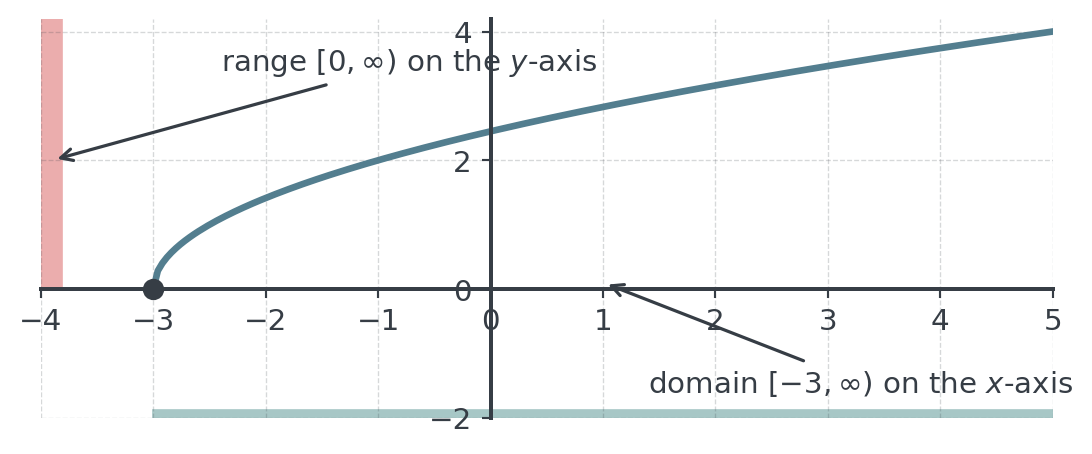
For \(g(x) = \sqrt{2x + 6}\):
- Argument must be non-negative
- \(2x + 6 \geq 0\)
- \(x \geq -3\)
- Domain: \([-3; \infty)\)
Production function \(P(x) = 100\sqrt{x}\) where \(x\) is hours of labor:
- Mathematical: \(x \geq 0\) (square root)
- Practical: \(0 \leq x \leq 24\) (hours per day)
- Domain: \([0; 24]\)
Understanding Range
The range is the set of all possible output values
- What values can the function actually produce?
- Often harder to find than domain
- Depends on the function’s behavior
- Critical for understanding business limitations
Range = Output!
Finding Range Examples
For \(f(x) = x^2 + 2\):
- When \(x = 0\): \(f(0) = 2\)
- Values grow larger as \(|x|\) increases
- Range: \([2; \infty)\)
- Note, we’ll learn to find exact minimum points soon!
For \(g(x) = \frac{1}{x}\) with domain \(x \neq 0\):
- Can be any value except 0
- Range: \(\mathbb{R} \setminus \{0\}\)
Monthly membership revenue \(R(x) = 50x\) where \(x\) is number of members:
- Minimum: \(R(0) = 0\) (no members)
- Increases linearly without bound
- Range: \([0; \infty)\)
- Practical limit depends on capacity
Seeing Domain and Range
For \(g(x) = \sqrt{2x + 6}\): domain = shadow on the \(x\)-axis, range = shadow on the \(y\)-axis.
Representations
Four Ways to Represent Functions
Each representation offers unique insights
- Verbal: “Base costs of 100 which increase by 3 for each additional unit”
- Algebraic: \(C(x) = 100 + 3x\)
- Numerical: Table of values
- Graphical: Visual representation
Question: How would you represent this function as table and as graph?
Example: Mobile Phone Plan
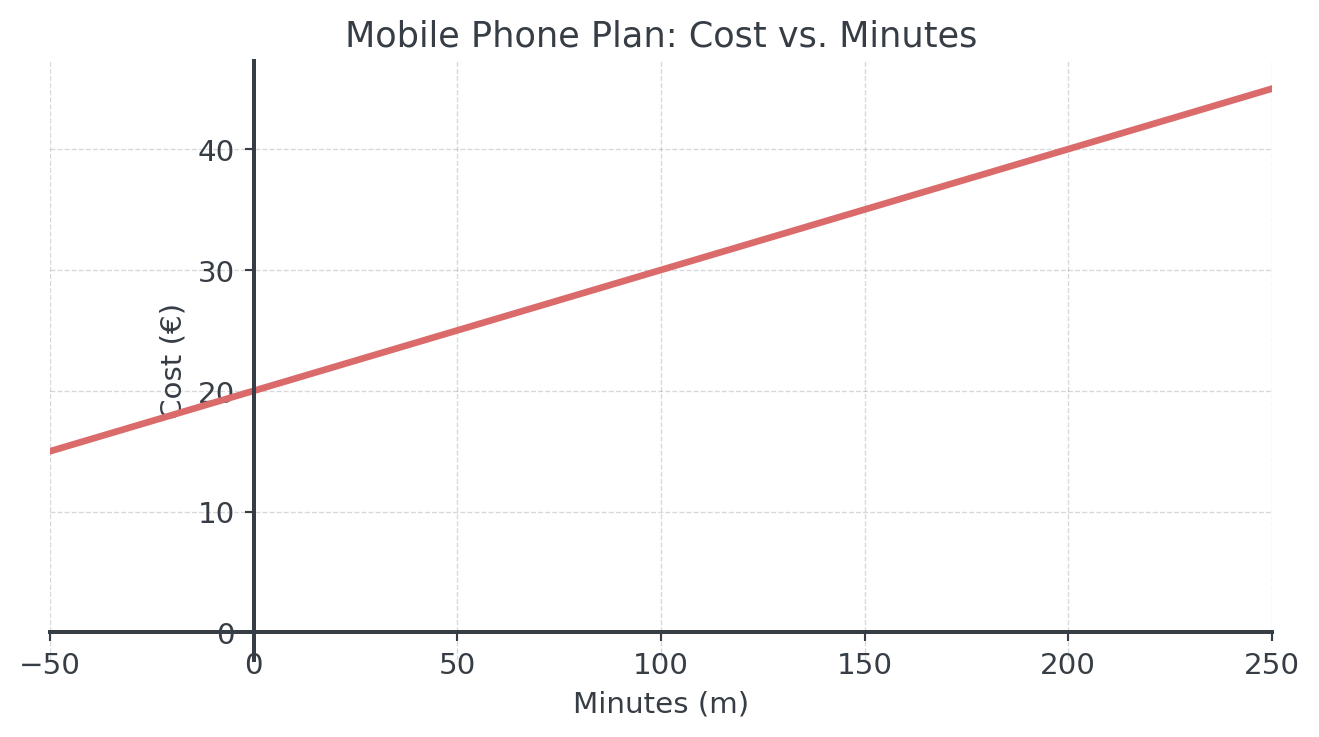
Scenario: Mobile plan costs 20 EUR base fee plus 0.10 EUR per minute.
Question: How would you represent this as a function, as a table and as a graph?
Graphical Representation
The Vertical Line Test
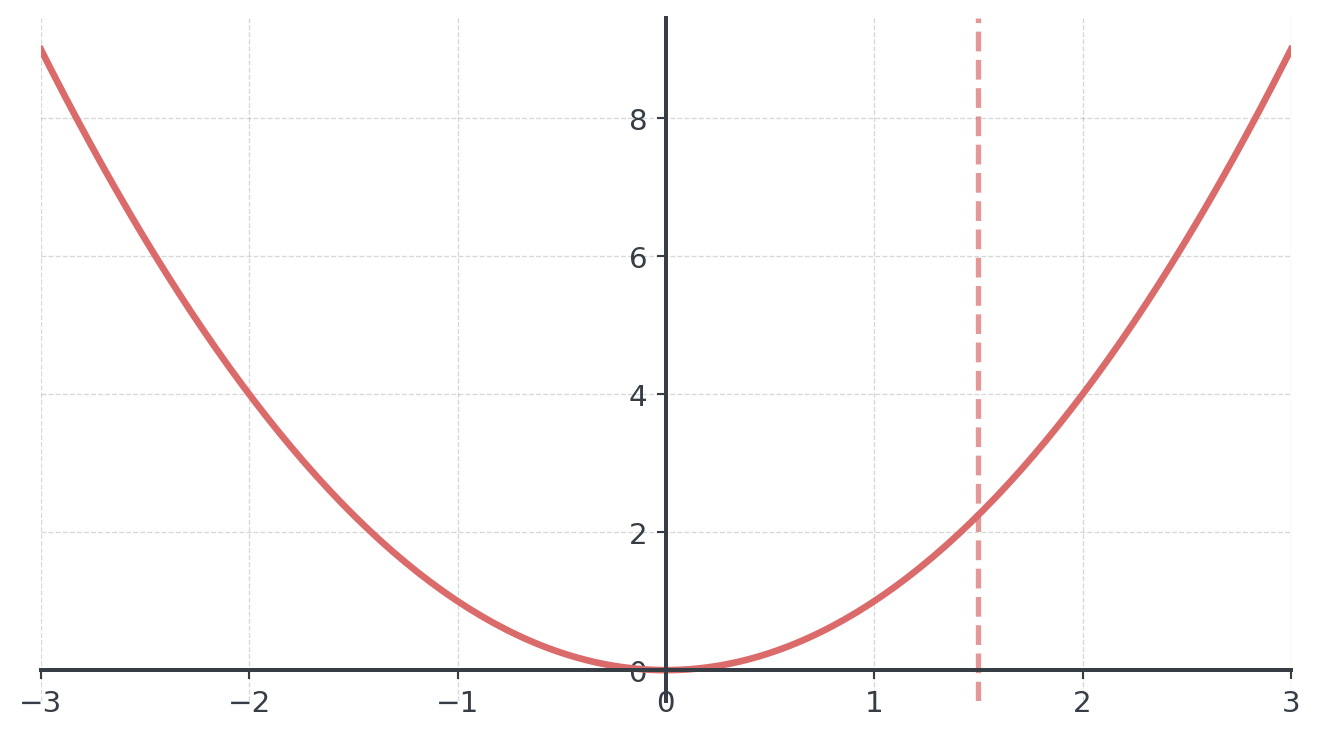
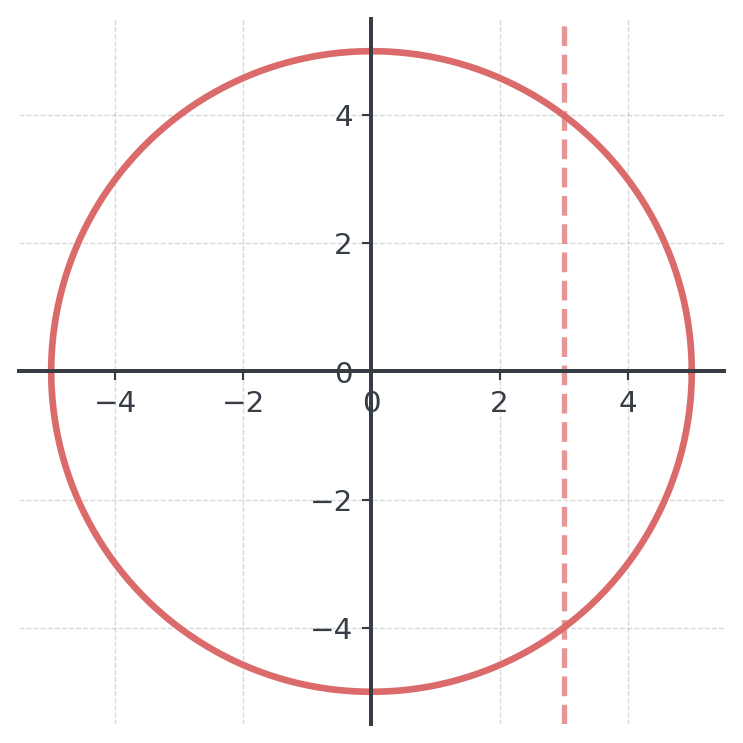
A graph only represents a function if every possible vertical line intersects it at most once
- Why? Each input must have exactly one output
- Pass: Linear, quadratic, exponential graphs
- Fail: Circles, sideways parabolas
- Business implication: No ambiguity in predictions
Is this a function?
What about this?
The Test at a Glance
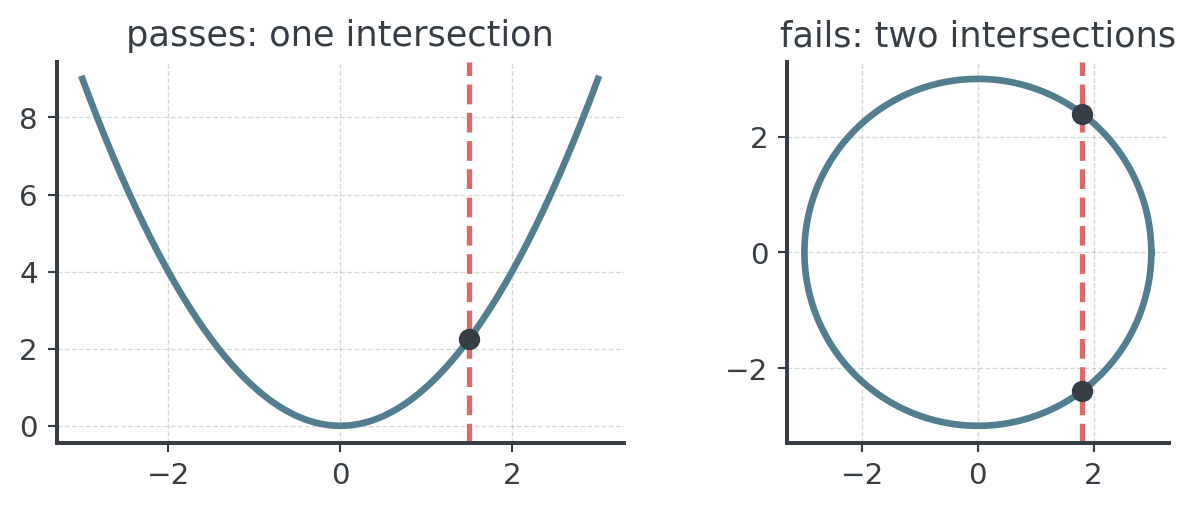
One vertical line, one intersection - that is the whole test.
Guided Practice
Individual Exercise Block
Work alone for 15 minutes
Find the domain of: \(f(x) = \frac{x+2}{x^2-4}\)
Cost function is \(C(x) = 1500 + 25x\) and revenue is \(R(x) = 40x\)
- Find the profit function \(P(x)\)
- What is the break-even point?
- What is a reasonable domain for this model?
Given the function \(g(x) = 2x + 8\):
- Find the domain and range
- Find where \(g(x) = 20\)
FSP-Style Practice
10 minutes - exam-style precision
Given \(f(x) = x^2 - 3x\) and the average-cost function \(\bar{C}(x) = \frac{2000 + 25x}{x}\):
Compute and simplify \(f(a + 2)\)
Compute and simplify \(f(2x) - 2f(x)\)
State the domain of \(\bar{C}(x)\) - mathematically and in the business context
Business Applications
Cost Functions in Detail
Understanding the structure of business costs
\[C(x) = \text{Fixed Costs} + \text{Variable Costs}\]
- Fixed Costs (FC): Rent, insurance, salaries
- Independent of production level
- Variable Costs (VC): Materials, hourly wages, utilities
- Proportional to production
- Total Cost: \(C(x) = FC + VC \cdot x\)
- Average Cost: \(AC(x) = \frac{C(x)}{x}\)
Revenue and Demand
The relationship between price and quantity
- Simple model: \(R(x) = p \cdot x\) (fixed price)
- Linear revenue function
- Reality: Price often depends on quantity sold
- Higher supply → lower price
- This creates more complex models
- Preview: In Session 03-03, we’ll explore quadratic models
- These allow us to find optimal quantities
- Essential for maximizing profit
Combining Functions
Example: Concert Tickets
- Fixed price: 40 EUR per ticket
- Fixed costs: 10,000 EUR, variable costs: 10 EUR per ticket
- Revenue: \(R(x) = 40x\) (linear function)
- Cost: \(C(x) = 10000 + 10x\) (linear function)
- Profit: \(P(x) = R(x) - C(x) = 40x - (10000 + 10x)\)
- Simplified: \(P(x) = 30x - 10000\) (also linear!)
- Break-even: When \(P(x) = 0\), so \(x = 333.33\) → need 334 tickets
Team Problem-Solving
Group Activity: Startup Analysis
The Scenario
A startup produces custom phone cases:
- Fixed monthly costs: 3,000 EUR (rent, equipment, insurance)
- Material cost per case: 8 EUR
- Labor cost per case: 7 EUR
- They plan to sell at a fixed price of 35 EUR per case
Your Tasks
Work in groups of if you like
- Develop the cost function \(C(x)\)
- Develop the revenue function \(R(x)\)
- Find the profit function \(P(x)\)
- Determine the break-even quantity (where \(P(x) = 0\))
- If they can produce maximum 500 cases per month, what’s their maximum possible profit?
Coffee Break
Practice Tasks
Identifying Functions (x)
Work individually and then we compare.
Determine whether each relation represents a function. If it is not a function, explain why using the vertical line test concept.
- \(y = 4x - 7\)
- \(x^2 + y^2 = 25\)
- \(y = |x - 2|\)
- \(x = y^2 + 1\)
Spot the Error
Each statement below contains one mistake - find it!
“The table \(\{(2, 5), (3, 7), (2, 9)\}\) is a function, because every pair has an output.”
“For \(f(x) = \frac{x+2}{x^2-4}\), I cancel \((x+2)\) first, so the domain is \(\mathbb{R} \setminus \{2\}\).”
“If \(f(x) = x^2\), then \(f(a + b) = f(a) + f(b) = a^2 + b^2\).”
Fitness Center Membership Model
A center has collected data on how membership varies with price.
| Monthly Fee (EUR) | Number of Members |
|---|---|
| 30 | 400 |
| 40 | 350 |
| 50 | 300 |
| 60 | 250 |
Fitness Center: Costs
The fitness center has:
- Fixed monthly costs: 15,000 EUR
- Variable costs: 5 EUR per member
Your Tasks
Work in groups for 20 minutes
- Show that this data represents a function with monthly fee as input and number of members as output
- Write the function \(N(p)\) where \(p\) is the monthly fee (assuming a linear relationship)
- Find a reasonable domain for this business context
- Write the profit function \(P(p)\) in terms of the monthly fee \(p\)
Wrap-Up & Takeaways
Key Takeaways
- Functions model relationships between variables
- Domain and range define boundaries of our models
- Business applications require multiple functions working together
- The same relationship can be represented in multiple ways
- Real-world constraints affect mathematical models
Why This Matters for the FSP
Functions are the backbone of the exam
- Problem 1 (Cost & Profit): builds directly on \(C(x)\), \(R(x)\), \(P(x)\) from today
- Problem 2 (Function Analysis): starts with domain, notation, and evaluation
- Every later topic - derivatives, integrals - operates on functions
- Precise notation and domain thinking earn points on every problem
Final Assessment
5 minutes - Individual work
A local gym has fixed costs of 5000 EUR per month and variable costs of 10 EUR per member. They charge 40 EUR per member per month.
- Write the cost function \(C(x)\) where \(x\) is the number of members
- Write the revenue function \(R(x)\)
- How many members are needed to break even?
Next Session Preview
03-02: Linear Functions & Economic Applications
- Deep dive into linear functions
- Supply and demand curves
- Market equilibrium
- Linear regression basics
- Cost-volume-profit analysis
Homework Assignment: Complete Tasks 03-01!