Session 01-03 - Core Algebra & Exponents
Section 01: Mathematical Foundations & Algebra
Entry Quiz
Quick Review from Last Session
Complete individually, then we review the results together
- Express in set-builder notation: All odd integers less than 20
- If \(A = \{1, 3, 5, 7\}\) and \(B = \{3, 4, 5, 6\}\), find \(A \cap B\) and \(A \cup B\)
- Is \(0.\overline{36}\) rational? If yes, express as a fraction.
- True or false: If \(p \Rightarrow q\) is true and \(q\) is false, what can we say about \(p\)?
Ok, let’s review together!
Homework Discussion
Homework Showcase
15 minutes for presentations and discussion
- Present and discuss your solutions from Tasks 01-02
- Share any challenging problems or interesting approaches
- This is your opportunity to ask questions and learn from each other
Remember: Explaining your solution helps solidify your understanding!
Learning Objectives
Learning Objectives
By the end of this session, you can:
- Apply the order of operations (PEMDAS) reliably
- Simplify expressions with the laws of exponents
- Convert and compute in scientific notation
- Solve absolute value equations and inequalities
- Factor out common factors and recognize special patterns
Algebraic Expressions
“Algebraic”?
An algebraic expression combines:
- Variables: letters representing unknown values (x, y, z, …)
- Constants: fixed numbers (2, π, -5, …)
- Operations: +, −, ×, ÷, and exponents
- Example: \(x^3 - 2x^2 + 7\)
Not algebraic: \(\sin(x)\), \(\log(x)\), \(e^x\)
These are transcendental functions - but no need to worry about this for now!
Order of Operations - PEMDAS
- Parentheses (brackets, braces)
- Exponents (powers, roots)
- Multiplication and Division (left to right)
- Addition and Subtraction (left to right)
Example: \(2 + 3 \times 4^2 - (5 - 3) \div 2\)
- Step 1 (Parentheses): \((5 - 3) = 2\)
- Step 2 (Exponents): \(4^2 = 16\)
- Steps 3-4: \(3 \times 16 = 48\), \(2 \div 2 = 1\), then \(2 + 48 - 1 = 49\)
Practice PEMDAS Together
Let’s evaluate step-by-step: \(\frac{3^2 + 2 \times (4 - 1)}{5 - 2}\)
- Numerator first:
- Parentheses: \((4 - 1) = 3\)
- Exponent: \(3^2 = 9\)
- Multiply: \(2 \times 3 = 6\)
- Add: \(9 + 6 = 15\)
- Denominator: \(5 - 2 = 3\)
- Final division: \(\frac{15}{3} = 5\)
Individual Exercise 01
Work individually for 5 minutes
Evaluate and then we’ll review together:
- \(4 + 2^3 \times 3 - 12 \div 4\)
- \((3 + 2)^2 - 3 \times (7 - 4)\)
- \(\frac{2^3 + 3 \times 2}{10 - 3}\)
- \(5 \times [2 + 3 \times (4 - 2)^2]\)
Break
Laws of Exponents
Why Exponents Matter
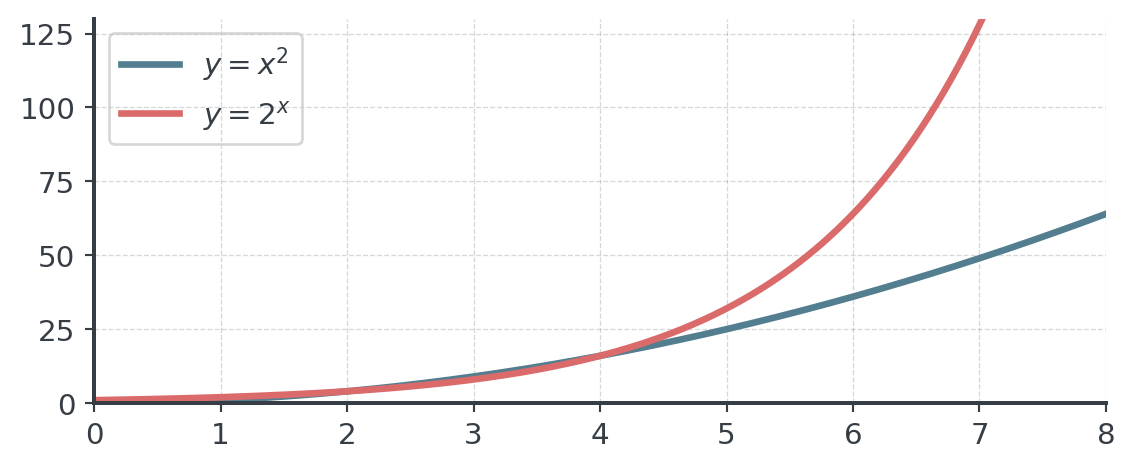
Doubling (\(2^x\)) overtakes squaring (\(x^2\)) for good at \(x = 4\) - the engine behind compound interest, which we revisit today.
The Fundamental Rules
These laws help us manage exponents!
| Rule | Formula | Example |
|---|---|---|
| Product Rule | \(a^m \cdot a^n = a^{m+n}\) | \(x^3 \cdot x^4 = x^7\) |
| Quotient Rule | \(\frac{a^m}{a^n} = a^{m-n}\) | \(\frac{x^5}{x^2} = x^3\) |
| Power Rule | \((a^m)^n = a^{mn}\) | \((x^3)^2 = x^6\) |
| Product Power | \((ab)^n = a^n b^n\) | \((2x)^3 = 8x^3\) |
| Quotient Power | \(\left(\frac{a}{b}\right)^n = \frac{a^n}{b^n}\) | \(\left(\frac{x}{3}\right)^2 = \frac{x^2}{9}\) |
Special Exponent Values
These are essential to memorize!
- \(a^0 = 1\) (for any \(a \neq 0\))
- \(a^1 = a\)
- \(a^{-n} = \frac{1}{a^n}\)
- \(a^{1/n} = \sqrt[n]{a}\)
- \(a^{m/n} = \sqrt[n]{a^m} = (\sqrt[n]{a})^m\)
WarningCommon Mistake
\((x + y)^2 \neq x^2 + y^2\), remember: \((x + y)^2 = x^2 + 2xy + y^2\)
More about this later!
Let’s Practice Together
Simplify: \(\frac{(3x^2y)^2 \cdot x^{-3}}{9xy^2}\)
- Expand the power: \(\frac{9x^4y^2 \cdot x^{-3}}{9xy^2}\)
- Combine exponents in numerator: \(\frac{9x^{4-3}y^2}{9xy^2}\)
- Simplify: \(\frac{9x^1y^2}{9xy^2}\)
- Finalize: \(\frac{1}{1} = 1\)
Your turn: Try \(\frac{(2a^3)^2 \cdot a^{-4}}{4a}\)
Pair Exercise 01
Work together in pairs for 5 minutes
Simplify completely:
- \((x^3)^2 \cdot x^{-4}\)
- \(\frac{12x^5y^3}{3x^2y}\)
- \(\left(\frac{2x^2}{y}\right)^3 \cdot \frac{y^2}{4x^3}\)
- \((3^2)^3 \cdot 3^{-5}\)
Scientific Notation
Why Scientific Notation?
Essential for extreme values!
Scientific notation: \(a \times 10^n\) where \(1 \leq |a| < 10\)
Real-world examples:
- World population: \(8,000,000,000 = 8.0 \times 10^9\) people
- Virus diameter: \(0.0000001 = 1 \times 10^{-7}\) meters
- US National debt: \(\text{\$}31,400,000,000,000 = 3.14 \times 10^{13}\) dollars
Scientific notation makes calculations with very large or very small numbers practical!
Converting to Scientific Notation
Convert 56,700,000
- Move decimal left to get one non-zero digit
- Count moves: 7 positions left
- Result: \(5.67 \times 10^7\)
Convert 0.00000423
- Move decimal right to get one non-zero digit
- Count moves: 6 positions right
- Result: \(4.23 \times 10^{-6}\)
- Moving decimal left → positive exponent
- Moving decimal right → negative exponent
Operations with Scientific Notation
Multiplication: \((3 \times 10^5) \times (2 \times 10^3)\)
- Multiply coefficients: \(3 \times 2 = 6\)
- Add exponents: \(10^5 \times 10^3 = 10^8\)
- Result: \(6 \times 10^8\)
Division: \(\frac{8.4 \times 10^7}{2.1 \times 10^4}\)
- Divide coefficients: \(8.4 \div 2.1 = 4\)
- Subtract exponents: \(10^7 \div 10^4 = 10^3\)
- Result: \(4 \times 10^3\)
Coffee Break
Absolute Value
Understanding Absolute Value
The absolute value \(|x|\) represents the distance from zero
Definition:
\[|x| = \begin{cases} x & \text{if } x \geq 0 \\ -x & \text{if } x < 0 \end{cases}\]
Examples:
- \(|5| = 5\), \(\quad|-3| = 3\), \(\quad|0| = 0\)
Think of absolute value as “removing the sign” or “distance without direction”
The Graph of \(|x|\)
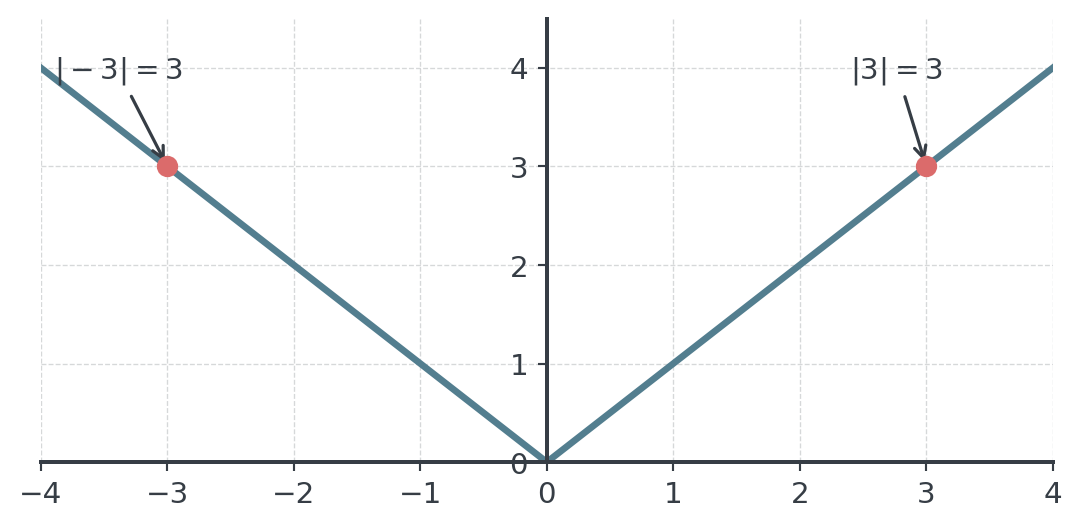
Both \(-3\) and \(3\) sit at the same height: they share the same distance from zero.
Properties of Absolute Value
These properties are fundamental for absolute values
- Non-negativity: \(|x| \geq 0\) for all \(x\) (never negative)
- Zero property: \(|x| = 0\) if and only if \(x = 0\)
- Multiplicative: \(|xy| = |x| \cdot |y|\)
- Quotient: \(\left|\frac{x}{y}\right| = \frac{|x|}{|y|}\) (when \(y \neq 0\))
- Squares: \(|x|^2 = x^2\)
TipGeometric Interpretation
\(|x|\) as the distance from \(x\) to \(0\) on the number line.
Solving Absolute Value Equations
Example: Solve \(|2x - 6| = 4\)
Two cases to consider:
- Case 1: \(2x - 6 = 4\)
- \(2x = 10\)
- \(x = 5\)
- Case 2: \(2x - 6 = -4\)
- \(2x = 2\)
- \(x = 1\)
- Solution: \(x \in \{1, 5\}\)
Working with Inequalities
Before we solve them, what are the rules?
An equation has solutions, an inequality has a solution set - usually a whole interval.
- Add or subtract anything on both sides: sign stays
- Multiply or divide by a positive number: sign stays
- Multiply or divide by a negative number: sign flips
\(-2x < 6\) becomes \(x > -3\), not \(x < -3\).
Multiplying by \(-1\) mirrors the number line: \(2 < 3\), but \(-2 > -3\).
Inequality Chains
A chain like \(-2 < x - 3 < 2\) is two inequalities at once
- Read it as: \(-2 < x - 3\) and \(x - 3 < 2\)
- Whatever you do, do it to all three parts
Quick practice: Solve \(-1 \leq 3 - 2x < 5\) and give the answer in interval notation.
Absolute Value Inequalities
\(|x| < a\) means \(-a < x < a\)
Example: \(|x - 3| < 2\)
- \(-2 < x - 3 < 2\)
- \(1 < x < 5\)
- Solution: \((1; 5)\)
\(|x| > a\) means \(x < -a\) OR \(x > a\)
Example: \(|x - 3| > 2\)
- \(x - 3 < -2\) OR \(x - 3 > 2\)
- \(x < 1\) OR \(x > 5\)
- Solution: \((-\infty; 1) \cup (5; \infty)\)
Quality Control: Bolts must be \(20 \pm 0.3\) mm
- Specification: \(|d - 20| \leq 0.3\)
- Acceptable range: \([19.7; 20.3]\) mm
Solution Sets on the Number Line
The two inequality types look very different:
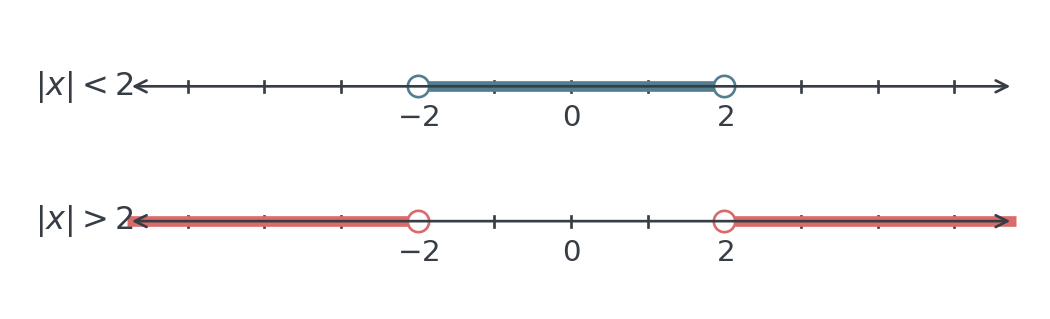
- \(|x| < 2\): one interval around zero, \((-2; 2)\)
- \(|x| > 2\): two rays pointing away from zero, \((-\infty; -2) \cup (2; \infty)\)
Basic Factorization
What Is Factoring For?
In product form you can see where an expression is zero
Factoring turns a sum into a product: \(12x^3 - 18x^2 + 6x = 6x(2x^2 - 3x + 1)\).
Zero-product rule: a product is zero exactly when one of its factors is zero.
\[A \cdot B = 0 \iff A = 0 \text{ or } B = 0\]
Example: \((x - 6)(x + 4) = 0 \iff x = 6\) or \(x = -4\)
Only with \(0\) on the other side: \(A \cdot B = 7\) does not mean \(A = 7\) or \(B = 7\).
What Does Zero Mean?
The zeros of a profit show where the profit starts and ends
Example: \(P = (x - 3)(11 - x)\) is a company’s profit, \(x\) the output in 100 units, \(P\) in 1,000 EUR. Only \(x > 0\) makes sense.
- At \(x = 3\) the loss turns into a profit: the break-even point. At \(x = 11\) the profit turns back into a loss: the profit limit.
- Same sign in both factors gives a positive product, different signs give a negative one
- One test value fixes the sign between two zeros: \(x = 7\) gives \(16 > 0\)
Profit is positive exactly on \((3; 11)\).
Quick Check: Zero-Product Rule
Work individually for 3 minutes
Solve \((x + 5)(x - 9) = 0\)
Where is \((x - 4)(6 - x)\) positive?
Common Factor Method
Always check for common factors first!
Example: Factor \(12x^3 - 18x^2 + 6x\)
- Find the GCF (Greatest Common Factor):
- Numbers: GCF of 12, 18, 6 is 6
- Variables: lowest power of x is \(x^1\)
- GCF = \(6x\)
- Factor out: \(6x(2x^2 - 3x + 1)\)
Difference of Squares
Pattern: \(a^2 - b^2 = (a + b)(a - b)\)
Examples:
- \(x^2 - 9 = x^2 - 3^2 = (x + 3)(x - 3)\)
- \(4x^2 - 25 = (2x)^2 - 5^2 = (2x + 5)(2x - 5)\)
- \(16x^2 - 49y^2 = (4x)^2 - (7y)^2 = (4x + 7y)(4x - 7y)\)
\(a^2 + b^2\) cannot be factored! This is because we need a difference (subtraction) between two perfect squares to use this factorization pattern. When we have a sum (addition) like \(x^2 + 9\), there’s no real number factorization.
Perfect Square Trinomials
Recognize these special patterns
| Pattern | Formula | How to Recognize |
|---|---|---|
| \((a + b)^2\) | \(a^2 + 2ab + b^2\) | Squares, middle = 2×(product of roots) |
| \((a - b)^2\) | \(a^2 - 2ab + b^2\) | Same, but middle term is negative |
Examples:
- \(x^2 + 6x + 9 = (x + 3)^2\)
- \(x^2 - 10x + 25 = (x - 5)^2\)
- \(4x^2 + 12x + 9 = (2x + 3)^2\)
Group Exercise 01
Work in groups for 8 minutes
Factor completely:
- \(3x^2 - 27\)
- \(x^2 - 8x + 16\)
- \(25x^2 - 9\)
- \(5x^3 - 20x\)
- \(x^2 + 14x + 49\)
Business Applications
Compound Interest Revisited
The power of exponential growth
Formula: \(A = P(1 + r)^t\)
- P = Principal (initial amount)
- r = Interest rate (as decimal), t = Time periods
- A = Final amount
Example: 5,000 EUR at 6% annual interest
- After 1 year: \(A = 5000(1.06)^1 = 5,300\text{ EUR}\)
- After 10 years: \(A = 5000(1.06)^{10} = 8,954.24\text{ EUR}\)
Scientific Notation in Business
Data Analysis Example: A tech company processes:
- Daily transactions: \(2.4 \times 10^8\)
- Average transaction value: \(3.5 \times 10^1\) euros
- Server cost per transaction: \(2 \times 10^{-4}\) euros
Calculate daily revenue and costs:
- Revenue = \((2.4 \times 10^8) \times (3.5 \times 10^1)\) = \(8.4 \times 10^9\) euros
- Costs = \((2.4 \times 10^8) \times (2 \times 10^{-4})\) = \(4.8 \times 10^4\) euros
- Profit = 8.4 billion EUR - 48,000 EUR ≈ 8.4 billion EUR
Practice Integration
Individual Exercise 02
Work individually for 5 minutes
- Simplify: \(\frac{(3x^2)^3 \cdot x^{-5}}{9x^2}\)
- Factor: \(4x^2 - 36\)
- Solve: \(|3x - 9| = 6\)
- Express in scientific notation: The distance from Earth to Moon is 384,400 km
- Evaluate: \(2 + 3 \times 2^3 - 16 \div 4\)
Pair Exercise 02
Work in pairs for 5 minutes
A manufacturing company has:
- Quality standard: Product weight must satisfy \(|w - 100| \leq 2\) grams
- Daily production: \(3.2 \times 10^3\) unit
- What is the acceptable weight range?
- Express monthly production in scientific notation (25 working days)
Wrap-up
Key Takeaways
- PEMDAS ensures consistent calculation order
- Exponent laws are the foundation for all algebra
- Scientific notation handles extreme values efficiently
- Absolute value measures distance and defines tolerances
- Basic factorization reveals structure in expressions
These are the foundation for all advanced mathematics!
Final Assessment
Quick Check
Work individually, then we discuss
- Simplify completely: \(\frac{(2x^3)^2 \cdot x^{-4}}{8x}\)
- A machine part passes quality control if its weight \(w\) (in grams) satisfies \(|w - 50| \leq 1.5\). State the acceptable weight range.
Next Session Preview
Coming Up
Advanced Factorization & Radicals
- Factoring trinomials \(ax^2 + bx + c\)
- Sum and difference of cubes
- Roots, radicals, and rationalizing denominators
- Complex algebraic manipulation
Complete Tasks 01-03!