Session 06-05 - Integration by Parts & Synthesis
Section 06: Integral Calculus
Entry Quiz
Quick Review from Session 06-04
Test your understanding of Area Between Curves & Surplus
Find the area between \(f(x) = x^2\) and \(g(x) = 2x\) from \(x = 0\) to \(x = 2\).
If demand is \(D(q) = 80 - 2q\) and supply is \(S(q) = 20 + q\), find equilibrium \((q^*, p^*)\).
Set up (but don’t evaluate) the consumer surplus integral for the market in problem 2.
Find \(\int (3x^2 - 4x + 5) \, dx\)
Homework Discussion
Your questions from Session 06-04
Focus on area between curves and economic surplus
- Finding intersection points
- Consumer and producer surplus calculations
- Minimum price effects on surplus
- Deadweight loss interpretation
Today we learn a powerful technique for integrating products of functions and synthesize our integration skills!
Learning Objectives
What You’ll Master Today
- Understand integration by parts as the reversed product rule
- Apply the LIATE rule to choose which function to differentiate
- Solve integrals of the form \(\int x \cdot e^x \, dx\)
- Handle repeated application for integrals like \(\int x^2 \cdot e^x \, dx\)
- Compute average value of a function over an interval
- Apply integration to revenue and cost accumulation
- Synthesize techniques from differential and integral calculus
Integration by parts is essential for the Feststellungsprüfung!
Product Rule Reversed
Motivation: Why Do We Need This?
Consider this integral:
\[\int x \cdot e^x \, dx\]
Question: Can we use the power rule?
No!
Some products of functions require a special technique.
The Product Rule Revisited
Recall the product rule for derivatives:
\[\frac{d}{dx}[u \cdot v] = u' \cdot v + u \cdot v'\]
Rearranging:
\[u \cdot v' = \frac{d}{dx}[u \cdot v] - u' \cdot v\]
Integrating both sides:
\[\int u \cdot v' \, dx = u \cdot v - \int u' \cdot v \, dx\]
The Integration by Parts Formula
\[\int \underbrace{u(x)}_{\text{choose}} \cdot \underbrace{v'(x) \, dx}_{= \, dv} = u(x) \cdot v(x) - \int \underbrace{v(x)}_{\text{from integrating } dv} \cdot \underbrace{u'(x) \, dx}_{= \, du}\]
This is the same as:
\[\int u \, dv = uv - \int v \, du\]
Strategy: Choose \(u\) and \(dv\) so that \(\int v \, du\) is easier than \(\int u \, dv\)!
What Do \(du\) and \(dv\) Mean?
You know this notation from every integral you’ve written!
- When you write \(\int x^2 \, dx\), the \(dx\) tells you what variable you integrate with respect to
- Now, \(du\) works the same way: it just says “with respect to \(u\)”
- The connection between them: if \(u\) is a function of \(x\), we can convert between \(du\) and \(dx\): \(du = u'(x) \, dx\)
- In words: \(du\) is the derivative of \(u\) with respect to \(x\), times \(dx\)
- The \(dx\) is needed for the remaining integral, don’t worry about it
Question: Do you get the basic idea?
The LIATE Rule
Choosing \(u\) - The LIATE Rule
How do we choose which function to call \(u\)?
| Letter | Function Type | Example |
|---|---|---|
| L | Logarithmic | \(\ln(x)\), \(\log(x)\) |
| I | Inverse trig | \(\arctan(x)\), \(\arcsin(x)\) |
| A | Algebraic | \(x\), \(x^2\), polynomials |
| T | Trigonometric | \(\sin(x)\), \(\cos(x)\) |
| E | Exponential | \(e^x\), \(2^x\) |
Choose \(u\) in this order of priority!
Why LIATE Works
The idea: Choose \(u\) to be the function that becomes simpler when differentiated.
- Logarithms (\(\ln x \to \frac{1}{x}\)): Derivatives are simpler
- Algebraic (\(x^n \to nx^{n-1}\)): Powers decrease
- Exponentials (\(e^x \to e^x\)): Don’t simplify - put in \(dv\)!
The LIATE rule is a guideline, not a strict rule. Sometimes you need to experiment!
Basic Examples
Example 1: \(\int x \cdot e^x \, dx\)
Step 1: Identify \(u\) and \(dv\) using LIATE: choose \(u = x\) (A before E)
Step 2: Set up the parts
| We choose: | We compute: |
|---|---|
| \(u = x\) | \(du = 1 \cdot dx = dx\) (differentiate \(u\), attach \(dx\)) |
| \(dv = e^x \, dx\) | \(v = \int e^x \, dx = e^x\) (integrate \(dv\) to get \(v\)) |
Step 3: Apply the formula \(\int u \, dv = uv - \int v \, du\)
\[\int \underbrace{x}_{u} \cdot \underbrace{e^x \, dx}_{dv} = \underbrace{x}_{u} \cdot \underbrace{e^x}_{v} - \int \underbrace{e^x}_{v} \, \underbrace{dx}_{du}\]
Example 1: Solution
\[\int x \cdot e^x \, dx = x \cdot e^x - \int e^x \, dx\]
\[= x \cdot e^x - e^x + C\]
\[= e^x(x - 1) + C\]
Verification: Differentiate to check: \[\frac{d}{dx}[e^x(x-1)] = e^x(x-1) + e^x \cdot 1 = e^x \cdot x - e^x + e^x = x \cdot e^x \quad \checkmark\]
Example 2: \(\int (x+1) \cdot e^x \, dx\)
This is a common exam problem!
Step 1: Choose \(u = x + 1\) (algebraic), \(dv = e^x \, dx\)
| We choose: | We compute: |
|---|---|
| \(u = x + 1\) | \(du = 1 \cdot dx = dx\) (differentiate \(u\), attach \(dx\)) |
| \(dv = e^x \, dx\) | \(v = \int e^x \, dx = e^x\) (integrate \(dv\) to get \(v\)) |
Step 2: Apply the formula
\[\int (x+1) \cdot e^x \, dx = (x+1) \cdot e^x - \int e^x \, dx\]
\[= (x+1) \cdot e^x - e^x + C = e^x(x + 1 - 1) + C = x \cdot e^x + C\]
Example 3: \(\int x \cdot \ln(x) \, dx\)
Step 1: Identify using LIATE: choose \(u = \ln(x)\) (L comes first!)
Step 2: Set up the parts
| We choose: | We compute: |
|---|---|
| \(u = \ln(x)\) | \(du = \frac{1}{x} \cdot dx\) (differentiate \(u\), attach \(dx\)) |
| \(dv = x \, dx\) | \(v = \int x \, dx = \frac{x^2}{2}\) (integrate \(dv\) to get \(v\)) |
Step 3: Apply the formula
\[\int x \cdot \ln(x) \, dx = \ln(x) \cdot \frac{x^2}{2} - \int \frac{x^2}{2} \cdot \frac{1}{x} \, dx\]
Example 3: Solution
\[\int x \cdot \ln(x) \, dx = \frac{x^2 \ln(x)}{2} - \int \frac{x}{2} \, dx\]
\[= \frac{x^2 \ln(x)}{2} - \frac{x^2}{4} + C\]
\[= \frac{x^2}{4}\left(2\ln(x) - 1\right) + C\]
Notice how choosing \(u = \ln(x)\) simplified the integral because \(\frac{1}{x} \cdot x^2 = x\) (simpler than before).
Break
Repeated by Parts
When One Application Isn’t Enough
Consider: \(\int x^2 \cdot e^x \, dx\)
First application: \(u = x^2\), \(dv = e^x \, dx\)
| We choose: | We compute: |
|---|---|
| \(u = x^2\) | \(du = 2x \cdot dx\) (differentiate \(u\), attach \(dx\)) |
| \(dv = e^x \, dx\) | \(v = \int e^x \, dx = e^x\) (integrate \(dv\) to get \(v\)) |
\[\int x^2 \cdot e^x \, dx = x^2 \cdot e^x - \int 2x \cdot e^x \, dx\]
Problem: We still have \(\int x \cdot e^x \, dx\) - another integration by parts problem!
Repeated Application
Second application: For \(\int x \cdot e^x \, dx\), let \(u = x\), \(dv = e^x \, dx\)
\[\int x \cdot e^x \, dx = x \cdot e^x - e^x\]
Substituting back:
\[\int x^2 \cdot e^x \, dx = x^2 \cdot e^x - 2(x \cdot e^x - e^x) + C\]
\[= x^2 \cdot e^x - 2x \cdot e^x + 2e^x + C= e^x(x^2 - 2x + 2) + C\]
Exam Example: \(\int x^2 \cdot e^{-x} \, dx\)
This exact type appeared on the exam!
First application: \(u = x^2\), \(dv = e^{-x} \, dx\), so \(v = -e^{-x}\)
\[\int x^2 \cdot e^{-x} \, dx = -x^2 \cdot e^{-x} - \int -2x \cdot e^{-x} \, dx\]
\[= -x^2 \cdot e^{-x} + 2\int x \cdot e^{-x} \, dx\]
Second application: \(u = x\), \(dv = e^{-x} \, dx\), so \(v = -e^{-x}\)
\[\int x \cdot e^{-x} \, dx = -x \cdot e^{-x} + \int e^{-x} \, dx = -x \cdot e^{-x} - e^{-x}\]
Exam Example: Final Answer
Substituting back:
\[\int x^2 \cdot e^{-x} \, dx = -x^2 \cdot e^{-x} + 2(-x \cdot e^{-x} - e^{-x}) + C\]
\[= -x^2 \cdot e^{-x} - 2x \cdot e^{-x} - 2e^{-x} + C\]
\[= -e^{-x}(x^2 + 2x + 2) + C\]
Verification is important! Differentiate your answer if you have the time: \[\frac{d}{dx}[-e^{-x}(x^2+2x+2)] = e^{-x}(x^2+2x+2-2x-2) = x^2 e^{-x}\]
Definite Integrals
Definite Integrals with Bounds
For definite integrals:
\[\int_a^b u \, dv = [uv]_a^b - \int_a^b v \, du\]
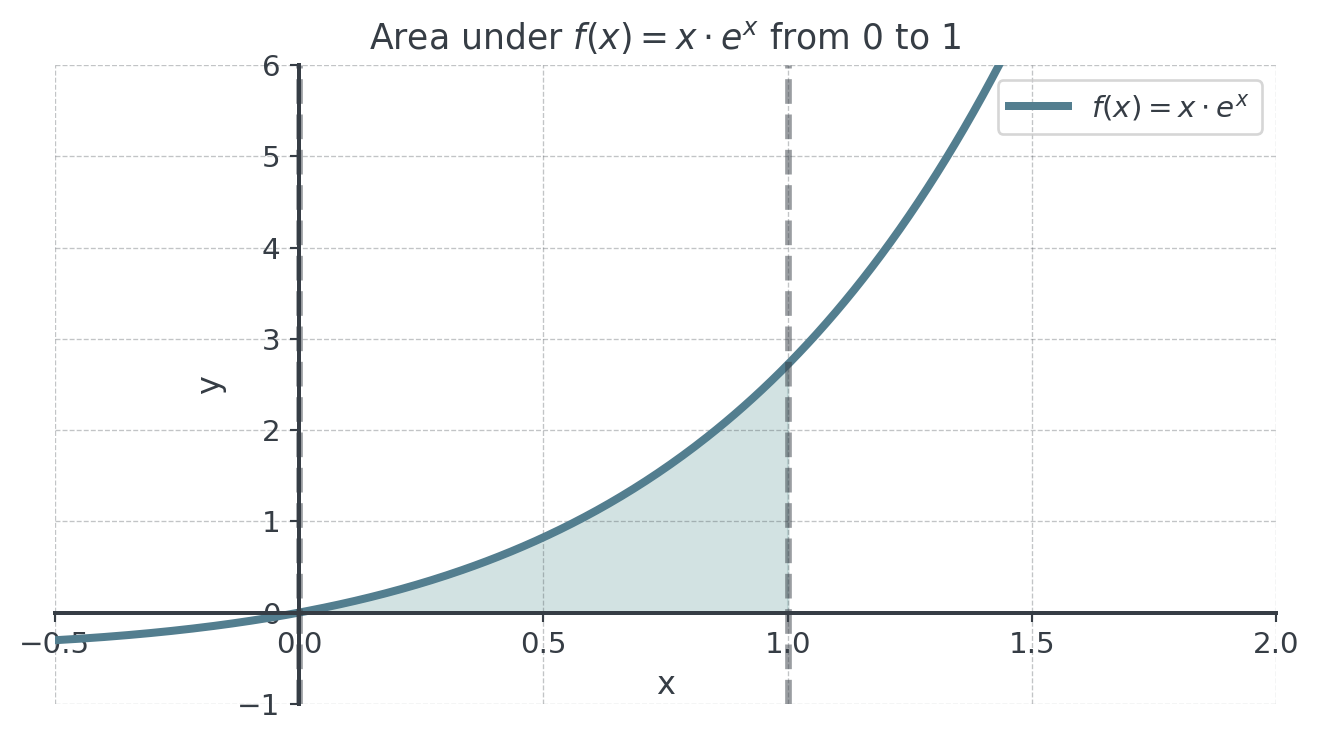
Example: \(\int_0^1 x \cdot e^x \, dx\), we found \(\int x \cdot e^x \, dx = e^x(x - 1) + C\)
\[\int_0^1 x \cdot e^x \, dx = [e^x(x-1)]_0^1 = e^1(1-1) - e^0(0-1)\]
\[= 0 - (-1) = 1\]
Definite Integral with Graph
Essentially, we use integration by parts and then compute the definite integral as learned.
Guided Practice
Practice Set A: Single Application
Work individually for 5 minutes
- \(\int 3x \cdot e^x \, dx\)
- \(\int (2x + 1) \cdot e^x \, dx\)
- \(\int x \cdot e^{-x} \, dx\)
- \(\int x^2 \cdot \ln(x) \, dx\)
Practice Set B: Double Application
Work individually for 7 minutes
- \(\int x^2 \cdot e^{2x} \, dx\)
- \(\int (x^2 + x) \cdot e^x \, dx\)
- \(\int_0^2 x \cdot e^x \, dx\) (evaluate with bounds)
Coffee Break
Average Value
The Average Value Formula
Key idea: What is the “average height” of a function over an interval?
\[f_{avg} = \frac{1}{b-a} \int_a^b f(x) \, dx\]
The Average Visualized
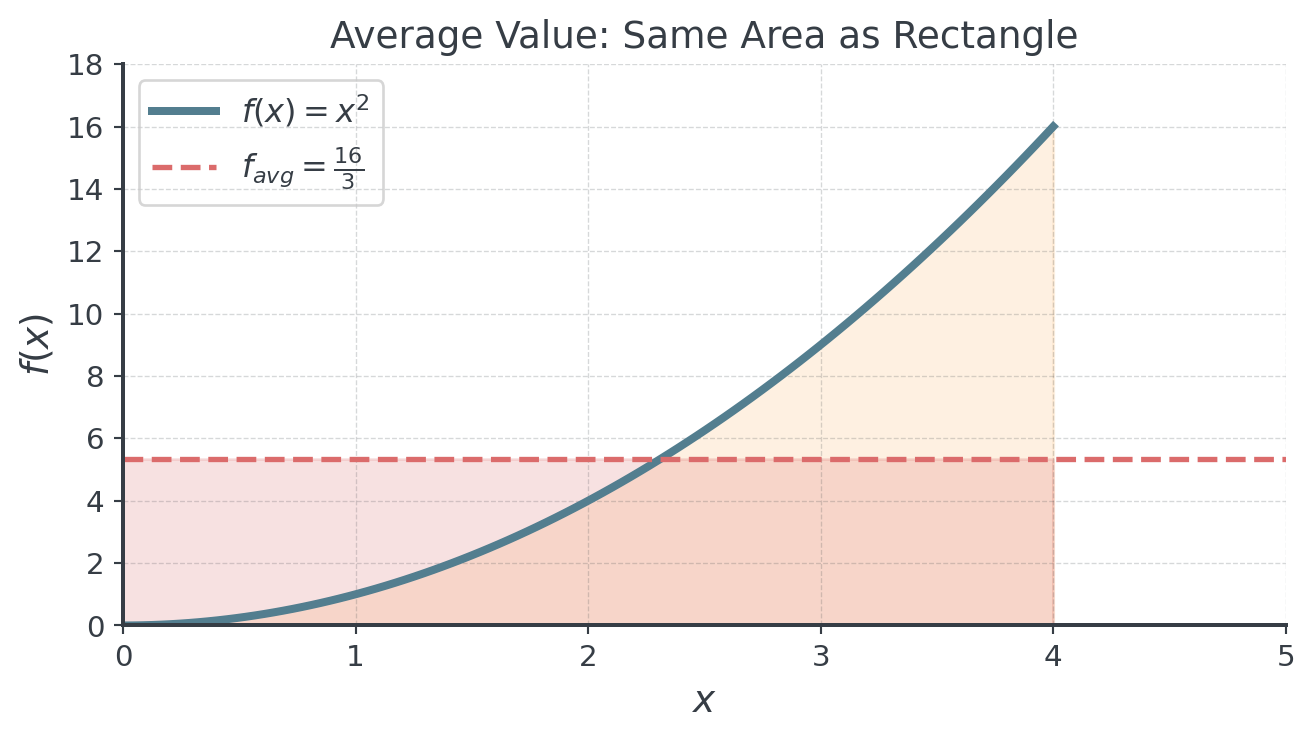
Makes sense, doesn’t it?
Example: Average Value
Find the average value of \(f(x) = x^2\) on \([0; 4]\)
\[f_{avg} = \frac{1}{4-0} \int_0^4 x^2 \, dx\]
\[= \frac{1}{4} \left[\frac{x^3}{3}\right]_0^4\]
\[= \frac{1}{4} \cdot \frac{64}{3} = \frac{16}{3} \approx 5.33\]
The area under \(f(x)\) equals the area of a rectangle with height \(f_{avg}\) and width \((b-a)\).
Proving an Antiderivative
Typical exam task: Daily sales \(f(t) = 40 + t \cdot e^{-0.5t}\) (units, \(t\) in weeks).
Prove that \(F(t) = 40t - 2t \cdot e^{-0.5t} - 4e^{-0.5t} + C\) is an antiderivative of \(f\).
Key idea: You do not need to integrate! Just show \(F'(t) = f(t)\).
- \(40t\) → power rule
- \(-2t \cdot e^{-0.5t}\) → product rule (and chain rule for \(e^{-0.5t}\))
- \(-4e^{-0.5t}\) → chain rule
Step by Step: \(F'(t)\)
Product rule on \(-2t \cdot e^{-0.5t}\): \(u = -2t\), \(v = e^{-0.5t}\), so \(u' = -2\), \(v' = -0.5e^{-0.5t}\)
\[(-2t \cdot e^{-0.5t})' = -2 \cdot e^{-0.5t} + (-2t)(-0.5e^{-0.5t}) = -2e^{-0.5t} + t \cdot e^{-0.5t}\]
Chain rule on \(-4e^{-0.5t}\): \((-4e^{-0.5t})' = -4 \cdot (-0.5)e^{-0.5t} = 2e^{-0.5t}\)
Collect:
\[F'(t) = 40 - 2e^{-0.5t} + t \cdot e^{-0.5t} + 2e^{-0.5t} = 40 + t \cdot e^{-0.5t} = f(t) \quad \checkmark\]
On the exam this “prove” step earns its points on its own, even if you never derive the integral yourself.
Then: Average Value with \(F\)
Average daily sales over the first 4 weeks:
\[f_{avg} = \frac{1}{4} \int_0^4 f(t) \, dt = \frac{1}{4}\left[F(4) - F(0)\right]\]
\[F(4) = 160 - 8e^{-2} - 4e^{-2} = 160 - 12e^{-2}, \quad F(0) = 0 - 0 - 4 = -4\]
\[f_{avg} = \frac{1}{4}\left(164 - 12e^{-2}\right) = 41 - 3e^{-2} \approx 40.59 \text{ units per day}\]
\(C\) cancels in \(F(4) - F(0)\), so you can set \(C = 0\) right away.
Practice: Prove and Average
Work individually for 5 minutes
Let \(f(t) = 20 + t \cdot e^{-t}\).
Prove that \(F(t) = 20t - (t + 1) \cdot e^{-t} + C\) is an antiderivative of \(f\).
Compute the average value of \(f\) on \([0; 2]\).
Accumulation
Revenue from Marginal Revenue
Key relationship: If \(MR(x)\) is the marginal revenue, then total revenue from selling \(a\) to \(b\) units is:
\[\text{Revenue}_{a \to b} = \int_a^b MR(x) \, dx\]
Example: \(MR(x) = 100 - 2x\), revenue from selling units 10 to 30:
\[\int_{10}^{30} (100 - 2x) \, dx = [100x - x^2]_{10}^{30}\]
\[= (3000 - 900) - (1000 - 100) = 2100 - 900 = 1200 \text{ EUR}\]
Profit Accumulation Over Time
Scenario: Profit rate \(P'(t) = 8t - t^2\) thousand EUR per month (\(t\))
Find total profit from month 2 to month 6.
\[P_{2 \to 6} = \int_2^6 (8t - t^2) \, dt = \left[4t^2 - \frac{t^3}{3}\right]_2^6\]
\[= \left(144 - 72\right) - \left(16 - \frac{8}{3}\right)\]
\[= 72 - \frac{40}{3} = \frac{216 - 40}{3} = \frac{176}{3} \approx 58.67 \text{ thousand EUR}\]
Team Problem-Solving
Practice Set C: Synthesis
Work with a partner for 10 minutes
Find the average value of \(f(x) = 2x + 1\) on \([0; 4]\)
A company’s marginal profit is \(P'(x) = 80 - 4x\) EUR/unit.
- Find the production level \(x^*\) that maximizes profit.
- Calculate the total profit from \(x = 5\) to \(x = 15\).
A machine’s production rate is \(P(t) = 100e^{-0.1t}\) units/hour. Find the average production rate over the first 10 hours.
Challenge: Accumulated Profit
Scenario: A company expects future profits that decay over time. The profit rate is the following, where \(t\) is years and profit is in thousands of euros.
\[P'(t) = (100 + 20t) \cdot e^{-0.05t}\]
Find the antiderivative of the profit rate using integration by parts
Calculate the total profit from year 0 to year 10
At what rate is profit changing at \(t = 5\)?
Interpret the results for a business decision
Wrap-Up & Takeaways
What We’ve Learned in Section 06
- Antiderivatives reverse differentiation: \(F'(x) = f(x)\)
- Definite integrals compute net accumulated change
- Area under curves using \(\int_a^b f(x) \, dx\)
- Area between curves using \(\int_a^b [f(x) - g(x)] \, dx\)
- Consumer Surplus: \(CS = \int_0^{q^*} [D(q) - p^*] \, dq\)
- Producer Surplus: \(PS = \int_0^{q^*} [p^* - S(q)] \, dq\)
- Integration by Parts: \(\int u \, dv = uv - \int v \, du\)
- Average Value: \(f_{avg} = \frac{1}{b-a} \int_a^b f(x) \, dx\)
Essential Formulas Summary
| Concept | Formula |
|---|---|
| Antiderivative | \(\int x^n \, dx = \frac{x^{n+1}}{n+1} + C\) |
| FTC | \(\int_a^b f(x) \, dx = F(b) - F(a)\) |
| Area Between | \(\int_a^b [f(x) - g(x)] \, dx\) |
| Consumer Surplus | \(\int_0^{q^*} [D(q) - p^*] \, dq\) |
| Producer Surplus | \(\int_0^{q^*} [p^* - S(q)] \, dq\) |
| Integration by Parts | \(\int u \, dv = uv - \int v \, du\) |
| Average Value | \(\frac{1}{b-a} \int_a^b f(x) \, dx\) |
Final Assessment
Quick Check
Work individually
Find \(\int (x + 2) \cdot e^x \, dx\)
Find the average value of \(f(x) = x^2\) on \([1; 3]\).
Why does LIATE put logarithms before algebraic functions?
What does consumer surplus measure economically?
Next Session Preview
Next Session: Mock Exam 07
Session 06-06 is exam only - no lecture
- 180 minutes working time plus 5 minutes reading time, 100 points
- Covers differential and integral calculus: graphical calculus, function analysis, areas, economic applications
- Allowed: non-programmable calculator, drawing instruments, monolingual dictionary
- Not allowed: notes, formula sheets, any electronic devices
- Counts toward the 60% of test points needed for exam admission
Preparing for Mock Exam 07
Complete Tasks 06-05, then prepare for Mock Exam 07 with FSP Training 06 (sidebar, Section 06 worksheets). Get a good night’s sleep and bring your calculator!