Session 02-01 - Systems of Linear Equations
Section 02: Equations & Problem-Solving Strategies
Entry Quiz
Entry Quiz from Session 01-06
Individual work, then class review
Translate and solve: “The cost of 5 items plus a 30 EUR delivery fee equals 180 EUR”
Break-even: A company has fixed costs of 4,000 EUR and variable costs of 15 EUR per unit. If they sell for 35 EUR per unit, find the break-even quantity.
Entry Quiz from Session 01-06 II
Mixture: How much 70% solution must be mixed with 20 liters of 30% solution to get a 45% solution?
Motion: Two cars start 450 km apart and drive toward each other. Car A travels 80 km/h, Car B travels 70 km/h. When do they meet?
Homework Discussion
Solution Showcase
15 minutes - presentations and discussion
- Discuss your most challenging problem from Tasks 01-06
- Share your problem-solving approach
- Show potential alternative methods
- Ask questions about problems you found difficult
Learning Objectives
Learning Objectives
By the end of this session, you can:
- Solve 2×2 systems by substitution and elimination
- Recognize the three geometric outcomes: one, none, or infinitely many solutions
- Extend systematic elimination to 3×3 systems
- Model business problems like equilibrium and production as linear systems
Key Concept
Systems of Equations
From Single to Multiple Unknowns
Previously, we mostly solved for one unknown:
\[ax + b = c\]
Now we tackle multiple unknowns simultaneously:
\[\begin{align} a_1x + b_1y &= c_1\\ a_2x + b_2y &= c_2 \end{align}\]
Question: When might a business problem require multiple unknowns?
Warm-up: Simple System
5 minutes - collaborative task
Solve this system using any method you know:
\[\begin{align} x + y &= 10\\ 2x - y &= 5 \end{align}\]
How did you proceed?
Break
Solving 2×2 Systems
The Substitution Method
When to Use Substitution
One variable is already isolated or one coefficient is 1 or -1
- Isolate one variable in one equation
- Substitute into the other equation
- Solve for the remaining variable
- Back-substitute to find the first variable
- Verify in both original equations
Example: Equilibrium
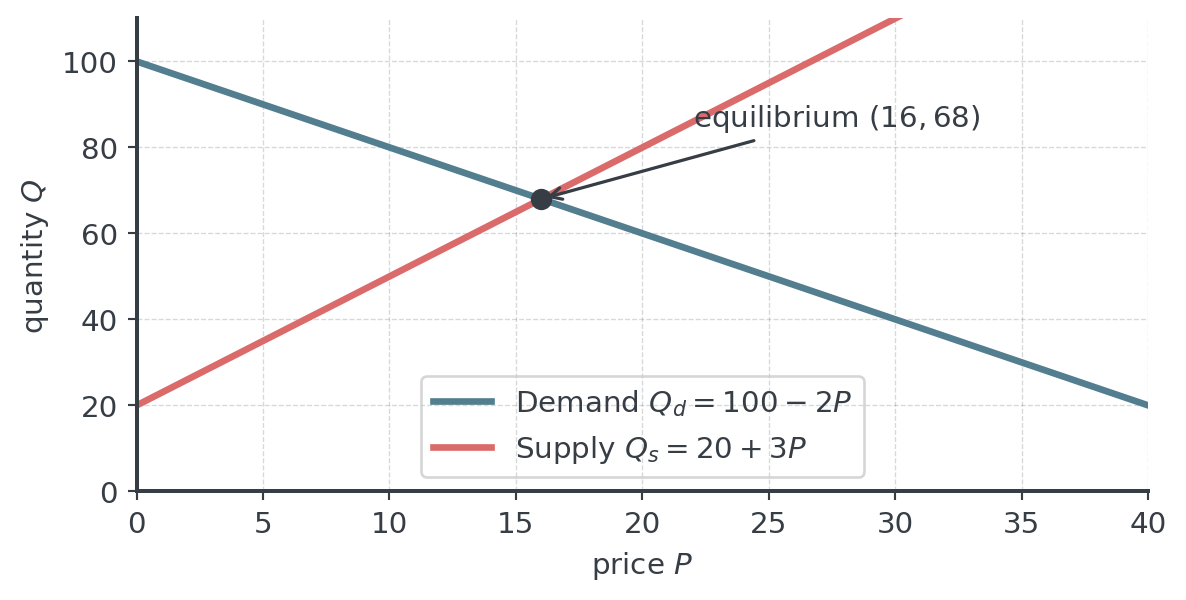
A market has demand \(Q_d = 100 - 2P\) and supply \(Q_s = 20 + 3P\).
Find the equilibrium price and quantity.
At equilibrium: \(Q_d = Q_s\)
\[\begin{align} Q &= 100 - 2P\\ Q &= 20 + 3P \end{align}\]
Since both equal Q:
- \(100 - 2P = 20 + 3P\)
- \(80 = 5P\)
- \(P = 16\)
- \(Q = 100 - 2(16) = 68\)
- Demand: \(Q_d = 100 - 2(16) = 68\) ✓
- Supply: \(Q_s = 20 + 3(16) = 68\) ✓
- Equilibrium: Price = 16 EUR, Quantity = 68 units
Equilibrium, Seen Graphically
Solving the system algebraically finds exactly this intersection point.
The Elimination Method
When to Use Elimination
Best when no variable is easily isolated or the system is symmetric.
- Align equations vertically
- Multiply to create opposite coefficients
- Add/Subtract to eliminate one variable
- Solve for remaining variable
- Back-substitute and verify
Example: Production Planning
A factory produces tables (T) and chairs (C). How many of each can be produced?
- Labor: 3T + 2C = 36 hours
- Materials: 2T + 2C = 28 units
\[\begin{align} 3T + 2C &= 36\\ 2T + 2C &= 28 \end{align}\]
Subtract equation 2 from equation 1:
- \((3T + 2C) - (2T + 2C) = 36 - 28\)
- \(T = 8\)
Substitute into equation 2:
- \(2(8) + 2C = 28\)
- \(2C = 12 \rightarrow C = 6\)
- Produce 8 tables
- Produce 6 chairs
- Uses all available resources
Graphical Interpretation
Three Possible Outcomes
No Solution
- Parallel lines
- Inconsistent system
- Same slope, different intercepts
Infinite Solutions
- Same line
- Dependent equations
- One equation is multiple of other
Unique Solution
- Lines intersect once
- Most common case
Question: Can anyone here sketch these versions?
One Solution: Intersecting Lines
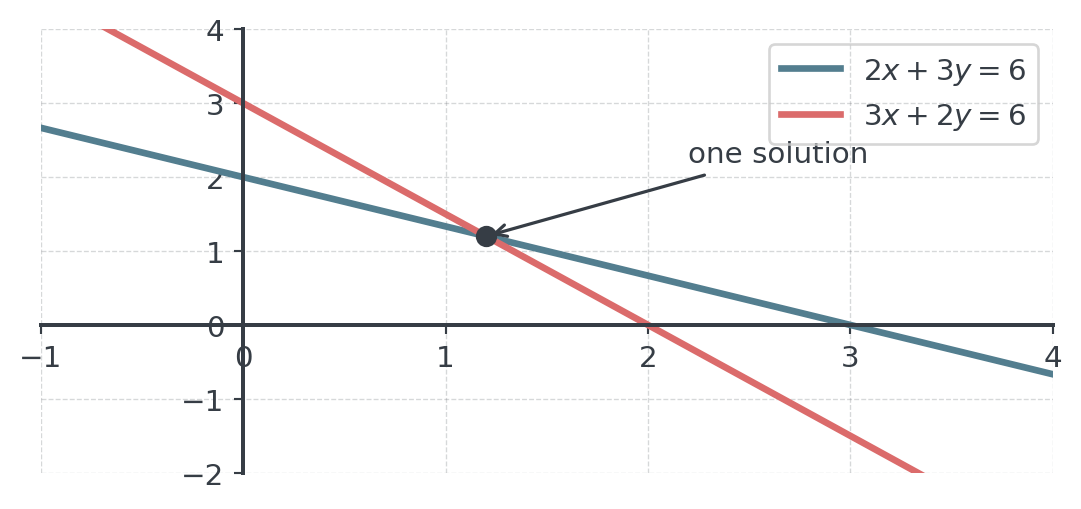
Different slopes → the lines cross exactly once.
No Solution: Parallel Lines
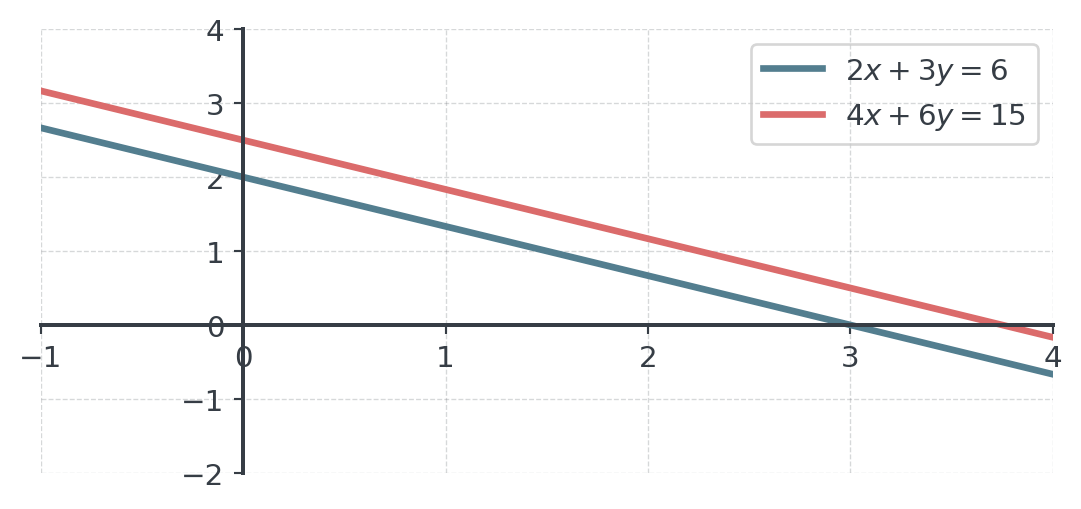
Same slope, different intercepts → the lines never meet: the system is inconsistent.
Infinitely Many: The Same Line
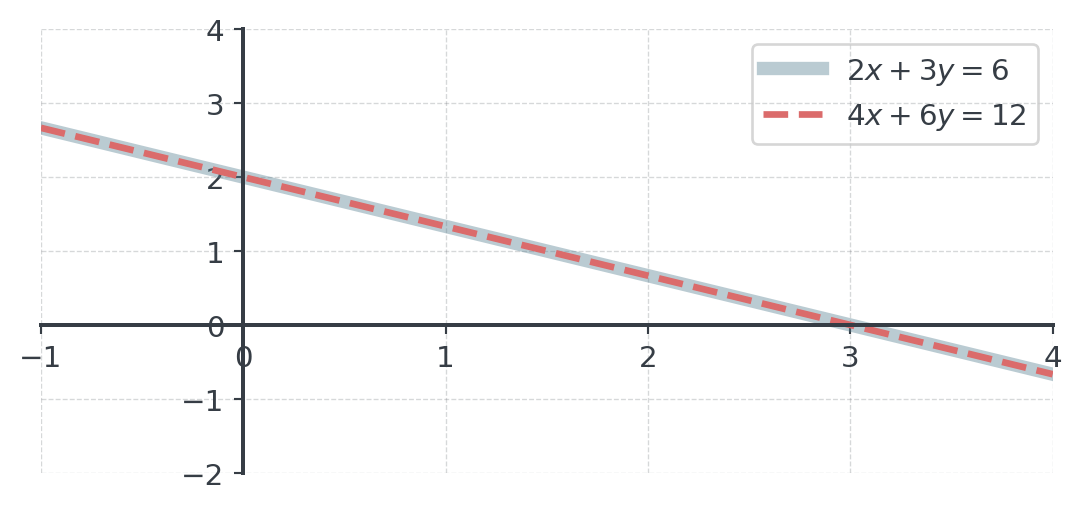
The second equation is just 2× the first → every point on the line solves both.
Spot the Pattern!
Work in groups to answer the following
Classify each system without solving:
\(\begin{cases} 2x + 3y = 6 \\ 4x + 6y = 12 \end{cases}\)
\(\begin{cases} 2x + 3y = 6 \\ 4x + 6y = 15 \end{cases}\)
\(\begin{cases} 2x + 3y = 6 \\ 3x + 2y = 6 \end{cases}\)
3×3 Systems
Three Variables, Three Equations
The Challenge
With three unknowns, we have three independent equations, which requires care! We need to try eliminate systematically:
- Use one equation to eliminate a variable from the others
- Solve resulting 2×2 system for the other two variables
- Back-substitute to find the eliminated variable from 1.
TipGaussian Elimination
For systems with three or more variables, we could also use Gaussian Elimination. It’s a systematic method using matrices and scales to any size. But as it is not required for the FSP, we decided to skip it here.
Example: Cost Function from Data
An e-scooter maker models its total costs by \(C(x) = ax^2 + bx + c\) (\(x\) in QU, \(C\) in MU). Producing 1 QU costs 164 MU, 2 QU cost 184 MU and 3 QU cost 210 MU.
Each data point gives one linear equation: insert its output for \(x\) and its costs for \(C(x)\).
\[\begin{aligned} \text{(I)} \quad a + b + c &= 164 \\ \text{(II)} \quad 4a + 2b + c &= 184 \\ \text{(III)} \quad 9a + 3b + c &= 210 \end{aligned}\]
Example: Cost Function (continued)
- Eliminate \(c\): \(\text{(II)} - \text{(I)}\) gives \(3a + b = 20\), and \(\text{(III)} - \text{(I)}\) gives \(8a + 2b = 46\), so \(4a + b = 23\)
- Subtract these two: \(a = 3\), then \(b = 20 - 9 = 11\) and \(c = 164 - 3 - 11 = 150\)
- Or let the calculator solve it: MENU → A → 1 → 3 Unbekannte (next slide)
- Check in (III): \(9 \cdot 3 + 3 \cdot 11 + 150 = 210\) ✓
\(C(x) = 3x^2 + 11x + 150\), with fixed costs \(C(0) = 150\) MU
Calculator: Systems of Equations
Solve the system:
\[\begin{cases} x - y + z = 2 \\ x + y - z = 0 \\ -x + y + z = 4 \end{cases}\]
Press MENU → A → 1 → 3 Unbekannte
Enter coefficients in matrix form!
Press = for solution: \(x=1, y=2, z=3\)
Calculator: 2×2 Market Equilibrium
From this session: Find equilibrium where supply equals demand
\[\begin{aligned} Q_d &= 100 - 2P \quad \text{(Demand)} \\ Q_s &= 20 + 3P \quad \text{(Supply)} \end{aligned}\]
Rewrite as system: \[\begin{cases} Q + 2P = 100 \\ Q - 3P = 20 \end{cases}\]
Calculator solution: \(P = 16\), \(Q = 68\)
Guided Practice
Practice Set: 2×2 Systems
15 minutes - Individual then group work
Problem 1 (xx): Find the unit costs
- 5 units of A and 3 units of B cost 410 EUR
- 2 units of A and 4 units of B cost 320 EUR
Problem 2 (xxx): Find new equilibrium
- Demand: Q = 120 - 2P
- Supply: Q = 3P - 30
- 5 EUR tax per unit on suppliers: they keep only \(P - 5\) of the price \(P\)
Practice: 3×3 System
10 minutes - FSP-style, work in pairs
Solve step by step with systematic elimination:
\[\begin{cases} x + y + z = 6 \\ 2x - y + z = 3 \\ x + 2y - z = 2 \end{cases}\]
Spot the Error
A student solved this system - find the mistake!
\[\begin{cases} 3x - 2y = 4 \\ 5x + 2y = 12 \end{cases}\]
Student’s work:
- Subtract the equations: \((3x - 2y) - (5x + 2y) = 4 - 12\)
- \(-2x - 4y = -8\)
- Divide by \(-2\): \(x + 2y = 4\)
- “That’s still two unknowns - the system cannot be solved!”
Coffee Break
Team Problem-Solving
Business Challenge
20 minutes - Work in groups
GlobalTrade operates in three regions with interconnected pricing:
Market conditions:
- Region A: Price affects demand in all regions
- Region B: Competes directly with Region C
- Region C: Premium market
Help Global Trade
The relationships
- \(P_A + 0.5P_B + 0.3P_C = 100\) (Combined market index)
- \(2P_A - P_B + P_C = 80\) (Competitive balance)
- \(P_A + P_B - 2P_C = -40\) (Premium differential)
- Find equilibrium prices
- Region B exits: drop the market index (1) and set \(P_B = 0\) in relations 2 and 3. How do the prices change?
Method Selection
Decision Framework
Use Substitution when:
- One equation solved for a variable
- Coefficients are 1 or -1
Use Elimination when:
- Similar-looking equations
- Integer coefficients and/or symmetric systems
Use Systematic Elimination and Substitution when:
- Clean integer coefficients
- Hand calculation
Use Gaussian Elimination when:
- Need a systematic approach (not necessary for FSP! :)
Quick Decision Practice
Think individually, then discuss
Which method would you choose?
\(\begin{cases} y = 3x - 5 \\ 2x + y = 10 \end{cases}\)
\(\begin{cases} 3x + 4y = 25 \\ 5x + 4y = 35 \end{cases}\)
\(\begin{cases} 2x + 3y - z = 7 \\ y + 2z = 5 \\ z = 3 \end{cases}\)
Training: 4×4 Systems
Four Unknowns: The Plan
Same idea as for 3×3 systems, one level deeper
- Pick the variable that is easiest to eliminate (coefficient \(1\) or \(-1\))
- Eliminate it from three pairs of equations: a 3×3 system is left
- Solve the 3×3 system as before, then back-substitute
- Check with the calculator: MENU → A → 1 → 4 Unbekannte
Look for shortcuts first: sometimes the sum of two equations removes two variables at once!
4×4 System
15 minutes, by hand, then check with the calculator
\[\begin{cases} 2x + y - z + 3w = 15 \\ x - 2y + 3z - w = 7 \\ 3x + 2y + z - 2w = 1 \\ -x + 3y + 2z + w = 2 \end{cases}\]
Wrap-Up & Takeaways
Key Takeaways
- Two methods for 2×2: Substitution vs. Elimination
- Three outcomes possible: Unique, none, or infinite solutions
- Business insights: Inconsistent constraints reveal planning issues
- Method selection matters: Choose based on equation structure
WarningWatch Out For These!
- Arithmetic errors in elimination - Check each step
- Forgetting to verify solutions - Always substitute back
- Missing special cases - Check for parallel/identical lines
- Rounding too early - Keep fractions until the end
Final Assessment
10 minutes - Individual work
A company produces products A and B:
- Combined production: 50 units
- Revenue: 30A + 40B = 1,700 EUR (prices 30 EUR and 40 EUR)
- Labor hours: 2A + 3B = 120
- Set up the system of equations
- Identify any redundant constraint (one that the others already imply)
Final Assessment II
- Solve for A and B
- Calculate total profit if costs are 20 EUR per unit for both
Next Session Preview
Session 02-02: Quadratic, Biquadratic & Cubic Equations
We’ll explore:
- The quadratic formula and discriminant
- Completing the square
- Biquadratic substitution techniques
- Cubic equations and factoring strategies
TipHomework Assignment
Complete Tasks 02-01! Also review factoring from Section 01 - we’ll apply it to quadratics next session.