Tasks 05-05 - Graphing Derivatives
Section 05: Differential Calculus
A: Skills
Problem 1: Sketching the Derivative from a Graph (x)
The figures show the graphs of two functions \(f\) and \(g\).
Note: Print the page or copy the figures onto squared paper. In the exam, you draw directly into the printed figure.
- Mark all points of the graph of \(f\) with a horizontal tangent line. Give the sign of \(f'(x)\) between them and graph the derivative \(f'(x)\) directly into the figure.
- Graph the derivative \(g'(x)\) directly into the figure. Mark the \(x\)-values at which \(g'\) has a local maximum or a local minimum and describe what happens to the graph of \(g\) there.
CautionSolution
Steps from the lecture: horizontal tangents of \(f\) are the zeros of \(f'\). Where \(f\) increases, \(f'\) is positive, where \(f\) decreases, \(f'\) is negative. Where \(f\) is steep, \(|f'|\) is large.
- Horizontal tangent lines at \(x = -1\) (local maximum, height about 2.75) and at \(x = 2\) (local minimum, height \(-4\)). So \(f'(-1) = f'(2) = 0\).
| \(x\) | \(x < -1\) | \(-1 < x < 2\) | \(x > 2\) |
|---|---|---|---|
| \(f\) | increasing | decreasing | increasing |
| \(f'(x)\) | \(+\) | \(-\) | \(+\) |
\(f\) falls most steeply at about \(x = 0.5\), where its curvature changes from concave down to concave up. There \(f'\) has its lowest value (about \(-3.4\)). At both ends of the figure, \(f\) is steep, so \(f'\) is large (about 6). The graph of \(f'\) is a parabola that opens upward with zeros at \(-1\) and \(2\):
- Horizontal tangent lines at \(x = -2\) (local minimum), \(x = 0\) (local maximum) and \(x = 3\) (local minimum). The signs of \(g'\) are \(-\), \(+\), \(-\), \(+\) from left to right, so \(g'\) has three zeros: \(-2\), \(0\) and \(3\).
\(g\) rises most steeply at about \(x = -1.1\) and falls most steeply at about \(x = 1.8\). There \(g'\) has a local maximum (about 2) and a local minimum (about \(-4.1\)). At these two \(x\)-values, the graph of \(g\) changes its curvature: from concave up to concave down at \(x \approx -1.1\) and back to concave up at \(x \approx 1.8\). These are the inflection points of \(g\).
Typical mistake: putting the zeros of \(f'\) at the zeros of \(f\). The zeros of \(f'\) belong to the horizontal tangent lines of \(f\). A second mistake is copying the shape of \(f\): the graph of \(f'\) shows the slope of \(f\), not its height.
Problem 2: Reading the Function from the Graph of \(f'\) (xx)
The figure shows the graph of the derivative \(f'\) of a function \(f\), not the graph of \(f\) itself.
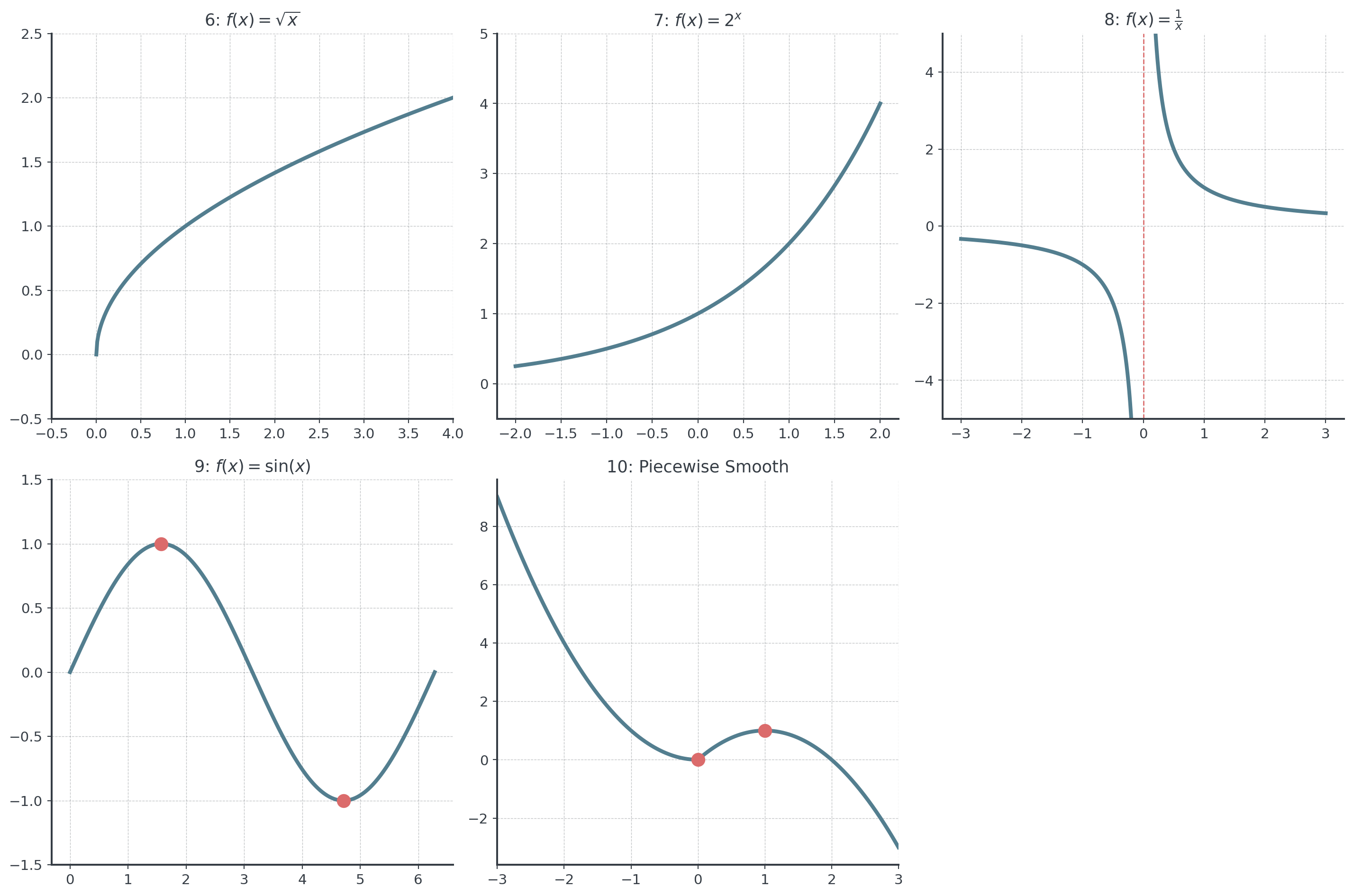
Give the intervals in the figure on which \(f\) is increasing and on which it is decreasing.
Determine the critical points of \(f\) and classify them with the sign of \(f'\).
Give the intervals on which \(f\) is concave up and on which it is concave down. Give the \(x\)-values of the inflection points of \(f\).
Give the \(x\)-value in the figure at which \(f\) increases fastest.
Sketch a possible graph of \(f\) with \(f(0) = 0\) in a new coordinate system.
CautionSolution
\(f'(x) < 0\) for \(-3 \le x < -2\): \(f\) is decreasing there. \(f'(x) > 0\) for \(-2 < x < 7\) and for \(7 < x \le 8.5\): \(f\) is increasing there. At \(x = 7\), \(f'\) only touches the \(x\)-axis and stays positive on both sides. So \(f\) keeps increasing: its graph only has a horizontal tangent line at \(x = 7\).
Critical points: \(f'(x) = 0\) at \(x = -2\) and \(x = 7\).
- \(x = -2\): \(f'\) changes its sign from \(-\) to \(+\), so \(f\) has a local minimum.
- \(x = 7\): \(f'\) is positive on both sides, there is no sign change. So \(f\) has no extremum there, but a saddle point (a stationary point without extremum).
- Concavity comes from the slope of \(f'\):
- \(f'\) increases for \(-3 \le x < 1\): \(f\) is concave up.
- \(f'\) decreases for \(1 < x < 7\): \(f\) is concave down.
- \(f'\) increases for \(7 < x \le 8.5\): \(f\) is concave up.
Inflection points of \(f\) at \(x = 1\) (local maximum of \(f'\)) and at \(x = 7\) (local minimum of \(f'\)). The saddle point at \(x = 7\) is a stationary point and an inflection point at the same time.
\(f\) increases fastest where \(f'\) has its largest value in the figure: at \(x = 1\), with slope \(f'(1) = 6\).
One possible graph (only the shape is fixed, the heights are an example):
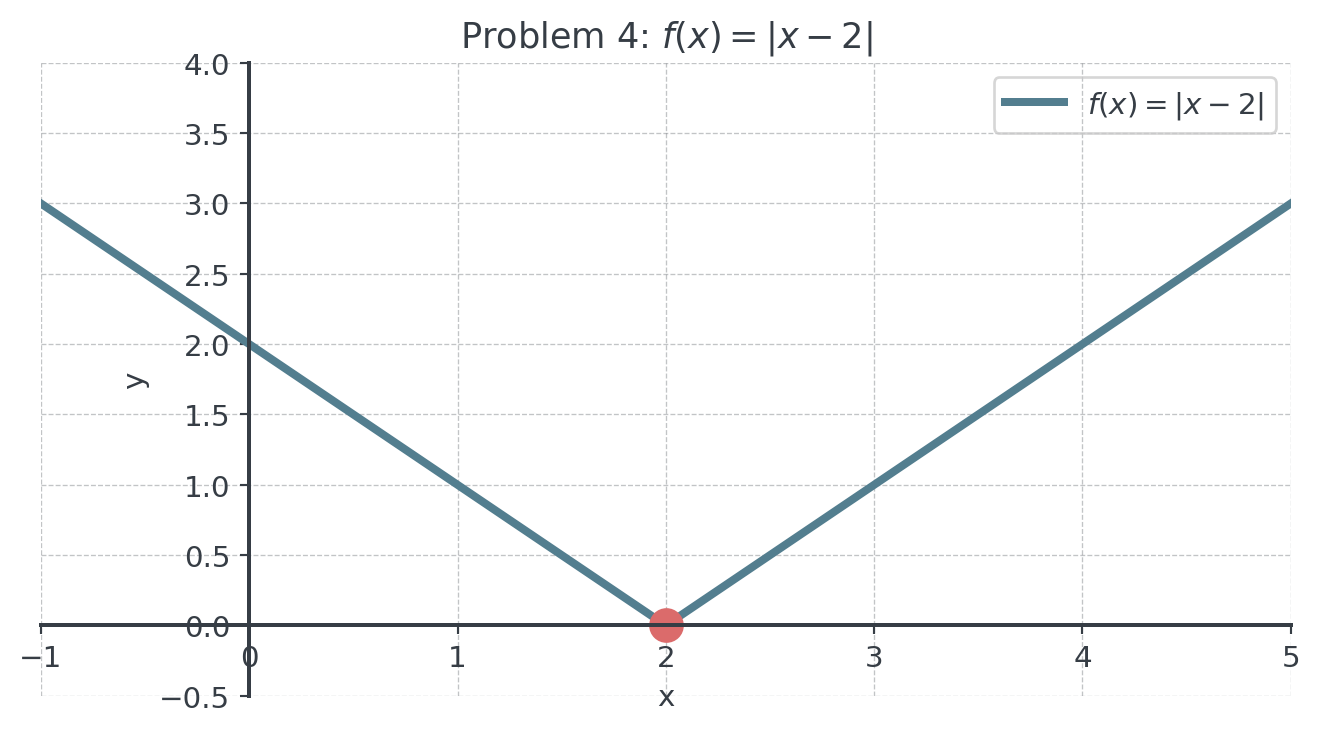
The graph falls to a minimum at \(x = -2\), rises most steeply at \(x = 1\), flattens to a horizontal tangent at \(x = 7\) without turning back, and then rises again.
Typical mistake: calling \(x = 7\) a maximum or a minimum because \(f'(7) = 0\). Without a sign change of \(f'\), there is no extremum.
Problem 3: Four Derivative Graphs (x)
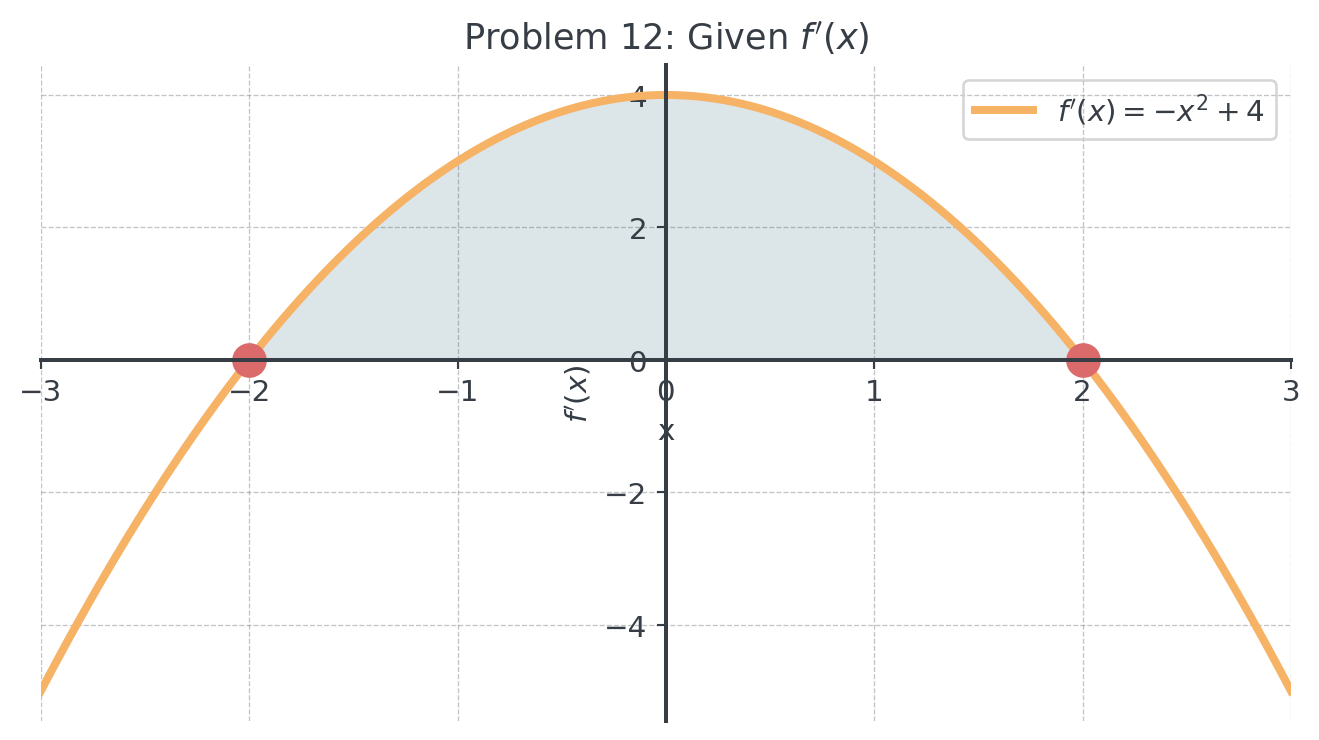
Each figure shows the graph of a derivative \(f'\). For each figure, give the intervals on which \(f\) is increasing, determine the local extrema of \(f\) with their type, and give the intervals on which \(f\) is concave up.
CautionSolution
(1) \(f'\) is negative for \(x < 2\) and positive for \(x > 2\). \(f\) is increasing for \(x > 2\) and has a local minimum at \(x = 2\) (sign change from \(-\) to \(+\)). \(f'\) increases everywhere, so \(f\) is concave up everywhere and has no inflection point.
(2) \(f'(x) \le 0\) everywhere, with \(f'(1) = 0\). \(f\) is increasing nowhere: it decreases everywhere and only has a horizontal tangent at \(x = 1\). No sign change, so no extremum, but a saddle point at \(x = 1\). \(f'\) increases for \(x < 1\) and decreases for \(x > 1\): \(f\) is concave up for \(x < 1\), concave down for \(x > 1\), and \(x = 1\) is an inflection point.
(3) \(f'(x) \ge 1 > 0\) everywhere: \(f\) is increasing everywhere and has no extremum. \(f'\) decreases for \(x < 2\) and increases for \(x > 2\): \(f\) is concave up for \(x > 2\) and concave down for \(x < 2\). At \(x = 2\), \(f\) has an inflection point, but no horizontal tangent (\(f'(2) = 1\)).
(4) \(f'\) is negative for \(x < -1\), positive for \(-1 < x < 4\) and negative for \(x > 4\). \(f\) is increasing on \((-1; 4)\), has a local minimum at \(x = -1\) (\(-\) to \(+\)) and a local maximum at \(x = 4\) (\(+\) to \(-\)). \(f'\) increases up to its highest point at \(x = 1.5\) and decreases after it: \(f\) is concave up for \(x < 1.5\), concave down for \(x > 1.5\), with an inflection point at \(x = 1.5\).
Typical mistake: in (3), “\(f'\) falls, so \(f\) falls”. A falling \(f'\) only means that \(f\) increases more and more slowly. \(f\) falls only where \(f'\) is negative.
Problem 4: Complete Analysis of a Polynomial (xx)
Let \(f(x) = 3x^4 + 4x^3 - 12x^2\). Round to two decimal places.
Determine \(f'(x)\) and \(f''(x)\). Factor \(f'(x)\) completely.
Determine all critical points of \(f\) and classify them with a sign table of \(f'\). Compute the function values at the critical points.
Determine the inflection points of \(f\) and check the sign change of \(f''\).
Give the intervals on which \(f\) is increasing, decreasing, concave up and concave down.
CautionSolution
- Power rule term by term:
\[f'(x) = 12x^3 + 12x^2 - 24x = 12x(x^2 + x - 2) = 12x(x + 2)(x - 1)\]
\[f''(x) = 36x^2 + 24x - 24 = 12(3x^2 + 2x - 2)\]
- \(f'(x) = 0\) (zero-product rule): \(x = -2\), \(x = 0\), \(x = 1\).
| \(x\) | \(x < -2\) | \(-2 < x < 0\) | \(0 < x < 1\) | \(x > 1\) |
|---|---|---|---|---|
| \(12x\) | \(-\) | \(-\) | \(+\) | \(+\) |
| \(x + 2\) | \(-\) | \(+\) | \(+\) | \(+\) |
| \(x - 1\) | \(-\) | \(-\) | \(-\) | \(+\) |
| \(f'(x)\) | \(-\) | \(+\) | \(-\) | \(+\) |
- \(x = -2\): \(-\) to \(+\), local minimum, \(f(-2) = 48 - 32 - 48 = -32\), point \((-2, -32)\)
- \(x = 0\): \(+\) to \(-\), local maximum, \(f(0) = 0\), point \((0, 0)\)
- \(x = 1\): \(-\) to \(+\), local minimum, \(f(1) = 3 + 4 - 12 = -5\), point \((1, -5)\)
- \(f''(x) = 0 \iff 3x^2 + 2x - 2 = 0\). Quadratic formula:
\[x = \frac{-2 \pm \sqrt{4 + 24}}{6} = \frac{-2 \pm \sqrt{28}}{6} = \frac{-1 \pm \sqrt{7}}{3}, \qquad x_1 \approx -1.22, \quad x_2 \approx 0.55\]
\(f''\) is a parabola that opens upward with these two zeros: \(f'' > 0\) outside and \(f'' < 0\) between them. So \(f''\) changes its sign at both zeros (e.g. \(f''(-2) = 72 > 0\), \(f''(0) = -24 < 0\), \(f''(1) = 36 > 0\)). Two inflection points:
\[(-1.22, -18.36) \qquad \text{and} \qquad (0.55, -2.68)\]
- From the sign tables of \(f'\) and \(f''\):
- increasing on \((-2; 0)\) and \((1; \infty)\), decreasing on \((-\infty; -2)\) and \((0; 1)\)
- concave up on \((-\infty; -1.22)\) and \((0.55; \infty)\), concave down on \((-1.22; 0.55)\)
Typical mistake: classifying \(x = 0\) by the factor \(12x\) alone. Only the sign of the whole product \(f'(x)\) counts, so every factor needs its own row in the table.
Problem 5: True or False? (x)
Argue whether the following statements are true or false. Give a reason or a counterexample.
If \(f''(2) = 0\), then \(f\) has an inflection point at \(x = 2\).
If \(f\) is concave down on an interval, then \(f\) is decreasing there.
If \(f'\) has a local maximum at \(x = 1\), then \(f\) has an inflection point at \(x = 1\).
If \(f'(x) > 0\) for all \(x\), then \(f\) has no local extremum.
If \(f'(3) = 0\) and \(f'\) changes its sign from negative to positive at \(x = 3\), then \(f\) has a local maximum at \(x = 3\).
CautionSolution
False. Counterexample: \(f(x) = (x - 2)^4\). With the chain rule, \(f''(x) = 12(x - 2)^2\), so \(f''(2) = 0\). But \(f''(x) > 0\) on both sides of \(x = 2\): there is no sign change, \(f\) stays concave up. \(f''(2) = 0\) only gives a candidate.
False. Counterexample: \(f(x) = -x^2\) for \(x < 0\). \(f''(x) = -2 < 0\), so \(f\) is concave down, but \(f'(x) = -2x > 0\) for \(x < 0\), so \(f\) is increasing there. Concave down only means that \(f'\) decreases (e.g. sales that grow more and more slowly).
True. \(f'\) increases before \(x = 1\) and decreases after it. So \(f\) is concave up before \(x = 1\) and concave down after it: the curvature changes, and \(x = 1\) is an inflection point.
True. \(f'\) has no zero and no sign change, so \(f\) has no critical point. \(f\) increases everywhere, so no point of the graph is higher or lower than all points near it.
False. \(f\) decreases before \(x = 3\) and increases after it: that is a local minimum.
B: Set Up & Check
Problem 6: From Words to Derivatives (xx)
Translate each statement into conditions on the function and its derivatives. Then answer the check question: it tells you whether your translation works.
“The weekly sales of a new video game grow, but more and more slowly.” \(S(t)\) is the number of games sold per week, \(t\) weeks after the release. Write the statement as two conditions on \(S'\) and \(S''\).
Check: Which of the two models \(S_1(t) = 2t^2 + 10t\) and \(S_2(t) = 40\sqrt{t}\) (for \(t > 0\)) fits the statement?
“The monthly sales of a new air fryer grow fastest 4 months after the launch.” \(S(t)\) is the number of air fryers sold per month, \(t\) months after the launch. Write the condition for “fastest growth” and name the point of the graph of \(S\) at \(t = 4\).
Check: Does your condition give \(t = 4\) for \(S(t) = -0.1t^3 + 1.2t^2 + 6t\)? Is \(S'(4)\) larger than \(S'(3)\) and \(S'(5)\)?
“The monthly profit of a hotel grew until a competitor opened 3 months from now. Then it fell. 7 months from now, the profit stops falling.” \(P(t)\) is the monthly profit, \(t\) months from now. Write the conditions on \(P'\) at and around \(t = 7\) and name the point of the graph of \(P\).
Check: The hotel’s controller uses \(P(t) = t^3 - 15t^2 + 63t + 20\) (thousand EUR). \(P'\) is zero at \(t = 3\) and at \(t = 7\). At which of the two does the profit stop falling, and what happens at the other one?
“The graph of \(f'\) crosses the \(x\)-axis from below at \(x = 4\).” Write this as conditions on \(f'\) and explain what it means for the graph of \(f\).
Check: For \(f(x) = x^2 - 8x + 20\), the derivative is \(f'(x) = 2x - 8\). Does its graph cross the \(x\)-axis from below at \(x = 4\)? Compare \(f(3)\), \(f(4)\) and \(f(5)\).
CautionSolution
“Grow” is about the sign of \(S'\), “more and more slowly” is about the change of \(S'\), i.e. the sign of \(S''\):
\[S'(t) > 0 \qquad \text{and} \qquad S''(t) < 0\]
The graph of \(S\) rises and is concave down.
Check: \(S_1'(t) = 4t + 10 > 0\), but \(S_1''(t) = 4 > 0\): \(S_1\) grows faster and faster, so it does not fit. \(S_2(t) = 40t^{1/2}\) gives \(S_2'(t) = 20t^{-1/2} = \frac{20}{\sqrt{t}} > 0\) and \(S_2''(t) = -10t^{-3/2} < 0\) ✓. \(S_2\) fits.
Typical mistake: \(S'(t) < 0\) for “more and more slowly”. That would mean the sales fall. The sales still grow, only their growth rate \(S'\) gets smaller.
The growth is the rate \(S'(t)\). “Fastest growth” means that \(S'\) has a maximum at \(t = 4\). So \(S''\) changes its sign from \(+\) to \(-\) there:
\[S''(4) = 0, \qquad S''(t) > 0 \text{ just before } t = 4, \qquad S''(t) < 0 \text{ just after } t = 4\]
At \(t = 4\), the graph of \(S\) has an inflection point (from concave up to concave down).
Check: \(S'(t) = -0.3t^2 + 2.4t + 6\) and \(S''(t) = -0.6t + 2.4 = 0 \iff t = 4\) ✓. \(S'(3) = 10.5\), \(S'(4) = 10.8\), \(S'(5) = 10.5\): the growth rate is largest at \(t = 4\) ✓.
Typical mistake: \(S'(4) = 0\). That is the moment when the sales stop growing (a possible maximum of \(S\)), not the moment of the fastest growth.
“Stops falling” means that \(P\) falls before \(t = 7\) and no longer falls after it:
\[P'(7) = 0, \qquad P'(t) < 0 \text{ just before } t = 7, \qquad P'(t) > 0 \text{ just after } t = 7\]
The sign change from \(-\) to \(+\) makes \((7, P(7))\) a local minimum of \(P\).
Check: \(P'(t) = 3t^2 - 30t + 63 = 3(t - 3)(t - 7)\). \(P'(6) = -9 < 0\) and \(P'(8) = 15 > 0\): at \(t = 7\), the profit stops falling ✓. At \(t = 3\), \(P'(2) = 15 > 0\) and \(P'(4) = -9 < 0\): there the profit stops growing (local maximum), when the competitor opens.
Typical mistake: \(P(7) = 0\). That would mean the profit is zero in month 7. “Stops falling” is a statement about the rate \(P'\), not about the value of \(P\).
“Crosses from below” means that \(f'\) is negative on the left, zero at 4 and positive on the right:
\[f'(4) = 0, \qquad f'(x) < 0 \text{ just left of } 4, \qquad f'(x) > 0 \text{ just right of } 4\]
So \(f\) decreases before \(x = 4\) and increases after it: \(f\) has a local minimum at \(x = 4\).
Check: \(f'(x) = 2x - 8\) is a rising line with \(f'(4) = 0\), \(f'(3) = -2 < 0\) and \(f'(5) = 2 > 0\) ✓. \(f(3) = 5\), \(f(4) = 4\), \(f(5) = 5\): the value at \(x = 4\) is the smallest ✓.
Typical mistake: “The graph of \(f'\) goes up, so \(f\) has a maximum.” The direction of \(f'\) at its zero decides: from below (\(-\) to \(+\)) gives a minimum of \(f\), from above (\(+\) to \(-\)) a maximum.
Problem 7: One Paragraph, All Conditions (xx)
A regional bus company introduces a ticket app. At the start, 500 people already use the app (they tested it before the launch). In the first 5 months, the number of active users grows faster and faster, and after that more and more slowly. After 12 months, it reaches its highest value of 9,000 active users, and then it falls. \(N(t)\) is the number of active users in thousands, \(t\) months after the start.
List every condition in this paragraph as a mathematical statement about \(N\), \(N'\) or \(N''\). Do not solve anything.
Check: An assistant writes “faster and faster until month 5” as \(N'(5) = 0\). Explain what is wrong with it.
CautionSolution
- Start: \(N(0) = 0.5\)
- Faster and faster in the first 5 months: \(N''(t) > 0\) for \(0 < t < 5\)
- More and more slowly after month 5: \(N''(t) < 0\) for \(5 < t < 12\)
- From 2 and 3: \(N''(5) = 0\) with a sign change from \(+\) to \(-\), i.e. an inflection point at \(t = 5\) (the fastest growth)
- The number grows up to month 12: \(N'(t) > 0\) for \(0 < t < 12\)
- Highest value after 12 months: \(N'(12) = 0\) (horizontal tangent) and \(N(12) = 9\)
- Then it falls: \(N'(t) < 0\) for \(t > 12\). With 5 and 6, \(N'\) changes its sign from \(+\) to \(-\) at \(t = 12\): a local maximum
Check: \(N'(5) = 0\) would mean that the number of users stops growing in month 5. But in month 5 it grows fastest: \(N'(5)\) is the largest growth rate, and the condition is \(N''(5) = 0\).
Typical mistake: only \(N(12) = 9\) for the highest value. One point on the graph does not make it the highest one. The horizontal tangent \(N'(12) = 0\) and the sign change of \(N'\) are needed as well.
C: Applied
Problem 8: Visitors of a Special Exhibition (xx)
An art museum shows a special exhibition (an exhibition that is open only for a limited time) for 14 weeks. In the opening week, many people come because of the reports in the press. After a dip, word of mouth brings more and more visitors. The number of visitors per week is
\[V(t) = -0.1t^3 + 2.1t^2 - 9.9t + 30, \qquad 0 \le t \le 14\]
in hundreds, \(t\) weeks after the opening.
- Determine \(V'(t)\) and factor it. Give the periods in which the weekly number of visitors grows and in which it falls.
(for verification: \(V'(t) = -0.3(t - 3)(t - 11)\))
Determine the nature and the coordinates of the stationary points of \(V\) (the points with \(V'(t) = 0\)). Interpret them for the museum.
Determine the inflection point of \(V\) and explain what it means for the museum.
The museum employs extra guides as long as the weekly number of visitors grows by more than 360 visitors per week. Determine this period.
At \(t = 8\), the director compares: “At \(t = 7\), our weekly number of visitors grew by 480 visitors per week. Now it grows by only 450 visitors per week. So our exhibition is losing visitors.” Check the director’s numbers and decide whether the director’s conclusion is right.
CautionSolution
a) Power rule term by term, then factor out \(-0.3\):
\[V'(t) = -0.3t^2 + 4.2t - 9.9 = -0.3(t^2 - 14t + 33) = -0.3(t - 3)(t - 11)\]
Sign: the factor \(-0.3\) is negative, and \((t - 3)(t - 11)\) is negative between 3 and 11 and positive outside. So
- \(V'(t) < 0\) for \(0 \le t < 3\): the weekly number falls in the first three weeks,
- \(V'(t) > 0\) for \(3 < t < 11\): it grows from week 3 to week 11,
- \(V'(t) < 0\) for \(11 < t \le 14\): it falls until the end of the exhibition.
b) Stationary points at \(t = 3\) and \(t = 11\).
- \(t = 3\): \(V'\) changes from \(-\) to \(+\), local minimum. \(V(3) = -2.7 + 18.9 - 29.7 + 30 = 16.5\), point \((3, 16.5)\).
- \(t = 11\): \(V'\) changes from \(+\) to \(-\), local maximum. \(V(11) = -133.1 + 254.1 - 108.9 + 30 = 42.1\), point \((11, 42.1)\).
After the opening week with 3,000 visitors, the dip reaches its lowest point three weeks later with 1,650 visitors per week. Then word of mouth works: the weekly number grows until week 11, to 4,210 visitors per week. After that, it falls, because many interested people have already seen the exhibition.
c) \(V''(t) = -0.6t + 4.2 = 0 \iff t = 7\). \(V''(t) > 0\) for \(t < 7\) and \(V''(t) < 0\) for \(t > 7\): the sign changes, so there is an inflection point. \(V(7) = -34.3 + 102.9 - 69.3 + 30 = 29.3\), point \((7, 29.3)\).
Meaning: \(V'(7) = -0.3 \cdot 4 \cdot (-4) = 4.8\). Seven weeks after the opening, the weekly number of visitors grows fastest, by about 480 visitors per week. Word of mouth has its strongest effect here. After week 7, the number still grows until week 11, but more and more slowly.
d) Condition \(V'(t) > 3.6\) (360 visitors are 3.6 hundred):
\[-0.3(t^2 - 14t + 33) > 3.6 \iff t^2 - 14t + 33 < -12 \iff t^2 - 14t + 45 < 0 \iff (t - 5)(t - 9) < 0\]
(dividing by \(-0.3\) flips the inequality sign). The product is negative between the zeros: \(5 < t < 9\). The museum needs the extra guides from week 5 to week 9, i.e. for 4 weeks. Check: \(V'(7) = 4.8 > 3.6\) ✓ and \(V'(4) = -0.3 \cdot 1 \cdot (-7) = 2.1 < 3.6\) ✓.
e) The director’s numbers are right: \(V'(7) = 4.8\) and \(V'(8) = -0.3 \cdot 5 \cdot (-3) = 4.5\), i.e. 480 and 450 visitors per week.
The director’s conclusion is wrong. \(V'(8) = 4.5 > 0\), so the weekly number of visitors still grows, by about 450 visitors per week. Only the growth rate \(V'\) falls, because \(t = 8\) lies after the inflection point (\(V''(8) = -0.6 < 0\)). The exhibition loses visitors only after week 11.
Problem 9: Monthly Fee of a Coworking Space (xx)
A coworking space (an office in which people rent a desk by the month) has 120 desks. At the moment, it charges 200 EUR per desk and month, the same fee as a second coworking space in the same street, and 90 desks are rented. The manager knows this market:
- If the fee is lowered, the other coworking space lowers its fee too. Each EUR less brings only 0.3 more rented desks.
- If the fee is raised, the other coworking space keeps its fee. Each EUR more costs one rented desk.
The costs of the coworking space hardly depend on the number of rented desks, so the manager wants the highest possible revenue.
Give the number \(D(p)\) of rented desks at a fee of \(p\) EUR as a piecewise function for \(100 \le p \le 290\). Show that \(D\) is continuous at \(p = 200\).
Give the monthly revenue \(R(p) = p \cdot D(p)\) as a piecewise function and determine \(R'(p)\) on both pieces.
(for verification: \(R'(p) = 150 - 0.6p\) for \(p < 200\))
Compare the slopes of both pieces at \(p = 200\) and decide whether \(R\) is differentiable at \(p = 200\).
Determine the sign of \(R'\) on both pieces. Explain why \(p = 200\) is a critical point of \(R\) and classify it.
Sketch the graph of \(R'\) for \(150 \le p \le 250\). Mark the point at which \(R'\) does not exist.
The manager thinks about a fee of 180 EUR or of 220 EUR. Compute both revenues, decide what the manager should do and explain why fees in such a market rarely change.
CautionSolution
a) Below 200 EUR: 90 desks plus 0.3 desks for each EUR less, \(D(p) = 90 + 0.3(200 - p) = 150 - 0.3p\). Above 200 EUR: 90 desks minus one desk for each EUR more, \(D(p) = 90 - (p - 200) = 290 - p\).
\[D(p) = \begin{cases} 150 - 0.3p & \text{if } 100 \le p \le 200 \\ 290 - p & \text{if } 200 < p \le 290 \end{cases}\]
(At 100 EUR all 120 desks are rented, at 290 EUR none.)
Continuity at \(p = 200\): \(D(200) = 150 - 60 = 90\), \(\lim_{p \to 200^-} D(p) = 90\) and \(\lim_{p \to 200^+} D(p) = 290 - 200 = 90\). All three values agree, so \(D\) is continuous at \(p = 200\).
b)
\[R(p) = \begin{cases} 150p - 0.3p^2 & \text{if } 100 \le p \le 200 \\ 290p - p^2 & \text{if } 200 < p \le 290 \end{cases} \qquad R'(p) = \begin{cases} 150 - 0.6p & \text{if } 100 < p < 200 \\ 290 - 2p & \text{if } 200 < p < 290 \end{cases}\]
c) Both pieces meet at \(R(200) = 200 \cdot 90 = 18{,}000\) EUR, so \(R\) is continuous. Slope of the left piece at 200: \(150 - 120 = 30\). Slope of the right piece at 200: \(290 - 400 = -110\). The slopes differ (\(30 \neq -110\)), so the graph of \(R\) has a corner at \(p = 200\): \(R\) is not differentiable there, and \(R'(200)\) does not exist.
d)
- Left piece: \(150 - 0.6p > 0 \iff p < 250\). So \(R'(p) > 0\) for all \(100 < p < 200\): the revenue rises.
- Right piece: \(290 - 2p < 0 \iff p > 145\). So \(R'(p) < 0\) for all \(200 < p < 290\): the revenue falls.
A critical point is a point where \(R'\) is zero or does not exist. \(R'(200)\) does not exist, so \(p = 200\) is a critical point. \(R'\) changes its sign from \(+\) to \(-\) there: local maximum with \(R(200) = 18{,}000\) EUR per month.
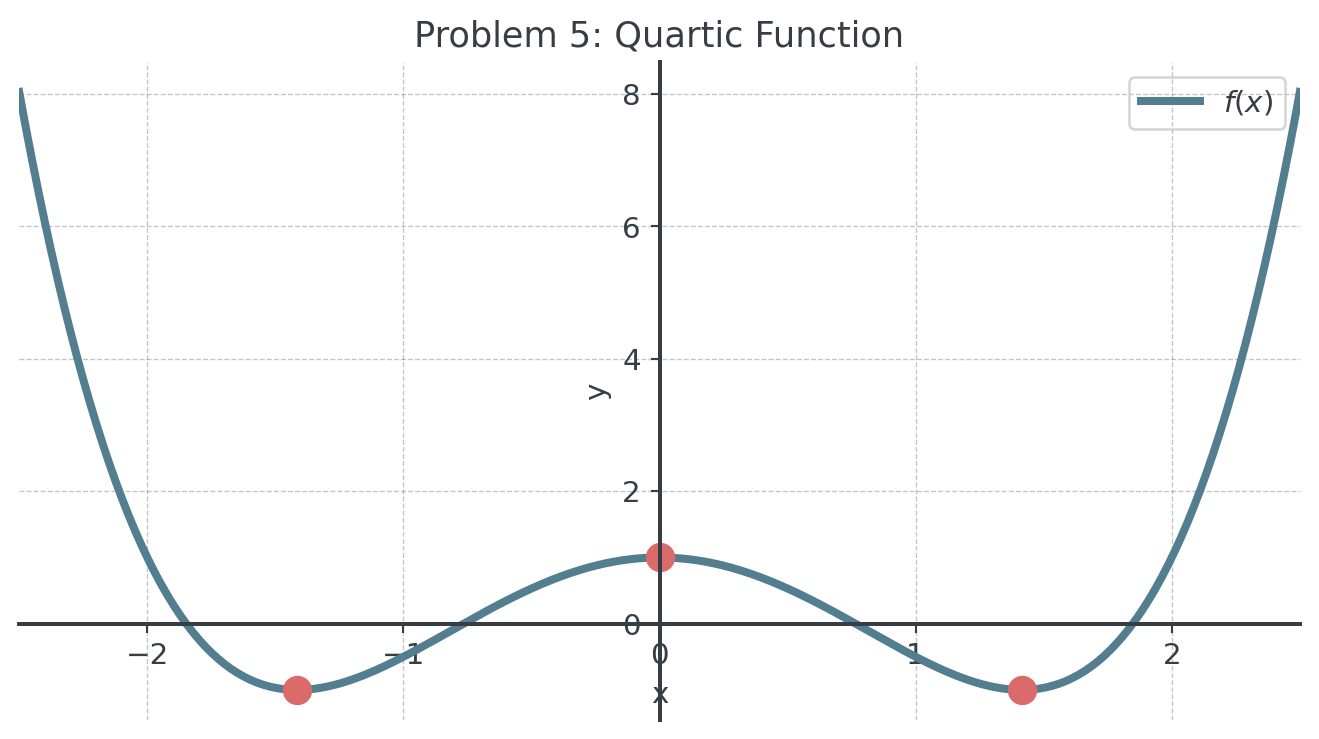
e) Two line segments with a jump at \(p = 200\): from \(R'(150) = 60\) down to \(30\) (open circle at \(p = 200\)), then from \(-110\) (open circle) down to \(R'(250) = -210\). \(R'(200)\) does not exist.
f) \(R(180) = 150 \cdot 180 - 0.3 \cdot 180^2 = 27{,}000 - 9{,}720 = 17{,}280\) EUR. \(R(220) = 290 \cdot 220 - 220^2 = 63{,}800 - 48{,}400 = 15{,}400\) EUR. Both are less than 18,000 EUR, so the manager should keep the fee of 200 EUR.
A lower fee is copied by the competitor and brings only a few new customers. A higher fee is not copied and drives many customers to the competitor. So the revenue has a corner with its maximum exactly at the current fee, and changing the fee in either direction costs revenue. This is why fees in such a market rarely change.
Problem 10: Marginal Cost of a Surfboard Workshop (xx)
A small workshop builds surfboards by hand, at most 12 boards per week. The figure shows its marginal cost \(MC(x) = C'(x)\) in hundred EUR per board, where \(C(x)\) are the weekly costs in hundred EUR for \(x\) boards per week.
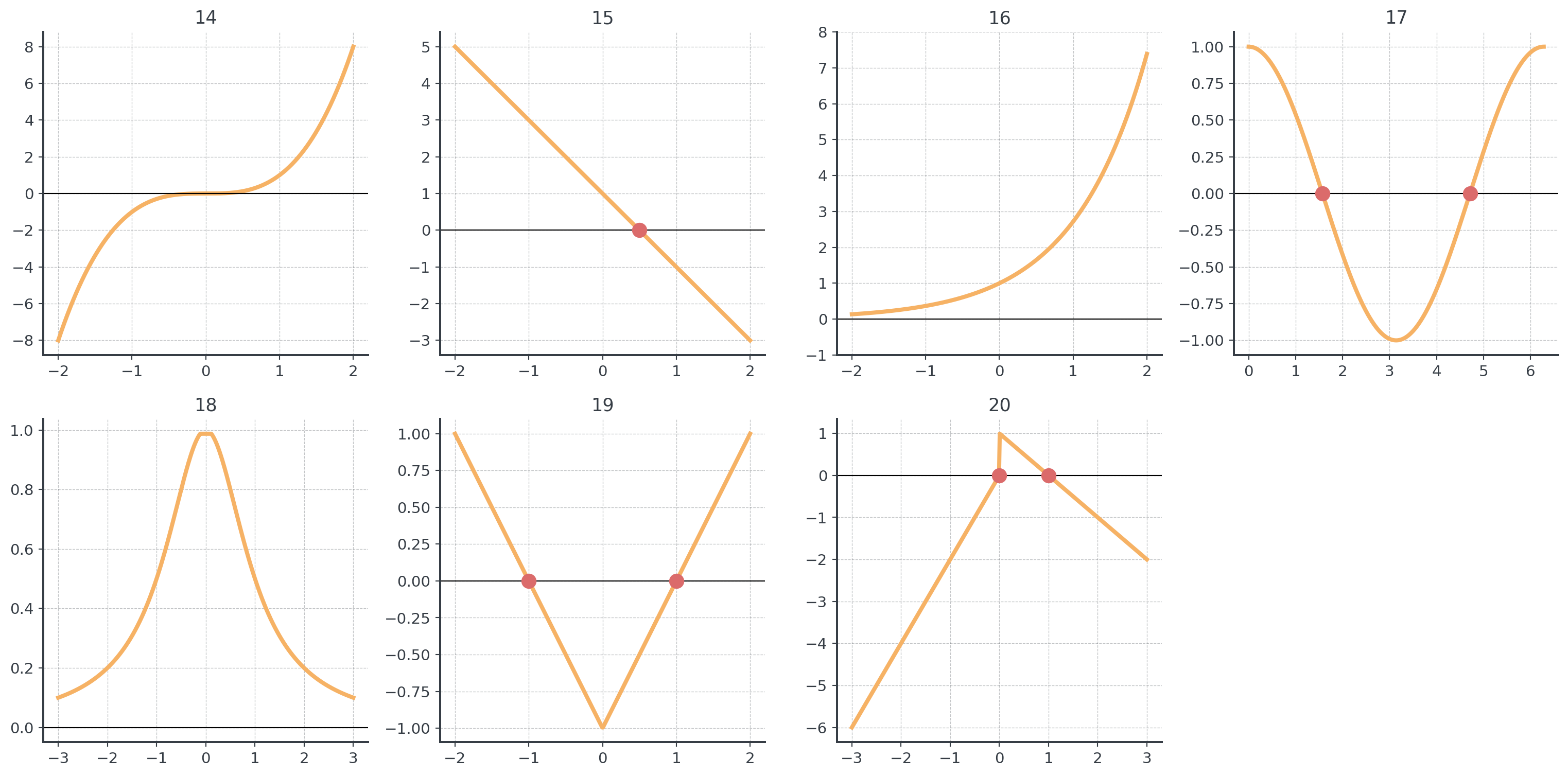
Explain with the figure why the weekly costs grow with every additional board. Give the output at which the costs grow most slowly and decide where the graph of \(C\) is concave down and where it is concave up.
Argue whether the following statements are true or false.
(1) Between 0 and 6 boards per week, the weekly costs fall.
(2) The cost function \(C\) has a minimum at \(x = 6\).
(3) The graph of \(C\) is concave up for \(6 < x \le 12\).
(4) At an output of 3 boards per week, one more board costs as much as at an output of 9 boards per week.
The marginal cost is \(MC(x) = 0.3x^2 - 3.6x + 14\), and the weekly costs are \(C(x) = 0.1x^3 - 1.8x^2 + 14x + 12\). Determine the inflection point of \(C\) computationally and explain its economical significance.
(for verification: inflection point \((6, 52.8)\))
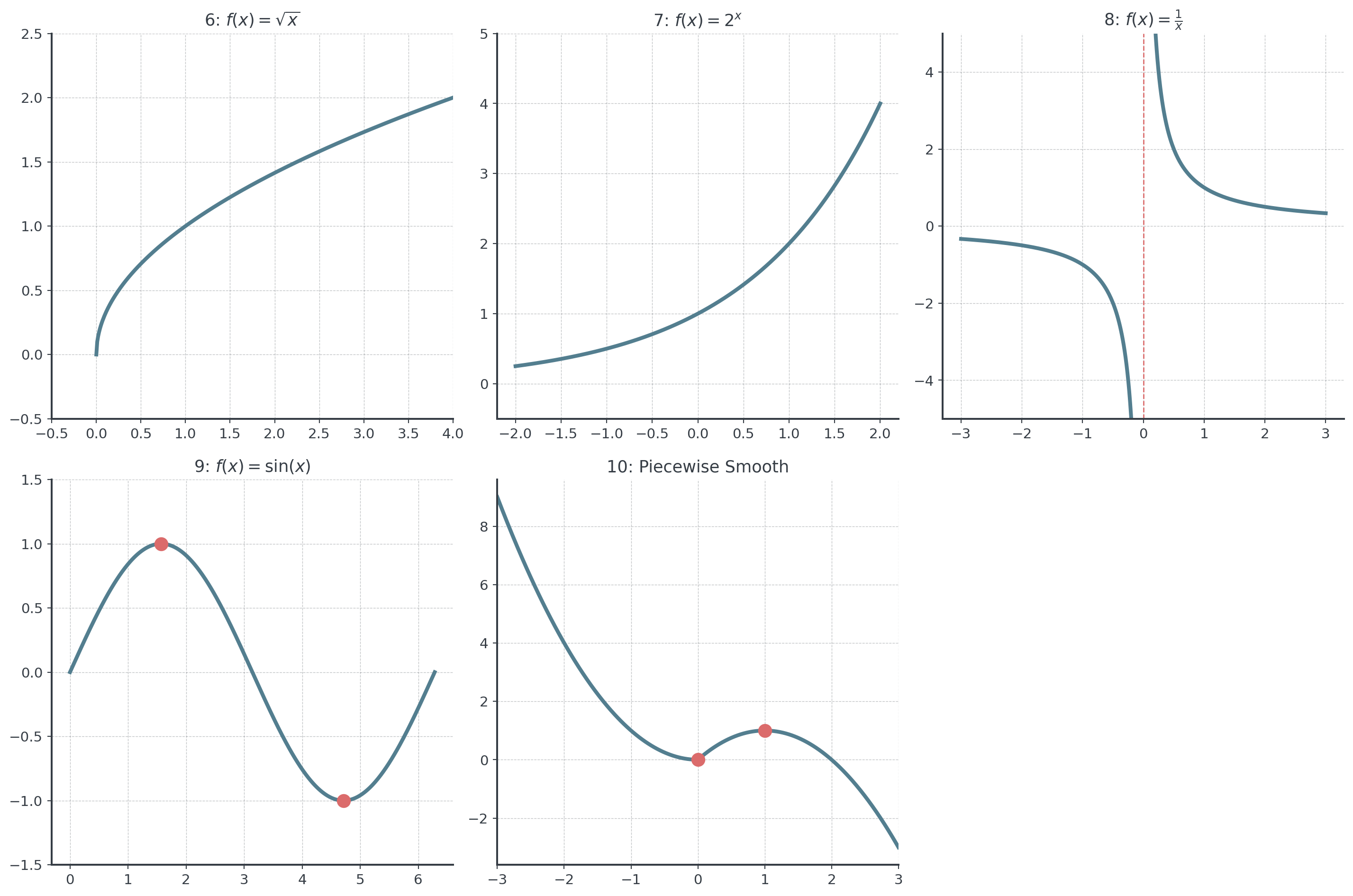
The workshop sells each board for 800 EUR. Draw the price as a horizontal line into the figure. The marginal profit is \(P'(x) = 8 - MC(x)\). Read from the figure where \(P'(x) = 0\), confirm it computationally and classify the stationary points of the profit with the sign of \(P'\).
Explain why the profit still grows between 6 and 10 boards per week, although the marginal cost grows there. Compute the weekly profit at 10 boards.
CautionSolution
a) The graph of \(MC\) lies above the \(x\)-axis everywhere, its lowest value is about 3.2 at \(x = 6\). So \(C'(x) > 0\) for all outputs: \(C\) increases, and every additional board raises the weekly costs. The costs grow most slowly where \(MC\) is smallest: at 6 boards per week (about 320 EUR for one more board). \(MC\) decreases for \(0 \le x < 6\), so \(C\) is concave down there. \(MC\) increases for \(6 < x \le 12\), so \(C\) is concave up there.
b)
(1) False. The marginal cost falls between 0 and 6, but it stays positive. The weekly costs still grow, only more and more slowly.
(2) False. A minimum of \(C\) needs \(C'(x) = MC(x) = 0\) with a sign change. But \(MC(6) \approx 3.2 > 0\). At \(x = 6\), the marginal cost has its minimum, which is the inflection point of \(C\).
(3) True. \(MC = C'\) increases for \(x > 6\), so \(C'' > 0\) and \(C\) is concave up.
(4) True. The graph of \(MC\) is a parabola, symmetric about \(x = 6\). So \(MC(3) = MC(9)\), and the figure shows about 5.9 for both (exactly: \(2.7 - 10.8 + 14 = 5.9\) and \(24.3 - 32.4 + 14 = 5.9\)): in both cases one more board costs about 590 EUR.
c) \(C''(x) = MC'(x) = 0.6x - 3.6 = 0 \iff x = 6\). \(C''(x) < 0\) for \(x < 6\) and \(C''(x) > 0\) for \(x > 6\): the sign changes, so there is an inflection point.
\[C(6) = 0.1 \cdot 216 - 1.8 \cdot 36 + 14 \cdot 6 + 12 = 21.6 - 64.8 + 84 + 12 = 52.8\]
Inflection point \((6, 52.8)\).
Economical significance: at 6 boards per week, the marginal cost is lowest, \(MC(6) = 10.8 - 21.6 + 14 = 3.2\), i.e. 320 EUR for one more board. Up to 6 boards, each additional board costs less than the one before (the workshop works more and more efficiently), so the costs grow more and more slowly. Above 6 boards, each board costs more than the one before (e.g. overtime and a crowded workshop), so the costs grow faster and faster. At this output, the weekly costs are 5,280 EUR.
d) The price line \(y = 8\) crosses the graph of \(MC\) at \(x = 2\) and \(x = 10\).
\[8 - (0.3x^2 - 3.6x + 14) = 0 \iff -0.3x^2 + 3.6x - 6 = 0 \iff x^2 - 12x + 20 = 0 \iff (x - 2)(x - 10) = 0\]
So \(P'(x) = 0\) at \(x = 2\) and \(x = 10\) ✓.
- \(x < 2\): \(MC\) lies above the price, \(P'(x) < 0\).
- \(2 < x < 10\): \(MC\) lies below the price, \(P'(x) > 0\).
- \(x > 10\): \(MC\) lies above the price, \(P'(x) < 0\).
At \(x = 2\), \(P'\) changes from \(-\) to \(+\): local minimum of the profit. At \(x = 10\), \(P'\) changes from \(+\) to \(-\): local maximum of the profit.
e) Between 6 and 10 boards, the marginal cost grows, but it stays below the price of 8 (e.g. \(MC(8) = 19.2 - 28.8 + 14 = 4.4\)). Each additional board still brings 800 EUR and costs less than that, so \(P'(x) > 0\) and the profit grows, only more and more slowly.
Profit at 10 boards: \(C(10) = 100 - 180 + 140 + 12 = 72\), so
\[P(10) = 8 \cdot 10 - C(10) = 80 - 72 = 8\]
The weekly profit at 10 boards is 800 EUR.
D: FSP Problem
Work on this problem as in the exam: write down every step. The points show what each part is worth.
FSP Problem: Camper Van Rental [20 pts. total]
A young company rents out camper vans (vans with a bed and a small kitchen for holidays). It was founded on 1 February. The balance of its business account (the money on the account) is
\[K(t) = -0.5t^3 + 7.5t^2 - 24t + 22, \qquad 0 \le t \le 12\]
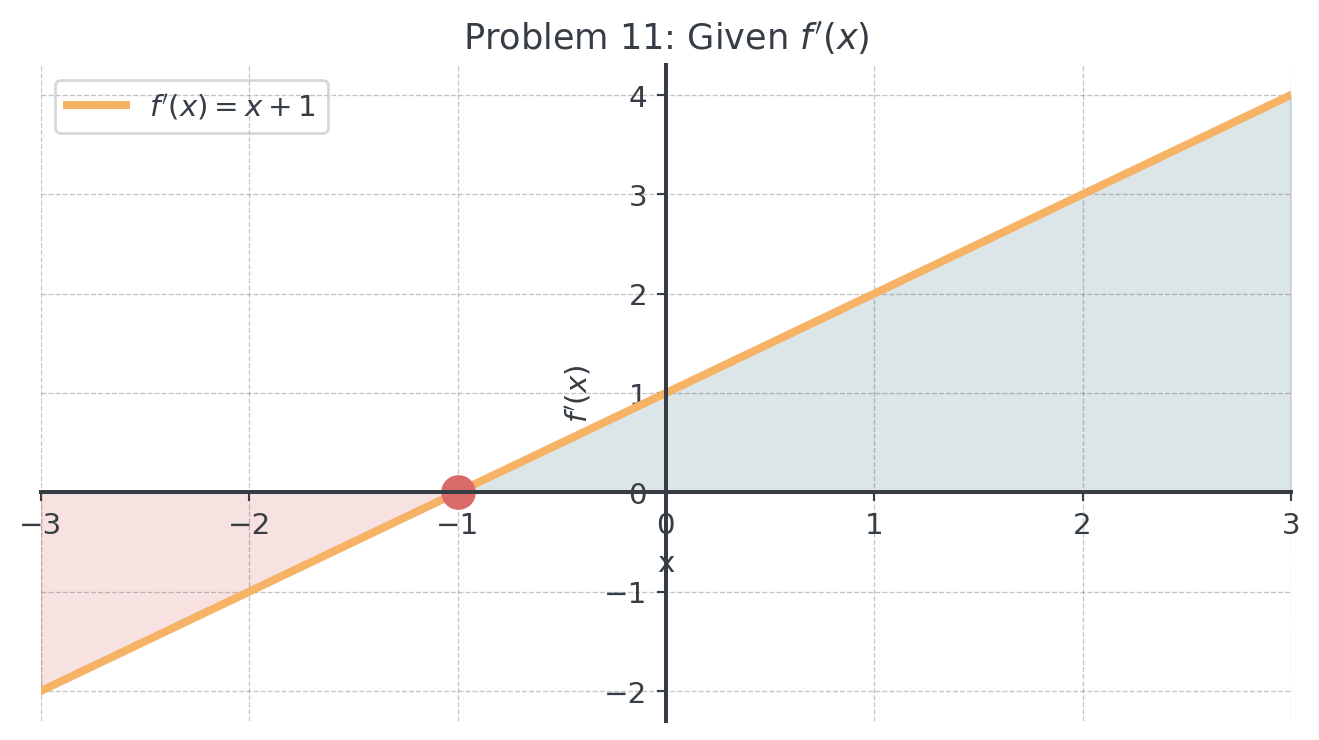
thousand EUR, \(t\) months after the founding. So \(t = 2\) is 1 April, \(t = 5\) is 1 July and \(t = 11\) is 1 January. The figure shows the graph of \(K\).
Part a)
The figure suggests that \(K\) has zeros at \(t = 2\) and \(t = 11\). Show that \(K(11) = 0\) and factor \(K\) completely with polynomial long division. Give the zeros with their multiplicities and explain the shape of the graph at \(t = 2\). Determine from which month on the company needs a loan. [5 pts.]
(for verification: \(K(t) = -0.5(t - 2)^2(t - 11)\))
CautionSolution
Zero at \(t = 11\):
\[K(11) = -0.5 \cdot 1331 + 7.5 \cdot 121 - 24 \cdot 11 + 22 = -665.5 + 907.5 - 264 + 22 = 0 \quad \checkmark\]
So \((t - 11)\) is a factor of \(K(t)\).
Polynomial long division by \((t - 11)\) (divide, multiply, subtract):
\[\begin{array}{l} (-0.5t^3 + 7.5t^2 - 24t + 22) : (t - 11) = -0.5t^2 + 2t - 2 \\ \underline{-(-0.5t^3 + 5.5t^2)} \\ \phantom{(-0.5t^3}\;\; 2t^2 - 24t \\ \phantom{(-0.5t^3}\;\; \underline{-(2t^2 - 22t)} \\ \phantom{(-0.5t^3 + 7.5t^2}\;\; -2t + 22 \\ \phantom{(-0.5t^3 + 7.5t^2}\;\; \underline{-(-2t + 22)} \\ \phantom{(-0.5t^3 + 7.5t^2 - 2t + }\;\; 0 \end{array}\]
Factor the quadratic as a perfect square: \(-0.5t^2 + 2t - 2 = -0.5(t^2 - 4t + 4) = -0.5(t - 2)^2\).
\[K(t) = -0.5(t - 2)^2(t - 11)\]
Zeros: \(t = 2\) (multiplicity 2) and \(t = 11\) (multiplicity 1). At the double zero \(t = 2\), the graph only touches the \(t\)-axis and turns back up: the balance falls to exactly 0 EUR on 1 April and then rises again. The founding capital just lasts.
Loan: \(K(t) = 0.5(t - 2)^2(11 - t)\). The factor \((t - 2)^2\) is positive for \(t \neq 2\), so \(K\) has the sign of \(11 - t\): \(K(t) > 0\) for \(t < 11\) (except \(K(2) = 0\)) and \(K(t) < 0\) for \(11 < t \le 12\). The balance becomes negative from \(t = 11\) on: the company needs a loan from 1 January.
Grading: 1 Pt. \(K(11) = 0\), 2 Pts. long division, 1 Pt. factored form with the multiplicities and the graph touching the axis at \(t = 2\), 1 Pt. loan from \(t = 11\) with the sign reason.
Part b)
The rate of change \(K'(t)\) is the net cash flow of the company (money coming in minus money going out, in thousand EUR per month). Graph the derivative \(K'(t)\) directly into the figure. Use only the graph of \(K\). [3 pts.]
CautionSolution
From the graph of \(K\):
- horizontal tangents at \(t = 2\) and \(t = 8\): zeros of \(K'\),
- \(K\) falls for \(t < 2\), rises for \(2 < t < 8\) and falls for \(t > 8\): \(K'\) is negative, positive, negative,
- \(K\) rises most steeply at about \(t = 5\): highest value of \(K'\) there, and \(K\) is very steep at both ends: large negative values of \(K'\) (about \(-24\) at \(t = 0\) and \(-60\) at \(t = 12\)).
The graph of \(K'\) is a parabola that opens downward:
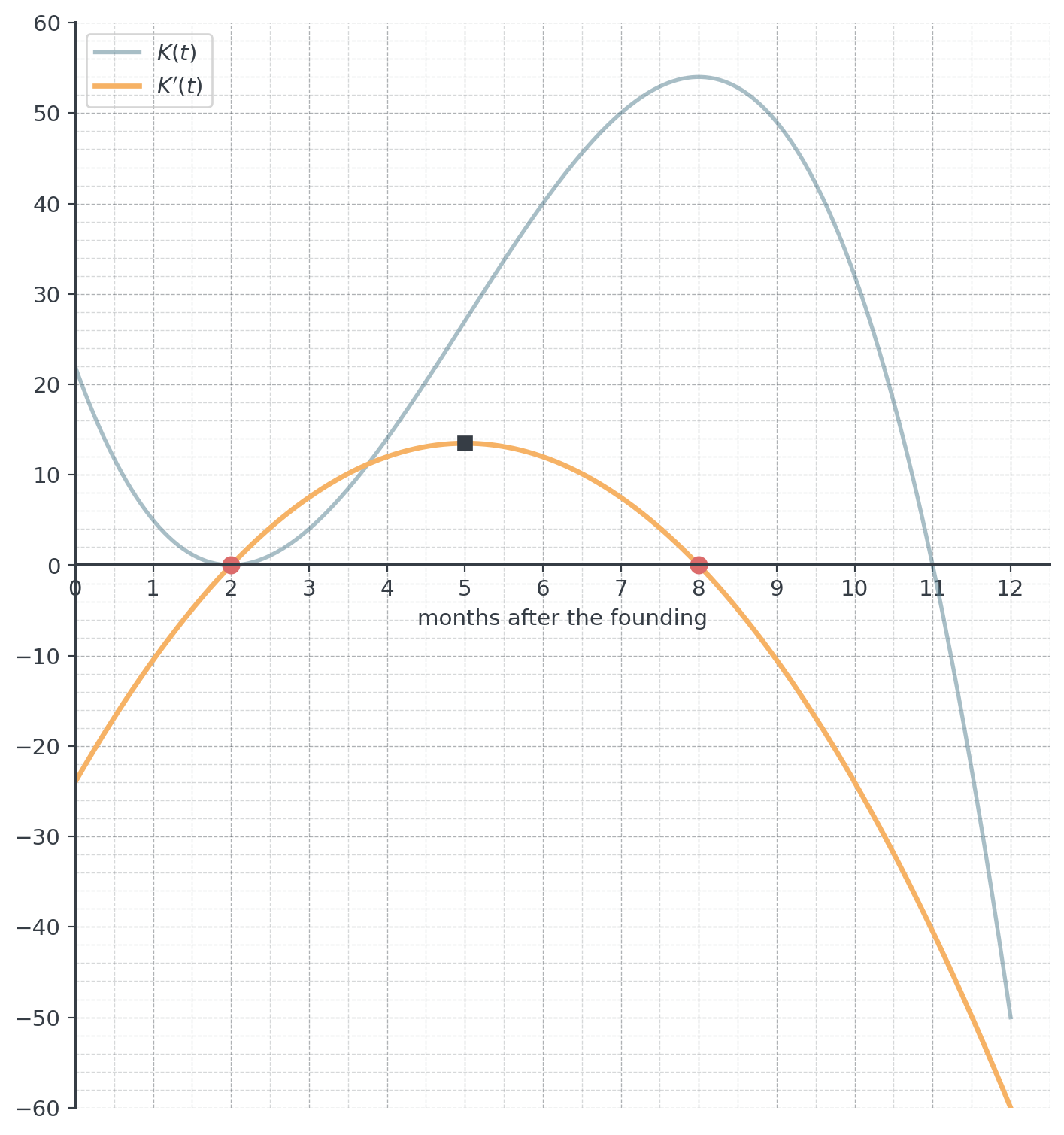
Grading: 1 Pt. zeros of \(K'\) at \(t = 2\) and \(t = 8\), 1 Pt. signs (negative, positive, negative), 1 Pt. highest value of \(K'\) at about \(t = 5\) and the steep negative ends.
Part c)
Determine the nature (local maximum, local minimum or saddle point) and the coordinates of all stationary points of \(K\) (the points with \(K'(t) = 0\)). Interpret them for the company. [4 pts.]
CautionSolution
Derivative (power rule):
\[K'(t) = -1.5t^2 + 15t - 24 = -1.5(t^2 - 10t + 16) = -1.5(t - 2)(t - 8)\]
\(K'(t) = 0\) at \(t = 2\) and \(t = 8\).
Sign table:
| \(t\) | \(0 \le t < 2\) | \(2 < t < 8\) | \(8 < t \le 12\) |
|---|---|---|---|
| \(K'(t)\) | \(-\) | \(+\) | \(-\) |
| \(K\) | falls | rises | falls |
- \(t = 2\): \(K'\) changes from \(-\) to \(+\), local minimum \((2, 0)\) with \(K(2) = 0\).
- \(t = 8\): \(K'\) changes from \(+\) to \(-\), local maximum \((8, 54)\) with \(K(8) = -256 + 480 - 192 + 22 = 54\).
Interpretation: the balance is lowest on 1 April with 0 EUR, just before the camper season brings money in. It is highest on 1 October with 54,000 EUR, at the end of the season. After that, more money goes out than comes in.
Grading: 1 Pt. \(K'(t)\) factored, 1 Pt. sign table, 1 Pt. local minimum \((2, 0)\), 1 Pt. local maximum \((8, 54)\) with the interpretation.
Part d)
Determine the inflection point of \(K\). Explain the economical significance of this point. [4 pts.]
CautionSolution
Second derivative: \(K''(t) = -3t + 15 = 0 \iff t = 5\).
Sign change: \(K''(t) > 0\) for \(t < 5\) and \(K''(t) < 0\) for \(t > 5\), so the curvature changes from concave up to concave down: \(t = 5\) is an inflection point.
Point: \(K(5) = -62.5 + 187.5 - 120 + 22 = 27\), inflection point \((5, 27)\).
Economical significance: \(K'(5) = -1.5 \cdot 3 \cdot (-3) = 13.5\). On 1 July, in the middle of the season, the net cash flow is highest: about 13,500 EUR more come in than go out per month, and the balance grows fastest. Before July, the net cash flow grows (the season starts). After July, it shrinks, and the balance grows more and more slowly until it stops growing on 1 October.
Grading: 1 Pt. \(K''(t)\) and \(t = 5\), 1 Pt. sign change of \(K''\), 1 Pt. point \((5, 27)\), 1 Pt. meaning with \(K'(5) = 13.5\) as the highest net cash flow.
Part e)
Argue whether the following statements are true or false.
- On 1 April (\(t = 2\)), as much money comes into the account per month as goes out.
- Between \(t = 2\) and \(t = 8\), the balance grows faster and faster.
- At \(t = 1\), the company needs a loan, because its balance falls.
- From \(t = 8\) on, more money goes out of the account per month than comes in.
[4 pts.]
CautionSolution
- True. \(K'(2) = 0\): the net cash flow is zero, so the money coming in equals the money going out.
- False. The balance grows faster and faster only up to the inflection point at \(t = 5\) (\(K'' > 0\)). Between \(t = 5\) and \(t = 8\), \(K''(t) < 0\): the balance still grows, but more and more slowly.
- False. The balance falls at \(t = 1\) (\(K'(1) = -10.5 < 0\)), but it is still positive: \(K(1) = -0.5 + 7.5 - 24 + 22 = 5\), i.e. 5,000 EUR. A falling balance is not a negative balance. By a), the balance never becomes negative before \(t = 11\).
- True. \(K'(t) < 0\) for \(t > 8\) (sign table in c): the net cash flow is negative, so more money goes out than comes in.
Grading: 1 Pt. per statement with a correct reason.