Session 03-04 - Transformations, Composition & Inverses
Section 03: Functions as Business Models
Entry Quiz
Review from Session 03-03
Work individually, then we compare together
Find the vertex of \(f(x) = -2x^2 + 12x - 10\) and determine if it’s a maximum or minimum.
A company’s profit function is \(P(x) = -x^2 + 80x - 1200\). Find:
- The quantity that maximizes profit
- The maximum profit
Review from Session 03-03 II
Convert \(g(x) = x^2 - 4x + 7\) to vertex form.
Revenue is modeled by \(R(p) = p(600 - 3p)\). What price maximizes revenue?
Homework Discussion
Learning Objectives
Learning Objectives
By the end of this session, you can:
- Apply vertical and horizontal shifts, stretches, and reflections to business functions
- Combine multiple transformations in the correct order
- Compose functions to model multi-step business processes
- Find and interpret inverse functions for prices, costs, and demand
Vertical Changes
Vertical Shifts
Moving graphs up or down
Given original function \(f(x)\):
- Upward shift: \(g(x) = f(x) + k\) (k > 0)
- Downward shift: \(g(x) = f(x) - k\) (k > 0)
- Graph effect: Entire graph moves vertically
- Business meaning:
- Fixed cost changes
- Base price adjustments
- Overhead modifications
Example: Cost Function Adjustment
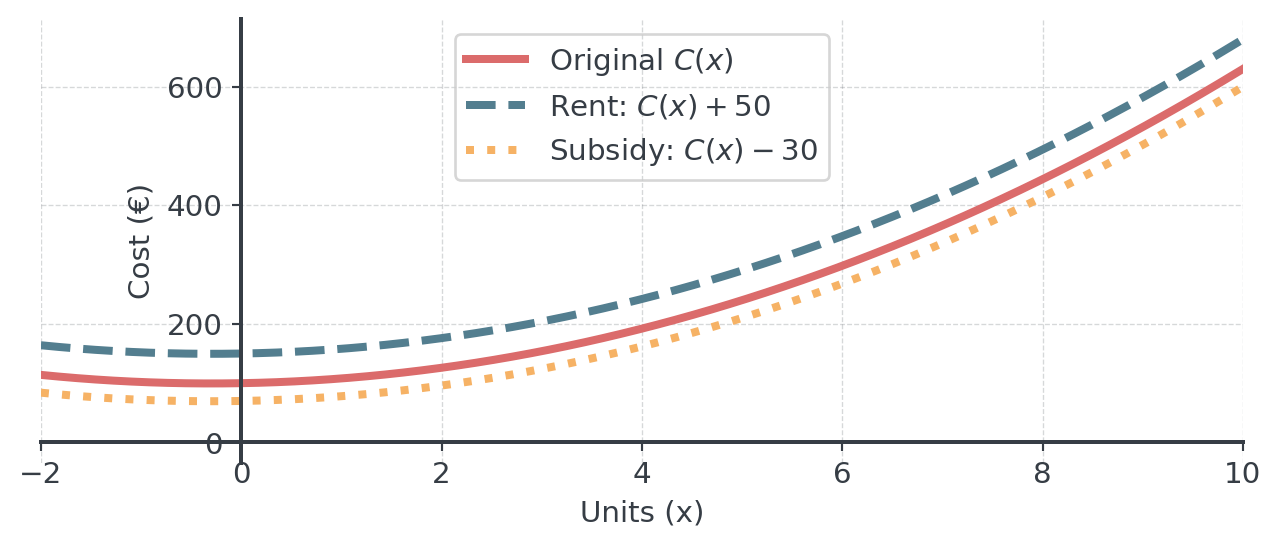
Original cost: \(C(x) = 5x^2 + 3x + 100\)
- Rent increases by 100 EUR: \(C_{new}(x) = 5x^2 + 3x + 200\)
- Government subsidy of 50 EUR: \(C_{new}(x) = 5x^2 + 3x + 50\)
Question: Any idea how we could graph this?
Vertical Shift Visualization
Same parabola shape, shifted vertically - fixed costs change, but variable cost structure remains the same!
Vertical Stretch & Compression
Changing the vertical scale
Given original function \(f(x)\):
- Vertical stretch: \(g(x) = a \cdot f(x)\) where \(a > 1\)
- Vertical compression: \(g(x) = a \cdot f(x)\) where \(0 < a < 1\)
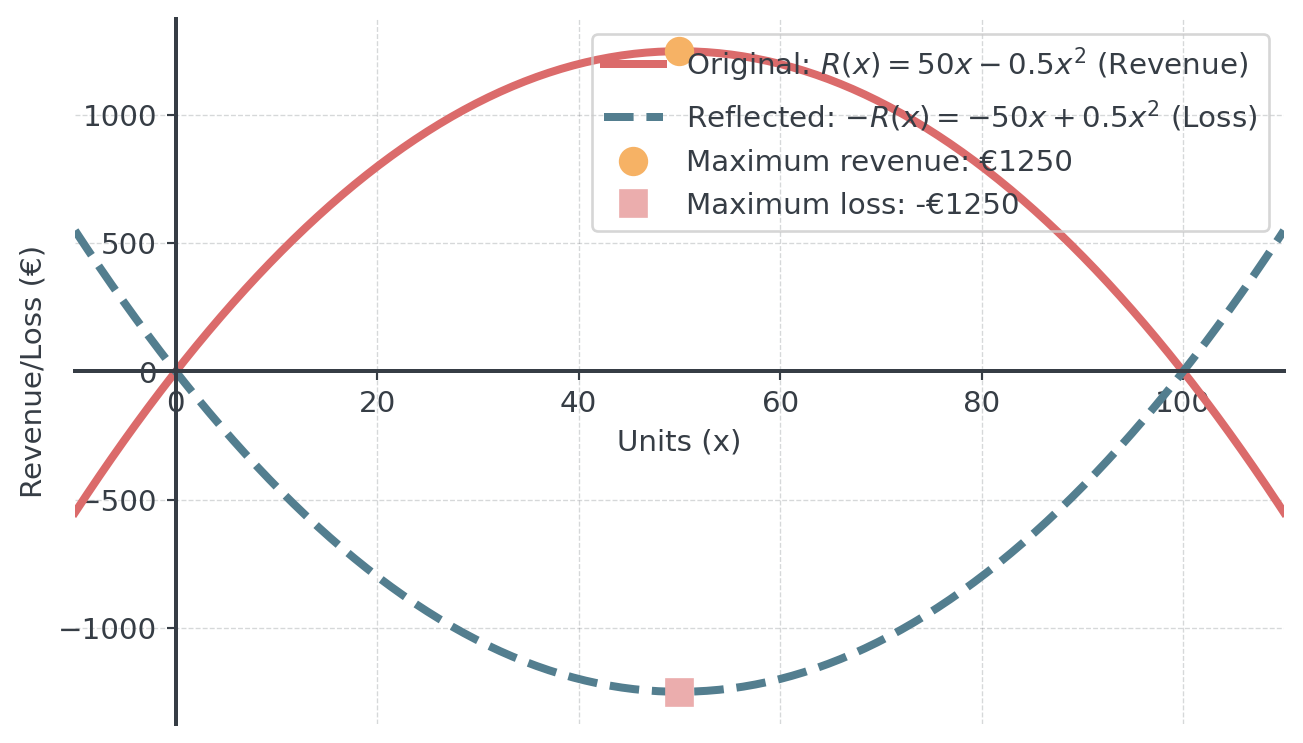
- Reflection: \(g(x) = -f(x)\) (flip over x-axis)
- Business meaning:
- Percentage markups/discounts
- Tax multipliers
- Currency conversions
Example: Revenue Scaling
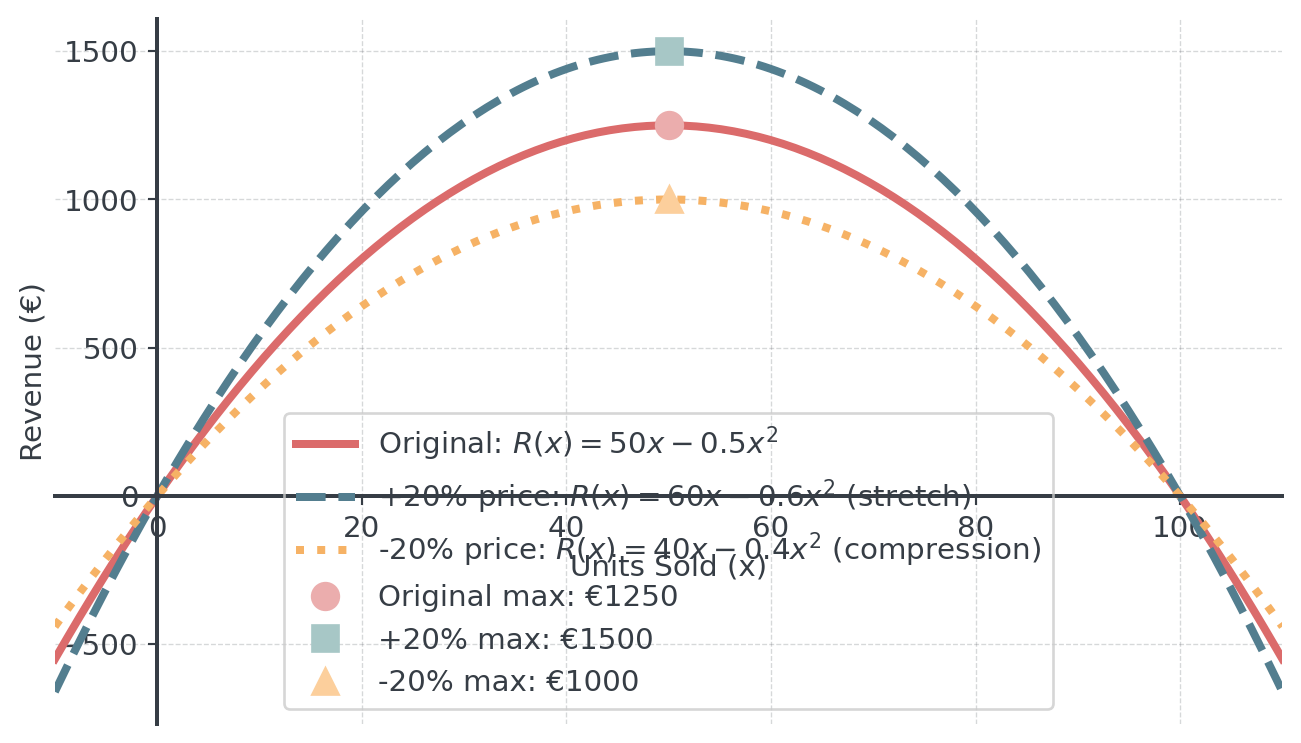
Original revenue: \(R(x) = 50x - 0.5x^2\)
- 20% price increase across all products: \(R_{new}(x) = 1.2(50x - 0.5x^2) = 60x - 0.6x^2\)
- 20% price decrease across all products: \(R_{new}(x) = 0.8(50x - 0.5x^2) = 40x - 0.4x^2\)
Question: Can anyone describe what happens now?
All three functions have the same optimal quantity (50 units), but revenue scales proportionally with price - stretch up or compress down!
Vertical Stretch and Compression
Reflection Visualization
Quick Practice
Work individually, then we discuss
Given the original profit function: \(P(x) = -x^2 + 40x - 200\)
- Write the new function if fixed costs increase by 100 EUR
- Write the new function if a government grant reduces costs by 50 EUR
- Write the new function if all profits increase by 30%
- Write the new function if all profits decrease by 25%
- What business scenario could \(-P(x)\) represent?
- Write the reflected function explicitly
Horizontal Changes
Horizontal Shifts
Moving graphs left or right
Given original function \(f(x)\):
- Right shift: \(g(x) = f(x - h)\) where \(h > 0\)
- Left shift: \(g(x) = f(x + h)\) where \(h > 0\)
- Business meaning:
- Time delays or advances
- Market entry timing, seasonal adjustments
Counterintuitive: Minus shifts right, plus shifts left!
Example: Seasonal Demand Shift
Summer demand peaks in June (month 6): \(D(t) = -(t-6)^2 + 100\)
- Unusually hot weather shifts peak to May (left shift): \(D_{new}(t) = -(t-5)^2 + 100\)
- Unusually cold weather shifts peak to July (right shift): \(D_{new}(t) = -(t-7)^2 + 100\)
Question: Anyone with an idea how to graph this?
Same shape parabola, shifted horizontally - peak demand moves but pattern stays the same!
Horizontal Shift Visualization
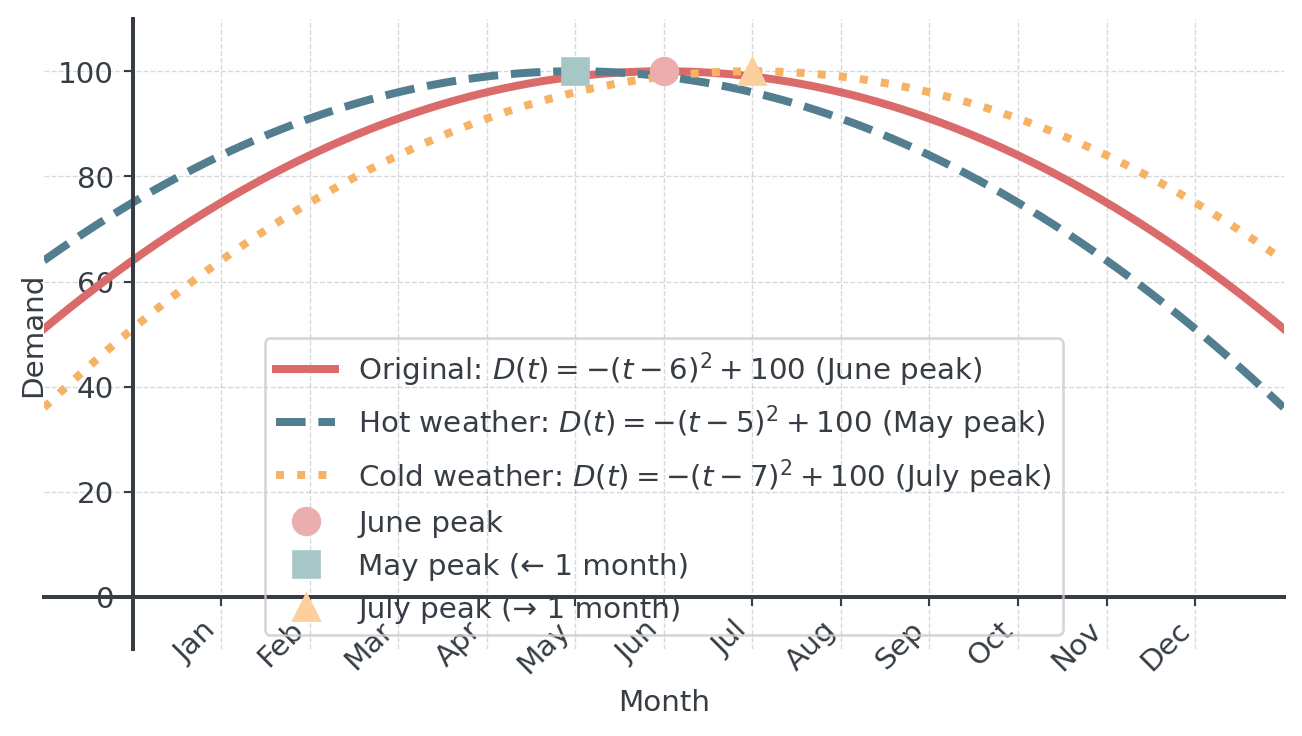
Remember: \(-(t-5)^2 + 100\) peaks at \(t = 5\) (May, shifted LEFT), \(-(t-7)^2 + 100\) peaks at \(t = 7\) (July, shifted RIGHT) - the number after the minus sign is the peak, not the direction!
Horizontal Stretch & Compression
Changing the horizontal scale
Given original function \(f(x)\):
- Horizontal stretch: \(g(x) = f(x/b)\) where \(b > 1\)
- Horizontal compression: \(g(x) = f(bx)\) where \(b > 1\)
- Reflection: \(g(x) = f(-x)\) (flip over y-axis)
- Business meaning:
- Time scaling (quarterly to monthly)
- Production speed changes
- Market cycle adjustments
Example: Product Lifecycle
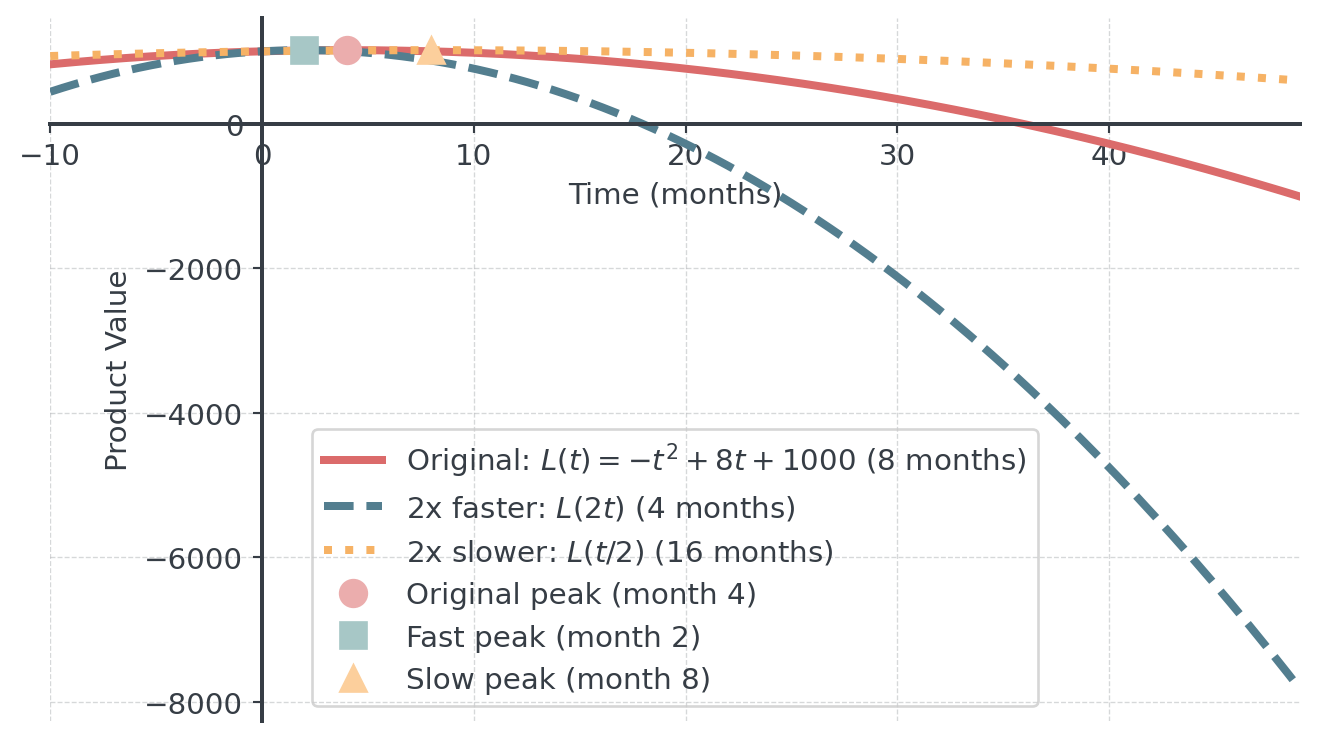
Original lifecycle (monthly): \(L(t) = -t^2 + 8t + 1000\)
- Competitor speeds up cycle (2x faster): \(L_{fast}(t) = -(2t)^2 + 8(2t) + 1000 = -4t^2 + 16t + 1000\)
- Extended warranty slows cycle (2x slower): \(L_{slow}(t) = -(t/2)^2 + 8(t/2) + 1000 = -0.25t^2 + 4t + 1000\)
Question: What happens to the lifecycle duration?
Horizontal compression (faster) → narrower curve, earlier peak.
Horizontal stretch (slower) → wider curve, later peak!
Counterintuitive again: \(f(2t)\) compresses (faster), \(f(t/2)\) stretches (slower)!
Horizontal Stretch/Compression
Combined Changes
Order of Operations
Apply transformations systematically
Standard order for \(g(x) = a \cdot f(b(x - h)) + k\):
- Horizontal stretch/compress by factor \(b\)
- Horizontal shift by \(h\)
- Vertical stretch/compress by factor \(a\)
- Vertical shift by \(k\)
Let’s apply these steps to a function!
Complete Transformation Example
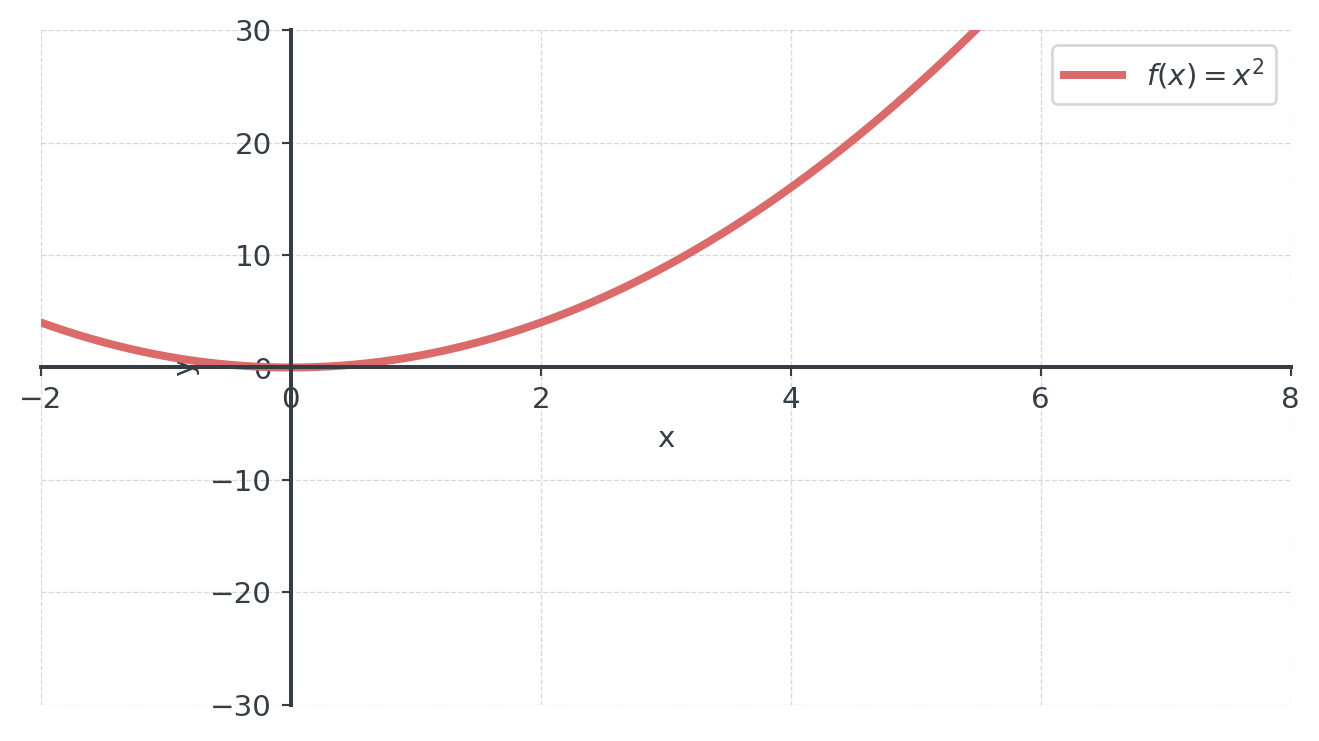
Start with \(f(x) = x^2\)
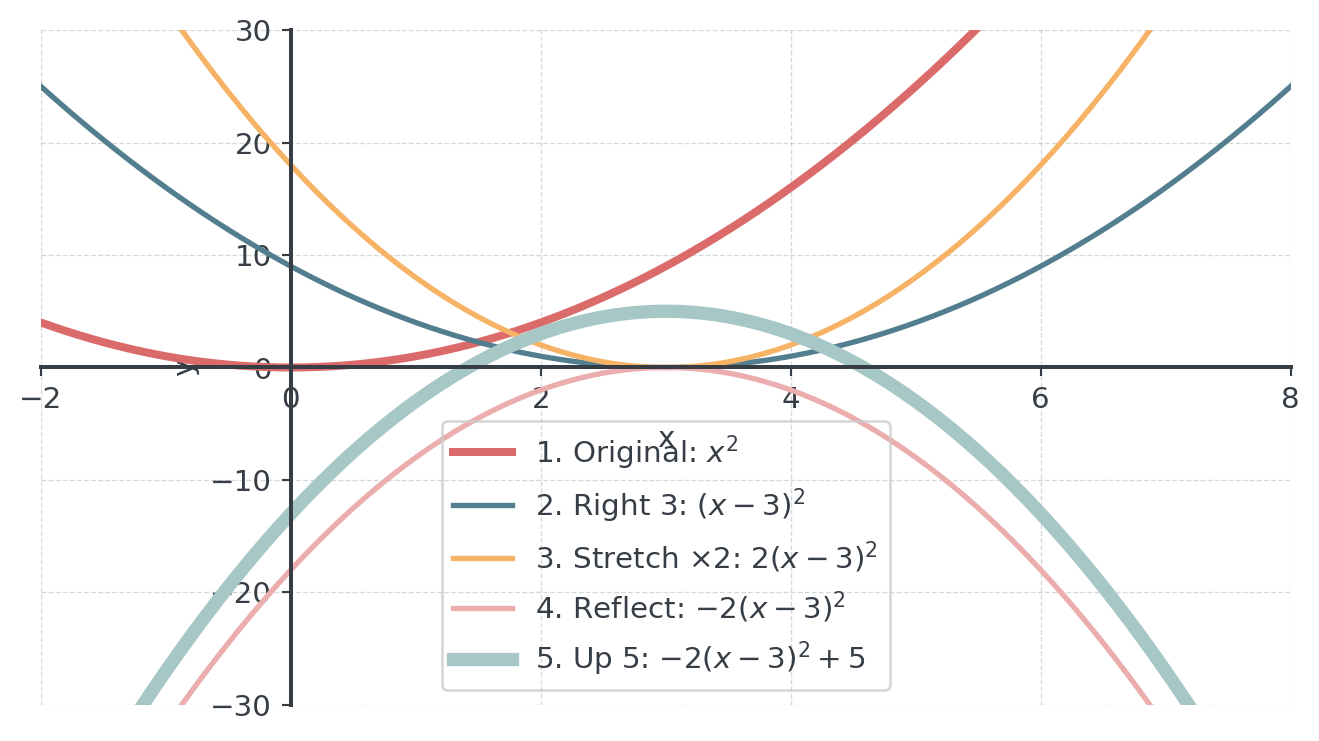
Transform to: \(g(x) = -2(x - 3)^2 + 5\)
- Shift right 3 units: \((x - 3)^2\)
- Stretch vertically by 2: \(2(x - 3)^2\)
- Reflect over x-axis: \(-2(x - 3)^2\)
- Shift up 5 units: \(-2(x - 3)^2 + 5\)
Question: Who can describe how this might look like?
Original Function
Progressive Transformation
Scenario: Market Expansion
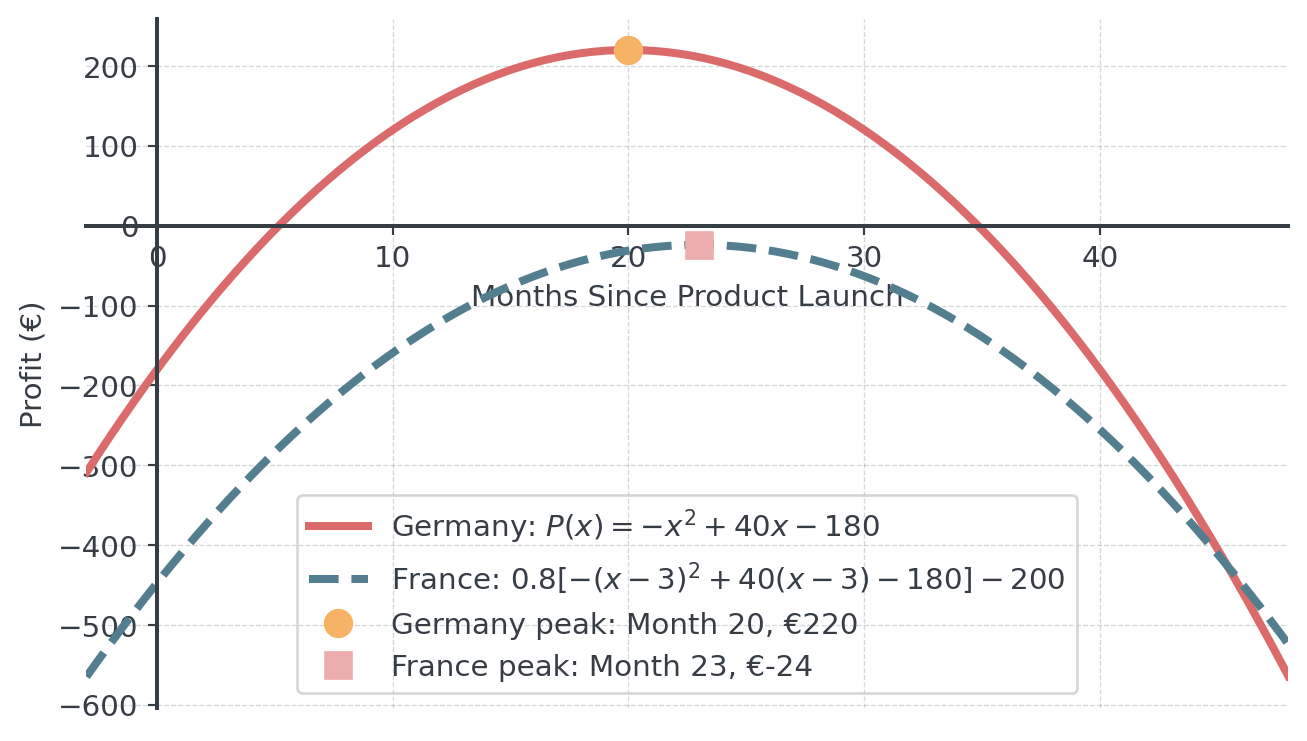
Original profit in Germany: \(P(x) = -x^2 + 40x - 180\)
Research estimates expansion to France with adjustments:
- 20% lower profit: Multiply by 0.8
- Fixed cost increase of 200 EUR: Subtract 200
- 3-month delay: Replace \(x\) with \((x - 3)\)
- \(P_{France}(x) = 0.8[-(x-3)^2 + 40(x-3) - 180] - 200\)
Question: Should the company expand to France?
Market Expansion Visualization
Guided Practice
Individual Exercise Block I
Work alone for 10 minutes, then we discuss the solutions
Given \(f(x) = x^2 - 4x + 3\), write the equation for:
- \(f(x)\) shifted up 5 units
- \(f(x)\) shifted left 2 units
- \(f(x)\) reflected over the x-axis
A cost function is \(C(x) = 0.5x^2 + 20x + 500\). Due to inflation:
- All costs increase by 10%
- An additional fixed cost of 100 EUR is added
- Write new cost function and find cost for producing 50 units.
Individual Exercise Block II
Work alone for 5 minutes, then we discuss the solutions
- The demand for ice cream follows \(D(t) = -2(t - 7)^2 + 200\) where \(t\) is the month.
- In which month is demand highest?
- If climate change shifts the peak 1 month earlier and increases maximum demand by 15%, write the new function.
Break
Function Composition
Understanding Composition
Composition models sequential processes
Definition: \((f \circ g)(x) = f(g(x))\)
- Read as “f composed with g”
- Apply g first, then f
- Output of g becomes input of f
- Order matters! \((f \circ g) \neq (g \circ f)\) usually
- Business meaning: Multi-step processes
Composition: Supply Chain
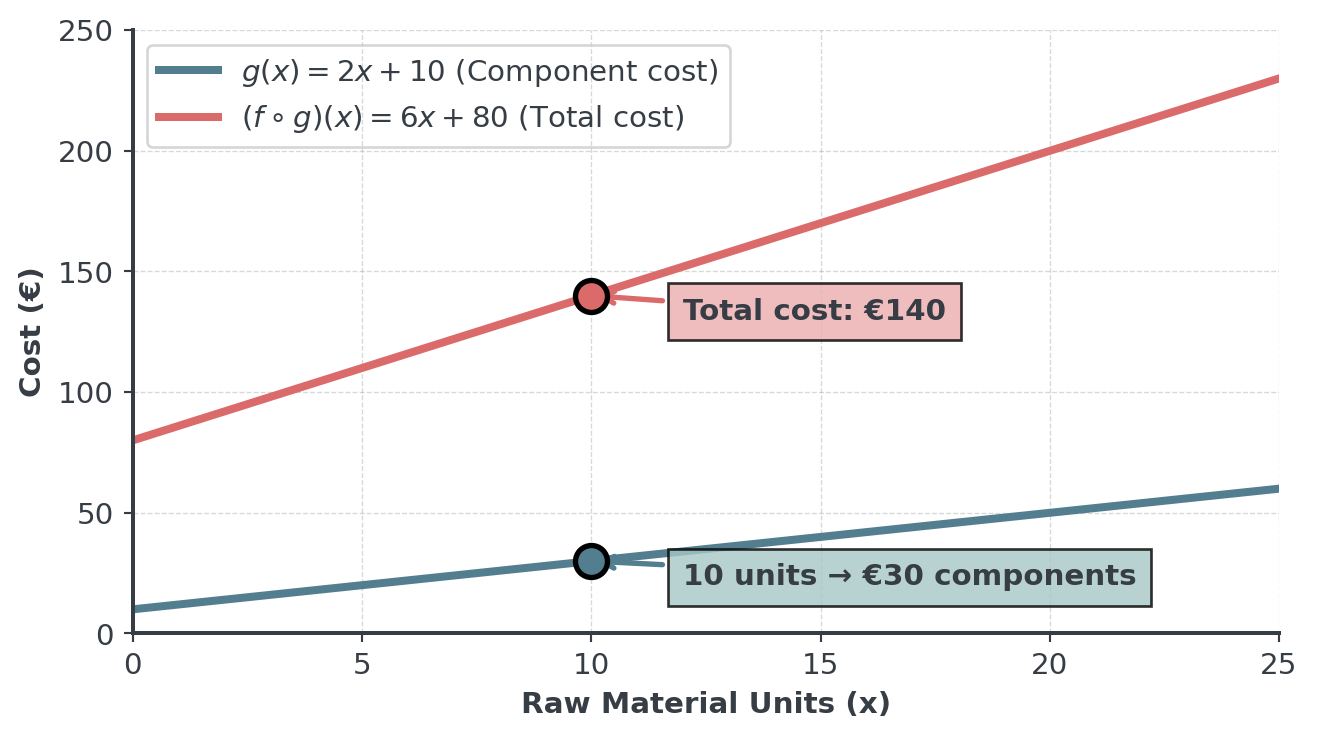
Imagine a company manufacturing products from raw materials.
- Raw materials to components: \(g(x) = 2x + 10\) (cost in EUR)
- Components to products: \(f(y) = 3y + 50\) (cost in EUR)
- \((f \circ g)(x) = f(g(x)) = f(2x + 10)\)
- \(= 3(2x + 10) + 50\)
- \(= 6x + 30 + 50\)
- \(= 6x + 80\)
- For 10 units raw material: Cost = 140 EUR
Supply Chain Visualization
Domain Considerations
Domain of composition can be restricted
For \((f \circ g)(x)\):
- Start with domain of \(g\)
- Find range of \(g\)
- Intersect with domain of \(f\)
- Track back to valid \(x\) values
This is not too complicated, right? Here we just need to be careful.
Example: Dosage & Safe Maximum
Calculate dosage based on body weight, then check safety limit
- Dosage from weight: \(g(x) = 5x\) mg (5mg per kg body weight)
- Safe processing: \(f(x) = \sqrt{500 - x}\) (requires total dose \(\leq 500\) mg)
- Composition requires: \(5x \leq 500\), so \(x \leq 100\) kg body weight
Therefore, we cannot process a patient weighing more than 100kg, as this would be unsafe!
Quick Practice
Work individually, then we discuss
A food delivery service has the following cost structure:
- Restaurant to warehouse: \(g(x) = 1.5x + 5\) (EUR per order, where \(x\) is number of orders)
- Warehouse to customer: \(f(y) = 2y + 8\) (EUR delivery cost)
Find the composition \((f \circ g)(x)\) representing total delivery cost.
Calculate the total cost for 20 orders.
If the domain of \(g\) is \([0; 100]\) orders, what is the range of \(g\)?
Inverse Functions
What is an Inverse Function?
An inverse function reverses the original function
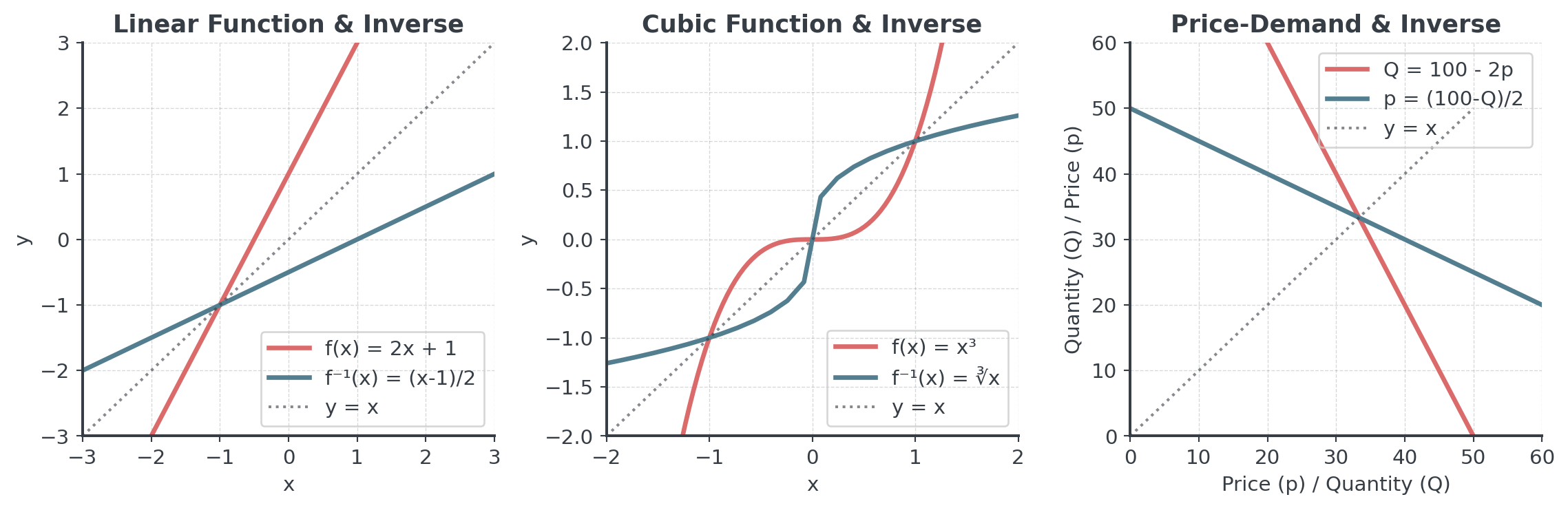
If \(f(a) = b\), then \(f^{-1}(b) = a\). The inverse “undoes” what the original function does.
Testing for Invertibility
A function has an inverse if it’s one-to-one
- Each output comes from exactly one input
- Horizontal line test: Each horizontal line hits graph at most once
- For continuous functions: Always increasing or always decreasing
Question: Which of these two fulfill the one-to-one condition?
- \(f(x) = 2x + 5\)
- \(g(x) = x^2\)
Just make sure, you don’t use the vertical line test here!
Finding Inverse Functions
Step-by-step process
- Replace \(f(x)\) with \(y\)
- Swap \(x\) and \(y\)
- Solve for \(y\)
- Replace \(y\) with \(f^{-1}(x)\)
- Verify domain and range
Looks complicated? It is actually rather easy!
Example: Simple Linear Function
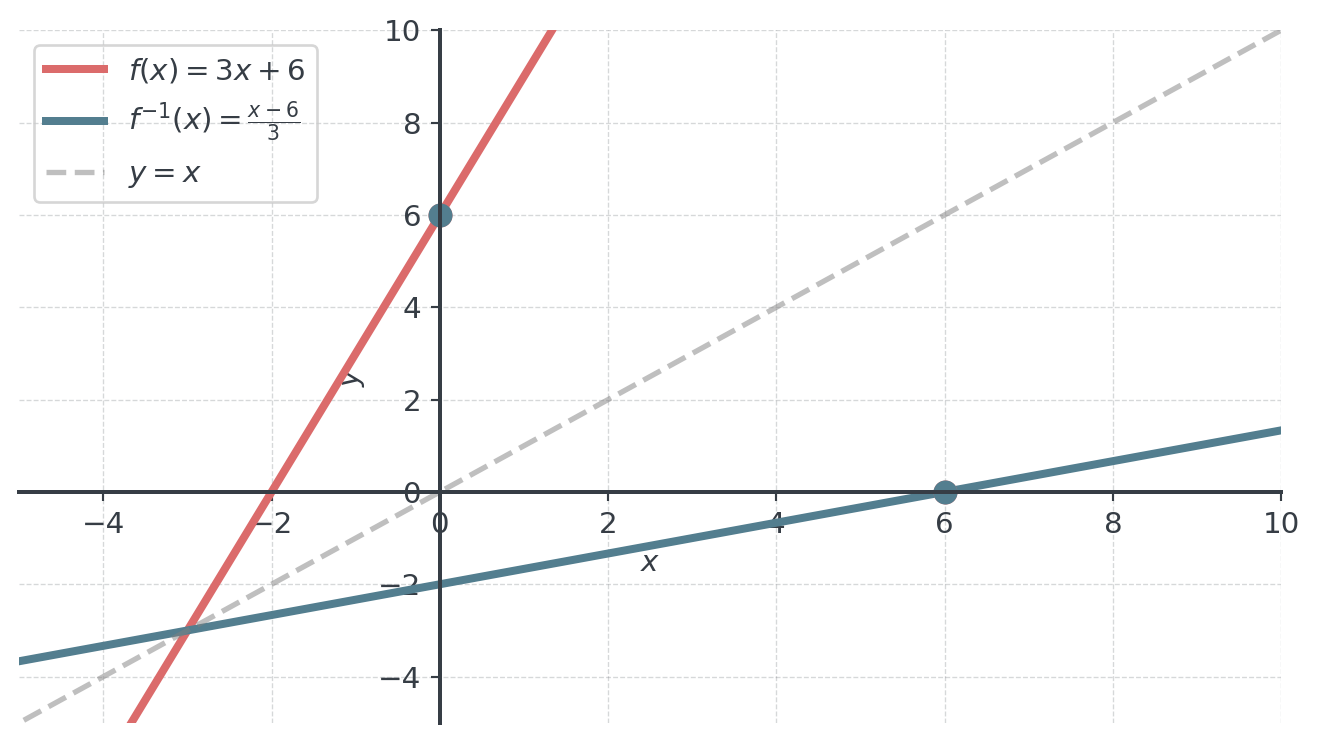
Find the inverse of \(f(x) = 3x + 6\)
- \(y = 3x + 6\)
- \(x = 3y + 6\) (swap \(x\) and \(y\))
- \(3y = x - 6\) (solve for \(y\))
- \(y = \frac{x - 6}{3}\)
- Inverse: \(f^{-1}(x) = \frac{x - 6}{3}\)
Verify: \(f(f^{-1}(x)) = f\left(\frac{x-6}{3}\right) = 3 \cdot \frac{x-6}{3} + 6 = x - 6 + 6 = x\) ✓
Visualizing the Inverse
Example: Price-Demand Inverse
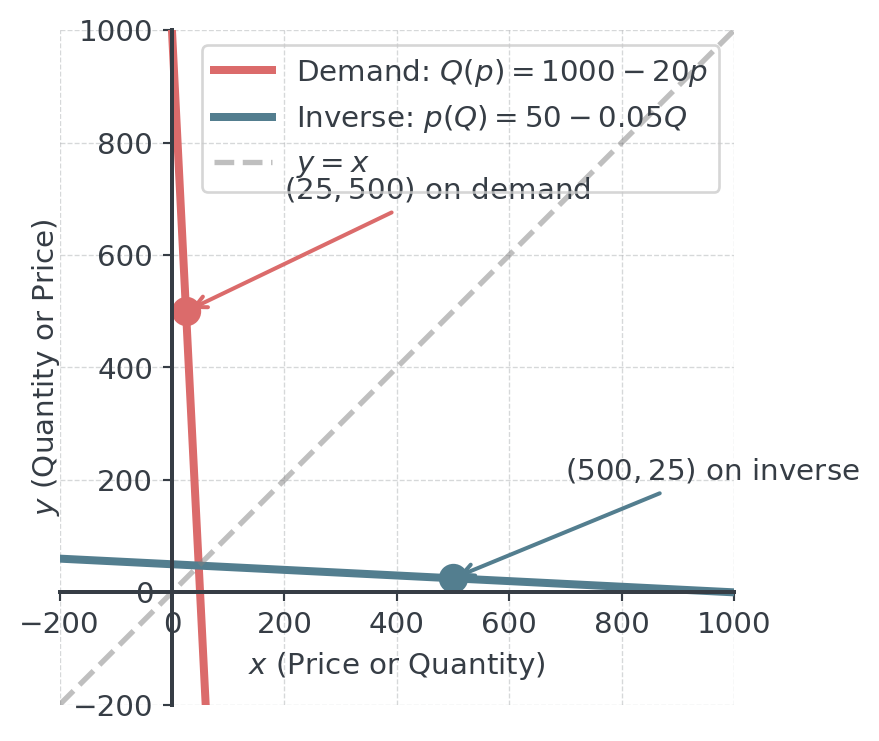
Demand function: \(Q = 1000 - 20p\)
- \(y = 1000 - 20p\)
- \(x = 1000 - 20p\) (swap)
- \(x - 1000 = -20p\)
- \(p = 50 - 0.05x\)
- Inverse: \(p(Q) = 50 - 0.05Q\)
What does this mean? It gives the price needed for specific quantity!
Visualizing Price and Demand
Guided Practice
Individual Exercise Block
Work alone for 15 minutes, then discuss for 10 minutes
Given \(f(x) = 2x + 3\) and \(g(x) = x^2 - 1\):
- Find \((f \circ g)(x)\) and evaluate \((f \circ g)(2)\)
- Find \((g \circ f)(x)\) and evaluate \((g \circ f)(2)\)
A company converts raw materials through two stages:
- Stage 1: \(C_1(x) = 50x + 200\) (process cost in EUR)
- Stage 2: \(C_2(y) = 2y + 500\) (assembly cost in EUR)
- Find the total cost function and cost of 100 units of material.
Find the inverse of \(f(x) = \frac{2x + 3}{5}\) and verify your answer.
Team Problem-Solving
International Business Model I
The Scenario: Global E-Commerce Platform
An e-commerce company operates internationally with these functions:
Pricing Model:
- Base price in USD: \(P(x) = 50 + 0.8x\) where \(x\) is quantity
- EUR conversion: \(E(p) = 0.85p\)
- UK markup: \(U(p) = 1.2p + 10\)
International Business Model II
The Scenario: Global E-Commerce Platform
Shipping Costs:
- Weight calculation: \(W(x) = 0.5x + 2\) (kg)
- Shipping cost: \(S(w) = 15w + 25\) (EUR)
Customer Demand:
- At total price \(T\): \(D(T) = 5000 - 20T\) units per month
Your Tasks
If you like, you can work in groups
Find the total price function for EU customers (product + shipping) as a function of quantity \(x\).
Find the inverse of the demand function. What does it represent?
Create a composite function that gives monthly demand based on quantity ordered.
If the company wants exactly 2000 units demanded per month, what should the quantity per order be?
The company can only process orders where total price leads to positive demand. Find the maximum viable order quantity.
Coffee Break
FSP Workshop
Problem 1: A Bath Bomb Press
A small manufactory presses bath bombs (fizzing balls for the bathtub) and sells them to drugstores. For each bath bomb, the drugstores pay 4 EUR more than its ingredients and packaging cost. When the press runs \(h\) hours per week, its weekly running costs (staff, energy, maintenance, overtime) are \(K(h) = 20h^2 + 640h + 8000\) EUR, with \(0 \leq h \leq 60\). The press makes 400 bath bombs per hour. Let \(x\) be the weekly output in QU (1 QU = 100 bath bombs).
- Give the running time \(h(x)\) in hours. Determine the running costs \(L(x) = K(h(x))\) as a function of the output, with their domain. Describe how the graph of \(L\) arises from the graph of \(K\). [4 pts.]
Bath Bombs: Maximum Profit
- Give the weekly profit \(P(x)\) in EUR. Compute the maximum profit and prove that it really is a maximum. Give the output in bath bombs and the running time of the press. [4 pts.]
(for verification: \(L(x) = 1.25x^2 + 160x + 8000\))
Bath Bombs: A Faster Press
A new mould makes the press 25 % faster: it now makes 500 bath bombs per hour. The running costs \(K(h)\) for \(h\) hours stay the same.
Show that the new running costs are \(L_2(x) = L\left(\frac{x}{1.25}\right)\). Describe this transformation and give \(L_2(x)\) in standard form. [3 pts.]
The production manager expects: “The press is 25 % faster, so the best output also rises by 25 %, to 12,000 bath bombs per week.” Determine the new profit-maximizing output, the running time and the maximum profit. Assess the manager’s expectation. [5 pts.]
Wrap-Up & Takeaways
Key Takeaways
- Vertical shifts represent fixed changes, horizontal shifts timing changes
- Stretches and compressions show scaling effects
- Composition models sequential processes - order matters: \((f \circ g) \neq (g \circ f)\)
- Inverses reverse calculations; one-to-one functions are invertible
- Multiple transformations and function chains model complex business scenarios
Final Assessment
5 minutes - Individual work
A retailer has:
- Cost function: \(C(x) = 20x + 500\)
- Price function: \(P(x) = 50 - 0.5x\)
- Revenue: \(R(x) = x \cdot P(x)\)
- Express revenue as a function of \(x\) explicitly
- Find the inverse of the cost function
- If the retailer has a budget of 2,500 EUR, how many units can they stock?
Next Session: Mock Exam 04
Session 03-05 is exam only - no lecture
- 90 minutes working time plus 5 minutes reading time, 50 points
- Covers all of Section 03: functions, linear and quadratic models, transformations, composition, inverses
- Allowed: non-programmable calculator, drawing instruments, monolingual dictionary
- Not allowed: notes, formula sheets, any electronic devices
- Counts toward the 60% of test points needed for exam admission
Preparing for Mock Exam 04
Homework: complete Tasks 03-04, then prepare for Mock Exam 04 with FSP Training 03 (sidebar, Section 03 worksheets).