Session 04-04 - Introduction to Trigonometric Functions
Section 04: Advanced Functions
Entry Quiz
Review from Session 04-03
Work individually for 5 minutes, then we discuss
Evaluate: \(e^{\ln(5)}\)
If an investment grows from 1000 EUR to 2000 EUR in 8 years with continuous compounding, what is the annual rate \(r\)? (Use \(A = Pe^{rt}\))
Solve: \(2^{3x-1} = 64\)
A bacteria population doubles every 4 hours. If you start with 100 bacteria, write the exponential model \(N(t)\) where \(t\) is in hours.
Homework Discussion
Your questions from Tasks 04-03
Focus on exponential functions and applications
- Challenges with exponential growth and decay models
- Compound interest calculations (discrete vs. continuous)
- Half-life and doubling time problems
- Comparing exponential vs. polynomial growth rates
- Real-world modeling (bookings, savings, learning curves)
Trigonometry introduces periodic (repeating) behavior - a new type of function compared to the always-increasing exponentials! Instead of continuous growth, we’ll see cycles and oscillations.
Learning Objectives
Today’s Goals
By the end of this session, you will be able to:
- Understand angles in degrees and radians
- Define sine, cosine, and tangent using the unit circle
- Calculate exact values for special angles
- Sketch basic trigonometric function graphs
- Identify amplitude, period, and phase shifts
- Apply trigonometry to real-world periodic phenomena
Measuring Angles
Degrees vs. Radians
Two ways to measure angles
- Full rotation = 360°
- Right angle = 90°
- Straight angle = 180°
- Historical: Based on ancient calendars
- Full rotation = \(2\pi\) radians
- Right angle = \(\frac{\pi}{2}\) radians
- Straight angle = \(\pi\) radians
- Radians make calculus formulas simpler!
- They’re the “natural” unit for mathematics
Conversion: \(180° = \pi \text{ radians}\), \(1° = \frac{\pi}{180}\) radians and \(1 \text{ radian} = \frac{180°}{\pi}\)
Why Radians Are Natural
The arc length connection
For a circle with radius \(r\) and central angle \(\theta\) (in radians):
\[\text{Arc length } s = r\theta\]
Why is this great?
- If \(\theta = 1\) radian, then arc length = radius (that’s the definition!)
- For a full circle: \(s = r \cdot 2\pi = 2\pi r\) (the circumference formula!)
- No conversion factors needed - it just works!
The Unit Circle
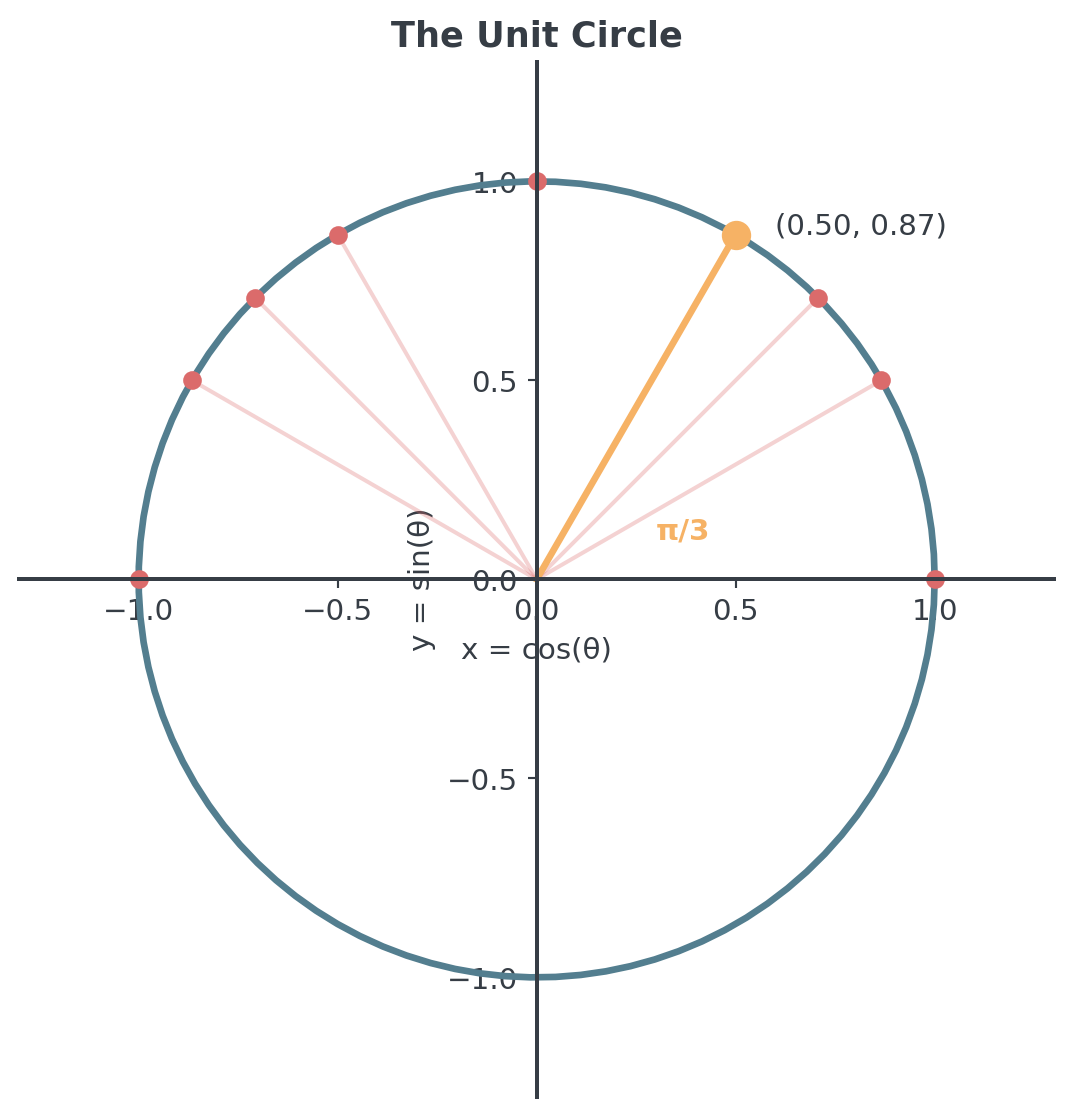
Defining the Unit Circle I
The unit circle is a circle with:
- Center at the origin (0, 0)
- Radius = 1
- Equation: \(x^2 + y^2 = 1\)
For any angle \(\theta\) from the positive x-axis:
- The point on the circle is \((\cos\theta, \sin\theta)\)
- This is the fundamental definition!
Every point on the unit circle can be written as \((cos θ, sin θ)\) for some angle θ!
Defining the Unit Circle II
Sine and Cosine
Sine Function Graph
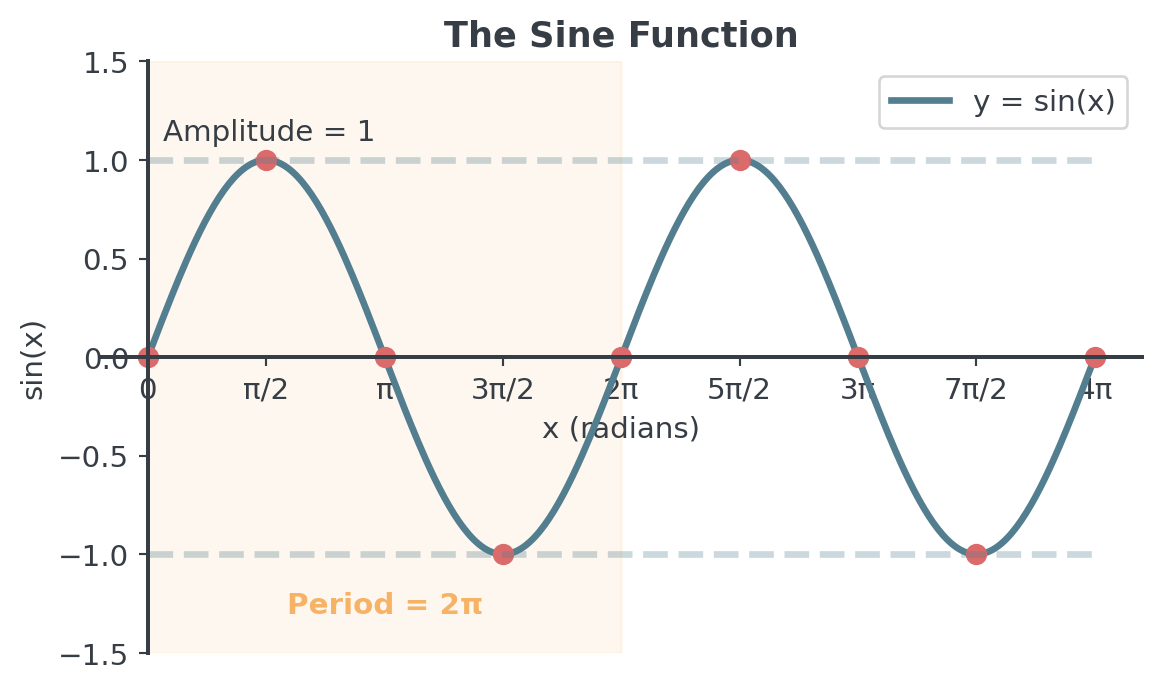
Domain: All real numbers, range: [-1; 1], period: 2π
Cosine Function Graph
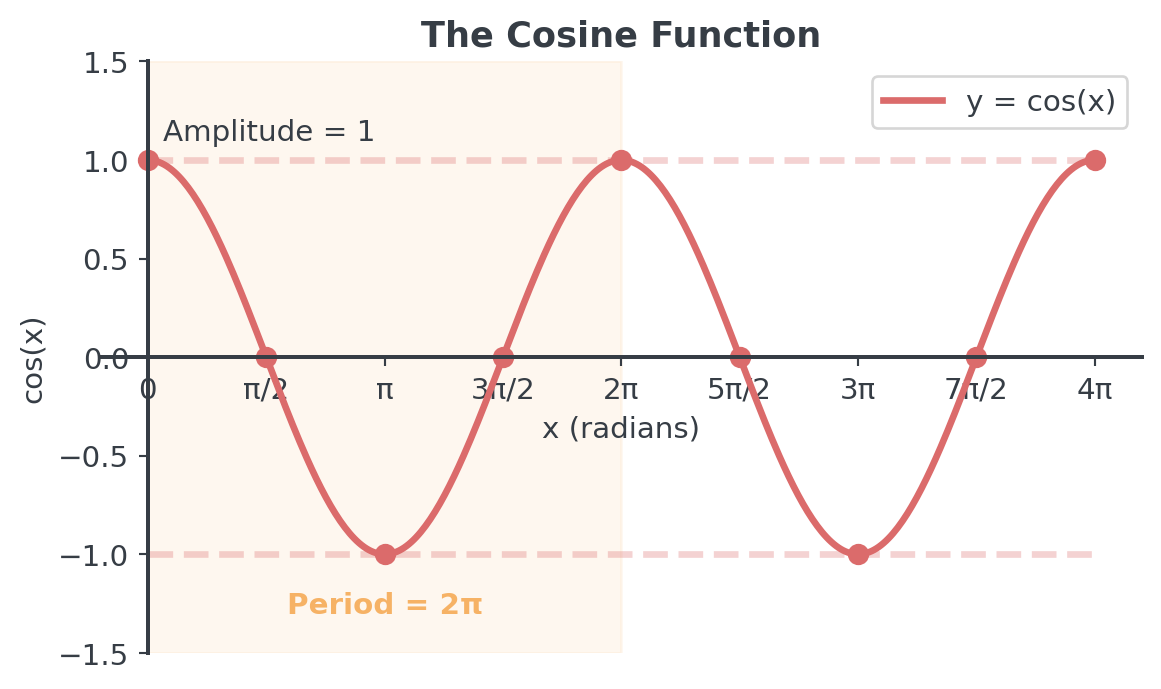
Domain: All real numbers, range: [-1; 1], period: 2π -> Shifted by π/2
Negative Transformations
Understanding -sin(x) and -cos(x)
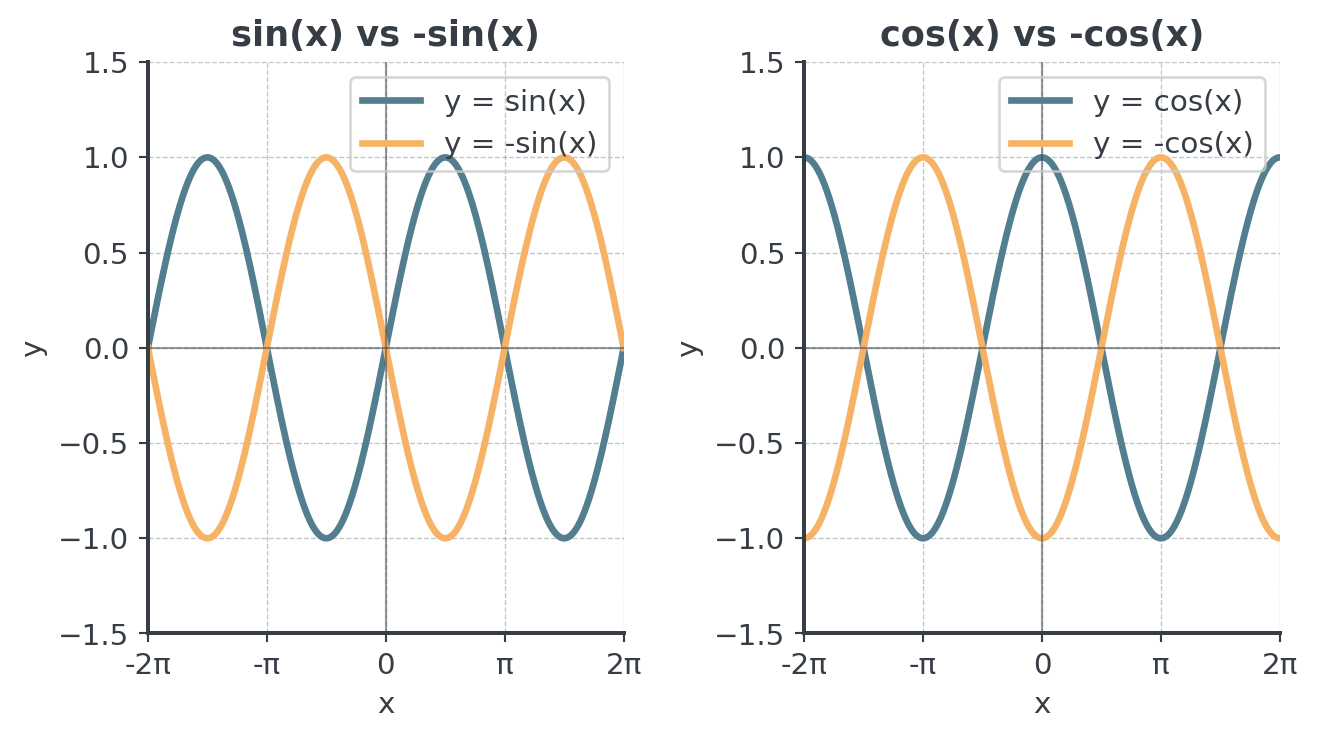
Multiplying by -1 creates a reflection across the x-axis!
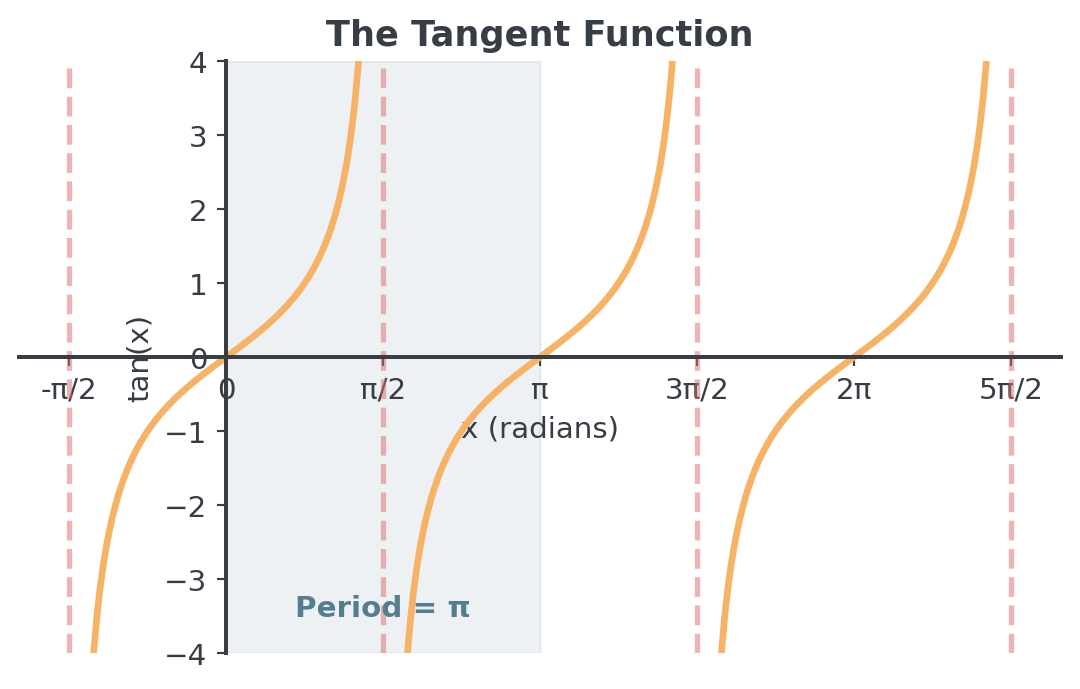
The Tangent Function
Definition and Graph
The ratio that creates asymptotes
Why Tangent Matters
Understanding slopes and angles
The tangent function has a special geometric meaning:
\[\tan(\theta) = \frac{\sin(\theta)}{\cos(\theta)}\]
Why Tangent Matters II
- Navigation & Surveying: Finding heights of buildings or mountains
- Physics: Calculating angles of projectile motion or inclined planes
- Computer Graphics: Rotating objects and calculating viewing angles
However, it is likely not important for the FSP and thus we won’t go into too much detail here!
Calculator: Trigonometry
Make sure angle mode is set correctly!
Check indicator: D = Degrees, R = Radians
| Function | Keys |
|---|---|
| \(\sin(x)\) | sin |
| \(\cos(x)\) | cos |
| \(\tan(x)\) | tan |
| \(\sin^{-1}(x)\) | SHIFT + sin |
| \(\tan^{-1}(x)\) | SHIFT + tan |
Example: \(\sin(30°) = 0.5\)
Amplitude and Period
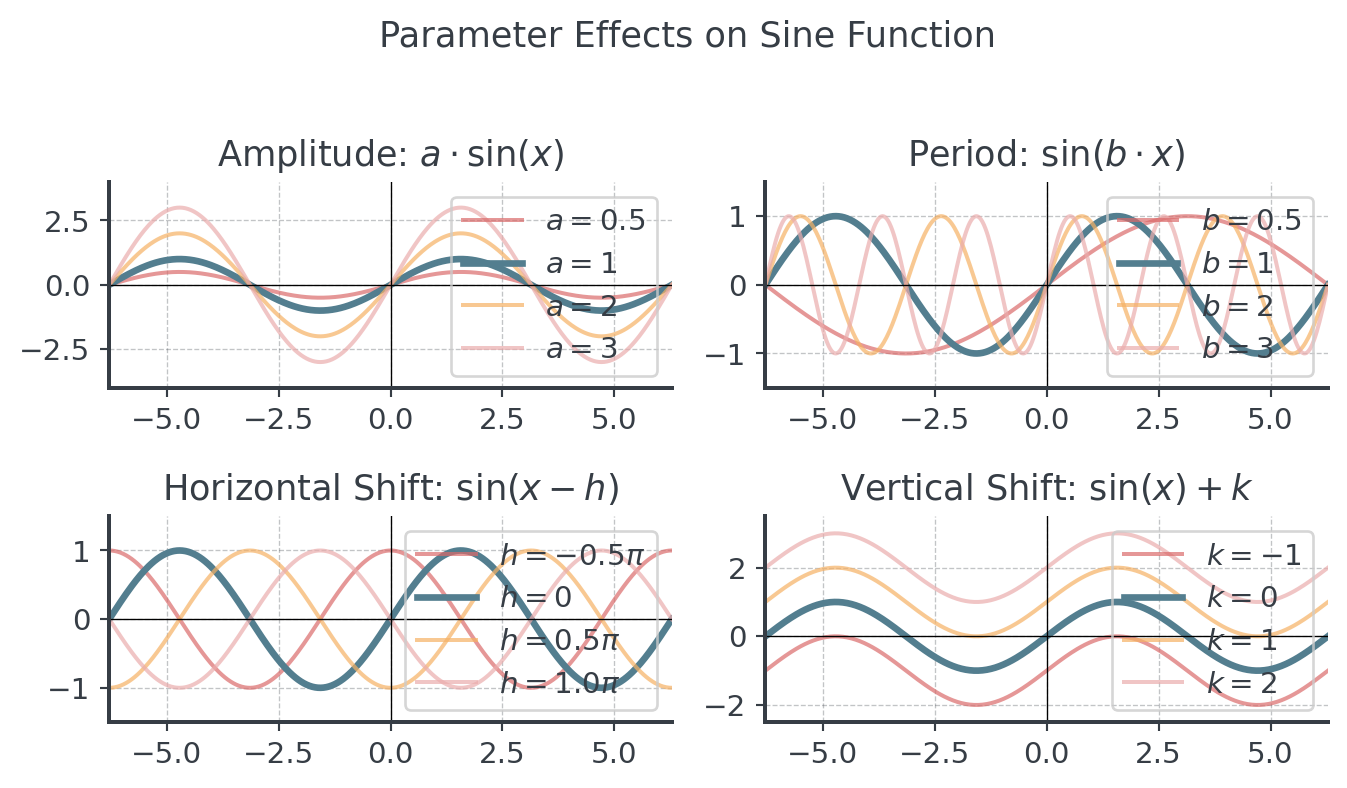
Transformations of Sine & Cosine I
Modifying the basic wave
General form: \(y = A\sin(B(x - C)) + D\)
- A: Amplitude (height of wave)
- B: Affects period (Period = 2π/B)
- C: Phase shift (horizontal shift)
- D: Midline \(y = D\) (vertical shift)
TipYou already know the order from functions!
Apply transformations in this order: horizontal stretch/compress, horizontal shift, vertical stretch/compress, vertical shift.
Transformations of Sine & Cosine II
Spot the Error: Trigonometry
Can you identify the errors? Work with your neighbor
Time allocation: 5 minutes to find errors, 5 minutes to discuss
Student work:
“Since sin(30°) = 0.5, then sin(60°) = 1”
“tan(90°) = sin(90°)/cos(90°) = 1/0 = ∞”
“The period of sin(3x) is 6π”
“cos²(x) + sin²(x) = 1 only when x = 0”
Reflect
Quickly think about these questions
- How are sine and cosine related to the unit circle?
- Why do we use radians instead of degrees in calculus?
- Think of real-world examples of periodic behavior
- Can you name three phenomena that oscillate?
Break
Applications
Sound Waves I
Music is trigonometry
A pure musical tone: \(y = A\sin(2\pi ft)\)
- A = amplitude (volume)
- f = frequency (pitch)
- t = time
Question: What happens if we increase the frequency?
Example: Middle A (440 Hz) \[y = \sin(2\pi \cdot 440 \cdot t) = \sin(880\pi t)\]
Sound Waves II
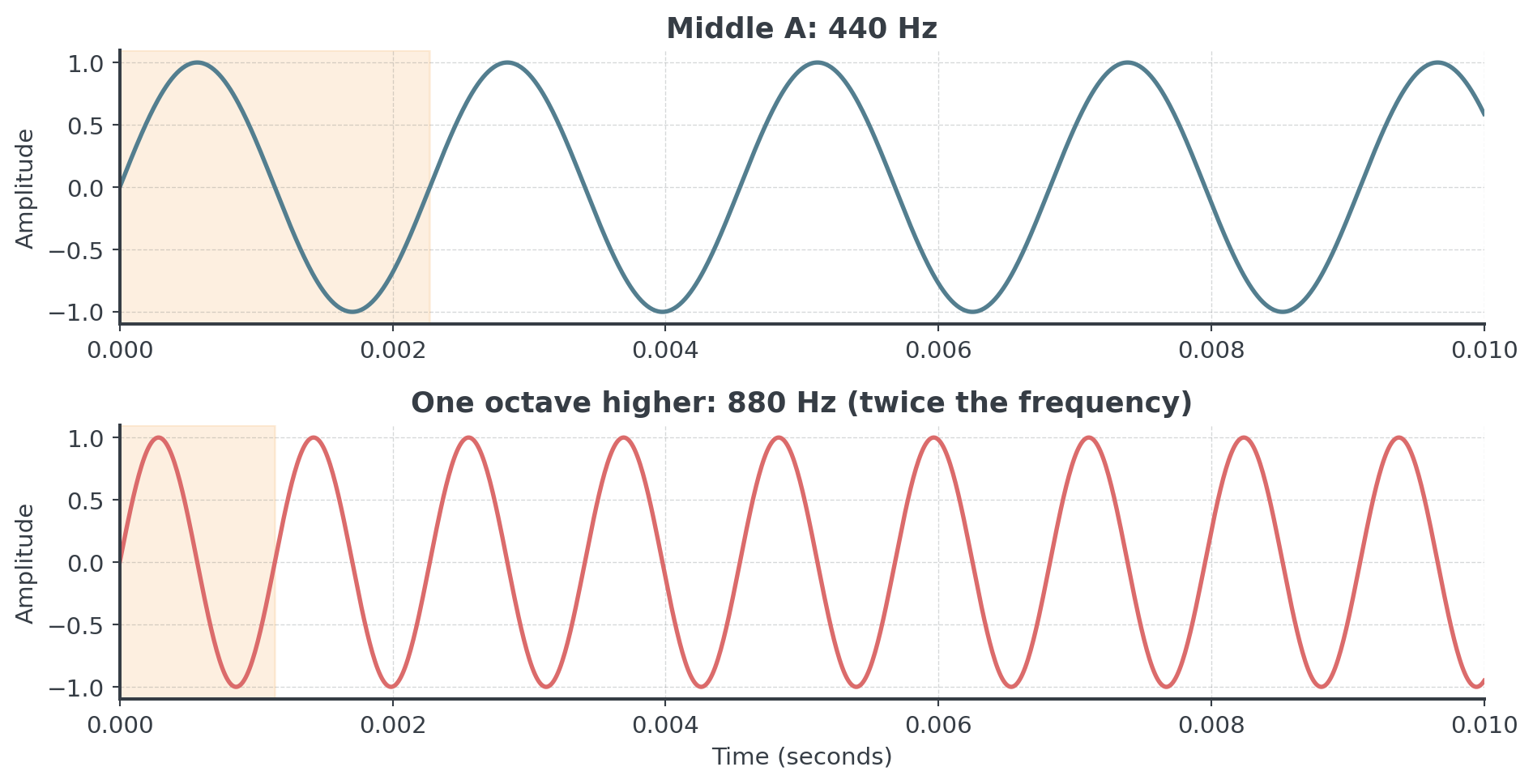
Notice: Doubling the frequency halves the period! The 880 Hz wave completes two cycles in the same time as 440 Hz completes one.
Seasonal Patterns I
Temperature variation
Average daily temperature in many locations: \[T(d) = A\sin\left(\frac{2\pi}{365}(d - C)\right) + T_{avg}\]
- d = day of year
- A = amplitude (half the difference between summer/winter)
- \(T_{avg}\) = average yearly temperature
- C = phase shift (adjusts when the peak occurs - typically 80-110 days)
Seasonal Patterns II
Hamburg’s temperature model
Using real Hamburg climate data (Weather Spark):
- Average annual temperature: \(T_{avg} = 9.2°C\)
- Warmest month (July): ~18°C
- Coldest months (Jan/Feb): ~1°C
- Amplitude: \(A = 8.5°C\)
\[T(d) = 8.5\sin\left(\frac{2\pi}{365}(d - 105)\right) + 9.2\]
Seasonal Patterns III
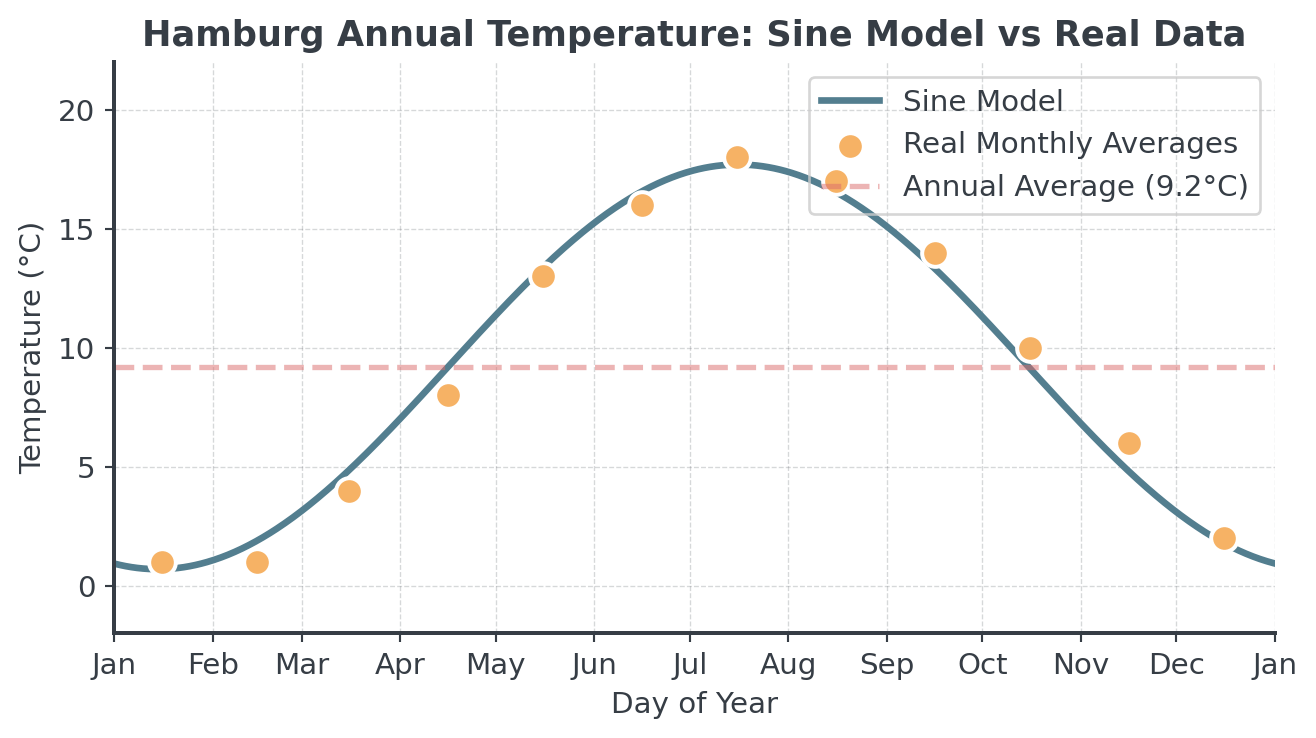
The sine function provides an great fit to Hamburg’s real climate data!
Guided Practice
Task 1: Function Properties
Work alone for 5 minutes, then discuss for 3 minutes
For \(y = 3\sin(2x) - 1\), find:
- Amplitude
- Period
- Midline
- Range
Task 2: Tidal Heights
Work alone for 5 minutes, then discuss for 3 minutes
The water depth in a harbor varies with the tides. At high tide, the water is 12 meters deep. At low tide, it is 4 meters deep. High tide occurs at noon, and the tide cycle repeats every 12 hours.
Write a function d(t) for the water depth t hours after noon.
Hint: What is the average depth? What is the amplitude?
Task 3: Matching Graphs
Work in pairs for 5 minutes, then discuss for 3 minutes
Match each equation to its description:
Equations:
\(y = 2\sin(x)\)
\(y = \sin(2x)\)
\(y = \sin(x) + 2\)
\(y = \sin\left(x + \frac{\pi}{2}\right)\)
Descriptions:
- Is shifted up 2 units
- Has amplitude 2
- Completes two cycles in 2π
- Looks like the cosine function
Task 4: Blood Pressure Modeling
Work alone for 7 minutes, then discuss for 4 minutes
A person’s blood pressure oscillates with each heartbeat. Suppose a person has: a maximum pressure (systolic): 120 mmHg, minimum pressure (diastolic): 80 mmHg and a heart rate: 72 beats per minute.
Questions:
- What is the amplitude of the blood pressure oscillation?
- What is the period in minutes?
- Write a function P(t) for blood pressure at time t minutes, assuming pressure starts at maximum.
Task 5: Ferris Wheel Challenge
Work alone for 5 minutes, then discuss for 3 minutes
A Ferris wheel with radius 20 meters completes one rotation every 4 minutes. The bottom of the wheel is 2 meters above ground. Write a function for the height of a rider at time t (in minutes), starting at the bottom.
Hints to consider:
- What is the center height of the wheel?
- What is the amplitude of the up-and-down motion?
- What is the period of rotation?
- Which function starts at the bottom: sine or cosine?
Inverse Trigonometry
Brief Addition
Going backwards
Sometimes we need to find the angle:
- If sin(θ) = 0.5, what is θ?
- Answer: θ = arcsin(0.5) = π/6 (or 30°)
Question: But wait! Doesn’t sin(150°) also equal 0.5?
Yes! That’s why we need restrictions…
Restricted Inverse
The inverse functions
- arcsin(x) or sin⁻¹(x): gives angle whose sine is x
- arccos(x) or cos⁻¹(x): gives angle whose cosine is x
- arctan(x) or tan⁻¹(x): gives angle whose tangent is x
To make inverses work, we restrict the output ranges (also called principal values):
- arcsin: [-π/2; π/2] (from -90° to 90°)
- arccos: [0; π] (from 0° to 180°)
- arctan: (-π/2; π/2) (from -90° to 90°, not including endpoints)
Visualizing Inverse Relationships
How sine and its inverse relate
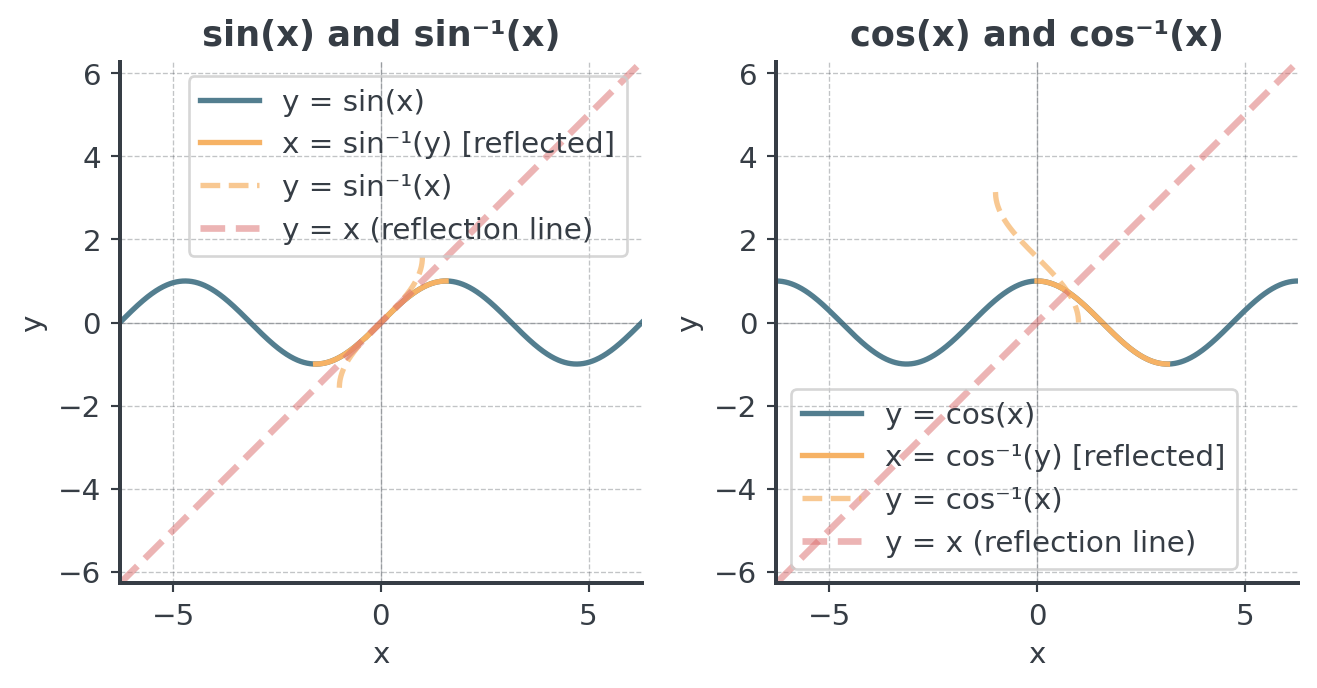
Inverse functions are reflections across the line y = x.
Challenge Problem
Combining Waves
Work individually for 8 minutes, then discuss for 4 minutes
Consider two sound waves where the combined wave is: \(y = y_1 + y_2\).
- Wave 1: \(y_1 = 2\sin(3x)\)
- Wave 2: \(y_2 = \sin(3x + \pi)\)
- Use the fact that \(\sin(x + \pi) = -\sin(x)\) to simplify y in terms of a single sine function.
- What is the amplitude and period of the combined wave?
Combining Waves II
- What happens if Wave 2 had amplitude 2: \(y_2 = 2\sin(3x + \pi) = -2\sin(3x)\)?
Coffee Break
FSP Workshop
Problem 1: Lettuce Under LEDs
A vertical farm grows lettuce indoors under LED lights. It buys electricity on a dynamic tariff, so the price changes over the day. On a winter weekday, the price \(p(t)\) in cents per kWh follows a sinusoidal function of the time \(t\) in hours after midnight, for one day \(t \in [0; 24]\). The price is highest at 18:00 with 42 cents per kWh, its midline is 30 cents per kWh, and the pattern repeats every 24 hours.
- Give \(p(t)\) in the form \(A\cos(B(t - C)) + D\) and explain how you find each parameter. Determine the lowest price and the time when it occurs. [4 pts.]
LEDs: The Dark Block
The lettuce needs 8 hours of darkness per day in one block. The farm switches the LEDs off during the 8 hours with the highest prices and runs them for the other 16 hours.
- Explain why this block lies symmetrically around 18:00 and determine it. Compute the price at its start and at its end. [4 pts.]
(for verification: \(p(t) = 12\cos\left(\frac{\pi}{12}(t - 18)\right) + 30\))
LEDs: Costs per Hour
While they are on, the LEDs draw 250 kW. So far, the farm ran them from 6:00 to 22:00.
- Give the lighting costs \(L(t)\) in EUR per hour while the LEDs are on and describe how the graph of \(L\) arises from the graph of \(p\). Determine the highest and the lowest hourly lighting cost with the new schedule from b) and compare the highest one with the old schedule. [4 pts.]
LEDs: The Summer Tariff
In summer, solar power flattens the curve. The price is highest at 20:00 with 38 cents per kWh and lowest with 22 cents per kWh. The period stays 24 hours.
- Show that the summer price is \(s(t) = \frac{2}{3}\,p(t - 2) + 10\). Describe the transformations from \(p\) to \(s\) in the correct order. Determine the summer dark block and the price at its ends. [4 pts.]
Key Concepts
Key Takeaways
You’ve learned
- Angle measurement in degrees and radians
- The unit circle and its significance
- Sine, cosine, and tangent functions
- Graphing and transformations
- Real-world periodic phenomena
Final Assessment
5 minutes - Individual work
Quick Check:
Convert 45° to radians
What is the period of y = sin(4x)?
What is the amplitude of y = -3cos(x) + 2?
Looking Ahead
Next Session: Mock Exam 05
Session 04-05 is exam only - no lecture
- 90 minutes working time plus 5 minutes reading time, 50 points
- Covers all of Section 04: polynomial, power, rational, exponential, logarithmic and trigonometric functions
- Allowed: non-programmable calculator, drawing instruments, monolingual dictionary
- Not allowed: notes, formula sheets, any electronic devices
- Counts toward the 60% of test points needed for exam admission
Preparing for Mock Exam 05
Complete Tasks 04-04, then prepare for Mock Exam 05 with FSP Training 04 (sidebar, Section 04 worksheets). The mock exam builds on both!