Tasks 06-01 - Antiderivatives & Indefinite Integrals
Section 06: Integral Calculus
A: Skills
Problem 1: Power Rule (x)
An antiderivative (German: Stammfunktion) of \(f\) is a function \(F\) with \(F'(x) = f(x)\). Determine the indefinite integrals. Check your results for d) and f) by differentiating.
\(\int x^7 \, dx\)
\(\int 18x^8 \, dx\)
\(\int (3x^2 - 14x + 5) \, dx\)
\(\int (8x^3 + 3x^2 - 6x - 2) \, dx\)
\(\int 2.5 \, dt\)
\(\int (0.4x^4 - 1.5x^2 + 0.8x) \, dx\)
CautionSolution
Power rule: add 1 to the power and divide by the new power, \(\int x^n \, dx = \frac{x^{n+1}}{n+1} + C\) for \(n \neq -1\). Constant factors stay, and sums are integrated term by term.
\(\int x^7 \, dx = \frac{x^8}{8} + C\)
\(\int 18x^8 \, dx = 18 \cdot \frac{x^9}{9} + C = 2x^9 + C\)
\(\int (3x^2 - 14x + 5) \, dx = 3 \cdot \frac{x^3}{3} - 14 \cdot \frac{x^2}{2} + 5x + C = x^3 - 7x^2 + 5x + C\)
\(\int (8x^3 + 3x^2 - 6x - 2) \, dx = 8 \cdot \frac{x^4}{4} + 3 \cdot \frac{x^3}{3} - 6 \cdot \frac{x^2}{2} - 2x + C = 2x^4 + x^3 - 3x^2 - 2x + C\)
Check: \(\frac{d}{dx}\left[2x^4 + x^3 - 3x^2 - 2x + C\right] = 8x^3 + 3x^2 - 6x - 2\) ✓
The variable is \(t\): \(\int 2.5 \, dt = 2.5t + C\)
\(\int (0.4x^4 - 1.5x^2 + 0.8x) \, dx = 0.4 \cdot \frac{x^5}{5} - 1.5 \cdot \frac{x^3}{3} + 0.8 \cdot \frac{x^2}{2} + C = 0.08x^5 - 0.5x^3 + 0.4x^2 + C\)
Check: \(\frac{d}{dx}\left[0.08x^5 - 0.5x^3 + 0.4x^2 + C\right] = 0.4x^4 - 1.5x^2 + 0.8x\) ✓
Typical mistake: multiplying by the new power instead of dividing, e.g. \(\int 18x^8 \, dx = 162x^9\). That is the rule for derivatives. A check by differentiating shows the mistake at once: \((162x^9)' = 1458x^8\).
Problem 2: Negative and Fractional Powers (x)
Rewrite each integrand as a sum of powers of \(x\). Then determine the integral. Assume \(x > 0\).
\(\int \frac{1}{x^5} \, dx\)
\(\int \frac{10}{x^6} \, dx\)
\(\int \sqrt[3]{x} \, dx\)
\(\int x\sqrt{x} \, dx\)
\(\int \left(\sqrt{x} - 1\right)^2 \, dx\)
\(\int \frac{x^3 - 5}{x^2} \, dx\)
CautionSolution
\(\int x^{-5} \, dx = \frac{x^{-4}}{-4} + C = -\frac{1}{4x^4} + C\)
\(\int 10x^{-6} \, dx = 10 \cdot \frac{x^{-5}}{-5} + C = -2x^{-5} + C = -\frac{2}{x^5} + C\)
\(\int x^{1/3} \, dx = \frac{x^{4/3}}{4/3} + C = \frac{3}{4}x^{4/3} + C = \frac{3}{4}x\sqrt[3]{x} + C\)
\(x\sqrt{x} = x^1 \cdot x^{1/2} = x^{3/2}\), so \(\int x^{3/2} \, dx = \frac{x^{5/2}}{5/2} + C = \frac{2}{5}x^{5/2} + C = \frac{2}{5}x^2\sqrt{x} + C\)
Expand first with the perfect square pattern \((a - b)^2 = a^2 - 2ab + b^2\): \(\left(\sqrt{x} - 1\right)^2 = x - 2\sqrt{x} + 1 = x - 2x^{1/2} + 1\).
\[\int \left(x - 2x^{1/2} + 1\right) dx = \frac{x^2}{2} - 2 \cdot \frac{x^{3/2}}{3/2} + x + C = \frac{x^2}{2} - \frac{4}{3}x^{3/2} + x + C\]
Divide each term by \(x^2\): \(\frac{x^3 - 5}{x^2} = x - 5x^{-2}\).
\[\int \left(x - 5x^{-2}\right) dx = \frac{x^2}{2} - 5 \cdot \frac{x^{-1}}{-1} + C = \frac{x^2}{2} + \frac{5}{x} + C\]
Check: \(\frac{d}{dx}\left[\frac{x^2}{2} + 5x^{-1}\right] = x - 5x^{-2} = \frac{x^3 - 5}{x^2}\) ✓
Typical mistake: integrating a product or a quotient part by part, e.g. \(\int \frac{x^3 - 5}{x^2} \, dx = \frac{x^4/4 - 5x}{x^3/3}\). There is no such rule. Rewrite the integrand as a sum of powers first, then use the power rule term by term.
Problem 3: Initial Value Problems (xx)
Determine the function \(f\) from its derivative and the initial condition. Check the initial condition.
\(f'(x) = 4x - 3\), \(f(2) = 1\)
\(f'(x) = 3x^2 + 8x - 5\), \(f(1) = -2\)
\(f'(x) = x^3 + 2x\), \(f(-2) = 3\)
\(f'(x) = 3\sqrt{x}\), \(f(4) = 10\) (for \(x \geq 0\))
Determine the antiderivative \(F\) of \(f(x) = 6x - 12\) whose graph touches the \(x\)-axis.
Hint: Where a graph touches the \(x\)-axis, it has a zero and a horizontal tangent there.
CautionSolution
Steps from the lecture: find the general antiderivative with \(+C\), put in the initial condition, solve for \(C\).
\(f(x) = 2x^2 - 3x + C\). \(f(2) = 8 - 6 + C = 2 + C = 1\), so \(C = -1\).
\[f(x) = 2x^2 - 3x - 1\]
Check: \(f(2) = 8 - 6 - 1 = 1\) ✓
\(f(x) = x^3 + 4x^2 - 5x + C\). \(f(1) = 1 + 4 - 5 + C = 0 + C = -2\), so \(C = -2\).
\[f(x) = x^3 + 4x^2 - 5x - 2\]
Check: \(f(1) = 1 + 4 - 5 - 2 = -2\) ✓
\(f(x) = \frac{x^4}{4} + x^2 + C\). \(f(-2) = \frac{16}{4} + 4 + C = 8 + C = 3\), so \(C = -5\).
\[f(x) = \frac{x^4}{4} + x^2 - 5\]
Check: \(f(-2) = 4 + 4 - 5 = 3\) ✓
\(3\sqrt{x} = 3x^{1/2}\), so \(f(x) = 3 \cdot \frac{x^{3/2}}{3/2} + C = 2x^{3/2} + C\). With \(4^{3/2} = \left(\sqrt{4}\right)^3 = 8\): \(f(4) = 16 + C = 10\), so \(C = -6\).
\[f(x) = 2x^{3/2} - 6 = 2x\sqrt{x} - 6\]
Check: \(f(4) = 2 \cdot 4 \cdot 2 - 6 = 10\) ✓
General antiderivative: \(F(x) = 3x^2 - 12x + C\). A horizontal tangent needs \(F'(x) = f(x) = 0\), i.e. \(6x - 12 = 0\) and \(x = 2\). There the graph touches the \(x\)-axis, so \(F(2) = 0\):
\[F(2) = 12 - 24 + C = 0 \iff C = 12, \qquad F(x) = 3x^2 - 12x + 12 = 3(x - 2)^2\]
Check: \(F(x) = 3(x - 2)^2\) has the double zero \(x = 2\) (even multiplicity), so its graph touches the \(x\)-axis there ✓
Typical mistake: putting the initial condition into the derivative, e.g. \(f'(2) = 1\) in a). The condition is a point on the graph of \(f\), so it belongs to \(f\), not to \(f'\).
Problem 4: Proving an Antiderivative (xx)
\(F\) is an antiderivative of \(f\) if \(F'(x) = f(x)\). So you prove it by differentiating \(F\).
Prove that \(F(x) = (x^2 + 5)^2\) is an antiderivative of \(f(x) = 4x^3 + 20x\).
Prove that \(F(x) = (4 - 2x) \cdot e^{-0.5x}\) is an antiderivative of \(f(x) = (x - 4) \cdot e^{-0.5x}\).
Show that \(F_1(x) = x^2 + 24x\) and \(F_2(x) = (x + 12)^2\) are both antiderivatives of \(f(x) = 2x + 24\). Explain why this is no contradiction and give the constant by which \(F_1\) and \(F_2\) differ.
A student integrates each factor on its own and writes \(\int 2x(x^2 + 1) \, dx = x^2 \cdot \left(\frac{x^3}{3} + x\right) + C\). Decide by differentiating whether the student is right. Determine the correct integral.
CautionSolution
Chain rule with the outer function \(u^2\) and the inner function \(u = x^2 + 5\), \(u' = 2x\):
\[F'(x) = 2(x^2 + 5) \cdot 2x = 4x^3 + 20x = f(x) \quad \checkmark\]
(Or expand first: \(F(x) = x^4 + 10x^2 + 25\), so \(F'(x) = 4x^3 + 20x\).)
Product rule with \(u = 4 - 2x\), \(u' = -2\) and \(v = e^{-0.5x}\), \(v' = -0.5e^{-0.5x}\) (chain rule):
\[F'(x) = -2 \cdot e^{-0.5x} + (4 - 2x) \cdot (-0.5)e^{-0.5x} = (-2 - 2 + x) \cdot e^{-0.5x} = (x - 4) \cdot e^{-0.5x} = f(x) \quad \checkmark\]
\(F_1'(x) = 2x + 24\) ✓ and, with the chain rule, \(F_2'(x) = 2(x + 12) \cdot 1 = 2x + 24\) ✓.
No contradiction: a function has infinitely many antiderivatives, and they differ only by a constant. Here \(F_2(x) = x^2 + 24x + 144 = F_1(x) + 144\). The graph of \(F_2\) is the graph of \(F_1\) moved up by 144. Both graphs have the same slope at every \(x\).
Differentiate the student’s result with the product rule:
\[2x \cdot \left(\frac{x^3}{3} + x\right) + x^2 \cdot (x^2 + 1) = \frac{2}{3}x^4 + 2x^2 + x^4 + x^2 = \frac{5}{3}x^4 + 3x^2 \neq 2x^3 + 2x\]
The student is wrong. Correct: expand first, \(2x(x^2 + 1) = 2x^3 + 2x\), then
\[\int (2x^3 + 2x) \, dx = \frac{x^4}{2} + x^2 + C\]
Check: \(\frac{d}{dx}\left[\frac{x^4}{2} + x^2\right] = 2x^3 + 2x\) ✓
Typical mistake: d) itself. There is no product rule that integrates factor by factor. Expand the product, then integrate term by term.
Problem 5: Sketching an Antiderivative from a Graph (xx)
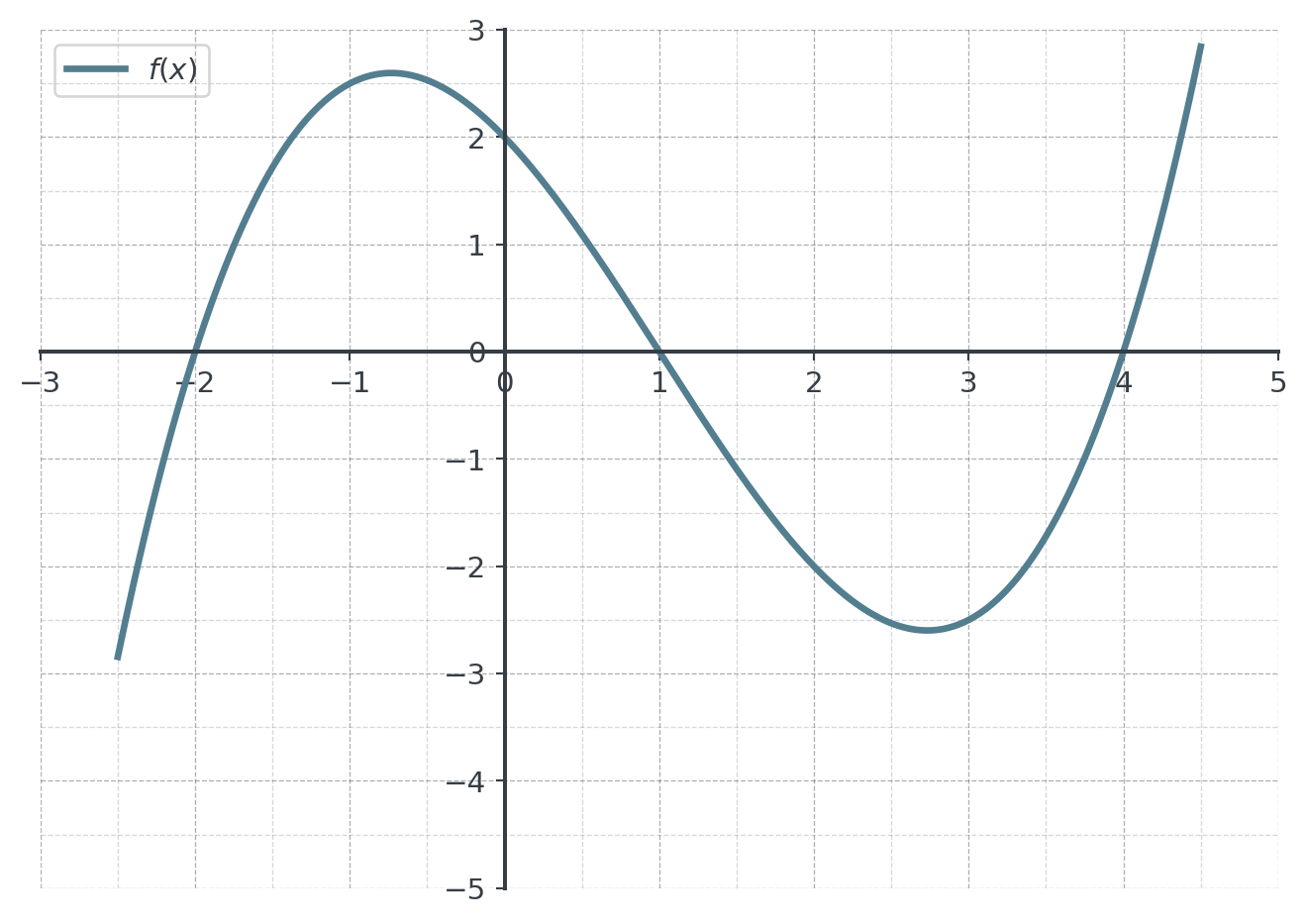
The figure shows the graph of a function \(f\) on the interval \([-2.5; 4.5]\).
Note: Print the page or copy the figure onto squared paper. In the exam, you draw directly into the printed figure.
Give the intervals on which an antiderivative \(F\) of \(f\) increases and decreases. Determine the \(x\)-values of the local extrema of \(F\) and their type.
Estimate the \(x\)-values of the inflection points of \(F\). Give the intervals on which \(F\) is concave up and concave down.
Sketch a possible antiderivative \(F\) with \(F(0) = 0\) directly into the figure.
Hint: Because \(F' = f\), the rules from Session 05-05 apply to \(F\): \(F\) increases where \(f\) is positive, \(F\) has a local extremum where \(f\) changes sign, and \(F\) has an inflection point where \(f\) has a local extremum.
CautionSolution
- The zeros of \(f\) are \(x = -2\), \(x = 1\) and \(x = 4\). Since \(F' = f\), the sign of \(f\) is the sign of the slope of \(F\):
| \(x\) | \(-2.5 < x < -2\) | \(-2 < x < 1\) | \(1 < x < 4\) | \(4 < x < 4.5\) |
|---|---|---|---|---|
| \(f(x) = F'(x)\) | \(-\) | \(+\) | \(-\) | \(+\) |
| \(F\) | decreasing | increasing | decreasing | increasing |
- \(x = -2\): \(f\) changes from \(-\) to \(+\), local minimum of \(F\)
- \(x = 1\): \(f\) changes from \(+\) to \(-\), local maximum of \(F\)
- \(x = 4\): \(f\) changes from \(-\) to \(+\), local minimum of \(F\)
- \(f\) has a local maximum at about \(x \approx -0.7\) and a local minimum at about \(x \approx 2.7\). There, the slope of \(F\) is largest or smallest, so \(F\) has its inflection points at \(x \approx -0.7\) and \(x \approx 2.7\). Where \(f = F'\) increases, \(F\) is concave up, and where \(f\) decreases, \(F\) is concave down:
- concave up for \(-2.5 < x < -0.7\) and \(2.7 < x < 4.5\)
- concave down for \(-0.7 < x < 2.7\)
- Start at \((0, 0)\). \(F\) increases there (towards the maximum at \(x = 1\)). To the left, \(F\) falls back to the minimum at \(x = -2\), to the right it falls from \(x = 1\) to the minimum at \(x = 4\) and rises again at the end. Your sketch only needs this shape: extrema and inflection points at the right \(x\)-values and the curve through \((0, 0)\). The figure shows the exact antiderivative for comparison (circles: extrema, squares: inflection points).
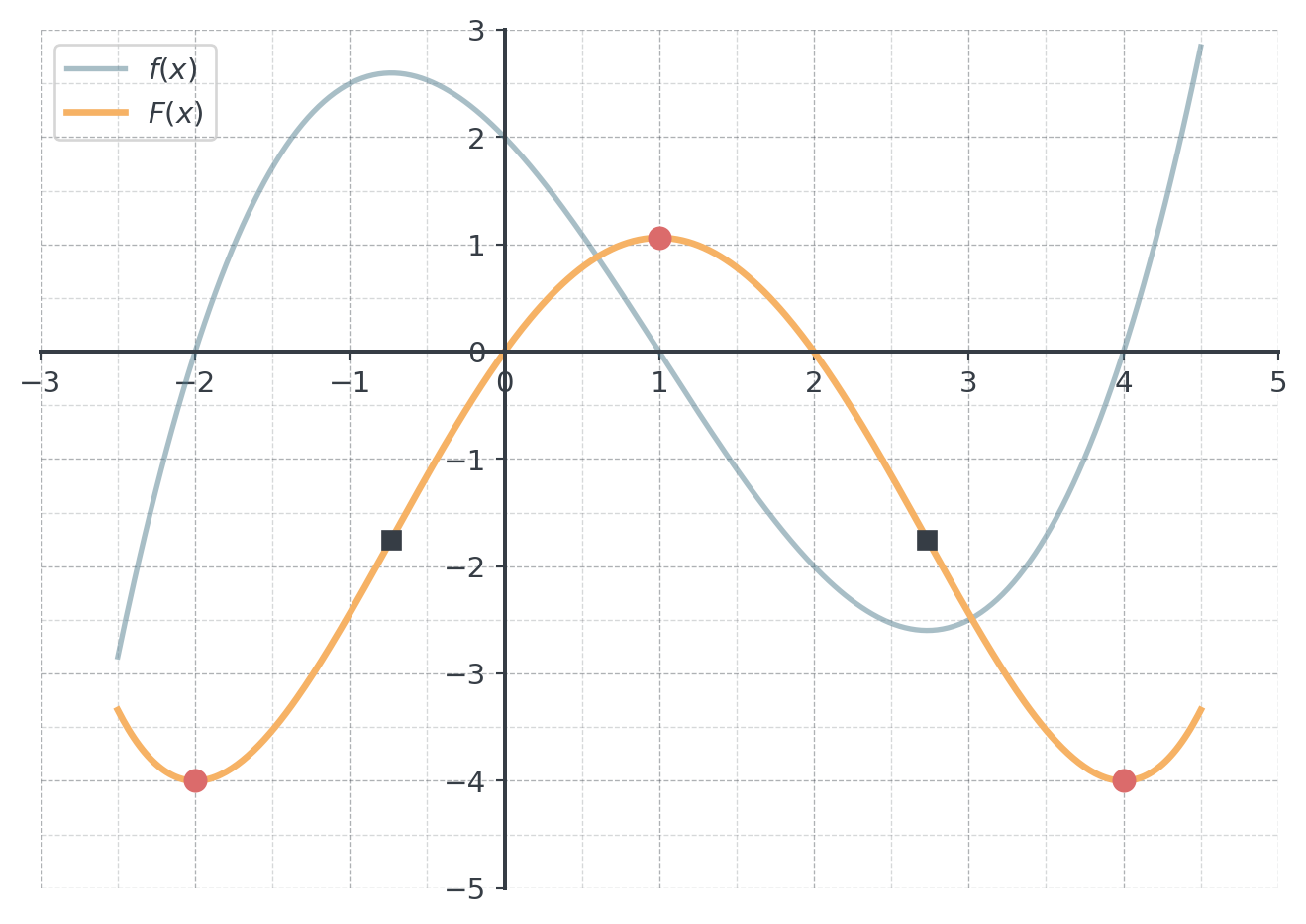
Typical mistake: putting the extrema of \(F\) at the extrema of \(f\). That is the rule for \(f'\). For \(F\), the extrema lie at the zeros of \(f\) (with a sign change), and the extrema of \(f\) become the inflection points of \(F\).
B: Set Up & Check
Problem 6: From Rates to Functions (xx)
Translate each statement into mathematics. Then answer the check question: it tells you whether your translation works. (QU = quantity units, MU = monetary units)
A company makes sleeping bags: “At an output of \(x\) sleeping bags per day, the marginal costs are \(C'(x) = 0.3x^2 - 12.6x + 150\) EUR per sleeping bag.” Write down the cost function \(C(x)\) as far as this sentence allows.
Check: A trainee writes \(C(x) = 0.6x - 12.6\). What did the trainee compute? Check your own \(C(x)\) by differentiating.
A company makes wall clocks: “The marginal costs are \(C'(x) = 4x + 44\) MU per QU. The fixed costs are 300 MU per month.” Write down the condition for the fixed costs and determine \(C(x)\).
Check: A colleague writes \(C(x) = 2(x + 11)^2 + k\). Show by differentiating that this is also an antiderivative of \(C'\). Is \(k = 300\)?
An online shop sells jigsaw puzzles: “The marginal revenue is \(R'(x) = 45 - 0.36x\) EUR per puzzle for \(x\) puzzles per day. Without sales, there is no revenue.” Write down the condition and determine \(R(x)\).
Check: Determine the price-demand function \(p(x) = \frac{R(x)}{x}\) and the maximum price. A colleague adds the fixed costs of 400 EUR per day and writes \(R(x) = 45x - 0.18x^2 + 400\). What would this revenue function say about a day without sales?
A shop sells houseplants online: “The marginal profit is \(P'(x) = 52.8 - 1.2x\) EUR per plant for \(x\) plants per week. The fixed costs are 700 EUR per week.” Write down the condition that fixes the constant of integration and determine \(P(x)\).
Check: The marginal revenue is \(R'(x) = 60 - 0.8x\) EUR per plant. Determine the marginal costs. A colleague uses \(P(0) = 700\). Compute the profit of 40 plants with the colleague’s condition and with yours.
An exam problem says: “The graph of the antiderivative \(F\) of \(f(x) = 3x^2 - 22x + 1\) passes through the point \((3, 2)\).” Write down the condition and determine \(F(x)\).
Check: Which of \(F_1(x) = x^3 - 11x^2 + x + 71\) and \(F_2(x) = x^3 - 11x^2 + x + 2\) fulfils your condition? What did the author of the other one do?
CautionSolution
The marginal costs are the derivative of the costs, so the cost function is an antiderivative of \(C'\):
\[C(x) = \int (0.3x^2 - 12.6x + 150) \, dx = 0.1x^3 - 6.3x^2 + 150x + k\]
The constant \(k\) stays unknown: the sentence gives no fixed costs.
Check: \(0.6x - 12.6\) is the derivative of \(C'(x)\), i.e. \(C''(x)\). The trainee differentiated instead of integrating. Your function: \(\frac{d}{dx}\left[0.1x^3 - 6.3x^2 + 150x + k\right] = 0.3x^2 - 12.6x + 150\) ✓
Typical mistake: differentiating the marginal costs. They already are a derivative. The cost function lies one step back: it is the function whose derivative is \(C'\).
The fixed costs are the costs without production:
\[C(0) = 300, \qquad C(x) = 2x^2 + 44x + k \text{ with } C(0) = k = 300, \qquad C(x) = 2x^2 + 44x + 300\]
Check: with the chain rule, \(\frac{d}{dx}\left[2(x + 11)^2 + k\right] = 4(x + 11) = 4x + 44\) ✓. But \(k \neq 300\): the condition gives \(C(0) = 2 \cdot 121 + k = 242 + k = 300\), so \(k = 58\). Then \(C(x) = 2(x + 11)^2 + 58 = 2x^2 + 44x + 300\), the same function as above.
Typical mistake: setting the constant equal to the fixed costs without computing \(C(0)\). This only works if \(C\) is written as a sum of powers of \(x\), because then every other term is 0 at \(x = 0\).
\[R(0) = 0, \qquad R(x) = \int (45 - 0.36x) \, dx = 45x - 0.18x^2 + k \text{ with } k = R(0) = 0, \qquad R(x) = 45x - 0.18x^2\]
Check: \(p(x) = \frac{45x - 0.18x^2}{x} = 45 - 0.18x\) EUR per puzzle. The maximum price is \(p(0) = 45\) EUR per puzzle: at this price or more, the shop sells no puzzle. The colleague’s function gives \(R(0) = 400\): 400 EUR revenue on a day without a single sale. That is impossible.
Typical mistake: a constant other than 0 in the revenue function. The fixed costs belong to the cost function, not to the revenue.
Without sales, there is no revenue, but the fixed costs have to be paid:
\[P(0) = R(0) - C(0) = 0 - 700 = -700, \qquad P(x) = \int (52.8 - 1.2x) \, dx = 52.8x - 0.6x^2 - 700\]
Check: \(P'(x) = R'(x) - C'(x)\), so \(C'(x) = R'(x) - P'(x) = 60 - 0.8x - 52.8 + 1.2x = 7.2 + 0.4x\) EUR per plant. Profit of 40 plants: \(P(40) = 2112 - 960 - 700 = 452\) EUR per week. With \(P(0) = 700\), the colleague gets \(2112 - 960 + 700 = 1852\) EUR, i.e. 1,400 EUR too much.
Typical mistake: \(P(0) = 700\) with the wrong sign. The profit without production is a loss equal to the fixed costs.
The point lies on the graph of \(F\):
\[F(3) = 2, \qquad F(x) = x^3 - 11x^2 + x + k, \qquad F(3) = 27 - 99 + 3 + k = -69 + k = 2 \iff k = 71\]
Check: \(F_1(3) = -69 + 71 = 2\) ✓, so \(F_1\) fulfils the condition. \(F_2(3) = -69 + 2 = -67 \neq 2\). The author of \(F_2\) put the \(y\)-value 2 as the constant. This only works for a point with \(x = 0\): \(F_2\) passes through \((0, 2)\), not through \((3, 2)\).
Typical mistake: writing the condition as \(f(3) = 2\). The point belongs to the graph of the antiderivative \(F\), not to \(f\). Here \(f(3) = 27 - 66 + 1 = -38\).
Problem 7: One Paragraph, All Conditions (xx)
A company produces cordless vacuum cleaners and sells them to retail chains. At an output of \(x\) QU, its marginal costs are \(C'(x) = 0.9x^2 - 12x + 70\) MU per QU. Even without production, the company pays 150 MU per month for its hall and its permanent staff. At the start of the sales, the marginal revenue is 130 MU per QU, and it falls by 10 MU per QU with every further QU. Without sales, there is no revenue. The owner wants to know the output with the maximum profit, a proof that it really is a maximum, and the price that the retail chains pay at this output.
List every condition and every function in this paragraph as a mathematical statement. Do not solve anything.
Check: An assistant writes the sentence about the 150 MU as \(C'(0) = 150\). Explain what is wrong. Show that the correct condition and \(R(0) = 0\) give \(P(0) = -150\).
CautionSolution
- Cost function: an antiderivative of the marginal costs, \(C(x) = \int (0.9x^2 - 12x + 70) \, dx\) with a constant of integration
- Fixed costs: \(C(0) = 150\)
- Marginal revenue, starting at 130 and falling by 10 per QU: \(R'(x) = 130 - 10x\)
- Revenue: an antiderivative of \(R'\) with \(R(0) = 0\)
- Profit: \(P(x) = R(x) - C(x)\), so \(P'(x) = R'(x) - C'(x)\)
- Price: \(p(x) = \frac{R(x)}{x}\) for \(x > 0\)
- Maximum profit at \(x_0\): \(P'(x_0) = 0\) and \(P''(x_0) < 0\) (or \(P'\) changes its sign from \(+\) to \(-\) at \(x_0\)), with \(x_0\) the only critical point for \(x \geq 0\). The price is \(p(x_0)\).
Check: the 150 MU are costs, not marginal costs. They arise at \(x = 0\) as a total, so the condition is on \(C\): \(C(0) = 150\). \(C'(0) = 150\) would say that the first units cost 150 MU per QU extra. It also contradicts the given marginal costs, \(C'(0) = 70\). With the correct condition:
\[P(0) = R(0) - C(0) = 0 - 150 = -150\]
Typical mistake: writing the marginal revenue as the revenue, \(R(x) = 130 - 10x\). The sentence describes how fast the revenue grows. The revenue itself is the antiderivative with \(R(0) = 0\).
C: Applied
Problem 8: Costs of a Picture Frame Workshop (xx)
A small workshop makes wooden picture frames for art galleries. At an output of \(x\) frames per week, its marginal costs are
\[C'(x) = 0.03x^2 - 1.92x + 45\]
EUR per frame. The fixed costs (rent, machines, insurance) are 1,500 EUR per week. At the moment, the workshop makes 50 frames per week.
- Find the cost function \(C(x)\) and check it by differentiating. Explain what the constant of integration means for the workshop.
(for verification: \(C(x) = 0.01x^3 - 0.96x^2 + 45x + 1500\))
Compute the weekly costs of 50 frames and the average costs (the total costs per frame).
A gallery orders 10 extra frames per week and pays 28 EUR per frame. Compute the extra costs \(C(60) - C(50)\) and decide whether the order pays off. The owner estimates the extra costs as \(10 \cdot C'(50)\). Compare the estimate with the extra costs and explain the difference.
Determine the output with the lowest marginal costs and give these marginal costs. Explain what this output means for the graph of \(C\).
CautionSolution
a) The cost function is an antiderivative of the marginal costs. Power rule term by term:
\[C(x) = \int (0.03x^2 - 1.92x + 45) \, dx = 0.03 \cdot \frac{x^3}{3} - 1.92 \cdot \frac{x^2}{2} + 45x + k = 0.01x^3 - 0.96x^2 + 45x + k\]
The fixed costs are the costs without production: \(C(0) = k = 1500\).
\[C(x) = 0.01x^3 - 0.96x^2 + 45x + 1500\]
Check: \(C'(x) = 0.03x^2 - 1.92x + 45\) ✓ and \(C(0) = 1500\) ✓
Meaning: the constant of integration is \(C(0)\), the fixed costs of 1,500 EUR per week. The workshop pays them even in a week without a single frame. The marginal costs cannot show them, because a constant disappears when you differentiate.
b) \(C(50) = 1250 - 2400 + 2250 + 1500 = 2600\) EUR per week. Average costs:
\[\frac{C(50)}{50} = \frac{2600}{50} = 52 \text{ EUR per frame}\]
c) \(C(60) = 2160 - 3456 + 2700 + 1500 = 2904\), so the extra costs are
\[C(60) - C(50) = 2904 - 2600 = 304 \text{ EUR per week}\]
The order brings \(10 \cdot 28 = 280\) EUR per week. \(280 < 304\): the order does not pay off, it lowers the profit by 24 EUR per week.
Estimate: \(C'(50) = 75 - 96 + 45 = 24\) EUR per frame, so \(10 \cdot C'(50) = 240\) EUR. The estimate is 64 EUR too low. It prices all ten extra frames with the marginal costs at 50 frames. But the marginal costs grow: \(C'(60) = 108 - 115.2 + 45 = 37.80\) EUR per frame. Every further frame costs a bit more than the one before. With the estimate, the owner would accept the order and expect 40 EUR extra profit per week, but in fact the workshop loses 24 EUR.
d) The graph of \(C'\) is a parabola that opens upward (\(0.03 > 0\)). Its vertex gives the lowest marginal costs:
\[x = \frac{1.92}{2 \cdot 0.03} = 32, \qquad C'(32) = 30.72 - 61.44 + 45 = 14.28 \text{ EUR per frame}\]
Meaning for \(C\): \(C''(x) = 0.06x - 1.92\), so \(C''(32) = 0\) and \(C'''(x) = 0.06 \neq 0\). At 32 frames, \(C\) has an inflection point, \((32, 2284.64)\) with \(C(32) = 327.68 - 983.04 + 1440 + 1500 = 2284.64\). There the costs grow most slowly. Below 32 frames, the graph of \(C\) is concave down (every further frame is cheaper than the one before), above 32 frames it is concave up (every further frame costs more).
Problem 9: Profit of a Road Bike Restorer (xx)
A small workshop buys old road bikes, restores them and sells them online. For \(x\) restored bikes per month, the marginal revenue is \(R'(x) = 720 - 10x\) EUR per bike and the marginal costs are \(C'(x) = 176 + 6x\) EUR per bike. The fixed costs (workshop rent, tools, website) are 7,200 EUR per month.
- Determine the marginal profit \(P'(x)\) and explain why \(P'(x) = R'(x) - C'(x)\). Determine the number of bikes per month with the maximum profit, without computing \(P(x)\) first. Prove that it is a maximum.
(for verification: \(P'(x) = 544 - 16x\))
Explain why \(P(0) = -7200\). Determine the profit function \(P(x)\) and compute the maximum profit.
Without sales, there is no revenue. Determine the revenue function \(R(x)\) and the price-demand function \(p(x) = \frac{R(x)}{x}\). Calculate the price per bike at the maximum profit. Determine the cost function \(C(x)\) as well and check that \(R(x) - C(x)\) gives your \(P(x)\) from b).
Determine the break-even point and the profit limit (upper break-even point). Decide in which range the workshop makes a profit.
CautionSolution
a) The profit is revenue minus costs, \(P(x) = R(x) - C(x)\). By the difference rule, the derivative of a difference is the difference of the derivatives:
\[P'(x) = R'(x) - C'(x) = 720 - 10x - (176 + 6x) = 544 - 16x\]
Necessary condition: \(P'(x) = 0 \iff 16x = 544 \iff x = 34\).
Proof: \(P'\) is a falling line. For \(x < 34\), \(P'(x) > 0\) (e.g. \(P'(24) = 160\)), and for \(x > 34\), \(P'(x) < 0\) (e.g. \(P'(44) = -160\)). \(P'\) changes its sign from \(+\) to \(-\) at \(x = 34\): maximum. (Also: \(P''(x) = -16 < 0\).) It is the only critical point, so no other output brings more profit. The maximum profit lies at 34 bikes per month.
b) Without sales, there is no revenue, but the fixed costs have to be paid: \(P(0) = R(0) - C(0) = 0 - 7200\).
\[P(x) = \int (544 - 16x) \, dx = 544x - 8x^2 + k, \qquad P(0) = k = -7200\]
\[P(x) = -8x^2 + 544x - 7200\]
Maximum profit: \(P(34) = -9248 + 18{,}496 - 7200 = 2048\) EUR per month.
c) \(R(x) = \int (720 - 10x) \, dx = 720x - 5x^2 + k\) with \(R(0) = k = 0\):
\[R(x) = 720x - 5x^2, \qquad p(x) = \frac{720x - 5x^2}{x} = 720 - 5x\]
Price at the maximum profit: \(p(34) = 720 - 170 = 550\) EUR per bike.
Costs: \(C(x) = \int (176 + 6x) \, dx = 176x + 3x^2 + k\) with \(C(0) = k = 7200\), so \(C(x) = 3x^2 + 176x + 7200\).
Check: \(R(x) - C(x) = 720x - 5x^2 - 3x^2 - 176x - 7200 = -8x^2 + 544x - 7200 = P(x)\) ✓
d) \(P(x) = 0 \iff -8x^2 + 544x - 7200 = 0 \iff x^2 - 68x + 900 = 0\). Factor (two numbers with product 900 and sum 68):
\[(x - 18)(x - 50) = 0 \iff x = 18 \text{ or } x = 50\]
Break-even point: 18 bikes per month. Profit limit: 50 bikes per month. The parabola \(P\) opens downward (\(-8 < 0\)), so \(P(x) > 0\) between the zeros. The workshop makes a profit with 19 to 49 bikes per month, i.e. for \(18 < x < 50\).
Problem 10: Video Doorbells (xxx)
A company produces video doorbells (doorbells with a camera that send a picture to the phone) and sells them to DIY stores. At an output of \(x\) QU per month, its marginal costs are \(C'(x) = 3x^2 - 26x + 84\) MU per QU and its marginal revenue is \(R'(x) = 183 - 2x\) MU per QU. The fixed costs are 238 MU per month. (1 QU = 1,000 doorbells, 1 MU = 1,000 EUR)
- Determine the cost function \(C(x)\) and the revenue function \(R(x)\). Without sales, there is no revenue. Show that the monthly profit is \(P(x) = -x^3 + 12x^2 + 99x - 238\).
(for verification: \(C(x) = x^3 - 13x^2 + 84x + 238\))
- Determine the break-even point and the profit limit (upper break-even point). Decide in which output range the company makes a profit.
Hint: The break-even point is a whole number of QU below 5. Find it by testing, then use polynomial long division.
- The sales manager wants to produce 14,000 doorbells per month. Compute the marginal revenue and the marginal costs at this output and decide whether the company should produce more or less. Determine the output at which the marginal revenue equals the marginal costs and prove that the profit is highest there. Give the maximum profit in EUR and the price in EUR per doorbell.
CautionSolution
a) Antiderivatives term by term, with the fixed costs \(C(0) = 238\) and \(R(0) = 0\):
\[C(x) = \int (3x^2 - 26x + 84) \, dx = x^3 - 13x^2 + 84x + k, \qquad C(0) = k = 238\]
\[C(x) = x^3 - 13x^2 + 84x + 238\]
\[R(x) = \int (183 - 2x) \, dx = 183x - x^2 + k, \qquad R(0) = k = 0, \qquad R(x) = 183x - x^2\]
\[P(x) = R(x) - C(x) = 183x - x^2 - (x^3 - 13x^2 + 84x + 238) = -x^3 + 12x^2 + 99x - 238 \quad \checkmark\]
b) Testing: \(P(1) = -1 + 12 + 99 - 238 = -128\) and \(P(2) = -8 + 48 + 198 - 238 = 0\) ✓. So \((x - 2)\) is a factor. Polynomial long division:
\[\begin{array}{l} (-x^3 + 12x^2 + 99x - 238) : (x - 2) = -x^2 + 10x + 119 \\ \underline{-(-x^3 + 2x^2)} \\ \phantom{(-x^3}\;\; 10x^2 + 99x \\ \phantom{(-x^3}\;\; \underline{-(10x^2 - 20x)} \\ \phantom{(-x^3 + 12x^2}\;\; 119x - 238 \\ \phantom{(-x^3 + 12x^2}\;\; \underline{-(119x - 238)} \\ \phantom{(-x^3 + 12x^2 + 99x}\;\; 0 \end{array}\]
\(-x^2 + 10x + 119 = 0 \iff x^2 - 10x - 119 = 0 \iff (x - 17)(x + 7) = 0\), so \(x = 17\) or \(x = -7\) (no output).
Break-even point: 2 QU, i.e. 2,000 doorbells per month. Profit limit: 17 QU, i.e. 17,000 doorbells per month.
Profit range: \(P(x) = -(x - 2)(x - 17)(x + 7)\). For \(2 < x < 17\), the factors have the signs \((+)\), \((-)\) and \((+)\), so \(P(x) = -(+)(-)(+) > 0\). The company makes a profit between 2,000 and 17,000 doorbells per month.
c) 14,000 doorbells are 14 QU:
\[R'(14) = 183 - 28 = 155, \qquad C'(14) = 588 - 364 + 84 = 308 \text{ MU per QU}\]
1 MU per QU is 1,000 EUR per 1,000 doorbells, i.e. 1 EUR per doorbell. At 14 QU, a further doorbell brings about 155 EUR revenue but costs about 308 EUR. \(C'(14) > R'(14)\): the profit falls there, so the company should produce less.
\(R'(x) = C'(x)\):
\[183 - 2x = 3x^2 - 26x + 84 \iff 3x^2 - 24x - 99 = 0 \iff x^2 - 8x - 33 = 0 \iff (x - 11)(x + 3) = 0\]
Only \(x = 11\) is an output. Proof: \(P'(x) = R'(x) - C'(x) = -3x^2 + 24x + 99 = -3(x - 11)(x + 3)\). For \(0 \le x < 11\), \(P'(x) > 0\), and for \(x > 11\), \(P'(x) < 0\). \(P'\) changes its sign from \(+\) to \(-\) at \(x = 11\): maximum, and it is the only critical point for \(x \geq 0\).
Maximum profit: \(P(11) = -1331 + 1452 + 1089 - 238 = 972\) MU, i.e. 972,000 EUR per month.
Price: \(p(x) = \frac{R(x)}{x} = 183 - x\), so \(p(11) = 172\) MU per QU, i.e. 172 EUR per doorbell.
D: FSP Problem
Work on this problem as in the exam: write down every step. The points show what each part is worth.
FSP Problem: Rowing Machines for Home Fitness [20 pts. total]
A company builds rowing machines for home fitness (training machines that copy the movement of rowing a boat) and sells them to sports retailers. At an output of \(x\) QU per month, its marginal costs are
\[C'(x) = 0.6x^2 - 11.4x + 90\]
MU per QU. The fixed costs are 375 MU per month. (1 QU = 100 rowing machines, 1 MU = 1,000 EUR)
Part a)
Find the antiderivative of \(C'(x)\) and show your work. Determine the cost function \(C(x)\). [5 pts.]
(for verification: \(C(x) = 0.2x^3 - 5.7x^2 + 90x + 375\))
CautionSolution
Approach: the cost function is an antiderivative of the marginal costs, \(C(x) = \int C'(x) \, dx\).
Power rule term by term:
\[\int (0.6x^2 - 11.4x + 90) \, dx = 0.6 \cdot \frac{x^3}{3} - 11.4 \cdot \frac{x^2}{2} + 90x + k = 0.2x^3 - 5.7x^2 + 90x + k\]
Constant of integration: the fixed costs are the costs without production, \(C(0) = k = 375\).
\[C(x) = 0.2x^3 - 5.7x^2 + 90x + 375\]
Check: \(C'(x) = 0.6x^2 - 11.4x + 90\) ✓ and \(C(0) = 375\) ✓
Grading: 1 Pt. approach \(C = \int C'(x) \, dx\) with a constant, 2 Pts. power rule term by term, 1 Pt. \(C(0) = 375\), 1 Pt. check by differentiating.
Part b)
Determine the linear demand function assuming a maximum price of 1,350 EUR per rowing machine and a market saturation at 5,000 rowing machines per month. Give \(p(x)\) in MU per QU. [4 pts.]
(for verification: \(p(x) = 135 - 2.7x\))
CautionSolution
Units: 1 MU per QU is 1,000 EUR per 100 rowing machines, i.e. 10 EUR per rowing machine.
- Maximum price: 1,350 EUR per rowing machine = 135 MU per QU at \(x = 0\): point \((0, 135)\)
- Market saturation: 5,000 rowing machines = 50 QU at the price 0: point \((50, 0)\)
Slope:
\[m = \frac{0 - 135}{50 - 0} = -2.7\]
Demand function with the \(y\)-intercept 135:
\[p(x) = 135 - 2.7x\]
Check: \(p(0) = 135\) ✓, \(p(50) = 135 - 135 = 0\) ✓
Grading: 1 Pt. conversion into MU per QU and QU, 1 Pt. both points, 1 Pt. slope, 1 Pt. \(p(x)\).
Part c)
Show that the profit function is given by \(P(x) = -0.2x^3 + 3x^2 + 45x - 375\). [2 pts.]
CautionSolution
Revenue: \(R(x) = x \cdot p(x) = x(135 - 2.7x) = 135x - 2.7x^2\)
Profit:
\[P(x) = R(x) - C(x) = 135x - 2.7x^2 - (0.2x^3 - 5.7x^2 + 90x + 375) = -0.2x^3 + 3x^2 + 45x - 375 \quad \checkmark\]
Grading: 1 Pt. \(R(x) = 135x - 2.7x^2\), 1 Pt. \(P(x)\) with the bracket resolved correctly.
Part d)
Compute the maximum profit and prove it really is a maximum. Calculate the price the company has to ask for to gain the maximum profit, in EUR per rowing machine. [6 pts.]
CautionSolution
Necessary condition:
\[P'(x) = -0.6x^2 + 6x + 45 = -0.6(x^2 - 10x - 75) = -0.6(x - 15)(x + 5) = 0\]
\(x = 15\) or \(x = -5\). Only \(x = 15\) is a possible output.
Sufficient condition: \(P''(x) = -1.2x + 6\), so \(P''(15) = -12 < 0\): \(P\) has a maximum at \(x = 15\). It is the only critical point for \(x \geq 0\), and \(P'\) changes from \(+\) to \(-\) there, so no other output brings more profit.
Maximum profit:
\[P(15) = -675 + 675 + 675 - 375 = 300 \text{ MU} = 300{,}000 \text{ EUR per month}\]
at 1,500 rowing machines per month.
Price: \(p(15) = 135 - 40.5 = 94.5\) MU per QU. With 1 MU per QU = 10 EUR per rowing machine, the company has to ask for 945 EUR per rowing machine.
Grading: 1 Pt. \(P'(x)\), 1 Pt. \(x = 15\) with \(x = -5\) excluded, 1 Pt. \(P''(15) < 0\), 1 Pt. \(P(15) = 300\) MU, 1 Pt. 300,000 EUR, 1 Pt. 945 EUR per rowing machine.
Part e)
The company moves into a larger hall. Its fixed costs rise by 120 MU per month, and its marginal costs stay the same. Explain why the output with the maximum profit does not change. Compute the new maximum profit in EUR. Determine the rise of the fixed costs at which the maximum profit would fall to 0. [3 pts.]
CautionSolution
Explanation: the fixed costs only enter the cost function as the constant of integration. The new cost function is \(C(x) + 120\), and the new profit function is \(P(x) - 120\). A constant disappears when you differentiate, so \(P'(x)\) stays the same, and so do its zero \(x = 15\) and the proof from part d). The graph of \(P\) only moves down by 120.
New maximum profit: \(P(15) - 120 = 300 - 120 = 180\) MU, i.e. 180,000 EUR per month, still at 1,500 rowing machines and 945 EUR per rowing machine.
Limit: the maximum profit falls to 0 when the fixed costs rise by 300 MU, i.e. by 300,000 EUR per month. With a larger rise, the company makes a loss at every output.
Grading: 1 Pt. explanation with the constant of integration (\(P'\) unchanged), 1 Pt. 180,000 EUR, 1 Pt. rise of 300 MU.