Session 07-02 - Basic Probability Concepts
Section 07: Probability & Statistics
Entry Quiz
Quick Review from Session 07-01
Test your understanding of Descriptive Statistics
Find the mean and median of: \(8, 12, 15, 9, 16, 12, 11\)
If the variance of a dataset is 16, what is the standard deviation?
A frequency table shows 15 out of 50 items are defective. What is the relative frequency of defective items?
What is the interquartile range if \(Q1 = 25\) and \(Q3 = 45\)?
Homework Discussion
Your Questions from Session 07-01
Focus on interpretation, not only computation.
- Choosing mean vs median in skewed data
- Reading histograms and box plots correctly
- Interpreting relative frequencies in context
Learning Objectives
What You’ll Master Today
- Define sample spaces and events using proper notation
- Apply probability axioms: \(0 \leq P(A) \leq 1\)
- Use the complement rule: \(P(A') = 1 - P(A)\)
- Apply the addition rule: \(P(A \cup B) = P(A) + P(B) - P(A \cap B)\)
- Distinguish between independent and mutually exclusive events
- Define a random variable and read a simple PMF/CDF
- Solve probability problems in business contexts
These concepts are fundamental for all probability calculations on the exam!
Sample Space & Events
Random Experiments
A random experiment is a process with uncertain outcomes.
Examples:
- Rolling a die
- Selecting a product for quality control
- Surveying a customer about satisfaction
- Measuring daily sales
Question: Do you know any other examples?
Sample Space
Definition: Sample Space (Ergebnismenge)
The sample space \(S\) (or \(\Omega\)) is the set of all possible outcomes of a random experiment.
Examples:
| Experiment | Sample Space |
|---|---|
| Coin flip | \(S = \{H, T\}\) |
| Die roll | \(S = \{1, 2, 3, 4, 5, 6\}\) |
| Two coin flips | \(S = \{HH, HT, TH, TT\}\) |
So far ok, right?
Events
Definition: Event (Ereignis)
An event \(A\) is a subset of the sample space \(S\).
Example: Die roll with \(S = \{1, 2, 3, 4, 5, 6\}\)
- Event A: “Rolling an even number” = \(\{2, 4, 6\}\)
- Event B: “Rolling greater than 4” = \(\{5, 6\}\)
- Event C: “Rolling a 7” = \(\emptyset\) (impossible event)
- Event D: “Rolling a positive number” = \(S\) (certain event)
Remember, \(\emptyset\) just means “nothing” while \(S\) means “everything”.
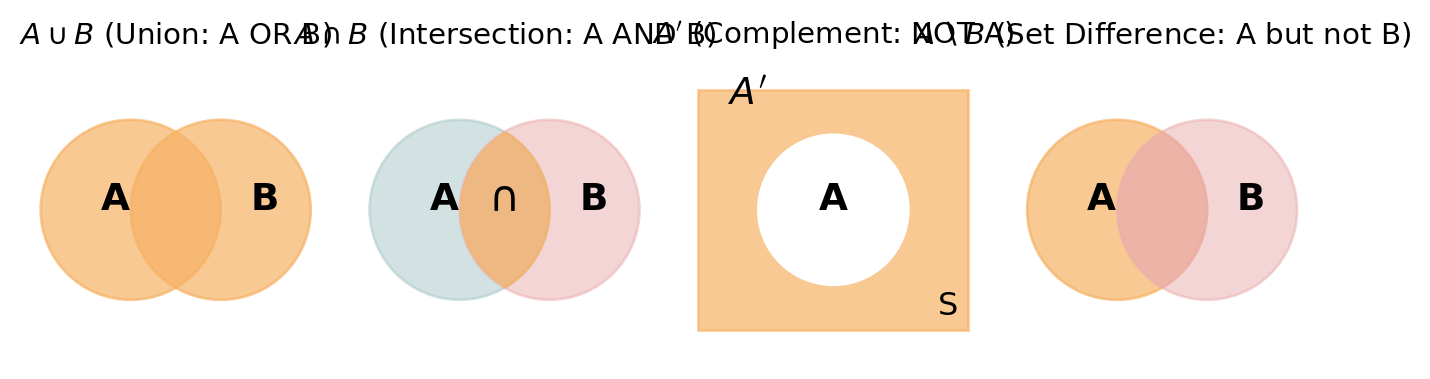
Set Operation Summary
Remember these from the start of the course?
| Operation | Notation | Meaning |
|---|---|---|
| Union | \(A \cup B\) | A or B (or both) |
| Intersection | \(A \cap B\) | A and B |
| Complement | \(A'\) or \(\bar{A}\) | Not A |
| Set difference | \(A \setminus B\) | A but not B (= \(A \cap B'\)) |
\(A \setminus B\) means outcomes that are in \(A\) but excluded from \(B\). In probability, this is often easier to compute as \(P(A) - P(A \cap B)\).
Set Operations on Events
If visualized, this is not too bad, isn’t it?
Probability Axioms
Definition of Probability
Kolmogorov Axioms, for any event \(A\):
\(P(A) \geq 0\) (non-negativity)
\(P(S) = 1\) (certainty)
For mutually exclusive events: \(P(A \cup B) = P(A) + P(B)\)
Consequence: \(0 \leq P(A) \leq 1\) for all events \(A\)
Classical Probability
For equally likely outcomes:
\[P(A) = \frac{\text{Number of favorable outcomes}}{\text{Total number of outcomes}} = \frac{|A|}{|S|}\]
Example: Rolling a fair die
\[P(\text{even}) = \frac{|\{2, 4, 6\}|}{|\{1,2,3,4,5,6\}|} = \frac{3}{6} = \frac{1}{2}\]
This is rather intuitive, just imagine playing board games.
Complements
Complement Rule (Gegenwahrscheinlichkeit):
\[P(A') = 1 - P(A)\]
Example: If probability of rain is 0.3, what is the probability of no rain?
\[P(\text{no rain}) = 1 - P(\text{rain}) = 1 - 0.3 = 0.7\]
The complement rule is often useful when it’s easier to calculate what you don’t want!
Example: Using the Complement
A company knows that 5% of its products are defective.
Question: Probability that a random product is NOT defective?
Solution:
- \(P(\text{defective}) = 0.05\)
- \(P(\text{not defective}) = 1 - 0.05 = 0.95\)
Question: In sample of 3 independent products, what’s the probability that at least one is defective?
Solution: Use complement! \[P(\text{at least one}) = 1 - P(\text{none defective}) = 1 - (0.95)^3 \approx 0.143\]
Addition Rule
Union of Events
General Addition Rule (Additionssatz)
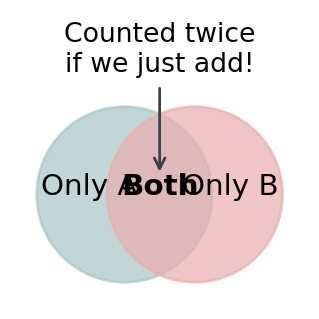
\[P(A \cup B) = P(A) + P(B) - P(A \cap B)\]
Why subtract? \(P(A \cap B)\) is counted twice:
Addition Rule Example
In a class of 100 students:
- 60 study mathematics, 40 study economics
- 25 study both
Question: What is the probability that a randomly selected student studies mathematics OR economics?
Solution:
- \(P(M \cup E) = P(M) + P(E) - P(M \cap E)\)
- \(= 0.60 + 0.40 - 0.25 = 0.75\)
Mutually Exclusive
Disjoint Events
Mutually Exclusive (Disjoint) Events:
Events A and B are mutually exclusive if they cannot occur together:
\[A \cap B = \emptyset \quad \Rightarrow \quad P(A \cap B) = 0\]
Examples:
- Rolling a 3 and rolling a 5 on one die
- A product being “good” and “defective”
- Being in age group “18-25” and “26-35”
Special Addition Rule
For mutually exclusive events:
\[P(A \cup B) = P(A) + P(B)\]
Example: Rolling a die, find \(P(\text{1 or 6})\)
Since rolling 1 and rolling 6 are mutually exclusive:
\[P(1 \cup 6) = P(1) + P(6) = \frac{1}{6} + \frac{1}{6} = \frac{2}{6} = \frac{1}{3}\]
That’s something we already intuitively knew!
Quick Check
Fast Notation Drill
Work individually
- Rewrite in symbols: “in A but not in B”.
- Compute \(P(A')\) if \(P(A)=0.72\).
- If \(P(A)=0.6\), \(P(B)=0.5\), and \(P(A \cap B)=0.2\), compute \(P(A \cup B)\).
Break
Independent Events
Independence
Definition: Independent Events
Events A and B are independent if the occurrence of one does not affect the probability of the other:
\[P(A \cap B) = P(A) \cdot P(B)\]
Don’t confuse:
- Mutually exclusive: Can’t happen together (\(P(A \cap B) = 0\))
- Independent: Don’t affect each other (\(P(A \cap B) = P(A) \cdot P(B)\))
Independence Example
Two machines work independently. Machine A has 95% reliability, Machine B has 90% reliability.
Question: What is the probability both machines work?
\[P(A \cap B) = P(A) \cdot P(B) = 0.95 \times 0.90 = 0.855\]
Question: What is the probability at least one machine fails?
\[P(\text{at least one fails}) = 1 - P(\text{both work}) = 1 - 0.855 = 0.145\]
Mutually Exclusive vs Independent
| Property | Mutually Exclusive | Independent |
|---|---|---|
| \(P(A \cap B)\) | \(= 0\) | \(= P(A) \cdot P(B)\) |
| Occur together? | No | Yes |
| A occurred… | …tells B didn’t | …tells nothing about B |
| Example | “Pass” vs “Fail” | Two separate coin flips |
If \(P(A) > 0\) and \(P(B) > 0\), then mutually exclusive events cannot be independent!
Quick Check
Mutually Exclusive or Independent?
Work individually
Classify each pair as mutually exclusive, independent, both, or neither.
- One coin flip: A = “Heads”, B = “Tails”
- Two separate coin flips: A = “Heads on flip 1”, B = “Heads on flip 2”
- One die roll: A = “even”, B = “greater than 3”
Business Applications
Quality Control Application
A factory produces items with:
- 3% have surface defects (event S)
- 2% have internal defects (event I)
- 0.5% have both defects
Find the probability that an item has:
- At least one type of defect
- A surface defect but no internal defect
- Exactly one type of defect
Market Research Application
In a survey of 500 consumers:
- 300 prefer Brand A
- 250 prefer organic products
- 150 prefer Brand A AND organic
Question: Are “preferring Brand A” and “preferring organic” independent?
Random Variables
Random Variable (Discrete Case)
Definition: A random variable \(X\) assigns a numerical value to each outcome in the sample space.
Formally: \(X:S\to\mathbb{R}\).
- Example: Number of defective items in a sample
- Example: Number shown on a die
Think of it like a function that takes an outcome and returns a number.
PMF
Definition: Probability Mass Function:
- For a discrete random variable \(X\), the PMF is \(p_X(x) = P(X=x)\)
- It has the following properties:
- \(p_X(x) \ge 0\)
- \(\sum_x p_X(x)=1\)
Example: Let \(X\) = number of heads in two fair coin flips.
| \(x\) | 0 | 1 | 2 |
|---|---|---|---|
| \(P(X=x)\) | \(\frac14\) | \(\frac12\) | \(\frac14\) |
CDF
Definition: Cumulative Distribution Function:
- For a random variable \(X\), the CDF is \(F_X(x)=P(X\le x)\)
- The CDF adds probabilities up to a threshold.
- Interpretation in words: “at most \(x\)”.
Using the same example:
- \(F_X(0)=P(X\le 0)=\frac14\)
- \(F_X(1)=P(X\le 1)=\frac14+\frac12=\frac34\)
- \(F_X(2)=1\)
PMF vs CDF Quick Comparison
| Question | Use | Example result |
|---|---|---|
| “Exactly 1 head” | PMF | \(P(X=1)=\frac12\) |
| “At most 1 head” | CDF | \(P(X\le1)=\frac34\) |
Common exam error: confusing \(P(X=1)\) with \(P(X\le 1)\). Always check whether the wording is “exactly” or “at most”.
Quick Check
PMF and CDF Practice
Work individually
Given the PMF:
| \(x\) | 0 | 1 | 2 | 3 |
|---|---|---|---|---|
| \(P(X=x)\) | 0.10 | 0.35 | 0.40 | 0.15 |
- Compute \(P(X\ge2)\).
- Compute \(F_X(1)\).
- Is \(F_X(1)\) the same as \(P(X=1)\)?
Guided Practice
Practice Problems I
Work in pairs
Problem 1: A card is drawn from a standard 52-card deck.
- Find \(P(\text{Heart})\) (4 suits of 13 cards)
- Find \(P(\text{Face card})\) (J, Q, K in each suit)
- Find \(P(\text{Heart OR Face card})\)
Problem 2: In a company, 40% of employees are in sales, 30% are in engineering, and 10% are in both. Find:
- \(P(\text{Sales OR Engineering})\)
- \(P(\text{neither Sales nor Engineering})\)
Practice Problems II
Work in pairs
Problem 3 (Notation Translation):
In a survey, let:
- \(T\) = has payback card
- \(K\) = active customer this month
- Write in words what \(T \setminus K\) means.
- Rewrite \(T \setminus K\) using intersection and complement notation.
- If \(P(T)=0.62\) and \(P(T \cap K)=0.41\), compute \(P(T \setminus K)\).
Practice Problems III
Work in pairs
Problem 4 (Complements + Wording):
In a support center, 18% of customers submit at least one complaint in a quarter.
- What is the probability that a customer submits no complaint?
- In words, explain what event is represented by the complement here.
- If 500 customers are observed, about how many are expected to submit no complaint?
Chained Exam Mini-Problem
Work individually, then compare
For events \(A\) and \(B\), suppose \(P(A)=0.55\), \(P(B)=0.40\), \(P(A\cap B)=0.18\).
- Compute \(P(A\cup B)\).
- Use your result from (a) to compute \(P((A\cup B)')\).
- Interpret part (b) in plain business language.
Coffee Break
Team Problem-Solving
Challenge: Customer Segments
Think individually then work in groups of 3-4
In a customer base:
- \(P(T)=0.58\) (uses app)
- \(P(K)=0.47\) (premium member)
- \(P(T \cap K)=0.29\)
- Compute \(P(T \cup K)\).
- Compute \(P(T \setminus K)\) and explain it in words.
- Check whether \(T\) and \(K\) are independent.
- Write one business recommendation based on your result.
Sample Space: Product Returns
Work in pairs
An online shop classifies returns by reason: Defective (D), Wrong Size (S), Changed Mind (M), or Other (O).
- Write the sample space \(\Omega\) for the reason of a single return.
- Define event \(A\) = “return is the customer’s fault” and list its outcomes.
- Write \(A'\) in words and list its outcomes.
- If \(P(D)=0.15\), \(P(S)=0.40\), \(P(M)=0.30\), find \(P(O)\) using the axioms.
Complement & Addition: Deliveries
Work individually
A logistics company tracks two events for its deliveries: \(L\) = “delivery is late” with \(P(L)=0.12\), \(D\) = “package is damaged” with \(P(D)=0.05\), and \(P(L \cap D)=0.02\).
- Find \(P(L \cup D)\) and interpret it in words.
- Find \(P(L')\) and interpret it.
- Find \(P(L \setminus D)\). What does this represent?
- Are \(L\) and \(D\) mutually exclusive? Are they independent?
Independence: Machine Failures
Work in pairs
A factory has two machines, A and B, that operate independently.
- \(P(\text{A fails}) = 0.08\)
- \(P(\text{B fails}) = 0.05\)
- What is the probability that both machines fail?
- What is the probability that at least one machine fails?
- What is the probability that exactly one machine fails?
- The factory shuts down only if both machines fail. What is the probability that the factory keeps running?
PMF and CDF: Customer Orders
Work individually, then compare
Let \(X\) be the number of items in a random online order. The PMF is:
| \(x\) | 1 | 2 | 3 | 4 | 5 |
|---|---|---|---|---|---|
| \(P(X=x)\) | 0.30 | 0.25 | 0.20 | 0.15 | 0.10 |
- Verify this is a valid PMF.
- Compute \(F_X(3) = P(X \le 3)\).
- Compute \(P(X > 3)\) using the CDF.
- Compute \(P(2 \le X \le 4)\).
Mixed Problem: Email Campaign
Work in groups
A marketing team surveys 200 customers. Let \(E\) = “opened the email” and \(C\) = “clicked the link”: 120 opened, 50 clicked, 40 did both.
- Find \(P(E)\), \(P(C)\), and \(P(E \cap C)\).
- Find \(P(E \cup C)\) and interpret it.
- Are \(E\) and \(C\) independent? Show your work.
- Let \(X\) = “number of actions taken” (opening and clicking count as one each). Write the PMF of \(X\).
Final Assessment
Exit Ticket
Work individually, then compare
- If \(P(A)=0.55\), what is \(P(A')\)?
- If \(P(A)=0.40\), \(P(B)=0.35\), and \(P(A \cap B)=0.12\), find \(P(A \cup B)\).
- In words, what does \(A \setminus B\) mean?
Wrap-Up & Takeaways
Today’s Essential Concepts
- Sample space \(S\): All possible outcomes
- Event: Subset of the sample space
- Probability axioms: \(0 \leq P(A) \leq 1\), \(P(S) = 1\)
- Complement: \(P(A') = 1 - P(A)\)
- Addition rule: \(P(A \cup B) = P(A) + P(B) - P(A \cap B)\)
- Mutually exclusive: \(P(A \cap B) = 0\)
- Independent: \(P(A \cap B) = P(A) \cdot P(B)\)
- Random variables: PMF for exact values, CDF for cumulative values
Next Session Preview
Coming Up: Combinatorics
- Fundamental counting principle
- Permutations: arrangements where order matters
- Combinations: selections where order doesn’t matter
- Applications to probability calculations
TipHomework
Complete Tasks 07-02:
- Practice sample space identification
- Apply probability rules
- Solve business probability problems