Functions and Their Representations
An Interactive Exploration
Part 1: Function Fundamentals
What is a Function?
Definition: A function is a special relationship between two sets where each element in the domain (input set) is paired with exactly one element in the range (output set).
Think of a function as a machine: you put something in (input), and it gives you exactly one thing out (output). You can’t get two different outputs for the same input!
Function Notation and Terminology
Let’s explore the language of functions:
| Symbol/Term | Name | Meaning |
|---|---|---|
| \(f, g, h\) | Function names | Letters used to identify different functions |
| \(D_f\) | Domain | The set of all possible input values (\(x\)-values) |
| \(W_f\) or \(R_f\) | Range | The set of all possible output values (\(y\)-values) |
| \(f(x_0)\) | Function value | The output when \(x_0\) is the input |
| \(f: x \rightarrow 3x^2 + 5\) | Function rule | The recipe that transforms inputs to outputs |
| \(f(x) = 3x^2 + 5\) | Function equation | The formula for calculating outputs |
Example: Understanding Function Notation
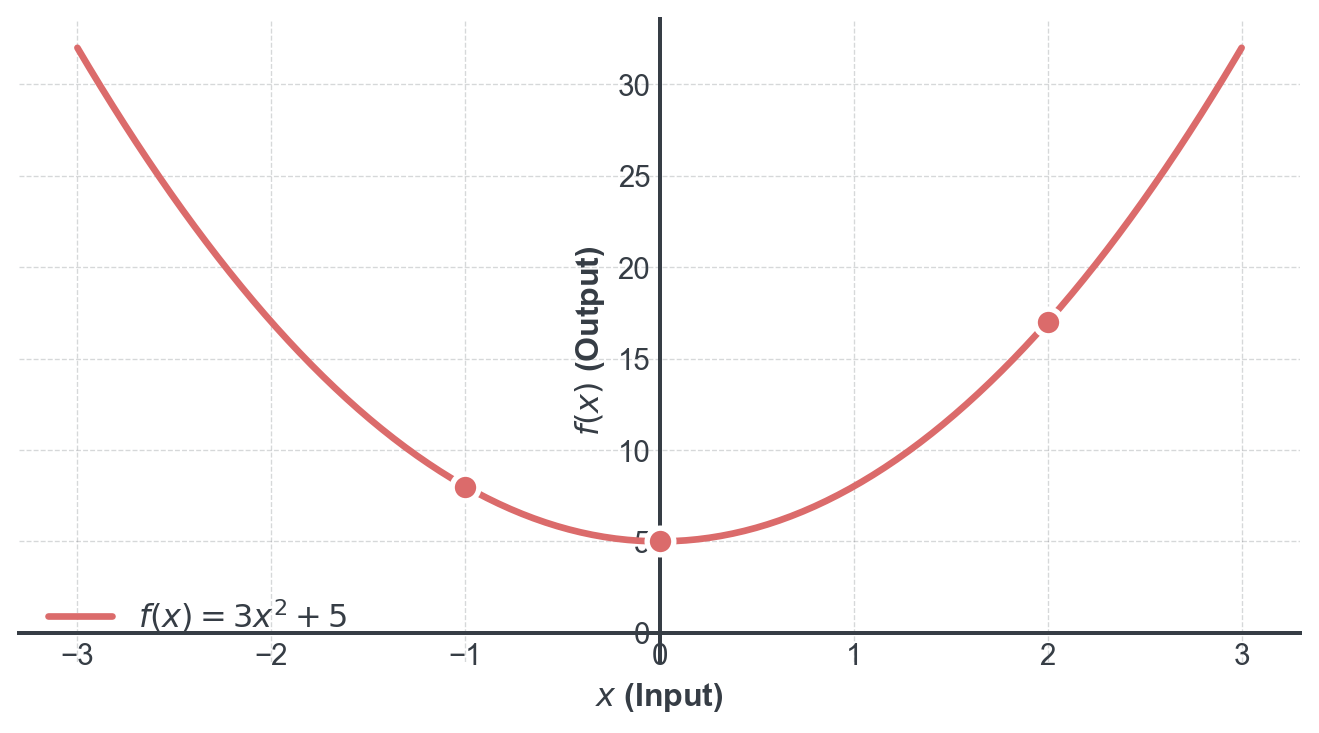
Consider the function \(f(x) = 3x^2 + 5\)
Function rule: \(f: x \rightarrow 3x^2 + 5\)
This tells us: “Take any number \(x\), square it, multiply by 3, then add 5”
Calculating function values:
- When \(x = 2\): \(f(2) = 3 \cdot 2^2 + 5 = 3 \cdot 4 + 5 = 17\)
- When \(x = -1\): \(f(-1) = 3 \cdot (-1)^2 + 5 = 3 \cdot 1 + 5 = 8\)
- When \(x = 0\): \(f(0) = 3 \cdot 0^2 + 5 = 5\)
Part 2: Visualizing Functions
Let’s see what this function looks like!
TipKey Observation:
Notice that for every \(x\)-value, there is exactly one \(y\)-value. This is what makes it a function!
Part 3: Domain and Range Notation
When describing domains and ranges, we use interval notation:
| Notation | Meaning | Description |
|---|---|---|
| \([a; b]\) | \(a \leq x \leq b\) | Closed interval (includes both endpoints) |
| \((a; b)\) | \(a < x < b\) | Open interval (excludes both endpoints) |
| \([a; b)\) | \(a \leq x < b\) | Half-open interval (includes \(a\), excludes \(b\)) |
| \([a; \infty)\) | \(x \geq a\) | All real numbers greater than or equal to \(a\) |
| \(\mathbb{R} \setminus \{a\}\) | All reals except \(a\) | The real numbers with \(a\) removed |
| \(\mathbb{R}^+\) | \(x > 0\) | All positive real numbers |
Visual Examples
![Five number lines from 0 to 9, each with a shaded interval. [2; 5]: filled dots at 2 and 5. (2; 5): open dots at 2 and 5. [2; 5): filled dot at 2, open dot at 5. [2; ∞): filled dot at 2 and an arrow to the right. All reals except 3: the line is shaded on both sides of an open dot at 3.](worksheet-functions_files/figure-html/fig-interval-notation-output-1.png)
Part 4: The Vertical Line Test
How to Identify a Function from its Graph
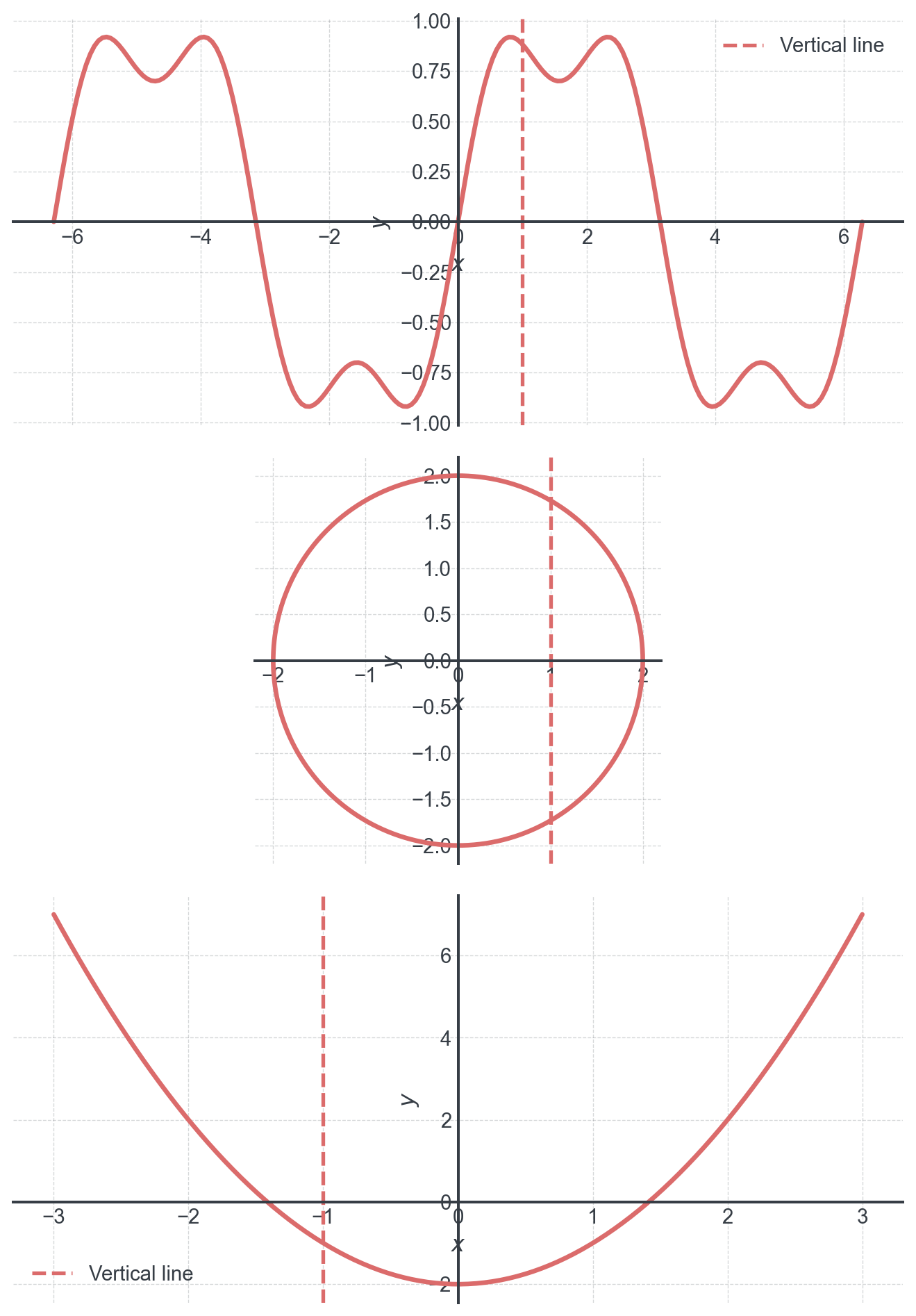
The Vertical Line Test: A graph represents a function if and only if no vertical line intersects the graph more than once.
Why does this work?
Remember: A function assigns exactly one output to each input. A vertical line represents all points with the same \(x\)-value (input). If it hits the graph twice, that means one input has two different outputs: not a function!
Part 5: Practice Exercises
Exercise 1: Identify Functions from Graphs
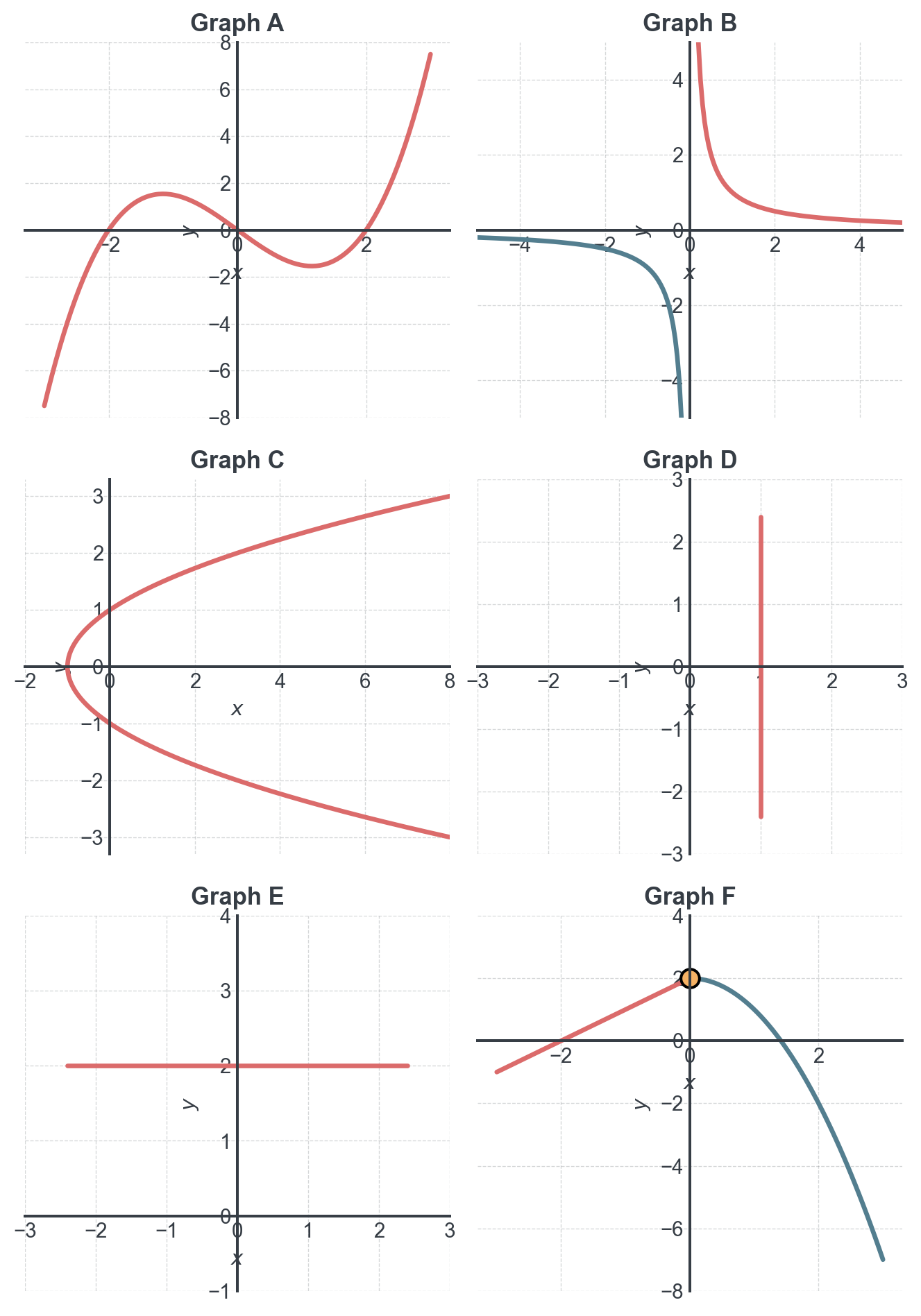
For each graph below, determine whether it represents a function. Explain your reasoning using the vertical line test.
Your answers:
| Graph | Function? (Yes/No) | Explanation |
|---|---|---|
| A | ||
| B | ||
| C | ||
| D | ||
| E | ||
| F |
Exercise 2: Finding Domain and Range
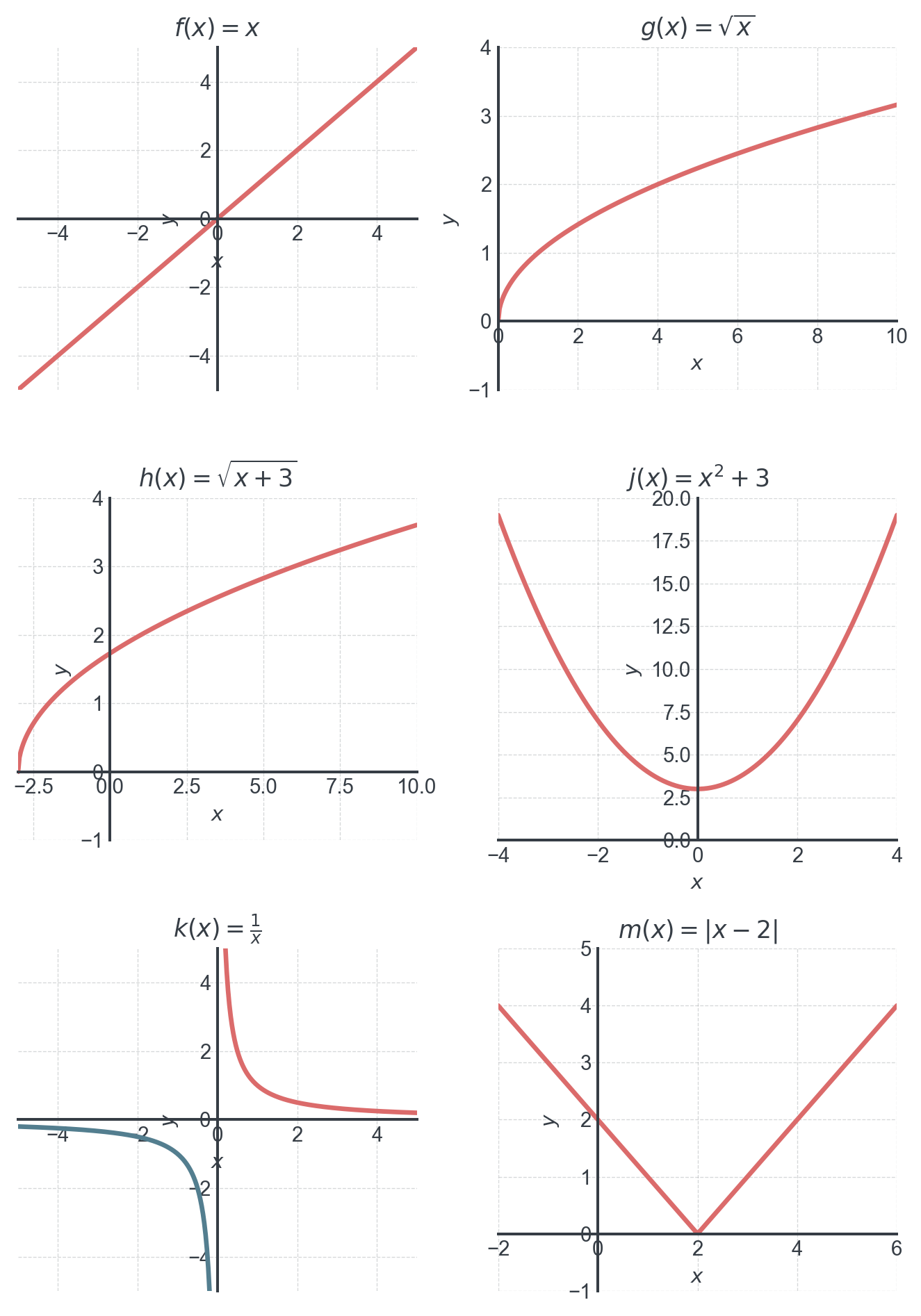
For each function below, determine the domain (\(D_f\)) and range (\(W_f\)). Write your answers using interval notation.
Complete the table:
| Function | Domain \(D_f\) | Range \(W_f\) |
|---|---|---|
| \(f(x) = x\) | ||
| \(g(x) = \sqrt{x}\) | ||
| \(h(x) = \sqrt{x + 3}\) | ||
| \(j(x) = x^2 + 3\) | ||
| \(k(x) = \frac{1}{x}\) | ||
| \(m(x) = \|x - 2\|\) |
Challenge Problems
Challenge 1: Analyzing a Complex Function
Consider the piecewise function:
\[ f(x) = \begin{cases} x + 2 & \text{if } x < 0 \\ x^2 & \text{if } 0 \leq x < 2 \\ 4 & \text{if } x \geq 2 \end{cases} \]
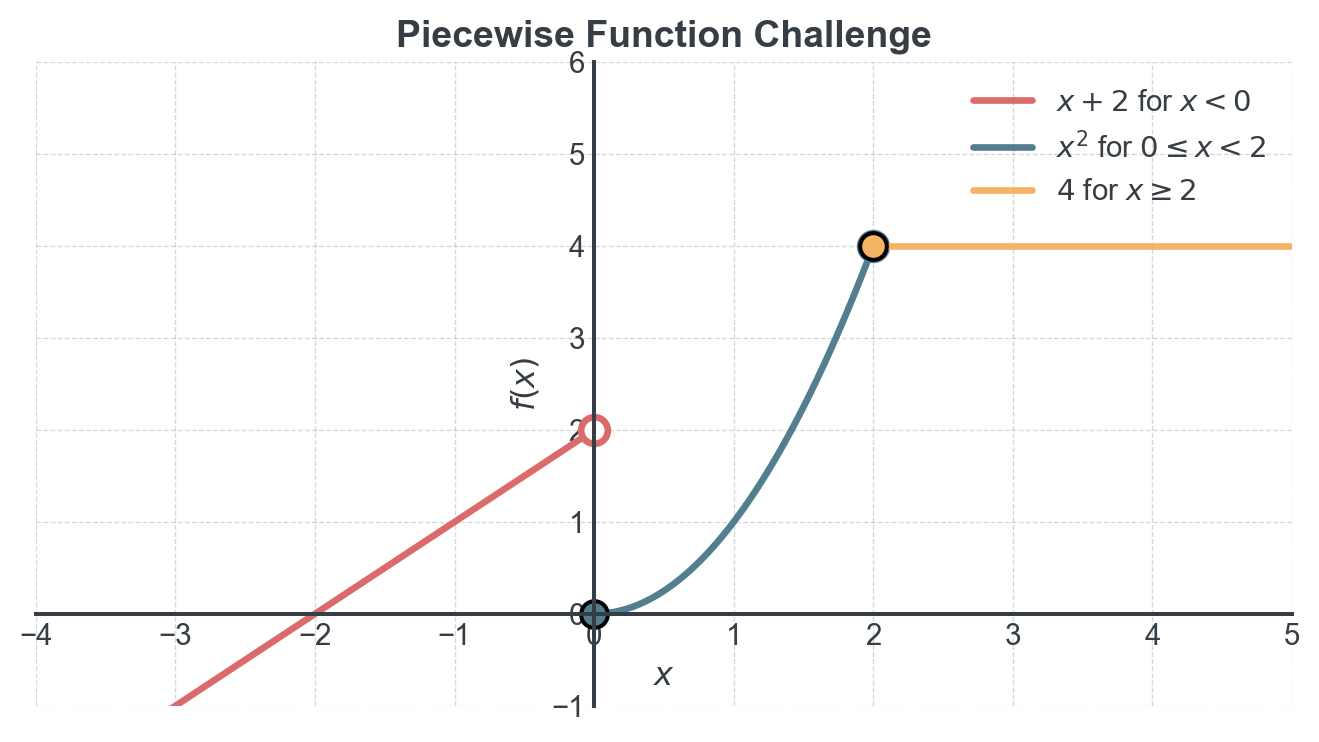
Questions:
What is the domain of \(f\)?
What is the range of \(f\)?
Calculate: \(f(-2)\), \(f(0)\), \(f(1)\), \(f(2)\), \(f(3)\)
Is this function continuous (can its graph be drawn without lifting the pen)? Explain your answer.
Challenge 2: Real-World Application
A delivery company charges based on package weight according to this rule:
\[ C(w) = \begin{cases} 5 & \text{if } 0 < w \leq 1 \\ 5 + 3(w-1) & \text{if } 1 < w \leq 5 \\ 17 + 5(w-5) & \text{if } w > 5 \end{cases} \]
where \(C\) is the cost in dollars and \(w\) is the weight in pounds.
Questions:
How much does it cost to ship a 0.5 lb package?
How much does it cost to ship a 3 lb package?
How much does it cost to ship a 7 lb package?
What is the domain of this function in the real-world context?
Sketch a graph of this function for \(0 < w \leq 10\).
Summary Checklist
Before you finish, make sure you can:
Answers
Exercise 1: Functions from Graphs
| Graph | Function? | Explanation |
|---|---|---|
| A | Yes | Any vertical line crosses the graph only once |
| B | Yes | Any vertical line crosses each branch only once (no point at \(x=0\)) |
| C | No | A vertical line at \(x = 2\) intersects the graph twice |
| D | No | This IS a vertical line, so it has infinite \(y\)-values for one \(x\)-value |
| E | Yes | Every \(x\)-value has exactly one \(y\)-value (which is 2) |
| F | Yes | Each piece passes the vertical line test, and they connect properly |
Exercise 2: Domain and Range
| Function | Domain \(D_f\) | Range \(W_f\) |
|---|---|---|
| \(f(x) = x\) | \(\mathbb{R}\) or \((-\infty; \infty)\) | \(\mathbb{R}\) or \((-\infty; \infty)\) |
| \(g(x) = \sqrt{x}\) | \([0; \infty)\) | \([0; \infty)\) |
| \(h(x) = \sqrt{x + 3}\) | \([-3; \infty)\) | \([0; \infty)\) |
| \(j(x) = x^2 + 3\) | \(\mathbb{R}\) or \((-\infty; \infty)\) | \([3; \infty)\) |
| \(k(x) = \frac{1}{x}\) | \(\mathbb{R} \setminus \{0\}\) or \((-\infty; 0) \cup (0; \infty)\) | \(\mathbb{R} \setminus \{0\}\) or \((-\infty; 0) \cup (0; \infty)\) |
| \(m(x) = \|x - 2\|\) | \(\mathbb{R}\) or \((-\infty; \infty)\) | \([0; \infty)\) |
Great work! You’ve completed the Functions and Their Representations worksheet!