Session 05-01 - Limits & Continuity Through Graphs
Section 05: Differential Calculus
Entry Quiz
Quick Review from Section 04
Test your understanding from Advanced Functions
What happens to \(f(x) = \frac{1}{x-2}\) as \(x\) approaches 2 from the right?
For the rational function \(g(x) = \frac{x^2-4}{x-2}\), does the graph have a hole or a vertical asymptote at \(x = 2\)?
What is the horizontal asymptote of \(f(x) = \frac{3x^2 + 1}{x^2 - 4}\)?
Homework Discussion
Solution from Tasks 04-04
15 minutes - presentation and discussion
- Present difficult problems
- Discuss your potential problems
- Share strategies for your solutions
Your questions from Section 04
Focus on rational functions and asymptotic behavior
- Challenges with finding asymptotes of rational functions
- Interpreting end behavior and horizontal asymptotes
- Understanding vertical asymptotes and domain restrictions
- Questions about transformations of functions
Today we formalize the “limit” concept that explains all this asymptotic behavior!
Learning Objectives
What You’ll Master Today
- Understand limits intuitively through graphical analysis
- Evaluate one-sided limits and determine when limits exist
- Identify types of discontinuities in real-world functions
- Apply continuity concepts to business scenarios
- Connect abstract math to practical decision-making
- Build the foundation for derivatives in the next session
Limits are the foundation of calculus!
The Limit Concept
From Asymptotes to Limits
Remember rational functions from Section 04?
- You saw that \(f(x) = \frac{1}{x}\) gets closer to 0 as \(x\) gets larger
- You identified vertical asymptotes where functions “blow up”
- You found horizontal asymptotes showing long-term behavior
Today’s Concept: A limit describes what value a function approaches as the input approaches a specific value.
Notation: \(\lim_{x \to a} f(x) = L\)
“The limit of \(f(x)\) as \(x\) approaches \(a\) is \(L\)”
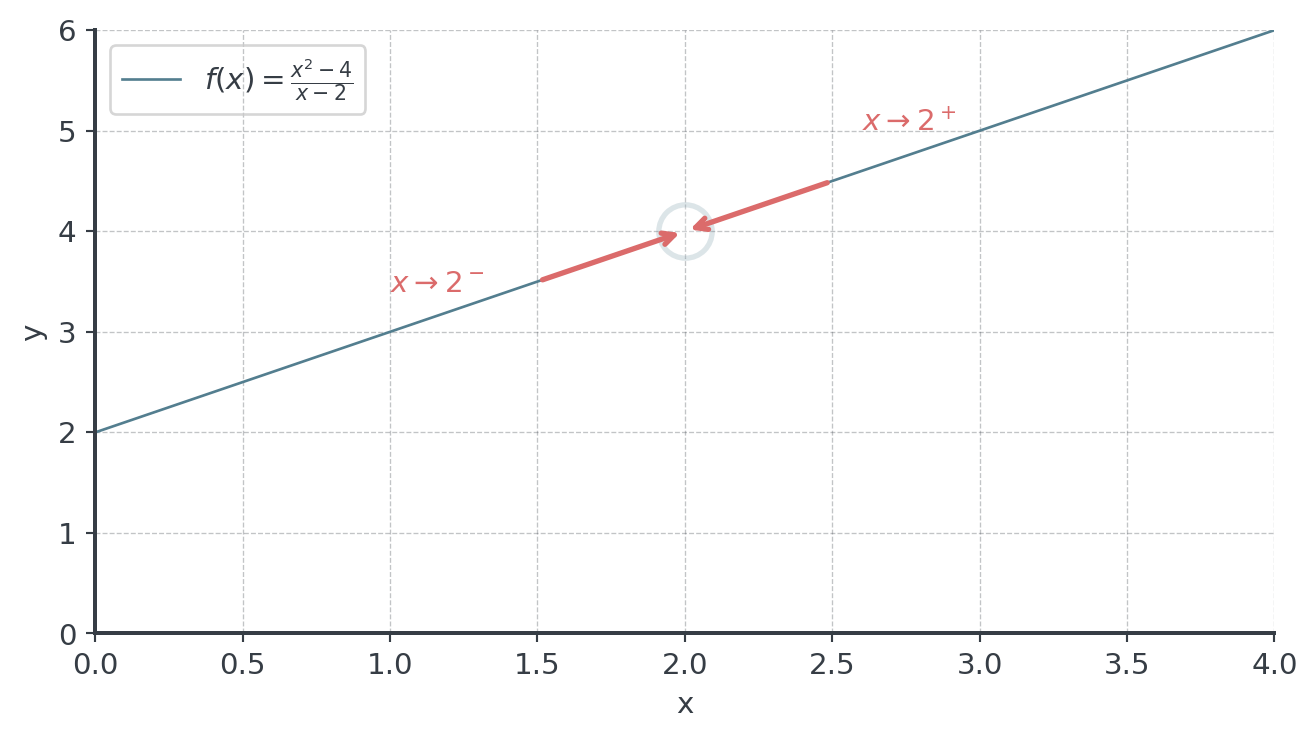
Visual Understanding of Limits
We write: \(\lim_{x \to 2} f(x) = 4\)
Look at the Following
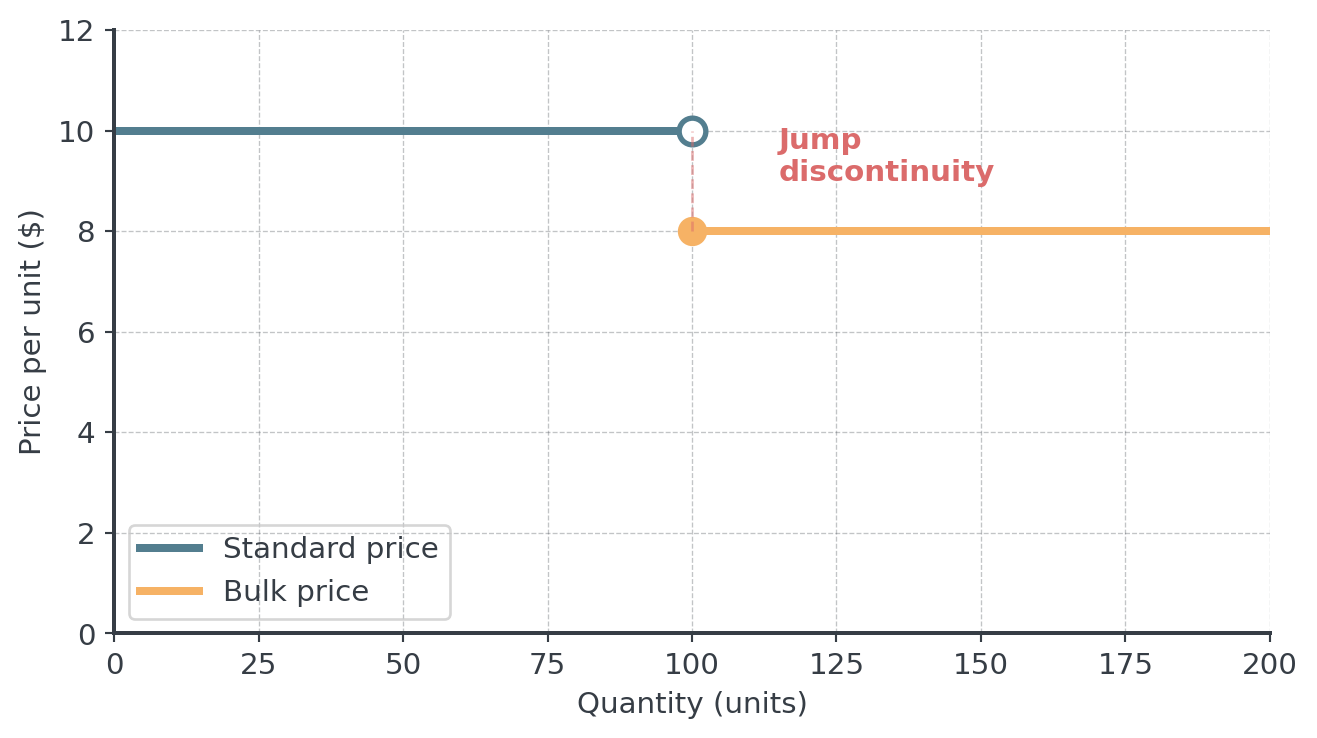
Question: What happens to the price as quantity approaches 100?
One-Sided Limits
Approaching from Two Directions
Sometimes the approach direction matters!
- Left-hand limit: \(\lim_{x \to a^-} f(x)\) (approaching from the left)
- Right-hand limit: \(\lim_{x \to a^+} f(x)\) (approaching from the right)
- Two-sided limit exists when: Left limit = Right limit
One-sided limits (like \(\lim_{x \to a^-} f(x)\)) always describe approaching from one direction!
Example: Tax Brackets
This is how taxes are often handled:
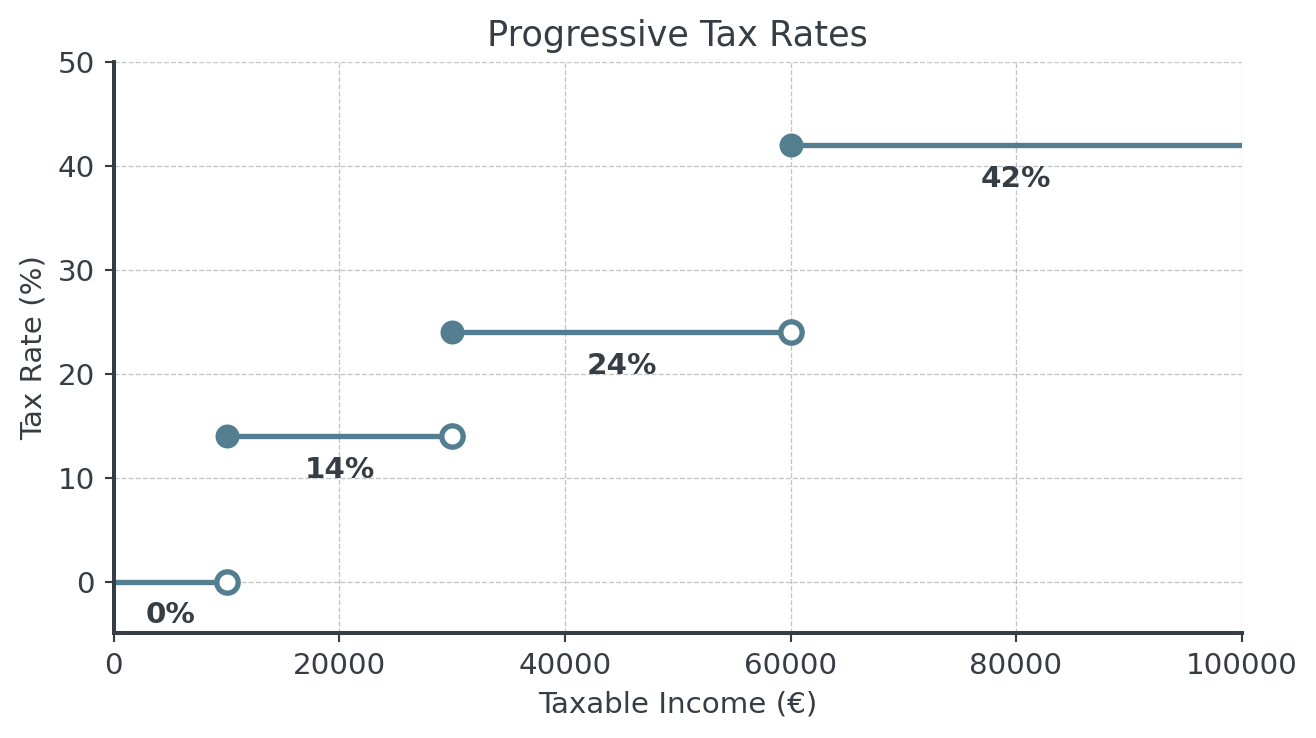
Marginal tax rates, not the effective rate on total income.
Evaluating One-Sided Limits
For the tax function at 30,000 EUR:
- From the left: \(\lim_{x \to 30000^-} T(x) = 14\%\)
- Income of 29,999 EUR → 14% rate
- Income of 29,999.99 EUR → 14% rate
- From the right: \(\lim_{x \to 30000^+} T(x) = 24\%\)
- Income of 30,001 EUR → 24% rate
- Income of 30,000.01 EUR → 24% rate
- Two-Sided limit doesn’t exist at 30,000 EUR (jump discontinuity)
When Limits Exist
Criterion for Two-Sided Limits
A two-sided limit \(\lim_{x \to a} f(x)\) exists if and only if:
- The left-hand limit exists: \(\lim_{x \to a^-} f(x) = L_1\)
- The right-hand limit exists: \(\lim_{x \to a^+} f(x) = L_2\)
- They are equal: \(L_1 = L_2\)
Two-sided limits (written simply as \(\lim_{x \to a} f(x)\)) require agreement from both sides. When we say “the limit doesn’t exist,” we typically mean the two-sided limit.
The limit describes approaching behavior, not the actual value at the point.
Types: Limit Exists
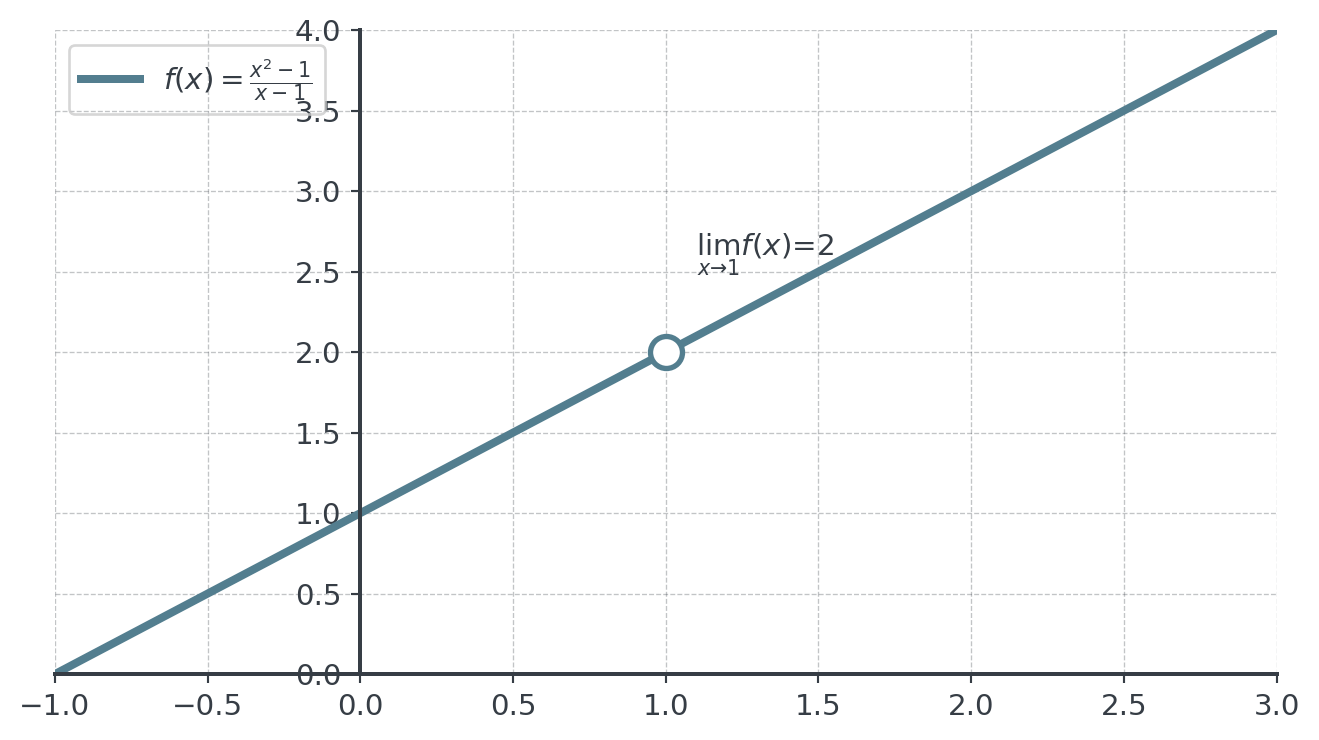
\(\lim_{x \to 1} f(x) = 2\) (even though \(f(1)\) is undefined)
Types: Jump Discontinuity
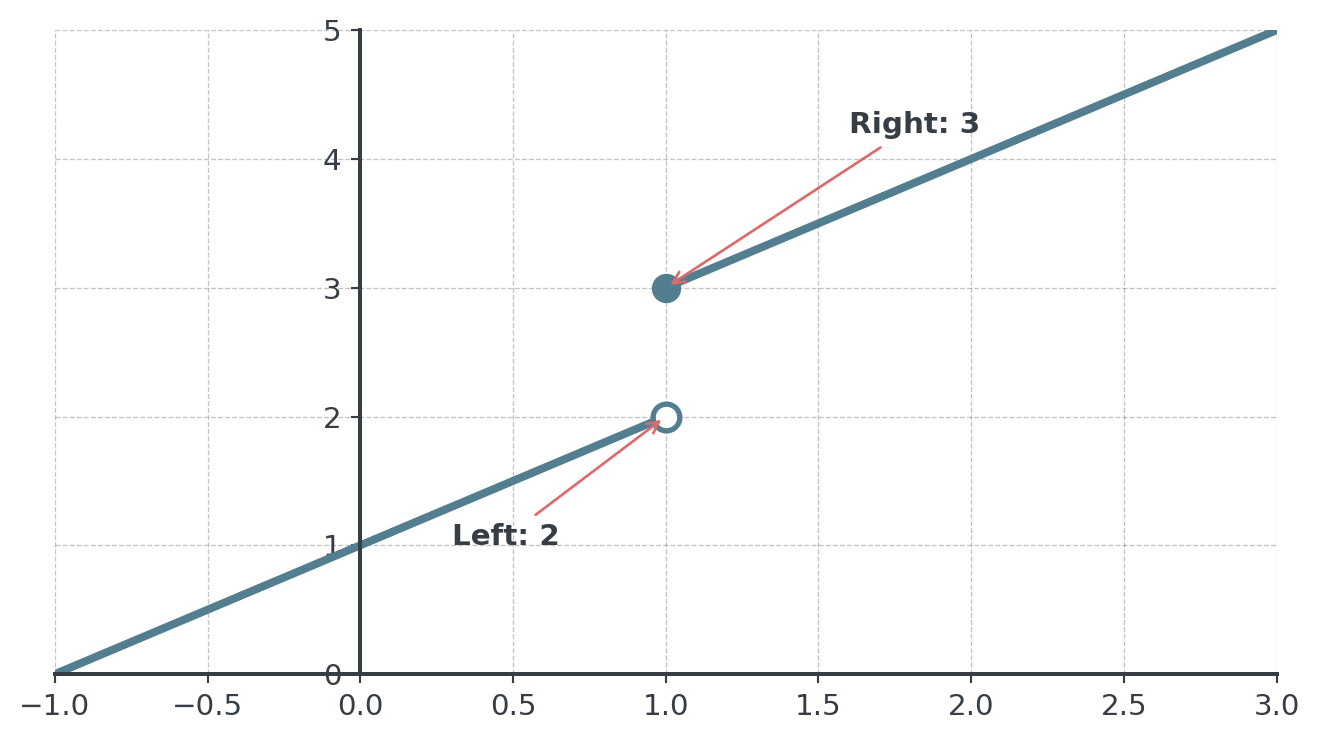
Left limit ≠ Right limit, so limit doesn’t exist (two-sided!)
Types: Infinite Discontinuity
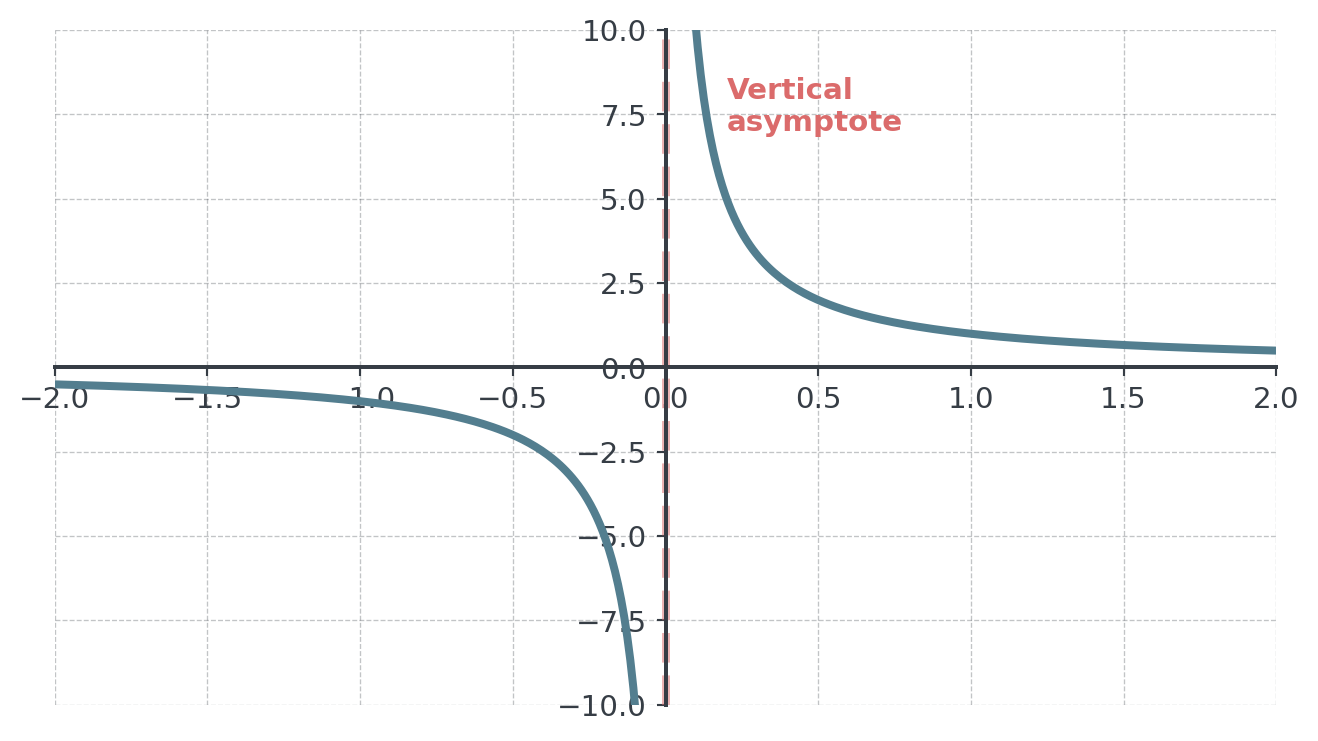
\(\lim_{x \to 0^-} f(x) = -\infty\) and \(\lim_{x \to 0^+} f(x) = +\infty\)
Quick Practice
Individual Exercise
Work individually, then compare
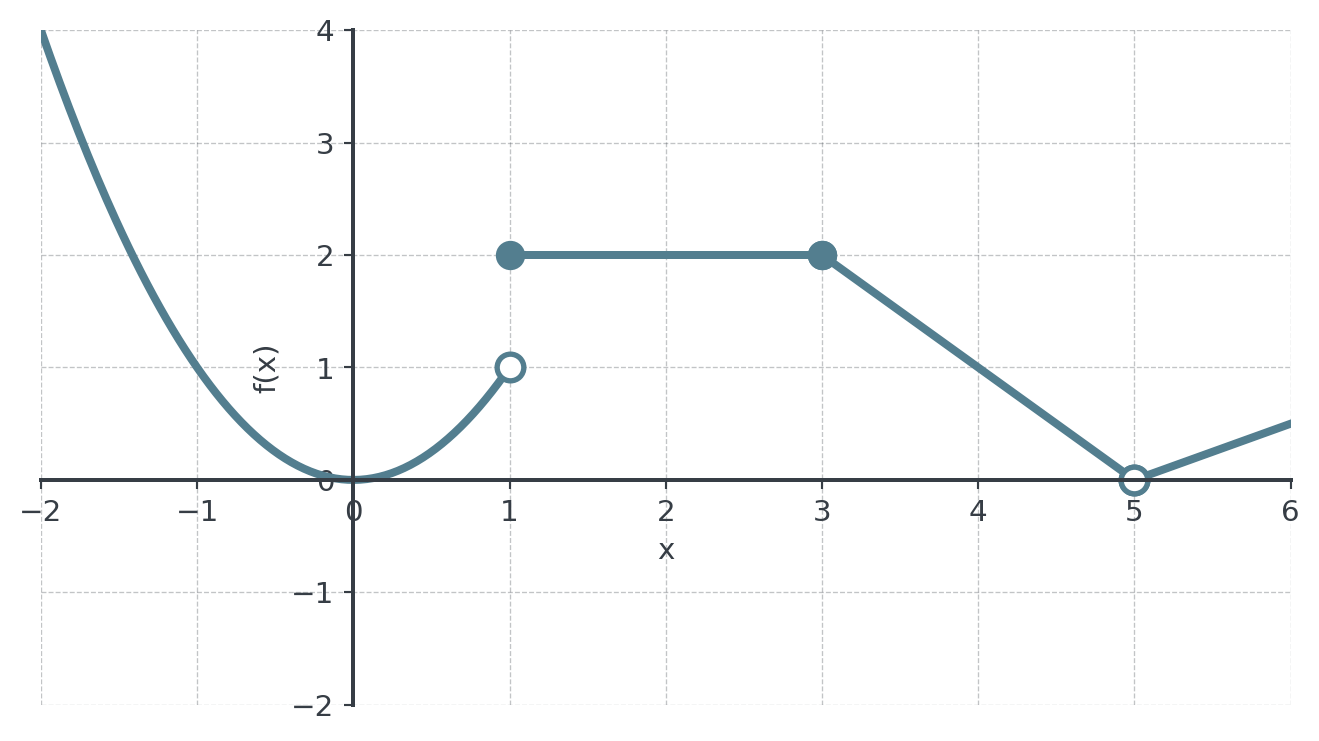
Your Tasks
Find the following:
- \(\lim_{x \to 1^-} f(x)\) and \(\lim_{x \to 1^+} f(x)\)
- \(\lim_{x \to 3} f(x)\)
- \(\lim_{x \to 5^-} f(x)\) and \(\lim_{x \to 5^+} f(x)\)
Trace the curve from each direction. The y-value you approach is the limit.
Break
Continuity at a Point
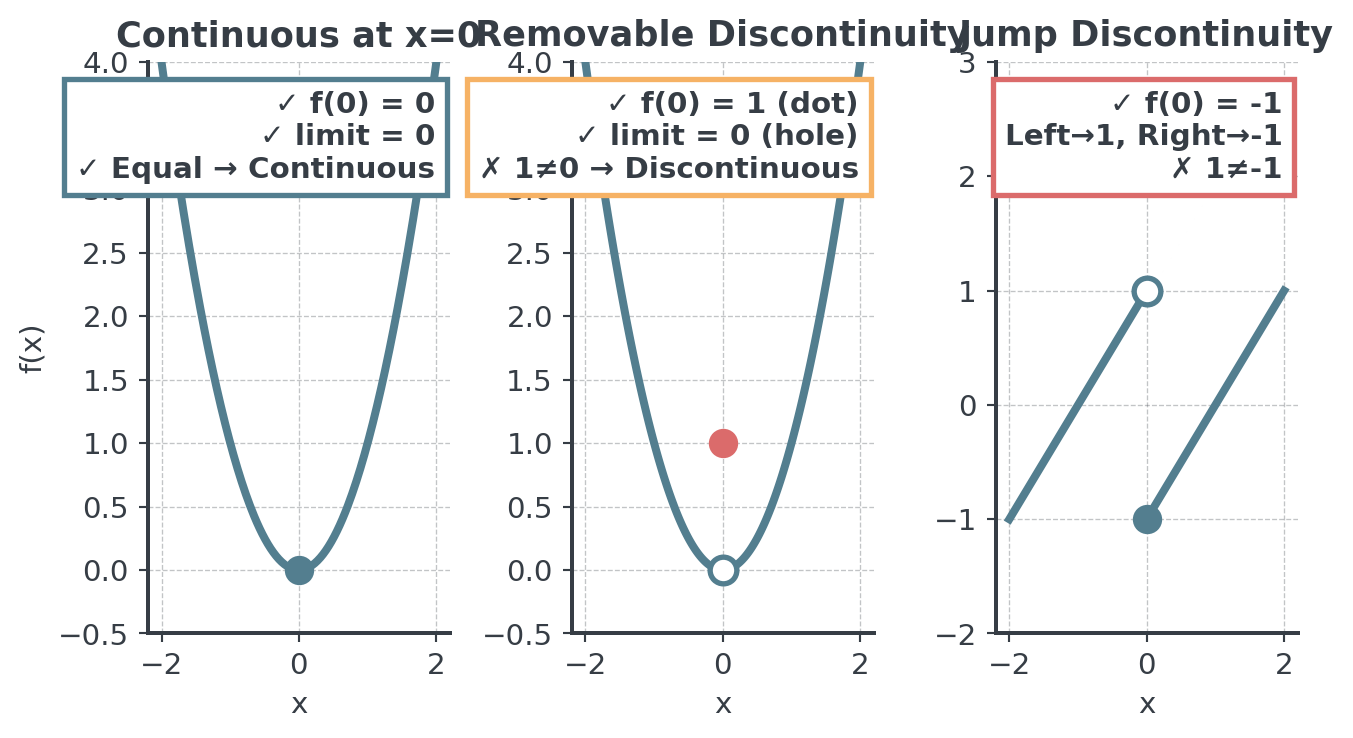
The Three Conditions for Continuity
A function \(f\) is continuous at \(x = a\) if:
- \(f(a)\) is defined (the function has a value at \(a\))
- \(\lim_{x \to a} f(x)\) exists (the limit exists)
- \(\lim_{x \to a} f(x) = f(a)\) (limit equals the function value)
NoteBusiness Interpretation
Continuity means “no sudden jumps”, important for:
- Smooth production processes
- Gradual price changes
- Predictable cost functions
Visual Continuity Test
Example: Production Capacity
A factory’s cost function changes at 1000 units:
\[C(x) = \begin{cases} 5x + 1000 & \text{if } x < 1000 \\ 3x + 3000 & \text{if } x \geq 1000 \end{cases}\]
Question: Any idea how this might look?
Production Capacity: Visualization
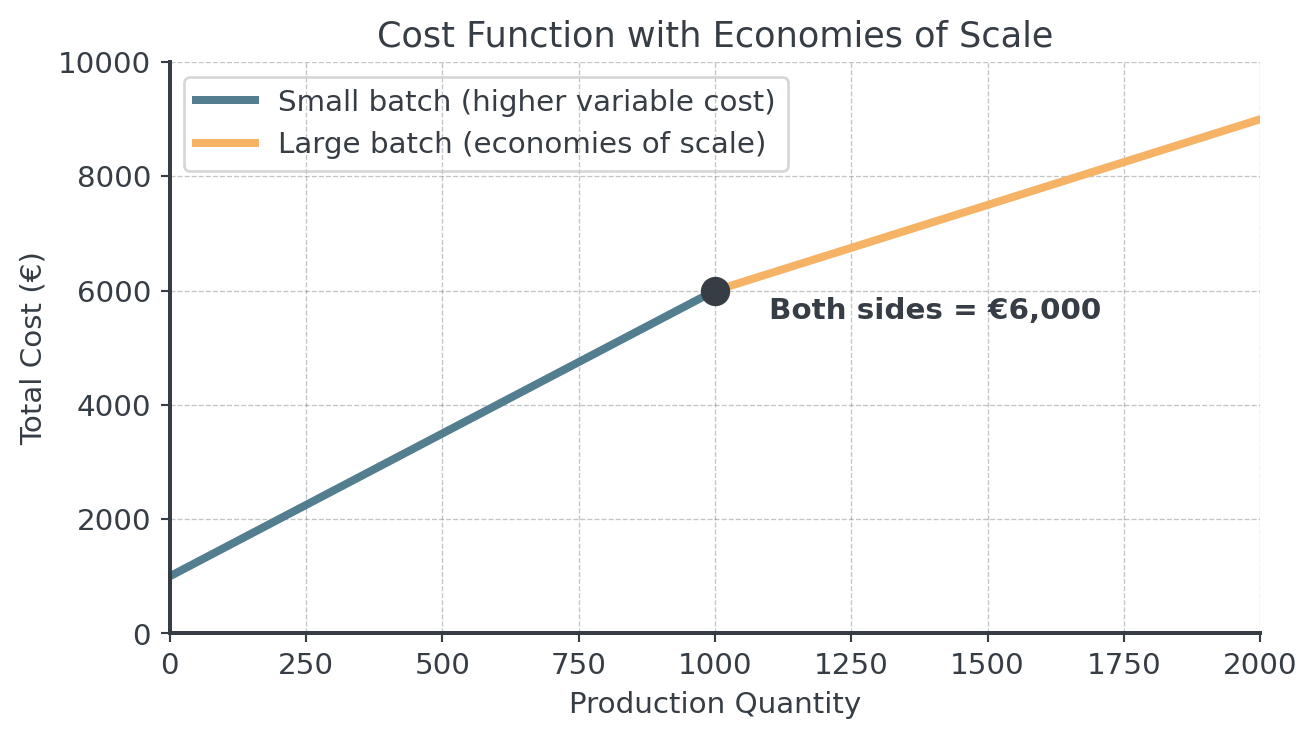
This is continuous! The company planned the transition carefully.
Guided Practice
Practice Set A: Limit Evaluation
Practice Set A: Questions
Work individually for 5 minutes
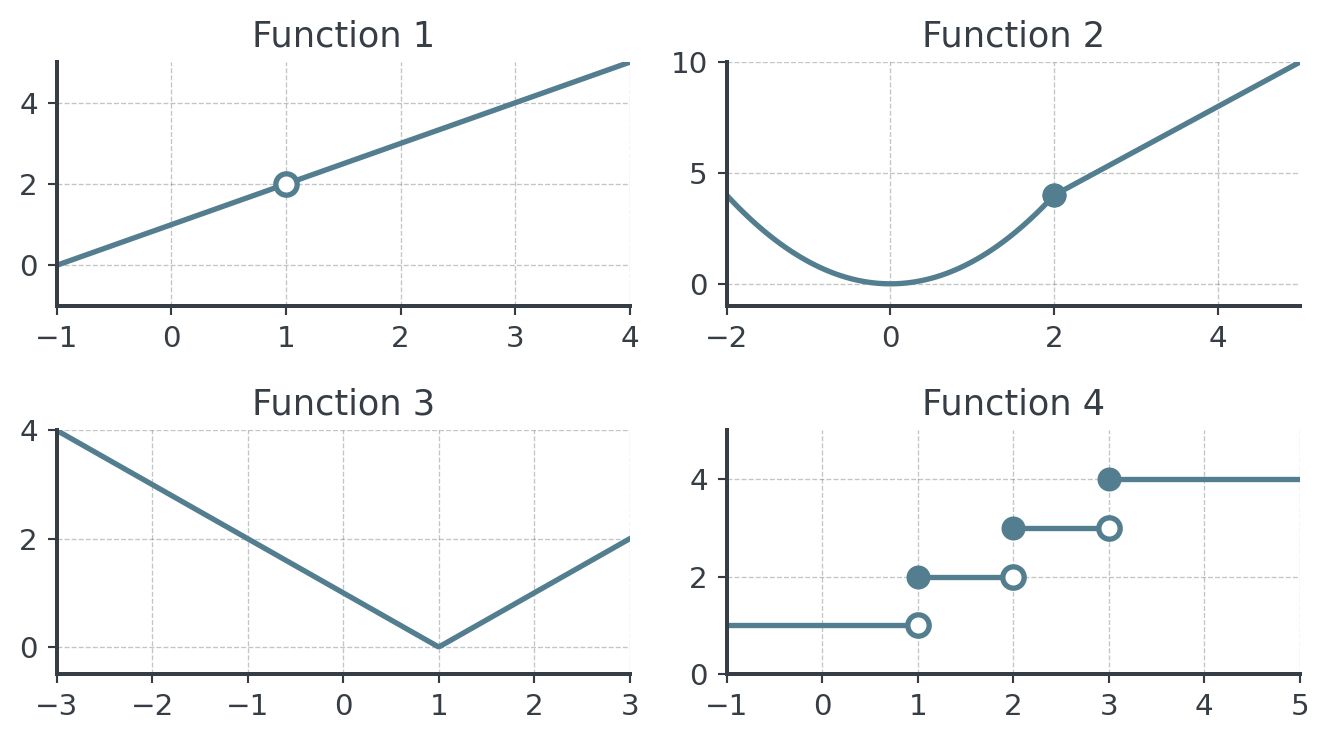
Evaluate the limits from the previous graphs:
- Function 1: \(\lim_{x \to 1} f(x)\)
- Function 2: \(\lim_{x \to 2^-} f(x)\) and \(\lim_{x \to 2^+} f(x)\)
- Function 3: \(\lim_{x \to 1} f(x)\)
- Function 4: Does \(\lim_{x \to 2} f(x)\) exist?
Practice Set B: Continuity Analysis
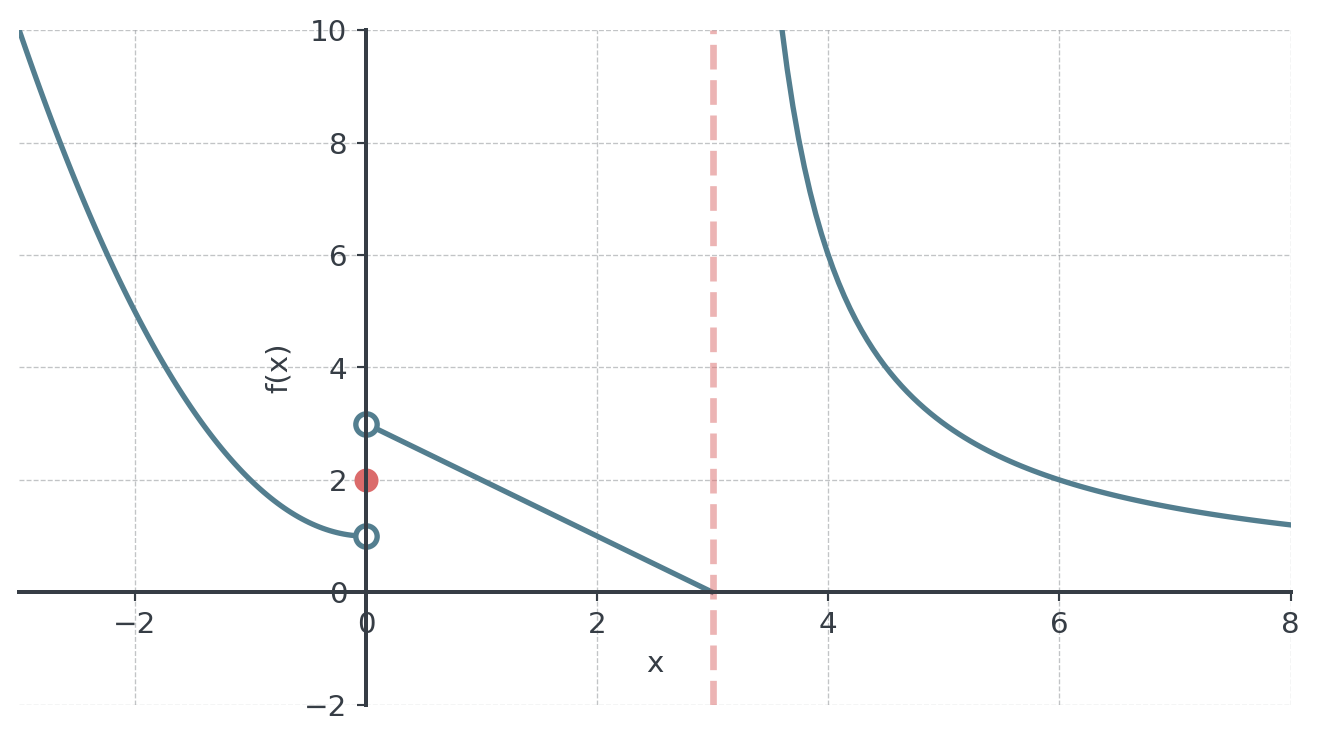
For the function below, determine where it is continuous:
\[f(x) = \begin{cases} x^2 + 1 & \text{if } x < 0 \\ 2 & \text{if } x = 0 \\ -x + 3 & \text{if } 0 < x < 3 \\ \frac{6}{x-3} & \text{if } x > 3 \end{cases}\]
- Check continuity at \(x = 0\)
- Check continuity at \(x = 3\)
- Sketch the function
- Where is \(f\) continuous?
Coffee Break
Business Applications
Shipping Cost Models
Online retailers often use step functions for shipping:
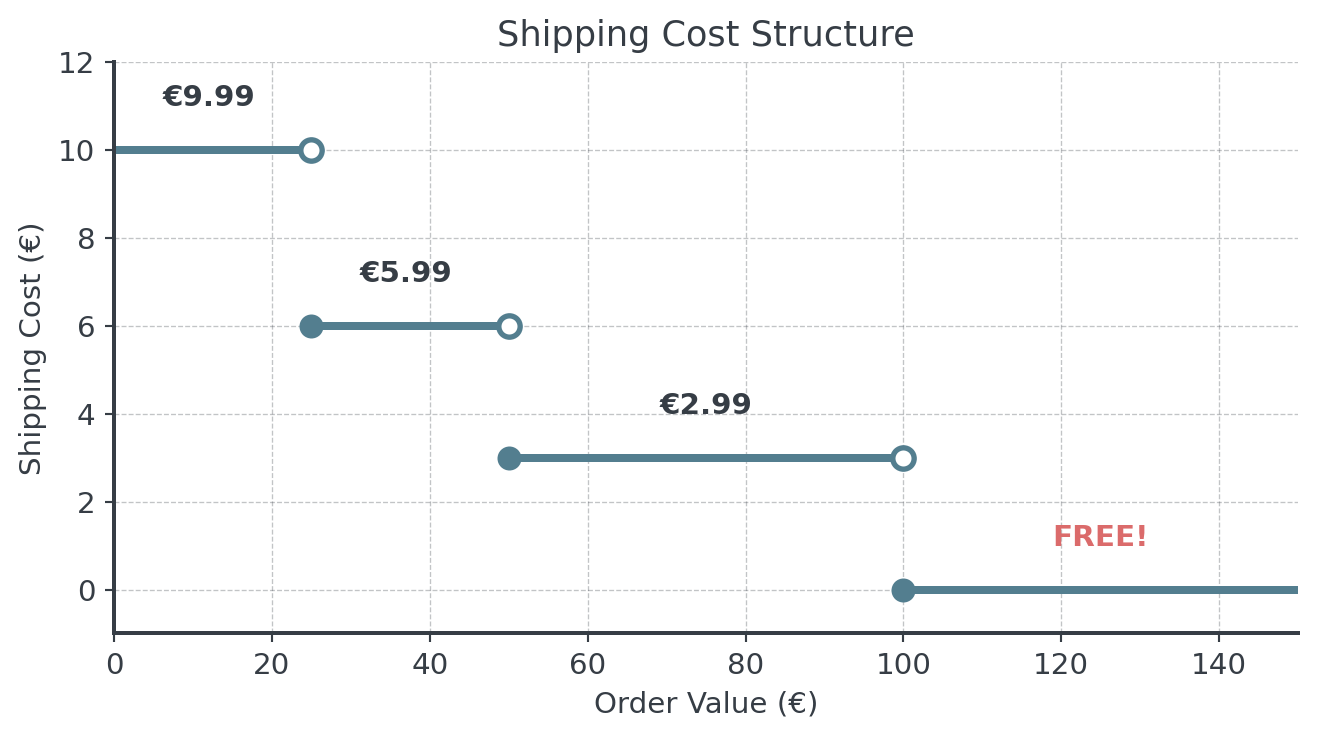
Question: How does this pricing structure influence customer behavior?
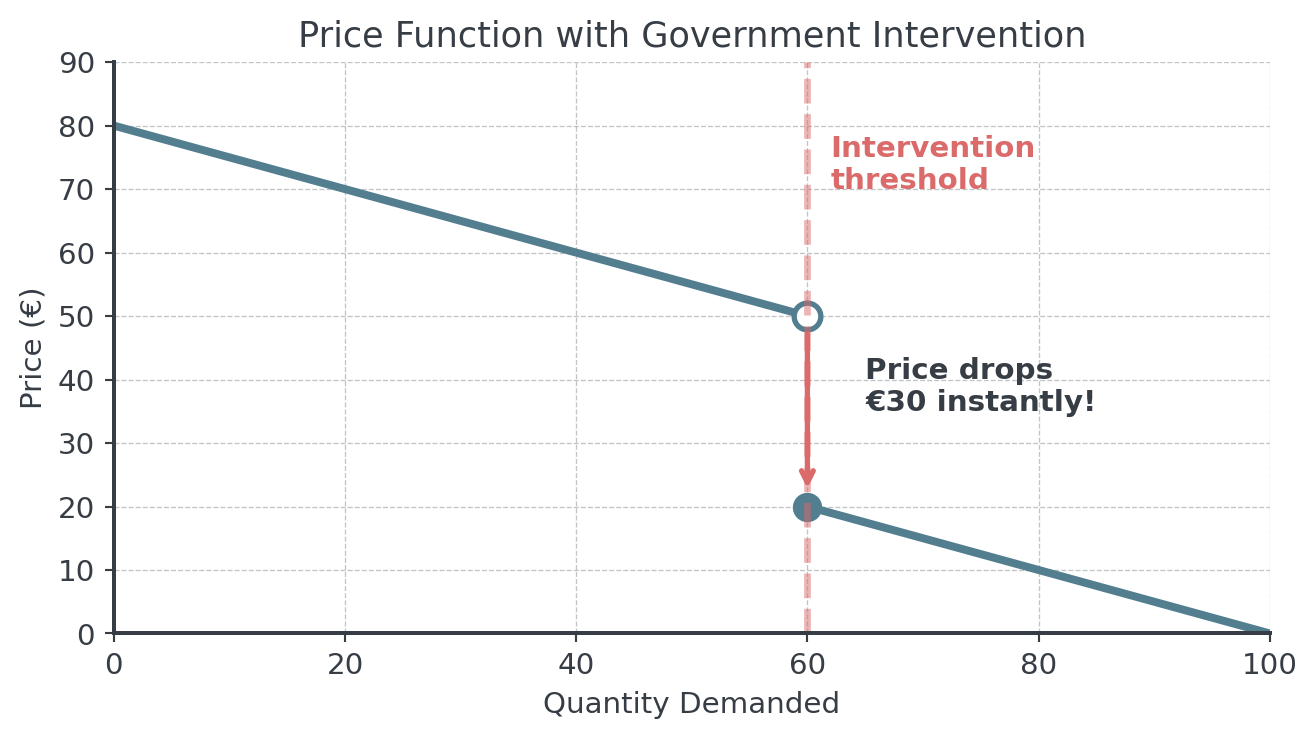
Government Price Intervention
Demand exceeds threshold, government releases emergency reserves:
Real-World
Examples of Discontinuous Price Functions
- Government reserves released when prices exceed threshold
- Rent control kicking in above certain income levels
- Tiered utility pricing with usage thresholds
- Tariffs applied when imports exceed quotas
Policy interventions often create discontinuities. Limits help us analyze prices “just before” and “just after” the threshold.
Economic: Long-Run Average Cost
Business Context: A company’s total cost function is \(C(x) = 5000 + 20x + 0.001x^2\).
Question: What happens to average cost in the long run?
\[\lim_{x \to \infty} \overline{C}(x) = \lim_{x \to \infty} \left(\frac{5000}{x} + 20 + 0.001x\right)\]
- \(\frac{5000}{x} \to 0\) (fixed costs spread over many units)
- \(20 \to 20\) (constant variable cost)
- \(0.001x \to \infty\) (diseconomies of scale eventually dominate)
More Limit Practice
Mastering Limit Evaluation
Evaluating limits requires recognizing the type of limit!
- Direct substitution first - if the function is continuous, plug in!
- Form 0/0 - factor and simplify
- Form ∞/∞ - compare degrees (rational functions)
- One-sided limits differ - limit doesn’t exist
- Infinite limits - vertical asymptote behavior
Forms like \(\frac{0}{0}\) or \(\frac{\infty}{\infty}\) are indeterminate - the form alone doesn’t tell you the answer. The limit could be any number! You must apply techniques (factoring, simplifying) to find the actual value.
Practice Set A: Algebraic Limits
Work individually for 8 minutes
Evaluate these limits:
\(\displaystyle\lim_{x \to 3} \frac{x^2 - 9}{x^2 - 5x + 6}\)
\(\displaystyle\lim_{x \to 0} \frac{x^3 - x}{x}\)
\(\displaystyle\lim_{x \to 4} \frac{\sqrt{x} - 2}{x - 4}\)
Practice Set B: Limits at Infinity
Work individually for 5 minutes
Evaluate these limits:
\(\displaystyle\lim_{x \to \infty} \frac{3x^2 + 2x}{5x^2 - 1}\)
\(\displaystyle\lim_{x \to \infty} \frac{x + 1}{x^3 - 2}\)
\(\displaystyle\lim_{x \to -\infty} \frac{2x^3}{x^2 + 1}\)
\(\displaystyle\lim_{x \to \infty} \frac{4x^2 - 3x + 1}{2x^2 + x}\)
Practice Set C: One-Sided & Infinite
Work individually for 5 minutes
\(\displaystyle\lim_{x \to 0^+} \frac{1}{x}\)
\(\displaystyle\lim_{x \to 0^-} \frac{1}{x}\)
Does \(\displaystyle\lim_{x \to 0} \frac{1}{x}\) exist? Why or why not?
\(\displaystyle\lim_{x \to 2^-} \frac{x}{x - 2}\) and \(\displaystyle\lim_{x \to 2^+} \frac{x}{x - 2}\)
Team Problem-Solving
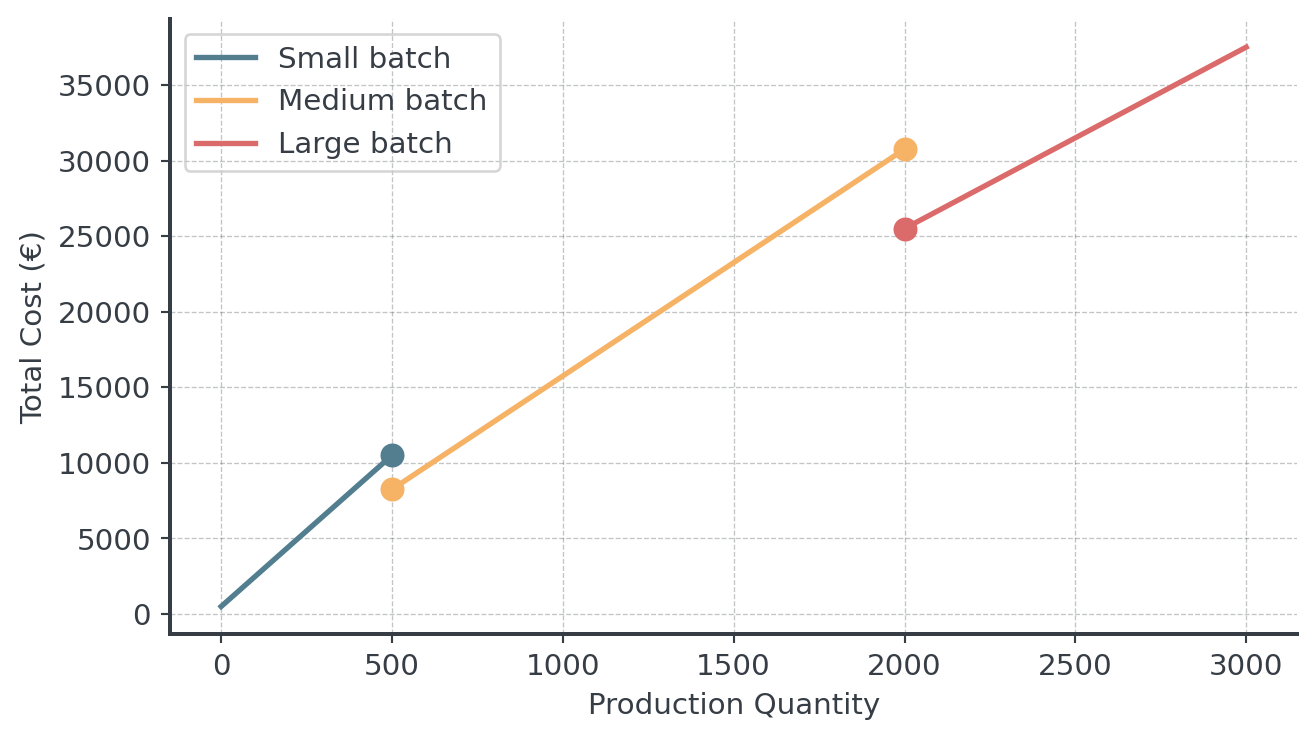
Challenge: Production Planning
A manufacturing company has this cost structure:
- Small batches (< 500 units): \(C_1(x) = 20x + 500\)
- Medium batches (500-2000 units): \(C_2(x) = 15x + 750\)
- Large batches (> 2000 units): \(C_3(x) = 12x + 1500\)
Challenge: Tasks
Work in groups of 3-4
- Write the complete piecewise cost function
- Identify all points of discontinuity
- Calculate limits at each transition point
- Determine which transitions are continuous
- Graph the cost function
- Recommend: Should the company smooth these transitions?
Wrap-Up & Takeaways
Today’s Essential Concepts
- Limits describe approaching behavior - what happens as we get close
- One-sided limits help analyze jumps and breaks
- Continuity requires three conditions - defined, limit exists, they match
- Discontinuity types: removable (hole), jump, infinite (asymptote)
- Business functions often have discontinuities - and that’s okay!
- Graphical analysis is powerful for understanding limits
Limits are the foundation of calculus. Next session, we’ll use them to define derivatives!
Final Assessment
Quick Check
Work individually, then we compare
For \(f(x) = \frac{x^2 - 9}{x - 3}\): Find \(\lim_{x \to 3} f(x)\) and is \(f\) continuous at \(x = 3\)?
A parking fee function: \[P(t) = \begin{cases} 5 & \text{if } 0 < t \leq 2 \\ 10 & \text{if } 2 < t \leq 4 \\ 20 & \text{if } t > 4 \end{cases}\] Where is \(P(t)\) discontinuous?
Next Session Preview
Coming Up: The Derivative
- From average rate of change to instantaneous rate
- The derivative as a limit
- Marginal cost, revenue, and profit
- Finding tangent lines to curves
Complete Tasks 05-01
- Focus on graphical limit evaluation
- Practice identifying discontinuity types
- Master the limit evaluation strategies we covered today
See you next time for derivatives!
Appendix I: Practice Set B
Appendix II: Group Challenge