Tasks 05-06 - Curve Sketching & Optimization
Section 05: Differential Calculus
A: Skills
Problem 1: First and Second Derivative Test (x)
Let \(f(x) = x^3 + 3x^2 - 24x + 10\). Determine all critical points of \(f\) and classify them with the first derivative test (sign chart of \(f'\)). Compute the function values at the critical points.
Let \(g(x) = x^4 - 4x^3 - 8x^2 + 3\). Determine the nature and the coordinates of all stationary points of \(g\) (the points with \(g'(x) = 0\)). Use the second derivative test.
CautionSolution
- Power rule, then factor out 3:
\[f'(x) = 3x^2 + 6x - 24 = 3(x^2 + 2x - 8) = 3(x + 4)(x - 2)\]
Critical points: \(f'(x) = 0\) at \(x = -4\) and \(x = 2\).
| \(x\) | \(x < -4\) | \(-4 < x < 2\) | \(x > 2\) |
|---|---|---|---|
| \(x + 4\) | \(-\) | \(+\) | \(+\) |
| \(x - 2\) | \(-\) | \(-\) | \(+\) |
| \(f'(x)\) | \(+\) | \(-\) | \(+\) |
| \(f\) | increasing | decreasing | increasing |
- \(x = -4\): \(f'\) changes from \(+\) to \(-\), local maximum, \(f(-4) = -64 + 48 + 96 + 10 = 90\), point \((-4, 90)\)
- \(x = 2\): \(f'\) changes from \(-\) to \(+\), local minimum, \(f(2) = 8 + 12 - 48 + 10 = -18\), point \((2, -18)\)
- Power rule, then factor out \(4x\):
\[g'(x) = 4x^3 - 12x^2 - 16x = 4x(x^2 - 3x - 4) = 4x(x - 4)(x + 1)\]
Critical points: \(x = -1\), \(x = 0\) and \(x = 4\). Second derivative:
\[g''(x) = 12x^2 - 24x - 16\]
- \(g''(-1) = 12 + 24 - 16 = 20 > 0\): concave up, local minimum, \(g(-1) = 1 + 4 - 8 + 3 = 0\), point \((-1, 0)\)
- \(g''(0) = -16 < 0\): concave down, local maximum, \(g(0) = 3\), point \((0, 3)\)
- \(g''(4) = 192 - 96 - 16 = 80 > 0\): concave up, local minimum, \(g(4) = 256 - 256 - 128 + 3 = -125\), point \((4, -125)\)
Typical mistake: swapping the two cases of the second derivative test. \(g''(c) > 0\) means concave up, like the bottom of a bowl, so the critical point is a minimum. \(g''(c) < 0\) means concave down, like the top of a hill: a maximum.
Problem 2: When the Second Derivative Test Fails (xx)
Let \(h(x) = x^4 - 6x^2 + 8x + 1\).
Determine \(h'(x)\) and show that \(h'(x) = 4(x + 2)(x - 1)^2\). Give the critical points of \(h\).
Classify the critical points with the second derivative test where it works.
Use the first derivative test for the critical point at which the second derivative test fails. Name the type of this point.
Determine the inflection points of \(h\) with the test \(h''(x_0) = 0\) and \(h'''(x_0) \neq 0\). Explain what is special about the point at \(x = 1\).
CautionSolution
- Power rule: \(h'(x) = 4x^3 - 12x + 8\). Expand the given product:
\[4(x + 2)(x - 1)^2 = 4(x + 2)(x^2 - 2x + 1) = 4(x^3 - 2x^2 + x + 2x^2 - 4x + 2) = 4(x^3 - 3x + 2) = 4x^3 - 12x + 8 \quad \checkmark\]
Critical points: \(h'(x) = 0\) at \(x = -2\) and \(x = 1\) (double zero).
- \(h''(x) = 12x^2 - 12\).
- \(h''(-2) = 48 - 12 = 36 > 0\): local minimum, \(h(-2) = 16 - 24 - 16 + 1 = -23\), point \((-2, -23)\)
- \(h''(1) = 12 - 12 = 0\): the second derivative test gives no answer at \(x = 1\).
Signs of \(h'(x) = 4(x + 2)(x - 1)^2\) close to \(x = 1\): the factor \(x + 2\) is positive, and \((x - 1)^2\) is a square, positive for \(x \neq 1\). So \(h'(x) > 0\) just before and just after \(x = 1\). \(h'\) does not change its sign: \(h\) keeps increasing, and \(x = 1\) is no extremum. It is a saddle point (a stationary point without extremum), \(h(1) = 1 - 6 + 8 + 1 = 4\), point \((1, 4)\).
\(h''(x) = 12x^2 - 12 = 12(x - 1)(x + 1) = 0\) at \(x = -1\) and \(x = 1\). Third derivative: \(h'''(x) = 24x\).
- \(h'''(-1) = -24 \neq 0\): inflection point, \(h(-1) = 1 - 6 - 8 + 1 = -12\), point \((-1, -12)\)
- \(h'''(1) = 24 \neq 0\): inflection point \((1, 4)\)
The point \((1, 4)\) is the saddle point from c). There, the graph has a horizontal tangent and changes its curvature (from concave down to concave up). A saddle point is an inflection point with a horizontal tangent.
Typical mistake: “\(h''(1) = 0\), so \(x = 1\) is not an extremum.” \(h''(1) = 0\) only means that the second derivative test gives no answer. The function \(x^4\) from the lecture has \(f''(0) = 0\) and still a minimum at \(x = 0\). Only the sign of \(h'\) around \(x = 1\) decides.
Problem 3: Global Extrema on a Closed Interval (xx)
Determine the absolute maximum and the absolute minimum of each function on the given interval.
\(f(x) = 2x^3 - 3x^2 - 36x + 10\) on \([-1; 6]\)
\(g(x) = x - 4\sqrt{x}\) on \([1; 16]\)
CautionSolution
Both functions are continuous on a closed interval, so by the Extreme Value Theorem both have an absolute maximum and an absolute minimum there. Candidates: the critical points inside the interval and both endpoints.
- \(f'(x) = 6x^2 - 6x - 36 = 6(x^2 - x - 6) = 6(x - 3)(x + 2)\). Critical points \(x = 3\) and \(x = -2\). Only \(x = 3\) lies in \([-1; 6]\).
| \(x\) | \(f(x)\) | Type |
|---|---|---|
| \(-1\) | \(-2 - 3 + 36 + 10 = 41\) | endpoint |
| \(3\) | \(54 - 27 - 108 + 10 = -71\) | critical point |
| \(6\) | \(432 - 108 - 216 + 10 = 118\) | endpoint |
Absolute maximum \(118\) at \(x = 6\) (an endpoint), absolute minimum \(-71\) at \(x = 3\).
- \(g(x) = x - 4x^{1/2}\), power rule: \(g'(x) = 1 - 2x^{-1/2} = 1 - \frac{2}{\sqrt{x}}\).
\[g'(x) = 0 \iff \frac{2}{\sqrt{x}} = 1 \iff \sqrt{x} = 2 \iff x = 4\]
\(x = 4\) lies in \([1; 16]\).
| \(x\) | \(g(x)\) | Type |
|---|---|---|
| \(1\) | \(1 - 4 = -3\) | endpoint |
| \(4\) | \(4 - 8 = -4\) | critical point |
| \(16\) | \(16 - 16 = 0\) | endpoint |
Absolute maximum \(0\) at \(x = 16\) (an endpoint), absolute minimum \(-4\) at \(x = 4\).
Typical mistake: in a), taking \(x = -2\) into the table. \(f(-2) = 54\) is larger than \(f(-1)\), but \(x = -2\) is not in the interval. A second mistake is to stop at the critical points: in both parts, the absolute maximum lies at an endpoint.
Problem 4: The 6-Step Algorithm (xxx)
Let \(f(x) = \frac{x^2 + 5}{x - 2}\). Work through the 6-step algorithm. Round to two decimal places where needed.
Give the domain and the intercepts of \(f\).
Determine the critical points of \(f\) and classify them.
(for verification: \(f'(x) = \frac{(x - 5)(x + 1)}{(x - 2)^2}\))
- Show with polynomial long division that \(f(x) = x + 2 + \frac{9}{x - 2}\). Use this form to determine \(f''(x)\) and decide whether \(f\) has inflection points.
Hint: Write the numerator as \(x^2 + 0x + 5\) before the long division.
Give the sign charts of \(f'\) and \(f''\).
Investigate the asymptotic behavior of \(f\).
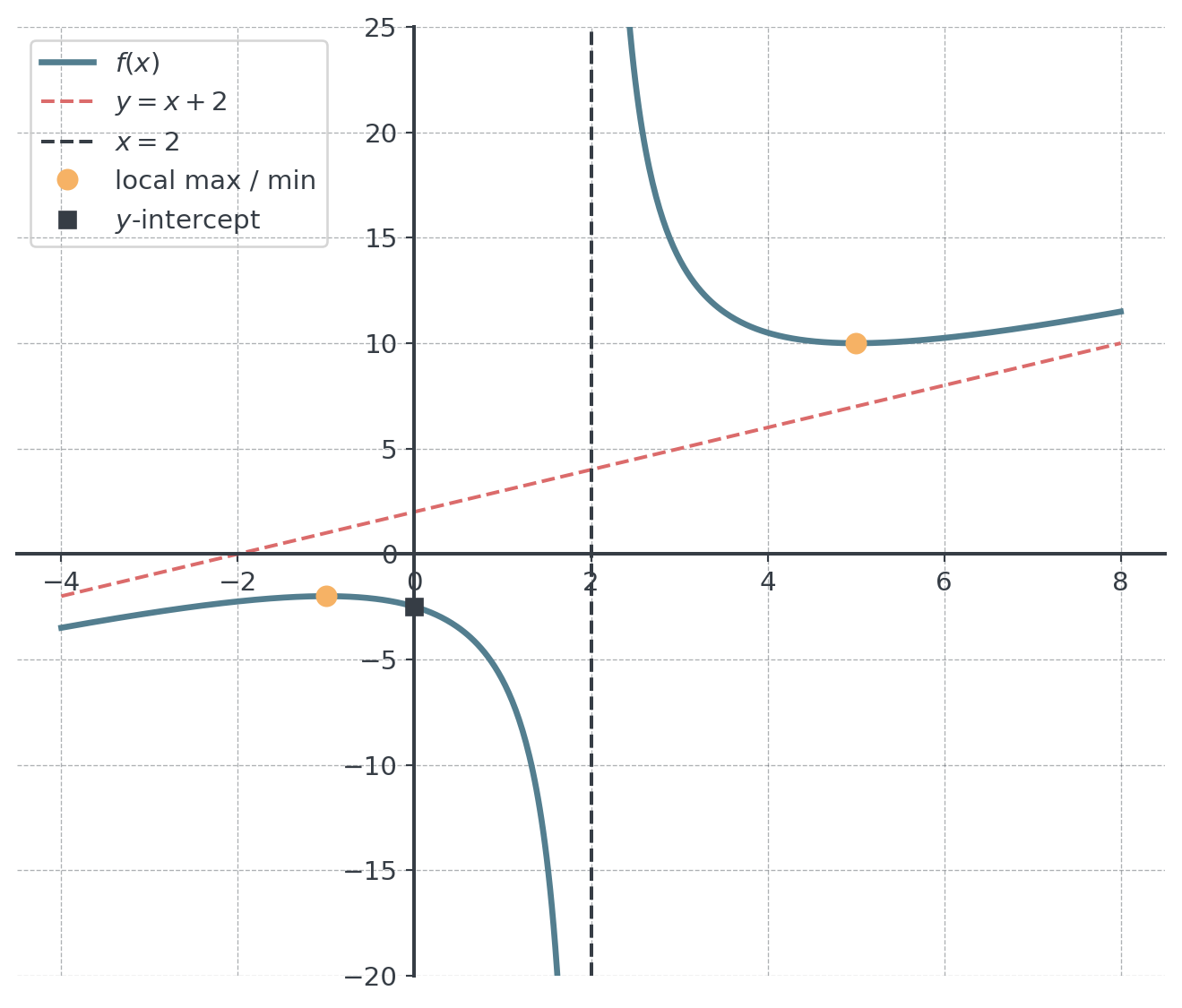
Sketch the graph \(G_f\) of \(f\) in the interval \([-4; 8]\). Draw the asymptotes and mark all points from a) and b).
CautionSolution
a) Step 1: Domain and intercepts
- Domain: the denominator is zero at \(x = 2\), so \(D = \mathbb{R} \setminus \{2\}\).
- \(y\)-intercept: \(f(0) = \frac{5}{-2} = -2.5\), point \((0, -2.5)\).
- \(x\)-intercepts: \(x^2 + 5 = 0\) has no solution, because \(x^2 + 5 \geq 5 > 0\). No \(x\)-intercepts.
b) Step 2: Critical points
Quotient rule with \(u = x^2 + 5\), \(u' = 2x\) and \(v = x - 2\), \(v' = 1\):
\[f'(x) = \frac{2x(x - 2) - (x^2 + 5)}{(x - 2)^2} = \frac{x^2 - 4x - 5}{(x - 2)^2} = \frac{(x - 5)(x + 1)}{(x - 2)^2}\]
\(f'(x) = 0\) at \(x = -1\) and \(x = 5\). The denominator \((x - 2)^2\) is positive, so \(f'\) has the sign of \((x - 5)(x + 1)\): positive for \(x < -1\), negative between \(-1\) and \(5\) (without \(x = 2\)), positive for \(x > 5\).
- \(x = -1\): \(f'\) changes from \(+\) to \(-\), local maximum \((-1, -2)\), since \(f(-1) = \frac{6}{-3} = -2\)
- \(x = 5\): \(f'\) changes from \(-\) to \(+\), local minimum \((5, 10)\), since \(f(5) = \frac{30}{3} = 10\)
The second derivative from c) confirms this: \(f''(-1) = \frac{18}{(-3)^3} = -\frac{2}{3} < 0\) and \(f''(5) = \frac{18}{3^3} = \frac{2}{3} > 0\).
c) Step 3: Inflection points
\[\begin{array}{l} (x^2 + 0x + 5) : (x - 2) = x + 2 \\ \underline{-(x^2 - 2x)} \\ \phantom{(x^2}\;\; 2x + 5 \\ \phantom{(x^2}\;\; \underline{-(2x - 4)} \\ \phantom{(x^2 + 0x}\;\; 9 \end{array}\]
So \(f(x) = x + 2 + \frac{9}{x - 2}\) (remainder 9). With \(\frac{9}{x - 2} = 9(x - 2)^{-1}\) and the chain rule:
\[f'(x) = 1 - 9(x - 2)^{-2}, \qquad f''(x) = 18(x - 2)^{-3} = \frac{18}{(x - 2)^3}\]
The numerator 18 is never zero, so \(f''(x) \neq 0\) for all \(x\): no inflection points. \(f''\) changes its sign only at \(x = 2\), which is not in the domain.
d) Step 4: Sign charts
| \(x\) | \(x < -1\) | \(-1 < x < 2\) | \(2 < x < 5\) | \(x > 5\) |
|---|---|---|---|---|
| \(f'(x)\) | \(+\) | \(-\) | \(-\) | \(+\) |
| \(f\) | increasing | decreasing | decreasing | increasing |
| \(f''(x)\) | \(-\) | \(-\) | \(+\) | \(+\) |
| \(f\) | concave down | concave down | concave up | concave up |
(The denominator \((x - 2)^2\) of \(f'\) is positive, so \(f'\) has the sign of \((x - 5)(x + 1)\). \(f''\) has the sign of \((x - 2)^3\).)
e) Step 5: Asymptotic behavior
- Vertical asymptote \(x = 2\): for \(x \to 2^-\), the numerator tends to 9 and the denominator to \(0\) from below, so \(f(x) \to -\infty\). For \(x \to 2^+\), \(f(x) \to +\infty\).
- Oblique asymptote \(y = x + 2\): \(\frac{9}{x - 2} \to 0\) for \(x \to \pm\infty\). The graph lies above the asymptote for \(x > 2\) and below it for \(x < 2\).
f) Step 6: Sketch with \(f(-4) = \frac{21}{-6} = -3.5\) and \(f(8) = \frac{69}{6} = 11.5\) at the ends of the interval:
Typical mistake: looking for inflection points only with \(f''(x) = 0\) and then drawing the graph with one smooth curve through \(x = 2\). The curvature does change at \(x = 2\), but \(f\) is not defined there: the graph breaks into two branches at the vertical asymptote.
Problem 5: Inflection Points and the Inflectional Tangent (xx)
Let \(g(x) = x^3 - 9x^2 + 15x + 4\). Determine the inflection point of \(g\) with the test \(g''(x_0) = 0\) and \(g'''(x_0) \neq 0\). Determine the inflectional tangent (the tangent at the inflection point) and explain why the graph of \(g\) falls most steeply at the inflection point.
A function \(f\) is positive everywhere. It has exactly one local maximum, at \(x = 2\), and its graph approaches the \(x\)-axis for \(x \to -\infty\) and for \(x \to +\infty\). Assess how many inflection points \(f\) has to possess at least. Give a reason.
CautionSolution
- Derivatives with the power rule:
\[g'(x) = 3x^2 - 18x + 15, \qquad g''(x) = 6x - 18, \qquad g'''(x) = 6\]
\(g''(x) = 0 \iff x = 3\), and \(g'''(3) = 6 \neq 0\): inflection point at \(x = 3\) with \(g(3) = 27 - 81 + 45 + 4 = -5\), point \((3, -5)\).
Inflectional tangent: slope \(g'(3) = 27 - 54 + 15 = -12\).
\[y = g'(3)(x - 3) + g(3) = -12(x - 3) - 5 = -12x + 31\]
Why steepest: \(g'(x) = 3x^2 - 18x + 15\) is a parabola that opens upward, and its vertex lies at \(x = 3\), where \(g''(x) = 0\). So \(g'(3) = -12\) is the smallest slope of \(g\): nowhere does the graph fall more steeply than at the inflection point.
- At least two inflection points.
- Left of \(x = 2\): \(f\) rises to its maximum, so \(f'(x) > 0\) there. For \(x \to -\infty\), the graph gets flat along the \(x\)-axis, so \(f'\) tends to 0. At \(x = 2\), \(f'(2) = 0\) again. So \(f'\) first grows and then falls back to 0: \(f'\) has a maximum somewhere left of 2. There, \(f\) changes from concave up to concave down: an inflection point.
- Right of \(x = 2\): \(f'(x) < 0\), \(f'(2) = 0\), and \(f'\) tends to 0 for \(x \to +\infty\). So \(f'\) has a minimum somewhere right of 2, where \(f\) changes from concave down back to concave up: a second inflection point.
A bell-shaped curve is an example of such a function.
Typical mistake: in a), using the tangent at a critical point, e.g. at the local minimum \(x = 5\). That tangent is horizontal. The inflectional tangent touches the graph at \(x = 3\) and has the slope \(g'(3) = -12\).
B: Set Up & Check
Problem 6: From Words to Conditions (xx)
Translate each statement into mathematics. Then answer the check question: it tells you whether your translation works.
“A company makes roof boxes (storage boxes for the roof of a car). Its monthly profit is \(P(x) = -x^3 + 21x^2 - 72x - 50\) thousand EUR for \(x\) thousand roof boxes.” The controller writes: “\(P'(2) = 0\), so at 2,000 roof boxes our profit is at its maximum.” Write down what the controller still has to show to prove that the profit really is at its maximum there.
Check: Compute \(P''(2)\). Is the controller right? Where does the maximum lie?
“A small workshop makes dog leashes by hand. Its weekly costs are \(C(x) = 0.1x^3 - 2x^2 + 18x + 800\) EUR for \(x\) leashes.” The owner wants “the output with the lowest unit costs” (the costs per leash). Write down the function that has to be minimized and the conditions for its minimum.
Check: Does \(x = 20\) fulfil your conditions? How high are the lowest unit costs? What do you get if you solve \(C'(x) = 0\) instead?
“A company makes tennis rackets. Its unit costs are \(k(x) = 2x + 60 + \frac{450}{x}\) EUR per racket when it makes \(x\) hundred rackets per month.” The long-term price floor is the lowest possible unit cost: below this price, the company cannot cover its total costs in the long run. The sales manager says: “Our long-term price floor is 15, because our unit costs are lowest at 15.” Write down the correct statement for the price floor.
Check: Compute the price floor. A sports chain offers 150 EUR per racket for a long-term contract. Can the company cover its total costs at this price?
“A flower nursery grows tulips for flower shops. Its weekly profit is \(P(x) = -0.25x^2 + 8x - 30\) hundred EUR for \(x\) thousand tulips. Its greenhouse allows at most 12 thousand tulips per week (the capacity, the maximum possible output).” The manager wants “the highest profit within the capacity”, solves \(P'(x) = 0\), gets \(x = 16\) and reports a highest profit of \(P(16) = 34\). Write down the domain and all candidates for the highest profit.
Check: Compute the profit at all candidates. What is wrong with the manager’s answer?
“A sunscreen brand sells \(S(t) = -t^3 + 12t^2 + 20t\) hundred bottles per week, \(t\) weeks after the start of the spring season (\(0 \le t \le 8\)).” The marketing team asks for “the inflectional tangent of \(S\) and its meaning”. Write down the conditions for the point of contact and the equation of the tangent in general form.
Check: Does your tangent pass through the point \((4, 208)\) with slope 68?
CautionSolution
A maximum needs more than a horizontal tangent. At \(x_0\), either
\[P'(x_0) = 0 \quad \text{and} \quad P''(x_0) < 0 \qquad \text{(second derivative test)}\]
or \(P'(x_0) = 0\) and \(P'\) changes its sign from \(+\) to \(-\) at \(x_0\) (first derivative test).
Check: \(P'(x) = -3x^2 + 42x - 72 = -3(x - 2)(x - 12)\) and \(P''(x) = -6x + 42\). \(P''(2) = 30 > 0\): at 2,000 roof boxes, the profit has a local minimum, \(P(2) = -8 + 84 - 144 - 50 = -118\), a loss of 118,000 EUR. The controller is wrong. The maximum lies at the other critical point: \(P''(12) = -30 < 0\), \(P(12) = -1728 + 3024 - 864 - 50 = 382\) thousand EUR at 12,000 roof boxes.
Typical mistake: stopping at \(P'(x) = 0\). A horizontal tangent belongs to a maximum, a minimum or a saddle point. Only the second derivative (or the sign change of \(P'\)) tells them apart.
The unit costs are the total costs divided by the output:
\[k(x) = \frac{C(x)}{x} = 0.1x^2 - 2x + 18 + \frac{800}{x}, \qquad k'(x_0) = 0 \quad \text{and} \quad k''(x_0) > 0\]
Check: \(k'(x) = 0.2x - 2 - \frac{800}{x^2}\), so \(k'(20) = 4 - 2 - 2 = 0\) ✓. \(k''(x) = 0.2 + \frac{1600}{x^3}\), so \(k''(20) = 0.2 + 0.2 = 0.4 > 0\) ✓, a minimum. Lowest unit costs: \(k(20) = 40 - 40 + 18 + 40 = 58\) EUR per leash. With \(C'(x) = 0.3x^2 - 4x + 18 = 0\) instead, the discriminant is \(16 - 21.6 < 0\): no solution. The total costs grow with every leash and have no minimum for \(x > 0\).
Typical mistake: minimizing the total costs \(C(x)\) instead of the unit costs \(\frac{C(x)}{x}\). The owner asks for the cheapest output per leash, not the cheapest week.
The price floor is a price, the lowest value of the unit costs, not the output at which it occurs:
\[\text{price floor} = k(x_0) \quad \text{with} \quad k'(x_0) = 0 \text{ and } k''(x_0) > 0\]
Check: \(k'(x) = 2 - \frac{450}{x^2} = 0 \iff x^2 = 225 \iff x = 15\) (for \(x > 0\)), and \(k''(x) = \frac{900}{x^3} > 0\). Price floor: \(k(15) = 30 + 60 + 30 = 120\) EUR per racket. The offer of 150 EUR lies above it: at 1,500 rackets per month, each racket costs 120 EUR, so the company covers its total costs and earns 30 EUR per racket.
Typical mistake: “The price floor is 15.” 15 is the output in hundred rackets. The sales manager has given the \(x\)-value of the minimum instead of its \(y\)-value.
Domain: \(0 \le x \le 12\). Candidates: the critical points inside the domain and both endpoints \(x = 0\) and \(x = 12\).
Check: \(P'(x) = -0.5x + 8 = 0 \iff x = 16\), which lies outside the domain. So only the endpoints are left: \(P(0) = -30\) and \(P(12) = -36 + 96 - 30 = 30\). \(P'(x) > 0\) for all \(x < 16\), so the profit grows up to the capacity. The highest profit within the capacity is 3,000 EUR per week at 12 thousand tulips. The manager’s 34 hundred EUR needs 16 thousand tulips, which the greenhouse cannot grow.
Typical mistake: reporting the critical point without checking the domain. With a capacity, the maximum may lie at the endpoint.
The point of contact is the inflection point \(t_0\):
\[S''(t_0) = 0, \quad S'''(t_0) \neq 0, \qquad \text{tangent: } y = S'(t_0)(t - t_0) + S(t_0)\]
Check: \(S'(t) = -3t^2 + 24t + 20\), \(S''(t) = -6t + 24 = 0 \iff t = 4\), and \(S'''(t) = -6 \neq 0\). \(S(4) = -64 + 192 + 80 = 208\) and \(S'(4) = -48 + 96 + 20 = 68\):
\[y = 68(t - 4) + 208 = 68t - 64\]
It passes through \((4, 208)\) with slope 68 ✓. Meaning: in week 4, the weekly sales grow fastest, by about 6,800 bottles per week.
Typical mistake: using \(S'(t_0) = 0\) for the point of contact. That gives a horizontal tangent at a critical point, not the tangent at the steepest point of the graph.
Problem 7: One Paragraph, All Conditions (xx)
A family company builds wooden garden sheds. Its weekly total costs \(C\) in EUR are a polynomial of third degree in the number \(x\) of sheds per week, and its fixed costs are 6,000 EUR per week. The costs grow most slowly at an output of 10 sheds per week. At 20 sheds per week, the unit costs (the costs per shed) are lowest, and the long-term price floor is 900 EUR per shed. The company can build at most 30 sheds per week. It sells every shed for 1,500 EUR. The owner wants the maximum weekly profit within the capacity and a proof that it really is a maximum.
List every condition and every function in this paragraph as a mathematical statement. Do not solve anything.
Check: An assistant writes the sentence about 20 sheds as the single condition \(C(20) = 900\). Explain what is wrong and name all conditions this sentence gives.
CautionSolution
- Cost function: \(C(x) = ax^3 + bx^2 + cx + d\), so \(C'(x) = 3ax^2 + 2bx + c\) and \(C''(x) = 6ax + 2b\)
- Fixed costs: \(C(0) = 6000\), i.e. \(d = 6000\)
- The costs grow most slowly at 10 sheds: \(C'\) has its minimum there, so \(C''(10) = 0\) (inflection point of \(C\))
- Unit costs: \(k(x) = \frac{C(x)}{x}\) for \(x > 0\)
- Lowest unit costs at 20 sheds: \(k'(20) = 0\)
- Long-term price floor: \(k(20) = 900\), i.e. \(C(20) = 18{,}000\)
- Capacity: \(0 \le x \le 30\)
- Revenue and profit: \(R(x) = 1500x\) and \(P(x) = R(x) - C(x)\)
- Maximum within the capacity: candidates are the solutions of \(P'(x) = 0\) with \(0 < x < 30\) and the endpoints \(x = 0\) and \(x = 30\). Proof: \(P''(x_0) < 0\) (or the sign change of \(P'\)), and \(P(x_0)\) is larger than \(P(0)\) and \(P(30)\).
Check: 900 EUR is the cost per shed, not the total cost of 20 sheds. So \(k(20) = \frac{C(20)}{20} = 900\), i.e. \(C(20) = 18{,}000\). The word “lowest” gives a second condition, \(k'(20) = 0\). Together with conditions 2 and 3, these are four conditions for the four unknowns \(a\), \(b\), \(c\), \(d\).
Typical mistake: \(C'(10) = 0\) for “the costs grow most slowly”. That would mean that the costs do not grow at all at 10 sheds. The slowest growth is the minimum of \(C'\), so the condition is on \(C''\).
C: Applied
Problem 8: Profit of a Stove Manufacturer (xx)
A company builds wood-burning stoves (stoves that heat a room by burning wood) and sells them to specialist dealers. Its monthly profit is
\[P(x) = -0.5x^3 + 9x^2 - 30x - 20, \qquad x \geq 0\]
thousand EUR for \(x\) hundred stoves per month. At the moment, its production hall allows at most 600 stoves per month (the capacity, the maximum possible output).
- Determine the critical points of \(P\) and classify them with the second derivative test. Interpret the local minimum for the company.
(for verification: \(P'(x) = -1.5(x - 2)(x - 10)\))
Compute the highest monthly profit within the current capacity. Explain why the local maximum from a) does not answer this question.
A second production hall would raise the capacity to 1,200 stoves per month. Leave out the rent for this hall for the moment. Compute the maximum profit within the new capacity and prove that it is the highest profit on the whole interval.
The second hall costs a fixed monthly rent. Determine the highest rent at which the second hall still pays off.
Determine the inflection point of \(P\) and explain its economical significance. Explain what it means for the current capacity.
CautionSolution
a) Power rule, then factor out \(-1.5\):
\[P'(x) = -1.5x^2 + 18x - 30 = -1.5(x^2 - 12x + 20) = -1.5(x - 2)(x - 10)\]
Critical points at \(x = 2\) and \(x = 10\). Second derivative: \(P''(x) = -3x + 18\).
- \(P''(2) = 12 > 0\): local minimum, \(P(2) = -4 + 36 - 60 - 20 = -48\)
- \(P''(10) = -12 < 0\): local maximum, \(P(10) = -500 + 900 - 300 - 20 = 80\)
Local minimum: at 200 stoves per month, the company makes a loss of 48,000 EUR, more than at any output close to it. Below 200 stoves, \(P'(x) < 0\): every further stove makes the loss larger, because such a small production cannot use the machines and the staff well. From 200 stoves on, every further stove brings profit.
b) Domain \(0 \le x \le 6\). Candidates: the critical point \(x = 2\) inside the domain and the endpoints.
| \(x\) | \(0\) | \(2\) | \(6\) |
|---|---|---|---|
| \(P(x)\) | \(-20\) | \(-48\) | \(-108 + 324 - 180 - 20 = 16\) |
The highest profit within the capacity is 16,000 EUR per month at 600 stoves, i.e. at the capacity limit. The local maximum at \(x = 10\) needs 1,000 stoves per month, which the current hall cannot build.
c) Domain \(0 \le x \le 12\). Both critical points lie inside, \(P(12) = -864 + 1296 - 360 - 20 = 52\):
| \(x\) | \(0\) | \(2\) | \(10\) | \(12\) |
|---|---|---|---|---|
| \(P(x)\) | \(-20\) | \(-48\) | \(80\) | \(52\) |
Maximum profit: 80,000 EUR per month at 1,000 stoves. Proof: \(P''(10) = -12 < 0\) makes it a local maximum, and the table shows that \(P(10)\) is larger than the values at all other candidates, including both endpoints. By the Extreme Value Theorem, \(P\) has an absolute maximum on \([0; 12]\), so it is \(P(10) = 80\).
d) A fixed rent of \(K\) thousand EUR per month lowers every value of \(P\) by \(K\), so the maximum stays at 1,000 stoves and becomes \(80 - K\). The second hall pays off if
\[80 - K > 16 \iff K < 64\]
The rent must be less than 64,000 EUR per month.
e) \(P''(x) = -3x + 18 = 0 \iff x = 6\), and \(P'''(x) = -3 \neq 0\): inflection point \((6, 16)\) with \(P(6) = 16\) from b).
Economical significance: \(P'(6) = -1.5 \cdot 4 \cdot (-4) = 24\) thousand EUR per hundred stoves, i.e. about 240 EUR per stove. At 600 stoves per month, the marginal profit is highest: here each further stove adds more profit than at any other output. Above 600 stoves, the profit still grows up to 1,000 stoves, but more and more slowly.
For the capacity: the current hall stops the production exactly where the profit grows fastest. This is a strong argument for the second hall.
Problem 9: Batch Size for Natural Shampoo (xx)
A company makes natural shampoo and fills it into bottles in batches. Before every batch, the filling line has to be cleaned and set up, which costs 500 EUR. For a batch of \(x\) hundred bottles, the costs are
\[C(x) = 0.8x^2 + 15x + 500 \text{ EUR}\]
The term \(0.8x^2\) describes the storage costs, which grow fast for large batches.
Give the unit costs \(k(x)\) of a batch (the costs per hundred bottles). Explain what happens to the setup costs per bottle for small and for large batches.
Compute the batch size with the lowest unit costs and prove that it is a minimum. Give the lowest costs per bottle.
(for verification: \(k(25) = 55\))
The storage room holds at most 2,000 bottles. Determine the lowest unit costs within this capacity and explain your answer with the sign of \(k'\).
The company fills 50,000 bottles per month. A bigger storage room for 2,500 bottles costs 400 EUR more per month. Decide whether the bigger storage room pays off.
Investigate the asymptotic behavior of \(k\) for \(x \to 0^+\) and for \(x \to \infty\) and explain its meaning.
A drugstore chain offers 0.53 EUR per bottle if the company fills its own-brand shampoo. Decide whether the company can accept the offer without a loss.
CautionSolution
a)
\[k(x) = \frac{C(x)}{x} = 0.8x + 15 + \frac{500}{x} \quad \text{EUR per hundred bottles}\]
The term \(\frac{500}{x}\) spreads the setup costs over the batch. In a small batch, each bottle carries a large share: 500 bottles carry \(\frac{500}{5} = 100\) EUR per hundred bottles. In a large batch, the share shrinks: 5,000 bottles carry only \(\frac{500}{50} = 10\) EUR per hundred bottles.
b) \(k(x) = 0.8x + 15 + 500x^{-1}\), power rule:
\[k'(x) = 0.8 - \frac{500}{x^2} = 0 \iff x^2 = 625 \iff x = 25 \quad (x > 0)\]
\(k''(x) = \frac{1000}{x^3} > 0\) for \(x > 0\), so \(x = 25\) is a minimum. Lowest unit costs: \(k(25) = 20 + 15 + 20 = 55\) EUR per hundred bottles. The best batch has 2,500 bottles, and a bottle then costs 0.55 EUR.
c) Capacity: \(x \le 20\). For \(0 < x < 25\), \(x^2 < 625\), so \(\frac{500}{x^2} > 0.8\) and \(k'(x) < 0\): the unit costs fall up to the capacity. The lowest unit costs within the capacity lie at the endpoint \(x = 20\):
\[k(20) = 16 + 15 + 25 = 56 \text{ EUR per hundred bottles}\]
i.e. 0.56 EUR per bottle.
d) With 2,000 bottles per batch: \(50{,}000 : 2{,}000 = 25\) batches, \(25 \cdot C(20) = 25 \cdot (320 + 300 + 500) = 25 \cdot 1120 = 28{,}000\) EUR per month.
With 2,500 bottles per batch: \(50{,}000 : 2{,}500 = 20\) batches, \(20 \cdot C(25) = 20 \cdot (500 + 375 + 500) = 20 \cdot 1375 = 27{,}500\) EUR per month.
The bigger batches save 500 EUR per month (the same as \(500 \cdot (56 - 55) = 500\) with the unit costs). That is more than the 400 EUR for the bigger storage room: it pays off, by 100 EUR per month.
e)
- \(x \to 0^+\): \(\frac{500}{x} \to +\infty\), so \(k(x) \to +\infty\). The line \(x = 0\) is a vertical asymptote. Very small batches are very expensive per bottle, because the setup costs are spread over only a few bottles.
- \(x \to \infty\): \(\frac{500}{x} \to 0\), so the graph of \(k\) approaches the oblique asymptote \(y = 0.8x + 15\) and grows without bound. For very large batches, the setup costs hardly matter, but the storage costs make every bottle more expensive.
f) 0.53 EUR per bottle are 53 EUR per hundred bottles. By c), \(k\) falls up to \(x = 25\), and for \(x > 25\), \(x^2 > 625\) gives \(k'(x) > 0\), so \(k\) rises after it. So the unit costs are at least \(k(25) = 55\) EUR per hundred bottles at every batch size. With this offer, the company loses at least 0.02 EUR on every bottle. It cannot accept the offer without a loss.
Problem 10: Sales of a New Protein Bar (xxx)
A sports nutrition company launches a new protein bar in supermarkets. After a large advertising campaign at the start, the weekly sales are
\[S(t) = 35 + (5t - 25) \cdot e^{-0.2t}, \qquad t \geq 0\]
thousand bars, \(t\) weeks after the launch. Round to two decimal places.
- Compute \(S(0)\) and interpret it. Determine \(S'(t)\), \(S''(t)\) and \(S'''(t)\).
(for verification: \(S'(t) = (10 - t) \cdot e^{-0.2t}\) and \(S''(t) = (0.2t - 3) \cdot e^{-0.2t}\))
Determine the week with the highest sales, prove that it is a maximum and compute the highest weekly sales.
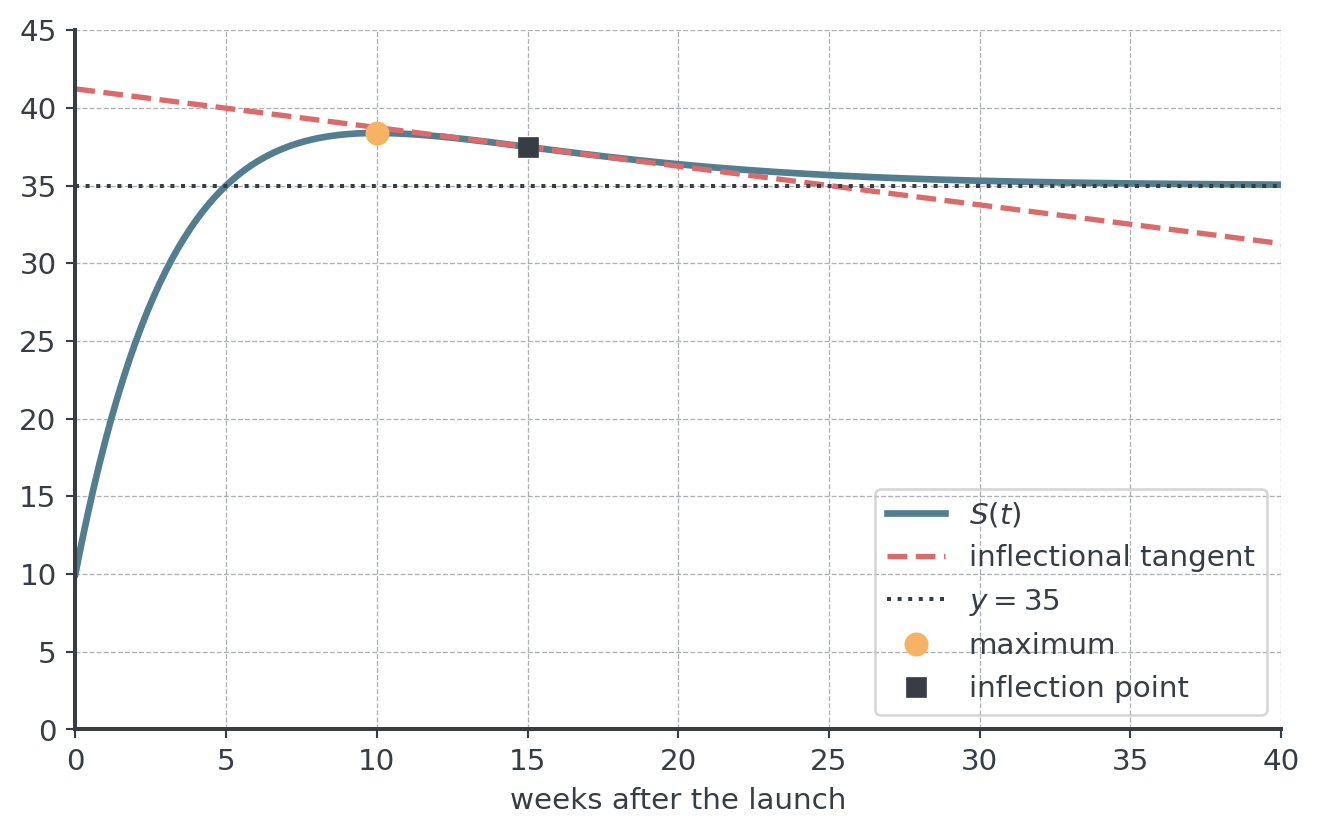
Show that \(S\) has an inflection point at \(t = 15\) and explain its meaning for the company.
Compute \(\lim_{t \to \infty} S(t)\) and interpret the result. Determine from which week on the weekly sales stay above this long-term level.
Determine the inflectional tangent and explain its meaning. A manager uses this tangent to predict the weekly sales in week 30. Compute the prediction, compare it with \(S(30)\) and explain the difference.
CautionSolution
a) \(S(0) = 35 + (-25) \cdot 1 = 10\). In the launch week, the company sells 10,000 bars.
Product rule on \((5t - 25) \cdot e^{-0.2t}\) with \(u = 5t - 25\), \(u' = 5\) and \(v = e^{-0.2t}\), \(v' = -0.2e^{-0.2t}\) (chain rule). The constant 35 vanishes. Factor out \(e^{-0.2t}\) after each step:
\[S'(t) = 5e^{-0.2t} + (5t - 25)(-0.2)e^{-0.2t} = e^{-0.2t}(5 - t + 5) = (10 - t) \cdot e^{-0.2t}\]
\[S''(t) = -1 \cdot e^{-0.2t} + (10 - t)(-0.2)e^{-0.2t} = e^{-0.2t}(-1 - 2 + 0.2t) = (0.2t - 3) \cdot e^{-0.2t}\]
\[S'''(t) = 0.2e^{-0.2t} + (0.2t - 3)(-0.2)e^{-0.2t} = e^{-0.2t}(0.2 - 0.04t + 0.6) = (0.8 - 0.04t) \cdot e^{-0.2t}\]
b) \(e^{-0.2t} > 0\) for all \(t\), so \(S'(t) = 0 \iff 10 - t = 0 \iff t = 10\).
\[S''(10) = (2 - 3) \cdot e^{-2} = -e^{-2} < 0 \quad \Rightarrow \quad \text{maximum}\]
\(S(10) = 35 + 25e^{-2} \approx 38.38\). The sales are highest in week 10, with about 38,380 bars.
c) \(S''(15) = (3 - 3) \cdot e^{-3} = 0\) and \(S'''(15) = (0.8 - 0.6) \cdot e^{-3} = 0.2e^{-3} \approx 0.01 \neq 0\): inflection point at \(t = 15\), with \(S(15) = 35 + 50e^{-3} \approx 37.49\).
Meaning: after the peak in week 10, the sales fall. \(S'(15) = -5e^{-3} \approx -0.25\): in week 15, they fall fastest, by about 250 bars per week. Before week 15, the decline gets faster. After week 15, it slows down, and the sales level off.
d) \((5t - 25) \cdot e^{-0.2t} = 5 \cdot t \cdot e^{-0.2t} - 25 \cdot e^{-0.2t}\). Both parts tend to 0: \(t \cdot e^{-0.2t} \to 0\) (the exponential beats the power) and \(e^{-0.2t} \to 0\). So
\[\lim_{t \to \infty} S(t) = 35 + 0 = 35\]
In the long run, the company sells about 35,000 bars per week: after the campaign, the regular customers remain.
Above the level: \(S(t) > 35 \iff (5t - 25) \cdot e^{-0.2t} > 0 \iff 5t - 25 > 0 \iff t > 5\), because \(e^{-0.2t} > 0\). From week 5 on, the weekly sales stay above 35,000 bars and approach this level from above.
e) Point \((15, 35 + 50e^{-3})\), slope \(S'(15) = -5e^{-3}\):
\[y = -5e^{-3}(t - 15) + 35 + 50e^{-3} = 35 + e^{-3}(125 - 5t) \approx 41.22 - 0.25t\]
Meaning: the slope \(-5e^{-3} \approx -0.25\) is the steepest decline of the sales curve. Around week 15, the weekly sales fall by about 250 bars per week, faster than at any other time.
Prediction for week 30: \(y(30) = 35 + e^{-3}(125 - 150) = 35 - 25e^{-3} \approx 33.76\), i.e. about 33,760 bars. The model gives \(S(30) = 35 + 125e^{-6} \approx 35.31\), i.e. about 35,310 bars. The tangent predicts too little, and even less than the long-term level from d). After week 15, the decline slows down (concave up), but the tangent keeps the steepest slope. The tangent is a good estimate only close to week 15.
D: FSP Problem
Work on this problem as in the exam: write down every step. The points show what each part is worth.
FSP Problem: Stand Mixers from a Household Appliance Maker [21 pts. total]
A company produces stand mixers (kitchen machines that knead and mix dough) and sells them to household goods stores. Its monthly total costs are
\[C(x) = x^3 - 13x^2 + 65x + 700\]
MU for an output of \(x\) QU. The price-demand function is \(p(x) = 200 - 7x\): at a price of \(p(x)\) MU per QU, the stores buy \(x\) QU per month. (1 QU = 100 stand mixers, 1 MU = 100 EUR) Round to two decimal places.
Part a)
Show that the monthly profit is given by \(P(x) = -x^3 + 6x^2 + 135x - 700\). [2 pts.]
CautionSolution
Revenue: \(R(x) = x \cdot p(x) = x(200 - 7x) = 200x - 7x^2\)
Profit:
\[P(x) = R(x) - C(x) = 200x - 7x^2 - (x^3 - 13x^2 + 65x + 700) = -x^3 + 6x^2 + 135x - 700 \quad \checkmark\]
Grading: 1 Pt. \(R(x) = 200x - 7x^2\), 1 Pt. \(P(x)\) with the bracket resolved correctly.
Part b)
The company breaks even at an output of 5 QU. Show this and determine the profit limit (upper break-even point) with polynomial long division. Decide in which output range the company makes a profit. [5 pts.]
CautionSolution
Break-even point:
\[P(5) = -125 + 150 + 675 - 700 = 0 \quad \checkmark\]
So \((x - 5)\) is a factor of \(P(x)\).
Polynomial long division by \((x - 5)\) (divide, multiply, subtract):
\[\begin{array}{l} (-x^3 + 6x^2 + 135x - 700) : (x - 5) = -x^2 + x + 140 \\ \underline{-(-x^3 + 5x^2)} \\ \phantom{(-x^3}\;\; x^2 + 135x \\ \phantom{(-x^3}\;\; \underline{-(x^2 - 5x)} \\ \phantom{(-x^3 + 6x^2}\;\; 140x - 700 \\ \phantom{(-x^3 + 6x^2}\;\; \underline{-(140x - 700)} \\ \phantom{(-x^3 + 6x^2 + 135x}\;\; 0 \end{array}\]
Profit limit: \(-x^2 + x + 140 = 0 \iff x^2 - x - 140 = 0\). Quadratic formula:
\[x = \frac{1 \pm \sqrt{1 + 560}}{2} = \frac{1 \pm \sqrt{561}}{2}, \qquad x_1 \approx 12.34, \quad x_2 \approx -11.34\]
\(x_2\) is negative and has no meaning. The profit limit lies at about 12.34 QU, i.e. about 1,234 stand mixers per month.
Profit range: \(P(x) = -(x - 5)(x - 12.34)(x + 11.34)\) approximately. For \(5 < x < 12.34\), the factors have the signs \((+)\), \((-)\) and \((+)\), so \(P(x) = -(+)(-)(+) > 0\). The company makes a profit for outputs between 5 QU and about 12.34 QU, i.e. between 500 and about 1,234 stand mixers per month.
Grading: 1 Pt. \(P(5) = 0\), 2 Pts. long division, 1 Pt. profit limit \(\approx 12.34\) QU, 1 Pt. profit range \(5 < x < 12.34\) with a reason.
Part c)
Compute the maximum profit and prove it really is a maximum. Give the maximum profit in EUR. [5 pts.]
CautionSolution
Necessary condition:
\[P'(x) = -3x^2 + 12x + 135 = -3(x^2 - 4x - 45) = -3(x - 9)(x + 5) = 0\]
\(x = 9\) or \(x = -5\). Only \(x = 9\) is a possible output.
Sufficient condition: \(P''(x) = -6x + 12\), so \(P''(9) = -42 < 0\): \(P\) has a maximum at \(x = 9\). It is the only critical point for \(x \ge 0\), and \(P'\) changes from \(+\) to \(-\) there, so no other output brings more profit.
Maximum profit:
\[P(9) = -729 + 486 + 1215 - 700 = 272 \text{ MU} = 272 \cdot 100 \text{ EUR} = 27{,}200 \text{ EUR}\]
The maximum profit is 27,200 EUR per month at 900 stand mixers.
Grading: 1 Pt. \(P'(x)\), 1 Pt. \(x = 9\) with \(x = -5\) excluded, 1 Pt. \(P''(9) < 0\), 1 Pt. \(P(9) = 272\) MU, 1 Pt. 27,200 EUR.
Part d)
Calculate the price the company has to ask for to gain the maximum profit. Give it in EUR per stand mixer. [2 pts.]
CautionSolution
\[p(9) = 200 - 7 \cdot 9 = 137 \text{ MU per QU}\]
1 MU per QU is 100 EUR per 100 stand mixers, i.e. 1 EUR per stand mixer. The company has to ask for 137 EUR per stand mixer.
Grading: 1 Pt. \(p(9) = 137\) MU per QU, 1 Pt. 137 EUR per stand mixer.
Part e)
The unit costs are the total costs per QU, \(k(x) = \frac{C(x)}{x}\). The long-term price floor is the lowest possible unit cost: below this price, the company cannot cover its total costs in the long run. Compute the output volume with the lowest unit costs. Also, determine the long-term price floor.
Hint: Multiply the equation \(k'(x) = 0\) by \(x^2\). You can solve the cubic equation by testing whole numbers or with the polynomial solver (MENU → A → 2).
[5 pts.]
CautionSolution
Unit costs:
\[k(x) = \frac{C(x)}{x} = x^2 - 13x + 65 + \frac{700}{x}\]
Necessary condition:
\[k'(x) = 2x - 13 - \frac{700}{x^2} = 0 \quad \Big| \cdot x^2 \quad \Rightarrow \quad 2x^3 - 13x^2 - 700 = 0\]
Test \(x = 10\): \(2000 - 1300 - 700 = 0\) ✓.
Sufficient condition: \(k''(x) = 2 + \frac{1400}{x^3} > 0\) for all \(x > 0\). So \(k'\) is increasing and has only one zero for \(x > 0\), and \(k''(10) > 0\) makes \(x = 10\) a minimum.
Lowest unit costs:
\[k(10) = 100 - 130 + 65 + 70 = 105 \text{ MU per QU}\]
The unit costs are lowest at an output of 10 QU, i.e. 1,000 stand mixers per month. The long-term price floor is 105 MU per QU, i.e. 105 EUR per stand mixer.
Grading: 1 Pt. \(k(x)\) and \(k'(x)\), 1 Pt. \(2x^3 - 13x^2 - 700 = 0\), 1 Pt. \(x = 10\) with \(k''(10) > 0\), 1 Pt. \(k(10) = 105\) MU per QU, 1 Pt. price floor 105 EUR per stand mixer.
Part f)
The owner says: “At 10 QU, our unit costs are lowest. So we should produce 10 QU, because then our profit is highest.” Decide whether the owner is right. Explain your decision. [2 pts.]
CautionSolution
\(P(10) = -1000 + 600 + 1350 - 700 = 250\) MU, i.e. 25,000 EUR. This is less than the maximum profit of 27,200 EUR from c): the owner is wrong.
To sell 10 QU, the company has to lower the price to \(p(10) = 130\) EUR per stand mixer. It then earns \(130 - 105 = 25\) EUR per stand mixer on 1,000 stand mixers. At 9 QU, it earns \(137 - k(9) \approx 137 - 106.78 = 30.22\) EUR on 900 stand mixers, which gives more in total. The lowest costs per stand mixer do not give the highest profit, because the price falls when the output grows.
Grading: 1 Pt. \(P(10) = 250 < 272\), 1 Pt. explanation with the falling price.
Calculator Practice
Problem 11: Calculator: Checking Critical Points (x)
Let \(f(x) = 2x^3 + 3x^2 - 72x + 5\).
Compute \(f'(-4)\), \(f'(1)\) and \(f'(3)\) with the d/dx template (SHIFT + ∫).
Decide which of the three \(x\)-values are critical points of \(f\).
Determine \(f'(x)\) by hand and solve \(f'(x) = 0\) with the polynomial solver (MENU → A → 2). Compare with b).
CautionSolution
Press SHIFT + ∫, enter \(2x^3 + 3x^2 - 72x + 5\) in the template, enter the \(x\)-value and press =.
\(f'(-4) = 0\), \(f'(1) = -60\), \(f'(3) = 0\)
\(x = -4\) and \(x = 3\) are critical points, because \(f'\) is zero there. \(x = 1\) is not: \(f'(1) = -60 \neq 0\), the graph falls there.
Power rule: \(f'(x) = 6x^2 + 6x - 72\). Polynomial solver with degree 2 and \(a = 6\), \(b = 6\), \(c = -72\): \(x = 3\) and \(x = -4\). After the two solutions, the calculator also shows the vertex of the parabola \(f'\). It is not needed here.
The solver confirms b), and it shows that there are no other critical points. The d/dx template can only check \(x\)-values you already have.
Problem 12: Calculator: Second Derivative and Concavity (xx)
Let \(f(x) = x^3 - 6x^2 - 15x + 4\).
Determine \(f'(x)\) by hand and give its zeros.
Enter \(f'(x)\) into the d/dx template. The template then gives values of \(f''\). Compute \(f''(-1)\), \(f''(2)\) and \(f''(5)\).
Classify the critical points of \(f\) with the second derivative test and give their coordinates.
Decide whether \(x = 2\) is a critical point. Explain what \(f''(2) = 0\) means here and check it with the \(f'''\) test.
CautionSolution
\(f'(x) = 3x^2 - 12x - 15 = 3(x^2 - 4x - 5) = 3(x - 5)(x + 1)\), zeros \(x = -1\) and \(x = 5\).
With \(3x^2 - 12x - 15\) in the template: \(f''(-1) = -18\), \(f''(2) = 0\), \(f''(5) = 18\). (By hand: \(f''(x) = 6x - 12\).)
- \(x = -1\): \(f''(-1) = -18 < 0\), local maximum, \(f(-1) = -1 - 6 + 15 + 4 = 12\), point \((-1, 12)\)
- \(x = 5\): \(f''(5) = 18 > 0\), local minimum, \(f(5) = 125 - 150 - 75 + 4 = -96\), point \((5, -96)\)
- \(f'(2) = 12 - 24 - 15 = -27 \neq 0\): \(x = 2\) is not a critical point, so the second derivative test does not apply. \(f''(2) = 0\) makes \(x = 2\) a candidate for an inflection point. With \(6x - 12\) in the template, \(f'''(2) = 6 \neq 0\): \(f\) has an inflection point at \((2, -42)\), since \(f(2) = 8 - 24 - 30 + 4 = -42\).
Problem 13: Calculator: Comprehensive Optimization (xx)
A company’s weekly profit is \(P(x) = -0.2x^3 + 3x^2 + 12x - 90\) thousand EUR for \(x\) hundred units. Round to two decimal places. Use your calculator.
Determine the break-even point and the profit limit with the polynomial solver (degree 3). Check the break-even point with SOLVE (SHIFT + CALC) and the start value 5.
Compute \(P'(10)\) with the d/dx template and interpret the result.
Determine \(P'(x)\) by hand and solve \(P'(x) = 0\) with the polynomial solver. Prove with the d/dx template, applied to \(P'(x)\), that the positive solution is a maximum.
Compute the maximum profit with the CALC key. Check it with a value table (MENU → 9) from 10 to 13 with the step 0.5.
CautionSolution
Polynomial solver with degree 3 and \(a = -0.2\), \(b = 3\), \(c = 12\), \(d = -90\): \(x \approx -6.23\), \(x \approx 4.26\) and \(x \approx 16.97\). The negative solution has no meaning. Break-even point at about 426 units, profit limit at about 1,697 units per week. SOLVE with the start value 5 gives \(x \approx 4.26\) ✓.
\(P'(10) = 12\) thousand EUR per hundred units. At 1,000 units per week, the profit still grows by about 120 EUR per additional unit.
Power rule: \(P'(x) = -0.6x^2 + 6x + 12\). Polynomial solver with degree 2 and \(a = -0.6\), \(b = 6\), \(c = 12\): \(x \approx 11.71\) and \(x \approx -1.71\). With \(-0.6x^2 + 6x + 12\) in the d/dx template at \(x = 11.71\): \(P''(11.71) \approx -8.05 < 0\), so \(P\) has a maximum at \(x \approx 11.71\), i.e. at about 1,171 units per week.
CALC with \(x = 11.71\): \(P(11.71) \approx 140.75\) thousand EUR, i.e. about 140,750 EUR per week.
| \(x\) | 10 | 10.5 | 11 | 11.5 | 12 | 12.5 | 13 |
|---|---|---|---|---|---|---|---|
| \(P(x)\) | 130 | 135.23 | 138.8 | 140.58 | 140.4 | 138.13 | 133.6 |
The table rises up to \(x = 11.5\) and falls after \(x = 12\): the maximum lies between 11.5 and 12, and no table value is larger than 140.75 ✓.