Tasks 07-01 - Descriptive Statistics
Section 07: Probability & Statistics
A: Skills
Problem 1: Measures of Central Tendency (x)
Compute the mean, the median and the mode of each data set. Round to two decimal places where needed. This rounding rule holds for all descriptive statistics on this sheet.
\(34, 41, 38, 45, 38, 52, 38, 40, 36, 48\)
\(7, 9, 8, 6, 9, 31, 9, 9\)
The payment methods of 12 customers in a shop: card, cash, card, app, card, cash, card, card, app, cash, card, card. Only the mode can be computed here: explain why.
Decide for a), b) and c) which measure describes the typical value best and give a reason.
CautionSolution
Mean: \(\bar{x} = \frac{34 + 41 + 38 + 45 + 38 + 52 + 38 + 40 + 36 + 48}{10} = \frac{410}{10} = 41\)
Sorted: \(34, 36, 38, 38, 38, 40, 41, 45, 48, 52\). \(n = 10\) is even, so the median is the mean of the 5th and the 6th value: \(\frac{38 + 40}{2} = 39\).
Mode: \(38\) (3 times).
Mean: \(\bar{x} = \frac{7 + 9 + 8 + 6 + 9 + 31 + 9 + 9}{8} = \frac{88}{8} = 11\)
Sorted: \(6, 7, 8, 9, 9, 9, 9, 31\). Median: \(\frac{9 + 9}{2} = 9\) (4th and 5th value).
Mode: \(9\) (4 times).
Mode: card (7 of 12 customers, cash 3 times, app 2 times). Payment methods are categories, not numbers: you cannot add them for a mean, and they have no natural order for a median.
In a), the values lie close together and there is no extreme value, so the mean (41) describes the typical value well. The median (39) is close to it.
In b), the value 31 is far away from all other values and pulls the mean up to 11, which is larger than 7 of the 8 values. The median (9) describes the typical value.
In c), only the mode (card) makes sense for categories.
Typical mistake: taking the median from the unsorted list. In a), the 5th and 6th value of the unsorted list give \(\frac{38 + 52}{2} = 45\). Always sort first.
Problem 2: Variance and Standard Deviation (x)
The values \(14, 9, 17, 12, 20, 12\) are a sample. Compute the mean, the sample variance \(s^2\) and the sample standard deviation \(s\).
Now the same six values are the whole population. Compute the population variance \(\sigma^2\) and the population standard deviation \(\sigma\). Explain why \(\sigma\) is smaller than \(s\).
Compute the mean and the sample standard deviation of the sample \(2.4, 3.1, 2.8, 3.5, 2.7\).
CautionSolution
Mean: \(\bar{x} = \frac{14 + 9 + 17 + 12 + 20 + 12}{6} = \frac{84}{6} = 14\)
\(x_i\) 14 9 17 12 20 12 \(x_i - \bar{x}\) 0 \(-5\) 3 \(-2\) 6 \(-2\) \((x_i - \bar{x})^2\) 0 25 9 4 36 4 \[\sum (x_i - \bar{x})^2 = 78, \qquad s^2 = \frac{78}{6 - 1} = 15.6, \qquad s = \sqrt{15.6} \approx 3.95\]
Same sum of squares, but divided by \(N = 6\):
\[\sigma^2 = \frac{78}{6} = 13, \qquad \sigma = \sqrt{13} \approx 3.61\]
The same positive number 78 is divided by the larger number 6 instead of 5, so the result is smaller.
Mean: \(\bar{x} = \frac{2.4 + 3.1 + 2.8 + 3.5 + 2.7}{5} = \frac{14.5}{5} = 2.9\)
Deviations: \(-0.5, \ 0.2, \ -0.1, \ 0.6, \ -0.2\). Squares: \(0.25, \ 0.04, \ 0.01, \ 0.36, \ 0.04\).
\[s^2 = \frac{0.70}{5 - 1} = 0.175, \qquad s = \sqrt{0.175} \approx 0.42\]
Typical mistake: adding the deviations without squaring them. The deviations from the mean always add up to 0, in c) for example \(-0.5 + 0.2 - 0.1 + 0.6 - 0.2 = 0\). Their sum therefore says nothing about the spread.
Problem 3: Quartiles, IQR and Outliers (xx)
On this sheet, the quartiles are the medians of the two halves of the sorted data: \(Q_1\) is the median of the lower half, \(Q_3\) the median of the upper half. In a) and b), sort the data and compute the range, the median, \(Q_1\), \(Q_3\) and the interquartile range \(\text{IQR} = Q_3 - Q_1\).
\(63, 58, 71, 49, 66, 54, 77, 60, 52, 69, 57, 64\)
\(23, 31, 18, 27, 35, 20, 29, 25, 33\)
Hint: With an odd number of values, leave the median out of both halves.
A value is an outlier if it lies below the lower fence \(Q_1 - 1.5 \cdot \text{IQR}\) or above the upper fence \(Q_3 + 1.5 \cdot \text{IQR}\). Parts c) and d) use the data
\[49, 55, 44, 57, 12, 52, 59, 47, 54, 51\]
Compute the median, \(Q_1\), \(Q_3\), the IQR and both fences. Decide which values are outliers.
Compute the mean and the median with and without the outlier. Explain which of the two measures reacts more strongly.
CautionSolution
Sorted (\(n = 12\)): \(49, 52, 54, 57, 58, 60, 63, 64, 66, 69, 71, 77\)
- Range: \(77 - 49 = 28\)
- Median: \(\frac{60 + 63}{2} = 61.5\) (6th and 7th value)
- Lower half \(49, 52, 54, 57, 58, 60\): \(Q_1 = \frac{54 + 57}{2} = 55.5\)
- Upper half \(63, 64, 66, 69, 71, 77\): \(Q_3 = \frac{66 + 69}{2} = 67.5\)
- \(\text{IQR} = 67.5 - 55.5 = 12\)
Sorted (\(n = 9\)): \(18, 20, 23, 25, 27, 29, 31, 33, 35\)
- Range: \(35 - 18 = 17\)
- Median: the 5th value, \(27\)
- Lower half without the median, \(18, 20, 23, 25\): \(Q_1 = \frac{20 + 23}{2} = 21.5\)
- Upper half without the median, \(29, 31, 33, 35\): \(Q_3 = \frac{31 + 33}{2} = 32\)
- \(\text{IQR} = 32 - 21.5 = 10.5\)
The middle 50 % of the values lie between \(Q_1\) and \(Q_3\). The IQR is the width of this middle part.
Typical mistake: in b), putting the median 27 into both halves. The halves then have five values each, and you get \(Q_1 = 23\) and \(Q_3 = 31\).
Sorted (\(n = 10\)): \(12, 44, 47, 49, 51, 52, 54, 55, 57, 59\)
- Median: \(\frac{51 + 52}{2} = 51.5\)
- Lower half \(12, 44, 47, 49, 51\): \(Q_1 = 47\)
- Upper half \(52, 54, 55, 57, 59\): \(Q_3 = 55\)
- \(\text{IQR} = 55 - 47 = 8\)
- Lower fence: \(47 - 1.5 \cdot 8 = 35\). Upper fence: \(55 + 1.5 \cdot 8 = 67\).
\(12 < 35\), so 12 is an outlier. No value lies above 67, so there are no other outliers.
With the outlier: \(\bar{x} = \frac{480}{10} = 48\), median \(51.5\).
Without the outlier (9 values \(44, 47, 49, 51, 52, 54, 55, 57, 59\)): \(\bar{x} = \frac{468}{9} = 52\), median = 5th value \(= 52\).
The mean changes by \(52 - 48 = 4\), the median only by \(52 - 51.5 = 0.5\). The mean uses every value, so one extreme value pulls it strongly. The median only depends on the middle of the sorted data.
Typical mistake: computing the fences from the median instead of the quartiles, e.g. \(51.5 - 1.5 \cdot 8 = 39.5\). The fences always start at \(Q_1\) and \(Q_3\).
Problem 4: Five-Number Summary and Box Plot (xx)
The data are
\[28, 35, 31, 42, 39, 33, 45, 30, 37, 41, 36, 47\]
Determine the five-number summary (minimum, \(Q_1\), median, \(Q_3\), maximum) and the IQR.
Check with the fences whether the data contain outliers.
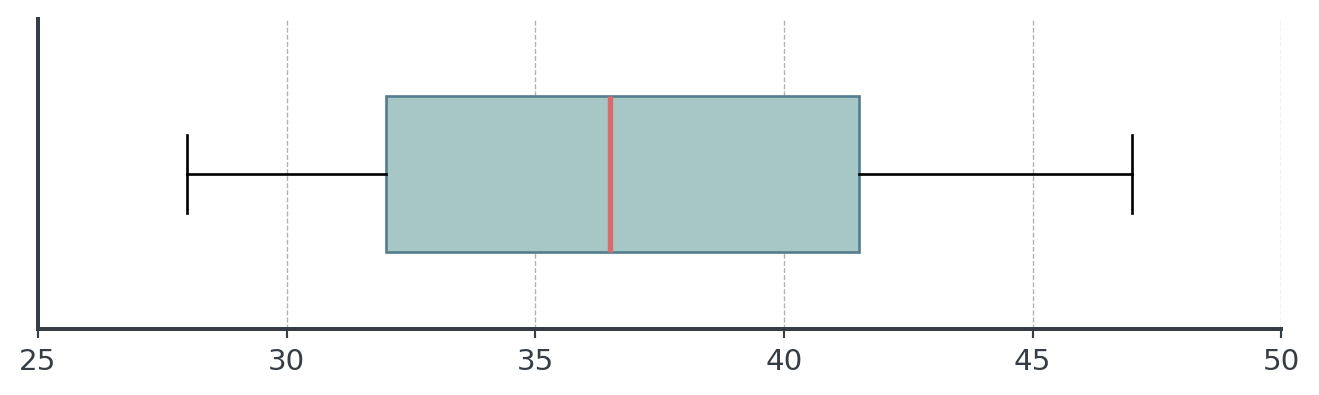
Draw a box plot above a number line from 25 to 50: a box from \(Q_1\) to \(Q_3\) with a line at the median, and whiskers from the box to the minimum and to the maximum.
Read from the box plot which share of the values lies inside the box and which share lies at or below the median. Check both shares by counting.
CautionSolution
Sorted (\(n = 12\)): \(28, 30, 31, 33, 35, 36, 37, 39, 41, 42, 45, 47\)
Minimum \(Q_1\) Median \(Q_3\) Maximum 28 \(\frac{31 + 33}{2} = 32\) \(\frac{36 + 37}{2} = 36.5\) \(\frac{41 + 42}{2} = 41.5\) 47 \(\text{IQR} = 41.5 - 32 = 9.5\)
Fences: \(32 - 1.5 \cdot 9.5 = 17.75\) and \(41.5 + 1.5 \cdot 9.5 = 55.75\). All values lie between 17.75 and 55.75, so there are no outliers.
- Inside the box lie about 50 % of the values (between \(Q_1\) and \(Q_3\)), and at or below the median lie about 50 %. Counting: \(33, 35, 36, 37, 39, 41\) lie inside the box, 6 of 12 values. \(28, 30, 31, 33, 35, 36\) lie at or below 36.5, also 6 of 12.
Typical mistake: reading the length of the box as “the box holds more values than a whisker”. Each of the four parts (whisker, half box, half box, whisker) holds about 25 % of the values, whatever its length. A long part only means that its values are spread out.
Problem 5: The 68-95-99.7 Rule (xx)
A quantity is normally distributed with mean \(\mu = 480\) and standard deviation \(\sigma = 15\). By the 68-95-99.7 rule, about 68 % of the values lie within \(\mu \pm \sigma\), about 95 % within \(\mu \pm 2\sigma\) and about 99.7 % within \(\mu \pm 3\sigma\).
Give the three intervals.
Give the share of the values in each case.
(1) between 465 and 510
(2) above 495
(3) below 450
(4) between 435 and 450
Another normally distributed quantity has about 95 % of its values between 184 and 216. Determine its \(\mu\) and \(\sigma\).
The first quantity is measured 4,000 times. Estimate how many of these values lie above 510.
Hint: The bell curve is symmetric about \(\mu\). The share of the values outside an interval \(\mu \pm k\sigma\) therefore splits into two equal parts, one below and one above the interval.
CautionSolution
- 68 %: \([480 - 15; 480 + 15] = [465; 495]\)
- 95 %: \([480 - 30; 480 + 30] = [450; 510]\)
- 99.7 %: \([480 - 45; 480 + 45] = [435; 525]\)
(1) From 465 to 480 (\(\mu - \sigma\) to \(\mu\)) lies half of 68 %, i.e. 34 %. From 480 to 510 (\(\mu\) to \(\mu + 2\sigma\)) lies half of 95 %, i.e. 47.5 %. Together: \(34 \% + 47.5 \% = 81.5 \%\).
(2) Outside \([465; 495]\) lie \(100 \% - 68 \% = 32 \%\), half of them above: \(16 \%\).
(3) Outside \([450; 510]\) lie \(100 \% - 95 \% = 5 \%\), half of them below: \(2.5 \%\).
(4) Between \(\mu - 3\sigma\) and \(\mu - 2\sigma\): \(\frac{99.7 \% - 95 \%}{2} = 2.35 \%\).
The interval is \(\mu \pm 2\sigma\), so \(\mu\) is its midpoint and \(2\sigma\) is half its width:
\[\mu = \frac{184 + 216}{2} = 200, \qquad 2\sigma = 216 - 200 = 16 \implies \sigma = 8\]
\(510 = \mu + 2\sigma\), so about 2.5 % of the values lie above it (as in (3), on the other side): \(0.025 \cdot 4000 = 100\) values.
Typical mistake: in (2), giving 32 %. This is the share outside the interval on both sides together. Above 495 lies only half of it.
B: Set Up & Check
Problem 6: From Words to Statistics (xx)
Translate each statement into a measure from this session. Then answer the check question: it tells you whether your translation works.
An estate agent offers eight flats with monthly rents of 760, 820, 840, 880, 900, 950, 990 and 3,100 EUR (a penthouse). The agent’s website should show “the typical rent of our flats”. Decide which measure fits and compute it.
Check: A classmate writes “typical rent: 1,155 EUR”. Explain what the classmate has computed and why it is not typical.
A mobile phone repair shop wants to state: “On the middle 50 % of our days, we repair between … and … phones.” On 12 days, it repaired 15, 5, 22, 10, 25, 13, 7, 18, 12, 20, 9 and 16 phones. Write the middle 50 % as an interval, compute it and give its width.
Check: A classmate takes the points a quarter and three quarters along the range, \(5 + 0.25 \cdot 20 = 10\) and \(5 + 0.75 \cdot 20 = 20\). Count how many of the 12 days lie in the classmate’s interval and explain the mistake.
A tax consultancy has exactly five offices. Last month, they won 13, 16, 9, 14 and 8 new clients. Decide whether the variance divides by \(N\) or by \(n - 1\) and compute the standard deviation. A reporter picks five of the 180 offices of a large tax consultancy chain at random and gets the same five numbers. Compute the standard deviation for the reporter’s data.
Check: A classmate uses \(n - 1 = 4\) in both cases, “because that is the formula for the standard deviation”. Explain the mistake.
A software company counts the support tickets per day. For the last quarter, \(Q_1 = 16\) and \(Q_3 = 28\) tickets. The team lead says: “A day is an outlier if it has more than … or fewer than … tickets.” Complete the statement.
Check: A classmate completes it with “more than \(1.5 \cdot 12 = 18\) tickets”. Find the mistake. Decide whether a day without any ticket is an outlier.
A street food stand sells dumplings. On 28 of the last 80 days, all dumplings were sold before closing time. Write the probability that the dumplings sell out on a randomly chosen day as a relative frequency and compute it. Give probabilities in percent with two decimal places. Estimate the number of sell-out days among the next 20 days.
Check: A classmate computes \(\frac{28}{52} \approx 0.54\). Explain what went wrong.
CautionSolution
The penthouse is far above all other rents, so the median fits. \(n = 8\), so it is the mean of the 4th and 5th value:
\[\text{median} = \frac{880 + 900}{2} = 890 \text{ EUR}\]
Check: \(\frac{9240}{8} = 1155\) is the mean. The penthouse pulls it up: 7 of the 8 flats cost less than 1,155 EUR, so this rent is not typical.
Typical mistake: reporting the mean for data with one extreme value. The median ignores how far away the extreme value is.
The middle 50 % lie between \(Q_1\) and \(Q_3\). Sorted: \(5, 7, 9, 10, 12, 13, 15, 16, 18, 20, 22, 25\).
Lower half \(5, 7, 9, 10, 12, 13\): \(Q_1 = \frac{9 + 10}{2} = 9.5\). Upper half \(15, 16, 18, 20, 22, 25\): \(Q_3 = \frac{18 + 20}{2} = 19\).
The middle 50 % of the days lie in \([9.5; 19]\) repaired phones, with width \(\text{IQR} = 19 - 9.5 = 9.5\).
Check: the classmate’s interval \([10; 20]\) contains \(10, 12, 13, 15, 16, 18, 20\), i.e. 7 of 12 days (about 58 %), not 50 %. Quartiles split the number of values into four equal parts, not the distance from the minimum to the maximum.
Typical mistake: computing quartiles from the range. Only the sorted values decide where \(Q_1\) and \(Q_3\) lie.
The five offices are all offices of the consultancy, so they are the whole population: divide by \(N = 5\). Mean: \(\mu = \frac{60}{5} = 12\). Squared deviations: \(1, 16, 9, 4, 16\), sum 46.
\[\sigma^2 = \frac{46}{5} = 9.2, \qquad \sigma = \sqrt{9.2} \approx 3.03\]
The reporter’s five offices are a sample of 180 offices: divide by \(n - 1 = 4\).
\[s^2 = \frac{46}{4} = 11.5, \qquad s = \sqrt{11.5} \approx 3.39\]
Check: \(n - 1\) is only for a sample. For the consultancy with exactly five offices, there is nothing beyond the five values, so the classmate must divide by \(N = 5\).
Typical mistake: deciding by the number of values. Both data sets have five values, but only the question “all of them or some of them?” decides.
\(\text{IQR} = 28 - 16 = 12\) and \(1.5 \cdot \text{IQR} = 18\).
Upper fence: \(28 + 18 = 46\). Lower fence: \(16 - 18 = -2\).
“A day is an outlier if it has more than 46 or fewer than \(-2\) tickets.” No day can have fewer than \(-2\) tickets, so only the upper part matters: more than 46 tickets.
Check: 18 is only the distance \(1.5 \cdot \text{IQR}\). The fence starts at \(Q_3\): \(28 + 18 = 46\). A day with 0 tickets is not an outlier, because \(0 > -2\).
Typical mistake: forgetting to add \(1.5 \cdot \text{IQR}\) to \(Q_3\) (or to subtract it from \(Q_1\)).
Relative frequency ≈ probability:
\[\frac{\text{number of sell-out days}}{\text{number of all days}} = \frac{28}{80} = 0.35 = 35.00 \%\]
Among the next 20 days, the stand can expect about \(0.35 \cdot 20 = 7\) sell-out days.
Check: \(52 = 80 - 28\) is the number of days without a sell-out. The classmate has compared sell-out days with the other days, but a relative frequency always divides by the number of all days.
Typical mistake: dividing by the wrong total. The denominator is the whole group you are talking about, here all 80 days.
Problem 7: One Paragraph, All Conditions (xx)
A comedy club has 150 seats. The manager looks at the numbers of visitors of 40 randomly chosen shows of the last year (a sample of all shows). The manager wants to know the typical number of visitors per show and how strongly the numbers vary around the mean. One interval should describe the middle 50 % of the shows. Shows with unusually many or unusually few visitors (outliers) should be marked. A show with fewer than 40 visitors does not cover its costs, and such shows should happen with a probability of at most 15 %. For the next year, the manager assumes that the numbers of visitors are normally distributed and wants at most 2.5 % of the shows to be sold out (150 visitors).
List every condition and every quantity in this paragraph as a mathematical statement. Do not solve anything.
Check: An assistant writes the last condition as \(\mu + 3\sigma \le 150\). Explain what this condition would mean and give the correct one.
Hint: Use the 68-95-99.7 rule and the symmetry of the bell curve from Problem 5.
CautionSolution
- Data: \(x_1, x_2, \ldots, x_{40}\) visitors per show, a sample with \(n = 40\)
- Typical number of visitors: the mean \(\bar{x} = \frac{1}{40}\sum_{i=1}^{40} x_i\) (or the median, if there are outliers)
- Variation around the mean: the sample standard deviation \(s = \sqrt{\frac{\sum (x_i - \bar{x})^2}{40 - 1}}\)
- Middle 50 % of the shows: the interval \([Q_1; Q_3]\) with width \(\text{IQR} = Q_3 - Q_1\)
- Outliers: shows with \(x_i < Q_1 - 1.5 \cdot \text{IQR}\) or \(x_i > Q_3 + 1.5 \cdot \text{IQR}\)
- Shows that do not cover their costs: \(\frac{\text{number of shows with } x_i < 40}{40} \le 0.15\) (relative frequency ≈ probability), i.e. at most 6 of the 40 shows
- Full house: numbers of visitors normally distributed with \(\mu\) and \(\sigma\). About 95 % lie within \(\mu \pm 2\sigma\), the other 5 % split into 2.5 % below and 2.5 % above. So “at most 2.5 % sold out”, i.e. at most 2.5 % with 150 visitors or more, means \(\mu + 2\sigma \le 150\)
Check: \(\mu + 3\sigma \le 150\) means that only about \(\frac{100 \% - 99.7 \%}{2} = 0.15 \%\) of the shows reach 150 visitors. This is much stricter than the manager’s 2.5 %. The correct condition is \(\mu + 2\sigma \le 150\).
Typical mistake: dividing by 40 in the standard deviation. The 40 shows are a sample of all shows, so the denominator is \(n - 1 = 39\).
C: Applied
Problem 8: Apple Harvest of a Fruit Farm (xx)
A fruit farm grows apples in two orchards. It sells apples of at least 160 g as table apples to supermarkets for 0.30 EUR each. Lighter apples go to its farm shop for 0.12 EUR each. In orchard 1, the farm weighs 25 randomly picked apples (in g):
\(128, 152, 163, 147, 184, 135, 158, 171, 143, 124,\)
\(166, 150, 192, 139, 155, 178, 141, 160, 131, 149,\)
\(169, 181, 156, 174, 188\)
Give probabilities in percent with two decimal places.
- Complete the frequency table for orchard 1. The class \([120; 140)\) contains all weights from 120 g to under 140 g.
| Weight (g) | \([120; 140)\) | \([140; 160)\) | \([160; 180)\) | \([180; 200)\) | Total |
|---|---|---|---|---|---|
| Frequency | |||||
| Relative frequency |
Draw a histogram for orchard 1 with the weight classes on the horizontal axis and the frequencies on the vertical axis. Name the class with the most apples.
Give the probability that a randomly picked apple from orchard 1 is a table apple. Estimate the number of table apples in a harvest of 18,000 apples from orchard 1.
(for verification: 44.00 %)
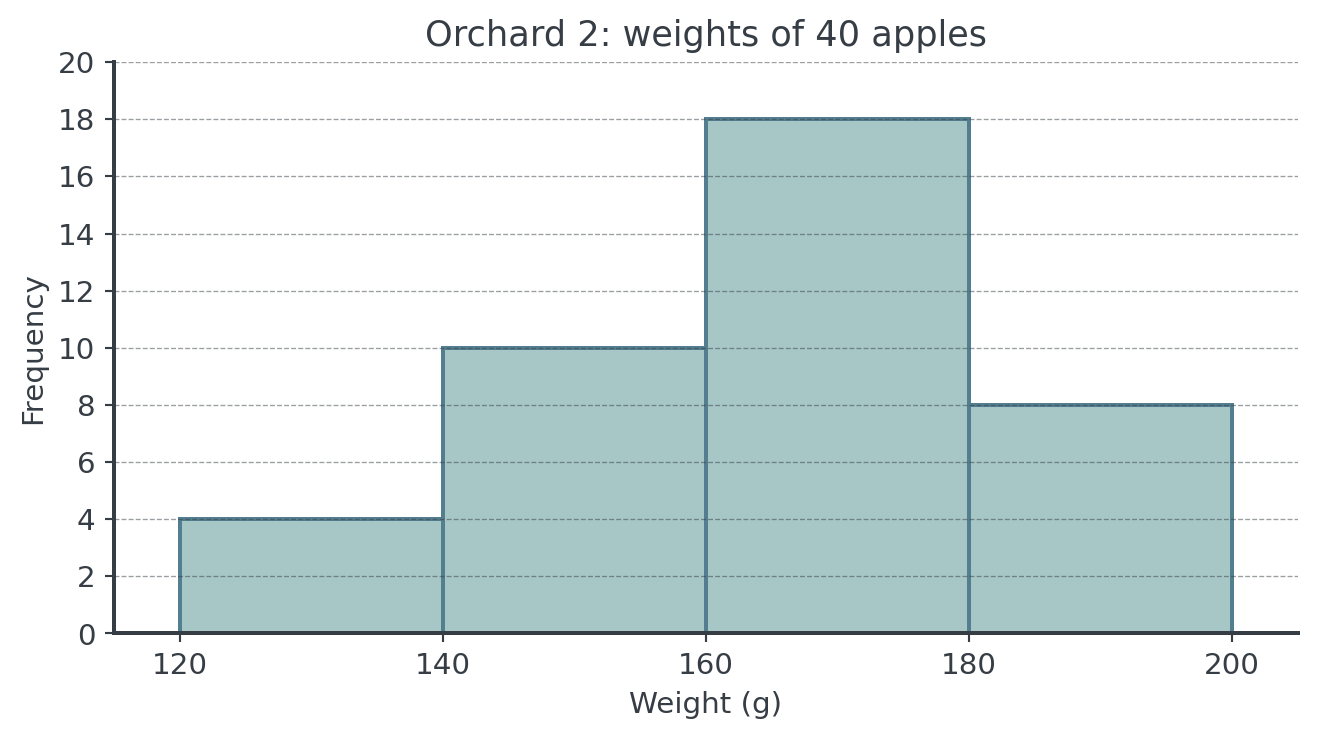
- The histogram below shows the weights of 40 randomly picked apples from orchard 2, in the same classes. Read the frequencies, compute the relative frequencies and give the probability that an apple from orchard 2 is a table apple.
- Orchard 2 also yields 18,000 apples. Estimate the revenue from each orchard’s harvest and compare the two orchards.
CautionSolution
a) Sort the apples into the classes. 160 g belongs to \([160; 180)\), and 139 g to \([120; 140)\).
- \([120; 140)\): \(128, 135, 124, 139, 131\)
- \([140; 160)\): \(152, 147, 158, 143, 150, 155, 141, 149, 156\)
- \([160; 180)\): \(163, 171, 166, 178, 160, 169, 174\)
- \([180; 200)\): \(184, 192, 181, 188\)
| Weight (g) | \([120; 140)\) | \([140; 160)\) | \([160; 180)\) | \([180; 200)\) | Total |
|---|---|---|---|---|---|
| Frequency | 5 | 9 | 7 | 4 | 25 |
| Relative frequency | \(\frac{5}{25} = 20 \%\) | \(\frac{9}{25} = 36 \%\) | \(\frac{7}{25} = 28 \%\) | \(\frac{4}{25} = 16 \%\) | 100 % |
Check: \(5 + 9 + 7 + 4 = 25\) and \(20 + 36 + 28 + 16 = 100\).
b)
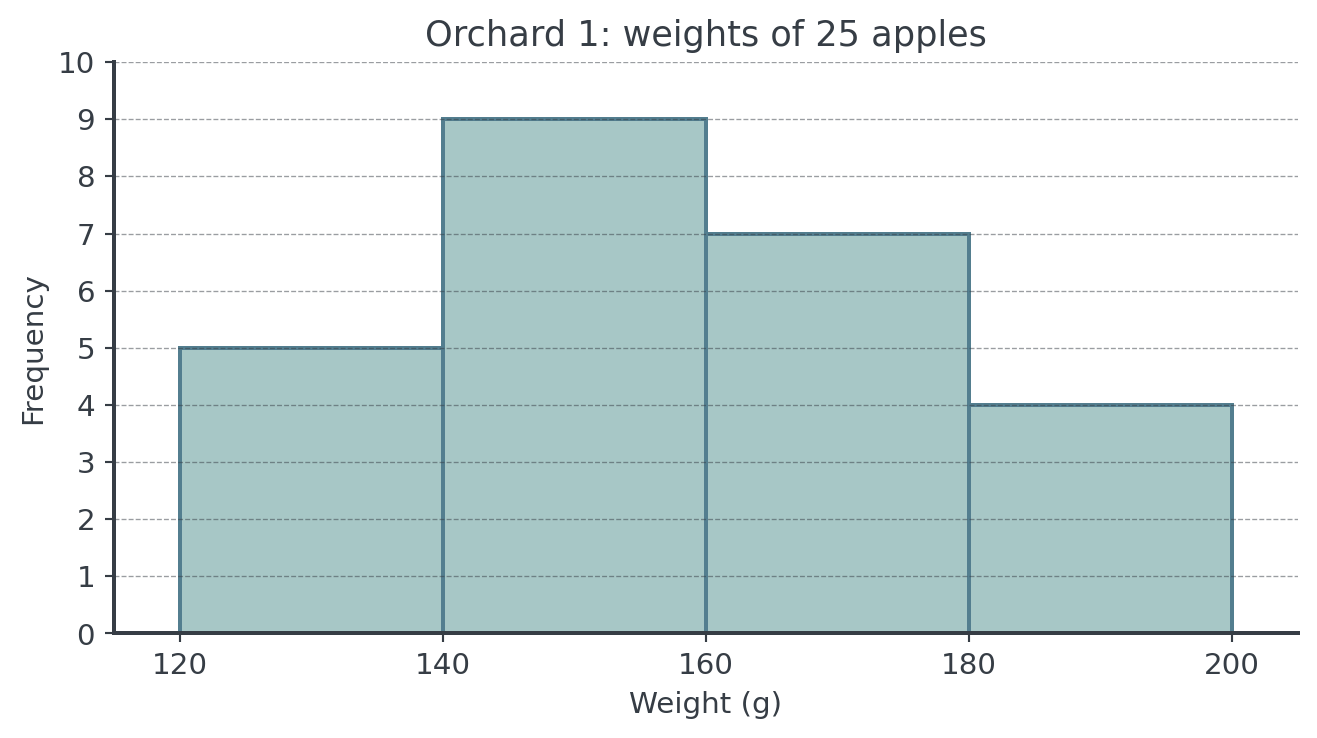
The class \([140; 160)\) has the most apples (9).
c) Table apples are the classes from 160 g on. Relative frequency ≈ probability:
\[\frac{7 + 4}{25} = \frac{11}{25} = 0.44 = 44.00 \%\]
In a harvest of 18,000 apples: about \(0.44 \cdot 18000 = 7920\) table apples.
d) Read off: 4, 10, 18 and 8 apples (total \(4 + 10 + 18 + 8 = 40\) ✓).
| Weight (g) | \([120; 140)\) | \([140; 160)\) | \([160; 180)\) | \([180; 200)\) | Total |
|---|---|---|---|---|---|
| Frequency | 4 | 10 | 18 | 8 | 40 |
| Relative frequency | 10 % | 25 % | 45 % | 20 % | 100 % |
Probability of a table apple in orchard 2: \(\frac{18 + 8}{40} = \frac{26}{40} = 0.65 = 65.00 \%\).
e) Orchard 1: \(7920\) table apples and \(18000 - 7920 = 10080\) other apples:
\[7920 \cdot 0.30 + 10080 \cdot 0.12 = 2376 + 1209.60 = 3585.60 \text{ EUR}\]
Orchard 2: \(0.65 \cdot 18000 = 11700\) table apples and \(6300\) other apples:
\[11700 \cdot 0.30 + 6300 \cdot 0.12 = 3510 + 756 = 4266 \text{ EUR}\]
Orchard 2 brings about \(4266 - 3585.60 = 680.40\) EUR more.
Typical mistake: comparing the frequencies directly: \(7 + 4 = 11\) table apples in orchard 1 against \(18 + 8 = 26\) in orchard 2. The samples have different sizes (25 and 40 apples), so only the relative frequencies can be compared.
Problem 9: Two Routes for an Airport Shuttle (xx)
A shuttle company drives hotel guests to the airport. It tests two routes and measures the travel time (in minutes) on 8 trips each:
- Route A (ring road): \(41, 38, 40, 43, 39, 42, 40, 37\)
- Route B (city centre): \(31, 44, 35, 29, 48, 33, 38, 30\)
Compute the mean and the range of each route. Name the route that is faster on average.
Compute the sample standard deviation of each route.
(for verification: \(s_A = 2\) minutes)
The guests must reach the airport at most 45 minutes after the departure, because the check-in closes then. Give for each route the share of the test trips that took longer than 45 minutes, as an estimate of the probability that a trip is too late. Decide which route is more consistent and which one the company should use. Give a reason.
The company plans each route with the travel time \(\bar{x} + 2s\) (mean plus two standard deviations), so that almost every trip arrives in time. Compute the planned travel time for both routes. Explain why the route that is slower on average gets the shorter planned travel time.
A ninth trip on route B takes exactly 36 minutes. Explain why the mean of route B stays the same. Compute the new sample standard deviation of route B and explain why it is smaller.
CautionSolution
a) Route A: \(\bar{x}_A = \frac{41 + 38 + 40 + 43 + 39 + 42 + 40 + 37}{8} = \frac{320}{8} = 40\) minutes, range \(43 - 37 = 6\) minutes.
Route B: \(\bar{x}_B = \frac{31 + 44 + 35 + 29 + 48 + 33 + 38 + 30}{8} = \frac{288}{8} = 36\) minutes, range \(48 - 29 = 19\) minutes.
Route B is faster on average, by 4 minutes.
b) Route A, deviations from 40: \(1, -2, 0, 3, -1, 2, 0, -3\)
\[s_A^2 = \frac{1 + 4 + 0 + 9 + 1 + 4 + 0 + 9}{8 - 1} = \frac{28}{7} = 4, \qquad s_A = 2 \text{ minutes}\]
Route B, deviations from 36: \(-5, 8, -1, -7, 12, -3, 2, -6\)
\[s_B^2 = \frac{25 + 64 + 1 + 49 + 144 + 9 + 4 + 36}{8 - 1} = \frac{332}{7} \approx 47.43, \qquad s_B \approx 6.89 \text{ minutes}\]
c) Route A: no trip took longer than 45 minutes, \(\frac{0}{8} = 0.00 \%\). Route B: one trip (48 minutes), \(\frac{1}{8} = 12.50 \%\).
Route A is more consistent: its standard deviation (2 minutes) and its range (6 minutes) are much smaller than those of route B (6.89 and 19 minutes). The company should use route A. Route B saves 4 minutes on average, but in about one of eight trips the guests would miss the check-in. For an airport shuttle, arriving in time on every trip matters more than a shorter average. With only 8 trips per route, both shares are rough estimates.
d) Route A: \(40 + 2 \cdot 2 = 44\) minutes. Route B: \(36 + 2\sqrt{\frac{332}{7}} \approx 49.77\) minutes (with the unrounded \(s_B\)).
Route B needs a buffer of about \(2\sqrt{\frac{332}{7}} \approx 13.77\) minutes because its travel times vary strongly. Route A needs only \(2 \cdot 2 = 4\) minutes. The larger buffer more than eats up the 4 minutes that route B saves on average.
e) The ninth value equals the old mean: \(\frac{288 + 36}{9} = \frac{324}{9} = 36\). A value exactly at the mean does not pull the mean in either direction.
Its deviation is \(36 - 36 = 0\), so the sum of the squared deviations stays 332, but it is now divided by \(9 - 1 = 8\):
\[s_B^2 = \frac{332}{8} = 41.5, \qquad s_B = \sqrt{41.5} \approx 6.44 \text{ minutes}\]
The same sum is divided by a larger number. A trip exactly at the mean adds no spread, but it counts as one more value.
Typical mistake: in c), choosing route B because its mean is smaller. The mean alone says nothing about how often a trip is much slower than usual. The standard deviation and the share of late trips show this.
Problem 10: Dishwasher Tabs (xxx)
A company presses dishwasher tabs with a target weight of 20.0 g. A tab is within the tolerance (the allowed deviation from the target) if it weighs between 19.4 g and 20.6 g. Tabs outside the tolerance are crushed and pressed again, which costs 0.08 EUR per tab. The press makes 50,000 tabs per day. A large sample shows that the weights are normally distributed with \(\mu = 20.0\) g and \(\sigma = 0.3\) g.
Hint: Use the 68-95-99.7 rule and the symmetry of the bell curve as in Problem 5.
Give the intervals \(\mu \pm \sigma\), \(\mu \pm 2\sigma\) and \(\mu \pm 3\sigma\). Decide which of them matches the tolerance and give the share of the tabs outside the tolerance.
Estimate the number of tabs per day outside the tolerance and the daily costs for pressing them again.
(for verification: 200 EUR per day)
The production manager suggests: “Let us raise the mean to 20.3 g. Then hardly any tab is too light.” With \(\sigma = 0.3\) g, compute the share of the tabs outside the tolerance and the daily costs. Explain why the suggestion fails. A press is called accurate if its mean is on target and precise if its spread is small. Decide whether the press is “accurate but not precise” or “precise but not accurate”.
A new dosing unit reduces the standard deviation. Determine the largest \(\sigma\) for which the whole interval \(\mu \pm 3\sigma\) with \(\mu = 20.0\) g lies within the tolerance. With this \(\sigma\), estimate the daily costs for pressing tabs again. The dosing unit costs 9,400 EUR. Compute after how many production days the savings have paid for it.
CautionSolution
a)
- \(\mu \pm \sigma\): \([19.7; 20.3]\)
- \(\mu \pm 2\sigma\): \([19.4; 20.6]\)
- \(\mu \pm 3\sigma\): \([19.1; 20.9]\)
The interval \(\mu \pm 2\sigma\) is the tolerance. About 95 % of the tabs lie within it, so about 5 % lie outside (2.5 % too light, 2.5 % too heavy).
b) \(0.05 \cdot 50000 = 2500\) tabs per day outside the tolerance, costs \(2500 \cdot 0.08 = 200\) EUR per day.
c) With \(\mu = 20.3\) g and \(\sigma = 0.3\) g:
- lower limit: \(19.4 = 20.3 - 0.9 = \mu - 3\sigma\), below it lie \(\frac{100 \% - 99.7 \%}{2} = 0.15 \%\)
- upper limit: \(20.6 = 20.3 + 0.3 = \mu + \sigma\), above it lie \(\frac{100 \% - 68 \%}{2} = 16 \%\)
Outside the tolerance: \(0.15 \% + 16 \% = 16.15 \%\), i.e. \(0.1615 \cdot 50000 = 8075\) tabs and \(8075 \cdot 0.08 = 646\) EUR per day.
The suggestion fails: fewer tabs are too light (0.15 % instead of 2.5 %), but many more are too heavy (16 % instead of 2.5 %). The costs more than triple. The mean is already on target, so the press is accurate but not precise. The problem is the spread \(\sigma\), not the mean.
d) The interval \(\mu \pm 3\sigma\) lies within \([19.4; 20.6]\) if \(3\sigma \le 0.6\), so \(\sigma \le 0.2\). The largest standard deviation is \(\sigma = 0.2\) g.
Then the tolerance is \(\mu \pm 3\sigma\), and about \(100 \% - 99.7 \% = 0.3 \%\) of the tabs lie outside: \(0.003 \cdot 50000 = 150\) tabs, costs \(150 \cdot 0.08 = 12\) EUR per day.
Savings: \(200 - 12 = 188\) EUR per day. With \(d\) production days:
\[188 \cdot d = 9400 \iff d = 50\]
The dosing unit has paid for itself after 50 production days.
Typical mistake: in c), adding the whole outside shares, \(32 \% + 0.3 \%\). Each side only gets half of the share outside the interval, so the shares are 16 % and 0.15 %.
D: FSP Problem
Work on this problem as in the exam: write down every step. The points show what each part is worth.
FSP Problem: Table Reservations at a Restaurant [21 pts. total]
A restaurant in a city centre takes exactly 50 table reservations every evening. Sometimes nobody comes to a reserved table and nobody has cancelled the reservation: this is called a no-show. On 12 randomly chosen evenings, the owner counted the following numbers of no-shows:
\[4, 2, 5, 3, 1, 12, 3, 4, 5, 2, 4, 3\]
Round descriptive statistics to two decimal places and give probabilities in percent with two decimal places.
Part a)
Determine the five-number summary and the interquartile range of the numbers of no-shows. [4 pts.]
CautionSolution
Sorted data (\(n = 12\)): \(1, 2, 2, 3, 3, 3, 4, 4, 4, 5, 5, 12\)
Median: \(n\) is even, so the median is the mean of the 6th and 7th value: \(\frac{3 + 4}{2} = 3.5\)
Quartiles: lower half \(1, 2, 2, 3, 3, 3\) and upper half \(4, 4, 4, 5, 5, 12\):
\[Q_1 = \frac{2 + 3}{2} = 2.5, \qquad Q_3 = \frac{4 + 5}{2} = 4.5\]
| Minimum | \(Q_1\) | Median | \(Q_3\) | Maximum |
|---|---|---|---|---|
| 1 | 2.5 | 3.5 | 4.5 | 12 |
\[\text{IQR} = Q_3 - Q_1 = 4.5 - 2.5 = 2\]
Grading: 1 Pt. sorted data, 1 Pt. median, 1 Pt. \(Q_1\) and \(Q_3\), 1 Pt. minimum, maximum and IQR.
Part b)
Compute the fences. Decide whether the data contain outliers. [3 pts.]
CautionSolution
\(1.5 \cdot \text{IQR} = 1.5 \cdot 2 = 3\)
\[\text{lower fence} = Q_1 - 1.5 \cdot \text{IQR} = 2.5 - 3 = -0.5, \qquad \text{upper fence} = Q_3 + 1.5 \cdot \text{IQR} = 4.5 + 3 = 7.5\]
\(12 > 7.5\), so the evening with 12 no-shows is an outlier. All other values lie between \(-0.5\) and \(7.5\). A number of no-shows cannot be negative, so there are no outliers at the bottom.
Grading: 1 Pt. lower fence, 1 Pt. upper fence, 1 Pt. decision: 12 is the only outlier.
Part c)
Compute the mean and the sample standard deviation of the numbers of no-shows.
(for verification: \(\bar{x} = 4\)) [4 pts.]
CautionSolution
Mean:
\[\bar{x} = \frac{4 + 2 + 5 + 3 + 1 + 12 + 3 + 4 + 5 + 2 + 4 + 3}{12} = \frac{48}{12} = 4\]
Sample standard deviation: deviations \(x_i - 4\): \(0, \ -2, \ 1, \ -1, \ -3, \ 8, \ -1, \ 0, \ 1, \ -2, \ 0, \ -1\)
\[\sum (x_i - \bar{x})^2 = 0 + 4 + 1 + 1 + 9 + 64 + 1 + 0 + 1 + 4 + 0 + 1 = 86\]
\[s^2 = \frac{86}{12 - 1} = \frac{86}{11} \approx 7.82, \qquad s = \sqrt{\frac{86}{11}} \approx 2.80\]
The 12 evenings are a sample of all evenings, so the denominator is \(n - 1 = 11\).
Grading: 1 Pt. mean, 1 Pt. squared deviations, 1 Pt. sum 86 divided by \(n - 1 = 11\), 1 Pt. \(s \approx 2.80\).
Part d)
Interpret the mean as the probability that a reservation ends as a no-show. The evening with 12 no-shows was the evening of a heavy storm. The owner claims: “On evenings without a storm, a reservation ends as a no-show with a probability below 7 %.” Check the claim with the other 11 evenings. [3 pts.]
CautionSolution
Interpretation: on average, 4 of the 50 reservations per evening are no-shows. Over all 12 evenings, these are 48 no-shows among \(12 \cdot 50 = 600\) reservations. Relative frequency ≈ probability:
\[\frac{48}{600} = \frac{4}{50} = 0.08 = 8.00 \%\]
A randomly chosen reservation ends as a no-show with a probability of about 8.00 %.
Without the storm evening: \(48 - 12 = 36\) no-shows among \(11 \cdot 50 = 550\) reservations:
\[\frac{36}{550} \approx 0.0655 = 6.55 \% < 7 \%\]
The claim is true for these 11 evenings.
Grading: 1 Pt. \(\frac{4}{50} = 8.00 \%\) as the probability, 1 Pt. 36 no-shows among 550 reservations, 1 Pt. 6.55 % < 7 % and decision.
Part e)
Draw a box plot of the numbers of no-shows above a number line from 0 to 13. Draw the right whisker only up to the largest value that is not an outlier and mark the outlier as a single dot. [3 pts.]
CautionSolution
Box from \(Q_1 = 2.5\) to \(Q_3 = 4.5\) with a line at the median \(3.5\). Left whisker to the minimum 1. The largest value that is not an outlier is 5, so the right whisker ends at 5. The outlier 12 is a single dot.
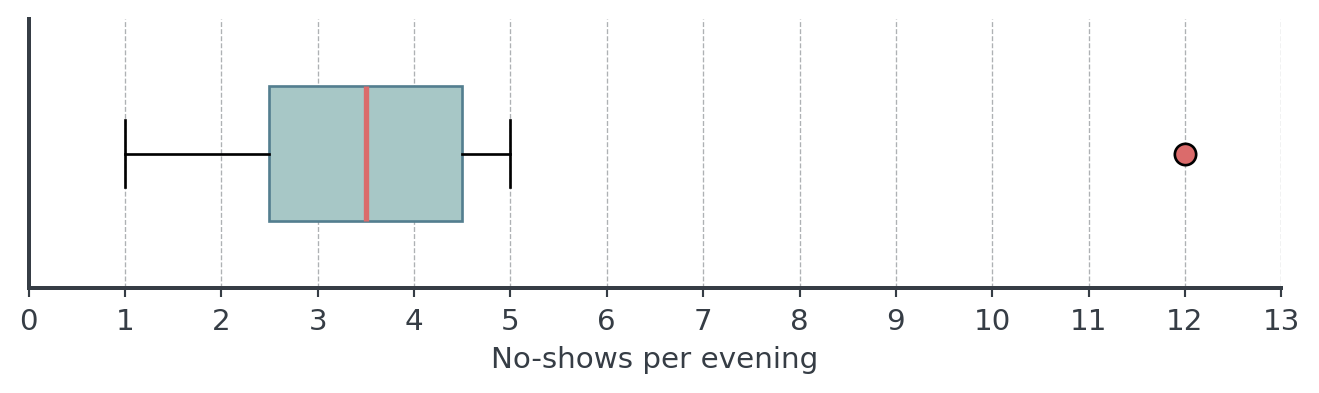
Grading: 1 Pt. box from 2.5 to 4.5 with the median line at 3.5, 1 Pt. whiskers to 1 and 5, 1 Pt. outlier as a dot at 12.
Part f)
Each no-show costs the restaurant 36 EUR (food bought for the table and a table that stays empty). The restaurant is open on 24 evenings per month. Compute the monthly costs of the no-shows with the mean from part c). Next year, the costs per no-show rise by 12.5 %. The owner wants the monthly costs of the no-shows to be 2,430 EUR or less. Determine the largest mean number of no-shows per evening that meets this goal. Give the necessary reduction of the mean in percent. [4 pts.]
CautionSolution
Monthly costs today: \(24 \cdot 4 \cdot 36 = 3456\) EUR.
Costs per no-show next year (an increase by 12.5 % means the factor \(1.125\)):
\[36 \cdot 1.125 = 40.50 \text{ EUR}\]
Condition for a mean of \(m\) no-shows per evening:
\[24 \cdot 40.50 \cdot m \le 2430 \iff 972m \le 2430 \iff m \le 2.5\]
The mean may be at most 2.5 no-shows per evening (a probability of \(\frac{2.5}{50} = 5.00 \%\) per reservation).
Reduction:
\[\frac{4 - 2.5}{4} = \frac{1.5}{4} = 0.375 = 37.5 \%\]
The restaurant has to lower the mean number of no-shows by 37.5 %.
Grading: 1 Pt. 3,456 EUR, 1 Pt. \(36 \cdot 1.125 = 40.50\) EUR, 1 Pt. inequality and \(m \le 2.5\), 1 Pt. reduction 37.5 %.