Session 02-02 - Quadratic, Biquadratic & Cubic Equations
Section 02: Equations & Problem-Solving Strategies
Entry Quiz
Quick Review of Essential Skills
10 minutes - individual work, then peer review
Factor completely: \(x^2 - 7x + 12\)
Factor by grouping: \(2x^3 - 6x^2 + x - 3\)
Solve the system: \(\begin{cases} 2x + y = 10 \\ x - y = 2 \end{cases}\)
Complete to a perfect square: \(x^2 + 6x + ?\)
Identify \(a\), \(b\), \(c\) in: \(3x^2 - 2x + 5 = 0\)
These skills are essential for today’s methods!
Homework Discussion
Solution from Tasks 02-01
15 minutes - presentation and discussion
- Present your most challenging problem
- Share alternative solution methods
- Discuss any conceptual difficulties
- Ask questions about problems you struggled with
Learning Objectives
Learning Objectives
By the end of this session, you can:
- Solve quadratic equations by factoring, formula, and completing the square
- Use the discriminant to predict the number and type of solutions
- Reduce biquadratic equations with the substitution \(u = x^2\)
- Factor and solve cubic equations with integer roots
Key Concepts
Equation Types Overview
Today’s new topics:
- Linear: \(ax + b = 0\) → One solution
- Quadratic: \(ax^2 + bx + c = 0\) → Up to two solutions
- Cubic: \(ax^3 + bx^2 + cx + d = 0\) → Up to three solutions
- Biquadratic: \(ax^4 + bx^2 + c = 0\) → Up to four solutions
NoteWhy equal to zero?
Good question! Either we want to determine the intersection of the graph and the x-axis (hence y=0) or we try to make an equation equal to zero to determine the value of x easily.
Solving Equations
Zero Form & Linear Equations
The Zero Product Property (the zero-product rule from Session 01-03)
If \(A \cdot B = 0\), then \(A = 0\) or \(B = 0\)
Example: Solve \(3x - 6 = 0\)
- Factor: \(3(x - 2) = 0\)
- Apply property: \(x - 2 = 0\)
- Solution: \(x = 2\)
This principle extends to all equation types! It is how we find the break-even points of a profit function: solve \(P(x) = 0\).
Three Methods for Quadratics
Let’s solve the same equation three ways: \(x^2 - 5x + 6 = 0\)
When to use: Integer coefficients, factorable, fastest
- Factor: \((x - 2)(x - 3) = 0\)
- Apply Zero Product Property
- Solutions: \(x = 2\) or \(x = 3\)
When to use: Always works, but is slower
- \(x = \frac{-b \pm \sqrt{b^2 - 4ac}}{2a}\)
- \(a = 1\), \(b = -5\), \(c = 6\)
- \(x = \frac{5 \pm \sqrt{25 - 24}}{2} = \frac{5 \pm 1}{2}\)
- Solutions: \(x = 3\) or \(x = 2\)
When to use: Only in special cases (my recomendation)
- \(x^2 - 5x = -6\)
- \(x^2 - 5x + \frac{25}{4} = -6 + \frac{25}{4} = \frac{1}{4}\)
- \((x - \frac{5}{2})^2 = \frac{1}{4}\)
- \(x - \frac{5}{2} = \pm\frac{1}{2}\) → Solutions: \(x = 3\) or \(x = 2\)
The Discriminant
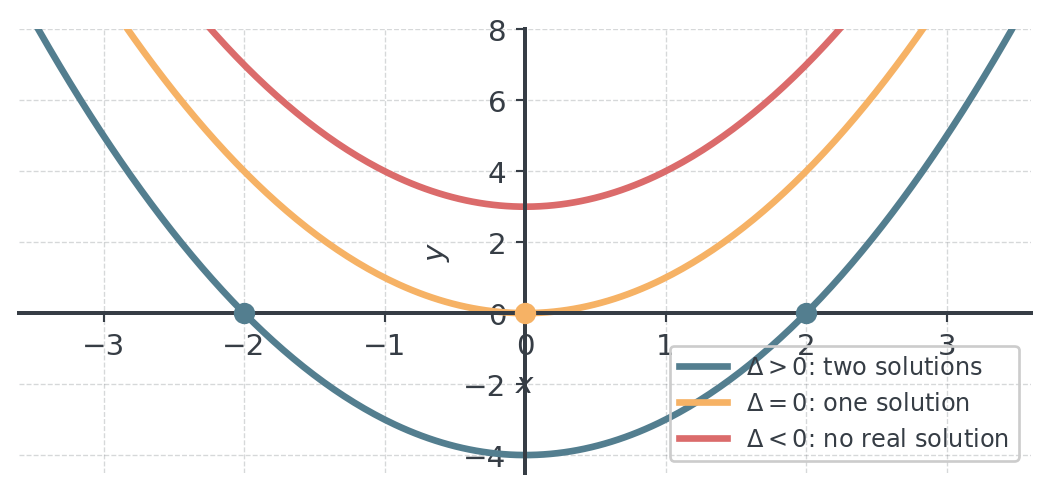
For \(ax^2 + bx + c = 0\), the discriminant \(\Delta = b^2 - 4ac\) tells us:
| \(\Delta\) Value | Solution Type | Graph | Factorability |
|---|---|---|---|
| \(\Delta > 0\), perfect square | Two rational | Crosses twice | Easily factorable |
| \(\Delta > 0\), not a square | Two real (irrational) | Crosses twice | Not over integers |
| \(\Delta = 0\) | One repeated | Touches once | Perfect square |
| \(\Delta < 0\) | No real solutions | Misses the x-axis | Not over reals |
Seeing the Discriminant
The parabola’s position relative to the x-axis is the discriminant story: crossing twice, touching once, or missing it entirely.
Method Selection Guide
Which method should you use?
Quadratic Equation: \(ax^2 + bx + c = 0\)
Calculate Δ = b² - 4ac
│
├─ Δ < 0 → No real solutions
│
├─ Δ = 0 → One solution: x = -b/(2a) (Perfect square trinomial)
│
└─ Δ > 0 → Two real solutions
           │
           └─ Is Δ a perfect square?
              │
              ├─ YES → Try factoring first
              │
              └─ NO → Use quadratic formula
Interested in more details and the origin of the quadratic formula? Head over here
Biquadratic Equations
Extending to fourth-degree
Form: \(ax^4 + bx^2 + c = 0\)
Strategy: Substitution!
- Let \(u = x^2\)
- Solve \(au^2 + bu + c = 0\)
- Back-substitute to find \(x\)
Solving Biquadratic Equations
Let’s Look at an Example
Example: \(x^4 - 5x^2 + 4 = 0\)
- Let \(u = x^2\): \(u^2 - 5u + 4 = 0\)
- Factor: \((u - 1)(u - 4) = 0\)
- So \(u = 1\) or \(u = 4\)
- If \(x^2 = 1\): \(x = \pm 1\)
- If \(x^2 = 4\): \(x = \pm 2\)
- Four solutions: \(x = -2, -1, 1, 2\)
Calculator: The Equation Solver
From MENU:
- Press MENU → A (Gleichung/Funkt)
- Choose your equation type:
- 1: Gleichungssyst. = Systems of linear equations
- 2: Polynom-Gleich. = Polynomial equations
Calculator: Quadratic Equations
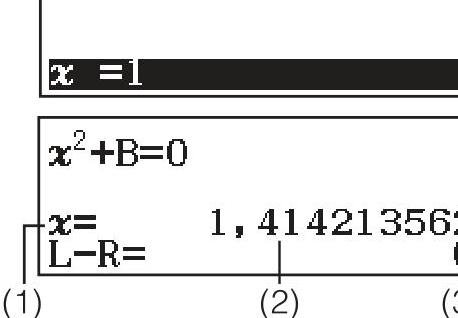
Solve \(x^2 + 2x - 2 = 0\)
- Press MENU → A → 2 (Polynom-Gleich.)
- Select Grad: 2 (for a cubic: Grad: 3, then enter a, b, c, d)
- Enter coefficients: a = 1, b = 2, c = -2
- Press = to see solutions
Calculator: Reading the Solutions
The calculator shows:
- \(x_1 = -1 + \sqrt{3}\)
- \(x_2 = -1 - \sqrt{3}\)
Press = repeatedly to cycle through all solutions.
After the two x-values, it also shows you the vertex!
Cubic Equations
From Degree Two to Degree Three
One step up: cubic equations
Form: \(ax^3 + bx^2 + cx + d = 0\)
For simple cubics, try small integer values:
- Test \(x = 0, \pm 1, \pm 2, \pm 3\)…
- If \(x = a\) works, then \((x - a)\) is a factor
- Find the other factor by comparing coefficients
For \(x^3 + px^2 + qx + r\):
- Look for common factors first
- Try grouping in pairs
- Example: \(x^3 + 2x^2 - x - 2 = x^2(x + 2) - 1(x + 2) = (x + 2)(x^2 - 1)\)
Recap: Sum & Difference of Cubes
You already know these from Session 01-04
- Sum of cubes: \(a^3 + b^3 = (a + b)(a^2 - ab + b^2)\)
- Difference of cubes: \(a^3 - b^3 = (a - b)(a^2 + ab + b^2)\)
Example: Solve \(x^3 - 27 = 0\)
- Factor: \((x - 3)(x^2 + 3x + 9) = 0\)
- Second factor: \(\Delta = 9 - 36 < 0\) → no real solutions
- Only real solution: \(x = 3\)
Recap felt fast? Revisit the derivation in Session 01-04.
Solving Cubic Equations
Step-by-step approach
Solve: \(x^3 - 6x^2 + 11x - 6 = 0\)
- Try simple values: Test \(x = 1\): \(1 - 6 + 11 - 6 = 0\) ✓
- So \((x - 1)\) is a factor! Now we find what it multiplies with
- Divide: We know \(x^3 - 6x^2 + 11x - 6 = (x - 1) \times ?\)
- Compare coefficients: \((x - 1)(x^2 + bx + 6)\) has \((b - 1)x^2\), so \(b - 1 = -6\) and \((x - 1)(x^2 - 5x + 6) = 0\)
- Factor the quadratic: \((x - 1)(x - 2)(x - 3) = 0\)
- Solutions: \(x = 1, 2, 3\)
Guided Practice
Individual Exercises
Work independently, then we’ll discuss
Solve: \((2x - 6)(x + 4) = 0\)
Solve: \(5x - 15 = 0\)
Solve by factoring: \(x^2 + 7x + 10 = 0\)
Use quadratic formula: \(2x^2 - 3x - 2 = 0\)
Complete the square: \(x^2 - 4x - 5 = 0\)
Solve: \(x^4 - 13x^2 + 36 = 0\)
Spot the Error
Two student solutions - both wrong!
Solution 1: \(\quad x^2 = 5x \;\Rightarrow\; x = 5\)
Solution 2: \(\quad 3x^2 - 12 = 0 \;\Rightarrow\; x^2 - 12 = 0 \;\Rightarrow\; x = \pm\sqrt{12}\)
Find and fix both errors!
Break
Practice Session
Practice Set A
10 minutes - Fundamentals
- Solve for \(x\):
- \(4x - 12 = 0\)
- \(-3x + 15 = 0\)
- \(\frac{2x - 8}{4} = 3\)
- Without solving, determine the number of real solutions:
- \(x^2 + 4x + 4 = 0\)
- \(x^2 - 3x + 5 = 0\)
- \(3x^2 - 12x + 9 = 0\)
Practice Set B: Core Skills
5 minutes - Individually
Solve each using the most efficient method and justify your choice:
- \(x^2 - 11x + 30 = 0\)
- \(2x^2 + 5x - 3 = 0\)
- \(x^2 - 6x + 9 = 0\)
- \(3x^2 - 7x + 1 = 0\)
Practice Set C: Challenge Problems
- Solve these equations:
- \((x^2 - 4)(x^2 - 9) = 0\)
- \(x^3 - 4x^2 - 5x + 20 = 0\)
- \((x - 1)^2(x + 3) = 0\)
- A factory produces custom widgets. The cost function is \(C = x^2 - 40x + 500\) and the revenue function is \(R = 20x\), where \(x\) is the number of units.
- Find the profit function \(P = R - C\)
- At what production levels does the factory break even?
Practice Set D: Patterns
5 minutes - Individually
Solve these related equations and find the pattern:
- \(x^2 - 5x + 6 = 0\)
- \(x^2 - 5x + 4 = 0\)
- \(x^2 - 5x + 0 = 0\)
- \(x^2 - 5x - 6 = 0\)
What do you notice about the solutions as the constant term changes?
Practice Set E: FSP-Style
10 minutes - individually, full written solutions
Solve completely: \(x^4 - 29x^2 + 100 = 0\)
Determine \(c\) so that \(x^2 - 10x + c = 0\) has exactly one solution, and state it.
Apply & Extend
Break Even
Real-world quadratic application
A company’s profit function1 \(P = -2x^2 + 120x - 1600\)
- Break-even: Solve \(-2x^2 + 120x - 1600 = 0\)
- Divide by -2: \(x^2 - 60x + 800 = 0\)
- Using formula: \(x = \frac{60 \pm \sqrt{3600 - 3200}}{2} = \frac{60 \pm 20}{2}\)
- Break-even point (lower break-even point): \(x = 20\) (2,000 units)
- Profit limit (upper break-even point): \(x = 40\) (4,000 units)
- Profit zone: \(20 < x < 40\), here \(P(x) > 0\)
Coffee Break
Team Problem-Solving
Market Analysis Challenge
Work in groups
A new product’s market share \(M\) after \(t\) months follows: \[M = -2t^2 + 12t\]
- Find when market share is zero (factor completely)
- Graph the market lifecycle
Hint: Compute \(M\) for \(t = 0, 1, \ldots, 6\) and join the points with a smooth curve.
We’ll explore finding the maximum profit point with quadratic functions in Section 03.
Wrap-Up & Takeaways
Key Takeaways
Essential skills mastered today
- Zero Product Property is fundamental to all equation solving
- Three methods for quadratics - each has its place
- Discriminant predicts solution behavior
- Biquadratic equations use substitution strategy
- Cubic equations: find one root, then factor down to a quadratic
- Business applications often involve quadratic models
Final Assessment
5 minutes - individual work
Solve using the most efficient method:
\(x^2 - 8x + 15 = 0\)
\(3x^2 + 2x - 1 = 0\)
\(x^4 - 10x^2 + 9 = 0\)
\(x^3 - 4x = 0\)
Next Session Preview
Session 02-03: Fractional, Radical, Exponential & Logarithmic Equations
- Rational equations and domain restrictions
- Radical equations and extraneous solutions
- Exponential and logarithmic equations
- Business applications with rates and growth
TipHomework Assignment
Complete Tasks 02-02!
Footnotes
Where \(x\) = units sold (in hundreds).↩︎