Section 05: Differential Calculus
Test your understanding of chain rule and implicit differentiation
Differentiate \(f(x) = (2x^3 - 5)^4\) using the chain rule.
Find \(\frac{dy}{dx}\) if \(x^2 + xy = 10\).
If \(f'(3) = 0\), what does this tell about the graph of \(f(x)\) at \(x = 3\)?
If \(f''(x) > 0\) for all \(x\) in an interval, what does this tell you about the shape of \(f(x)\)?
What questions do you have regarding the previous session?
Key Insight
Being able to translate between graphs of \(f\), \(f'\), and \(f''\) is one of the most important visual skills in calculus and frequently tested!
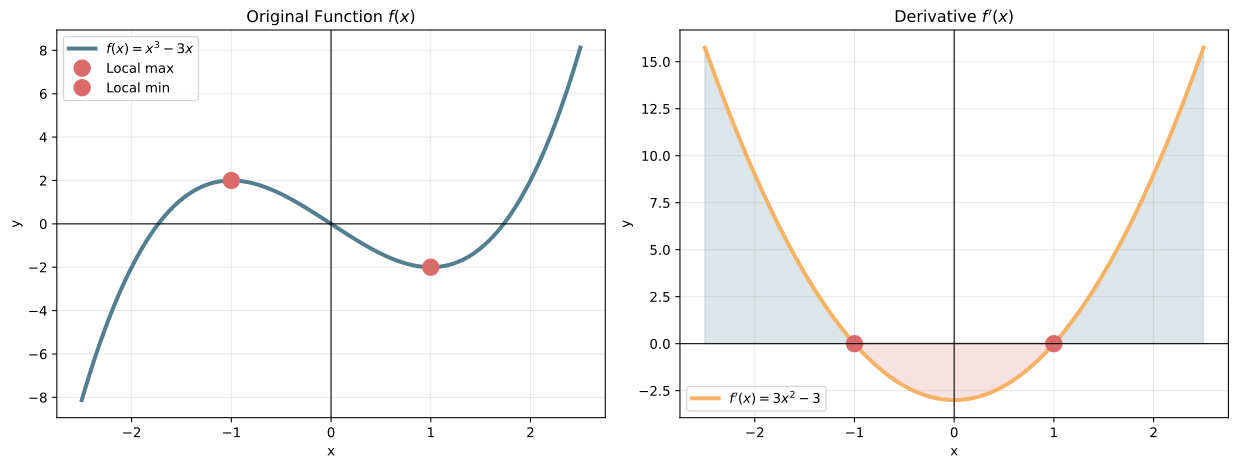
The graph of \(f'(x)\) shows the slope of \(f(x)\) at each point.
What to look for in \(f(x)\):
This shouldn’t be too complicated, right?
A parabola and its derivative: \(f(x) = x^2\)
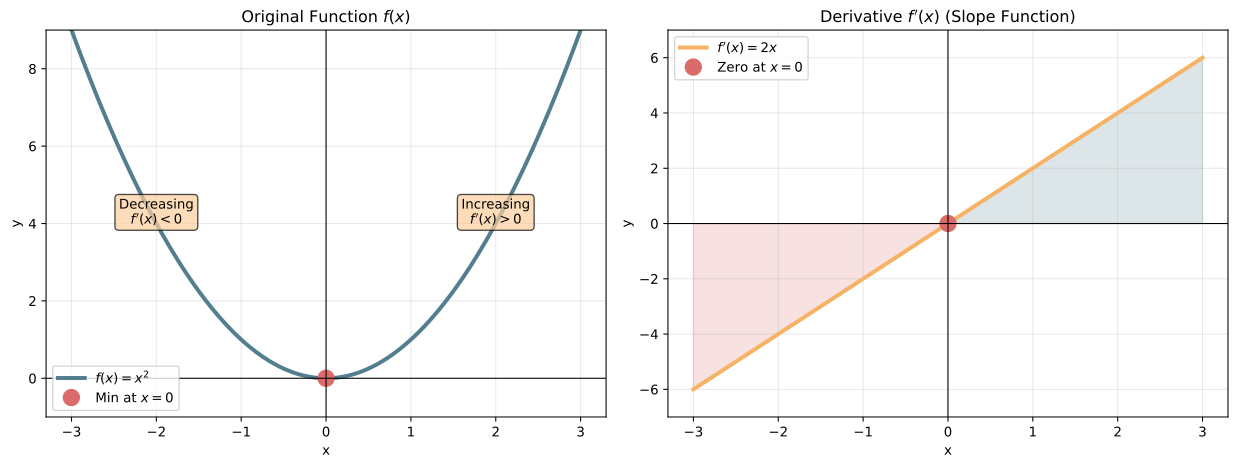
\(f\) has minimum at \(x = 0\) → \(f'\) crosses zero
The process is rather straightforward:
A cubic function and its derivative.

\(f\) increasing, then decreasing, then increasing → \(f'\) crosses zero twice
A point \(x = c\) where either:
Classification of Critical Points
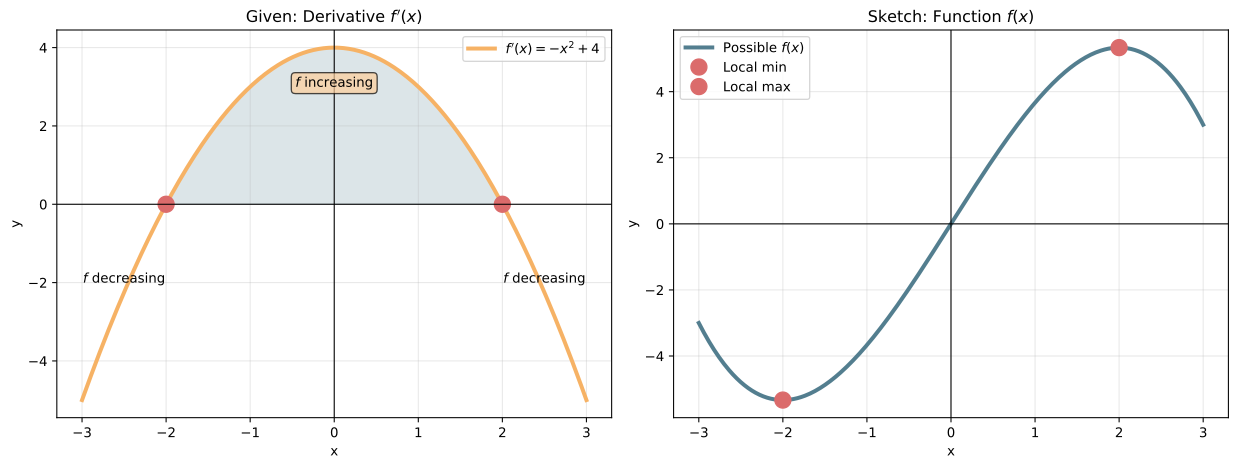
Given the graph of \(f'(x)\), we can determine:
Where \(f\) is increasing/decreasing:
Where \(f\) has local extrema: \(f'\) crosses zero
Where \(f\) is steepest: Where \(|f'(x)|\) is largest
Relative heights: Cannot determine absolute \(y\)-values!

Sketch the derivative of this function!
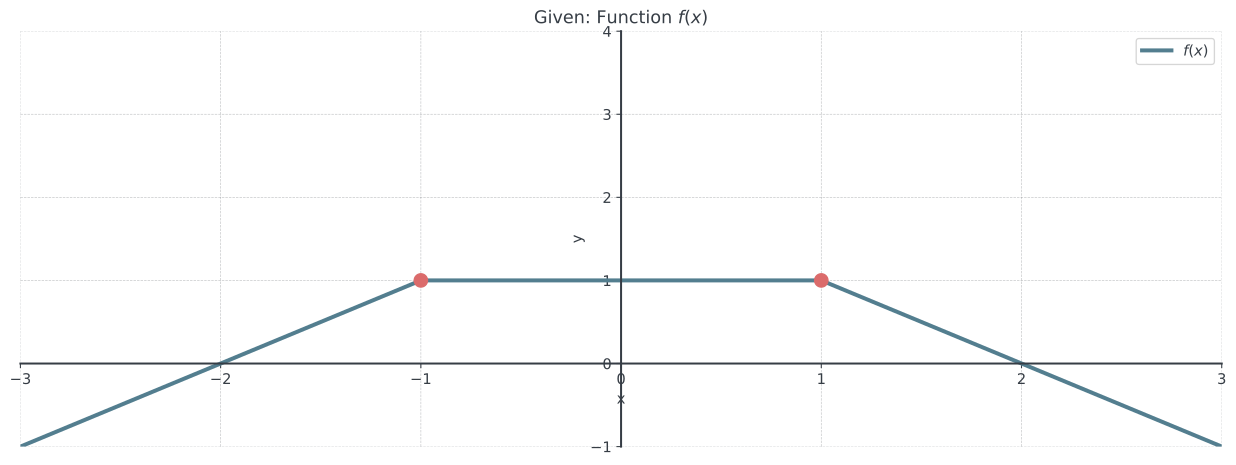
The Questions:
Where is \(f'(x) > 0\), \(f'(x) < 0\), and \(f'(x) = 0\)?
Sketch the graph of \(f'(x)\).
At what points does \(f'(x)\) not exist?
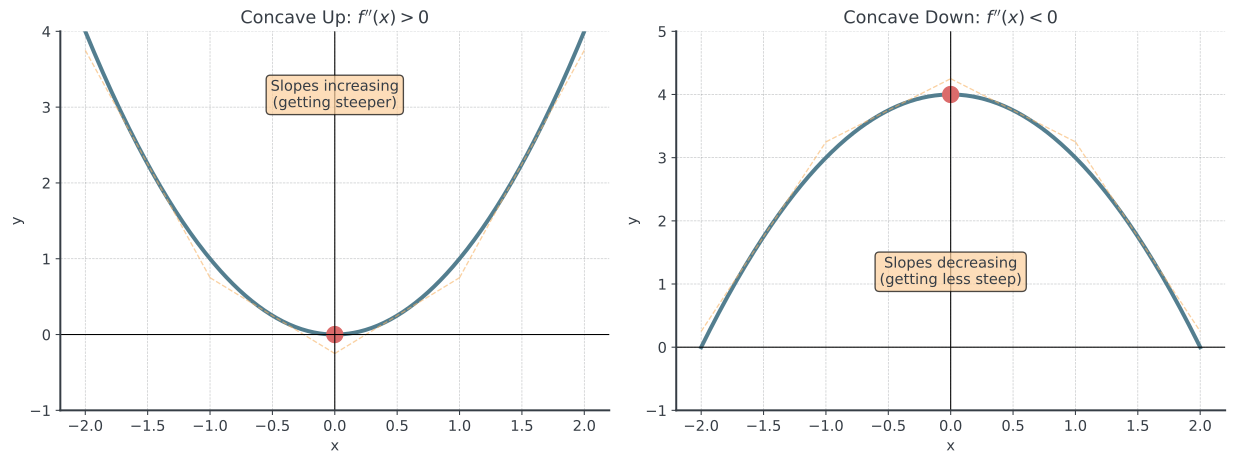
Describes the curving behavior of a function.
Concave up vs. concave down

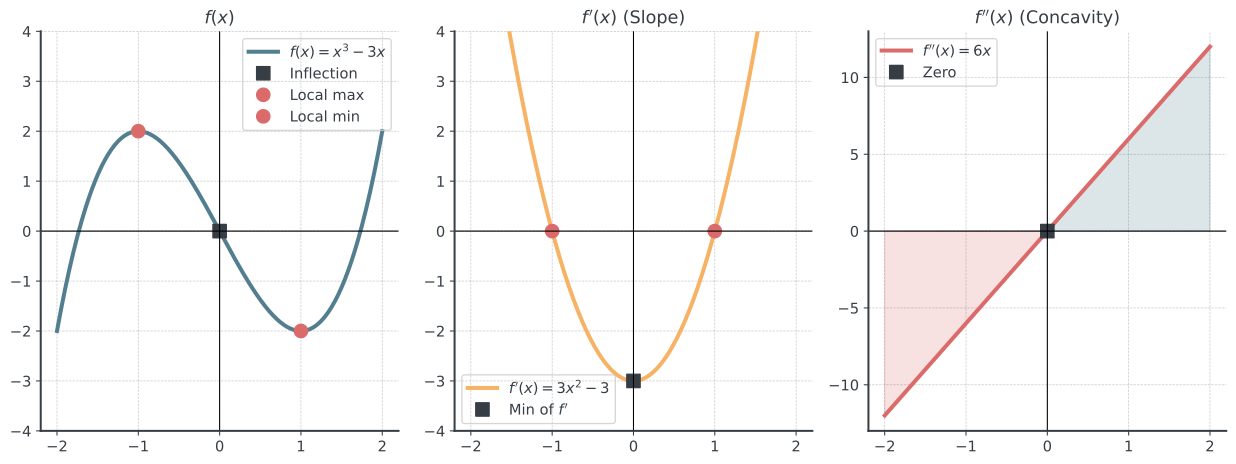
\(f''(x)\) tells us how \(f'(x)\) is changing, which determines the shape of \(f(x)\).
A point where concavity changes!
Example: \(f(x) = x^3\)

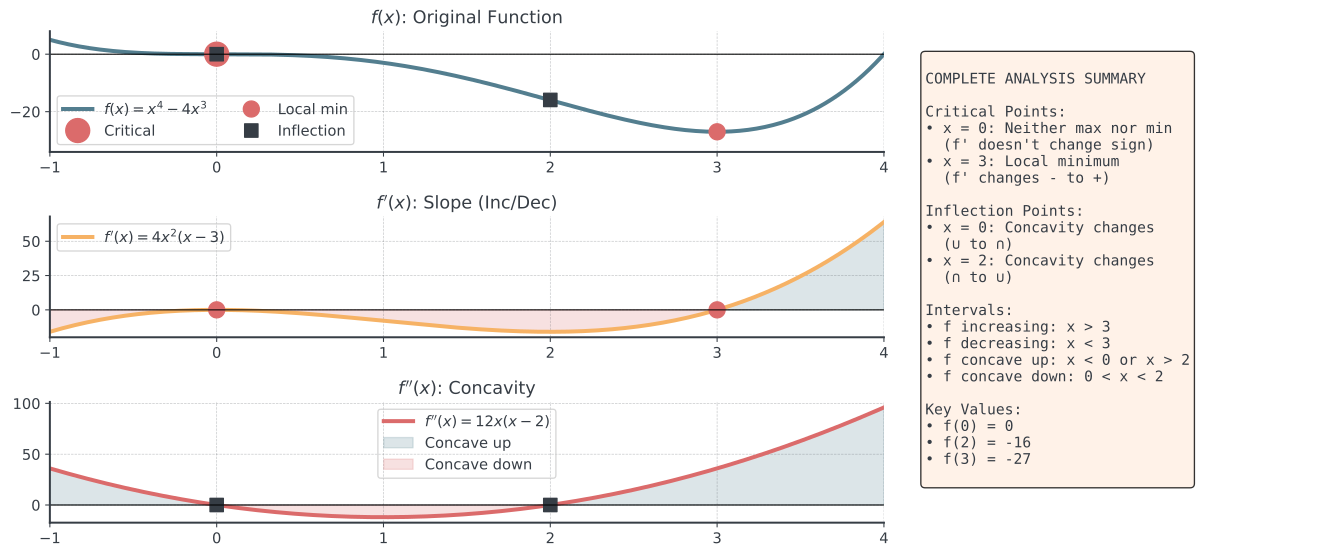
Given a function \(f(x)\), complete analysis involves:
Analyze \(f(x) = x^4 - 4x^3\)
First derivative:
\[f'(x) = 4x^3 - 12x^2 = 4x^2(x - 3)\]
Critical points: \(x = 0, 3\)
Second derivative:
\[f''(x) = 12x^2 - 24x = 12x(x - 2)\]
Inflection points: \(x = 0, 2\)

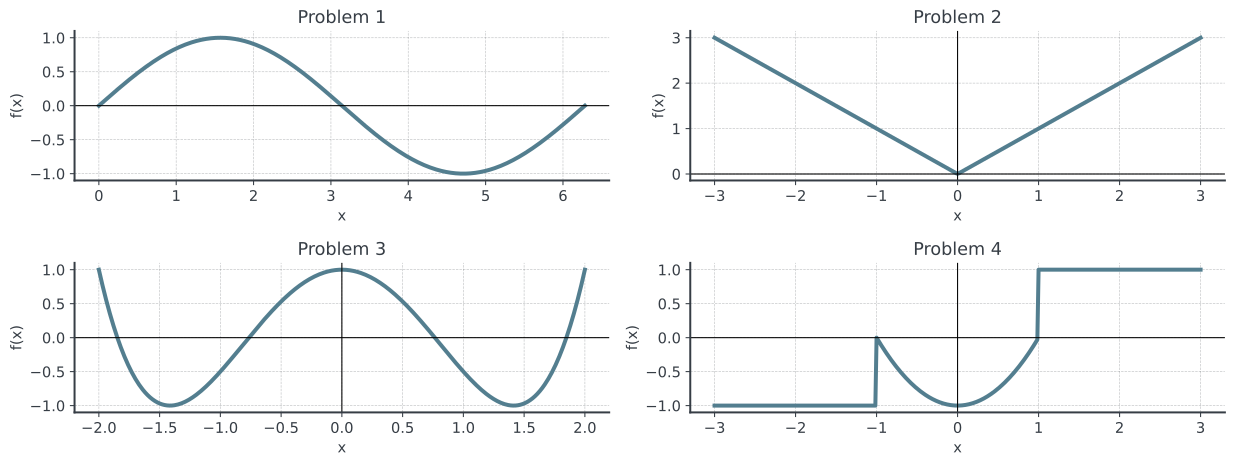
For each function graphed below, sketch \(f'(x)\) and identify:

Continue working for 10 minutes
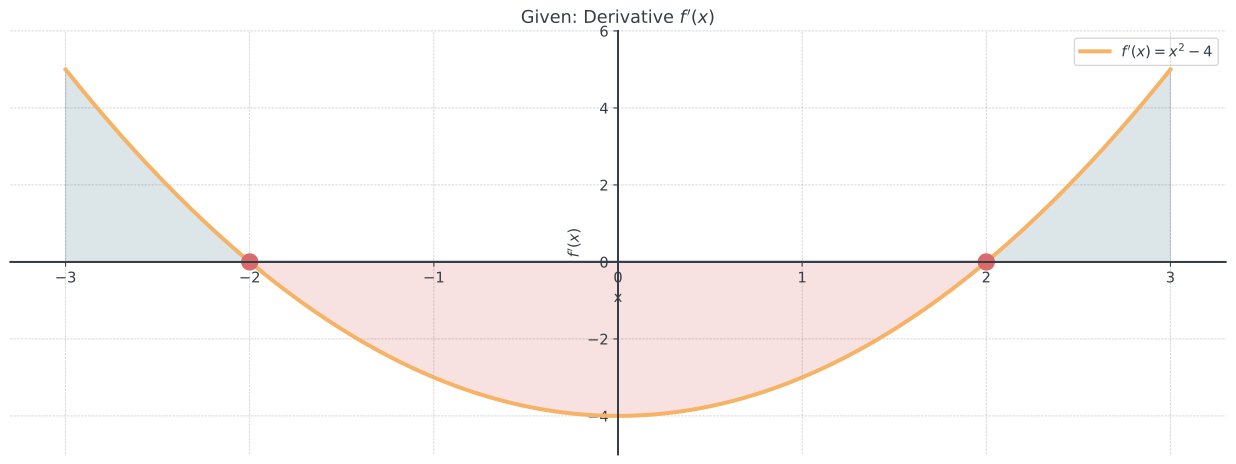
Given the graph of \(f'(x)\), answer:

Work individually for 5 minutes
For each function described, sketch both \(f(x)\) and \(f'(x)\):
\(f(x) = x^3 - 3x\) (cubic with local max and min)
\(f(x) = |x - 2|\) (V-shape shifted right)
\(f(x)\) is constant for \(x < 0\), then increases linearly for \(x \geq 0\)
\(f(x)\) has \(f'(x) > 0\) everywhere but \(f'(x) \to 0\) as \(x \to \infty\)
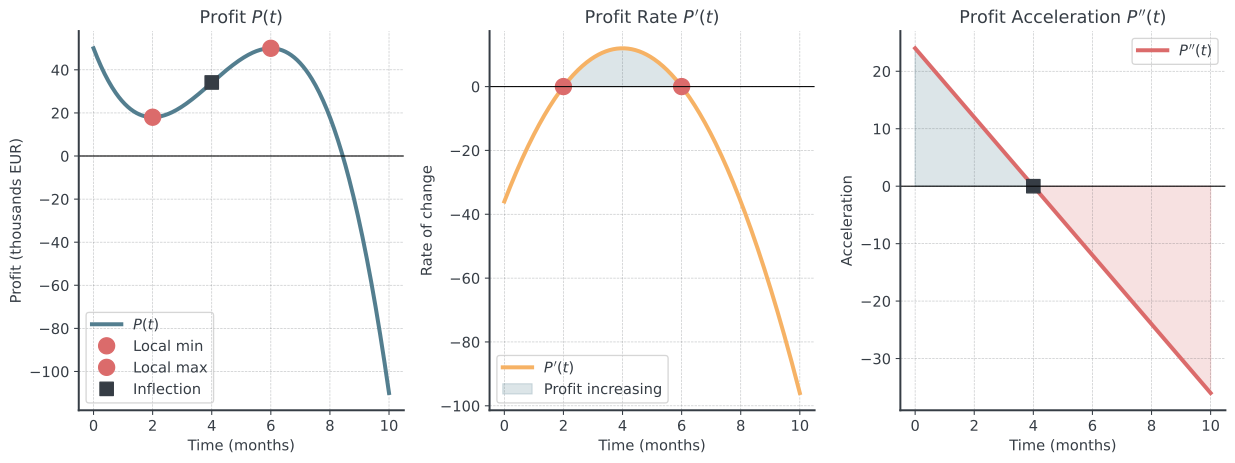
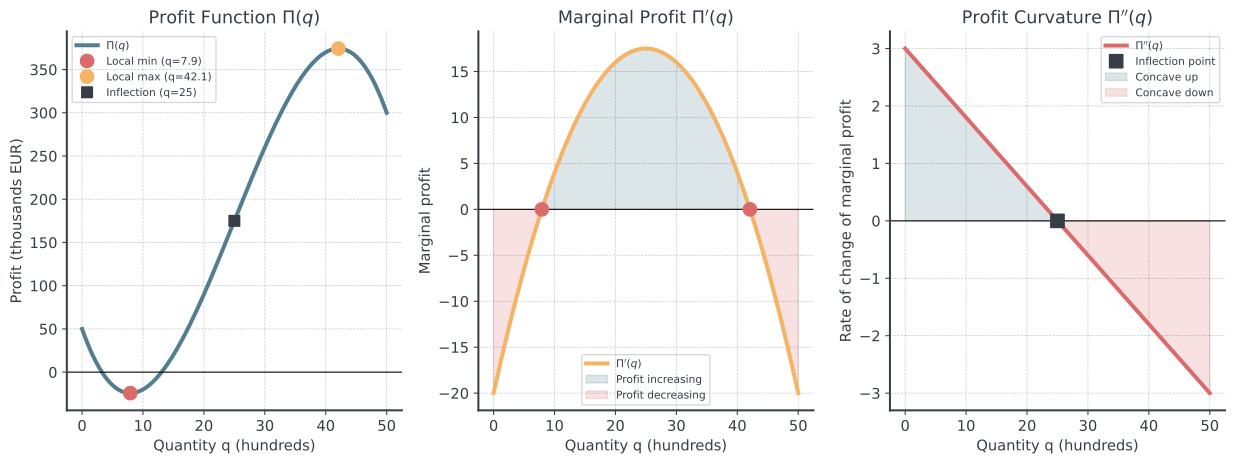
Business Context: A company’s monthly profit (in thousands €) is modeled by: \[P(t) = -t^3 + 12t^2 - 36t + 50\] where \(t\) is months since product launch.
Questions:
First derivative (profit rate of change): \[P'(t) = -3t^2 + 24t - 36 = -3(t^2 - 8t + 12) = -3(t - 2)(t - 6)\]
Critical points: \(t = 2, 6\) months
Second derivative (acceleration of profit change): \[P''(t) = -6t + 24 = -6(t - 4)\]
Inflection point: \(t = 4\) months

Question: How would you describe the behaviour?
Reading Business Graphs: Quick Rules
The sign of the derivative tells you the direction of change!
Inflection Points in Business
The inflection point (\(P''(t) = 0\) at month 4) marks where:
Business insight: Month 4 is when the company should start planning for the eventual peak. Growth is still positive but momentum is fading!
Scenario: An economist models consumer demand response using:
\[D(p) = \frac{100}{p + 1} - 2\]
where \(D\) is demand (thousands of units) and \(p\) is price (€).
Work in groups of 3-4
Find \(D'(p)\) and interpret its sign. What does this tell you economically?
Find \(D''(p)\). What does its sign tell you about how demand sensitivity changes with price?
Sketch the graphs of \(D(p)\), \(D'(p)\), and \(D''(p)\) on \(p \in [0, 10]\).
At what price is the rate of demand decrease (i.e., \(|D'(p)|\)) exactly 1 unit per €?
Business question: If you’re a monopolist who can set price, explain using calculus concepts why you wouldn’t set price arbitrarily high even though higher prices mean more revenue per unit.
Think individually, then discuss with class
Question: Consider these scenarios:
| If you know… | You can determine… |
|---|---|
| \(f' > 0\) | \(f\) is increasing |
| \(f' < 0\) | \(f\) is decreasing |
| \(f' = 0\) | Possible local extremum |
| \(f'' > 0\) | \(f\) concave up, \(f'\) increasing |
| \(f'' < 0\) | \(f\) concave down, \(f'\) decreasing |
| \(f'' = 0\) | Possible inflection point |
These are heavily Tested Skills in FSP!!!
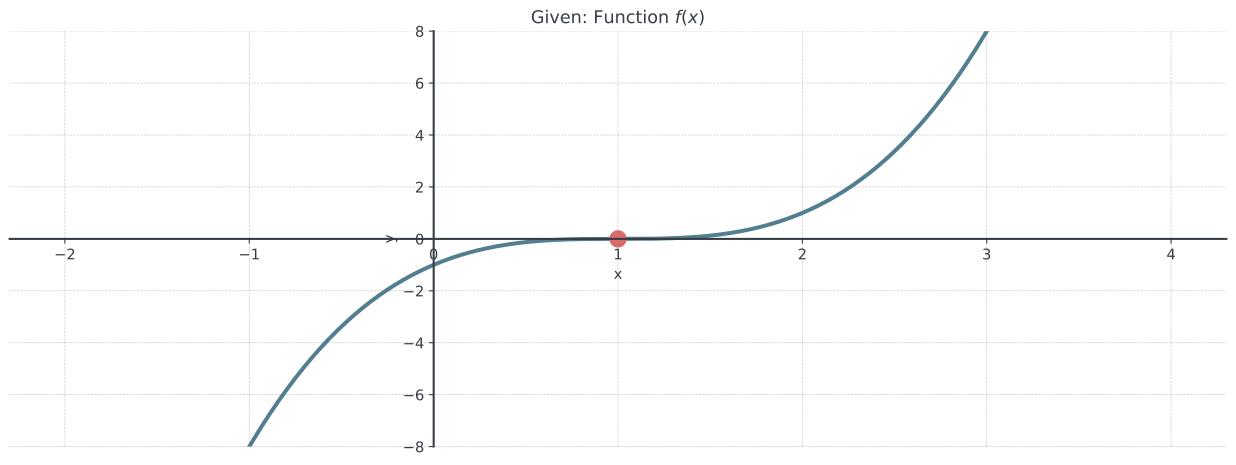
Consider this function:

Work individually, then we compare
Where is \(f'(x) > 0\)?
At \(x = 1\), is this a local max, local min, or neither?
Where is \(f(x)\) concave up?
True or False: If \(f'(c) = 0\), then \(f\) must have a local extremum at \(x = c\).
Optimization & Curve Sketching
Complete Tasks 05-05!
Session 05-05 - Graphical Calculus Mastery | Dr. Nikolai Heinrichs & Dr. Tobias Vlćek | Home