Session 08-03 - Cost Analysis & Pricing Decisions
Section 08: Financial Mathematics
Entry Quiz
Quick Review from Session 08-02
Test your understanding of Annuities
Calculate the future value of saving 250/month for 15 years at 4% annual interest.
Find the monthly payment for a 30,000 loan at 5.4% for 4 years.
After 12 payments on a 15,000 loan at 6% annual for 3 years, what is the outstanding balance?
What is the present value of receiving 1,500/month for 10 years at 6% annual?
Learning Objectives
What You’ll Master Today
- Understand cost function components: fixed vs. variable costs
- Calculate variable cost per unit \(\overline{C}_v(x)\)
- Find the short-term lower limit price (Kurzfristige Preisuntergrenze)
- Find the long-term lower limit price (Langfristige Preisuntergrenze)
- Make pricing and production decisions using cost analysis
WarningExam-Critical Topic
These pricing concepts appear frequently on the Feststellungsprüfung!
Cost Function Review
Components of Total Cost
Every business has two types of costs:
ImportantCost Components
Fixed Costs (\(C_f\)): Costs that don’t change with production quantity
- Rent, insurance, salaries, equipment depreciation
Variable Costs (\(C_v(x)\)): Costs that change with quantity produced
- Raw materials, energy, direct labor, packaging
\[C(x) = C_f + C_v(x)\]
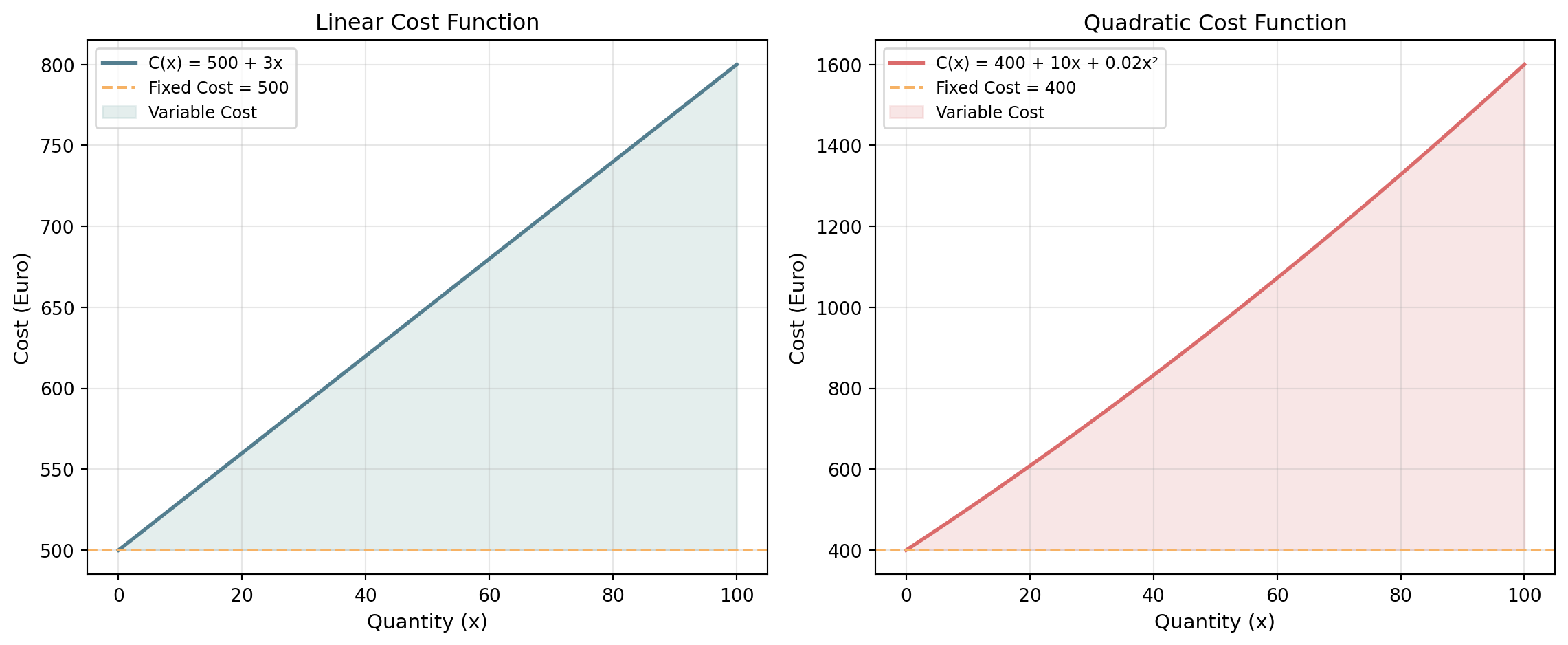
Total Cost Function Examples
Common cost function forms:
Linear: \(C(x) = 500 + 3x\): fixed cost 500, constant variable cost 3 per unit
Quadratic: \(C(x) = 400 + 10x + 0.02x^2\): variable costs increase with quantity
Cubic: \(C(x) = 1000 + 50x - 0.5x^2 + 0.01x^3\): the most realistic form, with economies and then diseconomies of scale
Visualizing Cost Functions
Average Cost
Average Total Cost
How much does each unit cost on average?
ImportantAverage Cost (Durchschnittskosten)
\[\overline{C}(x) = \frac{C(x)}{x} = \frac{C_f + C_v(x)}{x} = \frac{C_f}{x} + \frac{C_v(x)}{x}\]
This can be written as: \[\overline{C}(x) = \underbrace{\frac{C_f}{x}}_{\text{Avg. Fixed Cost}} + \underbrace{\frac{C_v(x)}{x}}_{\text{Avg. Variable Cost}}\]
Variable Cost Per Unit
ImportantVariable Cost Per Unit (Stückkosten variabel)
\[\overline{C}_v(x) = \frac{C_v(x)}{x} = \frac{C(x) - C_f}{x}\]
This is the average variable cost: what each unit costs in variable expenses alone.
Example: \(C(x) = 500 + 10x + 0.01x^2\)
\[\overline{C}_v(x) = \frac{(500 + 10x + 0.01x^2) - 500}{x} = \frac{10x + 0.01x^2}{x} = 10 + 0.01x\]
Why Variable Cost Per Unit Matters
Critical insight for pricing decisions:
- If price \(>\) average total cost: Profit
- If price \(<\) average total cost but \(>\) variable cost per unit: Loss, but covering some fixed costs
- If price \(<\) variable cost per unit: Should NOT produce, it loses money on every unit!
The variable cost per unit is the absolute minimum you should charge!
Short-Term Limit
The Short-Term Lower Limit
ImportantShort-Term Lower Limit Price (Kurzfristige Preisuntergrenze)
The minimum price at which a company should continue production in the short term.
\[p_{min,short} = \min\{\overline{C}_v(x)\} = \text{minimum variable cost per unit}\]
At this price, the company covers its variable costs but not fixed costs.
When to use:
- Fixed costs are “sunk” (already paid/committed)
- Short-term decision: continue or stop production?
Minimum Variable Cost per Unit
Method: Use calculus to find the minimum of \(\overline{C}_v(x)\)
Step 1: Calculate \(\overline{C}_v(x) = \frac{C(x) - C_f}{x}\)
Step 2: Find \(\overline{C}_v'(x)\) and set equal to zero
Step 3: Solve for \(x\)
Step 4: Calculate \(\overline{C}_v(x)\) at this value
Alternatively, use: \(\overline{C}_v'(x) = \frac{C'(x) \cdot x - (C(x) - C_f)}{x^2}\)
Setting this to zero: \(C'(x) \cdot x = C(x) - C_f\)
Example: Short-Term Lower Limit
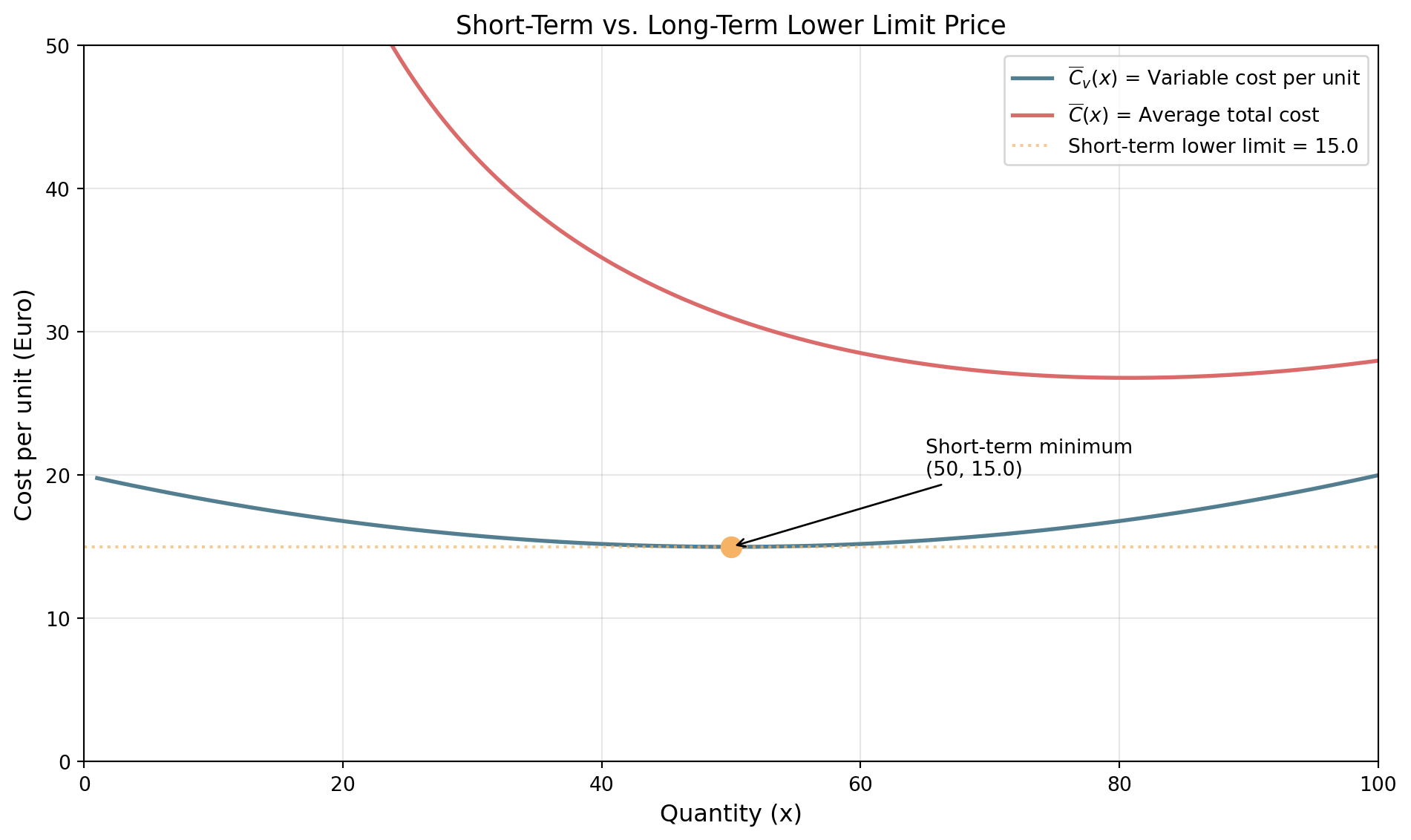
Given: \(C(x) = 800 + 20x - 0.2x^2 + 0.002x^3\)
Step 1: Variable cost function \[C_v(x) = 20x - 0.2x^2 + 0.002x^3\]
Step 2: Variable cost per unit \[\overline{C}_v(x) = \frac{20x - 0.2x^2 + 0.002x^3}{x} = 20 - 0.2x + 0.002x^2\]
Example (continued)
Step 3: Find minimum \[\overline{C}_v'(x) = -0.2 + 0.004x = 0\] \[x = 50\]
Step 4: Calculate minimum variable cost per unit \[\overline{C}_v(50) = 20 - 0.2(50) + 0.002(50)^2 = 20 - 10 + 5 = 15\]
Short-term lower limit price = 15 Euro per unit
The company should not sell below 15 Euro, even in the short term!
Graphical Representation
Break
Long-Term Limit
Long-Term Lower Limit Price
ImportantLong-Term Lower Limit Price (Langfristige Preisuntergrenze)
The minimum price for sustainable long-term production.
\[p_{min,long} = \min\{\overline{C}(x)\} = \text{minimum average total cost}\]
At this price, the company covers ALL costs (both fixed and variable).
When to use:
- Long-term strategic pricing decisions
- Deciding whether to enter/exit a market
Finding the Long-Term Lower Limit
Same method, but for average TOTAL cost:
Step 1: Calculate \(\overline{C}(x) = \frac{C(x)}{x}\)
Step 2: Find \(\overline{C}'(x)\) and set equal to zero
Step 3: Solve for \(x\)
Step 4: Calculate \(\overline{C}(x)\) at this value
Example: Long-Term Lower Limit
Same cost function: \(C(x) = 800 + 20x - 0.2x^2 + 0.002x^3\)
Step 1: Average total cost \[\overline{C}(x) = \frac{800 + 20x - 0.2x^2 + 0.002x^3}{x} = \frac{800}{x} + 20 - 0.2x + 0.002x^2\]
Step 2: Find minimum \[\overline{C}'(x) = -\frac{800}{x^2} - 0.2 + 0.004x = 0\]
Example: Long-Term Lower Limit II
Multiply by \(x^2\): \[-800 - 0.2x^2 + 0.004x^3 = 0\] \[0.004x^3 - 0.2x^2 - 800 = 0\]
Example (continued)
Solving \(0.004x^3 - 0.2x^2 - 800 = 0\) (or \(x^3 - 50x^2 - 200000 = 0\)):
Polynomial solver (MENU → A → 2, degree 3, Sessions 02-02 and 05-06): \(x \approx 80.7\)
Step 4: Calculate minimum average cost \[\overline{C}(80.7) = \frac{800}{80.7} + 20 - 0.2(80.7) + 0.002(80.7)^2 \approx 26.80\]
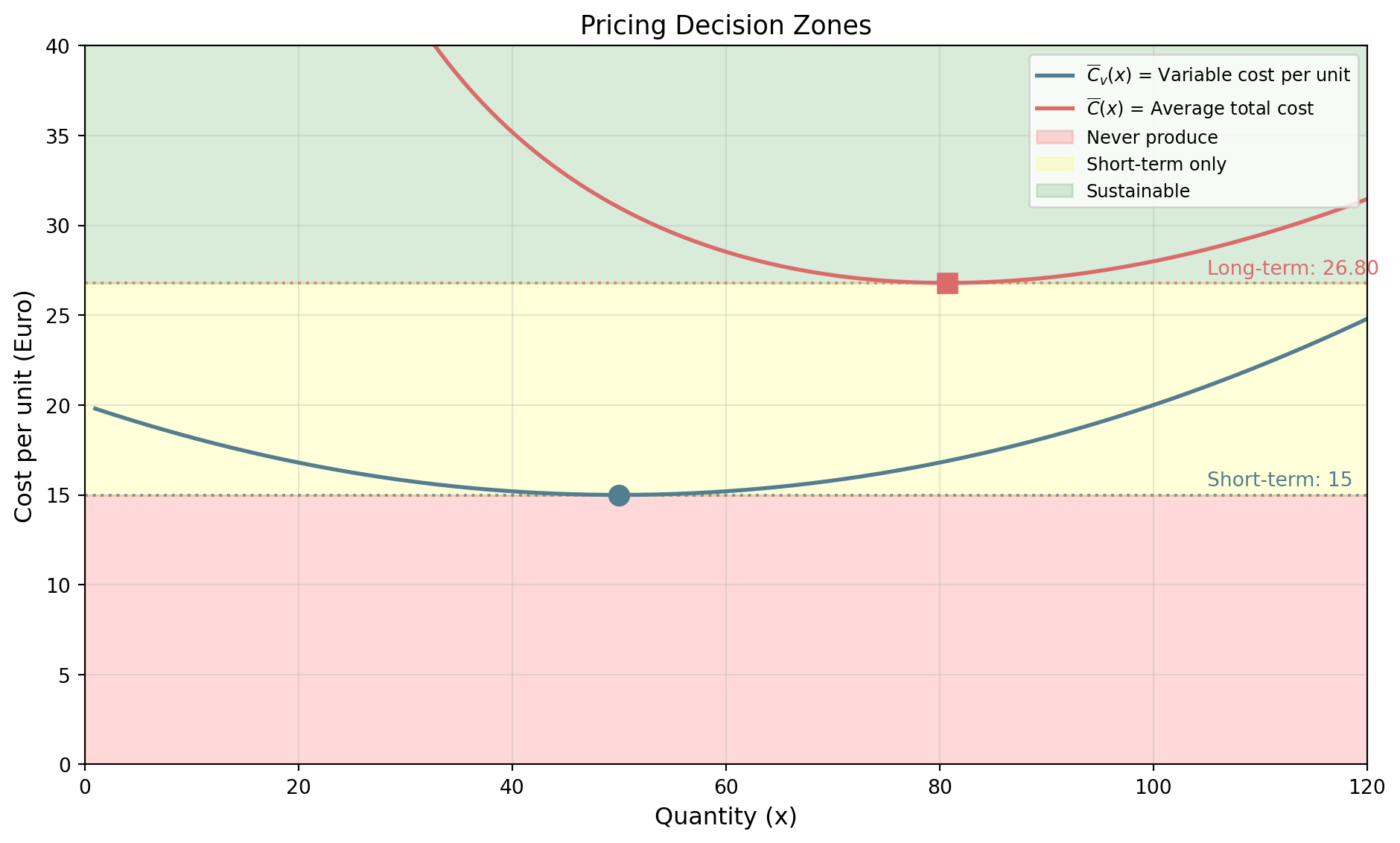
Long-term lower limit price = 26.80 Euro per unit
For sustainable production, the company must charge at least 26.80 Euro!
Short-Term vs Long-Term
Interpretation
Pricing Decision Framework
ImportantThree Pricing Zones
| Price Level | Decision |
|---|---|
| \(p < \overline{C}_v^{min}\) | STOP production: losing on every unit |
| \(\overline{C}_v^{min} \leq p < \overline{C}^{min}\) | Continue short-term: covers variable costs, contributes to fixed costs |
| \(p \geq \overline{C}^{min}\) | Sustainable: covers all costs |
When to Use Each Limit
Short-term lower limit price:
- Factory/equipment exists, fixed costs are committed (“sunk”)
- Deciding whether to accept a special order
- Economic downturn: better to produce and lose less than to stop
Long-term lower limit price:
- Deciding whether to enter a new market
- Setting regular prices for new products
- Strategic planning and investment decisions
Example: Special Order Decision
A company has excess capacity: next month, its machines would stand still. A customer offers to buy 50 units at 16 Euro each.
With our cost function: short-term lower limit 15 Euro, long-term lower limit 26.80 Euro.
Analysis:
- 16 > 15 (short-term limit) \(\checkmark\)
- 16 < 26.80 (long-term limit)
Decision: Accept! The 50 units cost \(\overline{C}_v(50) = 15\) Euro each in variable costs, so each unit contributes 1 Euro toward fixed costs. Not all costs are covered, but this is better than nothing.
Contribution Margin
ImportantContribution Margin (Deckungsbeitrag)
\[\text{Contribution per unit} = p - \overline{C}_v(x)\]
This is how much each unit “contributes” toward covering fixed costs.
Special order (x = 50, the whole production): \(16 - \overline{C}_v(50) = 16 - 15 = 1\) Euro per unit, so the 50 units contribute 50 Euro toward fixed costs.
Use \(\overline{C}_v\) at the output of the order: for 100 units, \(\overline{C}_v(100) = 20 > 16\), and the same price would not even cover the variable costs.
Guided Practice
Practice Problems
Problem 1: Given \(C(x) = 1200 + 30x + 0.1x^2\)
- Find the variable cost per unit function \(\overline{C}_v(x)\)
- Find the short-term lower limit price (if \(\overline{C}_v\) only rises, use very small \(x\))
- Find the long-term lower limit price
Practice Problems II
Problem 2: A company has cost function \(C(x) = 500 + 15x\)
- What is the short-term lower limit price?
- What is the average total cost at a production of 100 units?
- Should they accept an order for 50 units at 18 Euro each?
Exam-Style Problems
Typical Exam Problem Structure
FSP exam problems often combine these elements:
- Given a cost function \(C(x)\)
- Find the break-even point(s) given price \(p\)
- Find the profit-maximizing quantity
- Find the short-term/long-term lower limit price
- Interpret the results economically
Make sure you can distinguish between these questions:
- “Kurzfristige Preisuntergrenze” = Short-term = min of \(\overline{C}_v(x)\)
- “Langfristige Preisuntergrenze” = Long-term = min of \(\overline{C}(x)\)
Summary of Key Formulas
ImportantEssential Formulas for Cost Analysis
| Concept | Formula |
|---|---|
| Total Cost | \(C(x) = C_f + C_v(x)\) |
| Variable Cost per Unit | \(\overline{C}_v(x) = \frac{C(x) - C_f}{x}\) |
| Average Total Cost | \(\overline{C}(x) = \frac{C(x)}{x}\) |
| Short-term Limit | \(\min\{\overline{C}_v(x)\}\) |
| Long-term Limit | \(\min\{\overline{C}(x)\}\) |
| Contribution Margin | \(p - \overline{C}_v(x)\) |
Wrap-Up & Takeaways
Today’s Essential Concepts
- Variable cost per unit \(\overline{C}_v(x)\) = variable costs divided by quantity
- Short-term lower limit = minimum variable cost per unit
- Long-term lower limit = minimum average total cost
- Short-term limit < Long-term limit always (fixed costs!)
- Between the limits: Produce short-term, but not sustainable long-term
TipSection Complete!
You’ve completed Section 08: Financial Mathematics. Review all formulas before the exam!
Homework
Tasks 08-03
- Calculate variable cost per unit from various cost functions
- Find short-term and long-term lower limit prices
- Make production decisions based on price comparisons
- Interpret contribution margins in business contexts
These pricing decisions are frequently tested! Practice until you can solve them confidently.
Next Session Preview
Next Session: Mock Exam 09
Session 08-04 is exam only, no lecture
- 180 minutes working time plus 5 minutes reading time, 100 points
- Covers the whole course so far: cost and profit analysis, curve sketching with integration, probability and binomial distribution
- Allowed: non-programmable calculator, drawing instruments, monolingual dictionary
- Not allowed: notes, formula sheets, any electronic devices
- Counts toward the 60% of test points needed for exam admission
Preparing for Mock Exam 09
Complete Tasks 08-03, then prepare for Mock Exam 09 with FSP Training 08 (sidebar, Section 08 worksheets). Get a good night’s sleep and bring your calculator!