Session 08-02 - Annuities & Loan Amortization
Section 08: Financial Mathematics
Entry Quiz
Quick Review from Session 08-01
Test your understanding of Compound Interest
Find the 6th term of the geometric sequence: \(4, 12, 36, \ldots\)
Calculate the future value of 5,000 invested at 6% compounded quarterly for 5 years.
Find the effective annual rate for 8% compounded monthly.
How much should you invest today at 5% annual interest to have 15,000 in 8 years?
Learning Objectives
What You’ll Master Today
- Understand ordinary annuities and annuities due
- Calculate future value of regular payment streams
- Calculate present value of annuity payments
- Solve for payment amounts and number of payments
- Build loan amortization schedules
- Analyze interest vs. principal in loan payments
Annuity Basics
What is an Annuity?
An annuity is a series of equal payments made at regular intervals.
Examples:
- Monthly rent payments
- Salary deposits
- Loan repayments
- Retirement contributions
- Insurance premiums
The key: Equal payments at equal intervals
Types of Annuities
ImportantTwo Main Types
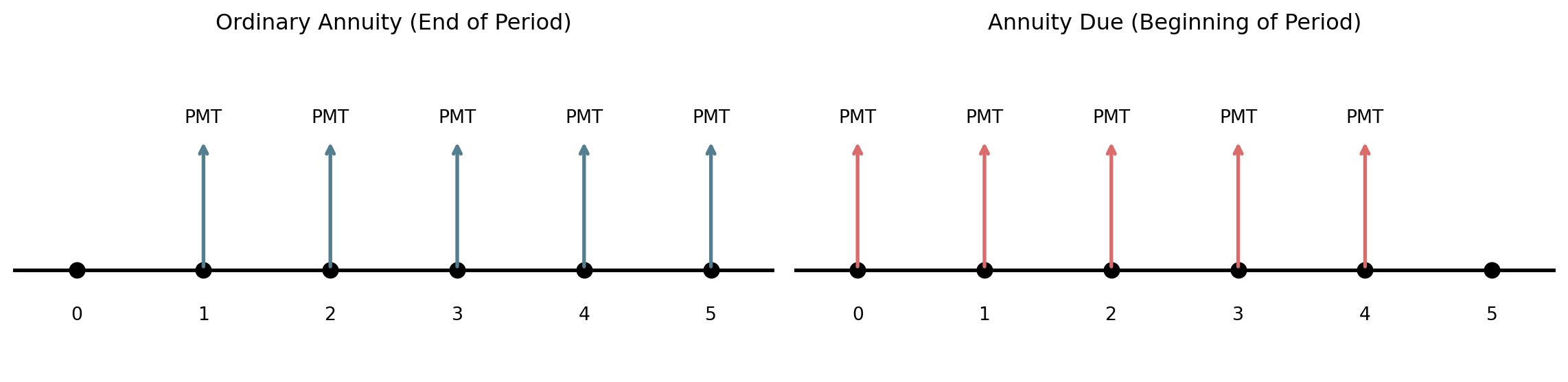
Ordinary Annuity (Nachschüssig): Payments made at the end of each period
Annuity Due (Vorschüssig): Payments made at the beginning of each period
Annuity Future Value
Future Value of Ordinary Annuity
Question: If you save 500 per month at 6% annual interest, how much will you have in 10 years?
ImportantFuture Value Formula (Ordinary Annuity)
\[FV = PMT \cdot \frac{(1 + r)^n - 1}{r}\]
where:
- \(PMT\) = Payment per period
- \(r\) = Interest rate per period
- \(n\) = Total number of payments
FV Calculation Example
Given: 500/month, 6% annual (0.5% monthly), 10 years (120 months)
\[FV = 500 \cdot \frac{(1.005)^{120} - 1}{0.005}\]
\[FV = 500 \cdot \frac{1.8194 - 1}{0.005} = 500 \cdot \frac{0.8194}{0.005}\]
\[FV = 500 \cdot 163.88 = 81,939.67\]
Total deposits: \(500 \times 120 = 60,000\)
Interest earned: \(81,939.67 - 60,000 = 21,939.67\)
FV of Annuity Due
Payments at beginning of period earn one extra period of interest:
ImportantFuture Value Formula (Annuity Due)
\[FV_{\text{due}} = PMT \cdot \frac{(1 + r)^n - 1}{r} \cdot (1 + r)\]
Or simply: \[FV_{\text{due}} = FV_{\text{ordinary}} \cdot (1 + r)\]
Same example as annuity due: \[FV = 81,939.67 \times 1.005 = 82,349.37\]
Annuity Present Value
Present Value of Ordinary Annuity
Question: How much is a stream of future payments worth today?
ImportantPresent Value Formula (Ordinary Annuity)
\[PV = PMT \cdot \frac{1 - (1 + r)^{-n}}{r}\]
Example: What is the present value of receiving 1,000/month for 5 years at 8% annual?
\[PV = 1000 \cdot \frac{1 - (1.00667)^{-60}}{0.00667} = 1000 \cdot 49.32 = 49,318.43\]
PV of Annuity Due
ImportantPresent Value Formula (Annuity Due)
\[PV_{\text{due}} = PMT \cdot \frac{1 - (1 + r)^{-n}}{r} \cdot (1 + r)\]
Or simply: \[PV_{\text{due}} = PV_{\text{ordinary}} \cdot (1 + r)\]
Same example as annuity due: \[PV = 49,318.43 \times 1.00667 = 49,647.22\]
Break
Solving for Unknowns
Finding the Payment Amount
Question: How much must you save monthly to have 100,000 in 15 years at 5%?
Rearrange the FV formula:
\[PMT = \frac{FV \cdot r}{(1 + r)^n - 1}\]
\[PMT = \frac{100000 \times 0.004167}{(1.004167)^{180} - 1} = \frac{416.67}{1.1137} = 374.13\]
You need to save 374.13 per month!
Finding Number of Payments
Question: How many months to pay off a 20,000 loan at 6% with 450/month payments?
From the PV formula, solve for \(n\):
\[n = -\frac{\ln(1 - \frac{PV \cdot r}{PMT})}{\ln(1 + r)}\]
\[n = -\frac{\ln(1 - \frac{20000 \times 0.005}{450})}{\ln(1.005)} = -\frac{\ln(0.7778)}{0.00499}\]
\[n = -\frac{-0.2513}{0.00499} = 50.4 \text{ months} \approx 51 \text{ payments}\]
Loan Amortization
What is Amortization?
Amortization = Paying off a loan through regular payments
Each payment consists of:
- Interest portion: Pays interest on remaining balance
- Principal portion: Reduces the loan balance
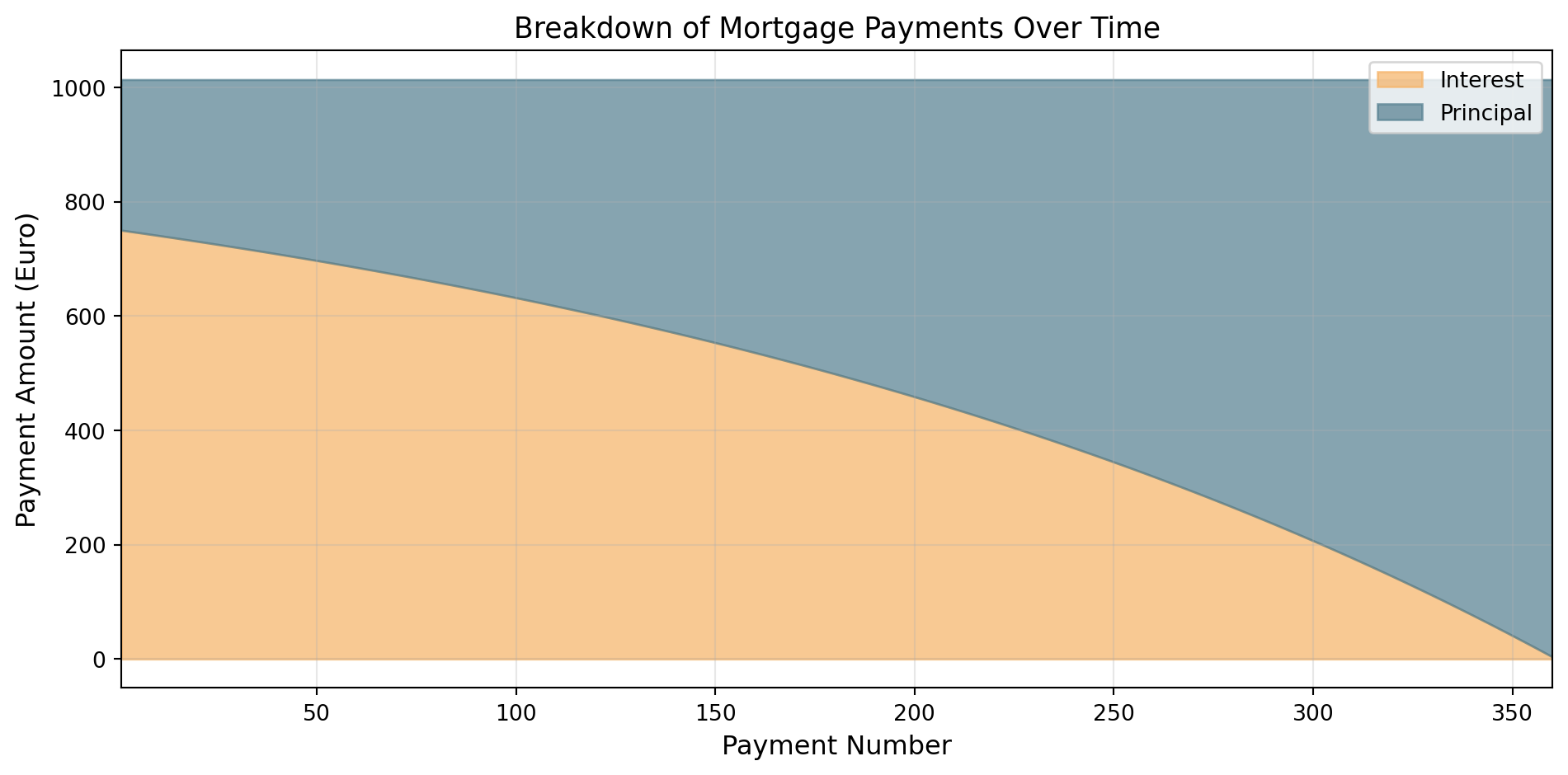
Key insight: Early payments are mostly interest, later payments are mostly principal!
Loan Payment Formula
ImportantMonthly Payment Formula
\[PMT = PV \cdot \frac{r}{1 - (1 + r)^{-n}}\]
where:
- \(PV\) = Loan amount (principal)
- \(r\) = Monthly interest rate
- \(n\) = Total number of payments
Payment Calculation Example
Loan: 200,000 at 4.5% annual for 30 years (mortgage)
\[r = 0.045/12 = 0.00375, \quad n = 360\]
\[PMT = 200000 \times \frac{0.00375}{1 - (1.00375)^{-360}}\]
\[PMT = 200000 \times \frac{0.00375}{1 - 0.2598} = 200000 \times \frac{0.00375}{0.7402}\]
\[PMT = 200000 \times 0.005067 = 1,013.37\]
Amortization Schedule I
First few payments of the 200,000 loan:
| Month | Payment | Interest | Principal | Balance |
|---|---|---|---|---|
| 0 | - | - | - | 200,000.00 |
| 1 | 1,013.37 | 750.00 | 263.37 | 199,736.63 |
| 2 | 1,013.37 | 749.01 | 264.36 | 199,472.27 |
| 3 | 1,013.37 | 748.02 | 265.35 | 199,206.92 |
| … | … | … | … | … |
Amortization Schedule II
How it works:
- Interest: Balance \(\times\) rate = \(200,000 \times 0.00375 = 750\)
- Principal: Payment - Interest = \(1,013.37 - 750 = 263.37\)
- New Balance: Old Balance - Principal = \(200,000 - 263.37\)
Visualizing the Amortization
Balance After k Payments
ImportantOutstanding Balance Formula
\[B_k = PV \cdot \frac{(1 + r)^n - (1 + r)^k}{(1 + r)^n - 1}\]
Or equivalently: \(B_k = PMT \cdot \dfrac{1 - (1 + r)^{-(n-k)}}{r}\)
Example: After 10 years (120 payments) on the 200,000 mortgage
\[\begin{aligned}B_{120} &= 1013.37 \times \frac{1 - (1.00375)^{-240}}{0.00375} \\ &= 1013.37 \times 158.07 = 160,178.77\end{aligned}\]
Applications
Retirement Planning
Scenario: You want 500,000 at retirement in 30 years. Investment earns 7% annually.
How much must you invest monthly?
\[PMT = \frac{FV \cdot r}{(1 + r)^n - 1} = \frac{500000 \times 0.005833}{(1.005833)^{360} - 1}\]
\[PMT = \frac{2916.67}{7.1165} = 409.85\]
Total invested: \(409.85 \times 360 = 147,546.00\)
Interest earned: \(500,000 - 147,546.00 = 352,454.00\) (about 2.4x your contributions!)
Lease vs. Buy Decision
Should a company lease or buy equipment?
Buy: 50,000 now
Lease: 1,200/month for 4 years, then return
At 6% annual rate, PV of lease payments:
\[PV = 1200 \times \frac{1 - (1.005)^{-48}}{0.005} = 1200 \times 42.58 = 51,096.38\]
Leasing costs 51,096 in present value terms, so buying at 50,000 is cheaper (before considering resale value of owned equipment).
Guided Practice
Practice Problems
Work in pairs
Problem 1: Calculate the future value of saving 300/month for 20 years at 5% annual interest.
Problem 2: Find the monthly payment for a 25,000 car loan at 4.8% for 5 years.
Problem 3: Create the first 3 rows of an amortization schedule for a 10,000 loan at 6% annual for 2 years (monthly payments).
Problem 4: How much is a monthly pension of 2,000 for 25 years worth today at 4% annual interest?
Wrap-Up & Takeaways
Today’s Essential Formulas
ImportantAnnuity Formulas
Future Value: \(FV = PMT \cdot \frac{(1 + r)^n - 1}{r}\)
Present Value: \(PV = PMT \cdot \frac{1 - (1 + r)^{-n}}{r}\)
Payment: \(PMT = PV \cdot \frac{r}{1 - (1 + r)^{-n}}\)
For annuity due: Multiply by \((1 + r)\)
Key Takeaways
- Annuities are equal payments at regular intervals
- FV of annuity tells you what regular savings will become
- PV of annuity tells you what a payment stream is worth today
- Amortization shows how loans are paid off
- Early payments are mostly interest, later payments mostly principal
TipComing Next
Session 08-03: Cost Analysis & Pricing Decisions, the minimum prices for profitability!
Homework
Tasks 08-02
- Calculate future and present values of annuities
- Solve for payment amounts and number of payments
- Build complete amortization schedules
- Apply concepts to retirement and loan decisions
These calculations require careful attention to the interest rate per period!