Tasks 09-01 - Advanced Functions Review
Section 09: Exam Preparation
A: Skills
Problem 1: Logarithms and Exponential Equations (xx)
Round results to two decimal places and keep intermediate results unrounded. This rule holds for the whole sheet unless a problem says otherwise.
- Simplify without a calculator.
(1) \(\log_6(4) + \log_6(9)\)
(2) \(\ln\left(\frac{e^{7}}{\sqrt{e}}\right)\)
(3) \(3\log_2(6) - \log_2(27)\)
- Solve for \(x\). Give the exact solution first and then the rounded value.
(1) \(4^{x - 1} = 8^{x + 2}\)
(2) \(2e^{0.3x} - 7 = 9\)
(3) \(2^{x} = 5^{x - 1}\)
- Determine the domain of each equation first. Then solve it and check every solution against the domain.
(1) \(2\log_3(x) - \log_3(x + 6) = 1\)
(2) \(\ln(2x + 1) - \ln(x - 1) = \ln(5)\)
CautionSolution
(1) Product rule: \(\log_6(4) + \log_6(9) = \log_6(4 \cdot 9) = \log_6(36) = 2\), because \(6^2 = 36\).
(2) Write the root as a power, \(\sqrt{e} = e^{0.5}\), and use the quotient rule for powers:
\[\ln\left(\frac{e^{7}}{e^{0.5}}\right) = \ln\left(e^{6.5}\right) = 6.5\]
(3) Power rule first, then the quotient rule:
\[3\log_2(6) - \log_2(27) = \log_2(6^3) - \log_2(27) = \log_2\left(\frac{216}{27}\right) = \log_2(8) = 3\]
(1) Both bases are powers of 2: \(4 = 2^2\) and \(8 = 2^3\).
\[2^{2(x - 1)} = 2^{3(x + 2)} \iff 2x - 2 = 3x + 6 \iff x = -8\]
Check: \(4^{-9} = 2^{-18}\) and \(8^{-6} = 2^{-18}\) ✓
(2) Isolate the power first, then take the logarithm:
\[2e^{0.3x} = 16 \iff e^{0.3x} = 8 \iff 0.3x = \ln(8) \iff x = \frac{\ln(8)}{0.3} = 10\ln(2) \approx 6.93\]
(3) The bases 2 and 5 cannot be made equal, so take \(\ln\) of both sides:
\[x\ln(2) = (x - 1)\ln(5) \iff x\ln(5) - x\ln(2) = \ln(5) \iff x = \frac{\ln(5)}{\ln(5) - \ln(2)} = \frac{\ln(5)}{\ln(2.5)} \approx 1.76\]
Check with the unrounded value \(x \approx 1.75647\): \(2^{x} \approx 3.38\) and \(5^{x - 1} \approx 3.38\) ✓
(1) Domain: \(x > 0\) and \(x + 6 > 0\), so \(x > 0\).
Power rule, then quotient rule:
\[\log_3\left(x^2\right) - \log_3(x + 6) = 1 \iff \log_3\left(\frac{x^2}{x + 6}\right) = 1 \iff \frac{x^2}{x + 6} = 3^1 = 3\]
\[x^2 = 3x + 18 \iff x^2 - 3x - 18 = 0 \iff (x - 6)(x + 3) = 0\]
\(x = 6\) lies in the domain. \(x = -3\) does not: \(\log_3(-3)\) is not defined. The only solution is \(x = 6\). Check: \(2\log_3(6) - \log_3(12) = \log_3\left(\frac{36}{12}\right) = \log_3(3) = 1\) ✓
(2) Domain: \(2x + 1 > 0\) and \(x - 1 > 0\), so \(x > 1\).
\[\ln\left(\frac{2x + 1}{x - 1}\right) = \ln(5) \iff \frac{2x + 1}{x - 1} = 5 \iff 2x + 1 = 5x - 5 \iff x = 2\]
\(x = 2 > 1\) lies in the domain. Check: \(\ln(5) - \ln(1) = \ln(5)\) ✓
Typical mistake: in c) (1), keeping \(x = -3\) because it solves the quadratic equation. The logarithm of a negative number is not defined, so check the domain at the end.
Problem 2: Rational Functions (xx)
Determine for each function the domain, all holes, the vertical asymptotes, the horizontal or oblique asymptote and the intercepts with both axes.
(1) \(f(x) = \frac{x^2 - 5x + 4}{2x^2 - 2x}\)
(2) \(g(x) = \frac{2x^2 + 3x - 9}{x + 4}\)
(3) \(h(x) = \frac{4x}{x^2 - x - 20}\)
Hint: Factor the numerator and the denominator first. A factor that cancels gives a hole, a factor that stays in the denominator gives a vertical asymptote.
CautionSolution
(1) Factor: \(x^2 - 5x + 4 = (x - 1)(x - 4)\) and \(2x^2 - 2x = 2x(x - 1)\), so
\[f(x) = \frac{(x - 1)(x - 4)}{2x(x - 1)} = \frac{x - 4}{2x} \quad \text{for } x \neq 1\]
- Domain: \(\mathbb{R} \setminus \{0, 1\}\)
- Hole: the factor \((x - 1)\) cancels. Its \(y\)-value comes from the shortened term: \(\frac{1 - 4}{2 \cdot 1} = -\frac{3}{2}\), so the hole is at \(\left(1, -\frac{3}{2}\right)\).
- Vertical asymptote: \(x = 0\) (the factor \(x\) stays in the denominator).
- Horizontal asymptote: numerator and denominator have the same degree, so \(y = \frac{1}{2}\) (the ratio of the leading coefficients).
- \(x\)-intercept: \(x - 4 = 0\), i.e. \((4, 0)\). \(y\)-intercept: none, because \(x = 0\) is not in the domain.
(2) Factor: \(2x^2 + 3x - 9 = (2x - 3)(x + 3)\). Nothing cancels with \(x + 4\).
- Domain: \(\mathbb{R} \setminus \{-4\}\), no hole
- Vertical asymptote: \(x = -4\)
- \(x\)-intercepts: \((1.5, 0)\) and \((-3, 0)\). \(y\)-intercept: \(g(0) = \frac{-9}{4}\), i.e. \(\left(0, -\frac{9}{4}\right)\).
The degree of the numerator is one higher than the degree of the denominator, so there is an oblique asymptote. Polynomial division:
\[\begin{array}{l} (2x^2 + 3x - 9) : (x + 4) = 2x - 5 + \frac{11}{x + 4} \\ \underline{-(2x^2 + 8x)} \\ \phantom{(2x^2}\;\; -5x - 9 \\ \phantom{(2x^2}\;\; \underline{-(-5x - 20)} \\ \phantom{(2x^2 + 3x}\;\; 11 \end{array}\]
\(\frac{11}{x + 4} \to 0\) for \(x \to \pm\infty\), so the oblique asymptote is \(y = 2x - 5\).
(3) Factor: \(x^2 - x - 20 = (x - 5)(x + 4)\). Nothing cancels with \(4x\).
- Domain: \(\mathbb{R} \setminus \{-4, 5\}\), no hole
- Vertical asymptotes: \(x = -4\) and \(x = 5\)
- Horizontal asymptote: the degree of the numerator is smaller, so \(y = 0\).
- Intercepts: \(h(0) = 0\), so the graph passes through the origin \((0, 0)\). This is the only intercept.
Typical mistake: in (1), calling \(x = 1\) a vertical asymptote because the original denominator is 0 there. The factor \((x - 1)\) cancels, so the graph only has a gap (a hole) at \(x = 1\).
Problem 3: Factoring Polynomials (xx)
Factor \(k(x) = x^3 + 6x^2 - x - 30\) completely. Find one zero with the Rational Root Theorem (\(\frac{p}{q}\) candidates) and divide by the matching linear factor with polynomial long division. Then give all zeros and the behavior of \(k(x)\) for \(x \to +\infty\) and \(x \to -\infty\).
Factor \(m(x) = 2x^3 - 5x^2 - 4x + 3\) completely in the same way. List all candidates of the Rational Root Theorem first.
Solve \(r(x) = 2x^4 - 7x^2 - 4 = 0\) with the substitution \(u = x^2\). Explain why \(r\) has only two zeros although it has degree 4.
CautionSolution
- Leading coefficient 1, constant term \(-30\): the candidates are the divisors of 30, \(\pm 1, \pm 2, \pm 3, \pm 5, \pm 6, \pm 10, \pm 15, \pm 30\). Testing: \(k(1) = -24\), \(k(2) = 8 + 24 - 2 - 30 = 0\) ✓
\[\begin{array}{l} (x^3 + 6x^2 - x - 30) : (x - 2) = x^2 + 8x + 15 \\ \underline{-(x^3 - 2x^2)} \\ \phantom{(x^3}\;\; 8x^2 - x \\ \phantom{(x^3}\;\; \underline{-(8x^2 - 16x)} \\ \phantom{(x^3 + 6x^2}\;\; 15x - 30 \\ \phantom{(x^3 + 6x^2}\;\; \underline{-(15x - 30)} \\ \phantom{(x^3 + 6x^2 - x}\;\; 0 \end{array}\]
\(x^2 + 8x + 15 = (x + 3)(x + 5)\), so
\[k(x) = (x - 2)(x + 3)(x + 5), \qquad \text{zeros } x = 2,\; x = -3,\; x = -5\]
The leading term \(x^3\) has an odd degree and a positive coefficient: \(k(x) \to +\infty\) for \(x \to +\infty\) and \(k(x) \to -\infty\) for \(x \to -\infty\).
- Candidates \(\frac{p}{q}\) with \(p \in \{\pm 1, \pm 3\}\) (divisors of the constant term 3) and \(q \in \{\pm 1, \pm 2\}\) (divisors of the leading coefficient 2): \(\pm 1, \pm 3, \pm \frac{1}{2}, \pm \frac{3}{2}\).
Testing: \(m(1) = -4\), \(m(-1) = -2 - 5 + 4 + 3 = 0\) ✓. Division:
\[\begin{array}{l} (2x^3 - 5x^2 - 4x + 3) : (x + 1) = 2x^2 - 7x + 3 \\ \underline{-(2x^3 + 2x^2)} \\ \phantom{(2x^3}\;\; -7x^2 - 4x \\ \phantom{(2x^3}\;\; \underline{-(-7x^2 - 7x)} \\ \phantom{(2x^3 - 5x^2}\;\; 3x + 3 \\ \phantom{(2x^3 - 5x^2}\;\; \underline{-(3x + 3)} \\ \phantom{(2x^3 - 5x^2 - 4x}\;\; 0 \end{array}\]
\(2x^2 - 7x + 3 = 0 \iff x = \frac{7 \pm \sqrt{49 - 24}}{4} = \frac{7 \pm 5}{4}\), so \(x = 3\) or \(x = \frac{1}{2}\). Both are on the candidate list.
\[m(x) = (x + 1)(x - 3)(2x - 1)\]
- With \(u = x^2\): \(2u^2 - 7u - 4 = 0 \iff u = \frac{7 \pm \sqrt{49 + 32}}{4} = \frac{7 \pm 9}{4}\), so \(u = 4\) or \(u = -\frac{1}{2}\).
- \(x^2 = 4 \iff x = 2\) or \(x = -2\)
- \(x^2 = -\frac{1}{2}\) has no real solution: a square is never negative.
So \(r(x) = (2x^2 + 1)(x^2 - 4) = (2x^2 + 1)(x - 2)(x + 2)\) has only the zeros \(x = \pm 2\). The factor \(2x^2 + 1 \geq 1\) is never 0. A polynomial of degree 4 has at most four zeros, not always four.
Typical mistake: in c), writing \(x = \pm\sqrt{-\frac{1}{2}}\) as two more zeros. Check the sign of \(u\) before you take the root.
Problem 4: Domain, Range and Composition (xx)
- Determine the domain and the range of each function.
(1) \(f(x) = \ln(5 - x)\)
(2) \(g(x) = \frac{2}{x + 1} - 3\)
(3) \(h(x) = 2 - \sqrt{3x + 6}\)
Hint: In (2), \(\frac{2}{x + 1}\) follows the pattern of \(\frac{1}{x}\): it can take every value except 0. In (3), the root grows with \(x\), so look at the value at the left end of the domain.
- Let \(u(x) = \sqrt{x + 9}\) and \(v(x) = 4x - 5\). Determine \((u \circ v)(x) = u(v(x))\) and \((v \circ u)(x) = v(u(x))\) with their domains. Give the range of \(v \circ u\).
CautionSolution
(1) The logarithm needs a positive argument: \(5 - x > 0 \iff x < 5\). Domain: \((-\infty; 5)\). For \(x \to 5\) from the left, \(5 - x\) comes closer and closer to 0 and \(\ln(5 - x) \to -\infty\). For \(x \to -\infty\), \(\ln(5 - x) \to +\infty\). Range: \(\mathbb{R}\).
(2) The denominator must not be 0, so the domain is \(\mathbb{R} \setminus \{-1\}\). \(\frac{2}{x + 1}\) takes every value except 0, so \(g(x)\) takes every value except \(0 - 3 = -3\). Range: \(\mathbb{R} \setminus \{-3\}\). The line \(y = -3\) is the horizontal asymptote.
(3) The root needs \(3x + 6 \geq 0 \iff x \geq -2\), so the domain is \([-2; \infty)\). \(\sqrt{3x + 6}\) starts at \(\sqrt{0} = 0\) and grows without bound, so \(h(x) = 2 - \sqrt{3x + 6}\) starts at \(h(-2) = 2\) and falls without bound. Range: \((-\infty; 2]\).
\((u \circ v)(x) = u(4x - 5) = \sqrt{4x - 5 + 9} = \sqrt{4x + 4}\). The root needs \(4x + 4 \geq 0 \iff x \geq -1\), so the domain is \([-1; \infty)\).
\((v \circ u)(x) = v\left(\sqrt{x + 9}\right) = 4\sqrt{x + 9} - 5\). Here \(u\) is applied first, so \(x + 9 \geq 0\) and the domain is \([-9; \infty)\).
Range: \(\sqrt{x + 9}\) starts at 0 and grows, so \(4\sqrt{x + 9} - 5\) starts at \(-5\) and grows without bound. The range of \(v \circ u\) is \([-5; \infty)\).
Typical mistake: in b), writing \((u \circ v)(x) = 4\sqrt{x + 9} - 5\). In \(u(v(x))\), \(v\) acts first, so \(v(x) = 4x - 5\) goes into the root.
Problem 5: Transformations, Mirror Images and the Inverse (xx)
Consider \(f(x) = 6 - 2e^{0.4x}\).
Describe step by step how the graph of \(f\) arises from the graph of \(y = e^{x}\). Use the order of the lecture: horizontal stretch or compression, horizontal shift, vertical stretch and reflection, vertical shift.
Give the horizontal asymptote and the range of \(f\). Determine the intercepts with both axes.
Give a function \(f_1(x)\) which is a mirror image of \(f(x)\) mirrored at the \(y\)-axis and give a reason for your choice. Give the horizontal asymptote of \(f_1\) and the side on which the graph approaches it.
Determine the inverse function \(f^{-1}(x)\) with its domain. Check your result with the point \((0, f(0))\).
CautionSolution
- Write \(f(x) = -2e^{0.4x} + 6\) and start with \(y = e^{x}\):
- Horizontal stretch by the factor \(2.5\): \(e^{0.4x} = e^{x/2.5}\) (the graph becomes 2.5 times as wide)
- No horizontal shift
- Vertical stretch by 2 and reflection at the \(x\)-axis: \(-2e^{0.4x}\)
- Shift 6 units up: \(-2e^{0.4x} + 6\)
For \(x \to -\infty\), \(e^{0.4x} \to 0\), so \(f(x) \to 6\): the horizontal asymptote is \(y = 6\). Since \(2e^{0.4x} > 0\), \(f(x) < 6\) for every \(x\), and for \(x \to +\infty\), \(f(x) \to -\infty\). Range: \((-\infty; 6)\).
\(y\)-intercept: \(f(0) = 6 - 2 = 4\), i.e. \((0, 4)\).
\(x\)-intercept: \(6 - 2e^{0.4x} = 0 \iff e^{0.4x} = 3 \iff x = \frac{\ln(3)}{0.4} = 2.5\ln(3) \approx 2.75\), i.e. \((2.75, 0)\).
\(f_1(x) = f(-x) = 6 - 2e^{-0.4x}\)
Reason: the mirror image at the \(y\)-axis keeps the height of every point and changes the sign of its \(x\)-coordinate. The point \((x, y)\) of \(f\) becomes \((-x, y)\), so \(f_1\) must take at \(-x\) the value that \(f\) takes at \(x\): \(f_1(-x) = f(x)\), i.e. \(f_1(x) = f(-x)\). Example: \(f(2.75) = 0\) and \(f_1(-2.75) = 6 - 2e^{1.1} \approx 0\) ✓
\(f_1\) keeps the asymptote \(y = 6\), but now it approaches it for \(x \to +\infty\) (on the right), from below.
Solve \(y = 6 - 2e^{0.4x}\) for \(x\):
\[2e^{0.4x} = 6 - y \iff e^{0.4x} = \frac{6 - y}{2} \iff 0.4x = \ln\left(\frac{6 - y}{2}\right) \iff x = 2.5\ln\left(\frac{6 - y}{2}\right)\]
Swap \(x\) and \(y\): \(f^{-1}(x) = 2.5\ln\left(\frac{6 - x}{2}\right)\). The logarithm needs \(\frac{6 - x}{2} > 0\), so the domain is \(x < 6\), the range of \(f\).
Check: \(f(0) = 4\) and \(f^{-1}(4) = 2.5\ln(1) = 0\) ✓
Typical mistake: in c), giving \(-f(x) = -6 + 2e^{0.4x}\). This is the mirror image at the \(x\)-axis. Mirroring at the \(y\)-axis changes the input \(x\), not the output.
B: Set Up & Check
Problem 6: From Words to Functions (xx)
Translate each statement into a function, a limit or an equation and compute the result. Then answer the check question: it tells you whether your translation works.
A garden centre’s social media account has 3,200 followers. The marketing team compares two forecasts. (I) “The number of followers grows by 4 % per month.” (II) “The number of followers grows continuously at a rate of 4 % per month.” Write a function for each forecast (\(t\) in months) and compute both numbers of followers after 12 months.
Check: Which forecast gives more followers after 12 months? Explain the difference with the growth factor per month.
In an outdoor swimming pool, sunlight breaks down the chlorine in the water. After 5 hours of sunshine, half of the chlorine is left: the half-life (the time after which half of the amount is left) is 5 hours. Write the share of the chlorine that is left after \(t\) hours as \(A(t) = e^{-kt}\) and determine \(k\). The staff add chlorine as soon as less than 30 % is left. Compute when this happens.
Check: A colleague says: “Half of the chlorine is gone after 5 hours, so after 10 hours all of it is gone.” Compute the share after 10 hours.
A small workshop sews canvas tote bags. Its weekly costs are \(C(x) = 1{,}250 + 7.5x\) EUR for \(x\) bags. The owner asks: “What do the costs per bag (the unit costs) approach when we sew more and more bags?” Write the unit costs \(\overline{C}(x) = \frac{C(x)}{x}\), compute their limit for \(x \to \infty\) and give the business meaning of the horizontal asymptote.
Check: A classmate says: “The costs per bag approach 0, because \(\frac{1250}{x} \to 0\).” Compute \(\overline{C}(1{,}000)\) and explain the mistake.
“The graph of \(f(x) = \sqrt{x}\) is shifted 3 units to the right and mirrored at the \(x\)-axis.” Write the new function \(g(x)\) and give its domain.
Check: The point \((4, 2)\) lies on the graph of \(f\). Where must it end up? Does your \(g\) pass through this point? A classmate mirrors first and shifts afterwards: does the result change? Would it change if the shift were 3 units up instead of to the right?
A municipal utility (the energy supplier owned by the town) starts a new green electricity tariff. At the start, 1,500 customers switch to it at once. In the long run, the number of customers approaches the market saturation (the largest number of customers the market can take) of 9,000. After 6 months, 4,000 customers have the tariff. The model has the form \(S(t) = L - a \cdot e^{-kt}\) with \(t\) in months. Write “approaches 9,000 in the long run” as a limit and determine \(L\), \(a\) and \(k\).
Check: A classmate writes \(S(t) = 9000 - 1500e^{-kt}\). Compute \(S(0)\) for this function. Does it fit the start?
CautionSolution
- A growth by 4 % per month multiplies by the growth factor 1.04 every month: \(F_I(t) = 3200 \cdot 1.04^t\). (II) Continuous growth at the rate 0.04 gives \(F_{II}(t) = 3200 \cdot e^{0.04t}\).
\[F_I(12) = 3200 \cdot 1.04^{12} \approx 5{,}123.30, \qquad F_{II}(12) = 3200 \cdot e^{0.48} \approx 5{,}171.44\]
After 12 months, forecast (I) gives about 5,123 followers and forecast (II) about 5,171.
Check: (II) gives about 48 followers more. Its growth factor per month is \(e^{0.04} \approx 1.0408\), a little more than 1.04: with continuous growth, the new followers also grow during the month.
Typical mistake: writing \(3200 \cdot e^{1.04t}\) or \(3200 \cdot 0.04^t\). The base of the power form is the growth factor \(1 + 0.04\), and the exponent of the \(e\)-form is the rate \(0.04\) times \(t\).
\(A(5) = 0.5\): \(e^{-5k} = 0.5 \iff -5k = \ln(0.5) \iff k = \frac{\ln(2)}{5} \approx 0.1386\) per hour.
\[e^{-kt} = 0.3 \iff -kt = \ln(0.3) \iff t = \frac{\ln(0.3)}{-k} = \frac{5\ln\left(\frac{10}{3}\right)}{\ln(2)} \approx 8.6848\]
After about 8.69 hours of sunshine (rounded up, because before that time more than 30 % is still left), less than 30 % of the chlorine is left.
Check: \(A(10) = e^{-10k} = e^{-2\ln(2)} = \frac{1}{4} = 25\,\%\). In each 5 hours, half of the remaining chlorine breaks down, so after 10 hours a quarter is left, not nothing.
Typical mistake: \(k = \frac{0.5}{5} = 0.1\). The half is a share of the amount, not a rate. The rate comes from \(e^{-5k} = 0.5\) with the logarithm.
\(\overline{C}(x) = \frac{1250 + 7.5x}{x} = \frac{1250}{x} + 7.5\)
\[\lim_{x \to \infty} \overline{C}(x) = 0 + 7.5 = 7.5\]
The horizontal asymptote is \(y = 7.5\): the more bags the workshop sews, the closer the costs per bag come to 7.50 EUR, the variable costs of one bag. The fixed costs of 1,250 EUR are shared by more and more bags, so their share per bag approaches 0.
Check: \(\overline{C}(1000) = 1.25 + 7.5 = 8.75\) EUR. The classmate forgot the variable costs: only the fixed costs per bag approach 0, every bag still needs material and work for 7.50 EUR.
Typical mistake: dividing only the fixed costs by \(x\). The unit costs are the total costs per bag.
Shift 3 units to the right: \(\sqrt{x - 3}\). Mirror at the \(x\)-axis: change the sign of the output.
\[g(x) = -\sqrt{x - 3}, \qquad \text{domain } x \geq 3\]
Check: the shift moves \((4, 2)\) to \((7, 2)\), the mirror image to \((7, -2)\). Indeed \(g(7) = -\sqrt{4} = -2\) ✓. Mirroring first gives \(-\sqrt{x}\), and the shift then gives \(-\sqrt{x - 3}\): the same function, because one step changes \(x\) and the other changes \(y\). With a shift 3 units up, the order matters: shift first gives \(-(\sqrt{x} + 3) = -\sqrt{x} - 3\), mirror first gives \(-\sqrt{x} + 3\).
Typical mistake: \(\sqrt{x + 3}\) for “3 units to the right”, or \(\sqrt{-x}\) for the mirror image at the \(x\)-axis. A shift to the right subtracts 3 from \(x\), and the mirror image at the \(x\)-axis changes the sign of \(f(x)\).
“Approaches 9,000 in the long run” means \(\lim\limits_{t \to \infty} S(t) = 9000\). Since \(e^{-kt} \to 0\) for \(k > 0\), the limit is \(L\), so \(L = 9000\).
Start: \(S(0) = L - a = 1500\), so \(a = 7500\).
After 6 months: \(9000 - 7500e^{-6k} = 4000 \iff e^{-6k} = \frac{2}{3} \iff k = \frac{\ln(1.5)}{6} \approx 0.0676\)
Check: the classmate’s function gives \(S(0) = 9000 - 1500 = 7{,}500\) customers at the start, not 1,500. In \(L - a\), \(a\) is the gap between the market saturation and the start value.
Typical mistake: taking the start value as \(a\). The start value is \(S(0) = L - a\).
Problem 7: One Paragraph, All Conditions (xx)
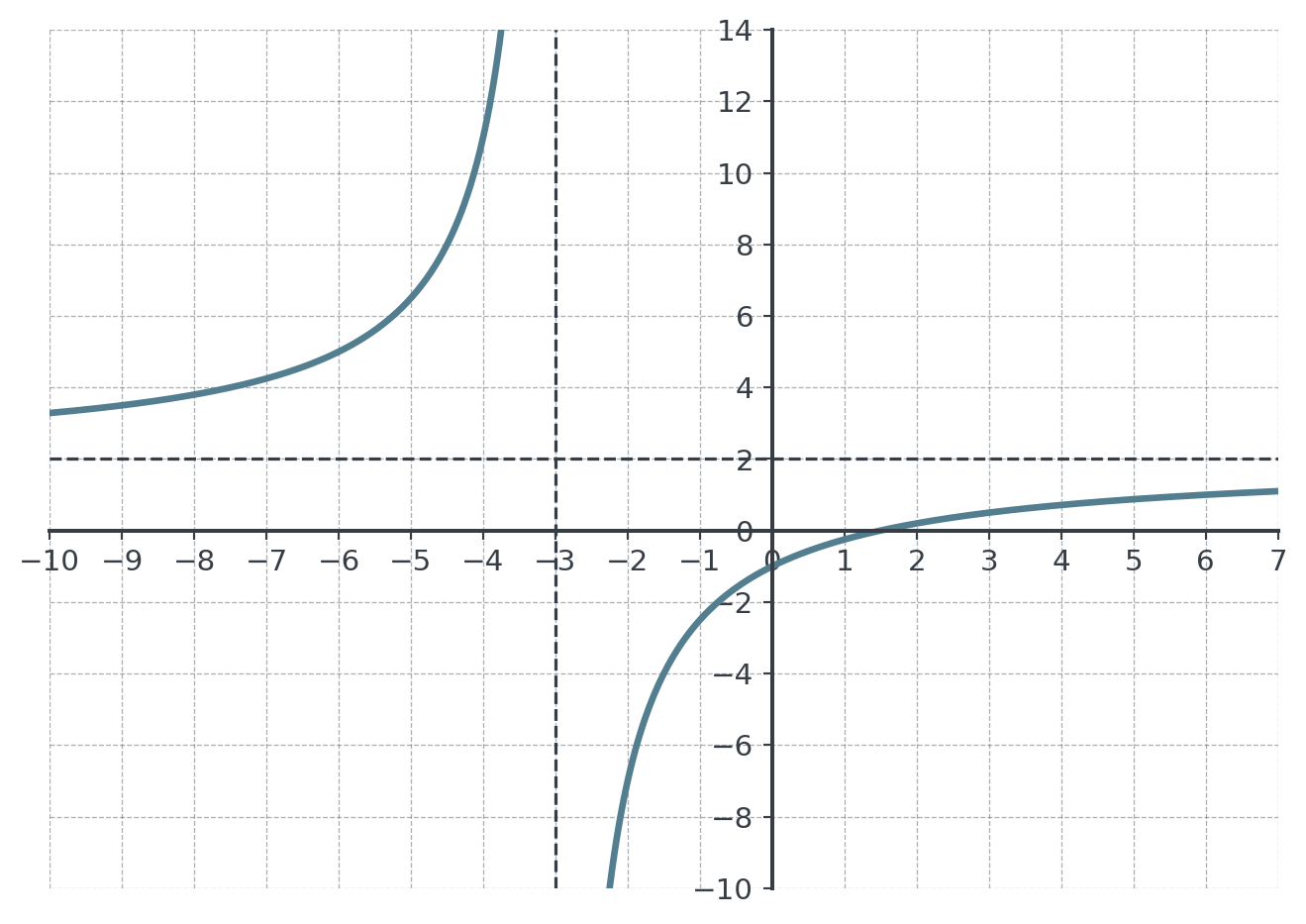
The figure shows the graph of a function of the form \(f(x) = \frac{a}{x + b} + c\) with unknown parameters \(a\), \(b\) and \(c\). A colleague reads from the figure: the graph has a vertical asymptote at \(x = -3\), and it approaches the line \(y = 2\) for \(x \to +\infty\) and for \(x \to -\infty\). It crosses the \(y\)-axis at \(-1\) and the \(x\)-axis at \(1.5\). The colleague wants to determine \(a\), \(b\) and \(c\) computationally and then check the result with one more piece of information.
List every piece of information from the paragraph as an equation for \(a\), \(b\) and \(c\). Do not solve anything. State which equation is left over for the check.
Check: An assistant writes the vertical asymptote as the condition \(f(-3) = 0\). Explain what is wrong.
CautionSolution
- Vertical asymptote at \(x = -3\): the denominator is 0 there, \(-3 + b = 0\) (and \(a \neq 0\), so that the numerator is not 0)
- Horizontal asymptote \(y = 2\): for \(x \to \pm\infty\), \(\frac{a}{x + b} \to 0\) and \(f(x) \to c\), so \(c = 2\)
- \(y\)-intercept: \(f(0) = -1\), i.e. \(\frac{a}{b} + c = -1\)
- \(x\)-intercept: \(f(1.5) = 0\), i.e. \(\frac{a}{1.5 + b} + c = 0\)
There are three unknowns, so equations 1 to 3 are enough to determine \(a\), \(b\) and \(c\). Equation 4 is left over for the check.
Check: at a vertical asymptote, \(f\) is not defined at all, so \(f(-3)\) does not exist. \(f(-3) = 0\) would mean that the graph crosses the \(x\)-axis at \(-3\). The asymptote is a condition on the denominator: \(x + b = 0\) for \(x = -3\).
Typical mistake: \(b = -3\) because the asymptote is “at \(-3\)”. The denominator \(x + b\) is 0 for \(x = -b\), so the asymptote at \(x = -3\) gives \(b = +3\).
C: Applied
Problem 8: Oxygen in a Trout Pond (xxx)
A trout farm keeps its fish in ponds. On a hot summer day, the oxygen content of one pond has fallen to 2.0 mg per litre, and the farmer switches on an aerator (a pump that blows air into the water). The oxygen content is modelled by
\[O(t) = L - a \cdot e^{-kt}\]
in mg per litre, \(t\) hours after the aerator was switched on, with \(a, k > 0\). At this water temperature, the water can hold at most 9.5 mg of oxygen per litre, so \(L = 9.5\). Two hours after the start, the farmer measures 6.0 mg per litre.
- Determine \(a\) and \(k\).
(for verification: \(a = 7.5\) and \(k \approx 0.3811\))
The farmer feeds the trout only when the oxygen content is at least 8 mg per litre. Determine with logarithms when this is the case. Give the time in hours and minutes.
Compute \(O'(0)\) and \(O'(4)\) and interpret both values. Explain with the formula of \(O'(t)\) why the oxygen content grows more and more slowly.
Compute the limit of \(O(t)\) at positive infinity and interpret its significance. The farmer says: “If I leave the aerator on long enough, the pond will reach 10 mg per litre.” Assess this claim.
A stronger aerator would make every change happen twice as fast: \(O_2(t) = O(2t)\). Give the term of \(O_2(t)\) and name the transformation of the graph. Determine without a new calculation when \(O_2\) reaches 8 mg per litre.
CautionSolution
a) Start: \(O(0) = 9.5 - a \cdot e^{0} = 9.5 - a = 2\), so \(a = 7.5\).
After 2 hours:
\[9.5 - 7.5e^{-2k} = 6 \iff e^{-2k} = \frac{3.5}{7.5} = \frac{7}{15} \iff -2k = \ln\left(\frac{7}{15}\right) \iff k = \frac{1}{2}\ln\left(\frac{15}{7}\right) \approx 0.3811\]
So \(O(t) = 9.5 - 7.5e^{-kt}\) with \(k = \frac{1}{2}\ln\left(\frac{15}{7}\right)\). Check: \(O(2) = 9.5 - 7.5 \cdot \frac{7}{15} = 9.5 - 3.5 = 6\) ✓
b) \(O(t)\) grows with \(t\), so solve \(O(t) = 8\):
\[9.5 - 7.5e^{-kt} = 8 \iff e^{-kt} = \frac{1.5}{7.5} = 0.2 \iff -kt = \ln(0.2) \iff t = \frac{\ln(5)}{k} \approx 4.22\]
\(0.2235 \cdot 60 \approx 13.4\) minutes, rounded up to 14 minutes, so the oxygen content reaches 8 mg per litre after about 4 hours and 14 minutes. From then on, the farmer can feed the trout.
c) Chain rule: \(O'(t) = -7.5 \cdot (-k) \cdot e^{-kt} = 7.5k \cdot e^{-kt}\)
\[O'(0) = 7.5k \approx 2.86, \qquad O'(4) = 7.5k \cdot e^{-4k} = 7.5k \cdot \left(\frac{7}{15}\right)^2 \approx 0.62\]
Right after the start, the oxygen content grows by about 2.86 mg per litre per hour. After 4 hours, it only grows by about 0.62 mg per litre per hour. \(O'(t)\) is positive, so \(O\) always grows, but \(e^{-kt}\) gets smaller with every hour, so the growth slows down. The closer the water comes to the 9.5 mg per litre it can hold, the less oxygen it takes up.
d) For \(t \to \infty\), \(e^{-kt} \to 0\), so
\[\lim_{t \to \infty} O(t) = 9.5 - 7.5 \cdot 0 = 9.5\]
In the long run, the oxygen content approaches 9.5 mg per litre, the most the water can hold at this temperature. Since \(7.5e^{-kt} > 0\), \(O(t) < 9.5\) for every \(t\). The claim is wrong: 10 mg per litre lie above the limit, so the pond never reaches them with this model, however long the aerator runs.
e) \(O_2(t) = O(2t) = 9.5 - 7.5e^{-2kt}\). Replacing \(t\) by \(2t\) compresses the graph horizontally by the factor 2: every value of \(O\) is reached in half the time. \(O_2\) reaches 8 mg per litre after \(\frac{4.22}{2} \approx 2.11\) hours, i.e. after about 2 hours and 7 minutes. Check: \(O_2(2.11) = 9.5 - 7.5e^{-2k \cdot 2.1117} = 9.5 - 7.5 \cdot 0.2 = 8\) ✓
Typical mistake: in a), setting \(a = 2\) (the start value). The start value is \(O(0) = L - a\), so \(a\) is the gap between 9.5 and 2.0.
Problem 9: Rooftop Tents for Outdoor Retailers (xxx)
A company builds rooftop tents (tents that are mounted on the roof of a car) and sells them to outdoor retailers. Its yearly total costs are
\[C(x) = 2.5x^2 + 38x + 468\]
MU for an output of \(x\) QU (1 QU = 100 tents, 1 MU = 1,000 EUR). The more tents the company offers, the lower the price the retailers pay: at an output of \(x\) QU, the price is \(p(x) = 288 - 1.5x - 2x^2\) MU per QU.
- The unit costs (the costs per QU) are \(\overline{C}(x) = \frac{C(x)}{x}\). Determine the domain of \(\overline{C}\) in this context.
Hint: Besides \(x \neq 0\), the price must not be negative.
Write \(\overline{C}(x)\) as a linear term plus a remainder term (polynomial division by \(x\)). Investigate the asymptotic behavior of \(\overline{C}\) and explain the business meaning of both asymptotes. Compute the limit of \(\overline{C}(x) - (2.5x + 38)\) at positive infinity and interpret its significance.
Give a term for the profit function \(P(x)\).
(for verification: \(P(x) = -2x^3 - 4x^2 + 250x - 468\))
- Show that revenue and costs are equal at 9 QU. Determine the (lower) break-even point and the profit limit (upper break-even point) and decide in which output range the company makes a profit.
Hint: Divide \(P(x)\) by \((x - 9)\).
- Show that the unit costs equal the price at both zeros of \(P\) from d) and explain why this must be so. Give the price per tent in EUR at both points.
CautionSolution
a) \(\overline{C}(x) = \frac{2.5x^2 + 38x + 468}{x}\) needs \(x \neq 0\), and an output is not negative, so \(x > 0\). The price must not be negative:
\[p(x) = 288 - 1.5x - 2x^2 \geq 0\]
Zeros of \(p\): \(2x^2 + 1.5x - 288 = 0 \iff x = \frac{-1.5 \pm \sqrt{2.25 + 2304}}{4} = \frac{-1.5 \pm \sqrt{2306.25}}{4}\), i.e. \(x \approx 11.63\) and \(x \approx -12.38\). The graph of \(p\) is a parabola that opens downward (\(-2 < 0\)), so \(p(x) \geq 0\) between its zeros. With \(x > 0\):
Domain in this context: \(0 < x \leq 11.63\), i.e. up to about 1,163 tents per year. At this output the retailers would pay nothing.
b) Polynomial division by \(x\):
\[\overline{C}(x) = (2.5x^2 + 38x + 468) : x = 2.5x + 38 + \frac{468}{x}\]
- For \(x \to 0\) from the right, \(\frac{468}{x} \to +\infty\): the vertical asymptote is \(x = 0\). Meaning: with a very small output, the fixed costs of 468 MU are shared by very few tents, so the costs per tent grow without bound.
- For \(x \to \infty\), \(\frac{468}{x} \to 0\): the oblique asymptote is \(y = 2.5x + 38\). Meaning: \(2.5x + 38 = \frac{C(x) - 468}{x} = \overline{C}_v(x)\) are the variable costs per QU. For large outputs, the unit costs come closer and closer to the variable costs per unit.
\[\lim_{x \to \infty} \left(\overline{C}(x) - (2.5x + 38)\right) = \lim_{x \to \infty} \frac{468}{x} = 0\]
The difference \(\frac{468}{x}\) is the fixed cost per QU. It approaches 0: the more tents, the less each tent has to carry of the fixed costs. In this market the output ends at about 11.63 QU, where the fixed cost share is still \(\frac{468}{11.631} \approx 40.24\) MU per QU. The asymptote shows the trend, not a value the company reaches.
c) Revenue: \(R(x) = p(x) \cdot x = 288x - 1.5x^2 - 2x^3\). Profit:
\[P(x) = R(x) - C(x) = 288x - 1.5x^2 - 2x^3 - (2.5x^2 + 38x + 468) = -2x^3 - 4x^2 + 250x - 468\]
d) \(R(9) = 288 \cdot 9 - 1.5 \cdot 81 - 2 \cdot 729 = 2592 - 121.5 - 1458 = 1012.5\) and \(C(9) = 202.5 + 342 + 468 = 1012.5\), so \(P(9) = 0\) ✓
Polynomial long division by \((x - 9)\):
\[\begin{array}{l} (-2x^3 - 4x^2 + 250x - 468) : (x - 9) = -2x^2 - 22x + 52 \\ \underline{-(-2x^3 + 18x^2)} \\ \phantom{(-2x^3}\;\; -22x^2 + 250x \\ \phantom{(-2x^3}\;\; \underline{-(-22x^2 + 198x)} \\ \phantom{(-2x^3 - 4x^2}\;\; 52x - 468 \\ \phantom{(-2x^3 - 4x^2}\;\; \underline{-(52x - 468)} \\ \phantom{(-2x^3 - 4x^2 + 250x}\;\; 0 \end{array}\]
\(-2x^2 - 22x + 52 = 0 \iff x^2 + 11x - 26 = 0 \iff (x - 2)(x + 13) = 0\), so \(x = 2\) or \(x = -13\). \(x = -13\) lies outside the domain.
The (lower) break-even point is 2 QU (200 tents), the profit limit (upper break-even point) is 9 QU (900 tents). With \(P(x) = -2(x - 9)(x - 2)(x + 13)\), the factors for \(2 < x < 9\) have the signs \((-)\), \((+)\), \((+)\), and the factor \(-2\) makes the product positive. The company makes a profit for \(2 < x < 9\), i.e. between 200 and 900 tents per year. Check: \(P(5) = -250 - 100 + 1250 - 468 = 432 > 0\) ✓
e) \(\overline{C}(2) = 5 + 38 + 234 = 277\) and \(p(2) = 288 - 3 - 8 = 277\) ✓. Also \(\overline{C}(9) = 22.5 + 38 + 52 = 112.5\) and \(p(9) = 288 - 13.5 - 162 = 112.5\) ✓
Reason: \(P(x) = p(x) \cdot x - \overline{C}(x) \cdot x = x\left(p(x) - \overline{C}(x)\right)\). For \(x > 0\), the profit is 0 exactly when the price equals the costs per QU.
1 MU per QU is 1,000 EUR per 100 tents, i.e. 10 EUR per tent. At the break-even point, a tent sells for 2,770 EUR, at the profit limit for 1,125 EUR.
Typical mistake: in b), reading the oblique asymptote as “the unit costs approach a constant”. The asymptote is a line with slope 2.5: the variable costs per QU themselves grow with the output, and the unit costs come closer and closer to this line, not to a fixed number.
Problem 10: A Crowdfunding Campaign (xxx)
A start-up collects money for its first product, a bird feeder with a camera, through crowdfunding: many people each pledge (promise to pay) a small amount on an internet platform. The campaign runs for 30 days. It is all-or-nothing: the start-up only receives the money if at least 50 thousand EUR are pledged by the end. The pledged amount is modelled by
\[M(t) = a \cdot \ln(bt + 1) + c\]
in thousand EUR, \(t\) days after the public start, with \(a, b > 0\). Friends and family pledged 5 thousand EUR before the public start (\(t = 0\)). After 4 days, 23 thousand EUR are pledged, after 12 days 41 thousand EUR.
- Set up the system of three equations for \(a\), \(b\) and \(c\). Show that it leads to \(\ln(12b + 1) = 2\ln(4b + 1)\) and solve this equation exactly. Then determine \(a\).
Hint: Use the first equation for \(c\). Then divide the third equation by the second one, so that \(a\) cancels.
(for verification: \(b = 0.25\) and \(a = \frac{18}{\ln(2)} \approx 25.97\))
Determine with logarithms after how many days the campaign reaches 50 thousand EUR and decide whether it succeeds. Compute the pledged amount at the end of the campaign.
The platform shows a campaign on its start page as long as it collects at least 1 thousand EUR per day. Determine \(M'(t)\) and the time until which the campaign stays on the start page.
Hint: The denominator of \(M'(t)\) is positive, so you can multiply both sides of the inequality by it without changing the sign.
- After 12 days, a founder says: “In the first 12 days, people pledged 36 thousand EUR. So in the next 12 days, they will pledge another 36 thousand EUR.” Check this claim with the model and explain the result with the shape of the logarithm.
CautionSolution
a) The three data points give
\[\text{(I)}\;\; a\ln(1) + c = 5, \qquad \text{(II)}\;\; a\ln(4b + 1) + c = 23, \qquad \text{(III)}\;\; a\ln(12b + 1) + c = 41\]
\(\ln(1) = 0\), so (I) gives \(c = 5\). Then (II) becomes \(a\ln(4b + 1) = 18\) and (III) becomes \(a\ln(12b + 1) = 36\). Since \(b > 0\), \(\ln(4b + 1) > 0\), and we may divide (III) by (II):
\[\frac{a\ln(12b + 1)}{a\ln(4b + 1)} = \frac{36}{18} = 2 \iff \ln(12b + 1) = 2\ln(4b + 1) \quad \checkmark\]
Power rule: \(2\ln(4b + 1) = \ln\left((4b + 1)^2\right)\), so the arguments are equal:
\[12b + 1 = 16b^2 + 8b + 1 \iff 16b^2 - 4b = 0 \iff 4b(4b - 1) = 0\]
\(b = 0\) is excluded (\(b > 0\)), so \(b = 0.25\). From (II): \(a\ln(2) = 18\), so \(a = \frac{18}{\ln(2)} \approx 25.97\).
Check with SOLVE: enter the difference of both sides, \(\ln(12x + 1) - 2\ln(4x + 1)\), with the initial guess (starting value) 0.5. The calculator gives \(x = 0.25\). (Another starting value can return the excluded solution \(x = 0\).)
\[M(t) = \frac{18}{\ln(2)} \cdot \ln(0.25t + 1) + 5\]
b) \(M\) grows with \(t\), so solve \(M(t) = 50\):
\[a\ln(0.25t + 1) = 45 \iff \ln(0.25t + 1) = \frac{45\ln(2)}{18} = 2.5\ln(2) \iff 0.25t + 1 = 2^{2.5} \iff t = 4\left(2^{2.5} - 1\right) \approx 18.63\]
The campaign reaches 50 thousand EUR after about 18.63 days, i.e. on day 19, well before the end. It succeeds.
At the end: \(M(30) = a\ln(8.5) + 5 \approx 25.97 \cdot 2.1401 + 5 \approx 60.57\), i.e. about 60,570 EUR.
c) Chain rule with \((\ln(u))' = \frac{1}{u}\):
\[M'(t) = a \cdot \frac{0.25}{0.25t + 1} = \frac{a}{t + 4}\]
\(M'(t)\) is the amount pledged per day in thousand EUR. It falls with \(t\), so the campaign stays on the start page as long as
\[\frac{a}{t + 4} \geq 1 \iff t + 4 \leq a \iff t \leq a - 4 \approx 21.9685\]
The campaign stays on the start page for about 21.96 days after the public start (a maximum, so rounded down), so it drops off about 8 days before the end. Check: \(M'(21) = \frac{a}{25} \approx 1.04 \geq 1\) and \(M'(22) = \frac{a}{26} \approx 0.9988 < 1\) ✓
d) \(M(24) - M(12) = a\ln(7) - a\ln(4) = a\ln(1.75) \approx 25.97 \cdot 0.5596 \approx 14.53\)
In the next 12 days, the model predicts only about 14.53 thousand EUR, not 36 thousand EUR. The founder assumes linear growth. The logarithm grows more and more slowly, \(M'(t) = \frac{a}{t + 4}\) falls: most people pledge in the first days, later fewer and fewer join.
Typical mistake: in a), dividing first and solving \(\frac{\ln(12b + 1)}{\ln(4b + 1)} = 2\) as \(\frac{12b + 1}{4b + 1} = 2\). A quotient of logarithms is not the logarithm of a quotient. Write the equation as \(\ln(12b + 1) = 2\ln(4b + 1)\) and use the power rule.
D: FSP Problem
Work on this problem as in the exam: write down every step. The points show what each part is worth.
FSP Problem: An Exponential Function with a Linear Term [26 pts. total]
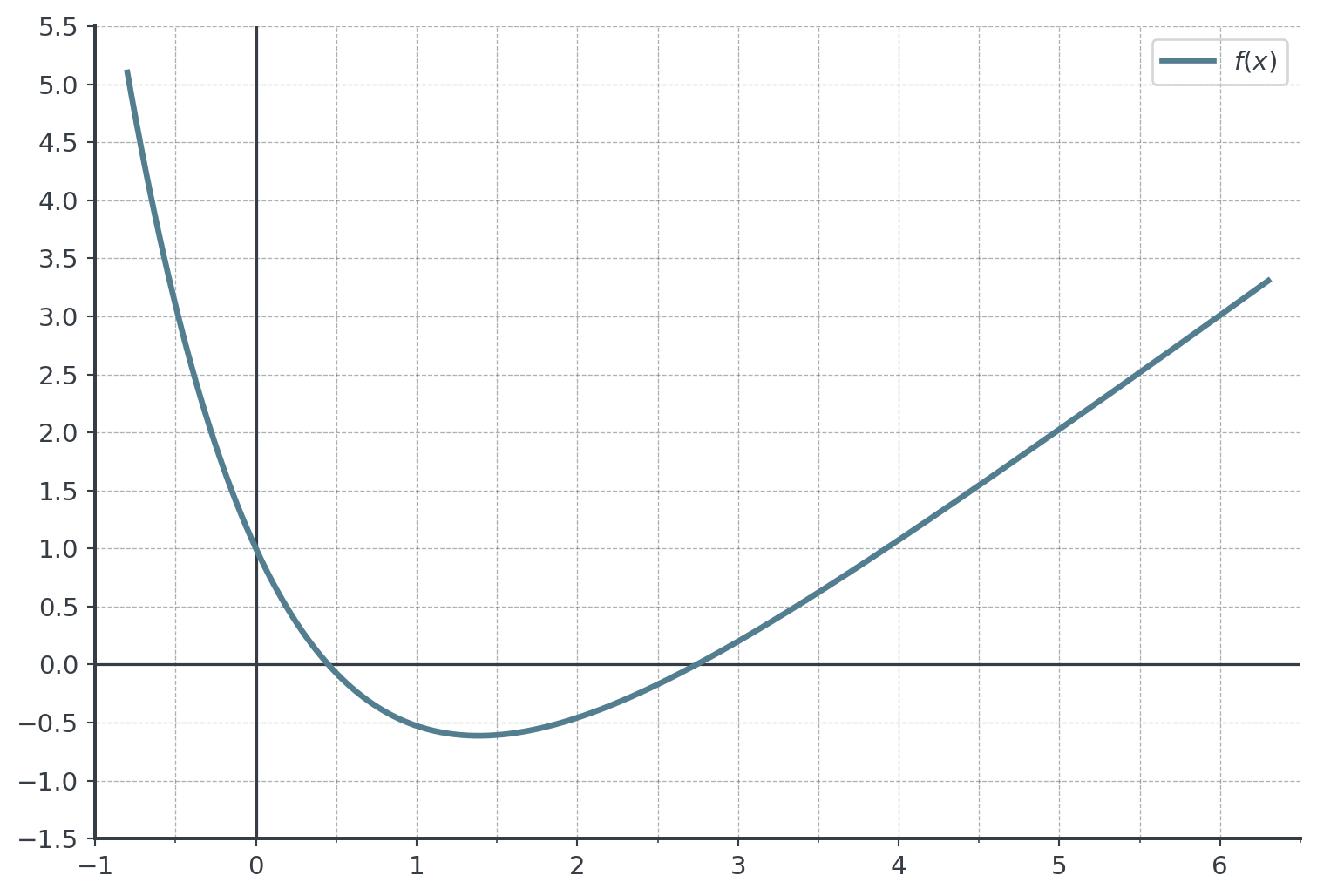
The function shown in fig. 1 belongs to the function \(f(x) = p \cdot e^{-x} + x + q\) with real parameters \(p\) and \(q\), \(x \in \mathbb{R}\).
Part a)
Determine \(p\) and \(q\) computationally for the function shown in fig. 1. You may round the values to one decimal place.
Hint: Use two points that you can read well, e.g. the \(y\)-intercept and the point of the graph at \(x = 5\).
[5 pts.]
CautionSolution
Reading from the graph: the \(y\)-intercept is \(f(0) = 1\). At \(x = 5\), the graph lies just above the grid line \(y = 2\): \(f(5) \approx 2.0\).
Setting up the system:
\[\text{(I)}\;\; f(0) = p \cdot e^{0} + 0 + q = p + q = 1\]
\[\text{(II)}\;\; f(5) = p \cdot e^{-5} + 5 + q = 2 \iff p \cdot e^{-5} + q = -3\]
Elimination: (I) \(-\) (II) removes \(q\):
\[p\left(1 - e^{-5}\right) = 1 - (-3) = 4 \iff p = \frac{4}{1 - e^{-5}} \approx \frac{4}{0.9933} \approx 4.03\]
From (I): \(q = 1 - p \approx -3.03\).
Rounded to one decimal place: \(p \approx 4.0\) and \(q \approx -3.0\), so \(f(x) = 4e^{-x} + x - 3\). Check: \(f(5) = 4e^{-5} + 2 \approx 2.03\), which matches the graph ✓. (A reading between 2.0 and 2.05 gives the same rounded values.)
Grading: 1 Pt. two points read from the graph, 1 Pt. equation (I), 1 Pt. equation (II), 1 Pt. elimination with \(p \approx 4.0\), 1 Pt. \(q \approx -3.0\).
Part b)
(for verification: \(p = 4\) and \(q = -3\), so \(f(x) = 4e^{-x} + x - 3\). Use this function from now on.)
Investigate the asymptotic behavior of \(f\), and determine the \(x\) and \(y\) intercepts.
Hint: An asymptote is a line the graph approaches. Check whether \(f(x) - (x - 3)\) tends to 0 for \(x \to +\infty\). For \(x \to -\infty\), \(e^{-x}\) grows faster than any polynomial.
Hint: The zeros cannot be found with logarithms. Use SOLVE (SHIFT + CALC) with initial guesses that you read from fig. 1.
[6 pts.]
CautionSolution
\(x \to +\infty\): \(4e^{-x} \to 0\), so the graph approaches the line \(y = x - 3\):
\[f(x) - (x - 3) = 4e^{-x} \to 0\]
The line \(y = x - 3\) is an oblique asymptote, and \(f(x) \to +\infty\). Since \(4e^{-x} > 0\), the graph always lies above the asymptote.
\(x \to -\infty\): \(x - 3 \to -\infty\), but \(4e^{-x}\) grows to \(+\infty\), and an exponential grows faster than any polynomial falls. So \(f(x) \to +\infty\), and there is no asymptote on the left.
\(y\)-intercept: \(f(0) = 4 + 0 - 3 = 1\), i.e. \((0, 1)\).
\(x\)-intercepts: \(4e^{-x} + x - 3 = 0\) contains \(x\) in the exponent and outside of it, so logarithms do not help. SOLVE with \(4e^{-x} + x - 3\) and the initial guesses 0.5 and 3 (read from fig. 1):
\[x_1 \approx 0.45, \qquad x_2 \approx 2.74\]
The \(x\)-intercepts are \((0.45, 0)\) and \((2.74, 0)\). Check: \(f(0.45) = 4e^{-0.45} - 2.55 \approx 0.0005 \approx 0\) ✓
Grading: 1 Pt. \(x \to +\infty\) with the oblique asymptote \(y = x - 3\), 1 Pt. graph above the asymptote with the reason, 1 Pt. \(x \to -\infty\): \(f(x) \to +\infty\) with the reason, 1 Pt. \(y\)-intercept \((0, 1)\), 2 Pts. both \(x\)-intercepts.
Part c)
Determine the nature and the coordinates of all stationary points.
[5 pts.]
CautionSolution
Derivatives (chain rule for \(e^{-x}\)):
\[f'(x) = -4e^{-x} + 1, \qquad f''(x) = 4e^{-x}\]
Necessary condition:
\[f'(x) = 0 \iff e^{-x} = \frac{1}{4} \iff -x = \ln\left(\frac{1}{4}\right) \iff x = \ln(4) \approx 1.39\]
\(e^{-x} = \frac{1}{4}\) has only this one solution, so \(f\) has exactly one stationary point.
Sufficient condition: \(f''(\ln(4)) = 4 \cdot \frac{1}{4} = 1 > 0\), so \(f\) has a minimum at \(x = \ln(4)\).
Coordinates:
\[f(\ln(4)) = 4 \cdot \frac{1}{4} + \ln(4) - 3 = \ln(4) - 2 \approx -0.61\]
The only stationary point is the minimum \(\left(\ln(4), \ln(4) - 2\right) \approx (1.39, -0.61)\). It lies below the \(x\)-axis, which fits the two zeros from b).
Grading: 1 Pt. \(f'(x)\) and \(f''(x)\), 1 Pt. \(f'(x) = 0\) with \(x = \ln(4)\), 1 Pt. only one stationary point, 1 Pt. \(f''(\ln(4)) > 0\) so minimum, 1 Pt. coordinates \((1.39, -0.61)\).
Part d)
Give a function \(f_1(x)\) which is a mirror image of \(f(x)\) mirrored at the \(y\)-axis and give a reason for your choice.
[3 pts.]
CautionSolution
\[f_1(x) = f(-x) = 4e^{x} - x - 3\]
Reason: the mirror image at the \(y\)-axis keeps the \(y\)-value of every point and changes the sign of the \(x\)-value. The point \((x, f(x))\) becomes \((-x, f(x))\), so \(f_1\) must take at \(-x\) the value that \(f\) takes at \(x\), i.e. \(f_1(x) = f(-x)\). Every \(x\) in the term is replaced by \(-x\): \(4e^{-(-x)} + (-x) - 3\).
Check with the minimum: \(f\) has its minimum at \((1.39, -0.61)\), so \(f_1\) must have it at \((-1.39, -0.61)\). Indeed \(f_1'(x) = 4e^{x} - 1 = 0 \iff x = -\ln(4) \approx -1.39\) ✓
Grading: 1 Pt. \(f_1(x) = 4e^{x} - x - 3\), 1 Pt. reason with \((x, y) \to (-x, y)\), 1 Pt. check with a point.
Part e)
Compute the area enclosed by the graph of \(f\), its oblique asymptote and the lines \(x = 0\) and \(x = \ln(4)\) (the \(x\)-coordinate of the minimum).
[4 pts.]
CautionSolution
Difference of the two functions: by b), the graph lies above the asymptote, so the upper function is \(f\):
\[f(x) - (x - 3) = 4e^{-x} > 0\]
Area: with \(\int e^{-x}\,dx = -e^{-x} + C\),
\[A = \int_0^{\ln(4)} 4e^{-x}\,dx = \Big[-4e^{-x}\Big]_0^{\ln(4)} = -4e^{-\ln(4)} - \left(-4e^{0}\right) = -4 \cdot \frac{1}{4} + 4 = 3\]
Here \(e^{-\ln(4)} = \frac{1}{e^{\ln(4)}} = \frac{1}{4}\).
The region has an area of exactly 3 area units.
Grading: 1 Pt. difference \(4e^{-x}\) with the upper function, 1 Pt. antiderivative \(-4e^{-x}\), 1 Pt. limits inserted with \(e^{-\ln(4)} = \frac{1}{4}\), 1 Pt. \(A = 3\).
Part f)
The graph of \(f\) is shifted vertically so that its lowest point lies on the \(x\)-axis. Give the term of the shifted function \(g(x)\). Determine the number of zeros of \(g\) and give a reason.
[3 pts.]
CautionSolution
Shift: by c), the lowest point is \(\left(\ln(4), \ln(4) - 2\right) \approx (1.39, -0.61)\). To bring it onto the \(x\)-axis, shift the graph up by \(2 - \ln(4) \approx 0.61\):
\[g(x) = f(x) + 2 - \ln(4) = 4e^{-x} + x - 1 - \ln(4)\]
Number of zeros: a vertical shift does not change the \(x\)-values, so \(g\) also has its only stationary point, a minimum, at \(x = \ln(4)\), now with \(g(\ln(4)) = 0\). \(g\) falls before it (\(g'(x) = f'(x) < 0\) for \(x < \ln(4)\)) and rises after it, so \(g(x) > 0\) everywhere else. \(g\) has exactly one zero, at \(x = \ln(4)\): the graph touches the \(x\)-axis there.
Grading: 1 Pt. shift by \(2 - \ln(4)\), 1 Pt. \(g(x) = 4e^{-x} + x - 1 - \ln(4)\), 1 Pt. exactly one zero with the reason.