Tasks 09-02 - Differential Calculus Review
Section 09: Exam Preparation
A: Skills
Problem 1: Derivatives (xx)
Round results to two decimal places and keep intermediate results unrounded. This rule holds for the whole sheet unless a problem says otherwise.
- Determine the first derivative of each function. Name the rules you use.
(1) \(f_1(x) = (3x - x^2) \cdot e^{2x}\)
(2) \(f_2(x) = \frac{4 - x}{x^2 + 5}\)
(3) \(f_3(x) = (x^2 + 1) \cdot \ln(x)\)
(4) \(f_4(x) = \sqrt{9 - 4x}\)
(5) \(f_5(x) = \ln(3x^2 + 2)\)
- Determine the first, second and third derivative of \(g(x) = (x - 2) \cdot e^{3x}\). Write each derivative as a linear term times \(e^{3x}\).
CautionSolution
(1) Product rule with \(u = 3x - x^2\), \(u' = 3 - 2x\) and \(v = e^{2x}\), \(v' = 2e^{2x}\) (chain rule):
\[f_1'(x) = (3 - 2x) \cdot e^{2x} + (3x - x^2) \cdot 2e^{2x} = (3 - 2x + 6x - 2x^2) \cdot e^{2x} = (-2x^2 + 4x + 3) \cdot e^{2x}\]
(2) Quotient rule with \(u = 4 - x\), \(u' = -1\) and \(v = x^2 + 5\), \(v' = 2x\):
\[f_2'(x) = \frac{-1 \cdot (x^2 + 5) - (4 - x) \cdot 2x}{(x^2 + 5)^2} = \frac{-x^2 - 5 - 8x + 2x^2}{(x^2 + 5)^2} = \frac{x^2 - 8x - 5}{(x^2 + 5)^2}\]
(3) Product rule with \(u = x^2 + 1\), \(u' = 2x\) and \(v = \ln(x)\), \(v' = \frac{1}{x}\):
\[f_3'(x) = 2x \cdot \ln(x) + (x^2 + 1) \cdot \frac{1}{x} = 2x\ln(x) + x + \frac{1}{x}\]
(4) Write the root as a power, \(f_4(x) = (9 - 4x)^{1/2}\). Chain rule with the inner function \(9 - 4x\) and the inner derivative \(-4\):
\[f_4'(x) = \frac{1}{2}(9 - 4x)^{-1/2} \cdot (-4) = -\frac{2}{\sqrt{9 - 4x}}\]
(5) Chain rule with \((\ln(u))' = \frac{1}{u}\) and the inner derivative \(6x\):
\[f_5'(x) = \frac{1}{3x^2 + 2} \cdot 6x = \frac{6x}{3x^2 + 2}\]
Product rule with \(u = x - 2\), \(u' = 1\) and \(v = e^{3x}\), \(v' = 3e^{3x}\):
\[g'(x) = 1 \cdot e^{3x} + (x - 2) \cdot 3e^{3x} = (3x - 5) \cdot e^{3x}\]
The same step for each further derivative:
\[g''(x) = 3 \cdot e^{3x} + (3x - 5) \cdot 3e^{3x} = (9x - 12) \cdot e^{3x}\]
\[g'''(x) = 9 \cdot e^{3x} + (9x - 12) \cdot 3e^{3x} = (27x - 27) \cdot e^{3x} = 27(x - 1) \cdot e^{3x}\]
Typical mistake: in a) (1) and in b), writing \((e^{2x})' = e^{2x}\). The chain rule gives the inner derivative as a factor: \((e^{2x})' = 2e^{2x}\) and \((e^{3x})' = 3e^{3x}\).
Problem 2: Limits (x)
Compute each limit. For a quotient, decide first which kind of limit it is: \(x \to \pm\infty\), or \(x \to x_0\) with the form \(\frac{0}{0}\).
(1) \(\lim\limits_{x \to \infty} \frac{5x^2 - 3x + 2}{10x^2 + x}\)
(2) \(\lim\limits_{x \to -\infty} \frac{3x - 1}{x^2 + 7}\)
(3) \(\lim\limits_{x \to -\infty} \frac{2x^3 + x}{5 - x^2}\)
(4) \(\lim\limits_{x \to 5} \frac{x^2 - 2x - 15}{x^2 - 25}\)
(5) \(\lim\limits_{x \to -1} \frac{2x^2 + x - 1}{x + 1}\)
Hint: For \(x \to \pm\infty\), only the terms with the highest powers matter. Watch the sign of the leading coefficient in the denominator.
CautionSolution
(1) Same degree in numerator and denominator. Divide both by \(x^2\):
\[\lim_{x \to \infty} \frac{5 - \frac{3}{x} + \frac{2}{x^2}}{10 + \frac{1}{x}} = \frac{5}{10} = \frac{1}{2}\]
(2) The degree of the denominator is higher. Divide both by \(x^2\):
\[\lim_{x \to -\infty} \frac{\frac{3}{x} - \frac{1}{x^2}}{1 + \frac{7}{x^2}} = \frac{0}{1} = 0\]
(3) The degree of the numerator is higher. Divide both by \(x^2\):
\[\frac{2x^3 + x}{5 - x^2} = \frac{2x + \frac{1}{x}}{\frac{5}{x^2} - 1}\]
For \(x \to -\infty\), the numerator goes to \(-\infty\) and the denominator to \(-1\). So the quotient goes to \(+\infty\): the limit does not exist as a number, \(\lim\limits_{x \to -\infty} \frac{2x^3 + x}{5 - x^2} = +\infty\).
(4) At \(x = 5\): numerator \(25 - 10 - 15 = 0\), denominator \(25 - 25 = 0\), the form \(\frac{0}{0}\). Factor and cancel:
\[\lim_{x \to 5} \frac{(x - 5)(x + 3)}{(x - 5)(x + 5)} = \lim_{x \to 5} \frac{x + 3}{x + 5} = \frac{8}{10} = 0.8\]
(5) At \(x = -1\): numerator \(2 - 1 - 1 = 0\), denominator 0, the form \(\frac{0}{0}\). Factor and cancel:
\[\lim_{x \to -1} \frac{(2x - 1)(x + 1)}{x + 1} = \lim_{x \to -1} (2x - 1) = -3\]
Typical mistake: in (3), answering \(-\infty\) because the numerator goes to \(-\infty\). The denominator \(5 - x^2\) is negative for large \(|x|\), so the signs cancel. In (4) and (5), the form \(\frac{0}{0}\) does not mean “no limit”: cancel the common factor first.
Problem 3: Stationary Points (xx)
Let \(g(x) = x^2 - 8x + 6 \cdot \ln(x)\) with \(x > 0\). Determine the nature and the coordinates of all stationary points of \(g\) with the second derivative test.
Let \(h(x) = 3x^4 - 4x^3 - 6x^2 + 12x\). Determine all stationary points of \(h\).
Hint: Factor out 12. Then group the four terms of the cubic in pairs and factor out the common bracket.
- Classify the stationary points of \(h\) with the second derivative test where it works. For a point where it fails, use the sign of \(h'\) on both sides and name the type of the point.
CautionSolution
Necessary condition: \(g'(x) = 2x - 8 + \frac{6}{x}\). Multiply \(g'(x) = 0\) by \(x > 0\):
\[2x^2 - 8x + 6 = 0 \iff x^2 - 4x + 3 = 0 \iff (x - 1)(x - 3) = 0 \iff x = 1 \text{ or } x = 3\]
Both values lie in the domain \(x > 0\).
Sufficient condition with \(g''(x) = 2 - \frac{6}{x^2}\):
- \(g''(1) = 2 - 6 = -4 < 0\): local maximum, \(g(1) = 1 - 8 + 6\ln(1) = -7\), point \((1, -7)\)
- \(g''(3) = 2 - \frac{6}{9} = \frac{4}{3} > 0\): local minimum, \(g(3) = 9 - 24 + 6\ln(3) \approx -8.41\), point \((3, -8.41)\)
\(h'(x) = 12x^3 - 12x^2 - 12x + 12 = 12(x^3 - x^2 - x + 1)\). Group in pairs:
\[x^3 - x^2 - x + 1 = x^2(x - 1) - (x - 1) = (x - 1)(x^2 - 1) = (x - 1)^2(x + 1)\]
So \(h'(x) = 12(x - 1)^2(x + 1)\). The stationary points lie at \(x = -1\) and \(x = 1\) (a double zero of \(h'\)).
\(h''(x) = 36x^2 - 24x - 12 = 12(3x^2 - 2x - 1) = 12(3x + 1)(x - 1)\)
- \(h''(-1) = 36 + 24 - 12 = 48 > 0\): local minimum, \(h(-1) = 3 + 4 - 6 - 12 = -11\), point \((-1, -11)\)
- \(h''(1) = 36 - 24 - 12 = 0\): the second derivative test gives no answer at \(x = 1\).
Sign of \(h'(x) = 12(x - 1)^2(x + 1)\) close to \(x = 1\): the factor \(x + 1\) is positive there, and \((x - 1)^2\) is a square, positive for \(x \neq 1\). So \(h'(x) > 0\) just before and just after \(x = 1\). \(h'\) does not change its sign: \(h\) keeps increasing, and \(x = 1\) is no extremum. It is a saddle point (a stationary point without an extremum), \(h(1) = 3 - 4 - 6 + 12 = 5\), point \((1, 5)\). Since \(h''(x) = 12(3x + 1)(x - 1)\) changes its sign at \(x = 1\), the saddle point is also an inflection point with a horizontal tangent.
Typical mistake: in c), concluding from \(h''(1) = 0\) that \(x = 1\) is no extremum. \(h''(1) = 0\) only means that the test gives no answer: \(x^4\) has \(f''(0) = 0\) and still a minimum at \(x = 0\). Only the sign of \(h'\) on both sides decides.
Problem 4: Tangent and Angle of Intersection (xx)
A line with slope \(m\) meets the \(x\)-axis at the angle \(\alpha = \arctan(m)\).
Determine the tangent of \(f(x) = \frac{x^2 + x + 3}{x + 1}\) at \(x = 2\). Compute the angle of intersection \(\alpha\) between the tangent and the \(x\)-axis.
Determine the tangent of \(g(x) = 2\sqrt{x} + x\) at \(x = 4\) and the angle of intersection \(\alpha\) between this tangent and the \(x\)-axis.
Hint: The indicator D must show. SHIFT + tan gives \(\arctan\).
CautionSolution
Point: \(f(2) = \frac{9}{3} = 3\), so the tangent touches the graph at \((2, 3)\).
Slope: quotient rule,
\[f'(x) = \frac{(2x + 1)(x + 1) - (x^2 + x + 3) \cdot 1}{(x + 1)^2} = \frac{x^2 + 2x - 2}{(x + 1)^2}, \qquad f'(2) = \frac{4 + 4 - 2}{9} = \frac{2}{3}\]
Tangent (point-slope form):
\[t(x) = \frac{2}{3}(x - 2) + 3 = \frac{2}{3}x + \frac{5}{3}\]
Angle: \(\alpha = \arctan\left(\frac{2}{3}\right) \approx 33.69°\)
\(g(4) = 2 \cdot 2 + 4 = 8\). With \(\sqrt{x} = x^{1/2}\): \(g'(x) = 2 \cdot \frac{1}{2}x^{-1/2} + 1 = \frac{1}{\sqrt{x}} + 1\), so \(g'(4) = \frac{1}{2} + 1 = 1.5\).
\[t(x) = 1.5(x - 4) + 8 = 1.5x + 2\]
\(\alpha = \arctan(1.5) \approx 56.31°\)
Typical mistake: taking the arctan of the function value, e.g. \(\arctan(3)\) in a). The angle depends only on the slope \(m = f'(2)\). With the indicator R, the calculator gives the angle in radians instead of degrees.
Problem 5: A Function Family (xx)
For every \(t > 0\), the function \(f_t(x) = x^2 - t \cdot \ln(x)\) with \(x > 0\) is given. Together, these functions form a function family (Funktionsschar): each value of the parameter \(t\) gives one function.
Determine \(t\) so that \(f_t\) has a stationary point at \(x = 4\). Determine the nature and the coordinates of this point.
Determine \(t\) so that the tangent of \(f_t\) at \(x = 1\) is parallel to the line \(y = -2x + 5\). Give this tangent.
Show that every \(f_t\) has exactly one stationary point, at \(x = \sqrt{\frac{t}{2}}\), and that it is a minimum. Determine \(t\) so that this minimum lies on the \(x\)-axis.
CautionSolution
The parameter \(t\) is a constant when you differentiate with respect to \(x\):
\[f_t'(x) = 2x - \frac{t}{x}, \qquad f_t''(x) = 2 + \frac{t}{x^2}\]
Stationary point at \(x = 4\): \(f_t'(4) = 8 - \frac{t}{4} = 0 \iff t = 32\).
\(f_{32}''(4) = 2 + \frac{32}{16} = 4 > 0\): a minimum. \(f_{32}(4) = 16 - 32\ln(4) \approx -28.36\), point \((4, -28.36)\).
Parallel lines have the same slope, so \(f_t'(1) = -2\):
\[2 - t = -2 \iff t = 4\]
\(f_4(1) = 1 - 4\ln(1) = 1\), so the tangent is \(y = -2(x - 1) + 1 = -2x + 3\).
Stationary points: for \(x > 0\),
\[f_t'(x) = 0 \iff 2x = \frac{t}{x} \iff x^2 = \frac{t}{2} \iff x = \sqrt{\frac{t}{2}}\]
(\(-\sqrt{\frac{t}{2}}\) is not in the domain.) So every \(f_t\) has exactly one stationary point. \(f_t''(x) = 2 + \frac{t}{x^2} > 0\) for every \(x > 0\) and \(t > 0\), so it is a minimum.
Minimum value: with \(\ln\left(\sqrt{u}\right) = \frac{1}{2}\ln(u)\),
\[f_t\left(\sqrt{\tfrac{t}{2}}\right) = \frac{t}{2} - t \cdot \frac{1}{2}\ln\left(\frac{t}{2}\right) = \frac{t}{2}\left(1 - \ln\left(\frac{t}{2}\right)\right)\]
The minimum lies on the \(x\)-axis when this value is 0. Since \(\frac{t}{2} > 0\):
\[1 - \ln\left(\frac{t}{2}\right) = 0 \iff \ln\left(\frac{t}{2}\right) = 1 \iff \frac{t}{2} = e \iff t = 2e \approx 5.44\]
Check: \(f_{2e}'(\sqrt{e}) = 2\sqrt{e} - \frac{2e}{\sqrt{e}} = 0\) ✓ and \(f_{2e}(\sqrt{e}) = e - 2e \cdot \frac{1}{2} = 0\) ✓
Typical mistake: in b), setting the function value \(f_t(1) = -2\). “Parallel” is a condition on the slope, so it uses \(f_t'(1)\).
B: Set Up & Check
Problem 6: What the Instruction Asks For (xx)
Each item quotes an instruction as it appears in the FSP. Write down what you have to compute (the conditions), carry it out for the given function and then answer the check question.
“Verify computationally that \(f(x) = x \cdot e^{-x^2/8}\) possesses a maximum at \(x = 2\).” Explain how your work would change if the instruction were “Determine the nature and the coordinates of all stationary points.”
Check: A classmate computes \(f(1.9) \approx 1.2100\), \(f(2) \approx 1.2131\) and \(f(2.1) \approx 1.2101\) and writes: “Both neighbours are smaller, so there is a maximum at \(x = 2\).” Explain why this does not verify the maximum computationally.
“The curvature of the graph of \(g(x) = 0.25x^4 - 0.5x^3 - 3x^2 + 5x\) changes its sign.” (The curvature says whether the graph bends upward or downward.) Write the conditions for an inflection point and determine all inflection points of \(g\).
Check: For \(k(x) = x^4 + x\), a classmate writes: “\(k''(0) = 0\), so \(k\) has an inflection point at \(x = 0\).” Check this claim with the sign of \(k''\).
A company launches a new hair dryer. In week \(t\) after the launch, with \(t\) from 0 to 10, it sells \(S(t) = -0.1t^3 + 0.9t^2 + 4.8t + 5\) hundred units. “Determine the week in which the sales grow fastest.” Write this as a condition on a derivative and solve it.
Check: A colleague solves \(S'(t) = 0\) and answers “week 8”. Explain what happens to the sales in week 8.
“Determine the tangent of \(h(x) = \frac{8}{x + 2}\) at \(x = 2\).” Write what you need for the tangent and give its equation.
Check: A classmate writes \(t(x) = -\frac{8}{(x + 2)^2} \cdot (x - 2) + 2\). Explain why this is not the tangent.
“Argue whether the following statements are true or false” for \(f(x) = 2 - 5e^{-0.5x}\):
(1) Because \(f'(x) > 0\) for every \(x\), \(f\) is increasing on the whole real line.
(2) Because \(f'(1) > 0\), the graph of \(f\) lies above the \(x\)-axis at \(x = 1\).
Check: Compute \(f(1)\). State what the sign of \(f'(1)\) tells you about the graph and what it does not tell you.
CautionSolution
“Verify … possesses a maximum at \(x = 2\)” asks for two conditions at the given \(x\) only. Product rule and chain rule give
\[f'(x) = e^{-x^2/8} + x \cdot \left(-\frac{x}{4}\right)e^{-x^2/8} = \left(1 - \frac{x^2}{4}\right)e^{-x^2/8}, \qquad f''(x) = \left(\frac{x^3}{16} - \frac{3x}{4}\right)e^{-x^2/8}\]
- necessary: \(f'(2) = (1 - 1) \cdot e^{-0.5} = 0\) ✓
- sufficient: \(f''(2) = (0.5 - 1.5) \cdot e^{-0.5} = -e^{-0.5} < 0\) ✓
So \(f\) has a maximum at \(x = 2\), with \(f(2) = 2e^{-0.5} \approx 1.21\).
“Determine the nature and the coordinates of all stationary points” asks for more: solve \(f'(x) = 0\) for all \(x\). Since \(e^{-x^2/8} > 0\): \(1 - \frac{x^2}{4} = 0\), so \(x = 2\) or \(x = -2\). Then decide each with \(f''\) and compute both \(y\)-values: maximum \((2, 1.21)\) and, with \(f''(-2) = e^{-0.5} > 0\), minimum \((-2, -1.21)\).
Check: three function values only show the graph at three points. They do not show what happens between them, and they are no computation of the conditions. The FSP expects \(f'(2) = 0\) and \(f''(2) < 0\).
Typical mistake: showing only \(f'(2) = 0\). A horizontal tangent can also belong to a minimum or a saddle point, so the sign of \(f''(2)\) is needed as well.
Inflection point: \(g''(x_0) = 0\) (necessary) and a sign change of \(g''\) at \(x_0\), or \(g'''(x_0) \neq 0\) (sufficient).
\[g'(x) = x^3 - 1.5x^2 - 6x + 5, \qquad g''(x) = 3x^2 - 3x - 6 = 3(x + 1)(x - 2), \qquad g'''(x) = 6x - 3\]
\(g''(x) = 0\) at \(x = -1\) and \(x = 2\). \(g'''(-1) = -9 \neq 0\) and \(g'''(2) = 9 \neq 0\), so both are inflection points: \((-1, g(-1)) = (-1, 0.25 + 0.5 - 3 - 5) = (-1, -7.25)\) and \((2, g(2)) = (2, 4 - 4 - 12 + 10) = (2, -2)\).
Check: \(k''(x) = 12x^2\) is positive on both sides of \(x = 0\). It does not change its sign, so the graph of \(k\) is concave up on both sides and has no inflection point at \(x = 0\). Here also \(k'''(0) = 24 \cdot 0 = 0\), so the \(k'''\) test gives no answer, and only the sign of \(k''\) decides.
Typical mistake: stopping at \(g''(x_0) = 0\). This condition is only necessary.
“The sales grow fastest” means: the growth rate \(S'(t)\) is largest. Find the maximum of \(S'\), i.e. \(S''(t) = 0\) (the inflection point of \(S\)):
\[S'(t) = -0.3t^2 + 1.8t + 4.8, \qquad S''(t) = -0.6t + 1.8 = 0 \iff t = 3, \qquad S'''(t) = -0.6 < 0\]
So \(S'\) has its maximum at \(t = 3\): in week 3, the sales grow fastest, by \(S'(3) = -2.7 + 5.4 + 4.8 = 7.5\) hundred units, i.e. 750 units per week.
Check: \(S'(8) = -19.2 + 14.4 + 4.8 = 0\). In week 8 the sales stop growing: \(S'\) changes from \(+\) to \(-\), so the sales are highest there, \(S(8) = -51.2 + 57.6 + 38.4 + 5 = 49.8\) hundred units. Afterwards they fall.
Typical mistake: confusing “highest sales” (\(S' = 0\)) with “fastest growth” (\(S'' = 0\)).
A tangent needs a point and a slope, both at \(x = 2\): the point \((2, h(2)) = (2, 2)\) and the slope \(h'(2)\). With \(h(x) = 8(x + 2)^{-1}\):
\[h'(x) = -\frac{8}{(x + 2)^2}, \qquad h'(2) = -\frac{8}{16} = -0.5, \qquad t(x) = -0.5(x - 2) + 2 = -0.5x + 3\]
Check: the classmate used the whole function \(h'(x)\) as the slope. Its value changes with \(x\), so the result is a curve, not a line. The slope of the tangent is the number \(h'(2)\).
Typical mistake: inserting \(x = 2\) into \(h\) but not into \(h'\).
(1) True. Chain rule: \(f'(x) = -5 \cdot (-0.5)e^{-0.5x} = 2.5e^{-0.5x} > 0\) for every \(x\), and a positive derivative means that \(f\) is increasing.
(2) False. The sign of \(f'\) says whether the graph rises or falls, not whether it lies above or below the \(x\)-axis. Counterexample: \(f(1) = 2 - 5e^{-0.5} \approx -1.03 < 0\), although \(f'(1) = 2.5e^{-0.5} \approx 1.52 > 0\). At \(x = 1\), the graph lies below the \(x\)-axis and rises. It crosses the \(x\)-axis only at \(x = 2\ln(2.5) \approx 1.83\).
Check: \(f'(1) > 0\) tells you that the graph rises at \(x = 1\). It does not tell you the height of the graph: for that, you need \(f(1)\).
Typical mistake: reading the sign of \(f'\) as the sign of \(f\).
Problem 7: One Paragraph, All Instructions (xx)
An FSP problem gives the function \(f(x) = \frac{x^2 - 3x + 2}{x + 1}\) and continues in one paragraph: Determine the domain of \(f\). Investigate the asymptotic behavior of \(f\), and determine the \(x\) and \(y\) intercepts. Determine the nature and the coordinates of all stationary points. Assess how many inflection points \(f\) has to possess at least and give a reason for your answer. Determine the tangent of \(f\) at \(x = 3\) and compute the angle of intersection \(\alpha\) between the tangent and the \(x\)-axis (\(\alpha = \arctan(m)\) for a line with slope \(m\)). Sketch the graph \(G_f\) in the interval \([-5; 4]\).
Turn the paragraph into a numbered list with one line per instruction. Write in each line what you have to compute: the equations, the conditions and the rules. Do not solve anything.
Check: A classmate’s line for the stationary points says: “Solve \(f(x) = 0\) and insert the solutions into \(f''(x)\).” Explain what is wrong.
CautionSolution
- Domain: the denominator must not be 0, so solve \(x + 1 = 0\) and remove this \(x\) from \(\mathbb{R}\).
- Asymptotic behavior and intercepts:
- vertical asymptote: at the zero of the denominator, if the numerator is not 0 there (check the numerator at \(x = -1\)), with the sign of \(f\) on both sides
- \(x \to \pm\infty\): the degree of the numerator is one higher than the degree of the denominator, so divide with polynomial long division. The linear part of the result is the oblique asymptote, and the remainder term goes to 0.
- \(y\)-intercept \(f(0)\), \(x\)-intercepts from numerator \(= 0\), i.e. \(x^2 - 3x + 2 = 0\) with the quadratic formula or by factoring
- Stationary points: \(f'(x)\) (quotient rule, or the power rule after the division from 2.) and \(f''(x)\). Necessary condition \(f'(x) = 0\), solved for all \(x\). Sufficient condition: the sign of \(f''\) at each solution (maximum for \(f'' < 0\), minimum for \(f'' > 0\)). The coordinates need the \(y\)-values \(f(x_0)\).
- Inflection points at least: no full computation is asked for. Use the results of 2. and 3.: where the extrema lie, on which side of the vertical asymptote they are, and how the graph must bend to reach the asymptotes. Each change of the curvature within one piece of the graph needs an inflection point, while a change across the vertical asymptote needs none. \(f''\) from 3. can confirm the answer. For this function it is \(f''(x) = \frac{12}{(x + 1)^3}\), which is never 0, so no inflection point is required: the graph is concave down left of the vertical asymptote and concave up right of it.
- Tangent and angle: point \((3, f(3))\) and slope \(m = f'(3)\), tangent \(t(x) = f'(3)(x - 3) + f(3)\). Angle \(\alpha = \arctan(f'(3))\) with the indicator D (degrees).
- Sketch: values at the ends of the interval, \(f(-5)\) and \(f(4)\). Draw the asymptotes from 2., mark the intercepts from 2. and the stationary points from 3., and draw the curve with the curvature from 4. The tangent from 5. can go into the same sketch.
Check: \(f(x) = 0\) gives the zeros of \(f\), the points where the graph crosses the \(x\)-axis. Stationary points are the points with a horizontal tangent, so the condition is \(f'(x) = 0\). Its solutions are then inserted into \(f''(x)\).
Typical mistake: forgetting the vertical asymptote in the sketch. The graph has two separate branches, one on each side of \(x = -1\), and the sketch must not connect them.
C: Applied
Problem 8: A Cubic Function from Its Graph (xxx)
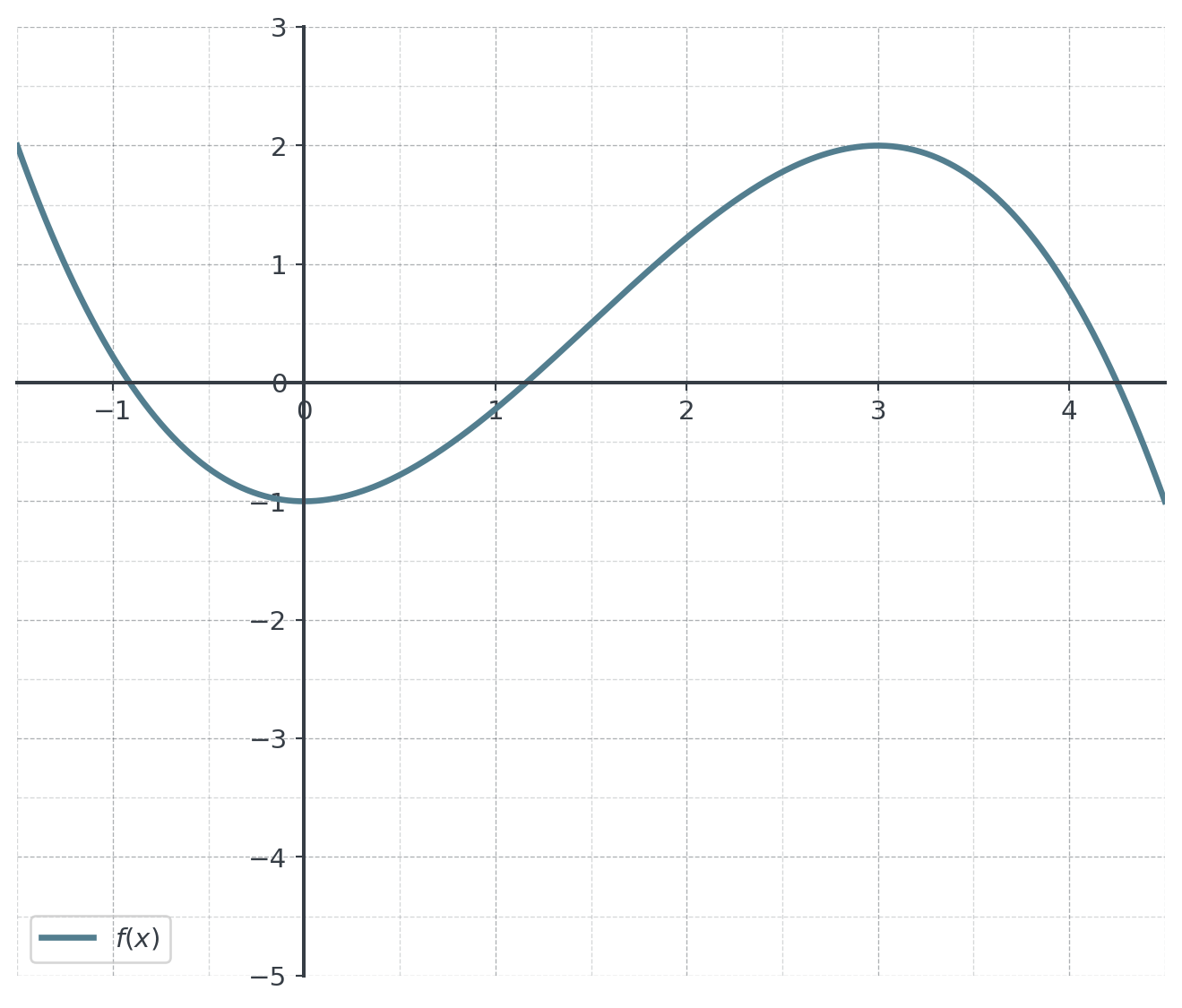
The figure shows the graph of a polynomial function \(f\) of degree 3. Its local minimum and its local maximum lie on grid points.
Note: Print the page or copy the figure onto squared paper. In the exam, you draw directly into the printed figure.
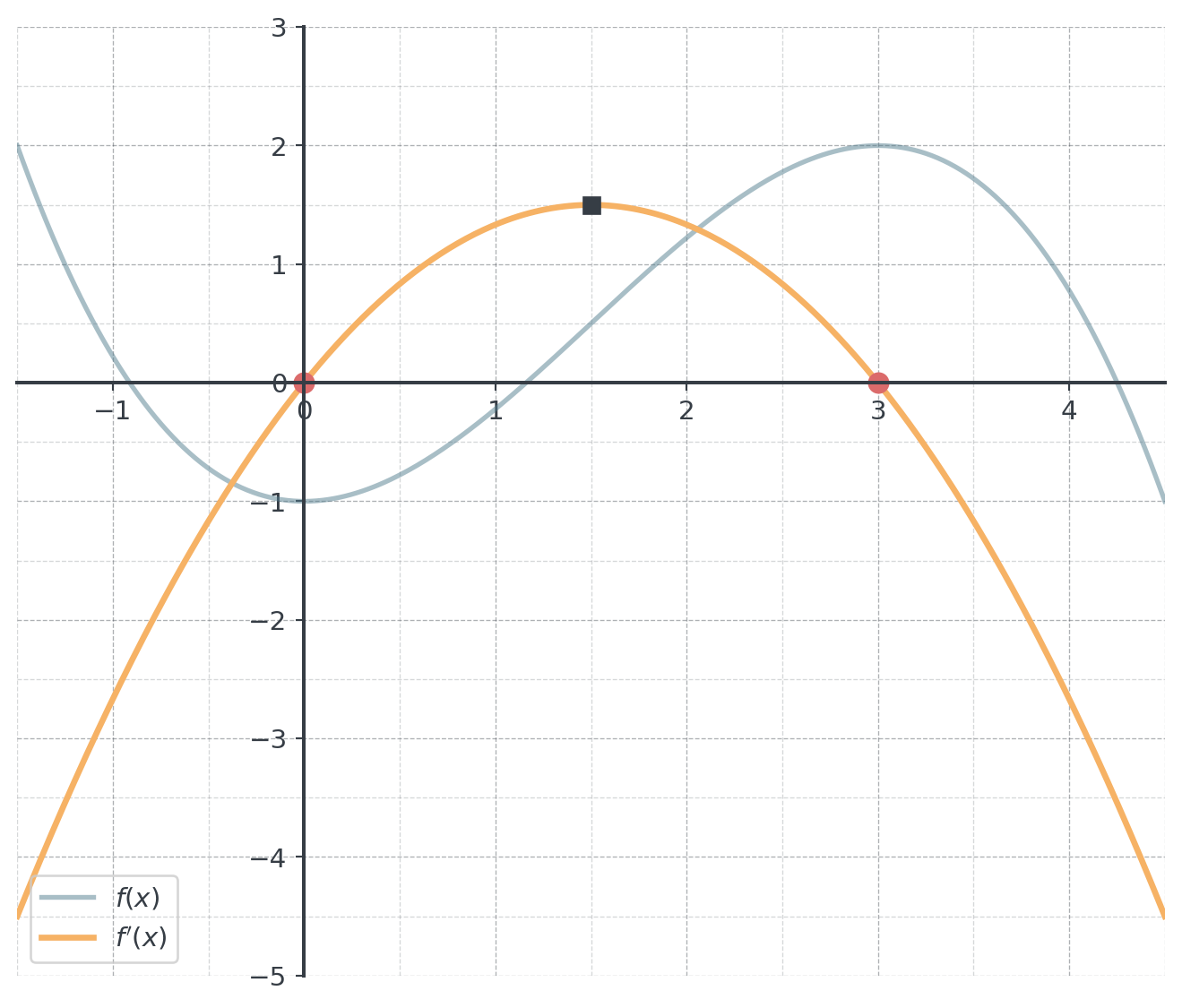
Graph the derivative \(f'(x)\) directly into the figure. Mark the zeros of \(f'\) and the point at which \(f'\) has its largest value, and explain how you found them.
Argue whether the following statements are true or false.
(1) \(f'(x) > 0\) for every \(x\) with \(0 < x < 3\).
(2) \(f'(3.5) > 0\), because the graph of \(f\) lies above the \(x\)-axis at \(x = 3.5\).
(3) On the interval \(-1 < x < 1\), the graph of \(f\) is concave up.
(4) The graph of \(f\) falls more steeply at \(x = 4\) than at \(x = 4.5\).
- The function has the form \(f(x) = ax^3 + bx^2 + cx + d\). Determine \(a\), \(b\), \(c\) and \(d\) computationally from the graph.
(for verification: \(f(x) = -\frac{2}{9}x^3 + x^2 - 1\))
- Show that \(f\) has an inflection point at \(x = 1.5\). Determine the tangent of \(f\) at \(x = 1.5\) (inflectional tangent: the tangent at the inflection point) and explain its meaning. Compare its slope with your graph of \(f'\) from a).
CautionSolution
a) The local minimum lies at \((0, -1)\) and the local maximum at \((3, 2)\). The tangent is horizontal there, so \(f'(0) = 0\) and \(f'(3) = 0\): these are the zeros of \(f'\). Between them, \(f\) increases, so \(f' > 0\). Left of 0 and right of 3, \(f\) decreases, so \(f' < 0\), and the graph of \(f\) gets steeper and steeper towards the edges of the figure.
\(f\) has degree 3, so \(f'\) is a parabola. It is positive between its zeros 0 and 3 and negative outside, so it opens downward. A parabola has its vertex halfway between its zeros (Session 03-03), so \(f'\) has its largest value at \(x = 1.5\): there \(f\) rises most steeply and changes from concave up to concave down. The slope of the graph there is about 1.5 (from \((1, -0.2)\) to \((2, 1.2)\) the graph rises by about 1.4), so the vertex of \(f'\) lies at about \((1.5, 1.5)\):
b) (1) True. Between the minimum at \(x = 0\) and the maximum at \(x = 3\), the graph of \(f\) rises, so \(f'(x) > 0\) there.
(2) False. \(f(3.5) > 0\) is a statement about the height of the graph, \(f'(3.5)\) about its slope. At \(x = 3.5\), the graph lies right of the maximum and falls, so \(f'(3.5) < 0\), although it still lies above the \(x\)-axis.
(3) True. On \(-1 < x < 1\), the graph of \(f\) lies left of the inflection point at \(x = 1.5\), around the minimum, and bends upward. Equivalently, \(f'\) increases there (see a)), so \(f'' > 0\).
(4) False. Right of the maximum, the graph falls more and more steeply: \(f'\) decreases on \(x > 1.5\). So \(f'(4.5) < f'(4) < 0\), and the graph is steeper at \(x = 4.5\). From the graph: between 4 and 4.5 the graph falls by about 1.8 units, much more than between 3.5 and 4.
c) Two points with horizontal tangents give four conditions. With \(f'(x) = 3ax^2 + 2bx + c\):
- minimum at \((0, -1)\): \(f(0) = d = -1\) and \(f'(0) = c = 0\)
- maximum at \((3, 2)\): \(f(3) = 27a + 9b + 3c + d = 2\) and \(f'(3) = 27a + 6b + c = 0\)
With \(c = 0\) and \(d = -1\):
\[\text{(I)}\;\; 27a + 9b = 3, \qquad \text{(II)}\;\; 27a + 6b = 0\]
- \(-\) (II): \(3b = 3\), so \(b = 1\). From (II): \(27a = -6\), so \(a = -\frac{2}{9}\).
\[f(x) = -\frac{2}{9}x^3 + x^2 - 1\]
Check with a point that was not used: the graph passes through \((-1.5, 2)\), and \(f(-1.5) = -\frac{2}{9} \cdot (-3.375) + 2.25 - 1 = 0.75 + 1.25 = 2\) ✓
d) \(f'(x) = -\frac{2}{3}x^2 + 2x\), \(f''(x) = -\frac{4}{3}x + 2\), \(f'''(x) = -\frac{4}{3}\).
\(f''(1.5) = -2 + 2 = 0\) and \(f'''(1.5) = -\frac{4}{3} \neq 0\): \(f\) has an inflection point at \(x = 1.5\), with \(f(1.5) = -0.75 + 2.25 - 1 = 0.5\).
Tangent: \(f'(1.5) = -1.5 + 3 = 1.5\), so
\[t(x) = 1.5(x - 1.5) + 0.5 = 1.5x - 1.75\]
Meaning: at the inflection point, \(f\) changes from concave up to concave down, and its slope is largest: no other tangent of \(f\) is steeper upward. Its slope 1.5 is exactly the highest point of the graph of \(f'\) in a), at \((1.5, 1.5)\) ✓.
Typical mistake: in a), putting the zeros of \(f'\) at the zeros of \(f\) (about \(-0.91\), \(1.16\) and \(4.25\)). The zeros of \(f'\) belong to the horizontal tangents of \(f\), i.e. to its extrema.
Problem 9: Acoustic Panels from a Small Workshop (xxx)
A small workshop makes acoustic panels (wall panels that absorb sound) for offices and restaurants. It can make at most 60 panels per week. Its weekly total costs are
\[C(x) = 900 + 25x + 0.5x^2 \cdot e^{0.02x}\]
in EUR for \(x\) panels per week (\(0 < x \leq 60\)). The last term grows faster than the output: it covers overtime and the extra wear of the machines.
Give the unit costs (average total cost) \(\overline{C}(x) = \frac{C(x)}{x}\) and compute them for 20 panels. Describe how each of the three terms of \(\overline{C}(x)\) changes when the output grows.
Determine \(\overline{C}'(x)\).
(for verification: \(\overline{C}'(x) = -\frac{900}{x^2} + 0.5e^{0.02x}(1 + 0.02x)\))
- Compute the output volume with the lowest unit costs. Also, determine the long term price floor (the long-term lower limit price: the lowest price at which the workshop still covers all its costs). Prove that you found a minimum. The workshop makes whole panels, so compare the two neighbouring whole numbers. Round the price floor up to the cent.
Hint: \(\overline{C}'(x) = 0\) cannot be solved by hand. Use SOLVE (SHIFT + CALC) with the initial guess (starting value) 25.
(for verification: the minimum lies at \(x \approx 26.37\))
- Interior designers pay 96 EUR per panel. Decide in which output range the workshop makes a profit. Give the smallest and the largest number of whole panels with a profit.
Hint: For \(x > 0\), the profit is \(x \cdot \left(96 - \overline{C}(x)\right)\). Use SOLVE twice, with one starting value on each side of the minimum from c).
CautionSolution
a) Divide every term by \(x\):
\[\overline{C}(x) = \frac{900}{x} + 25 + 0.5x \cdot e^{0.02x}\]
\[\overline{C}(20) = 45 + 25 + 10 \cdot e^{0.4} \approx 45 + 25 + 14.92 = 84.92 \text{ EUR per panel}\]
- \(\frac{900}{x}\), the fixed costs per panel, falls: more panels share the 900 EUR.
- \(25\), the material per panel, stays the same.
- \(0.5x \cdot e^{0.02x}\), the overtime and wear per panel, grows with the output.
So the unit costs first fall and later grow again: a minimum is possible.
b) \(\frac{900}{x} = 900x^{-1}\) gives \(-\frac{900}{x^2}\). Product rule for \(0.5x \cdot e^{0.02x}\) with \(u = 0.5x\), \(u' = 0.5\), \(v = e^{0.02x}\), \(v' = 0.02e^{0.02x}\) (chain rule):
\[\overline{C}'(x) = -\frac{900}{x^2} + 0.5e^{0.02x} + 0.5x \cdot 0.02e^{0.02x} = -\frac{900}{x^2} + 0.5e^{0.02x}(1 + 0.02x)\]
c) Necessary condition: \(\overline{C}'(x) = 0\). SOLVE with the starting value 25 gives \(x \approx 26.37\).
Sufficient condition:
\[\overline{C}''(x) = \frac{1800}{x^3} + 0.01e^{0.02x}(1 + 0.02x) + 0.01e^{0.02x} = \frac{1800}{x^3} + 0.01e^{0.02x}(2 + 0.02x)\]
For \(x > 0\), every term is positive, so \(\overline{C}''(x) > 0\). \(\overline{C}'\) is increasing and has only this one zero, and \(\overline{C}''(26.37) > 0\): a minimum, and the lowest unit costs on the whole interval.
Whole panels: \(\overline{C}(26) \approx 81.48\) and \(\overline{C}(27) \approx 81.50\) EUR per panel. The unit costs are lowest at 26 panels per week.
Long term price floor: \(\overline{C}(26.37) \approx 81.4719\), rounded up (it is a lower limit) 81.48 EUR per panel, the same value as at 26 panels. Below this price, the workshop cannot cover its total costs in the long run.
d) The profit \(x \cdot (96 - \overline{C}(x))\) is positive exactly when \(\overline{C}(x) < 96\). Solve \(\overline{C}(x) = 96\) with SOLVE: enter the difference of both sides, \(\frac{900}{x} + 25 + 0.5x \cdot e^{0.02x} - 96\).
- starting value 10: \(x_1 \approx 14.73\)
- starting value 40: \(x_2 \approx 42.56\)
By c), \(\overline{C}\) falls up to 26.37 and grows afterwards, so \(\overline{C}(x) < 96\) exactly for \(14.73 < x < 42.56\). The workshop makes a profit with 15 to 42 panels per week. Check of the neighbours: \(\overline{C}(14) \approx 98.55\) and \(\overline{C}(43) \approx 96.74\) lie above 96 EUR, \(\overline{C}(15) \approx 95.12\) and \(\overline{C}(42) \approx 95.07\) below.
Typical mistake: in c), minimising the total costs \(C(x)\). \(C'(x) = 25 + 0.5e^{0.02x}(2x + 0.02x^2)\) is positive for every \(x > 0\), so the total costs have no minimum. Only the costs per panel have one.
Problem 10: Season Passes for a Ski Resort (xxx)
A small ski resort in a low mountain range sells season passes. There is less and less snow, so the number of season passes sold falls continuously at a rate of 6 % per year:
\[N(t) = 5 \cdot e^{-0.06t}\]
in thousand passes per winter, \(t\) years from now. At the same time, the resort raises the price by 30 EUR per year: \(p(t) = 350 + 30t\) in EUR per pass. The revenue from season passes is \(R(t) = p(t) \cdot N(t)\) in thousand EUR per winter.
Compute \(N'(0)\) and \(p'(0)\) with their units and interpret them. Differentiate both sides of \(R = p \cdot N\) with respect to \(t\) and compute \(R'(0)\) from these two rates. Interpret \(R'(0)\).
Show that \(R'(t) = (45 - 9t) \cdot e^{-0.06t}\). Determine when the revenue is highest and prove that it is a maximum. Compute the highest revenue.
(for verification: the revenue is highest after 5 years)
The marketing manager says: “We raise the price by 30 EUR a year. That is about 8.57 % of 350 EUR, more than the 6 % of passes we lose. So the revenue grows every year.” (The quotient \(\frac{f'}{f}\) is the relative rate of change of \(f\), its growth rate in percent per year.) Show that \(\frac{R'(t)}{R(t)} = \frac{p'(t)}{p(t)} + \frac{N'(t)}{N(t)}\) and use this equation to explain where the manager’s argument goes wrong.
A consultant suggests raising the price by a fixed percentage instead: \(p_k(t) = 350 \cdot e^{kt}\) with \(k > 0\). Determine the smallest \(k\) for which the revenue never falls. Compare the revenue after 10 years for this \(k\) with \(R(10)\).
CautionSolution
a) Chain rule: \(N'(t) = 5 \cdot (-0.06) \cdot e^{-0.06t} = -0.3e^{-0.06t}\), so \(N'(0) = -0.3\) thousand passes per year: right now, the resort sells about 300 passes fewer per year. \(p'(t) = 30\), so \(p'(0) = 30\) EUR per year: the price rises by 30 EUR per year.
Both \(p\) and \(N\) change with \(t\). Differentiating \(R = p \cdot N\) with respect to \(t\) gives the product rule:
\[R'(t) = p'(t) \cdot N(t) + p(t) \cdot N'(t)\]
\[R'(0) = 30 \cdot 5 + 350 \cdot (-0.3) = 150 - 105 = 45\]
Right now, the revenue grows by about 45 thousand EUR per year. The higher price brings 150 thousand EUR more per year, the lost passes cost 105 thousand EUR per year.
b) Insert \(N(t)\), \(N'(t)\), \(p(t)\) and \(p'(t)\):
\[R'(t) = 30 \cdot 5e^{-0.06t} + (350 + 30t) \cdot (-0.3)e^{-0.06t} = (150 - 105 - 9t) \cdot e^{-0.06t} = (45 - 9t) \cdot e^{-0.06t} \quad \checkmark\]
Necessary condition: \(e^{-0.06t} > 0\), so \(R'(t) = 0 \iff 45 - 9t = 0 \iff t = 5\).
Sufficient condition: for \(t < 5\), \(45 - 9t > 0\) and \(R' > 0\). For \(t > 5\), \(R' < 0\). \(R'\) changes its sign from \(+\) to \(-\) at \(t = 5\): a maximum, and the only one, so the revenue is highest after 5 years.
Highest revenue: \(R(5) = 500 \cdot 5e^{-0.3} = 2500e^{-0.3} \approx 1{,}852.05\) thousand EUR, i.e. about 1.85 million EUR per winter. (Today: \(R(0) = 350 \cdot 5 = 1{,}750\) thousand EUR.)
c) Divide the product rule from a) by \(R(t) = p(t) \cdot N(t)\):
\[\frac{R'(t)}{R(t)} = \frac{p'(t) \cdot N(t)}{p(t) \cdot N(t)} + \frac{p(t) \cdot N'(t)}{p(t) \cdot N(t)} = \frac{p'(t)}{p(t)} + \frac{N'(t)}{N(t)} \quad \checkmark\]
The two quotients are the growth rates in percent per year. Here \(\frac{N'(t)}{N(t)} = -0.06\) always, but
\[\frac{p'(t)}{p(t)} = \frac{30}{350 + 30t}\]
falls, because the same 30 EUR are a smaller and smaller share of a growing price. Today it is \(\frac{30}{350} \approx 8.57\,\%\), after 5 years \(\frac{30}{500} = 6\,\%\), and afterwards less. So \(\frac{R'}{R} > 0\) only for \(t < 5\). The manager compares the rates only for today. From the sixth year on, the price rises by less than 6 % per year, and the revenue falls.
d) \(R_k(t) = 350e^{kt} \cdot 5e^{-0.06t} = 1750 \cdot e^{(k - 0.06)t}\), with \(R_k'(t) = 1750(k - 0.06) \cdot e^{(k - 0.06)t}\). The revenue never falls when \(k - 0.06 \geq 0\). The smallest such \(k\) is \(k = 0.06\): the price must grow continuously at the same rate of 6 % at which the passes are lost.
For \(k = 0.06\): \(R_{0.06}(t) = 1750\) for every \(t\), the revenue stays constant. After 10 years, \(R(10) = 650 \cdot 5e^{-0.6} \approx 1{,}783.64\) thousand EUR, which is still a little more. But \(R\) falls from the sixth year on (e.g. \(R(20) \approx 1{,}430.67\)), while \(R_{0.06}\) stays at 1,750 thousand EUR.
Typical mistake: in a), multiplying the two rates, \(30 \cdot (-0.3) = -9\). The rate of a product needs the product rule: each rate is multiplied by the other quantity.
D: FSP Problem
Work on this problem as in the exam: write down every step. The points show what each part is worth.
FSP Problem: An Exponential Function with a Quadratic Factor [30 pts. total]
Given is the function \(f(x) = (x^2 + 2x - 4) \cdot e^{-0.5x}\).
Part a)
Determine the domain of \(f\). Investigate the asymptotic behavior of \(f\), and determine the \(x\) and \(y\) intercepts.
[5 pts.]
CautionSolution
Domain: the polynomial and \(e^{-0.5x}\) are defined for every real number, so \(D_f = \mathbb{R}\).
\(x \to +\infty\): \(x^2 + 2x - 4 \to +\infty\), but \(e^{-0.5x} \to 0\), and the exponential function shrinks faster than any polynomial grows. So \(f(x) \to 0\): the \(x\)-axis \(y = 0\) is a horizontal asymptote. For large \(x\), \(x^2 + 2x - 4 > 0\), so the graph approaches the asymptote from above.
\(x \to -\infty\): \(x^2 + 2x - 4 \to +\infty\) and \(e^{-0.5x} \to +\infty\), so \(f(x) \to +\infty\). There is no asymptote on the left.
\(y\)-intercept: \(f(0) = -4 \cdot e^{0} = -4\), i.e. \((0, -4)\).
\(x\)-intercepts: \(e^{-0.5x} > 0\) for every \(x\), so \(f(x) = 0 \iff x^2 + 2x - 4 = 0\). Quadratic formula:
\[x = \frac{-2 \pm \sqrt{4 + 16}}{2} = -1 \pm \sqrt{5}, \qquad x_1 \approx -3.24, \quad x_2 \approx 1.24\]
The \(x\)-intercepts are \((-3.24, 0)\) and \((1.24, 0)\).
Grading: 1 Pt. domain \(\mathbb{R}\), 1 Pt. \(x \to +\infty\) with the asymptote \(y = 0\) from above, 1 Pt. \(x \to -\infty\): \(f(x) \to +\infty\), 1 Pt. \(y\)-intercept \((0, -4)\), 1 Pt. both \(x\)-intercepts.
Part b)
Determine the nature and the coordinates of all stationary points.
(for verification: \(f'(x) = -0.5\left(x^2 - 2x - 8\right) \cdot e^{-0.5x}\))
[7 pts.]
CautionSolution
First derivative: product rule with \(u = x^2 + 2x - 4\), \(u' = 2x + 2\) and \(v = e^{-0.5x}\), \(v' = -0.5e^{-0.5x}\) (chain rule):
\[f'(x) = (2x + 2) \cdot e^{-0.5x} + (x^2 + 2x - 4) \cdot (-0.5)e^{-0.5x} = (-0.5x^2 + x + 4) \cdot e^{-0.5x} = -0.5(x^2 - 2x - 8) \cdot e^{-0.5x}\]
Necessary condition: \(e^{-0.5x} > 0\), so
\[f'(x) = 0 \iff x^2 - 2x - 8 = 0 \iff (x - 4)(x + 2) = 0 \iff x = -2 \text{ or } x = 4\]
Second derivative: product rule again, with \(u = -0.5x^2 + x + 4\), \(u' = -x + 1\):
\[f''(x) = (-x + 1) \cdot e^{-0.5x} + (-0.5x^2 + x + 4) \cdot (-0.5)e^{-0.5x} = (0.25x^2 - 1.5x - 1) \cdot e^{-0.5x}\]
Sufficient condition:
- \(f''(-2) = (1 + 3 - 1) \cdot e^{1} = 3e \approx 8.15 > 0\): minimum, \(f(-2) = (4 - 4 - 4) \cdot e^{1} = -4e \approx -10.87\)
- \(f''(4) = (4 - 6 - 1) \cdot e^{-2} = -3e^{-2} \approx -0.41 < 0\): maximum, \(f(4) = (16 + 8 - 4) \cdot e^{-2} = 20e^{-2} \approx 2.71\)
Stationary points: minimum \((-2, -10.87)\) and maximum \((4, 2.71)\).
Grading: 2 Pts. \(f'(x)\) with product and chain rule, 1 Pt. \(x = -2\) and \(x = 4\), 1 Pt. \(f''(x)\), 1 Pt. nature of both points with \(f''\), 2 Pts. coordinates \((-2, -10.87)\) and \((4, 2.71)\).
Part c)
Determine the tangent of \(f\) at \(x = 2\). A line with slope \(m\) meets the \(x\)-axis at the angle \(\alpha = \arctan(m)\). Compute the angle of intersection \(\alpha\) between the tangent and the \(x\)-axis.
Hint: The indicator D must show. SHIFT + tan gives \(\arctan\).
[4 pts.]
CautionSolution
Point: \(f(2) = (4 + 4 - 4) \cdot e^{-1} = \frac{4}{e} \approx 1.47\)
Slope: \(f'(2) = -0.5(4 - 4 - 8) \cdot e^{-1} = \frac{4}{e} \approx 1.47\)
Tangent:
\[t(x) = \frac{4}{e}(x - 2) + \frac{4}{e} = \frac{4}{e}x - \frac{4}{e} \approx 1.47x - 1.47\]
The tangent crosses the \(x\)-axis at \(x = 1\).
Angle of intersection: \(\alpha = \arctan\left(\frac{4}{e}\right) \approx 55.80°\)
Grading: 1 Pt. \(f(2) = \frac{4}{e}\), 1 Pt. \(f'(2) = \frac{4}{e}\), 1 Pt. tangent \(t(x) \approx 1.47x - 1.47\), 1 Pt. \(\alpha \approx 55.80°\).
Part d)
Assess how many inflection points \(f\) has to possess at least. Give a reason for your answer.
[3 pts.]
CautionSolution
\(f\) has to possess at least two inflection points.
- Between the extrema: at the minimum \((-2, -10.87)\) the graph is concave up (\(f''(-2) > 0\)), at the maximum \((4, 2.71)\) it is concave down (\(f''(4) < 0\)). The curvature changes its sign in between, so there is an inflection point between \(x = -2\) and \(x = 4\).
- Right of the maximum: the graph falls from \((4, 2.71)\) and approaches the asymptote \(y = 0\) from above (part a)). If it stayed concave down, it would fall more and more steeply and cross the \(x\)-axis. So it must change to concave up: a second inflection point right of \(x = 4\).
Check: \(f''(x) = 0.25(x^2 - 6x - 4) \cdot e^{-0.5x} = 0\) gives \(x = 3 \pm \sqrt{13}\), i.e. \(x \approx -0.61\) and \(x \approx 6.61\): exactly two inflection points.
Grading: 1 Pt. at least two, 1 Pt. reason between the extrema, 1 Pt. reason right of the maximum with the asymptote.
Part e)
Sketch the graph \(G_f\) in the interval \([-3.5; 8]\). Draw the tangent from c) into the same figure.
[5 pts.]
CautionSolution
Values at the ends of the interval: \(f(-3.5) = 1.25 \cdot e^{1.75} \approx 7.19\) and \(f(8) = 76 \cdot e^{-4} \approx 1.39\).
Shape: coming from \(f(-3.5) \approx 7.19\), \(G_f\) falls through the zero \(x \approx -3.24\) to the minimum \((-2, -10.87)\). It rises through the \(y\)-intercept \((0, -4)\) and the zero \(x \approx 1.24\) to the maximum \((4, 2.71)\), then falls slowly towards the \(x\)-axis, staying above it, to \(f(8) \approx 1.39\). The tangent touches the graph at \((2, 1.47)\) and crosses the \(x\)-axis at \(x = 1\).
![Graph of f on [−3.5, 8]: it falls through the zero near x = −3.24 to the minimum at (−2, about −10.87), rises through the y-intercept (0, −4) and the zero near x = 1.24 to the maximum at (4, about 2.71) and then falls slowly towards the x-axis. The dashed tangent touches the graph at x = 2 and crosses the x-axis at x = 1.](tasks-09-02_files/figure-html/cell-4-output-1.png)
Grading: 1 Pt. values at the ends of the interval, 1 Pt. zeros and \(y\)-intercept, 1 Pt. minimum and maximum, 1 Pt. shape with the approach to \(y = 0\) from above, 1 Pt. tangent through \((2, 1.47)\) and \((1, 0)\).
Part f)
Prove that \(F(x) = -2(x^2 + 6x + 8) \cdot e^{-0.5x}\) is an antiderivative of \(f\). Compute the area enclosed by \(G_f\) and the \(x\)-axis.
[6 pts.]
CautionSolution
Proof: \(F\) is an antiderivative of \(f\) if \(F'(x) = f(x)\). Product rule with \(u = -2(x^2 + 6x + 8)\), \(u' = -4x - 12\) and \(v = e^{-0.5x}\), \(v' = -0.5e^{-0.5x}\):
\[F'(x) = (-4x - 12) \cdot e^{-0.5x} + (-2x^2 - 12x - 16) \cdot (-0.5)e^{-0.5x} = (-4x - 12 + x^2 + 6x + 8) \cdot e^{-0.5x} = (x^2 + 2x - 4) \cdot e^{-0.5x} = f(x) \quad \checkmark\]
Region: by a), \(G_f\) meets the \(x\)-axis only at \(x_1 = -1 - \sqrt{5}\) and \(x_2 = -1 + \sqrt{5}\). Between them, \(G_f\) lies below the \(x\)-axis (\(f(0) = -4 < 0\)). Left of \(x_1\) and right of \(x_2\), the graph does not come back to the \(x\)-axis, so the only enclosed region lies between the two zeros.
Integral with the unrounded zeros:
\[F(x_2) \approx -18.27, \qquad F(x_1) \approx 9.52\]
\[\int_{x_1}^{x_2} f(x)\,dx = F(x_2) - F(x_1) \approx -18.27 - 9.52 = -27.79\]
Area: the integral is negative because the region lies below the \(x\)-axis. The area is
\[A = \left|\int_{x_1}^{x_2} f(x)\,dx\right| \approx 27.79 \text{ area units}\]
Grading: 1 Pt. product rule for \(F'\), 1 Pt. \(F'(x) = f(x)\) simplified, 1 Pt. region between the two zeros below the \(x\)-axis, 1 Pt. \(F(x_2)\) and \(F(x_1)\), 1 Pt. integral \(\approx -27.79\), 1 Pt. area \(\approx 27.79\).