Tasks 09-03 - Integral Calculus Review
Section 09: Exam Preparation
A: Skills
Problem 1: Antiderivatives (x)
Round results to two decimal places and keep intermediate results unrounded. This rule holds for the whole sheet unless a problem says otherwise.
- Determine the general antiderivative. Rewrite roots and fractions as powers first. In every item, \(x > 0\).
(1) \(\int \left(8x^3 - 6x + \frac{1}{x}\right) dx\)
(2) \(\int \left(5\sqrt{x} - \frac{9}{x^4}\right) dx\)
(3) \(\int \left(3e^{-2x} + 8e^{0.5x}\right) dx\)
(4) \(\int \frac{x^3 + 6}{x^2} \, dx\)
Determine the antiderivative \(F\) of \(f(x) = 9x^2 - 4e^{2x}\) whose graph passes through the point \((0, 5)\).
Determine the antiderivative \(G\) of \(g(x) = 6x - \frac{3}{x}\) (\(x > 0\)) with \(G(1) = 4\).
CautionSolution
(1) Power rule term by term and \(\int \frac{1}{x} \, dx = \ln|x| + C\):
\[\int \left(8x^3 - 6x + \frac{1}{x}\right) dx = 2x^4 - 3x^2 + \ln|x| + C = 2x^4 - 3x^2 + \ln(x) + C \quad (x > 0)\]
(2) With \(\sqrt{x} = x^{1/2}\) and \(\frac{9}{x^4} = 9x^{-4}\):
\[\int \left(5x^{1/2} - 9x^{-4}\right) dx = 5 \cdot \frac{x^{3/2}}{3/2} - 9 \cdot \frac{x^{-3}}{-3} + C = \frac{10}{3}x^{3/2} + 3x^{-3} + C = \frac{10}{3}x\sqrt{x} + \frac{3}{x^3} + C\]
(3) With \(\int e^{ax} \, dx = \frac{1}{a}e^{ax} + C\):
\[\int \left(3e^{-2x} + 8e^{0.5x}\right) dx = 3 \cdot \frac{1}{-2}e^{-2x} + 8 \cdot \frac{1}{0.5}e^{0.5x} + C = -1.5e^{-2x} + 16e^{0.5x} + C\]
(4) Divide each term of the numerator by \(x^2\) first:
\[\int \frac{x^3 + 6}{x^2} \, dx = \int \left(x + 6x^{-2}\right) dx = \frac{x^2}{2} + 6 \cdot \frac{x^{-1}}{-1} + C = \frac{x^2}{2} - \frac{6}{x} + C\]
General antiderivative: \(F(x) = 3x^3 - 2e^{2x} + C\). The point \((0, 5)\) gives the condition \(F(0) = 5\):
\[F(0) = 0 - 2e^{0} + C = -2 + C = 5 \iff C = 7\]
So \(F(x) = 3x^3 - 2e^{2x} + 7\). Check: \(F'(x) = 9x^2 - 4e^{2x} = f(x)\) ✓
\(G(x) = 3x^2 - 3\ln(x) + C\). With \(\ln(1) = 0\):
\[G(1) = 3 - 0 + C = 4 \iff C = 1\]
So \(G(x) = 3x^2 - 3\ln(x) + 1\).
Typical mistake: in b), writing \(C = 5\) because \(x = 0\). The term \(-2e^{2x}\) does not vanish at \(x = 0\): \(e^0 = 1\), so it contributes \(-2\). In (3), forgetting the factor \(\frac{1}{a}\): \(\int 8e^{0.5x} \, dx = 16e^{0.5x}\), not \(4e^{0.5x}\).
Problem 2: Definite Integrals and Total Area (xx)
- Compute each integral. Give the exact value.
(1) \(\int_1^4 \left(3\sqrt{x} - 2\right) dx\)
(2) \(\int_0^{\ln(4)} 3e^{0.5x} \, dx\)
(3) \(\int_1^{e^2} \frac{5}{x} \, dx\)
- Let \(f(x) = 4 - e^{x}\). Compute the integral \(\int_0^2 f(x) \, dx\) and the total area between the graph of \(f\) and the \(x\)-axis on \([0; 2]\). Explain why the two numbers differ.
CautionSolution
(1) With \(3\sqrt{x} = 3x^{1/2}\) and \(4^{3/2} = 8\):
\[\int_1^4 \left(3x^{1/2} - 2\right) dx = \left[2x^{3/2} - 2x\right]_1^4 = (16 - 8) - (2 - 2) = 8\]
(2) \(\int 3e^{0.5x} \, dx = 6e^{0.5x}\), and \(e^{0.5\ln(4)} = e^{\ln(2)} = 2\), because \(0.5\ln(4) = \ln\left(4^{0.5}\right) = \ln(2)\):
\[\int_0^{\ln(4)} 3e^{0.5x} \, dx = \left[6e^{0.5x}\right]_0^{\ln(4)} = 6 \cdot 2 - 6 \cdot 1 = 6\]
(3) With \(\ln\left(e^2\right) = 2\) and \(\ln(1) = 0\):
\[\int_1^{e^2} \frac{5}{x} \, dx = \left[5\ln|x|\right]_1^{e^2} = 5 \cdot 2 - 5 \cdot 0 = 10\]
Integral:
\[\int_0^2 \left(4 - e^{x}\right) dx = \left[4x - e^{x}\right]_0^2 = \left(8 - e^2\right) - (0 - 1) = 9 - e^2 \approx 1.61\]
Total area: zero of \(f\): \(4 - e^x = 0 \iff e^x = 4 \iff x = \ln(4) \approx 1.39\). It lies inside \([0; 2]\). \(f(0) = 3 > 0\) and \(f(2) = 4 - e^2 \approx -3.39 < 0\), so the graph lies above the \(x\)-axis on \([0; \ln(4)]\) and below it on \([\ln(4); 2]\). With \(e^{\ln(4)} = 4\):
\[A_1 = \int_0^{\ln(4)} \left(4 - e^x\right) dx = \left(4\ln(4) - 4\right) - (0 - 1) = 4\ln(4) - 3 \approx 2.55\]
\[\int_{\ln(4)}^{2} \left(4 - e^x\right) dx = \left(8 - e^2\right) - \left(4\ln(4) - 4\right) = 12 - e^2 - 4\ln(4) \approx -0.93, \qquad A_2 = e^2 + 4\ln(4) - 12 \approx 0.93\]
\[A = A_1 + A_2 = e^2 + 8\ln(4) - 15 \approx 3.48\]
The integral counts the part below the \(x\)-axis negatively: \(\int_0^2 f(x) \, dx = A_1 - A_2 = 9 - e^2 \approx 1.61\). The total area adds both parts as positive numbers.
Typical mistake: in b), giving \(1.61\) as the area. An area is never negative and never cancels: split the interval at the zeros of \(f\) and add the absolute values.
Problem 3: Area Between Two Curves (xx)
Determine the intersection points of the two graphs. Compute the area of the region that the two graphs enclose.
\(f(x) = 0.5x^2 - 1.1x + 1\) and \(g(x) = 0.4x + 3\)
\(h(x) = 6 - x\) and \(k(x) = \frac{5}{x}\) for \(x > 0\)
CautionSolution
Intersections: \(0.5x^2 - 1.1x + 1 = 0.4x + 3 \iff 0.5x^2 - 1.5x - 2 = 0 \iff x^2 - 3x - 4 = 0 \iff (x - 4)(x + 1) = 0\), so \(x = -1\) and \(x = 4\). Points \((-1, 2.6)\) and \((4, 4.6)\).
Which graph is on top: test value \(x = 0\): \(g(0) = 3 > f(0) = 1\). So \(g \geq f\) on \([-1; 4]\).
\[A = \int_{-1}^{4} \left[g(x) - f(x)\right] dx = \int_{-1}^{4} \left(-0.5x^2 + 1.5x + 2\right) dx = \left[-\frac{x^3}{6} + 0.75x^2 + 2x\right]_{-1}^{4} = \frac{28}{3} - \left(-\frac{13}{12}\right) = \frac{125}{12} \approx 10.42\]
Intersections: multiply \(6 - x = \frac{5}{x}\) by \(x > 0\):
\[6x - x^2 = 5 \iff x^2 - 6x + 5 = 0 \iff (x - 1)(x - 5) = 0\]
so \(x = 1\) and \(x = 5\). Points \((1, 5)\) and \((5, 1)\).
Which graph is on top: test value \(x = 2\): \(h(2) = 4 > k(2) = 2.5\). So \(h \geq k\) on \([1; 5]\).
\[A = \int_1^5 \left(6 - x - \frac{5}{x}\right) dx = \left[6x - \frac{x^2}{2} - 5\ln(x)\right]_1^5 = \left(30 - 12.5 - 5\ln(5)\right) - (6 - 0.5 - 0) = 12 - 5\ln(5) \approx 3.95\]
Typical mistake: integrating \(f - g\) in a) without checking which graph is on top. The result \(-\frac{125}{12}\) is negative, but an area is not. Always test one \(x\)-value between the intersections.
Problem 4: Integration by Parts (xx)
Evaluate \(\int (2x + 3) \cdot e^{0.4x} \, dx\) with integration by parts. Write down \(u\), \(du\), \(dv\) and \(v\) first. Check your result by differentiating.
Use the LIATE rule to choose \(u\). Then evaluate \(\int \sqrt{x} \cdot \ln(x) \, dx\) (\(x > 0\)).
Prove that \(F(x) = x \cdot (\ln(x))^2 - 2x \cdot \ln(x) + 2x\) is an antiderivative of \(f(x) = (\ln(x))^2\) for \(x > 0\). Then compute \(\int_1^e (\ln(x))^2 \, dx\).
CautionSolution
\(u = 2x + 3\), \(du = 2 \, dx\), \(dv = e^{0.4x} \, dx\), \(v = \frac{1}{0.4}e^{0.4x} = 2.5e^{0.4x}\):
\[\int (2x + 3) \cdot e^{0.4x} \, dx = 2.5(2x + 3)e^{0.4x} - \int 5e^{0.4x} \, dx = (5x + 7.5)e^{0.4x} - 12.5e^{0.4x} + C = 5(x - 1)e^{0.4x} + C\]
Check (product rule, chain rule for \(e^{0.4x}\)):
\[\frac{d}{dx}\left[5(x - 1)e^{0.4x}\right] = 5e^{0.4x} + 5(x - 1) \cdot 0.4e^{0.4x} = (5 + 2x - 2)e^{0.4x} = (2x + 3)e^{0.4x} \quad \checkmark\]
L (logarithm) comes before A (algebraic), so \(u = \ln(x)\), \(du = \frac{1}{x} \, dx\), \(dv = x^{1/2} \, dx\), \(v = \frac{2}{3}x^{3/2}\):
\[\int x^{1/2}\ln(x) \, dx = \frac{2}{3}x^{3/2}\ln(x) - \int \frac{2}{3}x^{3/2} \cdot \frac{1}{x} \, dx = \frac{2}{3}x^{3/2}\ln(x) - \int \frac{2}{3}x^{1/2} \, dx\]
\[= \frac{2}{3}x^{3/2}\ln(x) - \frac{4}{9}x^{3/2} + C = \frac{2}{9}x^{3/2}\left(3\ln(x) - 2\right) + C\]
Proof: \(F\) is an antiderivative of \(f\) if \(F'(x) = f(x)\). Term by term:
- \(x \cdot (\ln(x))^2\): product rule, and the chain rule gives \(\left((\ln(x))^2\right)' = 2\ln(x) \cdot \frac{1}{x}\): \[\left(x \cdot (\ln(x))^2\right)' = 1 \cdot (\ln(x))^2 + x \cdot \frac{2\ln(x)}{x} = (\ln(x))^2 + 2\ln(x)\]
- \(-2x \cdot \ln(x)\): product rule, \(\left(-2x\ln(x)\right)' = -2\ln(x) - 2x \cdot \frac{1}{x} = -2\ln(x) - 2\)
- \(2x\): derivative \(2\)
\[F'(x) = (\ln(x))^2 + 2\ln(x) - 2\ln(x) - 2 + 2 = (\ln(x))^2 = f(x) \quad \checkmark\]
Integral: with \(\ln(e) = 1\) and \(\ln(1) = 0\):
\[\int_1^e (\ln(x))^2 \, dx = F(e) - F(1) = (e - 2e + 2e) - (0 - 0 + 2) = e - 2 \approx 0.72\]
Typical mistake: in b), choosing \(u = \sqrt{x}\). Then \(dv = \ln(x) \, dx\), and you would need an antiderivative of \(\ln(x)\) before you can start. In c), differentiating \((\ln(x))^2\) as \(2\ln(x)\): the chain rule adds the inner derivative \(\frac{1}{x}\).
Problem 5: Average Value of a Function (x)
The average value of \(f\) on \([a; b]\) is \(\frac{1}{b - a}\int_a^b f(x) \, dx\).
Compute the average value of \(f(x) = 9\sqrt{x}\) on \([4; 16]\). Determine the \(x\)-value in \([4; 16]\) at which \(f\) takes this average value.
Compute the average value of \(g(t) = 10e^{-0.3t}\) on \([0; 5]\).
CautionSolution
With \(9\sqrt{x} = 9x^{1/2}\), \(16^{3/2} = 64\) and \(4^{3/2} = 8\):
\[\int_4^{16} 9x^{1/2} \, dx = \left[6x^{3/2}\right]_4^{16} = 6 \cdot 64 - 6 \cdot 8 = 336, \qquad f_{avg} = \frac{1}{16 - 4} \cdot 336 = 28\]
\[9\sqrt{x} = 28 \iff \sqrt{x} = \frac{28}{9} \iff x = \left(\frac{28}{9}\right)^2 = \frac{784}{81} \approx 9.68\]
The rectangle of height 28 over \([4; 16]\) has the same area, 336, as the region under the graph.
\(\int 10e^{-0.3t} \, dt = \frac{10}{-0.3}e^{-0.3t} = -\frac{100}{3}e^{-0.3t}\):
\[g_{avg} = \frac{1}{5 - 0}\left[-\frac{100}{3}e^{-0.3t}\right]_0^5 = \frac{1}{5}\cdot\frac{100}{3}\left(1 - e^{-1.5}\right) = \frac{20}{3}\left(1 - e^{-1.5}\right) \approx 5.18\]
Typical mistake: forgetting the factor \(\frac{1}{b - a}\). The integral alone (336 in a)) is an area, not an average value.
B: Set Up & Check
Problem 6: What the Instruction Asks For (xx)
Each item quotes a sentence as it appears in an FSP problem. Write down what you have to compute (which integral, with which limits), carry it out and then answer the check question.
In the last 6 weeks of the summer season, a beach bar has the weekly profit rate \(P'(t) = 6 - 1.5t\) in thousand EUR per week, \(t\) in weeks, \(0 \leq t \leq 6\). “Compute the profit of the first 6 weeks.” “Compute the area between the graph of \(P'\) and the \(t\)-axis on \([0; 6]\).”
Check: The owner asks: “How much money did we make in these 6 weeks?” Decide which of your two numbers answers the question and explain what the other number counts.
A tailor makes made-to-measure shirts. The marginal costs are \(C'(x) = 0.6x + 25\) EUR per shirt at an output of \(x\) shirts per month. “The fixed costs are 900 EUR per month.” Write down the condition that fixes the constant of integration and determine \(C(x)\).
Check: A colleague does not know the fixed costs, only that 10 shirts cost 1,180 EUR in total. Show that this information gives the same cost function.
In a market, the demand function is \(D(q) = 48 - 1.6q\) (price in EUR per unit, \(q\) in thousand units). “Compute the consumer surplus at the market price of 24 EUR.” Write down the integral and its limits, and compute it.
Check: A classmate integrates \(D(q)\) from 0 to the quantity sold and gets 540. State what this number measures and how you get the consumer surplus from it with a rectangle.
A company’s output rate is \(f(t) = 12 + 4\sqrt{t}\) hundred units per month, \(t\) in months. “Compute the amount produced between month 2 and month 5.” “Compute the average monthly output within the first 12 months.”
Check: A classmate answers \(f(5) - f(2)\) for the amount and \(\frac{f(0) + f(12)}{2}\) for the average. Compute both numbers and explain what is wrong.
Given are \(f(x) = \frac{1}{3}x^3 - 2x + 2\) and \(g(x) = x + 2\). Their graphs enclose two regions. “Show computationally that both regions have equal size.”
Check: A classmate gets \(\int_0^3 \left(f(x) - g(x)\right) dx = -6.75\) and writes: “The second region is smaller, because its area is negative.” Explain the mistake.
CautionSolution
The profit of the first 6 weeks is the net change of \(P\): the integral \(\int_0^6 P'(t) \, dt\). The area needs the zeros of \(P'\) first: \(6 - 1.5t = 0 \iff t = 4\). \(P' > 0\) on \([0; 4)\) and \(P' < 0\) on \((4; 6]\).
\[\int_0^6 (6 - 1.5t) \, dt = \left[6t - 0.75t^2\right]_0^6 = 36 - 27 = 9\]
\[\int_0^4 (6 - 1.5t) \, dt = 24 - 12 = 12, \qquad \int_4^6 (6 - 1.5t) \, dt = 9 - 12 = -3, \qquad \text{area} = 12 + |-3| = 15\]
Check: the profit is 9 thousand EUR. The bar earned 12 thousand EUR in the first 4 weeks and lost 3 thousand EUR in weeks 4 to 6. The area, 15, adds the loss to the gains as if it were money earned. It counts the size of all changes, not the money left.
Typical mistake: splitting at the zero when the question asks for the profit. “Profit”, “amount” and “net change” ask for the integral. Only “area” asks for the absolute values.
The cost function is an antiderivative of the marginal costs:
\[C(x) = \int (0.6x + 25) \, dx = 0.3x^2 + 25x + K\]
Fixed costs are the costs at zero output, so the condition is \(C(0) = 900\). \(C(0) = K = 900\), so \(C(x) = 0.3x^2 + 25x + 900\).
Check: \(C(10) = 30 + 250 + K = 1180 \iff K = 900\). The same function.
Typical mistake: using \(C'(0) = 900\). \(C'(0) = 25\) EUR per shirt is the marginal cost of the first shirt. The fixed costs belong to \(C\), not to \(C'\).
Market quantity: \(48 - 1.6q = 24 \iff q = 15\) thousand units. The consumer surplus is the region between the demand curve and the price line, from 0 to the quantity sold:
\[CS = \int_0^{15} \left(D(q) - 24\right) dq = \int_0^{15} (24 - 1.6q) \, dq = \left[24q - 0.8q^2\right]_0^{15} = 360 - 180 = 180\]
The consumer surplus is 180 thousand EUR.
Check: \(\int_0^{15} D(q) \, dq = 540\) thousand EUR is what the buyers of the 15 thousand units would have been willing to pay in total. They pay only \(24 \cdot 15 = 360\) thousand EUR, the rectangle with height 24 and width 15. \(CS = 540 - 360 = 180\) thousand EUR ✓.
Typical mistake: integrating up to the market saturation \(q = 30\) instead of the quantity sold at the market price.
The amount produced is the net change of the total output, so integrate the rate from \(t = 2\) to \(t = 5\). With \(4\sqrt{t} = 4t^{1/2}\):
\[\int_2^5 \left(12 + 4t^{1/2}\right) dt = \left[12t + \frac{8}{3}t^{3/2}\right]_2^5 = 36 + \frac{8}{3}\left(5\sqrt{5} - 2\sqrt{2}\right) \approx 58.27\]
About 58.27 hundred units, i.e. about 5,827 units. The average uses the average value formula on \([0; 12]\), with \(12^{3/2} = 12\sqrt{12}\):
\[\frac{1}{12}\int_0^{12} \left(12 + 4t^{1/2}\right) dt = \frac{1}{12}\left(144 + \frac{8}{3} \cdot 12\sqrt{12}\right) = 12 + \frac{8}{3}\sqrt{12} \approx 21.24\]
About 21.24 hundred units per month.
Check: \(f(5) - f(2) = 4\left(\sqrt{5} - \sqrt{2}\right) \approx 3.29\) is the change of the rate (in month 5, the monthly output is about 329 units higher than in month 2), not an amount produced. \(\frac{f(0) + f(12)}{2} = 12 + 2\sqrt{12} \approx 18.93\) uses only two values of \(f\). The graph of \(f\) is curved, so the average of the end values is not the average value. The integral uses every value of \(f\) on \([0; 12]\).
Typical mistake: forgetting the factor \(\frac{1}{12}\). The integral alone, about 254.85 hundred units, is the output of the whole first year.
Intersections: \(f(x) = g(x) \iff \frac{1}{3}x^3 - 3x = 0 \iff \frac{1}{3}x\left(x^2 - 9\right) = 0\), so \(x = -3\), \(x = 0\) and \(x = 3\).
One integral per region, between neighbouring intersections, with \(\int \left(\frac{1}{3}x^3 - 3x\right) dx = \frac{x^4}{12} - 1.5x^2\):
\[\int_{-3}^{0} \left(f(x) - g(x)\right) dx = 0 - (6.75 - 13.5) = 6.75, \qquad \int_{0}^{3} \left(f(x) - g(x)\right) dx = (6.75 - 13.5) - 0 = -6.75\]
Areas (absolute values): \(A_1 = 6.75\) and \(A_2 = |-6.75| = 6.75\). Both regions have the same size, 6.75 area units.
Check: the sign of the integral only says that \(f\) lies below \(g\) on \([0; 3]\). The area of the second region is \(|-6.75| = 6.75\), the same as the first.
Typical mistake: integrating once from \(-3\) to \(3\). The result 0 is \(A_1 - A_2\): it shows no area at all, and without the sign of \(f - g\) on both pieces it proves nothing.
Problem 7: One Paragraph, All Integrals (xx)
An FSP problem continues in one paragraph: A bakery makes frozen pretzels on a new production line. In the first 40 days, its output rate is \(r(t) = 150 + 27t - 0.5t^2\) pretzels per day, \(t\) in days. Prove that \(R(t) = 150t + 13.5t^2 - \frac{t^3}{6}\) is an antiderivative of \(r\). Compute the number of pretzels produced in the first 10 days. Compute the average daily output volume within the first 30 days. Determine the period in which the output rate lies above 450 pretzels per day, and compute how many pretzels the line produces above this level in this period. An older line produces \(s(t) = 300 + 6t\) pretzels per day. Compute how many pretzels more the new line produces than the old one between day 10 and day 30.
Turn the paragraph into a numbered list with one line per instruction. Write in each line the integral you set up (integrand and limits) or the equation you solve first. Do not solve anything.
Check: A classmate’s line for the pretzels above 450 says: “\(\int_0^{40} \left(r(t) - 450\right) dt\).” Explain what is wrong.
CautionSolution
- Prove: differentiate \(R\) and show \(R'(t) = r(t)\). No integral is needed.
- Pretzels in the first 10 days: \(\int_0^{10} r(t) \, dt = R(10) - R(0)\).
- Average daily output within the first 30 days: \(\frac{1}{30 - 0}\int_0^{30} r(t) \, dt = \frac{1}{30}\left(R(30) - R(0)\right)\).
- Above 450 pretzels per day: first solve \(r(t) = 450\), i.e. \(0.5t^2 - 27t + 300 = 0\), with the quadratic formula. Call the solutions \(t_1 < t_2\) and check with a test value that \(r(t) > 450\) between them. Then \(\int_{t_1}^{t_2} \left(r(t) - 450\right) dt\), the area between the graph of \(r\) and the line \(y = 450\).
- New line minus old line: the difference of the two totals, \(\int_{10}^{30} \left(r(t) - s(t)\right) dt\) with \(r(t) - s(t) = -0.5t^2 + 21t - 150\). “How many more” asks for a net difference, so no splitting is needed here, unlike an area.
Check: on \([0; t_1]\) and \([t_2; 40]\) the output lies below 450, so \(r(t) - 450\) is negative there. The classmate’s integral subtracts these shortfalls from the pretzels above 450. The limits must be the two times at which \(r(t) = 450\).
Typical mistake: in line 3, writing \(\frac{r(0) + r(30)}{2}\). “Average … within the first 30 days” always means the average value formula with the integral.
C: Applied
Problem 8: Beehives for Beekeepers (xxx)
A small company builds beehives (wooden boxes in which a bee colony lives) and sells them to beekeepers. At an output of \(x\) beehives per month, its marginal costs are
\[C'(x) = 0.12x^2 - 5.28x + 80\]
in EUR per beehive (\(0 \leq x \leq 70\)). The fixed costs (rent, insurance and the machines) are 3,400 EUR per month.
- Find the antiderivative of \(C'\) and determine the cost function \(C\).
(for verification: \(C(x) = 0.04x^3 - 2.64x^2 + 80x + 3400\))
The company builds 30 beehives per month and plans to build 50. Compute the additional costs per month as an integral of the marginal costs. Check your result with \(C\) and give the additional costs per additional beehive.
The unit costs (average total cost) are \(\overline{C}(x) = \frac{C(x)}{x}\). Compute the output volume with the lowest unit costs. Also, determine the long term price floor (the long-term lower limit price). Prove that you found a minimum.
Hint: Multiply the equation \(\overline{C}'(x) = 0\) by \(x^2\). Solve the cubic equation with the polynomial solver (MENU → A → 2, degree 3) or by testing whole numbers.
(for verification: the unit costs are lowest at 50 beehives per month)
- The beekeepers now pay only 110 EUR per beehive. Decide whether the company can still cover all its costs. The variable costs per unit are \(\overline{C}_v(x) = \frac{C(x) - 3400}{x}\). Determine the short-term lower limit price (the minimum of \(\overline{C}_v\)) and decide whether the company should go on building beehives in the short run.
CautionSolution
a) The cost function is an antiderivative of the marginal costs:
\[C(x) = \int \left(0.12x^2 - 5.28x + 80\right) dx = 0.04x^3 - 2.64x^2 + 80x + K\]
The fixed costs are the costs at zero output: \(C(0) = K = 3400\). So
\[C(x) = 0.04x^3 - 2.64x^2 + 80x + 3400\]
b) The additional costs are the net change of \(C\) from 30 to 50 beehives (the constant \(K\) cancels):
\[\int_{30}^{50} C'(x) \, dx = \left[0.04x^3 - 2.64x^2 + 80x\right]_{30}^{50} = (5000 - 6600 + 4000) - (1080 - 2376 + 2400) = 2400 - 1104 = 1296\]
Check: \(C(50) = 5800\) and \(C(30) = 4504\), so \(C(50) - C(30) = 1296\) ✓. The 20 additional beehives cost 1,296 EUR per month, i.e. \(\frac{1296}{20} = 64.80\) EUR per additional beehive.
c) Divide every term of \(C\) by \(x\):
\[\overline{C}(x) = 0.04x^2 - 2.64x + 80 + \frac{3400}{x}, \qquad \overline{C}'(x) = 0.08x - 2.64 - \frac{3400}{x^2}\]
Necessary condition: \(\overline{C}'(x) = 0\). Multiply by \(x^2 > 0\):
\[0.08x^3 - 2.64x^2 - 3400 = 0\]
Solve the cubic with the polynomial solver (degree 3, as in Session 08-03) or by testing whole numbers: \(x = 50\) solves it. Test: \(0.08 \cdot 125{,}000 - 2.64 \cdot 2500 - 3400 = 10{,}000 - 6600 - 3400 = 0\) \(\checkmark\)
Sufficient condition:
\[\overline{C}''(x) = 0.08 + \frac{6800}{x^3} > 0 \quad \text{for every } x > 0\]
So \(x = 50\) is a minimum. Since \(\overline{C}'' > 0\), \(\overline{C}'\) is increasing and has no other zero: the unit costs are lowest at 50 beehives per month.
Long term price floor:
\[\overline{C}(50) = 100 - 132 + 80 + 68 = 116 \text{ EUR per beehive}\]
Below 116 EUR per beehive, the company cannot cover its total costs in the long run.
d) All costs: \(110 < 116\). By c), \(\overline{C}(x) \geq 116\) for every output, so at a price of 110 EUR every beehive brings a loss of at least 6 EUR. The company cannot cover all its costs at any output.
Short-term lower limit price: \(\overline{C}_v(x) = 0.04x^2 - 2.64x + 80\) is a parabola that opens upward (\(0.04 > 0\)). Its vertex is the minimum:
\[x = \frac{2.64}{2 \cdot 0.04} = 33, \qquad \overline{C}_v(33) = 43.56 - 87.12 + 80 = 36.44 \text{ EUR per beehive}\]
\(110 > 36.44\): in the short run, the company should go on building beehives. Each beehive covers its variable costs and pays part of the fixed costs. For example, at 50 beehives the monthly loss is \(50 \cdot (116 - 110) = 300\) EUR. If the company stopped, it would still pay the fixed costs and lose 3,400 EUR per month. In the long run, it must lower its costs or stop.
Typical mistake: in b), computing \(C'(50) - C'(30)\). This is the change of the marginal costs, not of the costs. The costs of the additional beehives are the integral of \(C'\) from 30 to 50.
Problem 9: From the Graph of f to an Antiderivative (xxx)
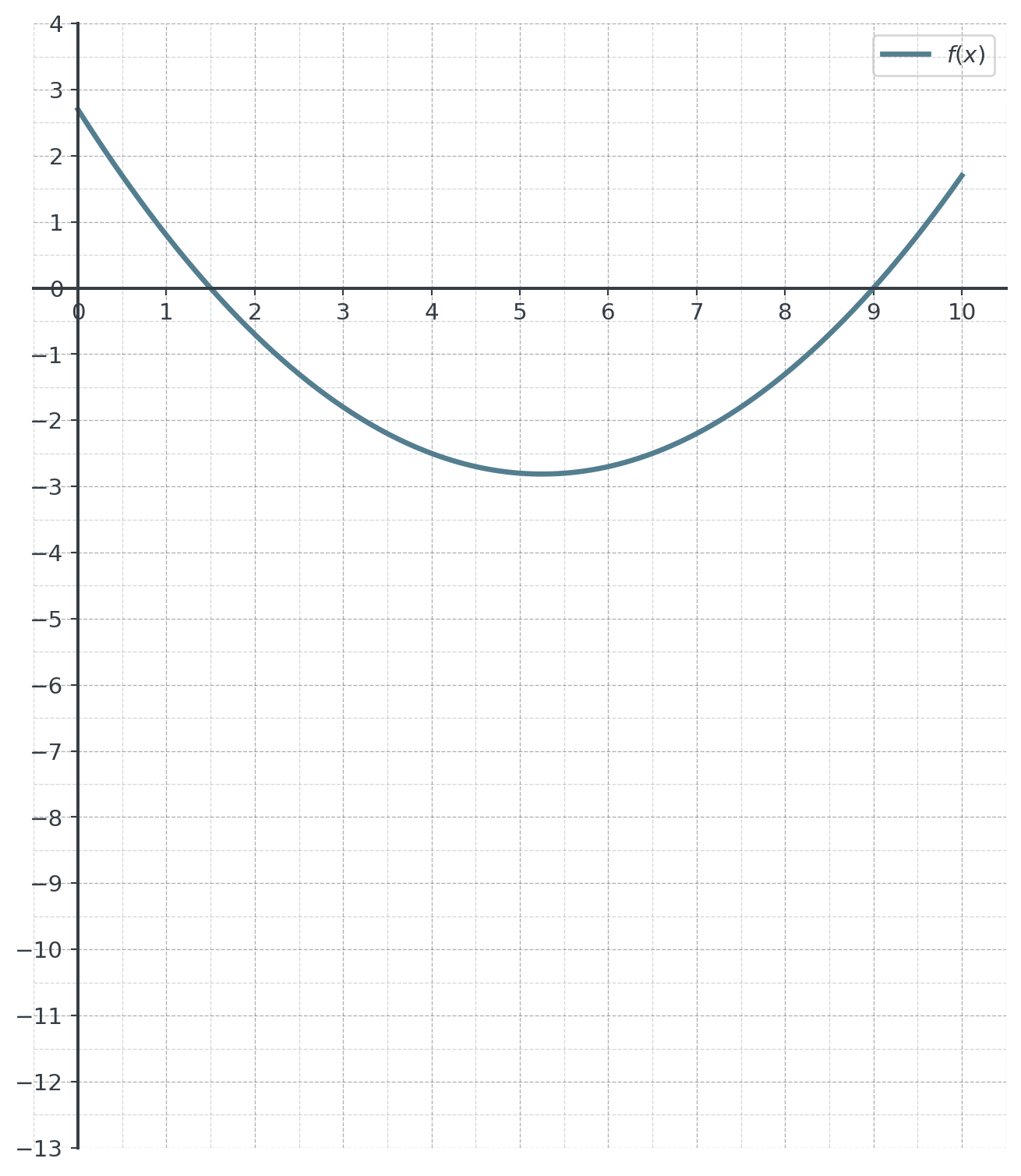
The figure shows the graph of a quadratic function \(f\) on the interval \([0; 10]\). Both zeros of \(f\) lie on grid points.
Note: Print the page or copy the figure onto squared paper. In the exam, you draw directly into the printed figure.
- Read the zeros of \(f\) and the \(x\)-value of the lowest point of its graph (halfway between the zeros) from the figure. Give the intervals on which an antiderivative \(F\) of \(f\) increases and decreases. Determine the \(x\)-values and the type of the local extrema of \(F\), and the \(x\)-value of the inflection point of \(F\).
Hint: Because \(F' = f\), the rules from Session 05-05 apply to \(F\): \(F\) increases where \(f\) is positive, \(F\) has a local extremum where \(f\) changes sign, and \(F\) has an inflection point where \(f\) has a local extremum.
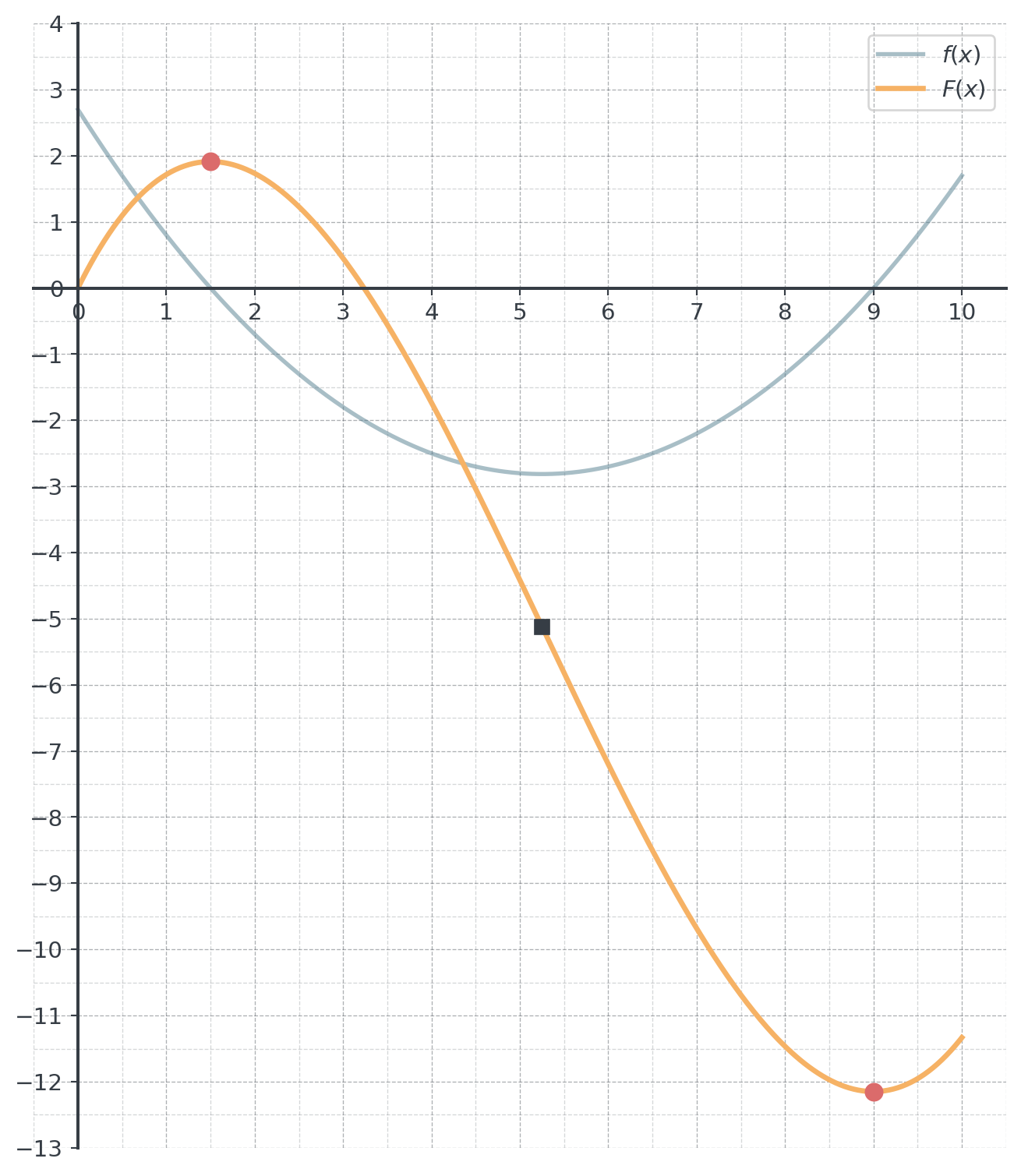
Sketch the antiderivative \(F\) with \(F(0) = 0\) directly into the figure. Explain how the graph of \(F\) is related to the graph of \(f\).
The figure shows \(f(x) = 0.2x^2 - 2.1x + 2.7\). Determine the antiderivative \(F\) with \(F(0) = 0\). Compute the coordinates of the local extrema of \(F\) and compare them with your sketch.
(for verification: \(F(x) = \frac{1}{15}x^3 - 1.05x^2 + 2.7x\))
- Compute the area enclosed by the graph of \(f\) and the \(x\)-axis. Explain why \(F(9) - F(1.5)\) is negative while the area is positive.
CautionSolution
a) The graph crosses the \(x\)-axis at \(x = 1.5\) and \(x = 9\). A parabola is symmetric, so its lowest point lies halfway between the zeros, at \(x = \frac{1.5 + 9}{2} = 5.25\). Since \(F' = f\), the sign of \(f\) is the sign of the slope of \(F\):
| \(x\) | \(0 < x < 1.5\) | \(1.5 < x < 9\) | \(9 < x < 10\) |
|---|---|---|---|
| \(f(x) = F'(x)\) | \(+\) | \(-\) | \(+\) |
| \(F\) | increasing | decreasing | increasing |
- \(x = 1.5\): \(f\) changes from \(+\) to \(-\), local maximum of \(F\)
- \(x = 9\): \(f\) changes from \(-\) to \(+\), local minimum of \(F\)
- \(x = 5.25\): \(f\) has its minimum, so the slope of \(F\) is smallest there: inflection point of \(F\). \(F\) is concave down for \(x < 5.25\) (where \(f\) decreases) and concave up for \(x > 5.25\) (where \(f\) increases).
b) Start at \((0, 0)\). \(F\) rises a little up to the maximum at \(x = 1.5\): the region under \(f\) on \([0; 1.5]\) is close to a triangle with area \(\frac{1}{2} \cdot 1.5 \cdot 2.7 \approx 2\). Then \(F\) falls, most steeply at \(x = 5.25\), where the slope is the lowest value of \(f\), about \(-2.8\). The region between \(f\) and the \(x\)-axis on \([1.5; 9]\) is much larger, so \(F\) falls far below the \(x\)-axis, to the minimum at \(x = 9\). After that, \(F\) rises slowly again.
Relation: the value of \(f\) at \(x\) is the slope of \(F\) at \(x\), and \(F(x) - F(0)\) is the integral of \(f\) from 0 to \(x\). Where \(f\) is far from the \(x\)-axis, \(F\) is steep. Where \(f\) is 0, \(F\) has a horizontal tangent. The figure shows the exact antiderivative for comparison (circles: extrema, square: inflection point). Your sketch only needs this shape.
c) Power rule term by term:
\[F(x) = 0.2 \cdot \frac{x^3}{3} - 2.1 \cdot \frac{x^2}{2} + 2.7x + K = \frac{1}{15}x^3 - 1.05x^2 + 2.7x + K\]
\(F(0) = K = 0\), so \(F(x) = \frac{1}{15}x^3 - 1.05x^2 + 2.7x\).
Extrema: \(F'(x) = f(x) = 0\) at \(x = 1.5\) and \(x = 9\). With \(F''(x) = f'(x) = 0.4x - 2.1\):
- \(F''(1.5) = -1.5 < 0\): maximum, \(F(1.5) = 0.225 - 2.3625 + 4.05 = 1.9125\), point \((1.5, 1.91)\)
- \(F''(9) = 1.5 > 0\): minimum, \(F(9) = 48.6 - 85.05 + 24.3 = -12.15\), point \((9, -12.15)\)
The estimate of about 2 for the maximum in b) fits. \(F''(x) = 0\) at \(x = 5.25\) confirms the inflection point from a).
d) Between the zeros 1.5 and 9, the graph of \(f\) lies below the \(x\)-axis (\(f(5.25) < 0\)). With \(F\) from c):
\[\int_{1.5}^{9} f(x) \, dx = F(9) - F(1.5) = -12.15 - 1.9125 = -14.0625\]
\[A = \left|\int_{1.5}^{9} f(x) \, dx\right| = 14.0625 \approx 14.06 \text{ area units}\]
\(F(9) - F(1.5)\) is negative because \(f < 0\) on \((1.5; 9)\): \(F\) falls by 14.06 there, as the sketch in b) shows. The area measures the size of the region, so it is the absolute value.
Typical mistake: in a), putting the extrema of \(F\) at the lowest point of \(f\), \(x = 5.25\). That is the rule for \(f'\). For \(F\), the extrema lie at the zeros of \(f\) with a sign change, and the extremum of \(f\) becomes the inflection point of \(F\).
Problem 10: A Minimum Price for Lambs (xxx)
In a heathland region, sheep farms sell lambs to butchers and restaurants. The demand function is \(D(q) = 130 - 3q\) and the supply function is \(S(q) = 0.4q^2 + 3q + 30\), with \(q\) in thousand lambs per year and prices in EUR per lamb.
- Determine the equilibrium quantity and the equilibrium price.
(for verification: \(q^* = 10\))
Compute the consumer surplus and the producer surplus at the equilibrium. State the meaning of the producer surplus for the sheep farms.
The regional government sets a minimum price of 112 EUR per lamb, so that the farms can afford to keep their sheep grazing the heath. Determine how many lambs the butchers and restaurants buy and how many lambs the farms would like to sell. Compute the new consumer surplus and the new producer surplus, both up to the quantity that is traded.
(for verification: 6 thousand lambs are traded)
- The deadweight loss is the part of the total surplus \(CS + PS\) that nobody gets any more. Compute the deadweight loss as an integral between the demand curve and the supply curve and check it with your results from b) and c). The farmers’ association says: “The minimum price helps the farms, because they get 12 EUR more for every lamb.” Check this claim.
Hint: The deadweight loss is the area between the demand curve and the supply curve over the quantities that are no longer traded.
CautionSolution
a) At the equilibrium, demand equals supply:
\[130 - 3q = 0.4q^2 + 3q + 30 \iff 0.4q^2 + 6q - 100 = 0 \iff q^2 + 15q - 250 = 0\]
Quadratic formula:
\[q = \frac{-15 \pm \sqrt{225 + 1000}}{2} = \frac{-15 \pm 35}{2}, \qquad q = 10 \text{ or } q = -25\]
A quantity cannot be negative, so \(q^* = 10\) thousand lambs and \(p^* = D(10) = 130 - 30 = 100\) EUR per lamb. Check: \(S(10) = 40 + 30 + 30 = 100\) ✓
b) Both surpluses are areas between a curve and the price line \(p^* = 100\), from 0 to \(q^* = 10\). The units are thousand lambs times EUR per lamb, i.e. thousand EUR.
\[CS = \int_0^{10} (130 - 3q - 100) \, dq = \left[30q - 1.5q^2\right]_0^{10} = 300 - 150 = 150\]
\[PS = \int_0^{10} \left(100 - 0.4q^2 - 3q - 30\right) dq = \left[70q - 1.5q^2 - \frac{0.4}{3}q^3\right]_0^{10} = 700 - 150 - \frac{400}{3} \approx 416.67\]
The consumer surplus is 150 thousand EUR and the producer surplus about 416.67 thousand EUR per year.
Meaning: the supply curve shows the lowest price at which the farms would still sell each lamb. All lambs are sold at 100 EUR, so the farms receive about 416,670 EUR per year more than these lowest prices.
c) Bought: \(130 - 3q = 112 \iff q = 6\) thousand lambs.
Offered: \(0.4q^2 + 3q + 30 = 112 \iff 0.4q^2 + 3q - 82 = 0 \iff q^2 + 7.5q - 205 = 0\):
\[q = \frac{-7.5 + \sqrt{56.25 + 820}}{2} = \frac{-7.5 + \sqrt{876.25}}{2} \approx 11.05\]
The farms would like to sell about 11.05 thousand lambs, but only 6 thousand are bought. About 5.05 thousand lambs find no buyer at this price.
New surpluses up to the traded quantity 6, with the price line at 112:
\[CS_{new} = \int_0^{6} (130 - 3q - 112) \, dq = \left[18q - 1.5q^2\right]_0^{6} = 108 - 54 = 54\]
\[PS_{new} = \int_0^{6} \left(112 - 0.4q^2 - 3q - 30\right) dq = \left[82q - 1.5q^2 - \frac{0.4}{3}q^3\right]_0^{6} = 492 - 54 - 28.8 = 409.2\]
d) At the quantities from 6 to 10, a buyer would pay more than the farms need (\(D(q) > S(q)\)), but these lambs are no longer traded:
\[DWL = \int_6^{10} \left(D(q) - S(q)\right) dq = \int_6^{10} \left(100 - 6q - 0.4q^2\right) dq = \left[100q - 3q^2 - \frac{0.4}{3}q^3\right]_6^{10}\]
\[= \left(1000 - 300 - \frac{400}{3}\right) - (600 - 108 - 28.8) \approx 566.67 - 463.20 = 103.47\]
Check: total surplus before \(150 + 416.67 = 566.67\), after \(54 + 409.20 = 463.20\), difference \(103.47\) thousand EUR ✓
Claim: the producer surplus falls from about 416.67 to 409.20 thousand EUR: the farms lose about 7.47 thousand EUR per year. They get 12 EUR more per lamb, but they sell 4 thousand lambs fewer, and the higher price does not make up for that. The claim is false. The butchers and restaurants lose \(150 - 54 = 96\) thousand EUR per year. Together, both sides lose \(96 + 7.47 = 103.47\) thousand EUR, exactly the deadweight loss.
Typical mistake: in c), computing the new producer surplus up to the quantity offered, about 11.05. The farms only earn money on the lambs that are actually bought, so every surplus ends at the traded quantity 6.
D: FSP Problem
Work on this problem as in the exam: write down every step. The points show what each part is worth.
FSP Problem: Sales of a New VR Headset [27 pts. total]
A technology company launches a new VR headset (virtual reality glasses for games and films). The monthly sales are modelled by
\[f(t) = \left(0.5t^2 + 3t\right) \cdot e^{-0.25t}\]
in thousand headsets per month, \(t\) months after the launch (\(t \geq 0\)).
Part a)
Verify computationally that \(f\) possesses a maximum at \(t = 6\). Compute the highest monthly sales.
(for verification: \(f'(t) = \left(-0.125t^2 + 0.25t + 3\right) \cdot e^{-0.25t}\))
[6 pts.]
CautionSolution
First derivative: product rule with \(u = 0.5t^2 + 3t\), \(u' = t + 3\) and \(v = e^{-0.25t}\), \(v' = -0.25e^{-0.25t}\) (chain rule):
\[f'(t) = (t + 3) \cdot e^{-0.25t} + \left(0.5t^2 + 3t\right) \cdot (-0.25)e^{-0.25t} = \left(-0.125t^2 + 0.25t + 3\right) \cdot e^{-0.25t}\]
Necessary condition: \(f'(6) = (-4.5 + 1.5 + 3) \cdot e^{-1.5} = 0 \cdot e^{-1.5} = 0\) ✓
Second derivative: product rule again, with \(u = -0.125t^2 + 0.25t + 3\), \(u' = -0.25t + 0.25\):
\[f''(t) = (-0.25t + 0.25) \cdot e^{-0.25t} + \left(-0.125t^2 + 0.25t + 3\right) \cdot (-0.25)e^{-0.25t} = \left(0.03125t^2 - 0.3125t - 0.5\right) \cdot e^{-0.25t}\]
Sufficient condition: \(f''(6) = (1.125 - 1.875 - 0.5) \cdot e^{-1.5} = -1.25e^{-1.5} \approx -0.28 < 0\) ✓
So \(f\) has a maximum at \(t = 6\).
Highest monthly sales: \(f(6) = (18 + 18) \cdot e^{-1.5} = 36e^{-1.5} \approx 8.03\) thousand headsets, i.e. about 8,030 headsets per month, 6 months after the launch.
Grading: 2 Pts. \(f'(t)\) with product and chain rule, 1 Pt. \(f'(6) = 0\), 1 Pt. \(f''(t)\), 1 Pt. \(f''(6) < 0\) and the conclusion, 1 Pt. highest monthly sales \(\approx 8.03\) thousand headsets.
Part b)
Compute the limit of \(f(t)\) at positive infinity and interpret its significance.
[3 pts.]
CautionSolution
For \(t \to \infty\), \(0.5t^2 + 3t \to \infty\), but \(e^{-0.25t} \to 0\), and the exponential function shrinks faster than any polynomial grows. So
\[\lim_{t \to \infty} f(t) = 0\]
Significance: after the maximum from a), the monthly sales fall, and in the long run they approach zero. After some time, hardly anyone buys this model any more, for example because newer headsets replace it.
Grading: 1 Pt. limit 0, 1 Pt. reason (the exponential function shrinks faster than the polynomial grows), 1 Pt. interpretation.
Part c)
Find the antiderivative of \(f(t)\) and show your work.
(for verification: \(F(t) = -2\left(t^2 + 14t + 56\right) \cdot e^{-0.25t} + C\))
[7 pts.]
CautionSolution
First step: by the LIATE rule, \(u\) is the polynomial: \(u = 0.5t^2 + 3t\), \(du = (t + 3) \, dt\), \(dv = e^{-0.25t} \, dt\), \(v = \frac{1}{-0.25}e^{-0.25t} = -4e^{-0.25t}\):
\[\int \left(0.5t^2 + 3t\right)e^{-0.25t} \, dt = -4\left(0.5t^2 + 3t\right)e^{-0.25t} - \int (t + 3) \cdot \left(-4e^{-0.25t}\right) dt = -\left(2t^2 + 12t\right)e^{-0.25t} + \int (4t + 12)e^{-0.25t} \, dt\]
Second step: \(u = 4t + 12\), \(du = 4 \, dt\), \(v = -4e^{-0.25t}\):
\[\int (4t + 12)e^{-0.25t} \, dt = -4(4t + 12)e^{-0.25t} - \int (-16)e^{-0.25t} \, dt = -(16t + 48)e^{-0.25t} - 64e^{-0.25t} = -(16t + 112)e^{-0.25t}\]
Together:
\[F(t) = -\left(2t^2 + 12t\right)e^{-0.25t} - (16t + 112)e^{-0.25t} + C = -\left(2t^2 + 28t + 112\right)e^{-0.25t} + C = -2\left(t^2 + 14t + 56\right)e^{-0.25t} + C\]
Check (product rule):
\[F'(t) = -2(2t + 14)e^{-0.25t} + 0.5\left(t^2 + 14t + 56\right)e^{-0.25t} = \left(-4t - 28 + 0.5t^2 + 7t + 28\right)e^{-0.25t} = \left(0.5t^2 + 3t\right)e^{-0.25t} = f(t) \quad \checkmark\]
Grading: 1 Pt. \(u\), \(du\), \(dv\) and \(v\) of the first step, 2 Pts. result of the first step, 2 Pts. second integration by parts, 1 Pt. \(F(t)\) simplified with \(+ C\), 1 Pt. check \(F'(t) = f(t)\).
Part d)
Compute the number of headsets sold between month 6 and month 12. Compute the average monthly sales within the first 20 months.
[6 pts.]
CautionSolution
Between month 6 and month 12: the sales are the integral of the monthly sales from \(t = 6\) to \(t = 12\). With \(F\) from c) (\(C\) cancels), \(F(6) = -2(36 + 84 + 56)e^{-1.5} = -352e^{-1.5}\) and \(F(12) = -2(144 + 168 + 56)e^{-3} = -736e^{-3}\):
\[\int_6^{12} f(t) \, dt = F(12) - F(6) = 352e^{-1.5} - 736e^{-3} \approx 41.90\]
About 41.90 thousand headsets, i.e. about 41,900 headsets, are sold between month 6 and month 12.
Average within the first 20 months: \(F(0) = -2 \cdot 56 = -112\) and \(F(20) = -2(400 + 280 + 56)e^{-5} = -1472e^{-5}\):
\[f_{avg} = \frac{1}{20 - 0}\int_0^{20} f(t) \, dt = \frac{1}{20}\left(112 - 1472e^{-5}\right) = 5.6 - 73.6e^{-5} \approx 5.10\]
On average, the company sells about 5.10 thousand headsets per month within the first 20 months.
Grading: 1 Pt. integral from 6 to 12, 1 Pt. \(F(12)\) and \(F(6)\), 1 Pt. about 41.90 thousand headsets, 1 Pt. average value formula with \(\frac{1}{20}\), 1 Pt. \(F(20)\) and \(F(0)\), 1 Pt. about 5.10 thousand headsets per month.
Part e)
Before the launch, the company built a first batch of 60,000 headsets. Show that this batch does not last for the first 12 months and determine the time at which it is sold out. Building a second batch takes 3 months. Determine the latest time at which the company has to start building it.
Hint: Use SOLVE (SHIFT + CALC) and enter the difference of both sides of your equation.
[5 pts.]
CautionSolution
Not enough: with \(F\) from c), the sales in the first 12 months are
\[\int_0^{12} f(t) \, dt = F(12) - F(0) = 112 - 736e^{-3} \approx 75.36\]
thousand headsets, more than the 60 thousand of the first batch.
Sold out: the batch is sold out at the time \(T\) at which the sales since the launch reach 60 thousand:
\[\int_0^T f(t) \, dt = F(T) - F(0) = 112 - 2\left(T^2 + 14T + 56\right)e^{-0.25T} = 60\]
SOLVE with \(112 - 2\left(x^2 + 14x + 56\right)e^{-0.25x} - 60\) and the initial guess 10 gives \(T \approx 9.49\). Check: \(\int_0^9 f(t) \, dt \approx 56.56 < 60\) and \(\int_0^{10} f(t) \, dt \approx 63.41 > 60\) ✓. The first batch is sold out about 9.49 months after the launch.
Latest start: \(9.49 - 3 = 6.49\). The company has to start building the second batch at the latest about 6.49 months after the launch (a latest time is rounded down).
Grading: 1 Pt. sales in the first 12 months \(\approx 75.36 > 60\), 1 Pt. equation \(F(T) - F(0) = 60\), 2 Pts. \(T \approx 9.49\) with SOLVE and a check, 1 Pt. latest start after about 6.49 months.