Session 09-05: Tasks
Final Recap - Calculus & Curve Sketching
Exam-Style Problem: Graphical Differentiation / Integration / System of Linear Equations
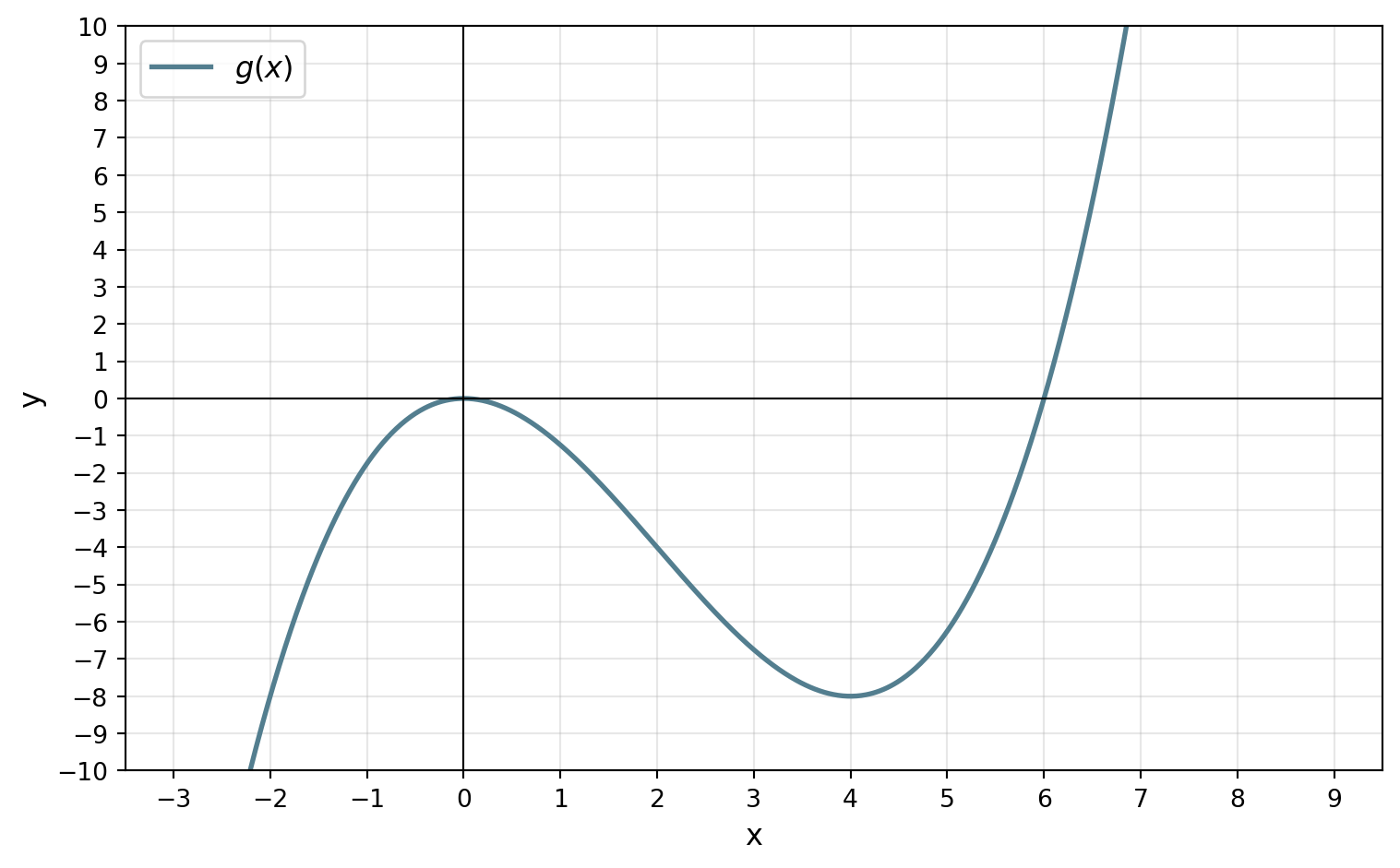
Consider the following third degree polynomial \(g(x)\):
Part a)
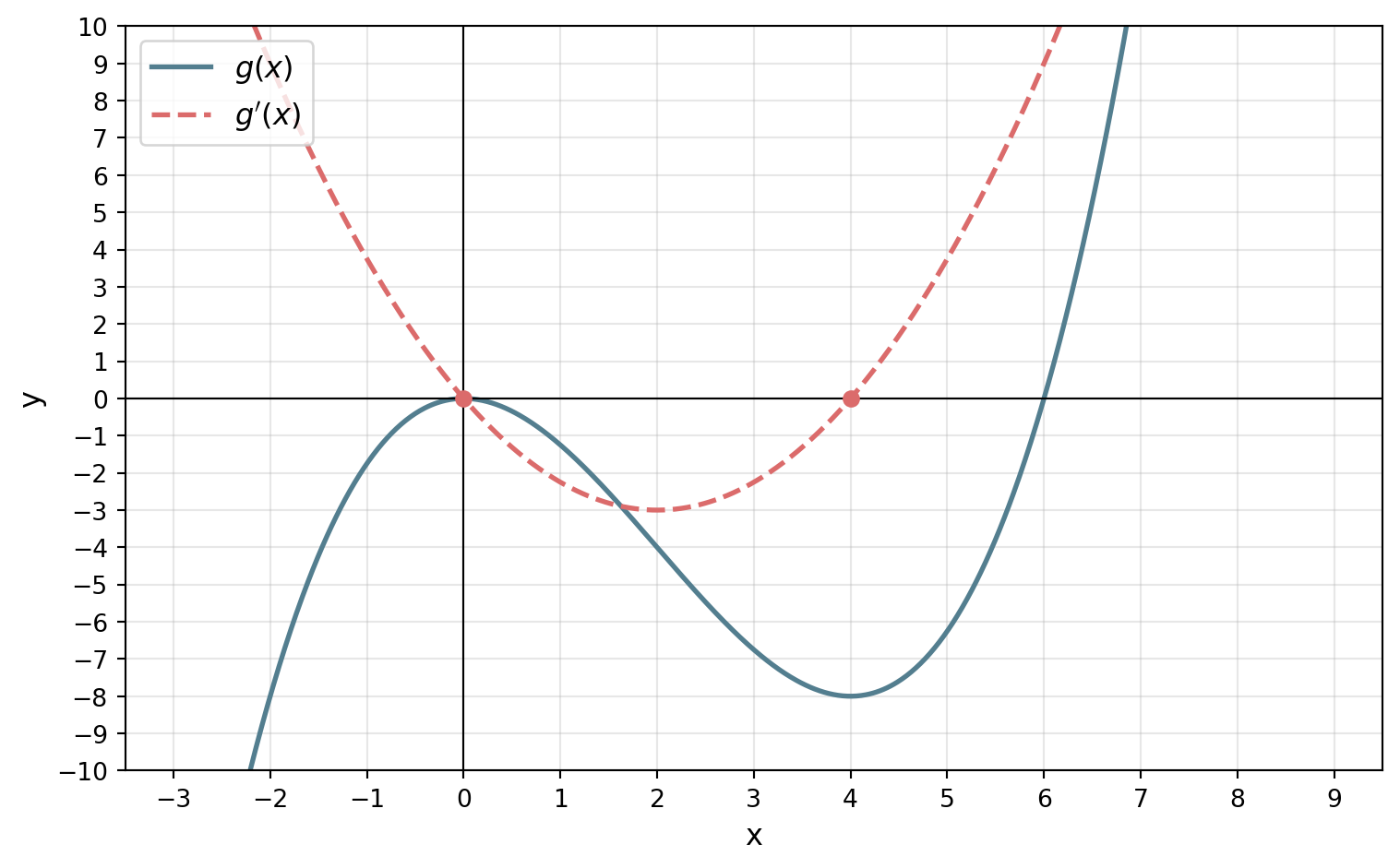
Graph the derivative \(g'(x)\) of the function depicted above directly into the figure.
CautionSolution
Key observations for sketching \(g'(x)\):
- \(g'(x) = 0\) at \(x = 0\) (local max of \(g\); double root touch) and \(x = 4\) (local min of \(g\))
- \(g'(x) > 0\) for \(x < 0\) and \(x > 4\) (where \(g\) is increasing)
- \(g'(x) < 0\) for \(0 < x < 4\) (where \(g\) is decreasing)
- \(g'(x)\) is a quadratic (upward-opening parabola) since \(g\) has a positive leading coefficient
Part b)
Graph the antiderivative \(G(x)\) of the function depicted above directly into the figure and interpret its relation to \(g(x)\).
CautionSolution
Since \(G'(x) = g(x)\), the antiderivative \(G\) increases where \(g > 0\) and decreases where \(g < 0\).
Sign analysis of \(g(x) = \frac{1}{4}x^2(x-6)\):
- For \(x < 0\): \(x^2 > 0\) and \((x-6) < 0\), so \(g(x) < 0\) \(\Rightarrow\) \(G\) decreasing
- For \(0 < x < 6\): \(x^2 > 0\) and \((x-6) < 0\), so \(g(x) < 0\) \(\Rightarrow\) \(G\) decreasing
- For \(x > 6\): \(x^2 > 0\) and \((x-6) > 0\), so \(g(x) > 0\) \(\Rightarrow\) \(G\) increasing
Special points:
- \(g(0) = 0\) but \(g\) does not change sign (double root) \(\Rightarrow\) \(G\) has an inflection point at \(x = 0\)
- \(g(6) = 0\) and \(g\) changes sign \(\Rightarrow\) \(G\) has a local minimum at \(x = 6\)
Choosing \(G(0) = 0\):
\[G(x) = \frac{x^4}{16} - \frac{x^3}{2}\]
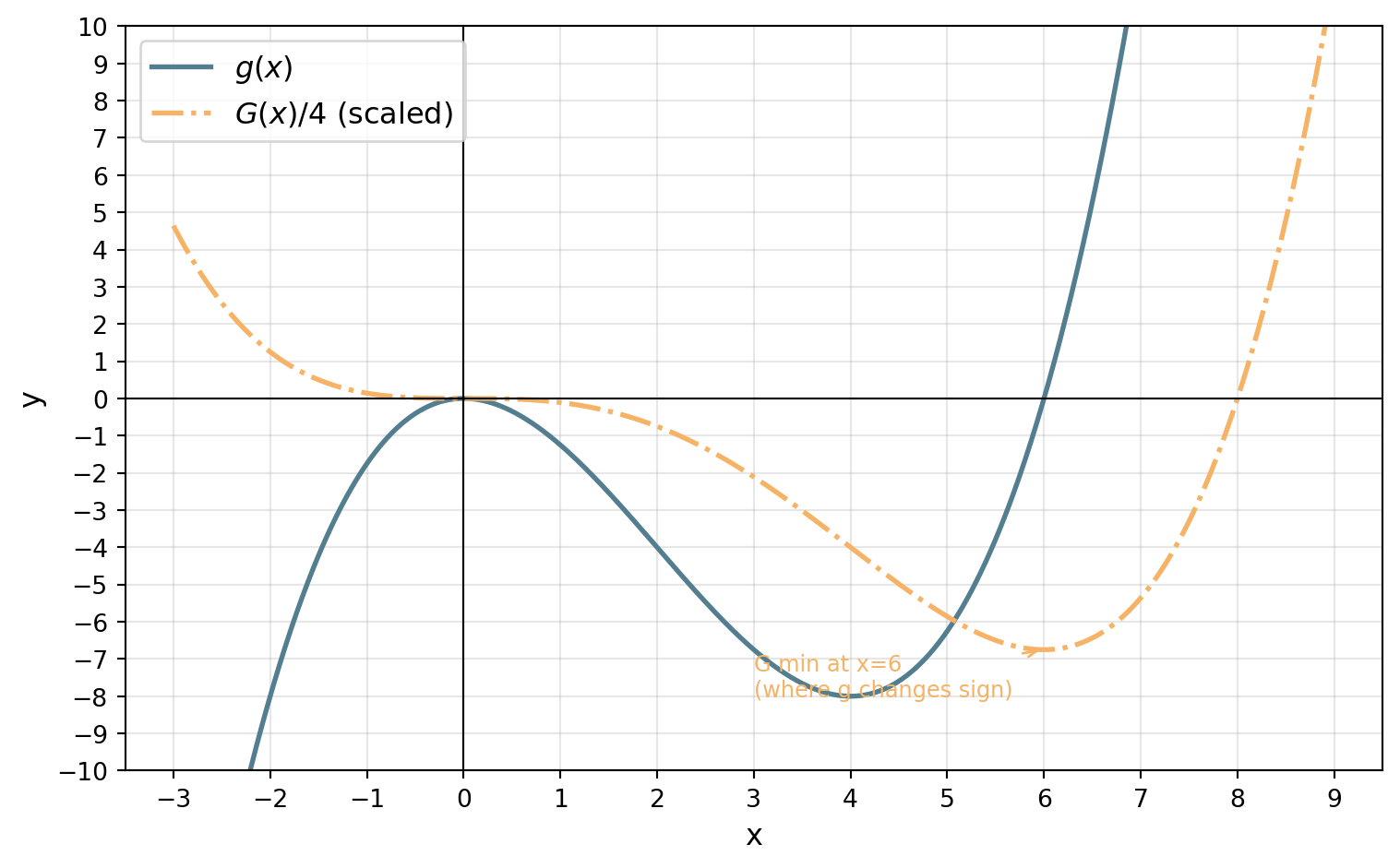
Interpretation: \(G(x)\) represents the accumulated (signed) area under \(g(x)\). Where \(g(x) > 0\), \(G\) increases; where \(g(x) < 0\), \(G\) decreases. The zeros of \(g\) correspond to critical points or inflection points of \(G\), depending on whether \(g\) changes sign.
Part c)
Determine the functional equation \(g(x) = ax^3 + bx^2 + cx + d\) by determining the values of \(a\), \(b\), \(c\), and \(d\).
CautionSolution
From the graph we read the following information:
- \(g(0) = 0\) (passes through origin)
- \(g'(0) = 0\) (local maximum at the origin; the graph touches the \(x\)-axis)
- \(g'(4) = 0\) (local minimum at \(x = 4\))
- \(g(4) = -8\) (value at the local minimum)
From \(g(0) = 0\): \(d = 0\)
From \(g'(0) = 0\): \(g'(x) = 3ax^2 + 2bx + c\), so \(g'(0) = c = 0\)
With \(c = 0\) and \(d = 0\), we have \(g(x) = ax^3 + bx^2\) and \(g'(x) = 3ax^2 + 2bx\).
Setting up the remaining equations:
\[g'(4) = 48a + 8b = 0 \quad \Rightarrow \quad 6a + b = 0 \quad \Rightarrow \quad b = -6a \quad (I)\]
\[g(4) = 64a + 16b = -8 \quad (II)\]
Substituting (I) into (II): \(64a + 16(-6a) = -8\)
\[64a - 96a = -8 \quad \Rightarrow \quad -32a = -8 \quad \Rightarrow \quad a = \frac{1}{4}\]
Back-substituting: \(b = -6 \cdot \frac{1}{4} = -\frac{3}{2}\)
\[\boxed{g(x) = \frac{1}{4}x^3 - \frac{3}{2}x^2}\]
Verification: \(g(x) = \frac{1}{4}x^2(x - 6)\)
- \(g(0) = 0\) \(\checkmark\)
- \(g(6) = \frac{1}{4}(36)(0) = 0\) \(\checkmark\)
- \(g(4) = \frac{1}{4}(16)(-2) = -8\) \(\checkmark\)
Part d)
Determine the functional equation of the tangent \(t(x)\) at \(x = -2\).
(Hint: Continue your work using the function \(g(x) = \frac{1}{4}x^3 - \frac{3}{2}x^2\).)
CautionSolution
Using the function \(g(x) = \frac{1}{4}x^3 - \frac{3}{2}x^2\):
Function value at \(x = -2\):
\[g(-2) = \frac{-8}{4} - \frac{3 \cdot 4}{2} = -2 - 6 = -8\]
Slope at \(x = -2\):
\[g'(x) = \frac{3x^2}{4} - 3x\]
\[g'(-2) = \frac{3 \cdot 4}{4} - 3 \cdot (-2) = 3 + 6 = 9\]
Tangent equation:
\[t(x) = g'(-2)(x - (-2)) + g(-2) = 9(x + 2) - 8 = 9x + 18 - 8\]
\[\boxed{t(x) = 9x + 10}\]
Part e)
Compute the angle of intersection \(\alpha\) between the tangent and the \(x\)-axis.
CautionSolution
The slope of the tangent is \(m = 9\).
\[\tan(\alpha) = m = 9\]
\[\alpha = \arctan(9) \approx 83.66°\]
\[\boxed{\alpha \approx 83.7°}\]