Session 08-01 - Compound Interest & Geometric Sequences
Section 08: Financial Mathematics
Entry Quiz
Quick Review from Section 07
Test your understanding of Probability
In a survey, 60% of customers are satisfied, 40% are repeat buyers, and 30% are both. Find \(P(\text{Satisfied OR Repeat})\).
A medical test has sensitivity 95% and specificity 90%. If disease prevalence is 2%, find the PPV.
A coin is flipped 4 times. Find \(P(\text{exactly 2 heads})\).
Create a contingency table: 100 people surveyed, 55 own cars, 40 own bikes, 20 own both.
Financial Mathematics
New Section Overview
Section 08 covers essential financial topics:
- Session 08-01: Compound Interest & Geometric Sequences (today)
- Session 08-02: Annuities & Loan Amortization
- Session 08-03: Cost Analysis & Pricing Decisions
Cost analysis and pricing decisions are exam-critical topics!
Learning Objectives
What You’ll Master Today
- Understand geometric sequences and their formulas
- Calculate compound interest for different compounding periods
- Find effective annual rates for comparison
- Apply present value concepts to business decisions
- Use the Rule of 72 for quick estimates
Geometric Sequences
What is a Geometric Sequence?
A sequence where each term is multiplied by a constant ratio:
\[a_1, \, a_1 \cdot r, \, a_1 \cdot r^2, \, a_1 \cdot r^3, \, \ldots\]
ImportantKey Formulas
Explicit formula (nth term): \[a_n = a_1 \cdot r^{n-1}\]
Recursive formula: \[a_n = a_{n-1} \cdot r\]
Examples of Geometric Sequences
Common ratio determines behavior:
\(r = 2\): \(3, 6, 12, 24, 48, \ldots\) (growth)
\(r = \frac{1}{2}\): \(16, 8, 4, 2, 1, \ldots\) (decay)
\(r = -2\): \(1, -2, 4, -8, 16, \ldots\) (alternating)
- \(|r| > 1\): sequence grows (or alternates with growth)
- \(|r| < 1\): sequence decays toward zero
- \(r = 1\): constant sequence
Sum of a Geometric Sequence
ImportantSum Formula
\[S_n = a_1 + a_1 r + a_1 r^2 + \ldots + a_1 r^{n-1} = a_1 \cdot \frac{r^n - 1}{r - 1} \quad (r \neq 1)\]
Example: A new product sells 1,200 units in its first year, and sales grow by 5 % per year. Total sales in the first 6 years:
\[S_6 = 1200 \cdot \frac{1.05^6 - 1}{1.05 - 1} \approx 8{,}162 \text{ units}\]
The annuity formulas in Session 08-02 are exactly such sums: each payment grows with the factor \((1 + r)\).
Compound Interest
Simple vs. Compound Interest
Two ways to grow money:
Simple Interest: Interest earned only on principal \[A = P(1 + rt)\]
Compound Interest: Interest earned on principal AND accumulated interest \[A = P(1 + r)^t\]
Compound interest creates exponential growth. This is where geometric sequences appear!
The Compound Interest Formula
Annual Compounding
\[A = P(1 + r)^t\]
where:
- \(A\) = Final amount (future value)
- \(P\) = Principal (initial investment)
- \(r\) = Annual interest rate (as decimal)
- \(t\) = Time in years
Example: Invest 1,000 at 5% for 10 years, \(A = 1000(1.05)^{10}\)
Multiple Compounding Periods
What if interest compounds more frequently?
General formula with \(n\) compounding periods per year:
\[A = P\left(1 + \frac{r}{n}\right)^{nt}\]
| Compounding | n |
|---|---|
| Annual | 1 |
| Semi-annual | 2 |
| Quarterly | 4 |
| Monthly | 12 |
| Daily | 365 |
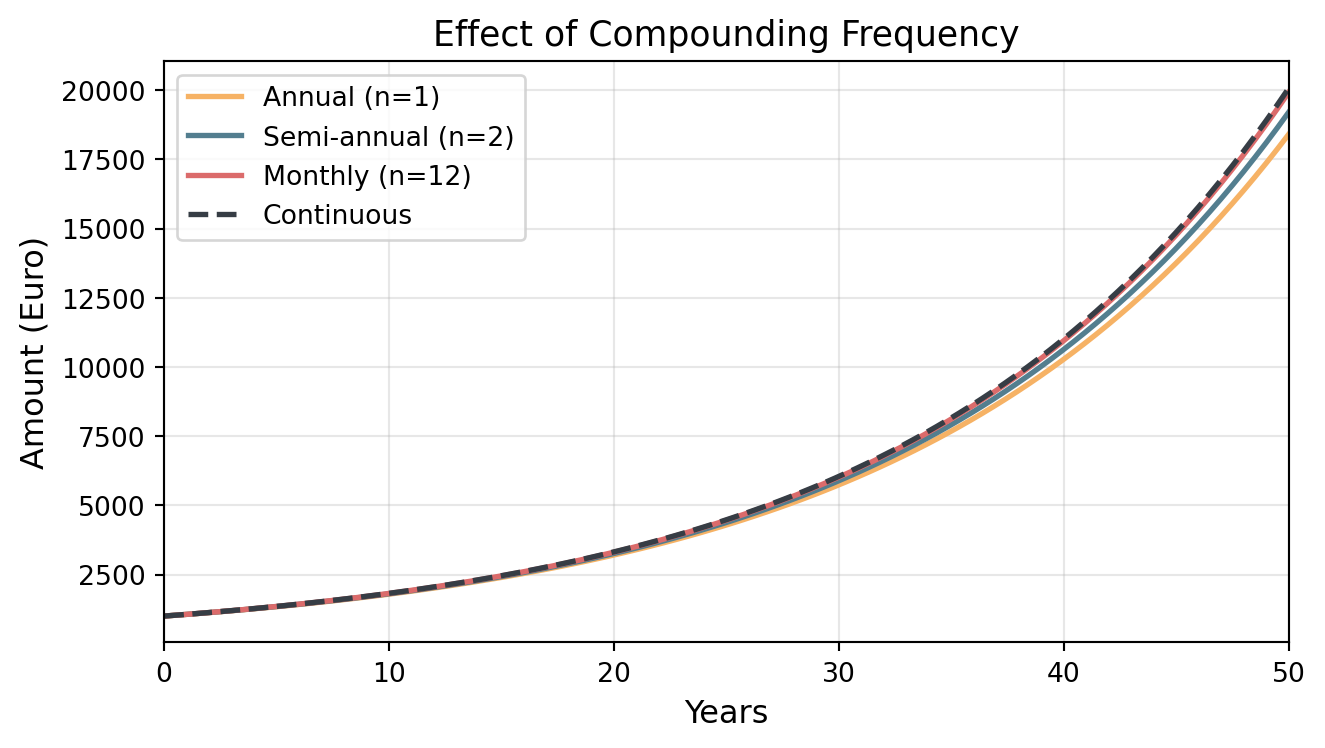
Compounding Comparison
1,000 invested at 6% for 50 years:
Continuous Compounding
As \(n \to \infty\), we get continuous compounding:
Continuous Compounding Formula
\[A = Pe^{rt}\]
where \(e \approx 2.71828\)
Derivation: \(\lim_{n \to \infty} \left(1 + \frac{r}{n}\right)^n = e^r\)
Example: 1,000 at 6% continuous for 5 years, \(A = 1000 \cdot e^{0.06 \times 5}\)
Break
Effective Annual Rate
Comparing Different Rates
Problem: Bank A offers 6% compounded monthly. Bank B offers 6.1% compounded annually. Which is better?
We need a common basis for comparison!
Effective Annual Rate (EAR)
\[r_{\text{eff}} = \left(1 + \frac{r}{n}\right)^n - 1\]
This gives the equivalent annual rate for any compounding frequency.
EAR Calculation Example
Bank A: 6% compounded monthly \[r_{\text{eff}} = \left(1 + \frac{0.06}{12}\right)^{12} - 1 = (1.005)^{12} - 1 = 0.0617 = 6.17\%\]
Bank B: 6.1% compounded annually \[r_{\text{eff}} = 6.1\%\]
Bank A is slightly better (6.17% > 6.10%)!
EAR for Continuous Compounding
For continuous compounding:
\[r_{\text{eff}} = e^r - 1\]
Example: 6% continuous compounding \[r_{\text{eff}} = e^{0.06} - 1 \approx 0.0618 = 6.18\%\]
Present Value
The Present Value Concept
Question: How much invest today to have 10,000 in 5 years at 6%?
We need to discount future values back to today.
Present Value Formula
\[PV = \frac{FV}{(1 + r)^t} = FV \cdot (1 + r)^{-t}\]
Present Value Example
Goal: 10,000 in 5 years at 6%
\[PV = \frac{10000}{(1.06)^5} = \frac{10000}{1.3382} = 7,472.58\]
You need to invest 7,472.58 today to have 10,000 in 5 years!
With monthly compounding: \[PV = \frac{10000}{(1 + 0.06/12)^{60}} = \frac{10000}{1.3489} = 7,413.72\]
Business Applications
Investment Growth Analysis
A company invests 50,000 in bonds paying 4.5% compounded quarterly.
- What is the value after 10 years?
- What is the effective annual rate?
- How long until the investment doubles?
Inflation Adjustment
Real Interest Rate (Fisher Equation)
\[r_{\text{real}} \approx r_{\text{nominal}} - r_{\text{inflation}}\]
Exact formula: \[1 + r_{\text{real}} = \frac{1 + r_{\text{nominal}}}{1 + r_{\text{inflation}}}\]
Example: 6% nominal return, 2% inflation \[r_{\text{real}} = \frac{1.06}{1.02} - 1 = 0.039 = 3.9\%\]
Guided Practice
Practice Problems
Work in pairs
Problem 1: Calculate the future value of 2,500 invested at 5.5% compounded monthly for 8 years.
Problem 2: Bank A offers 4.8% compounded daily. Bank B offers 4.9% compounded annually. Which bank offers a better return?
Problem 3: You need 25,000 in 6 years. How much must you invest today at 7% compounded quarterly?
Wrap-Up & Takeaways
Today’s Essential Concepts
- Geometric sequences have constant ratio: \(a_n = a_1 \cdot r^{n-1}\)
- Compound interest creates exponential growth
- More frequent compounding increases returns
- Effective annual rate allows fair comparison
- Present value discounts future amounts
- Rule of 72 estimates doubling time quickly
TipComing Next
Session 08-02: Annuities & Loan Amortization, the maths of regular payment streams!
Homework
Tasks 08-01
- Calculate geometric sequence terms and sums
- Compound interest with various compounding periods
- Compare investments using effective annual rates
- Present value calculations for financial planning
Practice with your calculator: these calculations appear frequently on exams!