Tasks 09-07 - Final Recap: Function Analysis & Probability
Section 09: Exam Preparation
Work on these problems as in the exam: write down every step. The points show what each part is worth.
FSP Problem 1: A Cubic Function and a Line [24 pts. total]
Consider the functions
\[f(x) = \frac{1}{2}x^3 - 9x^2 + 48x - 72 \qquad \text{and} \qquad g(x) = -\frac{3}{2}x + 9\]
Part a)
Verify computationally that \(f(x)\) possesses a maximum at \(x = 4\).
[4 pts.]
CautionSolution
Step 1: \(f'(4) = 0\)?
\[f'(x) = \frac{3}{2}x^2 - 18x + 48 = \frac{3}{2}(x^2 - 12x + 32) = \frac{3}{2}(x - 4)(x - 8)\]
\[f'(4) = \frac{3}{2} \cdot 0 \cdot (-4) = 0 \quad \checkmark\]
Step 2: \(f''(4) < 0\)?
\[f''(x) = 3x - 18 \qquad f''(4) = 12 - 18 = -6 < 0 \quad \checkmark\]
Step 3: maximum value: \(f(4) = 32 - 144 + 192 - 72 = 8\)
\[\boxed{\text{Local maximum at } (4, 8)}\]
Grading: 1 Pt. \(f'(x)\), 1 Pt. \(f'(4) = 0\), 1 Pt. \(f''(4) = -6 < 0\), 1 Pt. maximum \((4, 8)\).
Part b)
Give a function \(f_1(x)\) which is a mirror image of \(f(x)\) mirrored at the \(y\)-axis and give a reason for your choice.
[3 pts.]
CautionSolution
A reflection across the \(y\)-axis is obtained by replacing \(x\) with \(-x\):
\[f_1(x) = f(-x) = \frac{1}{2}(-x)^3 - 9(-x)^2 + 48(-x) - 72 = -\frac{1}{2}x^3 - 9x^2 - 48x - 72\]
Reason: every point \((a, f(a))\) maps to \((-a, f(a))\), so the graph is mirrored horizontally about the \(y\)-axis. Odd powers of \(x\) change their sign, even powers and the constant stay.
\[\boxed{f_1(x) = -\frac{1}{2}x^3 - 9x^2 - 48x - 72}\]
Grading: 1 Pt. \(f_1(x) = f(-x)\), 1 Pt. simplified term, 1 Pt. reason.
Part c)
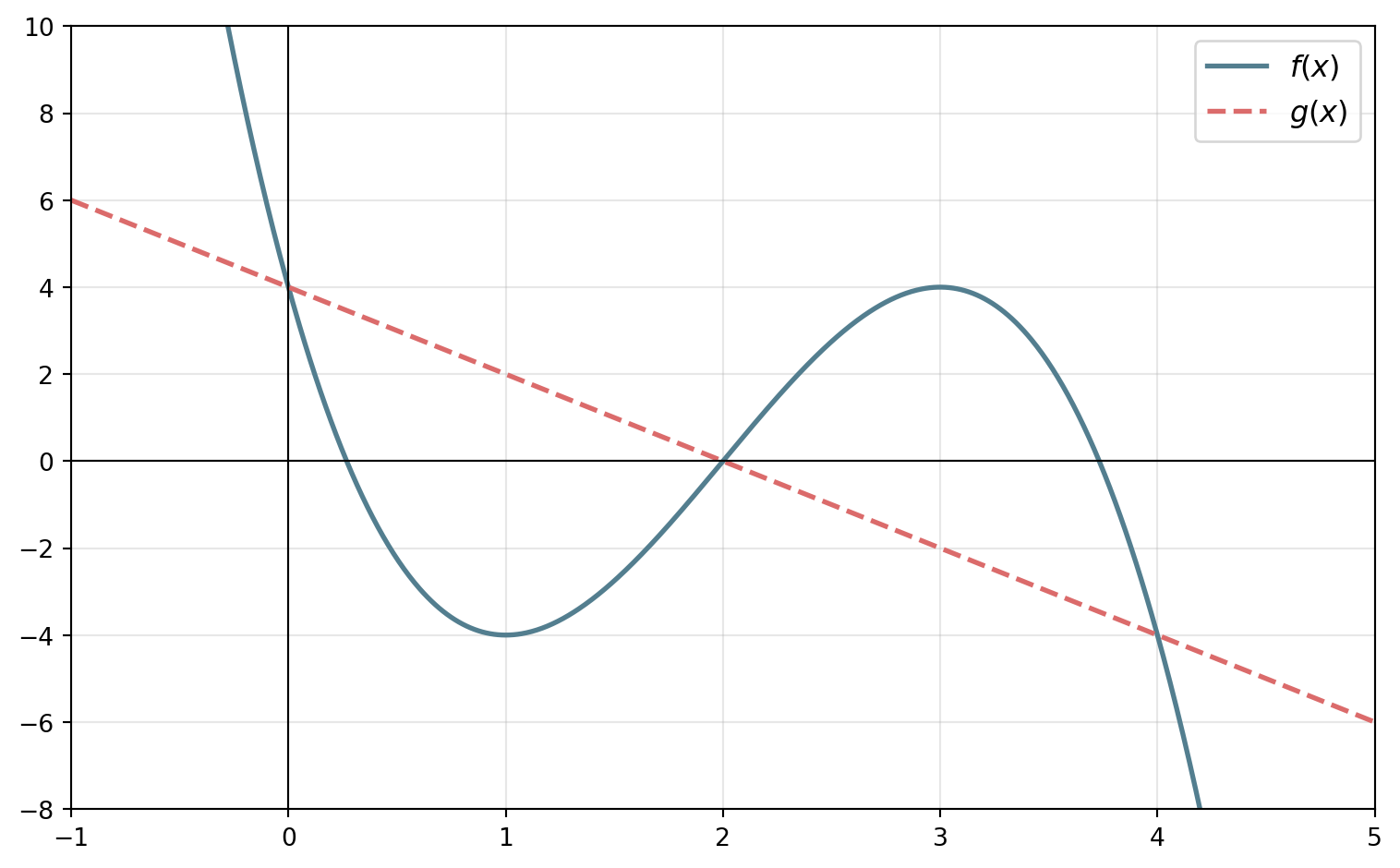
The functions \(f(x)\) and \(g(x)\) enclose two regions. Show computationally that both regions have equal size.
Hint: The figure suggests three intersection points. Check one of them by substitution and divide by the matching linear factor (or use the polynomial solver, MENU → A → 2, degree 3).
[9 pts.]
CautionSolution
Find intersections: \(f(x) = g(x)\):
\[\frac{1}{2}x^3 - 9x^2 + 48x - 72 = -\frac{3}{2}x + 9 \iff \frac{1}{2}x^3 - 9x^2 + \frac{99}{2}x - 81 = 0 \iff x^3 - 18x^2 + 99x - 162 = 0\]
The figure suggests \(x = 3\): \(27 - 162 + 297 - 162 = 0 \; \checkmark\)
Polynomial division: \((x^3 - 18x^2 + 99x - 162) : (x - 3) = x^2 - 15x + 54 = (x - 6)(x - 9)\)
\[x = 3, \quad x = 6, \quad x = 9\]
Difference function: \(h(x) = f(x) - g(x) = \frac{1}{2}(x - 3)(x - 6)(x - 9) = \frac{1}{2}x^3 - 9x^2 + \frac{99}{2}x - 81\)
Which graph lies above?
- \(3 < x < 6\) (test \(x = 4\)): \(h(4) = \frac{1}{2} \cdot 1 \cdot (-2) \cdot (-5) = 5 > 0\) (\(f\) above \(g\))
- \(6 < x < 9\) (test \(x = 7\)): \(h(7) = \frac{1}{2} \cdot 4 \cdot 1 \cdot (-2) = -4 < 0\) (\(g\) above \(f\))
Antiderivative of \(h\): \(H(x) = \frac{x^4}{8} - 3x^3 + \frac{99}{4}x^2 - 81x\) with
\[H(3) = 10.125 - 81 + 222.75 - 243 = -91.125, \quad H(6) = 162 - 648 + 891 - 486 = -81, \quad H(9) = 820.125 - 2187 + 2004.75 - 729 = -91.125\]
Region 1 (\(3 \leq x \leq 6\)):
\[A_1 = \int_3^6 h(x) \, dx = H(6) - H(3) = -81 - (-91.125) = 10.125\]
Region 2 (\(6 \leq x \leq 9\)):
\[A_2 = \left| \int_6^9 h(x) \, dx \right| = \left| H(9) - H(6) \right| = \left| -91.125 - (-81) \right| = 10.125\]
\[\boxed{A_1 = A_2 = 10.125 \quad \checkmark}\]
Grading: 1 Pt. equation \(f(x) = g(x)\), 1 Pt. \(x = 3\) checked, 1 Pt. polynomial division, 1 Pt. \(x = 6\) and \(x = 9\), 1 Pt. which graph lies above, 1 Pt. antiderivative \(H\), 2 Pts. \(A_1 = 10.125\) and \(A_2 = 10.125\) with the absolute value, 1 Pt. conclusion.
Part d)
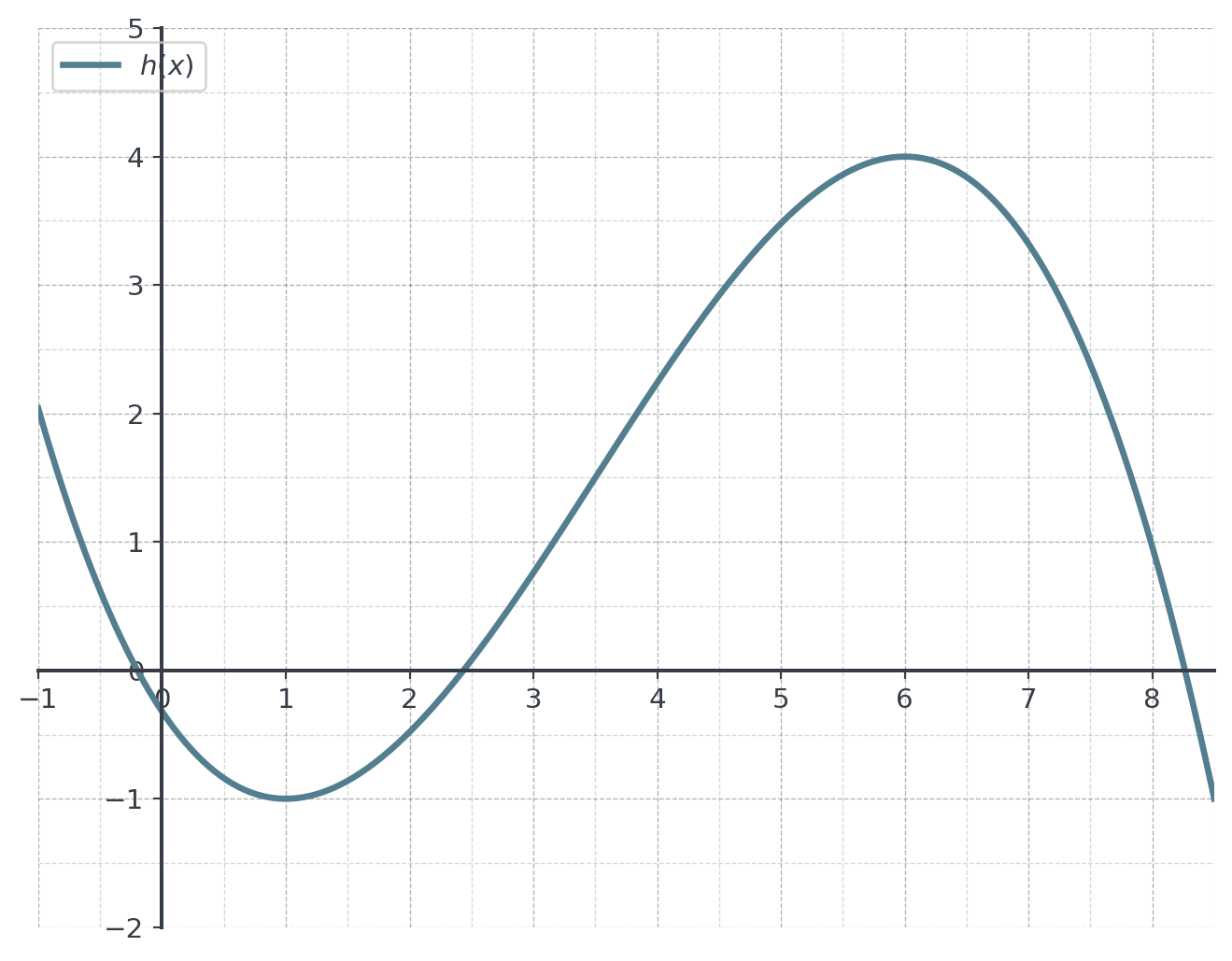
The following figure shows the graph of a function \(h(x)\) of degree 3. Its local minimum and its local maximum lie on grid points.
Argue whether the following statements are true or false.
(1) The graph of \(h\) is concave down on the interval \(4 < x < 6\).
(2) \(h''(1) = 0\), because the tangent of \(h\) at \(x = 1\) is horizontal.
(3) The graph of \(h'\) is a parabola that opens downward and has its highest point at \(x = 3.5\).
(4) The tangent of \(h\) at \(x = 3.5\) is less steep than the secant through the local minimum and the local maximum of \(h\).
[8 pts. total, 2 pts. each]
CautionSolution
From the graph: local minimum \((1, -1)\), local maximum \((6, 4)\). So \(h'(1) = h'(6) = 0\). \(h\) has degree 3, so \(h'\) is a parabola with the zeros 1 and 6. Its vertex lies halfway between the zeros, at \(x = 3.5\) (Session 03-03). There \(h'\) has its extremum, so \(h\) has its inflection point \((3.5, 1.5)\). The graph is concave up left of \(x = 3.5\) and concave down right of it.
(1) True. \(h'\) is a parabola with its highest point at \(x = 3.5\) (see (3)), so \(h'\) decreases on \(3.5 < x < 6\). Hence \(h'' < 0\) on \(4 < x < 6\), and the graph is concave down there.
(2) False. A horizontal tangent means \(h'(1) = 0\), not \(h''(1) = 0\). At the minimum the graph is concave up, so \(h''(1) > 0\).
(3) True. \(h\) has degree 3, so \(h'\) has degree 2: its graph is a parabola. \(h'\) is negative left of \(x = 1\), positive between 1 and 6 and negative right of 6, so the parabola opens downward with the zeros 1 and 6. Its highest point lies halfway between them, at \(x = 3.5\): there \(h\) rises most steeply, at its inflection point.
(4) False. The secant through \((1, -1)\) and \((6, 4)\) has the slope \(\frac{4 - (-1)}{6 - 1} = 1\). At the inflection point \(x = 3.5\), \(h\) rises more steeply than anywhere else, so its tangent there is steeper than the secant. From the graph: the tangent at \((3.5, 1.5)\) rises by about 1.5 per unit.
For checking: the figure shows \(h(x) = \frac{1}{25}\left(-2x^3 + 21x^2 - 36x - 8\right)\) with \(h'(x) = -\frac{6}{25}(x - 1)(x - 6)\), \(h''(x) = \frac{1}{25}(-12x + 42)\), \(h''(1) = 1.2 > 0\) and \(h'(3.5) = 1.5 > 1\).
Grading: per statement 1 Pt. true or false, 1 Pt. reason.
FSP Problem 2: An Exponential Function with Two Parameters [17 pts. total]
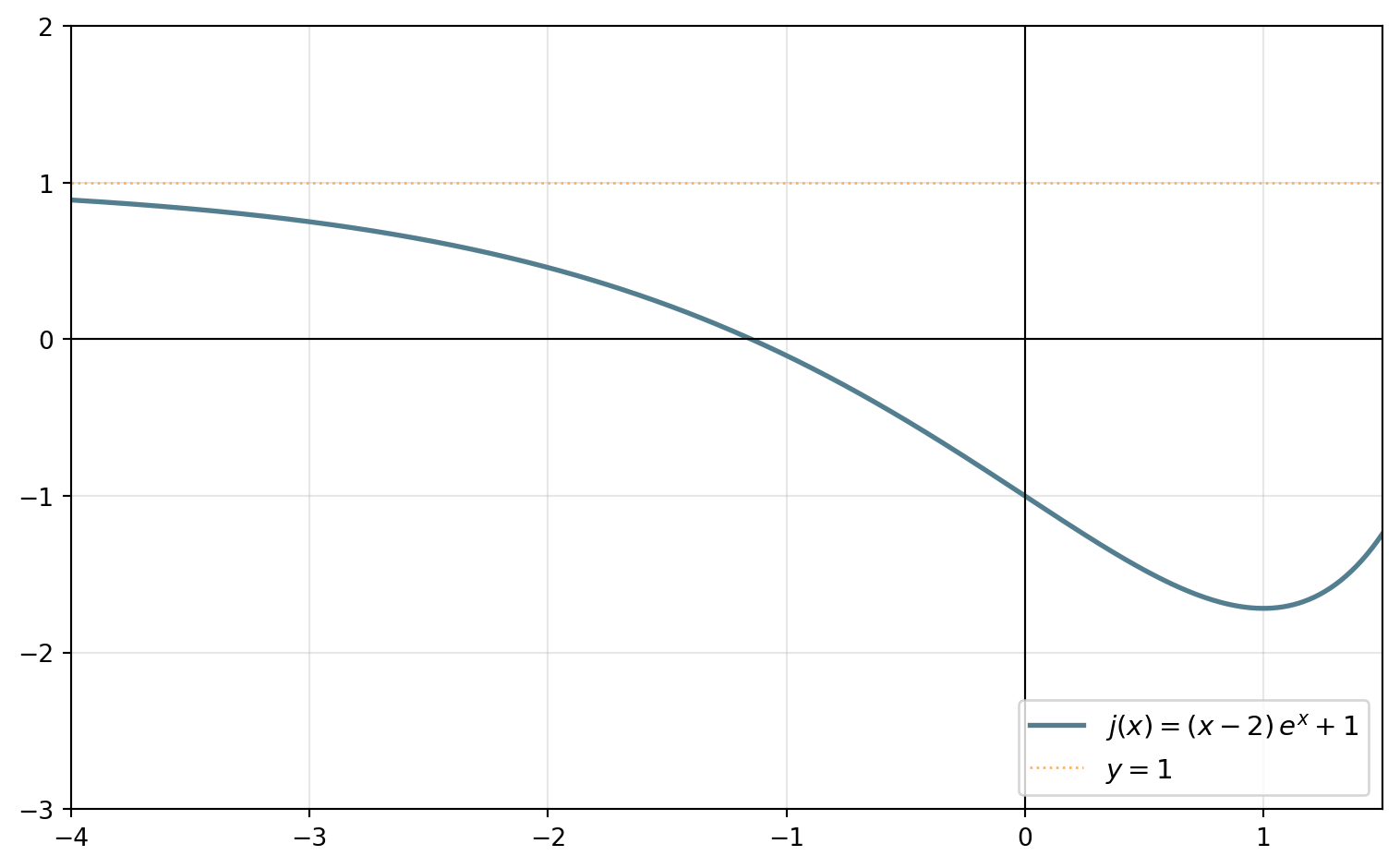
The function shown in Figure 3 belongs to the function \(j(x) = (x + p) \cdot e^x + q\) with real parameters \(p\) and \(q\). The graph passes through two grid points.
Part a)
Determine \(p\) and \(q\) computationally for the function shown in Figure 3.
[5 pts.]
CautionSolution
Reading from the graph: the graph passes through the grid points \((0, -1)\) (the \(y\)-intercept) and \((2, 1)\).
Setting up the system:
\[j(0) = (0 + p) \cdot e^0 + q = p + q = -1 \quad (I)\]
\[j(2) = (2 + p) \cdot e^2 + q = 1 \quad (II)\]
\((II) - (I)\) removes \(q\):
\[(2 + p)e^2 - p = 2 \iff p\left(e^2 - 1\right) = 2 - 2e^2 = -2\left(e^2 - 1\right) \iff p = -2\]
From \((I)\): \(q = -1 - p = 1\).
\[\boxed{p = -2, \quad q = 1, \qquad j(x) = (x - 2) \cdot e^x + 1}\]
Check: for \(x \to -\infty\) the graph approaches the line \(y = 1 = q\) ✓.
Grading: 1 Pt. two points read from the graph, 1 Pt. equation \((I)\), 1 Pt. equation \((II)\), 1 Pt. \(p = -2\), 1 Pt. \(q = 1\).
Part b)
(for verification: \(p = -2\) and \(q = 1\), so \(j(x) = (x - 2) \cdot e^x + 1\). Use this function from now on.)
Investigate the asymptotic behavior of \(j\).
[3 pts.]
CautionSolution
As \(x \to +\infty\): \((x - 2) \to \infty\) and \(e^x \to \infty\), so
\[\lim_{x \to +\infty} j(x) = +\infty\]
As \(x \to -\infty\): exponential decay beats linear growth, so \((x - 2) e^x \to 0\):
\[\lim_{x \to -\infty} j(x) = 0 + 1 = 1\]
\[\boxed{j \to +\infty \text{ at } +\infty; \quad y = 1 \text{ horizontal asymptote at } -\infty}\]
Grading: 1 Pt. \(j \to +\infty\) for \(x \to +\infty\), 1 Pt. \((x - 2)e^x \to 0\) for \(x \to -\infty\), 1 Pt. horizontal asymptote \(y = 1\).
Part c)
Determine the inflection point of \(j\).
[5 pts.]
CautionSolution
First and second derivative (product rule):
\[j'(x) = e^x + (x - 2) e^x = e^x (x - 1)\]
\[j''(x) = e^x (x - 1) + e^x = e^x \cdot x\]
Solve \(j''(x) = 0\): since \(e^x > 0\) always, \(x = 0\).
Sufficient condition: \(j'''(x) = e^x \cdot x + e^x = e^x(x + 1)\), so \(j'''(0) = 1 \neq 0\). Equivalently, \(j''(x) = e^x \cdot x\) changes its sign from \(-\) to \(+\) at \(x = 0\).
\(y\)-coordinate: \(j(0) = (-2) \cdot 1 + 1 = -1\).
\[\boxed{\text{Inflection point at } (0, -1)}\]
The inflection point is the \(y\)-intercept that you read in a).
Grading: 1 Pt. \(j'(x)\), 1 Pt. \(j''(x)\), 1 Pt. \(x = 0\) with \(e^x > 0\), 1 Pt. sufficient condition, 1 Pt. point \((0, -1)\).
Part d)
Find the antiderivative of \(j(x)\) and show your work.
[4 pts.]
CautionSolution
Split the integral:
\[\int j(x) \, dx = \int (x - 2) e^x \, dx + \int 1 \, dx\]
Integration by parts on \((x - 2) e^x\) with \(u = x - 2\), \(v' = e^x\) (so \(u' = 1\), \(v = e^x\)):
\[\int (x - 2) e^x \, dx = (x - 2) e^x - \int e^x \, dx = (x - 2) e^x - e^x = (x - 3) e^x\]
Combine:
\[\boxed{J(x) = (x - 3) e^x + x + C}\]
Check: \(J'(x) = e^x + (x - 3)e^x + 1 = (x - 2)e^x + 1 = j(x)\) ✓
Grading: 1 Pt. split into two integrals, 1 Pt. choice of \(u\) and \(v'\), 1 Pt. \(\int (x - 2)e^x \, dx = (x - 3)e^x\), 1 Pt. \(J(x)\) with \(+ x + C\).
FSP Problem 3: A Reading Club at a Bookstore [24 pts. total]
A bookstore has a reading club for its customers. Round probabilities to four decimal places.
Consider the following probabilities:
- The probability of a random person being a customer of this bookstore is 25%.
- A customer of this bookstore has an 80% chance of reading daily.
- A non-customer has a 15% chance of reading daily.
Use the following notation:
- \(C\): “is a customer of this bookstore”
- \(R\): “reads daily”
Part a)
Display the fractions in a contingency table for a population of 100,000 people. Fill in the blank fields.
| \(C\) | \(\bar{C}\) | Sum | |
|---|---|---|---|
| \(R\) | |||
| \(\bar{R}\) | |||
| Sum | 100,000 |
[6 pts.]
CautionSolution
Given: \(P(C) = 0.25\), \(P(R \mid C) = 0.80\), \(P(R \mid \bar{C}) = 0.15\).
Out of 100,000 people:
- \(C\): \(100{,}000 \times 0.25 = 25{,}000\)
- \(\bar{C}\): \(75{,}000\)
- \(R \cap C\): \(25{,}000 \times 0.80 = 20{,}000\)
- \(\bar{R} \cap C\): \(5{,}000\)
- \(R \cap \bar{C}\): \(75{,}000 \times 0.15 = 11{,}250\)
- \(\bar{R} \cap \bar{C}\): \(63{,}750\)
| \(C\) | \(\bar{C}\) | Sum | |
|---|---|---|---|
| \(R\) | 20,000 | 11,250 | 31,250 |
| \(\bar{R}\) | 5,000 | 63,750 | 68,750 |
| Sum | 25,000 | 75,000 | 100,000 |
Grading: 1 Pt. column sums 25,000 and 75,000, 2 Pts. \(R \cap C\) and \(\bar{R} \cap C\), 2 Pts. \(R \cap \bar{C}\) and \(\bar{R} \cap \bar{C}\), 1 Pt. row sums 31,250 and 68,750.
Part b)
State the businesslike meaning of the quantities \(\bar{R}\) and \(\bar{C} \cap \bar{R}\).
[2 pts.]
CautionSolution
- \(\bar{R}\): the person does not read daily (whether a customer of the bookstore or not).
- \(\bar{C} \cap \bar{R}\): the person is not a customer of this bookstore and does not read daily. For the bookstore, this is the group that the reading club hardly reaches.
Grading: 1 Pt. per quantity.
Part c)
Compute the probabilities \(P(\bar{C} \cap \bar{R})\) and \(P(\bar{C} \mid \bar{R})\).
[3 pts.]
CautionSolution
Joint probability:
\[P(\bar{C} \cap \bar{R}) = P(\bar{R} \mid \bar{C}) \cdot P(\bar{C}) = 0.85 \times 0.75 = 0.6375\]
This matches the table: \(\tfrac{63{,}750}{100{,}000} = 0.6375\).
Conditional probability:
\[P(\bar{C} \mid \bar{R}) = \frac{P(\bar{C} \cap \bar{R})}{P(\bar{R})} = \frac{63{,}750}{68{,}750} = \frac{51}{55} \approx 0.9273\]
About 92.73% of the people who do not read daily are not customers of the bookstore.
Grading: 1 Pt. \(P(\bar{C} \cap \bar{R}) = 0.6375\), 1 Pt. formula of the conditional probability, 1 Pt. \(P(\bar{C} \mid \bar{R}) \approx 0.9273\).
Part d)
A person reads daily. Compute the probability that this person is a customer of the bookstore.
[3 pts.]
CautionSolution
Bayes’ theorem (read directly from the table):
\[P(C \mid R) = \frac{|C \cap R|}{|R|} = \frac{20{,}000}{31{,}250} = 0.64\]
\[\boxed{P(C \mid R) = 64\%}\]
Only 25% of all people are customers, but 64% of the daily readers are. Reading daily is much more common among customers.
Grading: 1 Pt. \(P(C \mid R)\) as the probability asked for, 1 Pt. \(\frac{20{,}000}{31{,}250}\), 1 Pt. \(0.64\).
Part e)
For a sample of 10 people, determine the likelihood (probability) of the following events. This is a binomial distribution with \(n = 10\) and \(p = P(C) = 0.25\).
\[P(X = k) = \binom{10}{k} (0.25)^k (0.75)^{10 - k}\]
(1) Exactly 3 persons are customers of this bookstore.
[2 pts.]
CautionSolution
\[P(X = 3) = \binom{10}{3} (0.25)^3 (0.75)^7 = 120 \cdot 0.015625 \cdot 0.1335\]
\[\boxed{P(X = 3) \approx 0.2503 \approx 25.0\%}\]
Grading: 1 Pt. binomial term with \(\binom{10}{3} = 120\), 1 Pt. \(0.2503\).
(2) Not more than 3 persons are customers of this bookstore.
[4 pts.]
CautionSolution
\[P(X \leq 3) = P(X = 0) + P(X = 1) + P(X = 2) + P(X = 3)\]
- \(P(X = 0) = (0.75)^{10} \approx 0.0563\)
- \(P(X = 1) = 10 \cdot 0.25 \cdot (0.75)^9 \approx 0.1877\)
- \(P(X = 2) = 45 \cdot 0.0625 \cdot (0.75)^8 \approx 0.2816\)
- \(P(X = 3) \approx 0.2503\) (from above)
\[\boxed{P(X \leq 3) \approx 0.7759 \approx 77.6\%}\]
Grading: 1 Pt. sum from \(X = 0\) to \(X = 3\), 2 Pts. \(P(X = 0)\), \(P(X = 1)\) and \(P(X = 2)\), 1 Pt. \(0.7759\).
(3) At least 2 but not more than 4 persons are customers of this bookstore.
[4 pts.]
CautionSolution
\[P(2 \leq X \leq 4) = P(X = 2) + P(X = 3) + P(X = 4)\]
- \(P(X = 2) \approx 0.2816\)
- \(P(X = 3) \approx 0.2503\)
- \(P(X = 4) = 210 \cdot (0.25)^4 \cdot (0.75)^6 \approx 0.1460\)
\[\boxed{P(2 \leq X \leq 4) \approx 0.6778 \approx 67.8\%}\]
Grading: 1 Pt. sum from \(X = 2\) to \(X = 4\), 2 Pts. \(P(X = 4)\) with \(\binom{10}{4} = 210\), 1 Pt. \(0.6778\).