Session 02 - Sets
Mathematics for Master Students
Recap, Your Questions
Session 01 in a Nutshell
- \(\mathbb{N} \subset \mathbb{Z} \subset \mathbb{Q} \subset \mathbb{R}\), and \(\sqrt{2}\) is real but no fraction
- The warehouse accepts \(w \in [200, 1000)\): a \(200\) kg pallet goes in, a \(1000\) kg pallet does not
- Indices carry meaning: \(x_{ij}\) = flow from warehouse \(i\) to customer \(j\)
- “Order over €500 \(\Rightarrow\) free shipping” is broken only by an order over €500 that pays shipping
- “All shipments arrive on time” fails by one late shipment: negation swaps \(\forall\) and \(\exists\)
- Today: “and”, “or”, “not” get a picture, and the roastery’s 500 bags a week become a set
Common Issues in the Homework
- Counting terms: \(\sum_{i=3}^{10} x_i\) has \(10 - 3 + 1 = 8\) terms, not \(7\): both endpoints count!
- Over-strong negation: negating “some warehouse operates above \(90\%\) capacity” gives “every warehouse runs at at most \(90\%\)”, not “every warehouse is idle”
- Converse error: from “certified \(\Rightarrow\) passed audit” and a supplier that passed the audit, nothing follows about its certification
Which tasks gave you trouble? Bring them up now: we take the time to go through them before we move on to today’s topic.
Warm-Up: One More Negation
NoteQuestion
Negate: “Every customer pays by card or in cash.”
“Some customer pays neither by card nor in cash”: \(\forall\) becomes \(\exists\), and Session 1's De Morgan turns “or” into “neither … nor”.
WarningCommon Mistake
“Some customer does not pay by card or does not pay in cash” keeps the “or”: by De Morgan it must become “and”.
Today’s Plan
The roastery has to decide who gets a phone call, and how many bags it can plan per week. Today: describe each group as a set, then combine sets with “and”, “or” and “not”.
- Set basics: saying exactly who is in: elements, subsets, counting
- Set operations: \(\cup\), \(\cap\), \(^c\), and the call list in one line
- Products & power sets: counting pairs and selections
- Constraints as sets: which weekly quantities can the roastery plan?
Set Basics
Who Gets the Call?
The roastery from Session 1 sells to eight café customers:
| Customer | 1 | 2 | 3 | 4 | 5 | 6 | 7 | 8 |
|---|---|---|---|---|---|---|---|---|
| premium contract | ✓ | ✓ | ✓ | ✓ | ||||
| lost this year | ✓ | ✓ | ✓ | ✓ | ||||
| reads the newsletter | ✓ | ✓ | ✓ | ✓ |
NoteQuestion
Which customers are premium, lost, and not reached by the newsletter? They get a phone call.
Only customer \(3\). By the end of today, this search fits in one line.
What Is a Set?
To find customer \(3\) you only needed who is on each list: not the order, not how often.
A set is an unordered collection of distinct objects, called its elements.
- Premium customers: \(P = \{1, 2, 3, 4\}\)
- Transport modes: \(M = \{\text{road}, \text{rail}, \text{waterway}, \text{ocean}, \text{air}\}\)
- Order does not matter: \(\{1, 2, 3, 4\} = \{4, 3, 2, 1\}\)
- No duplicates: \(\{1, 2, 2, 3\} = \{1, 2, 3\}\)
Element Notation
Membership is the most basic set statement:
- \(a \in A\): “\(a\) is an element of \(A\)”
- \(a \notin A\): “\(a\) is not an element of \(A\)”
- \(\text{rail} \in M\), but \(\text{drone} \notin M\)
- From Session 1: \(3 \in \mathbb{N}\), while \(-3 \notin \mathbb{N}\) (but \(-3 \in \mathbb{Z}\))
Every “is it in or not?” question has a clear yes/no answer: that is what makes a set well-defined.
Describing Sets
NoteQuestion
The roastery roasts whole bags, at most \(500\) a week. How do you write down every possible weekly quantity?
- Listing: \(\{0, 1, 2, \dots, 500\}\): \(501\) elements (both endpoints count)
- Set-builder: \(\{q \in \mathbb{N}_0 : q \leq 500\}\): read “\(:\)” as such that (or “\(\mid\)”)
- In kg, not bags, listing fails: \([0, 500] = \{q \in \mathbb{R} : 0 \leq q \leq 500\}\)
- Same capacity, different base set: \(501\) versus infinitely many
Set-builder notation is a filter: keep the elements of a base set that pass a condition, as a database query does.
Set-Builder in Practice
The same filter pattern appears throughout your courses:
- Key accounts: \(\{c \in \text{Customers} : \text{revenue}(c) > 10000\}\)
- Late shipments: \(\{s \in \text{Shipments} : \text{arrival}(s) > \text{promised}(s)\}\)
Every filter has the same three parts: a base set, a colon, and a condition. Change the condition, and you have a new filter.
Your Turn: What Passes the Filter?
NoteQuestion
How many elements does \(\{x \in \mathbb{Z} : x^2 \leq 4\}\) have? Shout the number.
Five: the set is \(\{-2, -1, 0, 1, 2\}\).
WarningCommon Mistake
Answering \(3\) (only \(0, 1, 2\)) forgets that the base set is \(\mathbb{Z}\): negative integers square to positive numbers, so \(-1\) and \(-2\) pass the filter too.
Filter or Collect?
Set-builder comes in two shapes:
- Filter \(\{x \in A : \text{condition}\}\): keep the elements of \(A\) that pass
- Collect \(\{\text{expression} : x \in A\}\): one value for every element of \(A\)
- Session 1's \(\mathbb{Q} = \{\frac{a}{b} : a, b \in \mathbb{Z}, b \neq 0\}\) does both: collect every fraction, filter out \(b = 0\)
NoteQuestion
A pallet holds \(40\) bags. Which set is \(\{40k : k \in \{1, 2, 3\}\}\)? Shout the elements.
\(\{40, 80, 120\}\): the bag counts for one, two or three pallets. Before the colon, \(x \in A\) means filter, an expression like \(40k\) means collect.
The Empty Set
The empty set \(\emptyset = \{\}\) contains no elements at all.
- A filter whose conditions collide: \(\{x \in \mathbb{N}_0 : x \geq 20 \text{ and } x \leq 15\} = \emptyset\)
- An empty result is an answer, not an error: “no customer matches the filter”
WarningCommon Mistake
\(\emptyset \neq \{0\}\): the set containing zero has one element. The empty set has none.
Subsets
\(A \subseteq B\): every element of \(A\) is also in \(B\) (“\(A\) is a subset of \(B\)”).
- \(\{2, 3\} \subseteq \{1, 2, 3\}\), and also \(\{1, 2, 3\} \subseteq \{1, 2, 3\}\)
- Proper subset \(A \subset B\): \(A \subseteq B\) and \(A \neq B\)
- Session 1's hierarchy \(\mathbb{N} \subset \mathbb{Z} \subset \mathbb{Q} \subset \mathbb{R}\) is a chain of proper subsets
- \(\emptyset \subseteq A\) for every set \(A\): it has no element that could fail the test, like Session 1's €300 order that cannot break the rule
\(\subseteq\) works like \(\leq\) and \(\subset\) like \(<\): the extra line allows equality.
Checking a Subset Claim
Let \(F = \{x \in \mathbb{N} : x \text{ is divisible by } 4\}\) and \(E = \{x \in \mathbb{N} : x \text{ is even}\}\).
- \(F \subseteq E\)? Take any element of \(F\): a multiple of \(4\) is \(4k = 2 \cdot 2k\), hence even. Yes
- \(E \subseteq F\)? Look for a counterexample: \(2 \in E\), but \(2 \notin F\). No
- Equality needs both directions, \(A = B \Leftrightarrow A \subseteq B \text{ and } B \subseteq A\): here only one holds, so \(F \subset E\) is a proper subset
To prove \(A \subseteq B\), argue for an arbitrary element. To disprove it, one counterexample suffices: Session 1's \(\forall\) versus \(\exists\) again.
Element vs Subset
The classic confusion: \(\in\) relates an element to a set, \(\subseteq\) relates two sets.
Let \(A = \{1, 2, 3\}\):
| Statement | True? | Why |
|---|---|---|
| \(2 \in A\) | ✓ | \(2\) is an element of \(A\) |
| \(\{2\} \subseteq A\) | ✓ | every element of \(\{2\}\) is in \(A\) |
| \(\{2\} \in A\) | ✗ | the set \(\{2\}\) is not one of the three elements |
WarningCommon Mistake
Writing \(2 \subseteq A\): a number is not a set, so \(\subseteq\) does not apply. Ask first: element or set?
Your Turn: Element or Subset?
NoteQuestion
Let \(B = \{5, 10, 15\}\). Which statements are true: \(\quad 10 \in B, \quad \{5, 15\} \subseteq B, \quad \{10\} \in B, \quad \emptyset \subseteq B\)?
- \(10 \in B\): true, \(10\) is an element
- \(\{5, 15\} \subseteq B\): true, both elements of the left set are in \(B\)
- \(\{10\} \in B\): false, the elements of \(B\) are numbers, not sets (\(\{10\} \subseteq B\) would be true)
- \(\emptyset \subseteq B\): true, the empty set is a subset of every set
Cardinality
The cardinality \(|A|\) is the number of elements in \(A\):
- \(|\{\text{road}, \text{rail}, \text{waterway}, \text{ocean}, \text{air}\}| = 5\)
- \(|\emptyset| = 0\)
- \(\mathbb{N}\) has infinitely many elements: its cardinality is not a natural number
WarningCommon Mistake
Same bars, different meaning: \(|-5| = 5\) is an absolute value (of a number), \(|\{-5\}| = 1\) is a cardinality (of a set). What is inside the bars decides: a number or a set.
Your Turn: Count the Elements
NoteQuestion
What is \(|\{1, 2, 2, 3, \{4, 5\}\}|\)?
| (a) \(3\) | (b) \(4\) |
| (c) \(5\) | (d) \(6\) |
(b): the elements are \(1\), \(2\), \(3\) and the set \(\{4, 5\}\). The repeated \(2\) counts once, and \(\{4, 5\}\) is one element: a set sitting inside a set.
Set Operations
Venn Diagrams
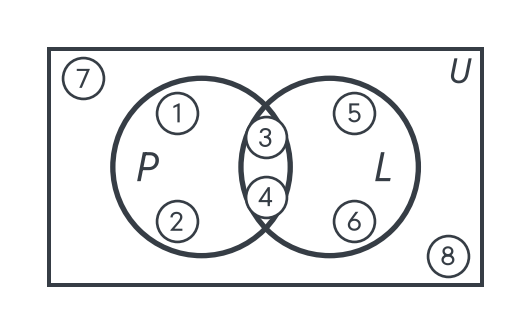
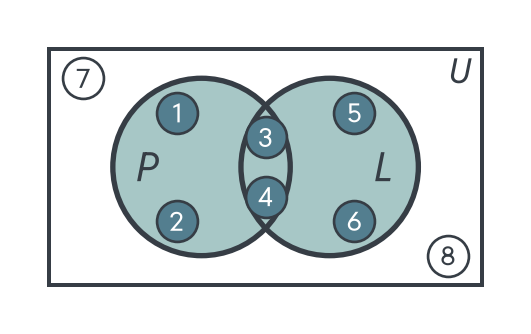
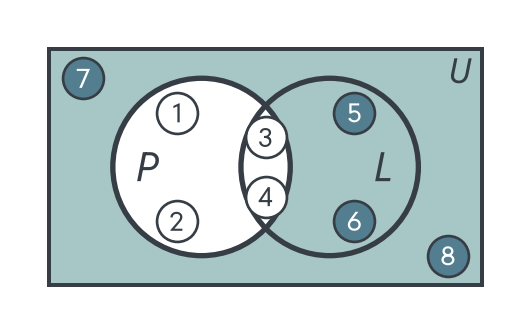
The eight café customers, one dot each: \(P\) = premium, \(L\) = lost.
Dots are elements (\(3 \in P\)), regions are sets (\(\{3, 4\} \subseteq P\)), and the box is the universal set \(U\): every customer on the list.
Union
NoteQuestion
A mailing goes to every customer who is premium or lost. Which dots get a mail?
\(P \cup L = \{x \in U : x \in P \text{ or } x \in L\}\): Session 1's inclusive “or”. Customers \(3\) and \(4\) get one mail, not two.
Intersection
NoteQuestion
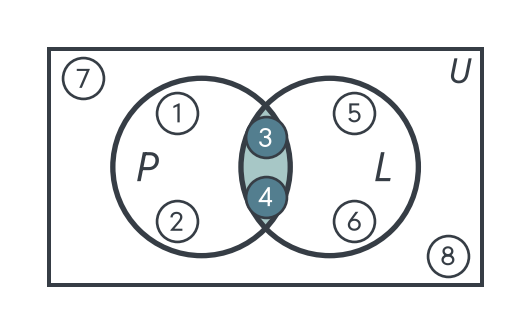
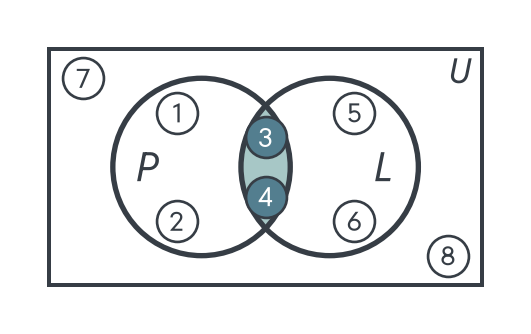
Premium and lost: who goes on the win-back list?
\(P \cap L = \{x \in U : x \in P \text{ and } x \in L\}\): two filters at once.
Set Difference
NoteQuestion
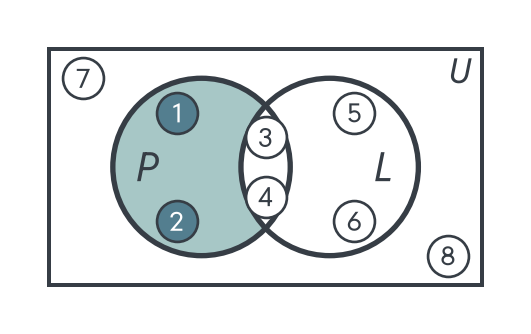
Premium but not lost? And lost but not premium?
\(P \setminus L = \{x \in U : x \in P \text{ and } x \notin L\}\) is \(\{1, 2\}\), but \(L \setminus P = \{5, 6\}\): order matters.
Complement
NoteQuestion
Who is not premium? Not premium… out of whom?
\(P^c = \{x \in U : x \notin P\} = \{5, 6, 7, 8\}\): only the box decides what “everything else” means, so \(U\) is a modelling choice: state it. Books also write \(\overline{P}\) or \(P'\): same idea.
Four Operations at Once
Let \(U = \{1, 2, \dots, 8\}\), \(P = \{1, 2, 3, 4\}\) and \(L = \{3, 4, 5, 6\}\):
| Expression | Result | Reading |
|---|---|---|
| \(P \cup L\) | \(\{1, 2, 3, 4, 5, 6\}\) | premium or lost |
| \(P \cap L\) | \(\{3, 4\}\) | premium and lost: the win-back list |
| \(P \setminus L\) | \(\{1, 2\}\) | premium, not lost |
| \(L \setminus P\) | \(\{5, 6\}\) | lost, not premium |
| \(P^c\) | \(\{5, 6, 7, 8\}\) | not premium: the upsell targets |
Your Turn: Compute the Operations
NoteQuestion
Let \(U = \{1, 2, \dots, 10\}\), \(A = \{2, 4, 6, 8, 10\}\) and \(B = \{1, 2, 3, 4, 5\}\). Shout: \(A \cap B, \quad A \setminus B, \quad B^c\), and the number \(|A \cup B|\).
- \(A \cap B = \{2, 4\}\): the even numbers up to \(5\)
- \(A \setminus B = \{6, 8, 10\}\): remove \(2\) and \(4\) from \(A\)
- \(B^c = \{6, 7, 8, 9, 10\}\): everything in \(U\) above \(5\)
- \(|A \cup B| = |\{1, 2, 3, 4, 5, 6, 8, 10\}| = 8\)
Disjoint Sets
\(A\) and \(B\) are disjoint if \(A \cap B = \emptyset\), no shared elements:
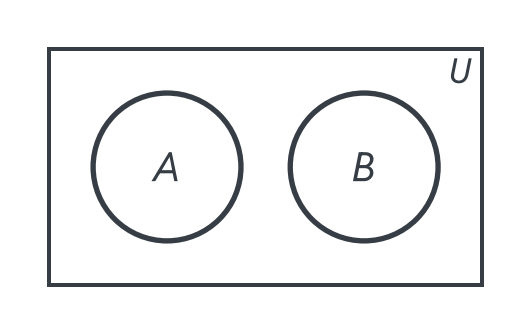
Disjoint sets model clean segmentations: no customer sits in two segments at once.
Your Turn: Where Do Brackets Go?
NoteQuestion
\(P = \{1, 2, 3, 4\}\), \(L = \{3, 4, 5, 6\}\), \(N = \{2, 4, 6, 8\}\). A voucher goes to customers who are “premium and lost or newsletter readers”. Shout \(|(P \cap L) \cup N|\) and \(|P \cap (L \cup N)|\).
- \((P \cap L) \cup N = \{3, 4\} \cup \{2, 4, 6, 8\} = \{2, 3, 4, 6, 8\}\): 5
- \(P \cap (L \cup N) = \{1, 2, 3, 4\} \cap \{2, 3, 4, 5, 6, 8\} = \{2, 3, 4\}\): 3
WarningCommon Mistake
“\(P \cap L \cup N\)” names neither set: when \(\cup\) and \(\cap\) mix, the brackets decide who gets the voucher. Always write them.
How Many in the Union?
NoteQuestion
Four customers are premium, four are lost. How many are premium or lost? Shout.
\[\begin{aligned} |P \cup L| &= |P| + |L| - |P \cap L| \\ &= 4 + 4 - 2 = 6 \end{aligned}\]
Customers \(3\) and \(4\) were counted twice: subtract them once. This is the inclusion-exclusion rule.
Your Turn: Who Bought Nothing?
NoteQuestion
Your guess from last week? Of \(200\) customers, \(120\) ordered online, \(90\) ordered in store, and \(40\) did both. How many customers ordered nothing this year? Shout the number.
\[|\text{online} \cup \text{store}| = 120 + 90 - 40 = 170\]
so \(200 - 170 = 30\) ordered nothing.
WarningCommon Mistake
\(120 + 90 = 210 > 200\) is not a contradiction: the \(40\) two-channel customers were counted twice. Subtract the intersection before taking the complement.
Segments as a Partition
A partition splits \(U\) into disjoint pieces that together cover everything:
- Regions \(R_1 = \text{North}\), \(R_2 = \text{East}\), \(R_3 = \text{South}\) with \(R_1 \cup R_2 \cup R_3 = U\) and \(R_i \cap R_j = \emptyset\) for \(i \neq j\)
- Every customer sits in exactly one region: no double counting, nobody missed
- Then the cardinalities simply add up: \(|U| = |R_1| + |R_2| + |R_3|\), no inclusion-exclusion needed
Segments that share customers (premium and lost) need inclusion-exclusion; a partition is exactly the case where the correction term vanishes.
One Pattern, Two Languages
You have met all four already in Session 1: \(x \in A \cup B\) means \(x \in A \vee x \in B\):
| Logic (Session 1) | Sets (today) |
|---|---|
| \(p \vee q\) (or) | \(A \cup B\) (union) |
| \(p \wedge q\) (and) | \(A \cap B\) (intersection) |
| \(\neg p\) (not) | \(A^c\) (complement) |
| \(p \Rightarrow q\) (implies) | \(A \subseteq B\) (subset) |
\(A \subseteq B\) means \(x \in A \Rightarrow x \in B\).
If you remember the logic rule, you get the set rule for free, and the other way around.
Does a Complement Keep \(\subseteq\)?
NoteQuestion
\(\mathbb{N} \subseteq \mathbb{Z}\) inside \(U = \mathbb{R}\). Which holds: (a) \(\mathbb{N}^c \subseteq \mathbb{Z}^c\) or (b) \(\mathbb{Z}^c \subseteq \mathbb{N}^c\)?
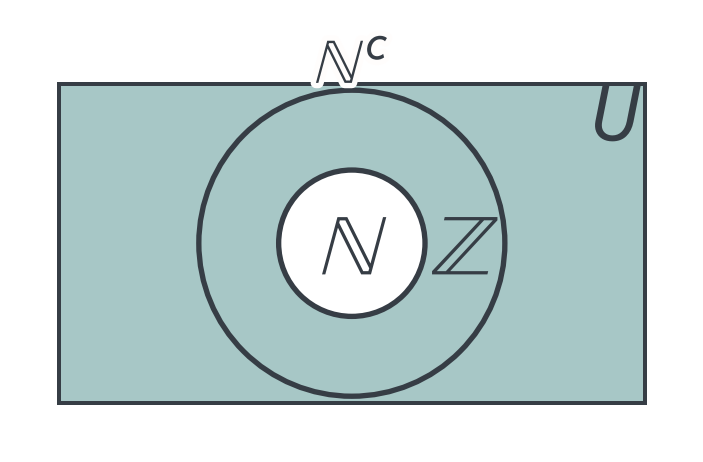
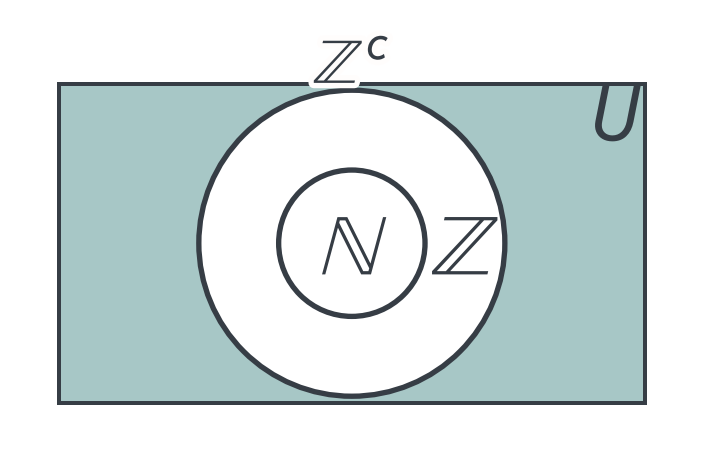
(b): \(-3 \in \mathbb{N}^c\) but \(-3 \notin \mathbb{Z}^c\). The smaller set has the bigger complement: Session 1's contrapositive, \(x \in A \Rightarrow x \in B\) becomes \(x \notin B \Rightarrow x \notin A\).
De Morgan’s Laws for Sets
NoteQuestion
A welcome offer goes to customers who are neither premium nor lost. Where do “not premium” and “not lost” meet?
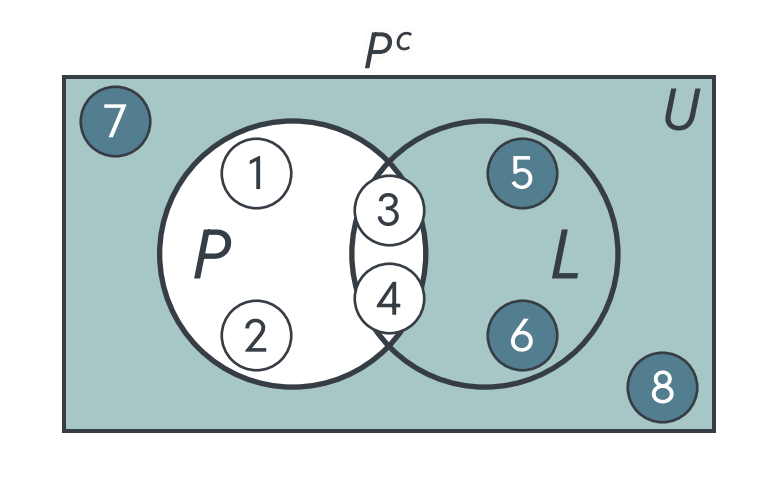
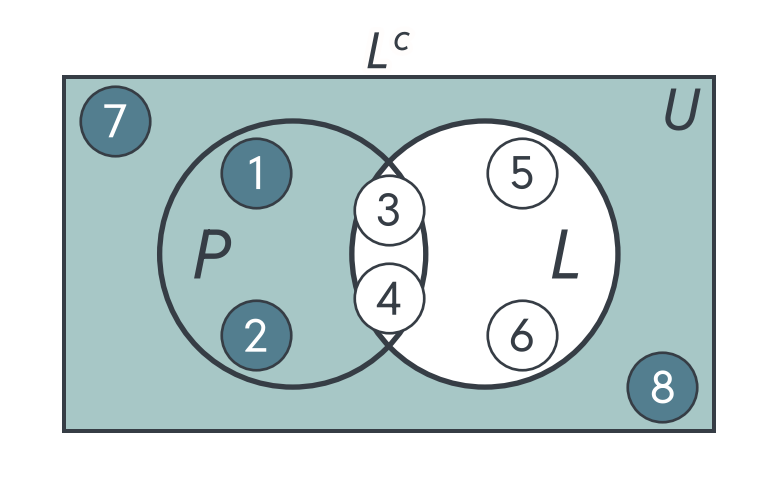
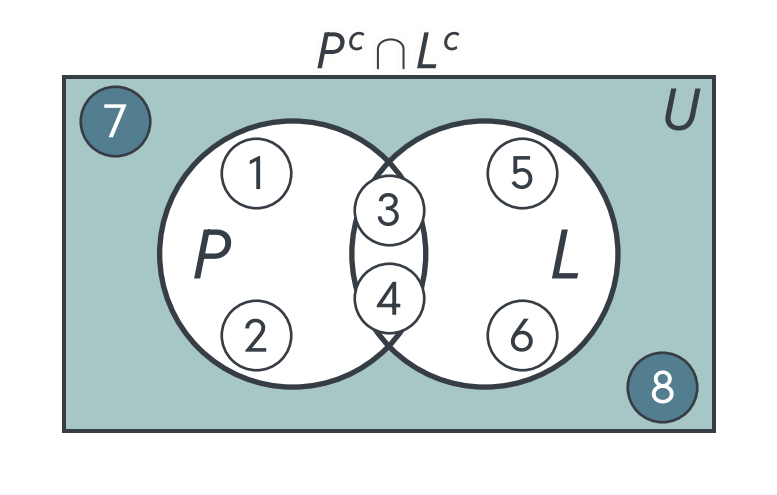
\[\begin{gathered}(P \cup L)^c = P^c \cap L^c = \{7, 8\} \\ (P \cap L)^c = P^c \cup L^c = \{1, 2, 5, 6, 7, 8\}\end{gathered}\]
Your Turn: Late or Incomplete
NoteQuestion
Let \(A\) = shipments on time, \(B\) = shipments complete. Which set is “shipments that are late or incomplete”?
| (a) \(A^c \cup B^c\) | (b) \(A^c \cap B^c\) |
| (c) \((A \cup B)^c\) | (d) \(A \cap B\) |
(a): late is \(A^c\), incomplete is \(B^c\), and “or” is \(\cup\). By De Morgan this equals \((A \cap B)^c\), Session 1's negation of “on time and complete”.
WarningCommon Mistake
(b) and (c) are the same set: shipments that are late and incomplete, a much smaller group. Every “or” of complaints is a \(\cup\).
Reading a Set Expression
How to read \((P \cap L) \setminus N\)? Work inside out:
- \(P \cap L = \{3, 4\}\): premium and lost
- \(\dots \setminus N\) removes customer \(4\), who reads the newsletter
- Result \(\{3\}\): the call list from the start, in one line
Every data filter you will ever build is a set operation: SQL’s AND/OR/NOT are \(\cap\), \(\cup\), \(^c\).
Your Turn: Build the Target List
NoteQuestion
\(P\) = premium, \(L\) = lost, \(N\) = newsletter subscribers. Which expression describes “active (not lost) premium customers who subscribe to the newsletter”?
| (a) \(P \cap L^c \cap N\) | (b) \(P \cup L^c \cup N\) |
| (c) \((P \cap L) \setminus N\) | (d) \(P \setminus (L \cap N)\) |
(a): premium and not lost and subscribed, three filters at once, so three intersections. On the customer table: customer \(2\).
WarningCommon Mistake
(d) removes only customers who are lost and subscribed: a lost premium customer without the newsletter, customer \(3\), stays on the list. Negate the whole condition, not half of it.
Products & Power Sets
Ordered Pairs
NoteQuestion
Is the trip (Hamburg, Munich) the same job as (Munich, Hamburg)? A set cannot tell them apart: \(\{\text{H}, \text{M}\} = \{\text{M}, \text{H}\}\).
An ordered pair \((a, b)\) is not a set. Here, order does matter:
- \((a, b) \neq (b, a)\) unless \(a = b\), but \(\{a, b\} = \{b, a\}\) always
- Coordinates in the plane are ordered pairs: \((2, 5) \neq (5, 2)\)
Curly braces \(\{\,\}\) = unordered set, round parentheses \((\,)\) = ordered pair. The bracket type carries the meaning.
A Product as a Grid
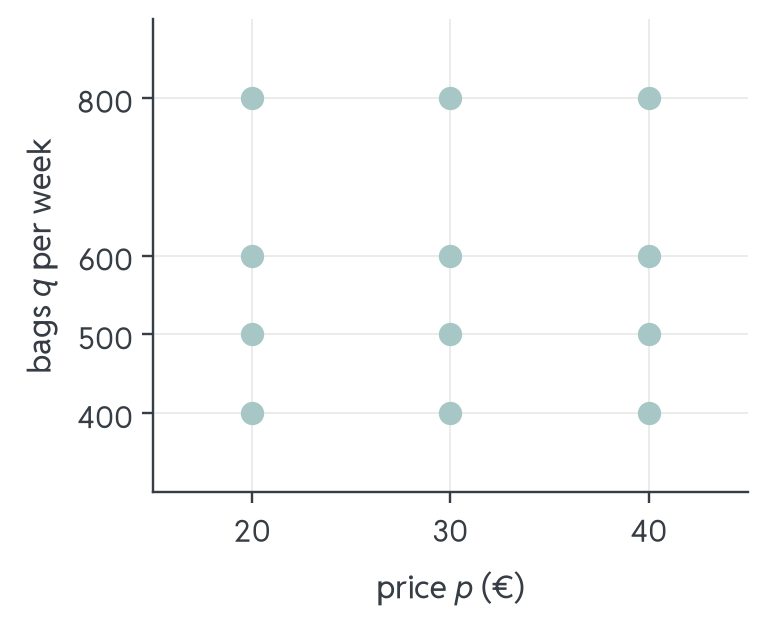
The roastery tests three prices, \(A = \{20, 30, 40\}\) (€ per bag), and weekly demand could land at \(B = \{400, 500, 600, 800\}\) bags. Each dot is one pair: price first, bags second. How many (price, bags) scenarios are there?
Twelve: three columns of four dots. The first entry runs across, the second up, as with \((x, y)\) in the plane.
The Cartesian Product
\(A \times B = \{(a, b) : a \in A, b \in B\}\): all ordered pairs with the first entry from \(A\), the second from \(B\): every dot of the grid.
- Columns times rows: \(|A \times B| = |A| \cdot |B| = 3 \cdot 4 = 12\)
- \((20, 800) \in A \times B\), but \((800, 20) \notin A \times B\): \(800\) is not a price
- \(B \times A\) has as many pairs, drawn the other way round
Products Build Route Sets
Let \(W = \{1, 2\}\) be warehouses and \(C = \{1, 2, 3\}\) be customers:
- \(W \times C\) = the set of all possible routes \((i, j)\): here \(2 \cdot 3 = 6\) of them
- Session 1's \(x_{ij}\) is defined for every pair \((i, j) \in W \times C\): the index set of the transportation problem is a Cartesian product
- \(\mathbb{R} \times \mathbb{R} = \mathbb{R}^2\) is the plane: every graph you will draw in Session 3 lives there
Your Turn: How Many Routes?
NoteQuestion
A carrier runs \(4\) depots \(D\) and serves \(5\) customers \(C\). How many depot-customer routes exist? And if each route can be driven by one of \(2\) vehicle types \(V\), how many route-vehicle combinations? Shout both numbers.
- Routes: \(|D \times C| = 4 \cdot 5 = 20\)
- With vehicles: \(20 \cdot 2 = 40\), every route combines with every vehicle type
- The counting rule stacks: three sets give \(|D| \cdot |C| \cdot |V|\) triples \((i, j, v)\)
Your Turn: Counting Options
NoteQuestion
A carrier may serve any subset of the regions \(\{\text{North}, \text{East}, \text{South}\}\). How many different service portfolios are possible?
\(8\) portfolios:
\[\emptyset, \{\text{N}\}, \{\text{E}\}, \{\text{S}\}, \{\text{N,E}\}, \{\text{N,S}\}, \{\text{E,S}\}, \{\text{N,E,S}\}\]
Note that \(\emptyset\) counts: “serve no region at all” is a valid (if unambitious) portfolio.
This list of all subsets has a name: the power set.
The Power Set
The power set \(\mathcal{P}(A)\) is the set of all subsets of \(A\), including \(\emptyset\) and \(A\) itself.
The \(8\) portfolios you just listed are \(\mathcal{P}(\{\text{North}, \text{East}, \text{South}\})\).
WarningCommon Mistake
The elements of \(\mathcal{P}(A)\) are themselves sets: \(\{\text{North}\} \in \mathcal{P}(\{\text{North}, \text{East}, \text{South}\})\), but \(\text{North} \notin \mathcal{P}(\{\text{North}, \text{East}, \text{South}\})\).
Your Turn: In the Power Set?
NoteQuestion
Let \(A = \{a, b\}\). Which statement is false?
| (a) \(\emptyset \in \mathcal{P}(A)\) | (b) \(\{a\} \in \mathcal{P}(A)\) |
| (c) \(a \in \mathcal{P}(A)\) | (d) \(A \in \mathcal{P}(A)\) |
(c): \(a\) is an element of \(A\), not a subset of \(A\). Only sets live in \(\mathcal{P}(A)\), and \(\{a\}\) is the set that does.
(a) and (d) are true for every set: \(\emptyset\) and \(A\) itself are always subsets of \(A\).
How Many Subsets?
- Build a subset by deciding for each element: in or out?
- A fourth region? Every old portfolio comes with and without it: \(2 \cdot 8 = 16\)
- Two choices per element, \(|A|\) elements: \(2 \cdot 2 \cdot \dots \cdot 2\)
- That count grows fast: 10 candidate suppliers already give \(2^{10} = 1024\) possible selections
\[|\mathcal{P}(A)| = 2^{|A|}\]
Constraints as Sets
Feasible Sets in Optimisation
At most \(500\) bags a week: can the roastery plan \(600\)? \(300\)? \(-10\)?
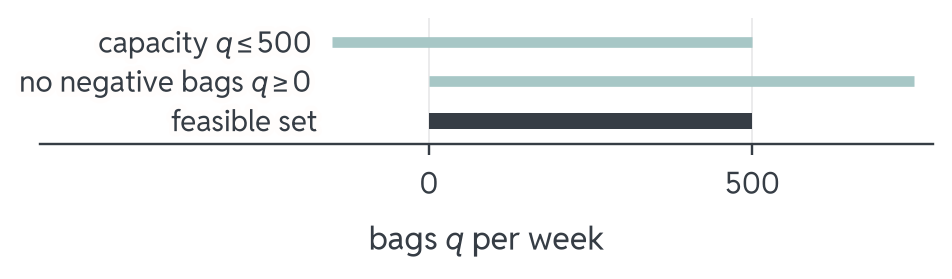
- Measured in kg, as on Describing Sets, \(q\) is real: each constraint is a set, \((-\infty, 500]\) and \([0, \infty)\)
- Plans must satisfy both: intersection \((-\infty, 500] \cap [0, \infty) = [0, 500]\)
- Optimisation = picking the best point of the feasible set
Your Turn: Still Feasible?
NoteQuestion
A supermarket chain offers the roastery a contract, but only for at least \(600\) bags a week: \(q \in [600, \infty)\). What is the feasible set now?
\[[0, 500] \cap [600, \infty) = \emptyset\]
- The problem is infeasible: no weekly plan satisfies all three rules
- Set notation shows which pair collides: \(q \geq 600\) against the capacity \(q \leq 500\), as on the Empty Set slide
- The roastery declines the contract
Sets in Your M.Sc. Courses
- Data Science: events in probability are sets: \(\Pr(A \cup B)\) uses today’s inclusion-exclusion rule
- Transportation & Distribution: decision variables are indexed by Cartesian products; feasible regions are intersections
- Statistics & Econometrics: a confidence interval \([a, b]\) is the set of plausible values for a parameter
- Whenever a slide says “for all \(x \in S\)”, you now read it fluently
Closing
Key Takeaways: Sets
- The roastery’s eight café customers are a set \(U\); \(3 \in P\) is an element, \(\{3, 4\} \subseteq P\) a subset
- The call list in one line: \((P \cap L) \setminus N = \{3, 4\} \setminus N = \{3\}\)
- \(\cup\), \(\cap\), \(^c\) are or, and, not: “neither premium nor lost” is \((P \cup L)^c = P^c \cap L^c = \{7, 8\}\)
- Counting a union: \(|P \cup L| = 4 + 4 - 2 = 6\), subtracting the intersection once
Key Takeaways: Grids & Constraints
- \(3\) prices \(\times\) \(4\) demand levels give \(12\) pairs in the grid; \(3\) regions give \(2^3 = 8\) selections
- The roastery’s weekly bags: \((-\infty, 500] \cap [0, \infty) = [0, 500]\); a \(600\)-bag contract makes it \(\emptyset\)
Until the Next Session
- Work through the Tasks: problems with worked solutions
- Check yourself with the Self-Test quiz
- Keep the Cheatsheet next to you while practising
- Note down anything unclear: we start next session with your questions
Draw a Venn diagram whenever a set expression looks confusing: two circles resolve most doubts faster than staring at symbols.
Preview: Session 03: Functions
- Back to today’s grid of \(12\) (price, bags) pairs: which dot lights up in each column?
- A function lights up exactly one dot in each column: one price, one weekly demand
- Domain and range are, you guessed it, sets
- Graphs live in \(\mathbb{R} \times \mathbb{R}\): today’s grid, filled in
- Session 1's question returns: which price earns the roastery the most?
See you there, and bring your questions!
Literature & Further Reading
- These sessions cover the essentials: textbooks offer more depth and practice
- Start with Sydsæter et al. (2012) or Jacques (2015); full recommendations on the tutorial’s literature page
Jacques, Ian. 2015. Mathematics for Economics and Business. 8th ed. Always Learning. Pearson.
Sydsæter, Knut, Peter J. Hammond, and Arne Strøm. 2012. Essential Mathematics for Economic Analysis. 4th ed. Pearson.