#=
YOUR ANSWER BELOW
=#Tutorial XII - Passenger Flow Control in Urban Rail
Applied Optimization with Julia
Introduction
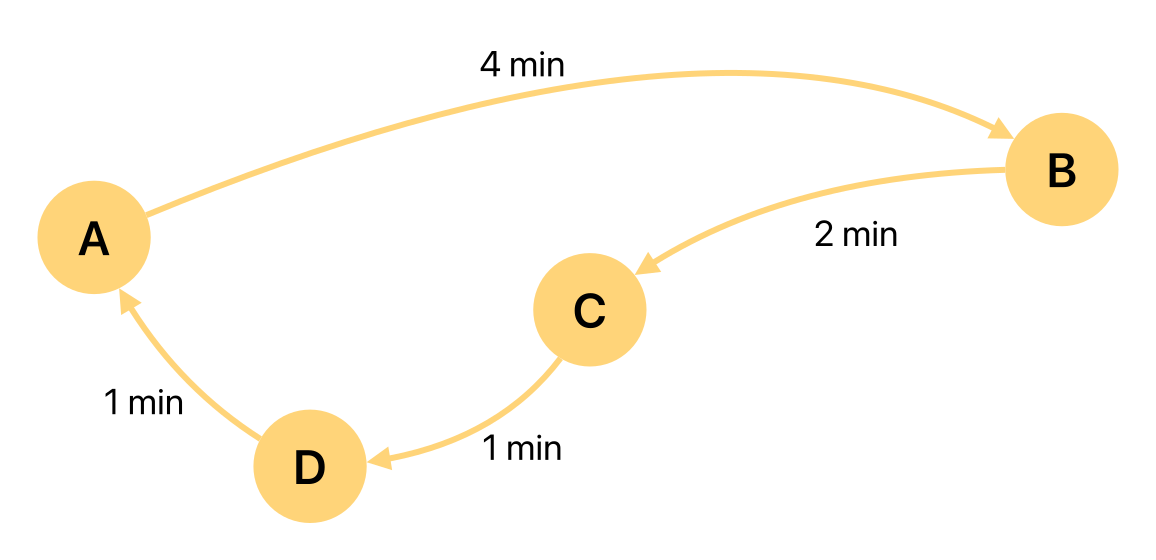
Consider the depicted ‘Golden Line’ with 4 different stations A, B, C, D. For an upcoming timeframe of 10 minutes divided into 10 periods, the transportation demand is going to exceed the available capacity of the network and each origin-destination pair will be requested by at least 1 passenger in every minute. To handle the inflow, queues will be put in place at each metro station.
The Challenge
Your task is to minimize the queues without exceeding the available transport capacity of max. 100 passengers per minute on each arc. A safety buffer per arc is not needed. Each station layout is excellent, with sufficient stairs and escalators. Thus, the station itself is fully capable of handling any inflow that may result from the optimized restricted inflow. Nonetheless, queues are still necessary as the arcs cannot handle the full inflow.
Recap: The Set \(\mathcal{R}_{e,t}\)
Recall the set from the lecture that maps station inflows to arc utilizations:
\[ \mathcal{R}_{e,t} = \{(o,d,p) \mid o,d \in \mathcal{O}, p \in \mathcal{P}, q_{o,d,p} > 0, e \in \mathcal{C}_{o,d}, t-\tau_{o,e} \in I_p\} \]
It contains all combinations \((o,d,p)\) of origin \(o\), destination \(d\), and period \(p\) whose passengers enter arc \(e\) in minute \(t\). Here, \(\mathcal{C}_{o,d}\) is the set of arcs on the shortest path from \(o\) to \(d\), and \(\tau_{o,e}\) is the travel time from station \(o\) to the entry of arc \(e\) along that path. In this tutorial, the period length is \(m = 1\): each period is exactly one minute, so the last condition simplifies to \(p = t - \tau_{o,e}\).
For example, a passenger entering station B in period 4 with destination A travels over B→C (2 min) and C→D (1 min) and thus enters arc (D,A) in minute \(4 + 3 = 7\). Hence, \((B,A,4) \in \mathcal{R}_{(D,A),7}\).
1. Flow Analysis
Suppose we are in minute 7 at the arc of (D,A). Which inflows from which stations are going to impact the flow into the arc in this minute?
Write out the set \(\mathcal{R}_{(D,A),7}\) and briefly explain your answer. You can write out the set in a comment, for example like this:
#=
{(A,B,1), (B,C,1), (C,D,1)}
=#
To solve this task, it might be helpful to work with paper and pen to sketch the problem.
2. Inflow Control
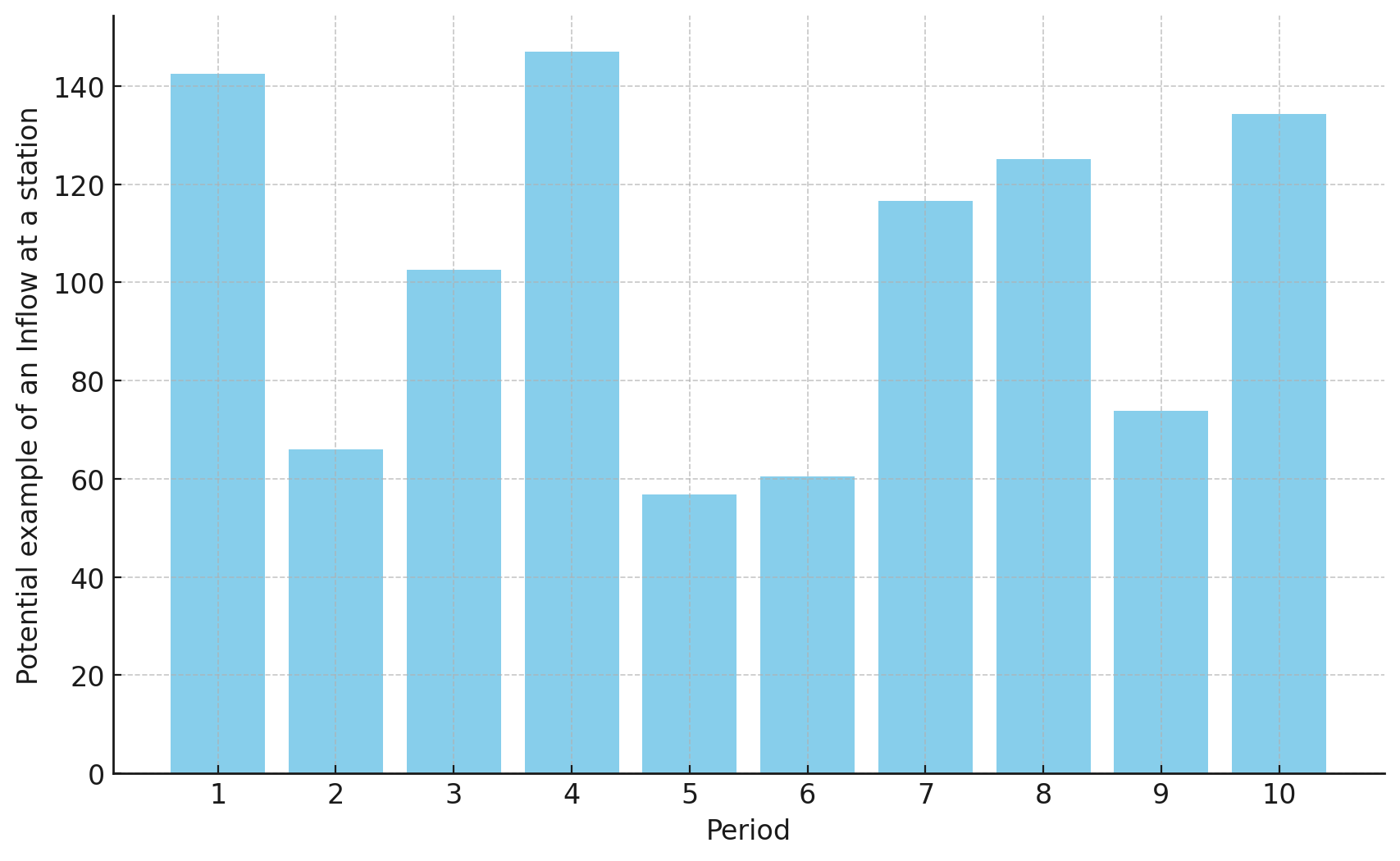
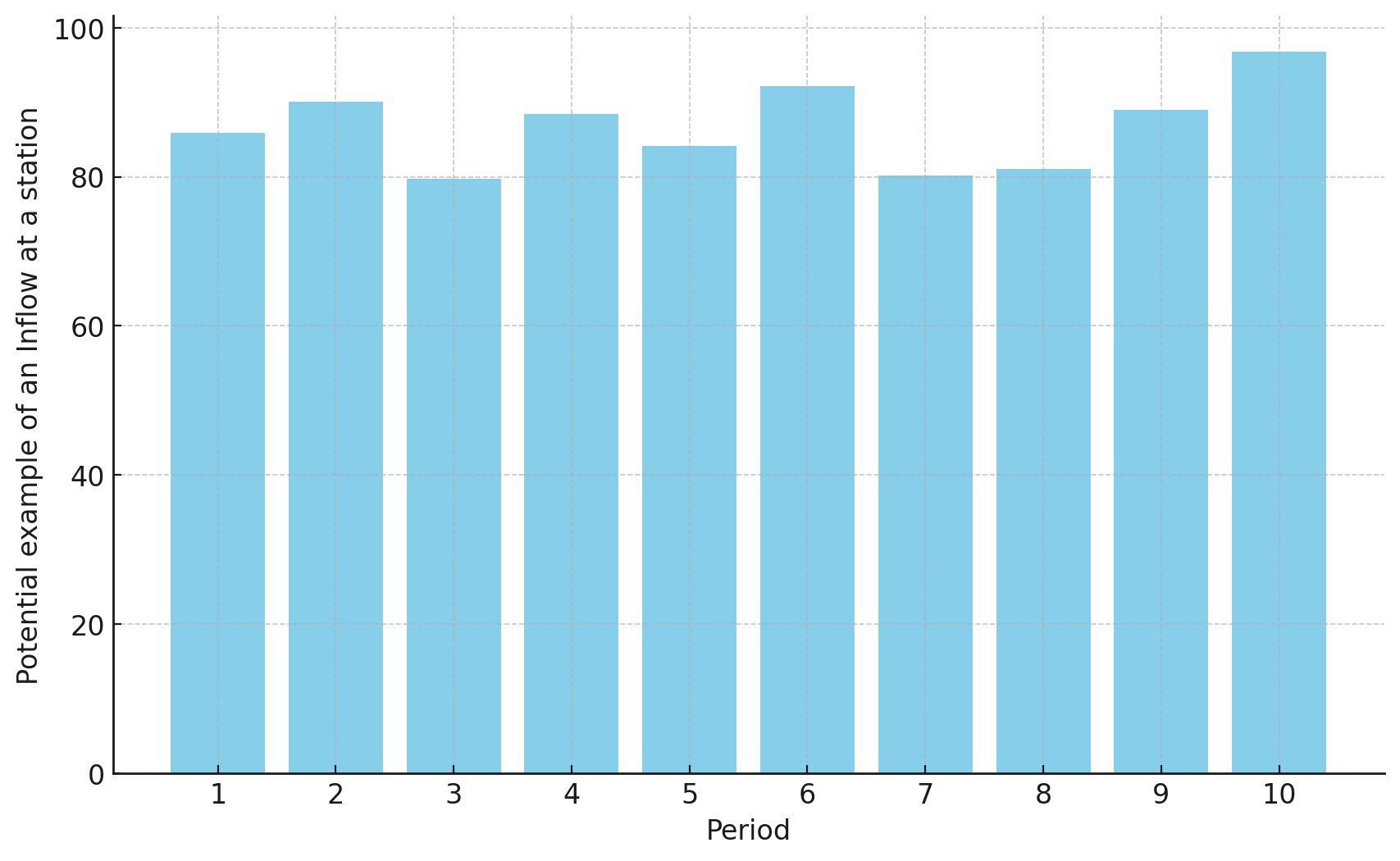
As there is a rather large fluctuation of allowed inflow between periods, you are asked to introduce new constraints for the model. In the first period, the inflow at each station is supposed to be unrestricted. Thereafter, it is allowed to change by at most 20 persons up or down per period at each station.
Can you write out the decision variables and the additional constraints for the model as JuMP constraints?
You don’t need to solve the model or define the objective function. You just need to constrain the fluctuations and add the appropriate variables.
using JuMP
metro_model = Model()

# YOUR CODE BELOW
3. Bidirectional Flow
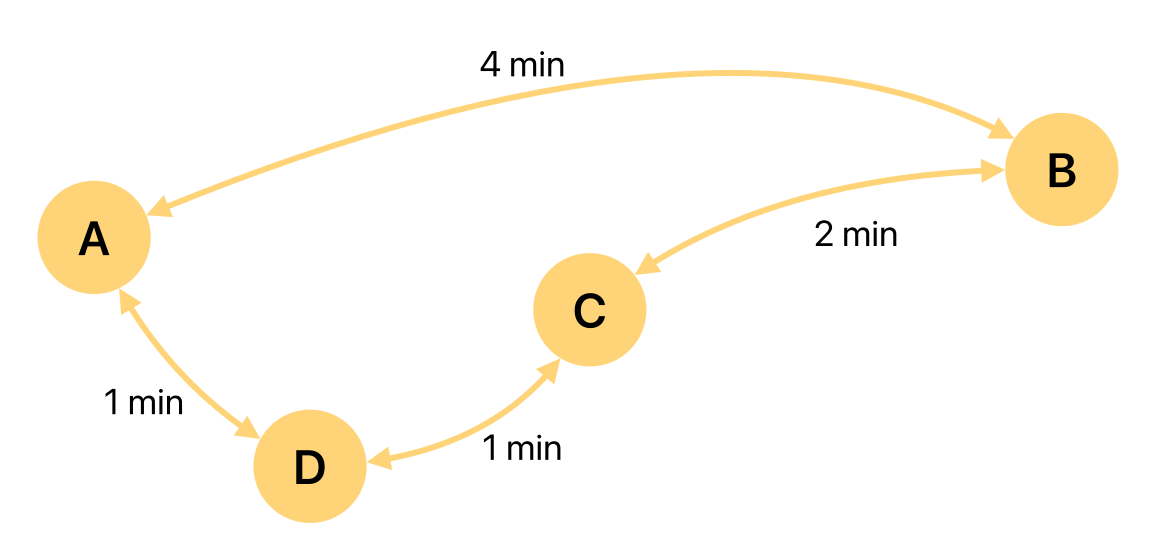
The metro was improved and there is now the possibility to travel in both directions. How would this change the set \(\mathcal{R}_{(D,A),7}\) from 1.?
Write out the new set \(\mathcal{R}_{(D,A),7}\) manually and briefly explain your answer.
#=
# YOUR ANSWER BELOW

=#
4. Capacity Analysis
Although the system is bidirectional now, the overall number of trains of the metro provider has not changed. Would the change from a unidirectional metro system to a bidirectional metro system decrease the likelihood of crowd accidents due to insufficient arc-capacities?
Please explain your answer in a few sentences.
#=
# YOUR ANSWER BELOW

=#
5. Computing the Set \(\mathcal{R}_{e,t}\)
Can you compute the set \(\mathcal{R}_{e,t}\) for the unidirectional flow? Generate a dictionary \(R\) that contains \(|\mathcal{E}| \times |\mathcal{T}| = 4 \times 10 = 40\) entries. Each entry \(\mathcal{R}_{e,t}\) should contain a vector with all origin-destination pairs and the corresponding time period saved as a tuple. Use the results to check your answer from the first task.
This task is a bit of a challenge. But as it is the last tutorial, I figured that’s fine.
# YOUR CODE BELOW
If you encounter any difficulties and cannot solve the problem, please document your issues here:
#=


=#
NoteFrom the set to the model
The dictionary R is exactly what the lecture’s arc-capacity constraint iterates over:
\[ \sum_{(o,d,p) \in \mathcal{R}_{e,t}} X_{o,p} \times \frac{q_{o,d,p}}{\sum_{f \in \mathcal{O}} q_{o,f,p}} \leq c_e \quad \forall e \in \mathcal{E}, t \in \mathcal{T} \]
With R computed and \(c_e = 100\), adding this constraint and the queue-minimizing objective from the lecture completes the model behind “The Challenge”. As no safety buffer is needed here, the factor \(\alpha\) is left out.
6. Bonus: Metro Flow Simulation (0.5 points)
Now, you can earn up to 0.5 additional bonus points by building a simulation of passenger flows through a metro network. The network consists of two lines with a shared transfer station T: line 1 runs A → B → T → E and line 2 runs C → D → T → F (see the paths dictionary below). Passengers enter at stations A, B, C, D and travel to various destinations.
First, study the network data below to understand the structure and then implement a minute-by-minute simulation that tracks the queues at entry stations, passenger flows through arcs and arc utilization over time. Then, visualize the results with some plots and try to implement inflow regulation to achieve a feasible solution (no arc exceeds capacity).
Good luck! This is really a tough task.
# Stations and arcs
stations = [:A, :B, :C, :D, :T, :E, :F]
entry_stations = [:A, :B, :C, :D]
arcs = [(:A, :B), (:B, :T), (:T, :E), (:C, :D), (:D, :T), (:T, :F)]

# Network parameters
travel_time = 1  # minutes per arc
arc_capacity = 90  # passengers per minute
n_minutes = 20  # total simulation time

# Inflow regulation: single constant rate per station (passengers/minute)
# Set to 1000 (no regulation) initially - experiment to find feasible values
inflow_rates = Dict(:A => 1000, :B => 1000, :C => 1000, :D => 1000)

# Paths for each OD pair
paths = Dict(
    (:A, :B) => [(:A, :B)],
    (:A, :E) => [(:A, :B), (:B, :T), (:T, :E)],
    (:A, :F) => [(:A, :B), (:B, :T), (:T, :F)],
    (:B, :E) => [(:B, :T), (:T, :E)],
    (:B, :F) => [(:B, :T), (:T, :F)],
    (:C, :D) => [(:C, :D)],
    (:C, :F) => [(:C, :D), (:D, :T), (:T, :F)],
    (:C, :E) => [(:C, :D), (:D, :T), (:T, :E)],
    (:D, :F) => [(:D, :T), (:T, :F)],
    (:D, :E) => [(:D, :T), (:T, :E)]
)

# Demand data: demand[period][(origin, destination)] = passengers
demand = Dict(
    1 => Dict((:A,:B)=>7,  (:A,:E)=>12, (:A,:F)=>5,  (:B,:E)=>15, (:B,:F)=>10,
              (:C,:D)=>5,  (:C,:F)=>10, (:C,:E)=>8,  (:D,:F)=>15, (:D,:E)=>12),
    2 => Dict((:A,:B)=>8,  (:A,:E)=>15, (:A,:F)=>10, (:B,:E)=>18, (:B,:F)=>15,
              (:C,:D)=>8,  (:C,:F)=>15, (:C,:E)=>10, (:D,:F)=>18, (:D,:E)=>15),
    3 => Dict((:A,:B)=>12, (:A,:E)=>22, (:A,:F)=>18, (:B,:E)=>28, (:B,:F)=>22,
              (:C,:D)=>12, (:C,:F)=>22, (:C,:E)=>15, (:D,:F)=>28, (:D,:E)=>18),
    4 => Dict((:A,:B)=>15, (:A,:E)=>28, (:A,:F)=>22, (:B,:E)=>32, (:B,:F)=>28,
              (:C,:D)=>15, (:C,:F)=>28, (:C,:E)=>27, (:D,:F)=>32, (:D,:E)=>22),
    5 => Dict((:A,:B)=>15, (:A,:E)=>28, (:A,:F)=>22, (:B,:E)=>32, (:B,:F)=>28,
              (:C,:D)=>15, (:C,:F)=>28, (:C,:E)=>18, (:D,:F)=>32, (:D,:E)=>22),
    6 => Dict((:A,:B)=>12, (:A,:E)=>22, (:A,:F)=>18, (:B,:E)=>22, (:B,:F)=>18,
              (:C,:D)=>12, (:C,:F)=>22, (:C,:E)=>15, (:D,:F)=>22, (:D,:E)=>21),
    7 => Dict((:A,:B)=>8,  (:A,:E)=>15, (:A,:F)=>10, (:B,:E)=>18, (:B,:F)=>15,
              (:C,:D)=>8,  (:C,:F)=>15, (:C,:E)=>10, (:D,:F)=>18, (:D,:E)=>15),
    8 => Dict((:A,:B)=>5,  (:A,:E)=>10, (:A,:F)=>5,  (:B,:E)=>15, (:B,:F)=>10,
              (:C,:D)=>5,  (:C,:F)=>10, (:C,:E)=>5,  (:D,:F)=>15, (:D,:E)=>10)
)
Solutions
You will likely find solutions to most exercises online. However, I strongly encourage you to work on these exercises independently without searching explicitly for the exact answers to the exercises. Understanding someone else’s solution is very different from developing your own. Use the lecture notes and try to solve the exercises on your own. This approach will significantly enhance your learning and problem-solving skills.
Remember, the goal is not just to complete the exercises, but to understand the concepts and improve your programming abilities. If you encounter difficulties, review the lecture materials, experiment with different approaches, and don’t hesitate to ask for clarification during class discussions.