Session 07-06 - Contingency Tables
Section 07: Probability & Statistics
Entry Quiz
Quick Review from Session 07-05
Test your understanding of Bayes’ Theorem
State Bayes’ Theorem.
A test has a true positive rate of 80% and a true negative rate of 90%. If the base rate is 10%, calculate the Positive Predictive Value.
What’s the difference between the true positive rate and the Positive Predictive Value?
If the Positive Predictive Value is low but the Negative Predictive Value is high, what does this tell us about the test?
Homework Discussion
Your Questions from Session 07-05
Bring Bayes questions and screening interpretation issues.
- Formula method vs contingency table method
- Interpreting low base rate results
Learning Objectives
What You’ll Master Today
- Construct contingency tables from word problems
- Complete tables with missing values using row/column relationships
- Read probabilities from tables: marginal, joint, conditional
- Test independence using table values
- Connect tables to Bayes’ theorem and conditional probability
- Work with relative frequency tables (percentages instead of counts)
Contingency tables are a key exam format: expect at least one problem!
Table Structure
Two-Way Contingency Table
Shows the joint distribution of two categorical variables.
| \(B\) | \(\bar{B}\) | Total | |
|---|---|---|---|
| \(A\) | \(n_{AB}\) | \(n_{A\bar{B}}\) | \(n_A\) |
| \(\bar{A}\) | \(n_{\bar{A}B}\) | \(n_{\bar{A}\bar{B}}\) | \(n_{\bar{A}}\) |
| Total | \(n_B\) | \(n_{\bar{B}}\) | \(n\) |
- Cells: Joint frequencies (both conditions met)
- Row and column totals: Marginal frequencies for A and B
- Grand total: \(n\) (bottom-right corner)
Reading Probabilities from Tables
| Type | Formula | Where to Look |
|---|---|---|
| Marginal | \(P(A)\) | Row total / Grand total |
| Joint | \(P(A \cap B)\) | Cell / Grand total |
| Conditional | \(P(A|B)\) | Cell / Column total |
The most common exam mistake: using the wrong denominator for conditional probabilities!
- \(P(A|B)\): denominator is the column total for \(B\)
- \(P(B|A)\): denominator is the row total for \(A\)
Example: Market Research
Survey of 500 customers about product preference and age:
| Age < 30 | Age ≥ 30 | Total | |
|---|---|---|---|
| Prefers A | 120 | 80 | 200 |
| Prefers B | 130 | 170 | 300 |
| Total | 250 | 250 | 500 |
- \(P(\text{Prefers A}) = \frac{200}{500} = 0.40\) (marginal)
- \(P(\text{Age} < 30 \cap \text{Prefers A}) = \frac{120}{500} = 0.24\) (joint)
- \(P(\text{Prefers A} | \text{Age} < 30) = \frac{120}{250} = 0.48\) (conditional)
Visualizing Contingency Tables
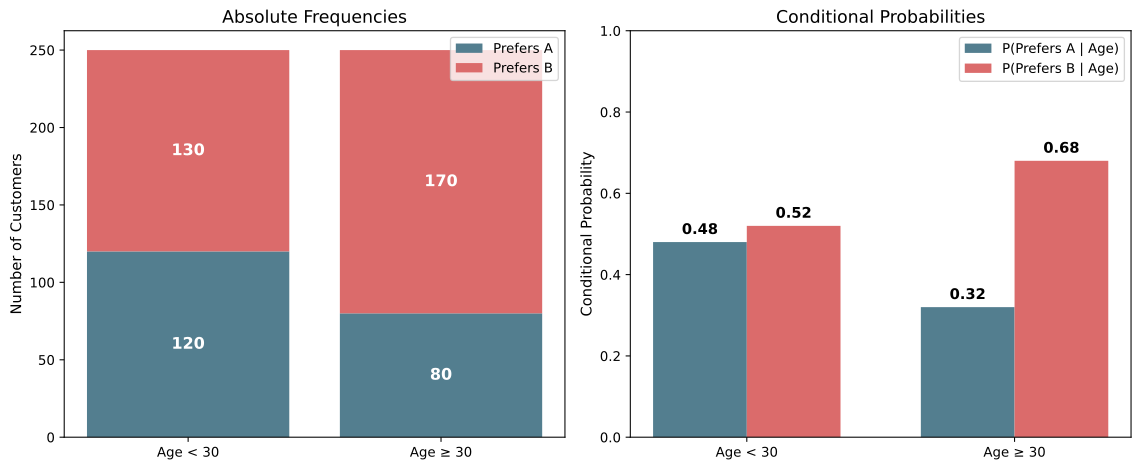
The right panel shows that preference depends on age: younger customers favour A more.
Constructing Tables
Strategy for Word Problems
Step-by-Step Approach:
- Identify the two variables and their categories
- Create empty table with row/column labels and totals
- Fill in given values (often percentages → convert to counts)
- Use subtraction to complete missing cells
- Verify: Row and column totals must match the grand total
Example: Building a Table
In a city of 10,000 residents:
- 40% are employed, 70% are adults (age ≥ 18)
- 35% are employed adults
Step 1: Fill in what we know
| Adult | Minor | Total | |
|---|---|---|---|
| Employed | 3,500 | ? | 4,000 |
| Not Employed | ? | ? | 6,000 |
| Total | 7,000 | 3,000 | 10,000 |
Completing the Table
Step 2: Use subtraction to fill remaining cells
| Adult | Minor | Total | |
|---|---|---|---|
| Employed | 3,500 | 500 | 4,000 |
| Not Employed | 3,500 | 2,500 | 6,000 |
| Total | 7,000 | 3,000 | 10,000 |
Now we can answer conditional questions:
- \(P(\text{Employed}|\text{Minor}) = \frac{500}{3{,}000} = \frac{1}{6} \approx 0.167\)
- \(P(\text{Adult}|\text{Employed}) = \frac{3{,}500}{4{,}000} = 0.875\)
Exam-Style Problem
A company surveyed 200 customers:
- 60% are satisfied with the product, 45% are repeat customers
- Of the satisfied customers, 60% are repeat customers
Step 1: Fill in direct values
| Repeat | New | Total | |
|---|---|---|---|
| Satisfied | ? | ? | 120 |
| Not Satisfied | ? | ? | 80 |
| Total | 90 | 110 | 200 |
Solution Continued
Step 2: Use “Of satisfied, 60% are repeat”
\(P(\text{Repeat}|\text{Satisfied}) = 0.60\), so \(72\) repeat AND satisfied
| Repeat | New | Total | |
|---|---|---|---|
| Satisfied | 72 | 48 | 120 |
| Not Satisfied | 18 | 62 | 80 |
| Total | 90 | 110 | 200 |
Always read conditional statements carefully: “of the satisfied” means the total number of satisfied is 120, not 200!
Quick Check
Building and Reading Tables
Work individually
A company has 300 employees. 180 are in Sales, the rest in Operations. Of the Sales employees, 40% received a bonus. Of Operations employees, 25% received a bonus.
- Construct the full contingency table.
- Compute \(P(\text{Sales}|\text{Bonus})\).
- Are department and bonus independent?
Break
Independence Testing
When Are Variables Independent?
Independence in Tables
Variables A and B are independent if and only if for every cell:
\[P(A \cap B) = P(A) \cdot P(B)\]
Equivalently, the expected count under independence is:
\[E_{ij} = \frac{\text{Row total} \times \text{Column total}}{\text{Grand total}}\]
If observed \(\neq\) expected in any cell, the variables are NOT independent.
Testing Independence: Example
From our customer survey:
| Repeat | New | Total | |
|---|---|---|---|
| Satisfied | 72 | 48 | 120 |
| Not Satisfied | 18 | 62 | 80 |
| Total | 90 | 110 | 200 |
Question: If satisfaction and repeat status were independent, what would we expect in the (Satisfied, Repeat) cell?
\[E = \frac{120 \times 90}{200} = 54\]
Visual: Observed vs Expected
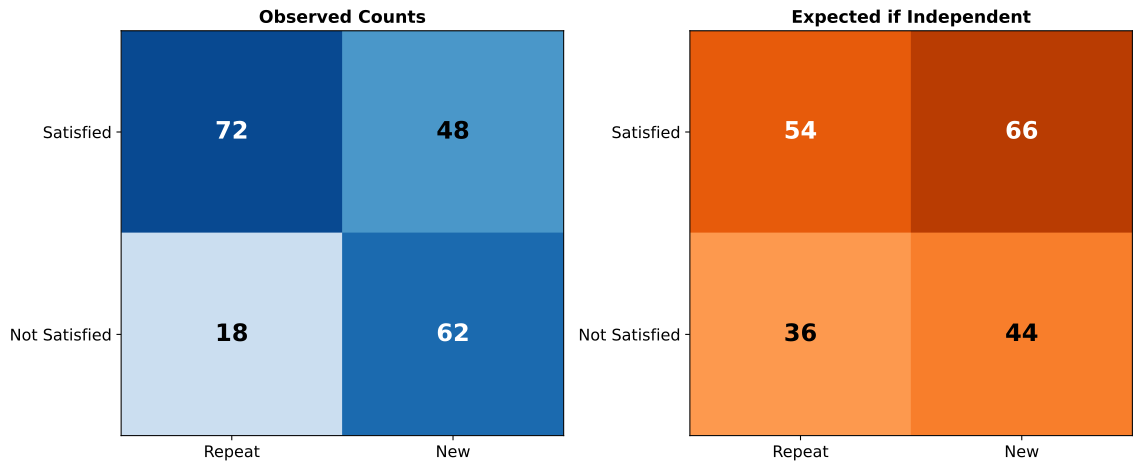
Large differences between observed and expected → strong evidence against independence.
Interpretation
The data suggests:
- Satisfied customers are MORE likely to be repeat customers
- \(P(\text{Repeat}|\text{Satisfied}) = \frac{72}{120} = 0.60\)
- \(P(\text{Repeat}|\text{Not Satisfied}) = \frac{18}{80} = 0.225\)
Satisfied customers are about 2.7 times more likely to be repeat customers!
Link to Bayes
Tables and Bayes
Table method from Session 07-05 is exactly this technique!
Classification as a contingency table:
| Condition (+) | Condition (−) | Total | |
|---|---|---|---|
| Predicted + | TP | FP | All + |
| Predicted − | FN | TN | All − |
| Total | Condition + | Condition − | Population |
- Positive Predictive Value = \(P(D|+) = \frac{\text{TP}}{\text{All +}}\): Bayes via the table!
- Negative Predictive Value = \(P(D'|-) = \frac{\text{TN}}{\text{All -}}\)
The Denominator Rule
For conditional prob., the denominator is always the condition total!
- \(P(A|B)\) → divide by “all \(B\)” (column total)
- \(P(B|A)\) → divide by “all \(A\)” (row total)
- \(P(A \cap B)\) → divide by grand total
Always state the condition in words before choosing the denominator.
Converting Between Approaches
Given: TPR = 90%, TNR = 95%, BR = 2%, Population = 10,000
| Condition + (200) | Condition − (9,800) | Total | |
|---|---|---|---|
| Predicted + | 180 | 490 | 670 |
| Predicted − | 20 | 9,310 | 9,330 |
| Total | 200 | 9,800 | 10,000 |
Direct calculations:
- Positive Predictive Value = \(\frac{180}{670} \approx 0.269\)
- Negative Predictive Value = \(\frac{9{,}310}{9{,}330} \approx 0.998\)
Relative Frequencies
Working with Percentages
Sometimes tables give proportions instead of counts:
| \(B\) | \(B'\) | Total | |
|---|---|---|---|
| \(A\) | 0.15 | 0.25 | 0.40 |
| \(A'\) | 0.35 | 0.25 | 0.60 |
| Total | 0.50 | 0.50 | 1.00 |
The same rules apply: cells are joint probabilities, margins are marginal probabilities.
\(P(A|B) = \frac{P(A \cap B)}{P(B)} = \frac{0.15}{0.50} = 0.30\), \(P(B|A) = \frac{P(A \cap B)}{P(A)} = \frac{0.15}{0.40} = 0.375\)
Independence Test: Proportions
From the previous table, test independence:
\[P(A) \cdot P(B) = 0.40 \times 0.50 = 0.20\]
\[P(A \cap B) = 0.15\]
\(0.15 \neq 0.20\), so A and B are NOT independent.
With a relative frequency table, you never need to multiply by a population size. Just compare the cell value directly with the product of the marginals.
Converting Between Formats
Question: Given a relative table, how do you get a count table?
Multiply every entry by the population size!
If \(n = 200\):
| \(B\) | \(B'\) | Total | |
|---|---|---|---|
| \(A\) | \(0.15 \times 200 = 30\) | \(0.25 \times 200 = 50\) | 80 |
| \(A'\) | \(0.35 \times 200 = 70\) | \(0.25 \times 200 = 50\) | 120 |
| Total | 100 | 100 | 200 |
If a problem gives percentages and asks for counts, pick a convenient total and multiply.
Build and Read Any 2×2 Table
Checklist:
Define event symbols first (e.g., \(A\), \(B\))
Fill totals and directly given values
Subtract to complete missing cells
Verify all four internal cells sum to grand total
Read probabilities with the correct denominator:
- Joint → divide by grand total
- Marginal → row or column total / grand total
- Conditional → divide by the condition’s total
Guided Practice
Practice Problem 1
Work in pairs
A survey of 400 employees found:
- 55% work full-time
- 40% have a graduate degree
- 25% work full-time AND have a graduate degree
- Construct the contingency table
- Find \(P(\text{Grad degree}|\text{Full-time})\)
- Find \(P(\text{Full-time}|\text{Grad degree})\)
- Are full-time status and graduate degree independent?
Practice Problem 2 (Exam-Style)
Work in pairs
A company produces items at two factories:
- Factory A produces 3,000 items, 5% defective
- Factory B produces 2,000 items, 8% defective
- Construct a contingency table
- An item is randomly selected and found defective. What’s the probability it came from Factory A?
- What percentage of all items are defective?
Practice Problem 3
In a retail database, let \(K\) = customer bought this month, and \(T\) = customer uses loyalty card.
| \(T\) | \(T'\) | Total | |
|---|---|---|---|
| \(K\) | 180 | 120 | 300 |
| \(K'\) | 90 | 210 | 300 |
| Total | 270 | 330 | 600 |
- State in words what each event means: \(T'\), \(K' \cap T\), \(T \setminus K\).
- Compute \(P(T \setminus K)\).
Practice Problem 3 II
- Write in words what \(P(T|K')\) means and compute it.
Practice Problem 4
A study reports the following relative frequency table:
| Online | In-Store | Total | |
|---|---|---|---|
| Return | 0.12 | 0.03 | 0.15 |
| Keep | 0.48 | 0.37 | 0.85 |
| Total | 0.60 | 0.40 | 1.00 |
- What is the probability that a randomly chosen purchase is an online return?
Practice Problem 4 II
- Given a purchase was returned, what is the probability it was online?
- Are purchase channel and return status independent?
Chained Exam Mini-Problem
Work individually, then compare
From a table: total \(n=500\), with \(n_{AB}=90\), row total \(n_A=200\), column total \(n_B=150\).
- Compute \(P(A \cap B)\).
- Use (a) and totals to compute \(P(A|B)\).
- Compare \(P(A \cap B)\) with \(P(A) \cdot P(B)\) and assess independence.
Coffee Break
Team Problem-Solving
Challenge 1: Campaign Conversion
Think individually (2 min), then work in groups of 3-4
A campaign contacts 800 customers.
- 320 clicked the email (\(C\))
- 180 purchased (\(P\))
- 110 both clicked and purchased
- Build the full 2×2 contingency table.
- Compute \(P(P|C)\) and \(P(P|C')\).
- Test whether clicking and purchasing are independent.
- Give one practical marketing interpretation.
Challenge 2: Student Performance
Think individually, then work in groups
A university tracks 600 students across two dimensions: study method (lecture-only vs lecture + tutorial) and exam result (pass vs fail).
360 students attended tutorials in addition to lectures, 480 students passed the exam and of those who attended tutorials, 85% passed
- Construct the contingency table.
Challenge 2: Tasks 2-4
- Compute \(P(\text{Pass}|\text{Lecture only})\).
- Are study method and exam result independent?
- A student passed. What is the probability they attended tutorials?
Challenge 3: Quality Audit
Think individually, then work in groups
An inspector tests items from two shifts (relative frequencies):
| Day Shift | Night Shift | Total | |
|---|---|---|---|
| Conforming | ? | ? | ? |
| Non-conforming | 0.04 | 0.06 | 0.10 |
| Total | 0.55 | 0.45 | 1.00 |
- Complete the table.
- Which shift has the higher non-conforming rate?
Challenge 3: Quality Audit II
- If the factory produces 2,000 items per day, construct the count table.
Final Assessment
Exit Ticket
Work individually
- In a contingency table, where do you find \(P(A \cap B)\)?
- If the cell count for \((A, B)\) is 36 and the column total for \(B\) is 120, what is \(P(A|B)\)?
- How do you check whether two variables in a table are independent?
Wrap-Up & Takeaways
Today’s Essential Concepts
- Table structure: Cells = joint, margins = marginal
- Reading probabilities: Joint, marginal, conditional: each has a different denominator
- Building tables: Fill given values, then subtract to complete
- Independence test: Compare observed cell with expected = row% × col% × total
- Relative frequency tables: Same rules, no population size needed
- Connection to Bayes: Tables provide a visual way to compute Bayes
Next Session Preview
Coming Up: Binomial Distribution
- Discrete probability distributions
- Binomial formula: \(P(X=k) = \binom{n}{k} p^k (1-p)^{n-k}\)
- “Exactly k”, “at most k”, “at least k”
- Expected value and variance
Homework
Complete Tasks 07-06: practice building and reading contingency tables!
Session 07-06 - Contingency Tables | Dr. Nikolai Heinrichs & Dr. Tobias Vlćek | Home