Session 07-04 - Conditional Probability
Section 07: Probability & Statistics
Entry Quiz
Quick Review from Session 07-03
Test your understanding of Combinatorics
Calculate \(\binom{8}{3}\)
How many ways can 5 people line up in a row?
A committee of 3 is chosen from 10 people. How many ways?
What’s the probability of getting exactly 3 heads in 5 coin flips? (Use combinations)
Homework Discussion
Your Questions from Session 07-03
Let’s resolve any confusion before conditional probability.
- Choosing permutations vs combinations
- Translating counting results into probabilities
- Avoiding overcounting
Learning Objectives
What You’ll Master Today
- Define conditional probability: \(P(A|B) = \frac{P(A \cap B)}{P(B)}\)
- Apply the multiplication rule: \(P(A \cap B) = P(A|B) \cdot P(B)\)
- Construct and use tree diagrams for sequential events
- Apply the law of total probability
- Test for independence using conditional probability
- Compute expectation and variance for discrete random variables
Conditional probability is heavily tested on the Feststellungsprüfung!
The Basic Concept
Motivation
Question: A card is drawn from a deck. What’s the probability it’s a king?
\[P(\text{King}) = \frac{4}{52} = \frac{1}{13}\]
Question: Given the card is a face card, what’s the probability it’s a king?
The condition changes the sample space!
\[P(\text{King} | \text{Face card}) = \frac{4}{12} = \frac{1}{3}\]
Conditional Probability Definition
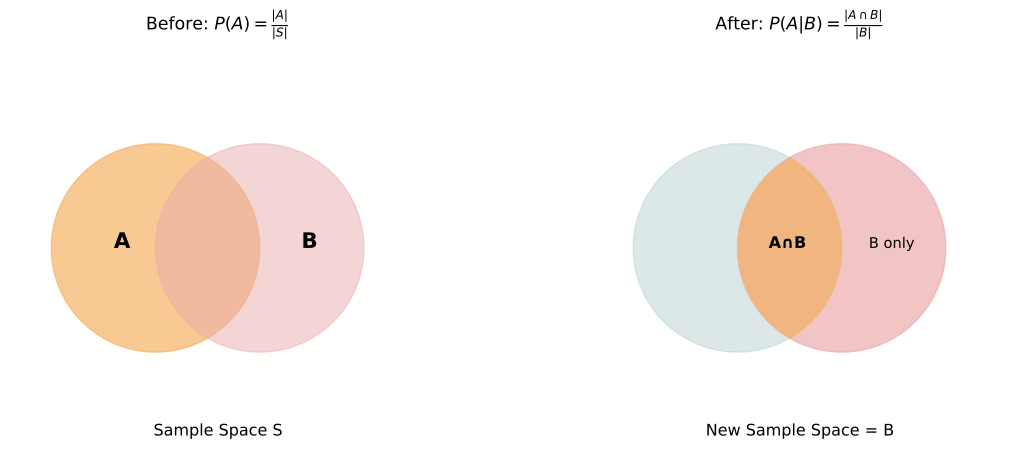
Definition: Conditional Probability
The probability of A given that B has occurred where \(P(B) > 0\).
\[P(A|B) = \frac{P(A \cap B)}{P(B)}\]
Read “\(P(A|B)\)” as “probability of A given B”
Visual Interpretation
Example Calculation
In a company: 60% work full-time, 30% work full-time AND have a degree.
Question: What’s the probability an employee has a degree, given they work full-time?
Let D = has degree, F = full-time
\[P(D|F) = \frac{P(D \cap F)}{P(F)} = \frac{0.30}{0.60} = 0.50\]
Given that someone works full-time, there’s a 50% chance they have a degree.
Multiplication Rule
Conditional to Joint Probability
Rearranging the definition of the Multiplication Rule:
\[P(A \cap B) = P(A|B) \cdot P(B)\]
or equivalently:
\[P(A \cap B) = P(B|A) \cdot P(A)\]
Both formulas give the same result!
Example: Sequential Selection
A box contains 5 red and 3 blue balls. Two balls are drawn without replacement.
Question: What’s the probability both are red?
Let \(R_1\) = first ball red, \(R_2\) = second ball red
\[P(R_1 \cap R_2) = P(R_2|R_1) \cdot P(R_1)\]
\[= \frac{4}{7} \times \frac{5}{8} = \frac{20}{56} = \frac{5}{14}\]
Extended Multiplication Rule
For three or more events:
\[P(A \cap B \cap C) = P(A) \cdot P(B|A) \cdot P(C|A \cap B)\]
Example: Drawing 3 cards without replacement of a deck of 52 cards. What’s the probability of getting 3 aces?
\[P(\text{3 aces}) = \frac{4}{52} \times \frac{3}{51} \times \frac{2}{50} = \frac{24}{132,600} = \frac{1}{5,525}\]
Do you get the idea? We can extend this to any number of events.
Tree Diagrams
Visual Tool for Sequential Events
Tree diagrams help visualize the multiplication rule.
- Branches = outcomes at each stage
- Branch labels = probabilities (conditional if sequential)
- Multiply along paths = joint probability
- Add across paths = union probability
Example: A machine’s items pass through 2 inspections: 90% pass inspection 1, and of those, 95% pass inspection 2. Of the failers, 60% do.
Example: Quality Control
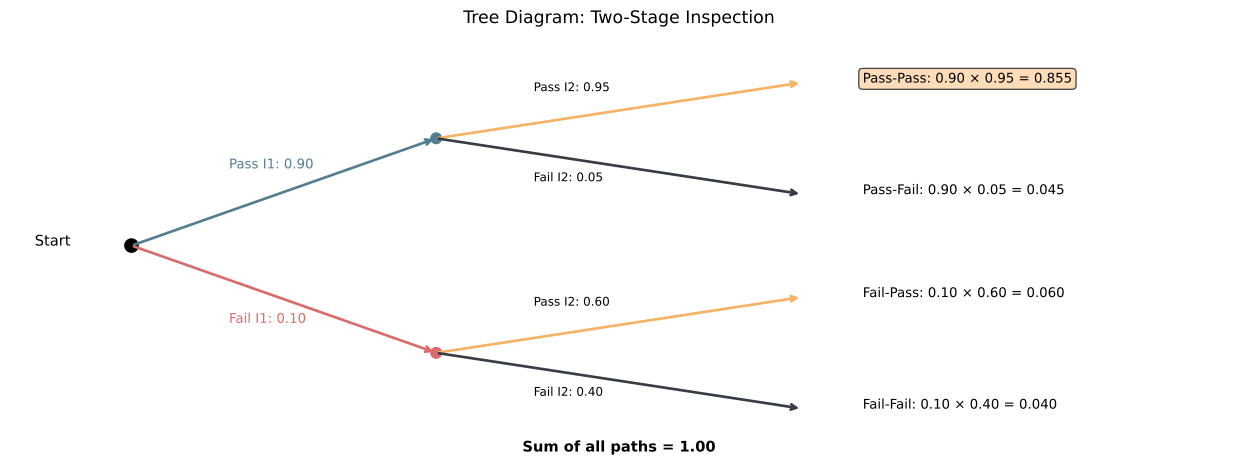
These diagrams are a great way to visualize the multiplication rule!
Reading Tree Diagrams
From the previous example:
P(item passes both inspections): Follow Pass-Pass path \[0.90 \times 0.95 = 0.855\]
P(item passes inspection 2): Add all paths ending with Pass I2 \[0.855 + 0.060 = 0.915\]
P(passed I1 | passed I2): (We’ll use Bayes for this later!) \[P(I_1|I_2) = \frac{P(I_1 \cap I_2)}{P(I_2)} = \frac{0.855}{0.915} \approx 0.934\]
With vs Without Replacement
Same setup, different dependency structure:
Suppose a bag has 3 red and 2 blue marbles, draw two marbles.
With replacement:
- First red then second red: \(\frac{3}{5}\cdot\frac{3}{5}=\frac{9}{25}\)
- Second draw probability stays the same: composition resets.
Without replacement:
- First red then second red: \(\frac{3}{5}\cdot\frac{2}{4}=\frac{3}{10}\)
- Second draw probability changes: one marble is removed.
Quick Check
Conditional vs Reverse Conditional
Work individually
Given \(P(A)=0.4\), \(P(B)=0.5\), and \(P(A \cap B)=0.2\):
- Compute \(P(A|B)\).
- Compute \(P(B|A)\).
- Explain in one sentence why these two values can differ.
Break
Total Probability
Partitioning the Sample Space
Definition: Law of Total Probability
If events \(B_1, B_2, ..., B_n\) partition the sample space (mutually exclusive and exhaustive):
\[P(A) = \sum_{i=1}^{n} P(A|B_i) \cdot P(B_i)\]
Common case with two partitions:
\[P(A) = P(A|B) \cdot P(B) + P(A|B') \cdot P(B')\]
Example: Market Segments
A company sells to three market segments:
- Segment A: 50% of customers, 20% buy premium
- Segment B: 30% of customers, 35% buy premium
- Segment C: 20% of customers, 50% buy premium
Question: What percentage of all customers buy premium?
\[\begin{aligned}P(\text{Premium}) &= 0.20(0.50) + 0.35(0.30) + 0.50(0.20) \\ &= 0.10 + 0.105 + 0.10 = 0.305\end{aligned}\]
30.5% of customers buy premium products.
Testing Independence
Testing Independence
Definition: Independence Test
Events A and B are independent if and only if:
\[P(A|B) = P(A)\]
Learning B occurred doesn’t change the probability of A!
Equivalently: \(P(B|A) = P(B)\) or \(P(A \cap B) = P(A) \cdot P(B)\)
Example: Testing Independence
Survey data shows:
- \(P(\text{Exercise regularly}) = 0.40\)
- \(P(\text{Healthy weight}) = 0.55\)
- \(P(\text{Healthy weight}|\text{Exercise}) = 0.70\)
Question: Are “exercise regularly” and “healthy weight” independent?
- Test: Is \(P(\text{Healthy}|\text{Exercise}) = P(\text{Healthy})\)? \(0.70 \neq 0.55\)
- Conclusion: Events are NOT independent, exercise is associated with healthy weight.
Mean & Variance
Expected Value
Definition of the Expected Value
For a discrete random variable \(X\) with values \(x_i\) and probabilities \(p_i\):
\[E[X]=\sum_i x_i p_i\]
Interpretation: long-run average outcome with \(p_i=P(X=x_i)\).
Although it looks formally difficult, the expected value is something you might feel that has to be true. It simply states that the average outcome is the weighted average of all possible outcomes.
VAR and STD (Recap)
You already know these from Session 07-01:
| Descriptive Statistics | Random Variable Notation |
|---|---|
| \(s^2 = \frac{\sum (x_i - \bar{x})^2}{n-1}\) | \(\mathrm{Var}(X) = E[(X - \mu)^2]\) |
| \(s = \sqrt{s^2}\) | \(\sigma_X = \sqrt{\mathrm{Var}(X)}\) |
Same idea, new notation: instead of averaging squared deviations from a sample, we take the expected value of squared deviations from \(\mu = E[X]\).
Worked Mini Example
A project has outcomes for weekly profit (in kEUR):
| \(x\) | 10 | 20 | 30 |
|---|---|---|---|
| \(P(X=x)\) | 0.2 | 0.5 | 0.3 |
\[E[X]=10(0.2)+20(0.5)+30(0.3)=2+10+9=21\]
So the expected weekly profit is 21 kEUR.
Linearity and Transformation Rules
Definition: High-Value Rules
For constants \(a,b\):
\[E[aX+b]=aE[X]+b\]
\[\mathrm{Var}(aX+b)=a^2\mathrm{Var}(X)\]
Adding a constant shifts the mean but does not change variance.
Makes intuitive sense: if you add 100 to every outcome, the mean increases by 100, but the spread of outcomes does not change.
Sum of Independent Variables
If \(X\) and \(Y\) are independent:
\[E[X+Y]=E[X]+E[Y]\]
\[\mathrm{Var}(X+Y)=\mathrm{Var}(X)+\mathrm{Var}(Y)\]
Example: If \(E[X]=10\), \(\mathrm{Var}(X)=4\) and \(E[Y]=6\), \(\mathrm{Var}(Y)=3\):
- \(E[X+Y]=10+6=16\)
- \(\mathrm{Var}(X+Y)=4+3=7\) (if independent!)
Expectation always adds. Variance adds only under independence.
Application: Two Campaigns
A and B have random profit contributions \(X\) and \(Y\), independent.
- \(E[X]=8\), \(\mathrm{Var}(X)=9\)
- \(E[Y]=5\), \(\mathrm{Var}(Y)=4\)
For total \(T=X+Y\):
- \(E[T]=8+5=13\)
- \(\mathrm{Var}(T)=9+4=13\)
- \(\sigma_T=\sqrt{13}\approx3.61\)
Expectation and Variance Practice
Work individually
Given a random variable with \(E[X]=12\) and \(\mathrm{Var}(X)=5\):
- Compute \(E[3X-2]\).
- Compute \(\mathrm{Var}(3X-2)\).
- If independent \(Y\) has \(E[Y]=4\), \(\mathrm{Var}(Y)=7\), compute \(E[X+Y]\) and \(\mathrm{Var}(X+Y)\).
Guided Practice
Practice Problems
Work in pairs
Problem 1: 70% of students study math, 60% study economics, and 45% study both.
- Find \(P(\text{Econ}|\text{Math})\)
- Find \(P(\text{Math}|\text{Econ})\)
- Are these events independent?
Problem 2: Draw a tree diagram for: A bag has 3 red and 2 blue marbles. Two marbles are drawn without replacement. Find \(P(\text{both same color})\).
Chained Exam Mini-Problem
Work individually, then compare
Given \(P(A)=0.50\), \(P(B)=0.30\), and \(P(B|A)=0.60\):
- Compute \(P(A\cap B)\).
- Use (a) to compute \(P(A|B)\).
- Decide whether \(A\) and \(B\) are independent.
Coffee Break
Team Problem-Solving
Challenge: Supplier Reliability
Think individually then work in groups
A company has two suppliers. Let: \(A\) = order from Supplier A and \(O\) = order arrives on time. Given: \(P(A)=0.6\), \(P(O|A)=0.9\), \(P(O|A')=0.75\)
- Compute \(P(A \cap O)\) and \(P(A' \cap O)\).
- Compute overall on-time probability \(P(O)\).
- Compute \(P(A|O)\).
- Decide whether on-time arrival is independent of supplier choice.
Challenge: Scholarship Fund
Think individually then work in groups
A university awards scholarships to two groups of applicants: domestic (\(D\)) and international (\(I\)).
- 65% of applicants are domestic, 35% are international.
- \(P(\text{Award}|D)=0.25\), \(P(\text{Award}|I)=0.15\)
- Compute \(P(\text{Award} \cap D)\) and \(P(\text{Award} \cap I)\).
- What fraction of all applicants receive a scholarship?
- Given a student received a scholarship, what is \(P(D|\text{Award})\)?
- Are “domestic” and “receiving a scholarship” independent?
Ride-Sharing Surge Pricing
Think individually then work in groups
A ride-sharing app classifies rides as peak (\(K\)) or off-peak (\(K'\)). Let \(C\) = customer gives 5-star rating.
- 40% of rides occur during peak hours.
- \(P(C|K)=0.60\), \(P(C|K')=0.80\)
- Draw a tree diagram and label all branch probabilities.
- Compute \(P(C)\) using the law of total probability.
Ride-Sharing Surge Pricing II
- Compute \(P(K|C)\) and \(P(K'|C)\).
- Do peak and off-peak rides receive 5-star ratings at the same rate?
Final Assessment
Exit Ticket
Work individually, then compare
- If \(P(A \cap B)=0.18\) and \(P(B)=0.30\), find \(P(A|B)\).
- In one sentence, explain the difference between \(P(A|B)\) and \(P(B|A)\).
- A bag has 4 red and 1 blue ball. Two draws without replacement. Is \(P(\text{second red}|\text{first red})\) equal to \(P(\text{second red})\)?
Wrap-Up & Takeaways
Today’s Essential Concepts
- Conditional probability: \(P(A|B) = \frac{P(A \cap B)}{P(B)}\)
- Multiplication rule: \(P(A \cap B) = P(A|B) \cdot P(B)\)
- Tree diagrams: Multiply along paths, add across paths
- Total probability: Sum over all branches
- Independence: \(P(A|B) = P(A)\)
- Expectation/variance: summarize average outcome and risk
Next Session Preview
Coming Up: Bayes’ Theorem
- Reversing conditional probabilities
- Prior and posterior probabilities
- Medical testing applications (sensitivity, specificity)
- Business decision making
Homework
Complete Tasks 07-04, focus on tree diagrams and conditional probability!
Session 07-04 - Conditional Probability | Dr. Nikolai Heinrichs & Dr. Tobias Vlćek | Home