Session 07-03 - Combinatorics & Counting
Section 07: Probability & Statistics
Entry Quiz
Quick Review from Session 07-02
Test your understanding of Basic Probability
If \(P(A) = 0.4\) and \(P(B) = 0.3\) and A and B are independent, find \(P(A \cap B)\).
Use the complement rule: If \(P(\text{rain}) = 0.25\), find \(P(\text{no rain})\).
If \(P(A) = 0.5\), \(P(B) = 0.4\), and \(P(A \cap B) = 0.2\), find \(P(A \cup B)\).
Are events A and B from question 3 independent? Why or why not?
Homework Discussion
Your Questions from Session 07-02
Let’s clarify notation before counting gets harder.
- Independent vs mutually exclusive events
- Complement strategy for “at least one”
- Translating set notation into plain language
Learning Objectives
What You’ll Master Today
- Apply the fundamental counting principle for sequential events
- Calculate permutations: \(P(n,r) = \frac{n!}{(n-r)!}\)
- Calculate combinations: \(C(n,r) = \binom{n}{r} = \frac{n!}{r!(n-r)!}\)
- Distinguish when order matters vs. doesn’t matter
- Connect counting to probability calculations
Combinatorics is essential for calculating probabilities on the exam!
Counting Principle
Sequential Choices
If you make sequential choices with \(n_1, n_2, ..., n_k\) options:
\[\text{Total possibilities} = n_1 \times n_2 \times ... \times n_k\]
Example: Creating an outfit
- 4 shirts
- 3 pairs of pants
- 2 pairs of shoes
Total outfits: \(4 \times 3 \times 2 = 24\)
License Plate Example
A license plate has:
- 3 letters (A-Z, 26 options each)
- 4 digits (0-9, 10 options each)
Question: How many different plates are possible?
With repetition allowed: \[26 \times 26 \times 26 \times 10 \times 10 \times 10 \times 10 = 26^3 \times 10^4 = 175,760,000\]
Without repetition: \[26 \times 25 \times 24 \times 10 \times 9 \times 8 \times 7 = 78,624,000\]
Factorial Notation
Definition: Factorial
\[n! = n \times (n-1) \times (n-2) \times \dots \times 1\]
Special cases: \(0! = 1\) and \(1! = 1\)
Examples:
- \(5! = 5 \times 4 \times 3 \times 2 \times 1 = 120\)
- \(3! = 3 \times 2 \times 1 = 6\)
- \(10! = 3,628,800\)
Permutations
When Order Matters
Definition: Permutation
A permutation is an arrangement of objects where order matters.
\[P(n,r) = \frac{n!}{(n-r)!}\]
= Number of ways to arrange \(r\) objects from \(n\) distinct objects
Example: How many ways can 3 people win gold, silver, and bronze from 8 competitors?
\[P(8,3) = \frac{8!}{5!} = \frac{8 \times 7 \times 6 \times 5!}{5!} = 8 \times 7 \times 6 = 336\]
Permutation Examples
Example 1: Arrange all letters in “MATH”
\[P(4,4) = 4! = 24 \text{ arrangements}\]
Example 2: How many 4-digit PINs with no repeated digits?
\[P(10,4) = \frac{10!}{6!} = 10 \times 9 \times 8 \times 7 = 5,040\]
Example 3: A president, VP, and treasurer from 12 candidates?
\[P(12,3) = 12 \times 11 \times 10 = 1,320\]
Combinations
When Order Doesn’t Matter
Definition: Combination
A combination is a selection of objects where order doesn’t matter.
\[C(n,r) = \binom{n}{r} = \frac{n!}{r!(n-r)!}\]
= Number of ways to choose \(r\) objects from \(n\) distinct objects
Insight: Each combination corresponds to \(r!\) permutations
\[C(n,r) = \frac{P(n,r)}{r!}\]
Combination Examples
Example 1: Choose 3 students from 10 for a committee
\[C(10,3) = \binom{10}{3} = \frac{10!}{3! \cdot 7!} = \frac{10 \times 9 \times 8}{3 \times 2 \times 1} = 120\]
Example 2: Choose 5 cards from a 52-card deck
\[C(52,5) = \binom{52}{5} = \frac{52!}{5! \cdot 47!} = \frac{52 \times 51 \times 50 \times 49 \times 48}{120} = 2,598,960\]
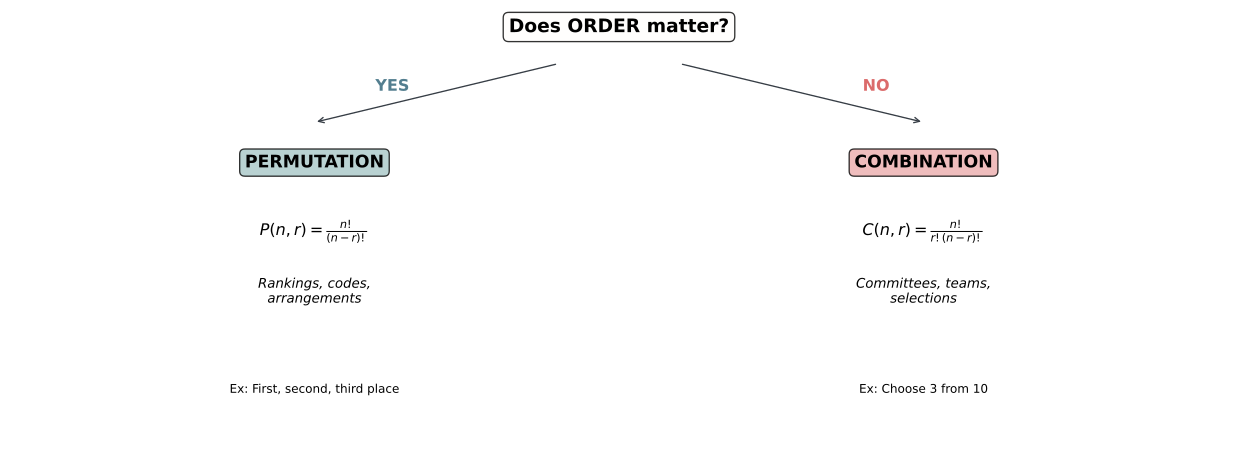
Decision Tree
If order matters, use permutations. If not, use combinations.
Calculator: Factorial, Permutations
Factorial with SHIFT + x⁻¹ (x!):
- Enter:
10SHIFT x⁻¹ = - Result: \(10! =\) 3,628,800
Permutations with SHIFT + × (nPr):
- Enter:
8SHIFT ×3= - Result: \(P(8,3) =\) 336, the gold, silver and bronze example
Always type \(n\) first, then the function key, then \(r\).
Calculator: Combinations
Combinations with SHIFT + ÷ (nCr):
- Enter:
10SHIFT ÷3= - Result: \(\binom{10}{3} =\) 120, the committee of 3 from 10 students
Example: All 5-card hands from a 52-card deck
- Enter:
52SHIFT ÷5= - Result: \(\binom{52}{5} =\) 2,598,960
In the exam you still write the formula and your steps by hand. Use the calculator to check the result.
Quick Check
Decide the Method First
Work individually
For each situation, write either permutation or combination and compute:
- Choose 2 class representatives from 11 students.
- Assign president and vice president from 11 students.
- Number of 3-digit PINs from digits 0-9 (repetition allowed).
Break
Counting & Probability
Connecting Counting to Probability
For equally likely outcomes:
\[P(A) = \frac{\text{Number of favorable outcomes}}{\text{Total number of outcomes}}\]
- Counting helps us find both numbers!
- Let’s look at some examples.
Question: Probability of being dealt exactly 2 hearts in a 5-card hand?
Example: Card Probability
Favorable: Choose 2 hearts from 13, AND 3 non-hearts from 39
\[\binom{13}{2} \times \binom{39}{3} = 78 \times 9,139 = 712,842\]
Total outcomes: Choose any 5 cards from 52
\[\binom{52}{5} = 2,598,960\]
Probability: \(P(\text{exactly 2 hearts}) = \frac{712,842}{2,598,960} \approx 0.274\)
Example: Committee Selection
A committee of 4 must be chosen from 6 men and 5 women.
Question: Probability that the committee has exactly 2 women?
- Total ways to form committee: \(\binom{11}{4} = 330\)
- Ways to get exactly 2 women: \(\binom{5}{2} \times \binom{6}{2} = 10 \times 15 = 150\)
- Probability: \(P(\text{exactly 2 women}) = \frac{150}{330} = \frac{5}{11} \approx 0.455\)
Do you see a pattern here?
Example: Quality Control
Box contains 20 items: 4 are defective. We select 3 items randomly:
- \(P(\text{none defective})\)
\[P = \frac{\binom{16}{3}}{\binom{20}{3}} = \frac{560}{1140} = \frac{28}{57} \approx 0.491\]
- \(P(\text{at least one defective})\)
\[P = 1 - P(\text{none}) = 1 - 0.491 = 0.509\]
Pascal’s Triangle
A Shortcut for Binomial Coefficients
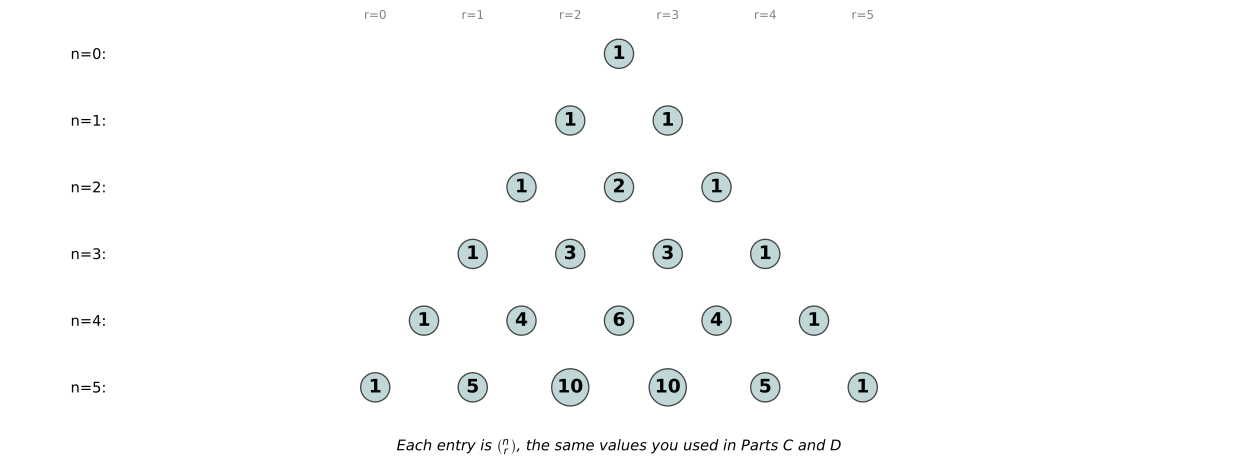
You’ve been computing \(\binom{n}{r}\) all session: for card hands, committees, and defective items. Pascal’s triangle arranges all these values in a pattern that makes them easy to look up and verify.
Pascal’s Triangle
The recursive property: each entry is the sum of the two above it.
\[\binom{n}{r} + \binom{n}{r+1} = \binom{n+1}{r+1}\]
Why this matters: Instead of computing \(\binom{5}{2} = \frac{5!}{2!\,3!}\) from scratch, find row \(n=5\) and look up the entry for \(r=2\) → 10. This saves time when verifying combination calculations.
Or use SHIFT + ÷ (nCr) on your calculator, as shown under Combinations.
Guided Practice
Practice Problems
Work in pairs
Problem 1: A password must have 3 letters followed by 2 digits.
- How many passwords are possible (with repetition)?
- How many if no repetition is allowed?
Problem 2: From 8 candidates, we select a president, VP, secretary, and treasurer. How many ways?
Problem 3: A lottery requires choosing 6 numbers from 49. How many possible combinations?
Chained Exam Mini-Problem
Work individually, then compare
A committee of 4 is chosen from 10 people, including 3 finance majors.
- Compute total possible committees.
- Compute committees with exactly 2 finance majors.
- Use (a) and (b) to compute the probability of exactly 2 finance majors.
Training Tasks I
Work individually
An ice cream shop offers 12 flavors. You order a bowl with 3 scoops.
- How many bowls are possible if you choose 3 different flavors and the order of scoops doesn’t matter?
- Your friend orders a cone where the stacking order matters. How many cones with 3 different flavors are possible?
- What is the probability that a randomly chosen bowl (from part a) contains your two favorite flavors?
Training Tasks II
Work individually
A class has 15 students: 9 from Business and 6 from Economics. The professor randomly forms a project team of 5 students.
- How many possible teams are there?
- How many teams have exactly 3 Business and 2 Economics students?
- What is the probability that the team has exactly 3 Business and 2 Economics students?
Coffee Break
Team Problem-Solving
Group Challenge: Event Planning
Think individually, then work in groups
An event team must choose from 9 volunteers:
- A chairperson, vice-chairperson, and treasurer.
- A separate 4-person logistics team.
- The probability that exactly 2 of 5 selected panelists are international students, if 7 of 18 applicants are international.
For each part, explain clearly whether order matters and why.
Counting Principle: Travel Routes
Work in pairs
A sales representative must visit 3 cities: office → City A by 4 routes, A → B by 3 routes, B → C by 2 routes.
- How many different travel plans are possible?
- If the representative must also return from City C to the office and there are 3 return routes, how many round trips are possible?
- If one route from office to City A is closed, how many travel plans remain for part (a)?
Permutations vs. Combinations
Work in pairs
A student has 8 different textbooks.
- How many ways can the student arrange all 8 books on a shelf?
- How many ways can the student choose 4 books to take on a trip?
- The student wants to stack the 4 chosen books in a pile on the desk. How many different stacks are possible?
- Explain why (b) and (c) give different answers.
Raffle Draw
Work individually, then compare
A company raffle has 30 tickets. You bought 4 tickets. Three winning tickets are drawn at random.
- How many ways can the 3 winning tickets be drawn?
- How many ways can all 3 winners come from your tickets?
- What is the probability that you win all 3 prizes?
- What is the probability that you win exactly 1 prize?
Mixed Problem: Digital Security
Work in groups
A company assigns 6-character access codes using digits 0-9 and uppercase letters A-Z (36 characters total).
- How many codes are possible if repetition is allowed?
- How many codes are possible if no character may repeat?
- A valid code must contain exactly 2 digits and 4 letters (no repetition, order matters). How many valid codes are there?
- If a code is generated at random (under the rules of part c), what is the probability that the two digits are adjacent?
Complement Strategy: Defects
Work individually
A shipment contains 25 items, of which 5 are defective. A quality inspector selects 4 items at random.
- What is the probability that none of the selected items are defective?
- What is the probability that at least one selected item is defective?
- What is the probability that exactly 2 selected items are defective?
Final Assessment
Exit Ticket
Work individually
- How many 4-letter codes can be formed from 26 letters with repetition?
- How many ways to choose 3 students from 12?
- Which uses combinations: “arrange” or “choose”?
Wrap-Up & Takeaways
Today’s Essential Concepts
- Counting principle: Multiply choices for sequential events
- Factorial: \(n! = n \times (n-1) \times ... \times 1\)
- Permutations: Order matters, \(P(n,r) = \frac{n!}{(n-r)!}\)
- Combinations: Order doesn’t matter, \(C(n,r) = \frac{n!}{r!(n-r)!}\)
- Key question: Does the order of selection matter?
Next Session Preview
Coming Up: Conditional Probability
- Conditional probability: \(P(A|B)\)
- Multiplication rule
- Tree diagrams
- Independence revisited
Homework
Complete Tasks 07-03:
- Practice permutation and combination calculations
- Solve probability problems using combinatorics
Session 07-03 - Combinatorics & Counting | Dr. Nikolai Heinrichs & Dr. Tobias Vlćek | Home