Session 06-04 - Area Between Curves & Economic Surplus
Section 06: Integral Calculus
Entry Quiz
Quick Review from Session 06-03
Test your understanding of Area Problems
Find the total area between \(f(x) = x - 3\) and the x-axis from \(x = 0\) to \(x = 5\).
Evaluate \(\int_0^2 3e^{2x} \, dx\)
Evaluate \(\int_1^e \frac{4}{x} \, dx\)
If a production rate is \(P(t) = 100 - 5t\), find total production from \(t = 0\) to \(t = 10\).
Homework Discussion
Your questions from Session 06-03
Focus on area problems and special integrals
- Handling regions above and below the x-axis
- Exponential and logarithmic integrals
- Business applications of area
- Setting up integrals from word problems
Today we find the area between two curves and apply this to economic surplus!
Learning Objectives
What You’ll Master Today
- Find intersection points of two functions algebraically
- Determine which function is on top in each region
- Set up integrals for area between curves: \(\int_a^b [f(x) - g(x)] \, dx\)
- Handle multiple regions when curves cross
- Calculate Consumer and Producer Surplus using areas
- Find equilibrium and interpret market efficiency
Area between curves is the foundation for understanding economic surplus!
The Basic Concept
Area Between Two Curves
Key idea: If \(f(x) \geq g(x)\) on \([a; b]\), then: \(\text{Area} = \int_a^b [f(x) - g(x)] \, dx\)
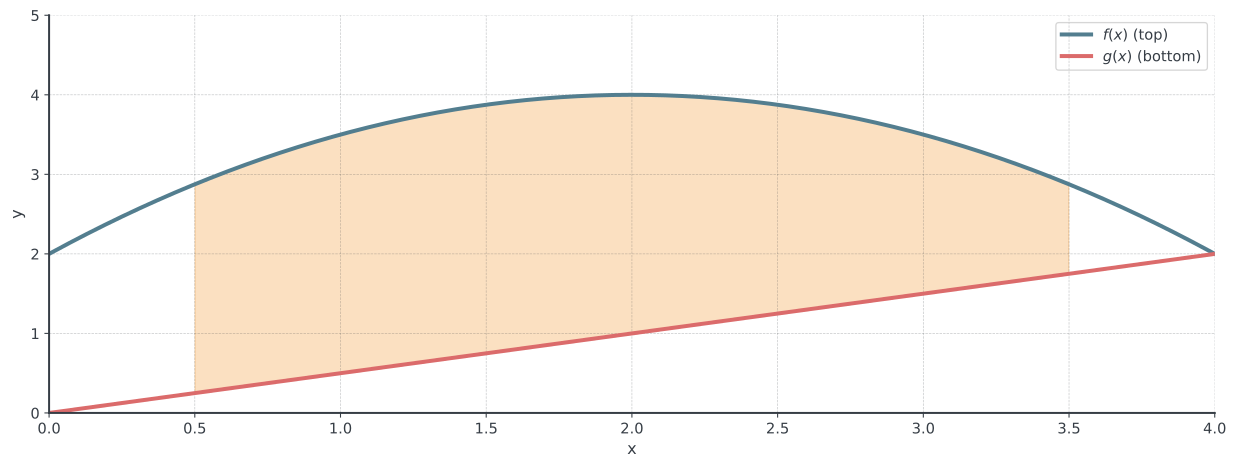
Top curve minus bottom curve!
Why Does This Work?
Think of it as subtracting areas:
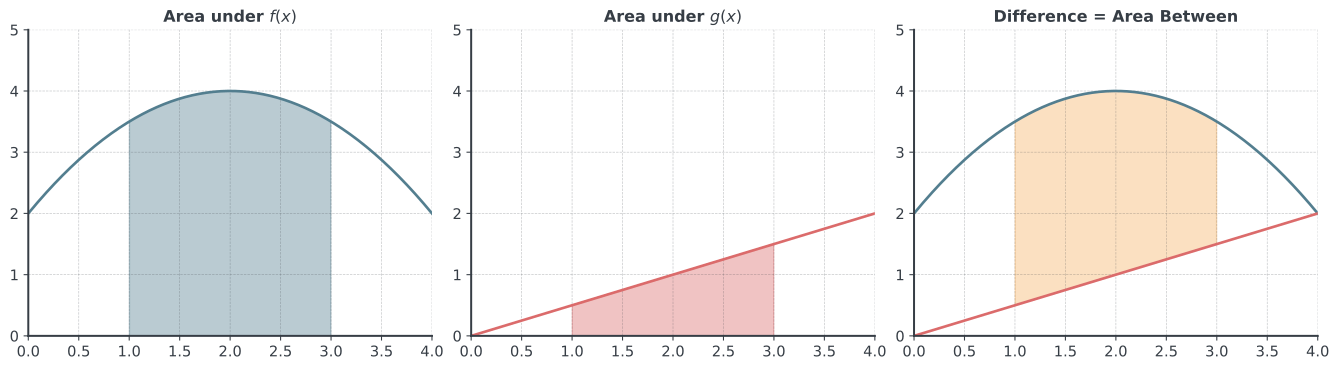
\[\int_a^b f(x) \, dx - \int_a^b g(x) \, dx = \int_a^b [f(x) - g(x)] \, dx\]
The Formula
Area between curves:
\[\text{Area} = \int_a^b |f(x) - g(x)| \, dx\]
Or if you know \(f(x) \geq g(x)\):
\[\text{Area} = \int_a^b [f(x) - g(x)] \, dx\]
Find intersection points (bounds \(a\) and \(b\)), determine which function is on top and then integrate top minus bottom.
Intersection Points
Setting Up the Problem
To find where curves intersect:
- Set \(f(x) = g(x)\) and solve for \(x\).
Example: Find where \(f(x) = 6 - x^2\) and \(g(x) = x\) intersect.
\[6 - x^2 = x\] \[x^2 + x - 6 = 0\] \[(x + 3)(x - 2) = 0\] \[x = -3 \text{ or } x = 2\]
Example: Complete Solution
Find the area between \(f(x) = 6 - x^2\) and \(g(x) = x\).
- Step 1: Intersection points are \(x = -3\) and \(x = 2\) ✓
- Step 2: Which is on top? Test \(x = 0\):
- \(f(0) = 6\)
- \(g(0) = 0\)
- So \(f(x) \geq g(x)\) on \([-3; 2]\) ✓
- Step 3: Calculate the area:
- \(\int_{-3}^{2} [(6 - x^2) - x] \, dx = \int_{-3}^{2} (6 - x - x^2) \, dx\)
Completing the Calculation
\[\int_{-3}^{2} (6 - x - x^2) \, dx = \left[6x - \frac{x^2}{2} - \frac{x^3}{3}\right]_{-3}^{2}\]
At \(x = 2\): \(12 - 2 - \frac{8}{3} = 10 - \frac{8}{3} = \frac{22}{3}\)
At \(x = -3\): \(-18 - \frac{9}{2} + 9 = -9 - \frac{9}{2} = -\frac{27}{2}\)
\[\text{Area} = \frac{22}{3} - \left(-\frac{27}{2}\right) = \frac{22}{3} + \frac{27}{2} = \frac{44 + 81}{6} = \frac{125}{6}\]
Visualization
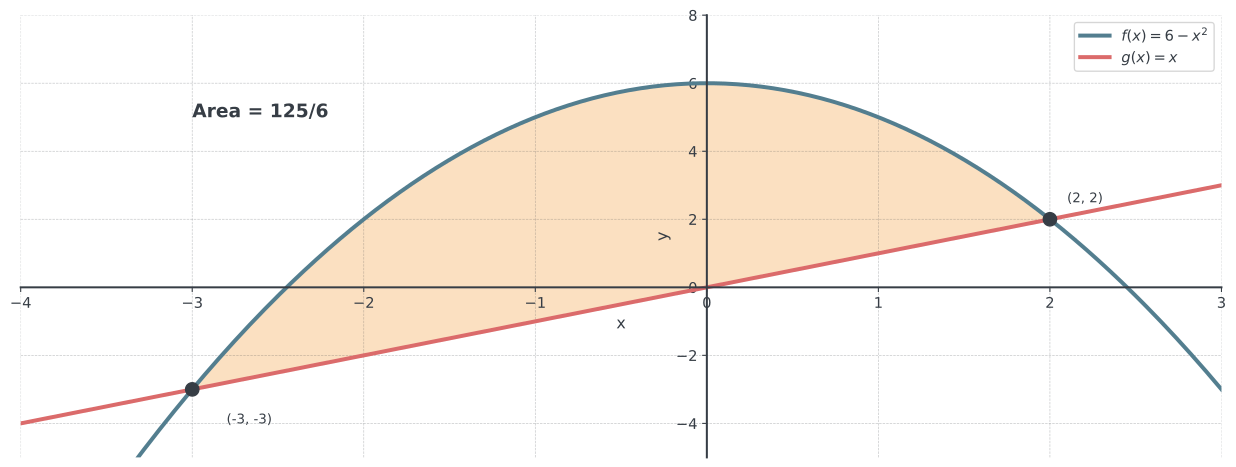
Even though part of this region lies below the x-axis, the area is still positive because we integrate \((f(x) - g(x))\) where \(f\) is above \(g\).
Break
When Curves Cross
Strategy for Crossing Curves
When curves cross:
- Find all intersection points
- Split the interval at each crossing
- In each region, determine which curve is on top
- Calculate area of each region separately
- Add all regions (all positive)
\[\text{Total Area} = \int_{a}^{c} |f - g| \, dx + \int_{c}^{b} |f - g| \, dx\]
Example: Crossing Curves
Find the area between \(f(x) = x^2\) and \(g(x) = x\) from \(x = 0\) to \(x = 2\).
- Step 1: Find intersections on \([0; 2]\):
- \(x^2 = x \implies x^2 - x = 0 \implies x(x-1) = 0\)
- Intersections at \(x = 0\) and \(x = 1\)
- Step 2: Determine which is on top:
- On \([0; 1]\): Test \(x = 0.5\): \(f(0.5) = 0.25\), \(g(0.5) = 0.5\). So \(g > f\)
- On \([1; 2]\): Test \(x = 1.5\): \(f(1.5) = 2.25\), \(g(1.5) = 1.5\). So \(f > g\)
- Step 3: Calculate each region (next slide)
Calculate each Region
Region 1 \((0 \leq x \leq 1)\): \(g\) on top
\[\int_0^1 (x - x^2) \, dx = \left[\frac{x^2}{2} - \frac{x^3}{3}\right]_0^1 = \frac{1}{2} - \frac{1}{3} = \frac{1}{6}\]
Calculate each Region II
Region 2 \((1 \leq x \leq 2)\): \(f\) on top
\[\int_1^2 (x^2 - x) \, dx = \left[\frac{x^3}{3} - \frac{x^2}{2}\right]_1^2\]
\[= \left(\frac{8}{3} - 2\right) - \left(\frac{1}{3} - \frac{1}{2}\right) = \frac{2}{3} + \frac{1}{6} = \frac{5}{6}\]
Total Area \(= \frac{1}{6} + \frac{5}{6} = 1\)
Visualization
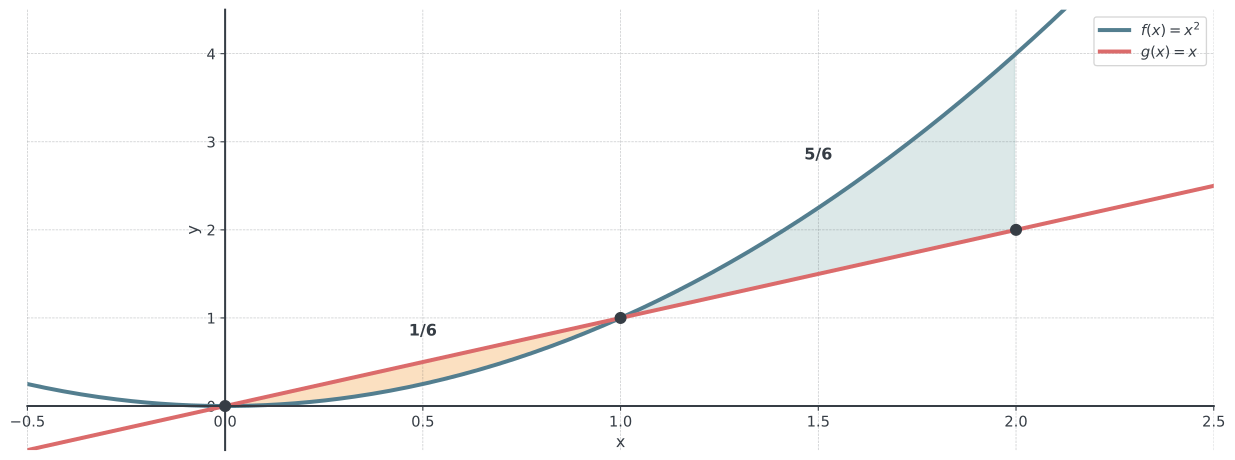
Total Area = 1/6 + 5/6 = 1
Guided Practice
Set A: Basic Area Between Curves
Work individually for 8 minutes
Find the area between \(f(x) = x^2\) and \(g(x) = 4\) from \(x = -2\) to \(x = 2\).
Find the area between \(f(x) = x + 2\) and \(g(x) = x^2\) (find intersection points first).
Find the area between \(y = \sqrt{x}\) and \(y = x\) for \(x \in [0; 1]\).
Practice Set B: Curves That Cross
Work individually for 6 minutes
Find the area enclosed between \(f(x) = 4 - x^2\) and \(g(x) = 3x\) from \(x = -1\) to \(x = 1\).
Find the total area between \(f(x) = x^3\) and \(g(x) = x\) from \(x = -1\) to \(x = 1\).
Coffee Break
Consumer Surplus
The Economic Intuition
Consumers benefit when they pay less than their willingness to pay
Example: If you’d pay up to 80 EUR for a concert ticket but it costs 50 EUR…
- Your consumer surplus = 80 - 50 = 30 EUR
- This is the “bonus” you receive from the transaction
For an entire market, we sum up all individual surpluses using integration!
Consumer Surplus Formula
Definition: Area between demand curve and equilibrium, from 0 to \(q^*\):
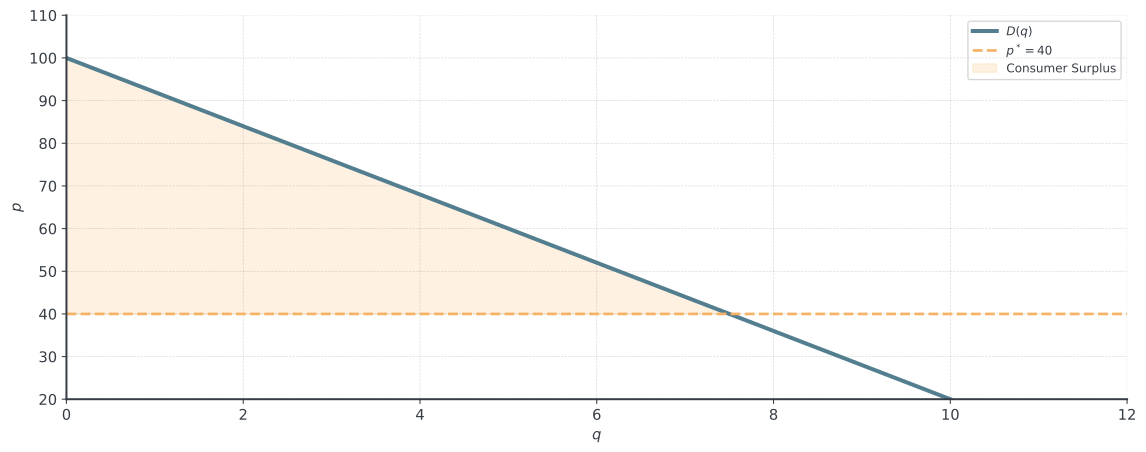
\(CS = \int_0^{q^*} [D(q) - p^*] \, dq\)
Example: Computing Surplus
Demand curve: \(D(q) = 100 - 4q\) EUR, equilibrium at \(q^* = 15\) units, \(p^* = 40\) EUR
\[CS = \int_0^{15} [(100 - 4q) - 40] \, dq\]
\[= \int_0^{15} (60 - 4q) \, dq\]
\[= \left[60q - 2q^2\right]_0^{15}\]
\[= 900 - 450 = 450 \text{ EUR}\]
Producer Surplus
The Economic Intuition
Producers benefit when they receive more than their minimum acceptable price
Example: If a farmer would sell wheat for minimum 30 EUR/unit but receives 50 EUR…
- Their producer surplus = 50 - 30 = 20 EUR per unit
- This is their “bonus” from the transaction
For an entire market, we sum up all producer surpluses using integration!
Producer Surplus Formula
Definition: Area between equilibrium and supply curve, from 0 to \(q^*\):
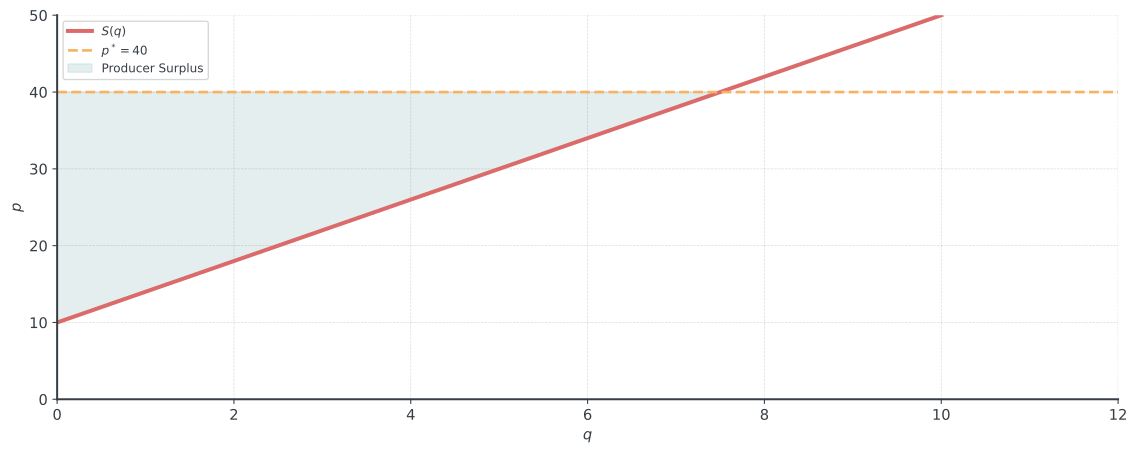
\(PS = \int_0^{q^*} [p^* - S(q)] \, dq\)
Example: Producer Surplus
Supply curve: \(S(q) = 10 + 2q\) EUR, equilibrium at \(q^* = 15\) units, \(p^* = 40\) EUR
\[PS = \int_0^{15} [40 - (10 + 2q)] \, dq\]
\[= \int_0^{15} (30 - 2q) \, dq\]
\[= \left[30q - q^2\right]_0^{15}\]
\[= 450 - 225 = 225 \text{ EUR}\]
Total Surplus
Finding Equilibrium
At equilibrium: Demand equals Supply, so \(D(q) = S(q)\)
Example: \(D(q) = 120 - 3q\) and \(S(q) = 20 + q\)
\[120 - 3q = 20 + q\] \[100 = 4q\] \[q^* = 25\]
\[p^* = 120 - 3(25) = 45 \text{ EUR}\]
Always verify: \(S(25) = 20 + 25 = 45\) ✓
Total Surplus
Total Surplus = Consumer Surplus + Producer Surplus
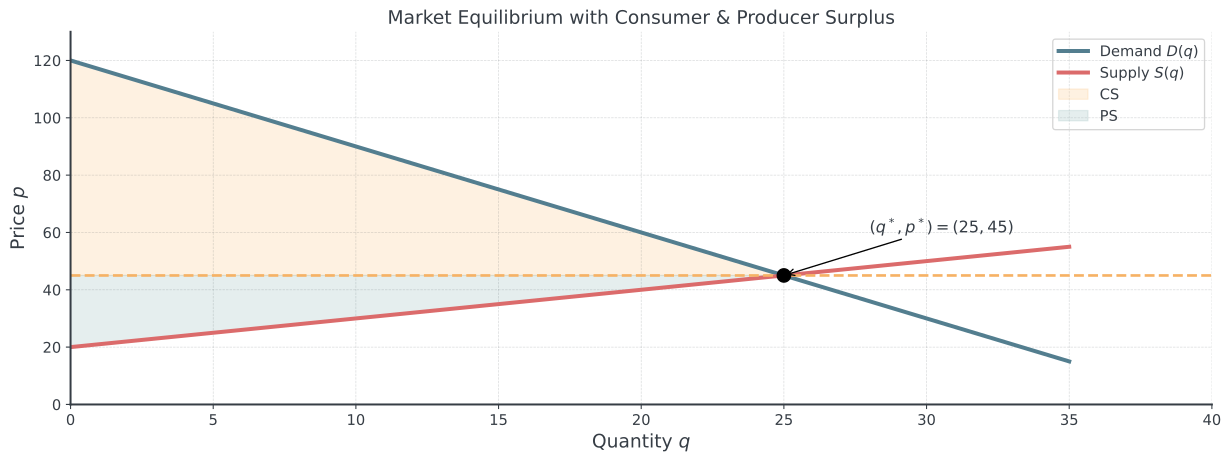
Complete Market Analysis I
Given: \(D(q) = 120 - 3q\), \(S(q) = 20 + q\), equilibrium \((q^*, p^*) = (25, 45)\)
Consumer Surplus: \[CS = \int_0^{25} [(120 - 3q) - 45] \, dq = \int_0^{25} (75 - 3q) \, dq\]
\[= \left[75q - \frac{3q^2}{2}\right]_0^{25} = 1875 - 937.5 = 937.5 \text{ EUR}\]
Complete Market Analysis II
Producer Surplus: \[PS = \int_0^{25} [45 - (20 + q)] \, dq = \int_0^{25} (25 - q) \, dq\]
\[= \left[25q - \frac{q^2}{2}\right]_0^{25} = 625 - 312.5 = 312.5 \text{ EUR}\]
Total Surplus: \(937.5 + 312.5 = 1250\) EUR
Total surplus measures the economic benefit a market generates for all participants. It equals the area between the demand and supply curves up to the equilibrium quantity. At equilibrium, it is maximized. Any deviation, e.g. price controls or taxes, reduces it.
Team Problem-Solving
Set C: Market Analysis
Work in pairs for 10 minutes
A market has demand \(D(q) = 150 - 5q\) and supply \(S(q) = 30 + 3q\).
Find equilibrium \((q^*, p^*)\)
Calculate CS and PS
Find total surplus
Market Analysis: Minimum Price
Scenario: Organic-produce market, \(q\) in tons, prices in EUR: demand \(D(q) = 80 - 0.5q\), supply \(S(q) = 20 + 0.25q\).
- Find the equilibrium quantity and price.
- Calculate consumer surplus and producer surplus at equilibrium.
Market Analysis: Minimum Price II
- If the state sets a minimum price of 50 EUR (do not confuse it with a company’s long-term lower limit price, Session 08-03): what quantities are demanded and supplied? Calculate the new CS and PS with the price 50 EUR up to the quantity traded (only the quantity demanded is sold).
- Compare the surpluses. Sketch both scenarios on the same graph.
Wrap-Up & Takeaways
Today’s Essential Concepts
- Area between curves: \(\int_a^b [f(x) - g(x)] \, dx\) where \(f \geq g\)
- Finding bounds: Set \(f(x) = g(x)\) to find intersection points
- Multiple regions: Split at crossings, sum absolute values
- Consumer Surplus: \(CS = \int_0^{q^*} [D(q) - p^*] \, dq\)
- Producer Surplus: \(PS = \int_0^{q^*} [p^* - S(q)] \, dq\)
- Total Surplus: CS + PS = total benefit to society
Next session: Integration by Parts and Synthesis!
Final Assessment
Quick Check
Work individually, then compare
Find the area between \(f(x) = 4 - x\) and \(g(x) = x\) from \(x = 0\) to \(x = 2\).
If demand is \(D(q) = 100 - 2q\) and supply is \(S(q) = 20 + q\), find equilibrium \((q^*, p^*)\).
For the market in problem 2, set up (but don’t evaluate) the integrals for CS and PS.
Next Session Preview
Coming Up: Integration by Parts
- Integration by Parts: The reverse product rule
- LIATE Rule: How to choose \(u\) and \(dv\)
- Common integrals: \(\int x e^x \, dx\), \(\int x \ln x \, dx\)
- Average Value of a function
- Revenue and Cost accumulation over time
- Synthesis: Combining optimization and integration
Complete Tasks 06-04
- Practice finding intersection points
- Work on area between curves problems
Session 06-04 - Area Between Curves & Economic Surplus | Dr. Nikolai Heinrichs & Dr. Tobias Vlćek | Home