Session 06-02 - Definite Integrals & The Fundamental Theorem
Section 06: Integral Calculus
Entry Quiz
Quick Review from Session 06-01
Test your understanding of Antiderivatives
Find \(\int (4x^3 - 6x + 2) \, dx\)
Find \(\int \frac{3}{x^2} \, dx\)
If \(f'(x) = 2x + 1\) and \(f(0) = 3\), find \(f(x)\).
Why do we write \(+C\) when finding indefinite integrals?
Homework Discussion
Your questions from Session 06-01
Focus on antiderivatives and indefinite integrals
- Challenges with the power rule
- Initial value problems
- Business applications (marginal cost → total cost)
- Verification by differentiation
Today we connect integration to area and discover the Fundamental Theorem of Calculus!
Learning Objectives
What You’ll Master Today
- Understand the definite integral as a limit of sums
- Interpret definite integrals as signed area under curves
- Apply the Fundamental Theorem to evaluate integrals
- Use the evaluation formula \(\int_a^b f(x) \, dx = F(b) - F(a)\)
- Apply properties of definite integrals
- Interpret net change using definite integrals
- Connect integration to accumulation in business contexts
The Fundamental Theorem connects the area problem to antiderivatives!
The Area Problem
Motivating Question
How do we find the area under a curve?
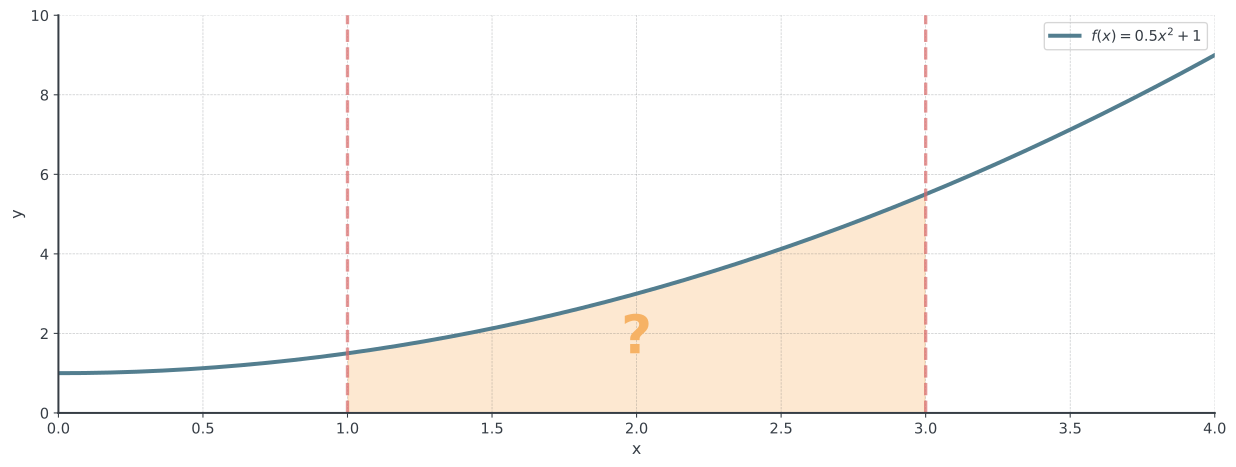
Question: What is the area of the shaded region between \(x = 1\) and \(x = 3\)?
The Rectangle Approximation Idea
Strategy: Approximate the curved region with rectangles!
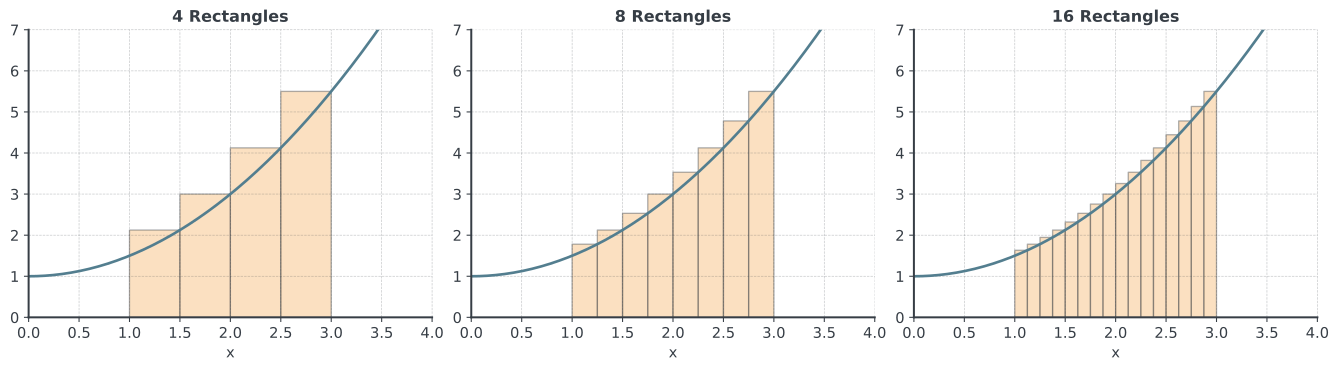
More rectangles → Better approximation!
The Riemann Sum
Definition: A Riemann sum approximates area using rectangles:
\[\sum_{i=1}^{n} f(x_i^*) \cdot \Delta x\]
- \(\Delta x = \frac{b-a}{n}\) is the width of each rectangle
- \(x_i^*\) is a sample point in the \(i\)-th subinterval
- \(f(x_i^*)\) is the height of the \(i\)-th rectangle
- We sum the areas of all \(n\) rectangles
- As \(n \to \infty\), the Riemann sum approaches the exact area!
From Sum to Integral
The Definite Integral:
\[\int_a^b f(x) \, dx = \lim_{n \to \infty} \sum_{i=1}^{n} f(x_i^*) \cdot \Delta x\]
- \(\int_a^b\) means “integrate from \(a\) to \(b\)”
- \(a\) is the lower limit of integration
- \(b\) is the upper limit of integration
- The result is a number (not a function!)
Signed Area
Area Above vs. Below the x-axis
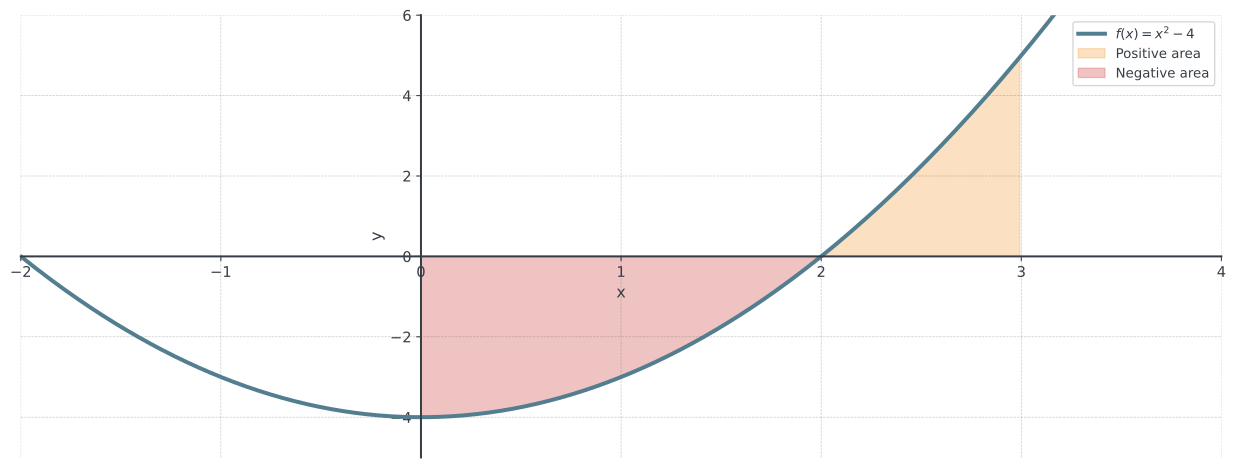
Key insight: Definite integrals measure signed area!
Signed Area Rules
The definite integral gives signed area:
- Above x-axis: Area counts as positive
- Below x-axis: Area counts as negative
- Total: Positive area minus negative area
Signed area ≠ Total area
If you want total (unsigned) area, you need to handle regions above and below separately!
Example: Signed vs. Total Area
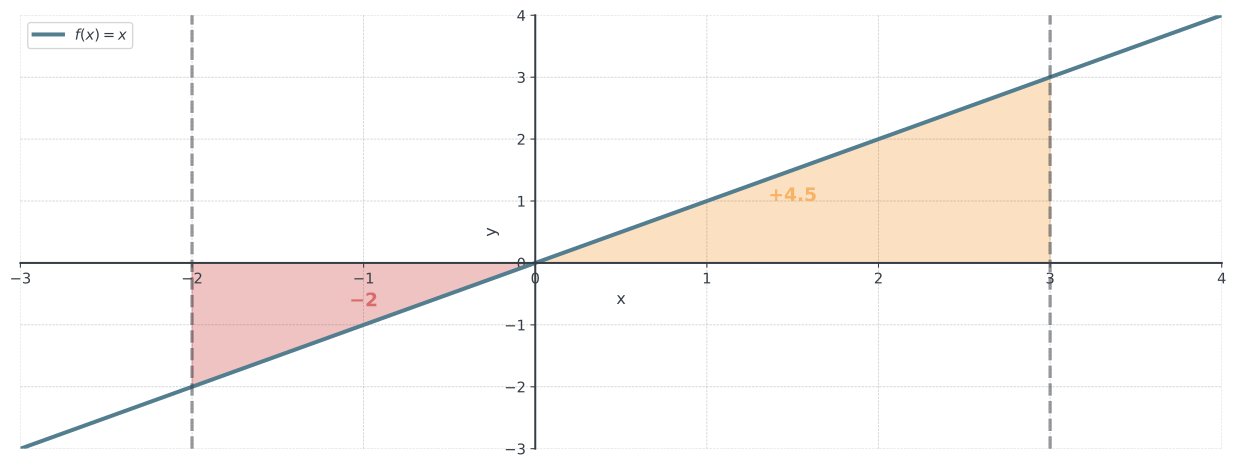
- Signed area: \(\int_{-2}^{3} x \, dx = 4.5 - 2 = 2.5\)
- Total area: \(|{-2}| + 4.5 = 6.5\)
Break
Fundamental Theorem
The Big Connection
The Fundamental Theorem of Calculus (FTC):
If \(F(x)\) is an antiderivative of \(f(x)\), then:
\[\int_a^b f(x) \, dx = F(b) - F(a)\]
This is one of the most important theorems in mathematics! It connects:
- Differentiation (finding rates of change)
- Integration (finding accumulated quantities/areas)
Why the FTC Works
Intuition: The integral accumulates the rate of change.
- \(f(x)\) represents a rate of change
- \(F(x)\) represents the total accumulated quantity
- \(F(b) - F(a)\) = total change from \(x = a\) to \(x = b\)
Imagine filling a water tank where \(f(x)\) is the flow rate (liters per minute).
- \(F(x)\) is the water level at time \(x\)
- So \(F(b) - F(a)\) = (final level) − (initial level) = total liters added!
- Each tiny change \(f(x) \cdot \Delta x\) adds up to \(F(b) - F(a)\).
Notation: The Evaluation Bar
We write:
\[\int_a^b f(x) \, dx = F(x) \Big|_a^b = F(b) - F(a)\]
The notation \(F(x) \Big|_a^b\) means “evaluate \(F\) at \(b\) and subtract \(F\) at \(a\)”
Also written as:
\[\left[ F(x) \right]_a^b = F(b) - F(a)\]
Example 1: Basic Evaluation
Evaluate: \(\int_1^4 2x \, dx\)
Step 1: Find an antiderivative
\[F(x) = x^2\]
Step 2: Apply the FTC
\[\int_1^4 2x \, dx = x^2 \Big|_1^4 = 4^2 - 1^2 = 16 - 1 = 15\]
No \(+C\) needed for definite integrals! The constants cancel: \((F(b) + C) - (F(a) + C) = F(b) - F(a)\)
Example 2: Polynomial
Evaluate: \(\int_0^3 (x^2 - 2x + 1) \, dx\)
Step 1: Find an antiderivative
\[F(x) = \frac{x^3}{3} - x^2 + x\]
Step 2: Evaluate at bounds
\[= \left[\frac{x^3}{3} - x^2 + x\right]_0^3 = \left(\frac{27}{3} - 9 + 3\right) - \left(0 - 0 + 0\right)\]
\[= 9 - 9 + 3 = 3\]
Example 3: With Negative Values
Evaluate: \(\int_{-1}^{2} 3x^2 \, dx\)
Step 1: Antiderivative is \(F(x) = x^3\)
Step 2: Evaluate
\[\int_{-1}^{2} 3x^2 \, dx = x^3 \Big|_{-1}^{2} = 2^3 - (-1)^3 = 8 - (-1) = 9\]
Be careful with negative lower limits! \((-1)^3 = -1\), not \(1\).
Integral Properties
Key Properties
Property 1: Reversing Limits
\[\int_a^b f(x) \, dx = -\int_b^a f(x) \, dx\]
Property 2: Splitting Intervals
\[\int_a^b f(x) \, dx + \int_b^c f(x) \, dx = \int_a^c f(x) \, dx\]
More Properties
Property 3: Constant Multiple
\[\int_a^b k \cdot f(x) \, dx = k \int_a^b f(x) \, dx\]
Property 4: Sum/Difference
\[\int_a^b [f(x) \pm g(x)] \, dx = \int_a^b f(x) \, dx \pm \int_a^b g(x) \, dx\]
These properties are the same as for indefinite integrals, just applied to definite integrals!
Using Properties: Example
Given: \(\int_0^5 f(x) \, dx = 12\) and \(\int_0^3 f(x) \, dx = 7\), find: \(\int_3^5 f(x) \, dx\)
Solution: Using the splitting property:
\[\int_0^3 f(x) \, dx + \int_3^5 f(x) \, dx = \int_0^5 f(x) \, dx\]
\[7 + \int_3^5 f(x) \, dx = 12\]
\[\int_3^5 f(x) \, dx = 5\]
Guided Practice
Practice Set A: Basic Evaluation
Work individually for 5 minutes
Evaluate these definite integrals:
- \(\int_0^2 3x^2 \, dx\)
- \(\int_1^4 (2x - 1) \, dx\)
- \(\int_{-2}^{1} x^3 \, dx\)
- \(\int_0^1 (x^2 + x + 1) \, dx\)
Practice Set B: More Complex
Work individually for 7 minutes
\(\int_1^9 \frac{2}{\sqrt{x}} \, dx\)
\(\int_{-1}^{3} (4 - x^2) \, dx\)
Given \(\int_0^6 g(x) \, dx = 15\) and \(\int_4^6 g(x) \, dx = 8\), find \(\int_0^4 g(x) \, dx\)
\(\int_2^5 (3x^2 - 4x + 2) \, dx\)
Practice Set C: Area Interpretation
Work in pairs for 8 minutes
Calculate the signed area: \(\int_{-2}^{2} x^3 \, dx\). Explain why this result makes geometric sense.
For \(f(x) = x - 1\) from \(x = 0\) to \(x = 3\):
- Calculate the signed area \(\int_0^3 (x-1) \, dx\)
- Find the total (unsigned) area between the curve and x-axis
Coffee Break
Net Change Theorem
Net Change Interpretation
The Fundamental Theorem as Net Change:
\[\int_a^b f'(x) \, dx = f(b) - f(a)\]
In words: The integral of a rate of change gives the net change in the original quantity.
| Rate (Derivative) | Integral Gives |
|---|---|
| Marginal cost \(C'(x)\) | Change in cost \(C(b) - C(a)\) |
| Population growth rate | Change in population |
| Production rate | Total production |
Example: Total Cost Change
Scenario: A company’s marginal cost is \(MC(x) = C'(x) = 20 + 0.5x\) EUR per unit. What is the total cost of increasing production from 10 to 50 units?
Solution:
\[\int_{10}^{50} (20 + 0.5x) \, dx = \left[20x + 0.25x^2\right]_{10}^{50}\]
\[= (1000 + 625) - (200 + 25) = 1625 - 225 = 1400 \text{ EUR}\]
The total additional cost of producing 40 more units is 1,400 EUR.
Example: Monthly Profit Rate
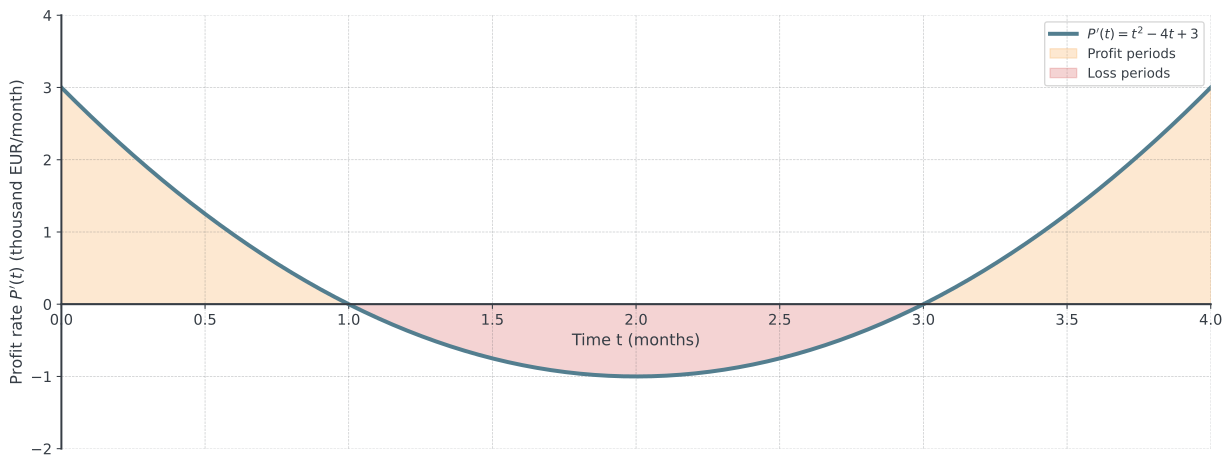
Scenario: A startup’s monthly profit rate (in thousand EUR) is:
\[P'(t) = t^2 - 4t + 3 \text{ (thousand EUR/month)}\]
where \(t\) is months since launch.
Question: What is the net profit over the first 4 months?
Solution:
\[\int_0^4 (t^2 - 4t + 3) \, dt = \left[\frac{t^3}{3} - 2t^2 + 3t\right]_0^4 = \frac{4}{3} \text{ thousand} = 1{,}333 \text{ EUR}\]
Net Profit vs. Total Cash Flow
Net profit = \(\int_a^b P'(t) \, dt\) (profits minus losses) - total cash movement = \(\int_a^b |P'(t)| \, dt\) (all money that moved)
Why Both Measures Matter
Business interpretation:
- Months 0-1: Profitable (early adopters)
- Months 1-3: Losses (scaling costs exceed revenue)
- Months 3-4: Profitable again (economies of scale kick in)
For investors: Net profit of 1,333 EUR sounds good!
For cash management: The company needed reserves to survive the loss period (months 1-3), even though it ended up profitable overall.
Team Problem-Solving
Challenge: Production Analysis
Scenario: A manufacturing plant’s production rate varies during an 8-hour shift:
\[P(t) = 50 + 30t - 3t^2 \text{ units per hour}\]
where \(t\) is hours since the shift started.
Group Tasks
Work in groups of 3-4
Graph \(P(t)\) for \(0 \leq t \leq 8\). At what time is production rate highest?
Calculate the total production during the first 4 hours: \(\int_0^4 P(t) \, dt\)
Calculate total production for the entire 8-hour shift.
Group Tasks II
When does production rate drop to zero? What does this mean?
If workers are paid 0.50 EUR per unit, calculate total labor cost for:
- The first half of the shift (0-4 hours)
- The second half (4-8 hours)
Wrap-Up & Takeaways
Today’s Essential Concepts
- Definite integral = limit of Riemann sums = signed area
- Fundamental Theorem: \(\int_a^b f(x) \, dx = F(b) - F(a)\)
- Signed area: Above x-axis positive, below negative
- Properties: Reversing limits, splitting intervals, linearity
- Net change: \(\int_a^b f'(x) \, dx = f(b) - f(a)\)
- Applications: Total cost, displacement, accumulated quantities
Next session: Area under curves and between curves with applications!
Comparison: Indefinite vs. Definite
| Indefinite Integral | Definite Integral |
|---|---|
| \(\int f(x) \, dx\) | \(\int_a^b f(x) \, dx\) |
| Result is a function + C | Result is a number |
| Family of antiderivatives | Signed area / net change |
| Need \(+C\) | No \(+C\) needed |
Final Assessment
Quick Check
Work individually, then compare
Evaluate \(\int_1^3 (2x + 4) \, dx\)
If \(\int_0^5 f(x) \, dx = 20\) and \(\int_0^2 f(x) \, dx = 6\), find \(\int_2^5 f(x) \, dx\)
A company’s marginal profit is \(MP(x) = 100 - 2x\). Find the total profit gained by increasing production from 20 to 40 units.
Next Session Preview
Up: Area Problems & Applications
- Area under a single curve
- Area between a curve and the x-axis
- Handling regions where \(f(x) < 0\)
- Exponential and logarithmic integrals
- Business applications: total profit, accumulated production
Complete Tasks 06-02
- Practice evaluating definite integrals
- Focus on the FTC and its applications
- Work on signed vs. total area problems
Session 06-02 - Definite Integrals & The Fundamental Theorem | Dr. Nikolai Heinrichs & Dr. Tobias Vlćek | Home