Session 06-01 - Antiderivatives & Indefinite Integrals
Section 06: Integral Calculus
Entry Quiz
Quick Review from Section 05
Test your understanding of Differential Calculus
Find \(f'(x)\) for \(f(x) = 3x^4 - 2x^2 + 5x - 7\)
A profit function is \(P(x) = -x^2 + 80x - 400\). Find the production level that maximizes profit.
For \(g(x) = x^3 - 6x^2 + 9x + 1\), find all critical points and classify them.
If \(C'(x) = 6x + 10\) represents marginal cost, what does \(C'(5) = 40\) mean in business terms?
Homework Discussion
Your questions from Section 05
Focus on differential calculus applications
- Challenges with optimization problems
- Curve sketching and second derivative test
- Function determination (Funktionsscharen)
- Any remaining questions before we move forward
Today we begin Integral Calculus - the reverse of differentiation!
Learning Objectives
What You’ll Master Today
- Understand the antiderivative as reversing differentiation
- Apply the power rule for integration: \(\int x^n \, dx\)
- Use sum and constant rules to integrate polynomials
- Interpret the constant of integration (+C) and function families
- Solve initial value problems to find specific antiderivatives
- Verify antiderivatives by differentiation
- Apply integration to business (marginal cost → total cost)
Integration is the reverse of differentiation - today we learn to “undo” derivatives!
The Antiderivative
From Derivatives to Antiderivatives
Remember differentiation?
\[f(x) = x^3 \quad \xrightarrow{\text{differentiate}} \quad f'(x) = 3x^2\]
Now we reverse the process:
\[F'(x) = 3x^2 \quad \xleftarrow{\text{antidifferentiate}} \quad F(x) = x^3\]
Definition: Antiderivative (Stammfunktion)
\(F(x)\) is an antiderivative of \(f(x)\) if \(F'(x) = f(x)\).
In German: \(F\) is the Stammfunktion of \(f\).
The Question We’re Solving
Given a derivative, find the original function
Example Questions:
- If \(f'(x) = 2x\), what could \(f(x)\) be?
- If the marginal cost is \(C'(x) = 50\), what is the total cost function?
- If velocity is \(v(t) = 3t^2\), what is the position function?
Business Context: We often know the rate of change (marginal cost, growth rate) and need to find the total quantity (total cost, population).
Finding: First Examples
Question: If \(F'(x) = 2x\), what is \(F(x)\)?
Think: What function, when differentiated, gives \(2x\)?
- If \(F(x) = x^2\), then \(F'(x) = 2x\) ✓
- But also: \(F(x) = x^2 + 5\) gives \(F'(x) = 2x\) ✓
- And: \(F(x) = x^2 - 100\) gives \(F'(x) = 2x\) ✓
Problem: There are infinitely many antiderivatives!
The Family of Antiderivatives
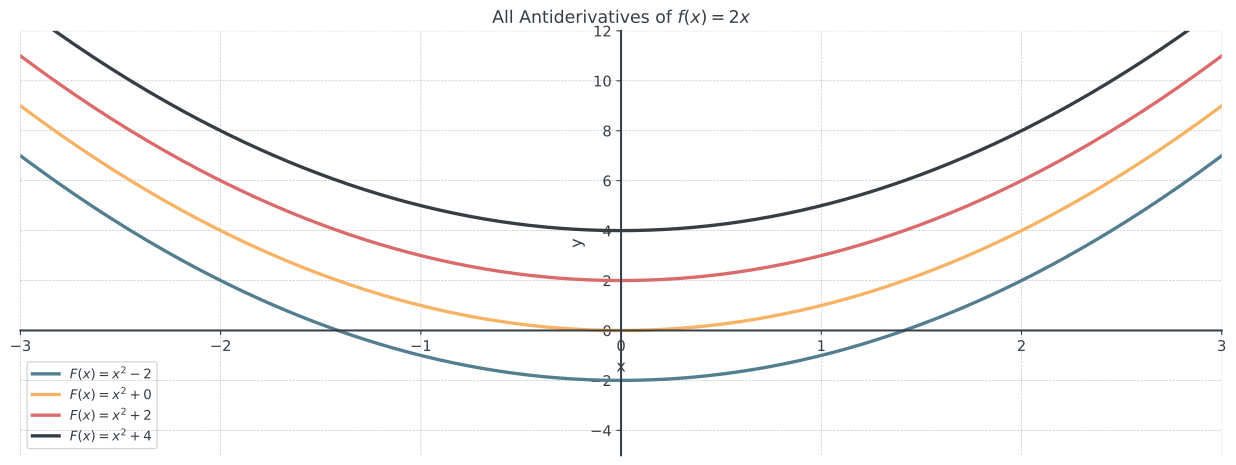
All these curves have the same slope at each x-value!
The Constant of Integration
Solution: We write the general antiderivative with a constant \(C\):
\[\int 2x \, dx = x^2 + C\]
- The symbol \(\int\) means “integrate” (find the antiderivative)
- \(dx\) indicates we integrate with respect to \(x\)
- \(+C\) represents any constant (the constant of integration)
- This notation is called an indefinite integral
Always include +C for indefinite integrals!
Integrating Powers
Reversing the Power Rule
Recall the power rule for derivatives:
\[\frac{d}{dx}[x^n] = nx^{n-1}\]
Reverse it for integration:
\[\int x^n \, dx = \frac{x^{n+1}}{n+1} + C \quad \text{for } n \neq -1\]
Memory trick: “Add 1 to the power, divide by the new power”
Power Rule Examples
Example 1: \(\int x^3 \, dx\)
\[\int x^3 \, dx = \frac{x^{3+1}}{3+1} + C = \frac{x^4}{4} + C\]
Check: \(\frac{d}{dx}\left[\frac{x^4}{4} + C\right] = \frac{4x^3}{4} = x^3\) ✓
Example 2: \(\int x^5 \, dx\)
\[\int x^5 \, dx = \frac{x^6}{6} + C\]
Special Cases
Constant function: \(\int 1 \, dx\) (or \(\int dx\))
Think of \(1 = x^0\): \[\int x^0 \, dx = \frac{x^{0+1}}{0+1} + C = x + C\]
Linear function: \(\int x \, dx\)
\[\int x^1 \, dx = \frac{x^2}{2} + C\]
The antiderivative of a constant is a line, the antiderivative of \(x\) is a parabola.
Negative and Fractional Powers
Negative powers: \(\int x^{-2} \, dx\)
\[\int x^{-2} \, dx = \frac{x^{-2+1}}{-2+1} + C = \frac{x^{-1}}{-1} + C = -\frac{1}{x} + C\]
Fractional powers: \(\int x^{1/2} \, dx = \int \sqrt{x} \, dx\)
\[\int x^{1/2} \, dx = \frac{x^{3/2}}{3/2} + C = \frac{2x^{3/2}}{3} + C = \frac{2\sqrt{x^3}}{3} + C\]
The power rule fails when \(n = -1\) (we would divide by zero). We’ll handle \(\int \frac{1}{x} \, dx\) later.
Sum & Constant Rules
Constant Multiple Rule
If \(k\) is a constant:
\[\int k \cdot f(x) \, dx = k \cdot \int f(x) \, dx\]
Example: \(\int 5x^3 \, dx\)
\[\int 5x^3 \, dx = 5 \int x^3 \, dx = 5 \cdot \frac{x^4}{4} + C = \frac{5x^4}{4} + C\]
Pull constants outside the integral, then integrate!
Sum and Difference Rules
For sums and differences:
\[\int [f(x) \pm g(x)] \, dx = \int f(x) \, dx \pm \int g(x) \, dx\]
Example: \(\int (x^2 + 3x - 5) \, dx\)
\[= \int x^2 \, dx + \int 3x \, dx - \int 5 \, dx\]
\[= \frac{x^3}{3} + 3 \cdot \frac{x^2}{2} - 5x + C = \frac{x^3}{3} + \frac{3x^2}{2} - 5x + C\]
Polynomial Integration
Example: \(\int (4x^3 - 6x^2 + 2x - 7) \, dx\)
- \(\int 4x^3 \, dx = 4 \cdot \frac{x^4}{4} = x^4\)
- \(\int 6x^2 \, dx = 6 \cdot \frac{x^3}{3} = 2x^3\)
- \(\int 2x \, dx = 2 \cdot \frac{x^2}{2} = x^2\)
- \(\int 7 \, dx = 7x\)
Answer: \(\int (4x^3 - 6x^2 + 2x - 7) \, dx = x^4 - 2x^3 + x^2 - 7x + C\)
Check: \(\frac{d}{dx}[x^4 - 2x^3 + x^2 - 7x + C] = 4x^3 - 6x^2 + 2x - 7\) ✓
Practice
Practice: Basic Integration
Work individually for 3 minutes
Find the following antiderivatives:
- \(\int 6x^2 \, dx\)
- \(\int (x^4 - 3x^2 + 1) \, dx\)
- \(\int \frac{4}{x^3} \, dx\) (rewrite as power first)
- \(\int (2\sqrt{x} + 3) \, dx\)
Integration Drill
Work in pairs
Evaluate these integrals and verify by differentiation:
- \(\int (3x^2 + 4x + 5) \, dx\)
- \(\int (x^3 - 2x + 4) \, dx\)
- \(\int 10x^4 \, dx\)
- \(\int \left(x^2 + \frac{1}{x^2}\right) \, dx\)
Break
Initial Value Problems
Finding a Specific Antiderivative
Problem: The general antiderivative has infinitely many solutions. How do we find a specific one?
Solution: Use an initial condition, a known point on the function: given \(f'(x)\) and a condition like \(f(a) = b\), find the specific function \(f(x)\).
Steps:
- Find the general antiderivative with \(+C\)
- Substitute the initial condition to solve for \(C\)
- Write the specific solution
Example: Initial Value Problem
Problem: Find \(f(x)\) if \(f'(x) = 6x^2 - 4\) and \(f(1) = 5\).
Step 1: Find the general antiderivative
\[f(x) = \int (6x^2 - 4) \, dx = 2x^3 - 4x + C\]
Step 2: Use the initial condition \(f(1) = 5\)
\[f(1) = 2(1)^3 - 4(1) + C = 5; C = 7\]
Step 3: Write the specific solution
\[f(x) = 2x^3 - 4x + 7\]
Visualizing the Initial Condition
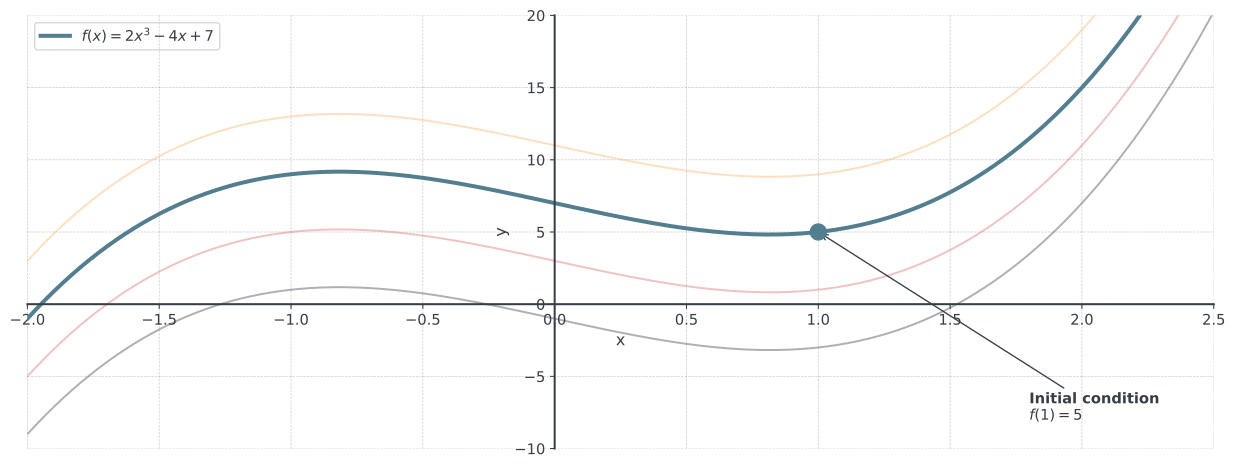
The initial condition selects one curve from the family!
Total Cost from Marginal Cost
Scenario: A manufacturing company knows its marginal cost function:
\[MC(x) = C'(x) = 0.3x^2 - 2x + 50\]
The fixed costs are 1,000 EUR (cost when producing 0 units).
Question: Find the total cost function \(C(x)\).
Step 1: Integrate marginal cost
\[C(x) = \int (0.3x^2 - 2x + 50) \, dx = 0.1x^3 - x^2 + 50x + C\]
Completing the Business Problem
Step 2: Use the initial condition \(C(0) = 1000\)
\[C(0) = 0.1(0)^3 - (0)^2 + 50(0) + C = 1000\] \[C = 1000\]
Step 3: Final answer
\[C(x) = 0.1x^3 - x^2 + 50x + 1000\]
The constant \(C\) represents the fixed costs, costs that don’t depend on production level.
Visualizing Cost Functions
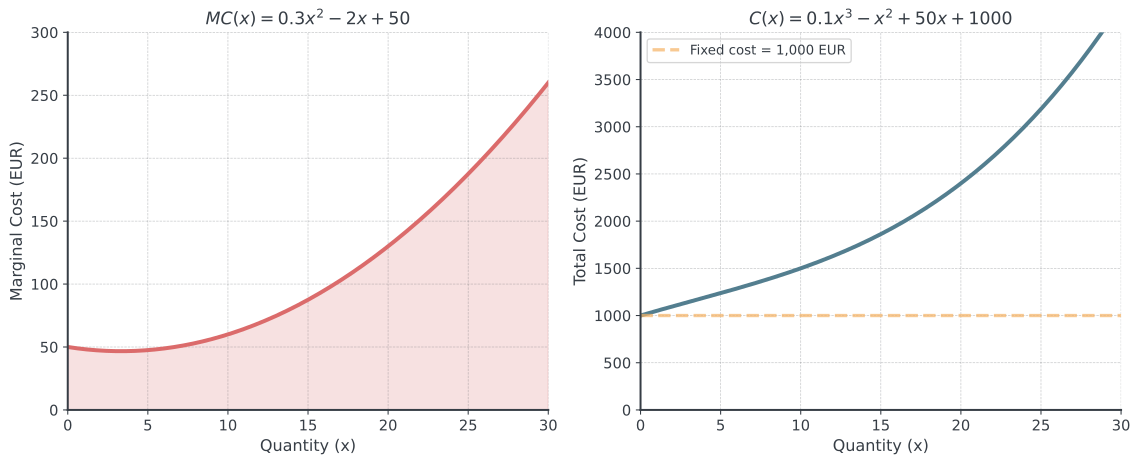
The marginal cost (derivative) shows the rate; the total cost (antiderivative) shows the accumulated total.
Velocity and Position
Application: Motion
Key relationships:
- Position: \(s(t)\) = where the object is
- Velocity: \(v(t) = s'(t)\) = rate of change of position
- Acceleration: \(a(t) = v'(t) = s''(t)\) = rate of change of velocity
Reversing the relationships:
- If you know velocity, integrate to find position: \(s(t) = \int v(t) \, dt\)
- If you know acceleration, integrate to find velocity: \(v(t) = \int a(t) \, dt\)
Finding Position from Velocity
Problem: A car’s velocity is \(v(t) = 3t^2 + 2t\) m/s (\(t\) in seconds). At \(t = 0\), the car is at \(s = 10\) meters. Find the position function \(s(t)\).
Step 1: Integrate velocity to get position
\[s(t) = \int (3t^2 + 2t) \, dt = t^3 + t^2 + C\]
Step 2: Use initial condition \(s(0) = 10\)
\[s(0) = 0 + 0 + C = 10 \implies C = 10\]
\[s(t) = t^3 + t^2 + 10\]
Verifying Our Answer
Check: Does \(s'(t) = v(t)\)?
\[s(t) = t^3 + t^2 + 10\] \[s'(t) = 3t^2 + 2t = v(t) \quad \checkmark\]
Check: Does \(s(0) = 10\)?
\[s(0) = 0 + 0 + 10 = 10 \quad \checkmark\]
Always check your antiderivative by differentiating to recover the original function and substituting the initial condition!
Guided Practice
Practice Set A: Basic Antiderivatives
Work individually for 5 minutes
Find the following indefinite integrals:
- \(\int (5x^4 - 3x^2 + 2) \, dx\)
- \(\int (x^3 + x^{-1/2}) \, dx\)
- \(\int \frac{6}{x^4} \, dx\)
- \(\int (4\sqrt{x} - \frac{3}{x^2}) \, dx\)
Practice Set B: Initial Values
Work individually for 7 minutes
Solve these initial value problems:
\(f'(x) = 4x^3 - 6x\), \(f(2) = 10\). Find \(f(x)\).
\(g'(x) = 3x^2 + 4\), \(g(0) = 5\). Find \(g(x)\).
The marginal revenue is \(MR(x) = 100 - 2x\). Revenue is 0 EUR when no units are sold. Find \(R(x)\).
Practice Set C: Business Problems
Work in pairs for 8 minutes
A company’s marginal cost is \(MC(x) = 20 + 0.4x\) EUR per unit. Fixed costs are 500 EUR. Find the total cost function \(C(x)\) and calculate the total cost of producing 50 units.
A product’s marginal profit is \(MP(x) = 80 - 4x\) EUR per unit. The fixed costs are 300 EUR. Find the profit function \(P(x)\), the number of units that maximizes profit, and the maximum profit.
Coffee Break
Business Applications
From Rates to Totals
Integration connects rates of change to accumulated totals:
| Rate Function (Derivative) | Total Function (Antiderivative) |
|---|---|
| Marginal cost \(C'(x)\) | Total cost \(C(x)\) |
| Marginal revenue \(R'(x)\) | Total revenue \(R(x)\) |
| Marginal profit \(P'(x)\) | Total profit \(P(x)\) |
| Production rate | Total production |
| Growth rate | Total quantity |
The constant of integration often represents a fixed quantity (fixed costs, initial inventory, starting capital).
Example: Complete Cost Analysis
Scenario: A furniture manufacturer has marginal cost \(MC(x) = 0.02x^2 - 2x + 100\) EUR per unit, fixed costs of 5,000 EUR, and each unit sells for 150 EUR.
Tasks:
- Find the total cost function \(C(x)\)
- Find the revenue function \(R(x)\)
- Find the profit function \(P(x)\)
- Determine the break-even points
Solution Part 1: Cost Function
Step 1: Integrate marginal cost
\[C(x) = \int (0.02x^2 - 2x + 100) \, dx\]
\[C(x) = \frac{0.02x^3}{3} - x^2 + 100x + C\]
Step 2: Apply initial condition \(C(0) = 5000\)
\[C = 5000\]
Answer: \(C(x) = \frac{x^3}{150} - x^2 + 100x + 5000\)
Solution Part 2: Revenue and Profit
Revenue: (Price × Quantity)
\[R(x) = 150x\]
Profit: (Revenue − Cost)
\[P(x) = R(x) - C(x)\]
\[P(x) = 150x - \left(\frac{x^3}{150} - x^2 + 100x + 5000\right)\]
\[P(x) = -\frac{x^3}{150} + x^2 + 50x - 5000\]
Visualizing the Business Model
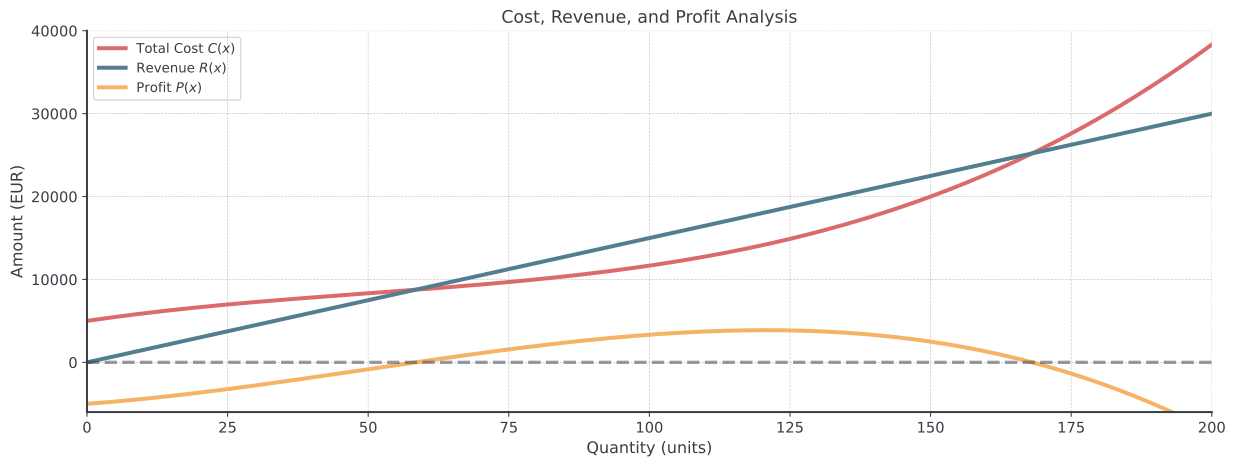
Break-even points: \(P(x) = 0\) with the polynomial solver (degree 3): \(x \approx 58.37\) and \(x \approx 168.07\) (the third solution is negative).
Team Problem-Solving
Group Challenge: Startup Analysis
Scenario: A tech startup is launching a new app. Their data analytics team has modeled:
Marginal cost (per user): \(MC(x) = 0.01x + 5\) EUR, where \(x\) is thousands of users
Fixed costs: 50,000 EUR (servers, development, etc.)
Revenue per user: 12 EUR
Group Challenge: Tasks
Work in groups and then we compare
- Find the total cost function \(C(x)\) for \(x\) thousand users
- Find the revenue function \(R(x)\)
- Find the profit function \(P(x)\)
- Calculate the profit/loss at 1,000 users, 5,000 users, and 10,000 users
- Find the break-even point(s)
- At what user count is profit maximized?
Wrap-Up & Takeaways
Today’s Essential Concepts
- Antiderivative: If \(F'(x) = f(x)\), then \(F(x)\) is antiderivative of \(f(x)\)
- Power rule: \(\int x^n \, dx = \frac{x^{n+1}}{n+1} + C\) (for \(n \neq -1\))
- Sum/Constant rules: Split integrals, pull out constants
- +C is essential: Represents the family of all antiderivatives
- Initial conditions: Fix the value of \(C\) to find a specific function
- Verification: Always differentiate to check your answer
Next session: We’ll learn about definite integrals and the Fundamental Theorem of Calculus!
Integration Formulas Summary
| Function | Antiderivative |
|---|---|
| \(x^n\) (\(n \neq -1\)) | \(\frac{x^{n+1}}{n+1} + C\) |
| \(k\) (constant) | \(kx + C\) |
| \(kf(x)\) | \(k \int f(x) \, dx\) |
| \(f(x) \pm g(x)\) | \(\int f(x) \, dx \pm \int g(x) \, dx\) |
Integration is “undo-ing” differentiation. Ask yourself: “What function, when differentiated, gives me this?”
Final Assessment
Quick Check
Work individually, then compare
Find \(\int (2x^3 - 5x + 3) \, dx\)
Given \(f'(x) = 6x - 2\) and \(f(1) = 4\), find \(f(x)\).
A company’s marginal cost is \(MC(x) = 30 + 0.5x\). Fixed costs are 200 EUR. What is the cost of producing 20 units?
Next Session Preview
Coming Up: Definite Integrals
- The definite integral as a signed area
- The Fundamental Theorem of Calculus
- Evaluating integrals using \(F(b) - F(a)\)
- Properties of definite integrals
- Applications to accumulated quantities
Complete Tasks 06-01
- Practice basic antiderivatives until they’re automatic
- Work through initial value problems
- Focus on business applications (cost, revenue, profit)
Session 06-01 - Antiderivatives & Indefinite Integrals | Dr. Nikolai Heinrichs & Dr. Tobias Vlćek | Home