Session 05-06 - Optimization & Curve Sketching
Section 05: Differential Calculus
Entry Quiz
Quick Review from Session 05-05
Test your understanding of limits, continuity, and function families
For \(f_t(x) = x^2 - 4tx + 3\) (one function for each number \(t\)), find \(t\) such that \(f_t(x)\) has exactly one zero.
Evaluate \(\lim_{x \to 4} \frac{x^2 - 16}{x - 4}\)
Is \(f(x) = \begin{cases} x + 2 & x < 1 \\ 3 & x = 1 \\ 2x & x > 1 \end{cases}\) continuous at \(x = 1\)?
Find \(\lim_{n \to \infty} \frac{3n^2 + 5n}{2n^2 - 1}\)
Homework Discussion
Your questions from Session 05-05
What questions do you have regarding the previous session?
Learning Objectives
What You’ll Master Today
- Apply the first derivative test to classify critical points
- Use the second derivative test when applicable
- Find global extrema on closed intervals
- Master the complete curve sketching algorithm (6 steps)
- Solve optimization problems in business contexts
- Maximize profit and minimize cost using calculus
- Sketch complete, accurate graphs of functions
Optimization is the central application of calculus in business! Today’s techniques will help you maximize profit, minimize cost, and make optimal decisions.
Tests for Extrema
Critical Points Review
A critical point of \(f(x)\) occurs at \(x = c\) if:
- \(f'(c) = 0\) (horizontal tangent), OR
- \(f'(c)\) does not exist (sharp corner, vertical tangent, etc.)
Key Fact: Extrema (max/min) can only occur at:
- Critical points (inside the domain)
- Endpoints of the domain
- Points where \(f\) is not differentiable
First Derivative Test
To classify a critical point at \(x = c\), examine how \(f'(x)\) changes sign:
Local Maximum: If \(f'\) changes from \((+)\) to \((-)\) at \(x = c\)
- Function increases before \(c\), decreases after \(c\)
Local Minimum: If \(f'\) changes from \((-)\) to \((+)\) at \(x = c\)
- Function decreases before \(c\), increases after \(c\)
Saddle point (neither max nor min): If \(f'\) does not change sign at \(x = c\)
- Example: \(f(x) = x^3\) at \(x = 0\)
First Derivative Test Example
Problem: Find and classify all critical points of \(f(x) = x^3 - 3x^2 - 9x + 5\).
Step 1: Find \(f'(x)\): \[f'(x) = 3x^2 - 6x - 9 = 3(x^2 - 2x - 3) = 3(x-3)(x+1)\]
Step 2: Find critical points (\(f'(x) = 0\)): \[x = -1 \text{ or } x = 3\]
Step 3: Create a sign chart for \(f'(x)\):
Sign Chart Analysis
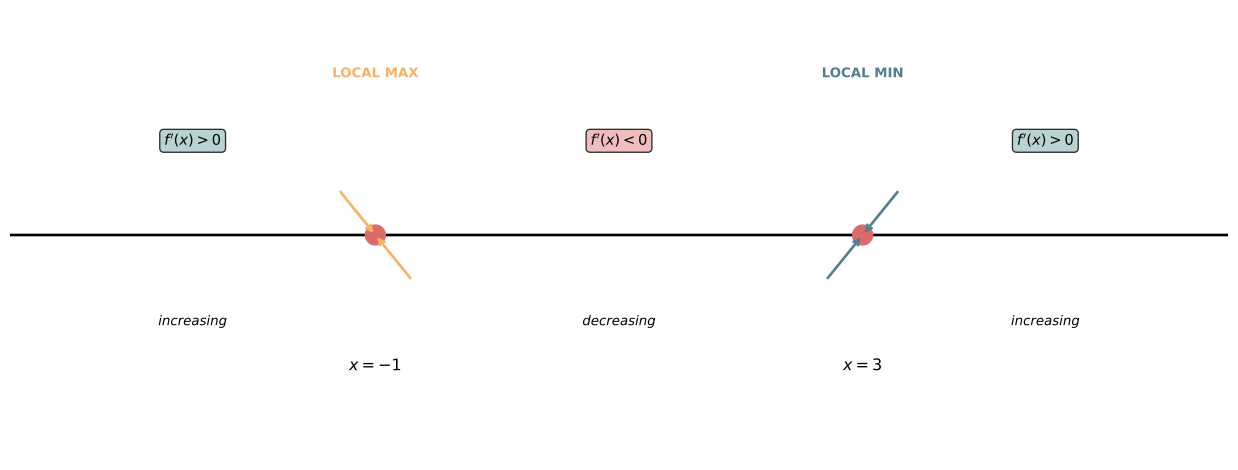
- \(f'\) changes from \((+)\) to \((-)\) at \(x = -1\) → Local maximum
- \(f'\) changes from \((-)\) to \((+)\) at \(x = 3\) → Local minimum
Visualizing the Function
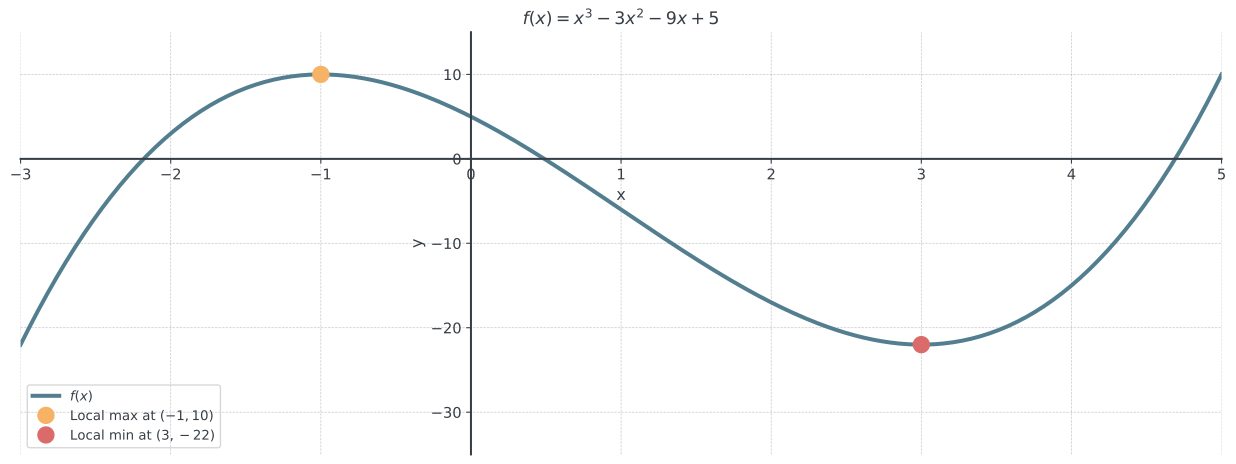
Makes intuitive sense, doesn’t it?
Second Derivative Test
Alternative Method: If \(f'(c) = 0\) and \(f''(c)\) exists:
If \(f''(c) > 0\): \(f\) is concave up at \(c\) → Local minimum
- Think: holding water (bottom of a bowl)
If \(f''(c) < 0\): \(f\) is concave down at \(c\) → Local maximum
- Think: shedding water (top of a hill)
If \(f''(c) = 0\): The test is inconclusive → Use first derivative test
When to Use Which Test?
- First derivative test: Always works, requires sign chart
- Second derivative test: Faster when \(f''\) is easy to compute, but can be inconclusive
Second Derivative Test Example
Problem: Use on \(f(x) = x^3 - 3x^2 - 9x + 5\) at \(x = -1\) and \(x = 3\).
Find \(f''(x)\): \[f''(x) = 6x - 6\]
At \(x = -1\): Local maximum \[f''(-1) = 6(-1) - 6 = -12 < 0\]
At \(x = 3\): Local minimum \[f''(3) = 6(3) - 6 = 12 > 0\]
When Second Derivative Test Fails
Example: \(f(x) = x^4\)
- \(f'(x) = 4x^3\), so \(f'(0) = 0\) (critical point at \(x = 0\))
- \(f''(x) = 12x^2\), so \(f''(0) = 0\) (inconclusive!)
Use first derivative test instead:
- For \(x < 0\): \(f'(x) = 4x^3 < 0\) (decreasing)
- For \(x > 0\): \(f'(x) = 4x^3 > 0\) (increasing)
- Sign changes from \((-)\) to \((+)\) → Local minimum at \(x = 0\)
Global Extrema
Extreme Value Theorem
If \(f\) is continuous on closed interval \([a; b]\), then \(f\) has both:
- An absolute maximum (global max)
- An absolute minimum (global min)
Strategy to find global extrema on \([a; b]\):
- Find all critical points \(c\) in \((a; b)\)
- Evaluate \(f\) at all critical points and both endpoints \(f(a)\), \(f(b)\)
- Largest value = absolute maximum, smallest value = absolute minimum
Example: Global Extrema
Challenge: Find the absolute maximum and minimum of \(f(x) = x^3 - 3x + 2\) on \([-2; 2]\).
Step 1: Find critical points.
\[f'(x) = 3x^2 - 3 = 3(x^2 - 1) = 3(x-1)(x+1) = 0\]
\[x = -1 \text{ or } x = 1\]
Both are in \((-2; 2)\)
Step 2: Evaluate \(f\) at critical points and endpoints.
Evaluation Table
| \(x\) | \(f(x) = x^3 - 3x + 2\) | Type |
|---|---|---|
| \(-2\) | \((-2)^3 - 3(-2) + 2 = -8 + 6 + 2 = 0\) | Endpoint |
| \(-1\) | \((-1)^3 - 3(-1) + 2 = -1 + 3 + 2 = 4\) | Critical |
| \(1\) | \((1)^3 - 3(1) + 2 = 1 - 3 + 2 = 0\) | Critical |
| \(2\) | \((2)^3 - 3(2) + 2 = 8 - 6 + 2 = 4\) | Endpoint |
Common exam mistake: Finding critical points but forgetting to check endpoints.
- The global maximum/minimum might occur at \(x = a\) or \(x = b\)
- Always create a table comparing ALL candidates (critical points + endpoints)
- In business: Production constraints define your “endpoints”
Visualizing Global Extrema
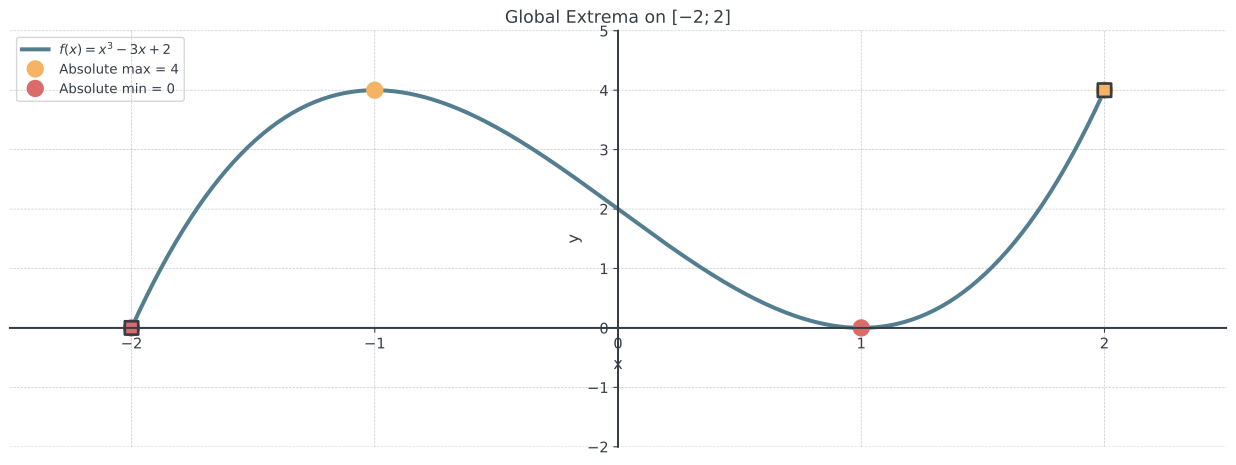
- Squares indicate the interval endpoints
- Circles show where extrema occur
Quick Practice
Practice Problems
Work individually, then compare with a neighbor
Find all critical points of \(g(x) = x^4 - 4x^3 + 5\).
Use the second derivative test to classify the critical points of \(g(x)\) from problem 1.
Find the absolute maximum and minimum of \(h(x) = x^2 - 4x + 1\) on \([0; 5]\).
For \(f(x) = 2x^3 - 3x^2 - 12x + 7\), use the first derivative test to classify all critical points.
Break
Curve Sketching
The 6-Step Algorithm
Master Process for Sketching \(y = f(x)\):
Domain and Intercepts
- Find where \(f\) is defined
- \(y\)-intercept: \(f(0)\)
- \(x\)-intercepts: solve \(f(x) = 0\)
Critical Points (\(f'(x) = 0\) or DNE)
- Find critical points, classify by first or second derivative test
Inflection Points (\(f''(x) = 0\) or DNE)
- Find where concavity changes
The 6-Step Algorithm (continued)
Sign Charts
- Sign chart for \(f'(x)\) (increasing/decreasing)
- Sign chart for \(f''(x)\) (concave up/down)
Asymptotic Behavior
- Vertical asymptotes: where denominator = 0
- Horizontal asymptotes: \(\lim_{x \to \pm\infty} f(x)\)
- End behavior
Complete Sketch
- Plot key points and include all features
Polynomial
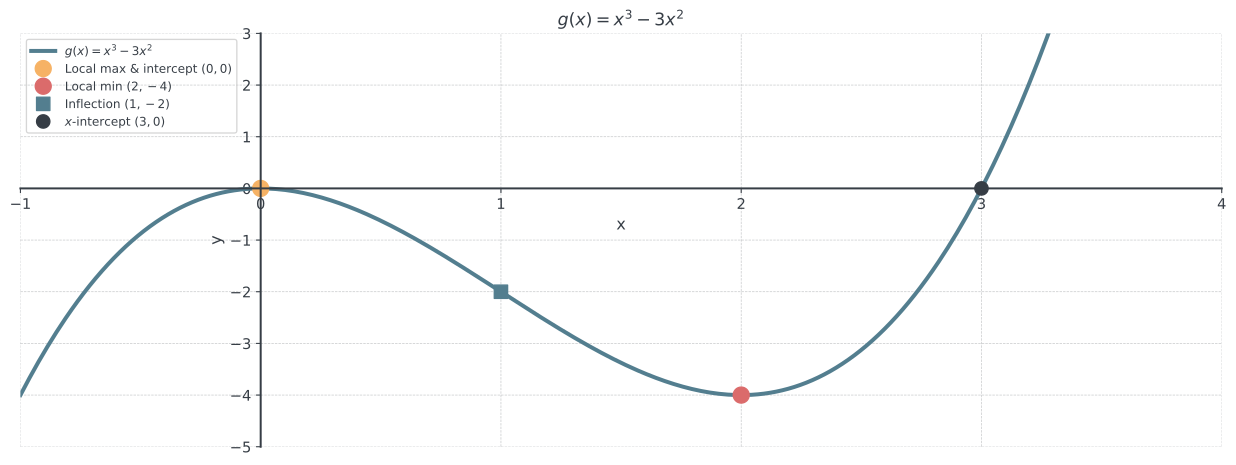
Problem: Sketch \(g(x) = x^3 - 3x^2\)
Step 1: Domain and Intercepts
- Domain: All reals
- \(y\)-intercept: \(g(0) = 0\)
- \(x\)-intercepts: Solve \(x^3 - 3x^2 = x^2(x - 3) = 0 \implies x = 0, \, x = 3\)
Steps 2: Critical Points
Problem: Sketch \(g(x) = x^3 - 3x^2\)
Classification using first derivative:
\[g'(x) = 3x^2 - 6x\]
\[3x(x - 2) = 0\]
\[x = 0 \text{ or } x = 2\]
Rather easy, right?
Steps 3: Inflection Points
Problem: Sketch \(g(x) = x^3 - 3x^2\)
Classification using second derivative:
\[g''(x) = 6x - 6\]
- \(g''(0) = -6 < 0\) → local max at \(x = 0\)
- \(g''(2) = 6 > 0\) → local min at \(x = 2\)
Inflection points:
\[g''(x) = 6x - 6 = 0 \implies x = 1\]
Steps 4-5: Sign Charts and Behavior
Problem: Sketch \(g(x) = x^3 - 3x^2\)
\(g'(x) = 3x(x-2)\):
- \((+)\) for \(x < 0\), \((-)\) for \(0 < x < 2\), \((+)\) for \(x > 2\)
\(g''(x) = 6x - 6 = 6(x-1)\):
- \((-)\) for \(x < 1\) (concave down), \((+)\) for \(x > 1\) (concave up)
End behavior:
- As \(x \to -\infty\): \(g(x) \to -\infty\), as \(x \to +\infty\): \(g(x) \to +\infty\) (leading term \(x^3\))
Step 6: Complete Sketch
Inflection Points: The Quick Test
Checking the sign change of \(f''\) always works, but there is a faster test:
- If \(f''(x_0) = 0\) and \(f'''(x_0) \neq 0\), then \(x_0\) is an inflection point
- If \(f'''(x_0) = 0\) as well, the test is inconclusive → check the sign change of \(f''\)
Same idea as the second derivative test, one level up: \(f'''(x_0) \neq 0\) guarantees that \(f''\) changes sign at \(x_0\).
Check on \(g(x) = x^3 - 3x^2\): \(g''(x) = 6x - 6\), \(g'''(x) = 6 \neq 0\) → \(x = 1\) is an inflection point ✓
The Inflectional Tangent
The tangent at an inflection point \(x_0\) (German: Wendetangente):
\[y = f'(x_0)(x - x_0) + f(x_0)\]
- At an inflection point, \(f'\) has an extremum → the graph is steepest there
- Economically: the moment of fastest growth (or fastest decline)
- Exam wording: “Determine the tangent at the inflection point and explain its meaning”
Example: An Exponential Model
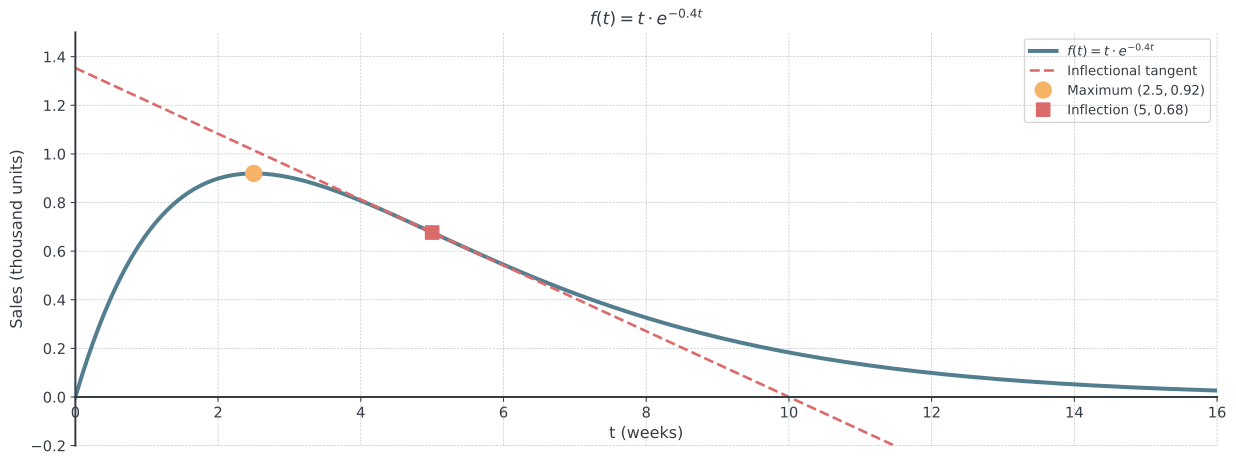
Problem: \(f(t) = t \cdot e^{-0.4t}\) describes weekly sales (in thousand units) \(t\) weeks after a launch.
Derivatives (product and chain rule, then factor out \(e^{-0.4t}\)):
- \(f'(t) = e^{-0.4t} \cdot 1 + t \cdot (-0.4)e^{-0.4t} = e^{-0.4t}(1 - 0.4t)\)
- \(f''(t) = -0.4e^{-0.4t}(1 - 0.4t) + e^{-0.4t}(-0.4) = e^{-0.4t}(0.16t - 0.8)\)
- \(f'''(t) = -0.4e^{-0.4t}(0.16t - 0.8) + e^{-0.4t}(0.16)\) \(= e^{-0.4t}(0.48 - 0.064t)\)
Since \(e^{-0.4t} > 0\) for all \(t\), only the bracket can become zero!
Maximum and Inflection Point
Maximum: \(f'(t) = 0 \iff 1 - 0.4t = 0 \iff t = 2.5\)
- \(f''(2.5) = e^{-1}(0.4 - 0.8) < 0\) → maximum at \((2.5, 2.5e^{-1}) \approx (2.5, 0.92)\)
Inflection point: \(f''(t) = 0 \iff 0.16t - 0.8 = 0 \iff t = 5\)
- \(f'''(5) = e^{-2}(0.48 - 0.32) = 0.16e^{-2} \neq 0\) ✓
- Inflection point at \((5, 5e^{-2}) \approx (5, 0.68)\)
- Meaning: after week 5 sales still fall, but the decline slows down
Inflectional Tangent and Limit
Slope at the inflection point: \(f'(5) = e^{-2}(1 - 2) = -e^{-2} \approx -0.135\)
\[y = -e^{-2}(t - 5) + 5e^{-2} = e^{-2}(10 - t) \approx 1.35 - 0.135t\]
- This is the fastest decline: about 135 units per week
Limit: \(\lim_{t \to \infty} t \cdot e^{-0.4t} = 0\)
The exponential beats the polynomial: \(e^{-kt}\) shrinks faster than any power \(t^n\) grows, so \(t^n \cdot e^{-kt} \to 0\) for \(k > 0\). Sales fade out completely in the long run.
Visualizing the Model
Quick Practice: Wendetangente
Work individually, then compare with a neighbor
For \(h(t) = 20 + t \cdot e^{-0.4t}\):
- Find the inflection point using the \(h'''\) test.
- Determine the inflectional tangent.
- What is \(\lim_{t \to \infty} h(t)\)?
Fewest Possible Inflection Points
FSP: “Assess how many inflection points \(f\) has to possess at least. Give a reason.”
Example: \(f\) has a local minimum at \(x = 1\), a local maximum at \(x = 4\), and afterwards falls towards the horizontal asymptote \(y = 0\).
Guided Practice
Set A - Work in Pairs
Complete these problems in pairs
Find and classify all critical points of \(f(x) = x^4 - 4x^3 + 10\) using the second derivative test.
Find the absolute extrema of \(g(x) = x^3 - 3x^2 + 1\) on \([-1; 3]\).
For \(h(x) = \frac{x^2 + 1}{x}\), find: (a) domain, (b) intercepts, (c) asymptotes.
Determine the intervals where \(f(x) = x^3 - 3x + 2\) is increasing and decreasing.
Set B - Work in Pairs
Continue with your partner
Sketch a sign chart for \(f'(x)\) and \(f''(x)\) where \(f(x) = x^4 - 2x^2\).
Find all inflection points of \(g(x) = x^4 - 4x^3 + 6\).
For \(h(x) = 2x^3 - 9x^2 + 12x\), find the absolute extrema on \([0; 3]\).
Determine the concavity intervals for \(f(x) = x^3 - 6x^2 + 9x\).
Coffee Break
Business Applications
Application 1: Profit Maximization
A company’s profit function (in thousands) is:
\[P(x) = -2x^3 + 15x^2 - 24x + 20\]
where \(x\) is the number of units produced (in thousands).
Question: Find the production level that maximizes profit.
1. Find critical points:
\[P'(x) = -6x^2 + 30x - 24 = -6(x^2 - 5x + 4) = -6(x-1)(x-4)\]
Critical points: \(x = 1\) and \(x = 4\)
Classification of Critical Points
2. Use second derivative test: \(P''(x) = -12x + 30\)
- \(P''(1) = 18 > 0\) → minimum; \(\quad P''(4) = -18 < 0\) → maximum
- Answer: Maximum profit occurs at \(x = 4\) (4000 units)
3. Calculate profit at critical maximum point:
- \(P(4) = -2(64) + 15(16) - 24(4) + 20\) \(= -128 + 240 - 96 + 20 = 36\)
- Maximum profit: 36,000 EUR at 4000 units
Visualizing Profit
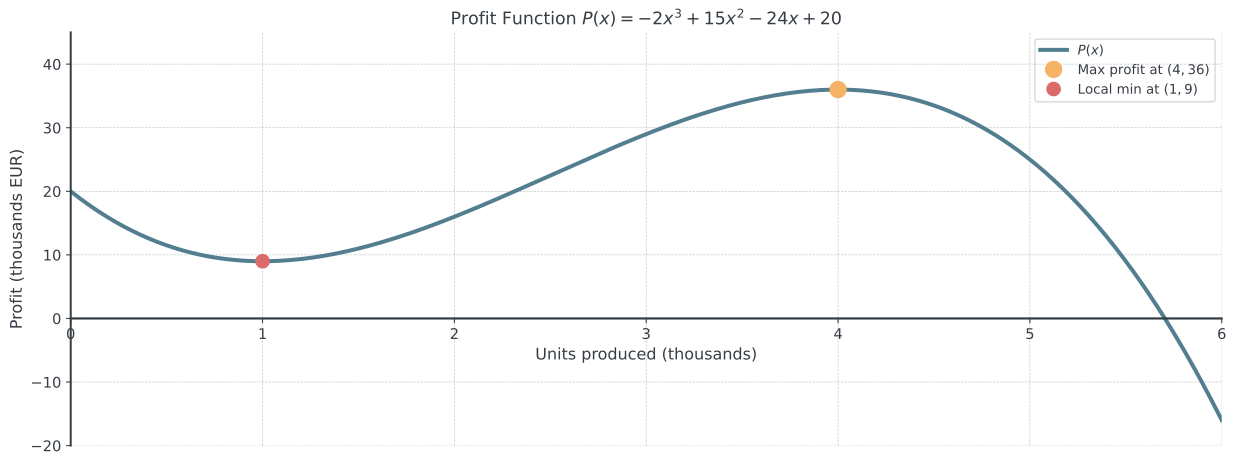
The max on the left is cut off because we have to produce at least 0 units.
Application 2: Cost Minimization
Average cost per unit for a manufacturer is:
\[\bar{C}(x) = \frac{100}{x} + 2x + 5\]
where \(x\) is batch size (in hundreds).
Question: What batch size minimizes average cost?
Critical Points
1. Find critical points:
\[\bar{C}'(x) = -\frac{100}{x^2} + 2\]
\[-\frac{100}{x^2} + 2 = 0\]
\[2 = \frac{100}{x^2}\]
\[x^2 = 50\]
\[x = \sqrt{50} = 5\sqrt{2} \approx 7.07\]
Verification and Answer
2. Verify it’s a minimum using second derivative:
- \(\bar{C}''(x) = \frac{200}{x^3}\), at \(x = 5\sqrt{2}\): \(\bar{C}''(5\sqrt{2}) = \frac{200}{(5\sqrt{2})^3} > 0\) → minimum
3. Minimum average cost:
- \(\bar{C}(5\sqrt{2}) = \frac{100}{5\sqrt{2}} + 2(5\sqrt{2}) + 5 = \frac{20}{\sqrt{2}} + 10\sqrt{2} + 5\)
- \(10\sqrt{2} + 10\sqrt{2} + 5 = 20\sqrt{2} + 5 \approx 33.28\)
- Answer: Batch size of 707 units minimizes average cost at approximately 33.28 EUR per unit
Application 3: Maximizing Revenue
A company’s revenue, where \(x\) is units sold (in thousands): \[R(x) = 50x - 0.5x^2\]
Question: What level maximizes revenue, and what is the maximum?
- \(R'(x) = 50 - x = 0\) → \(x = 50\)
- Verify: \(R''(x) = -1 < 0\) → maximum!
- Maximum: \(R(50) = 50(50) - 0.5(50)^2 = 2500 - 1250 = 1250\)
- Answer: 1,250,000 EUR at 50,000 units sold
Team Problem-Solving
Group Challenge I
Scenario: A manufacturing company has the following functions:
- Cost: \(C(x) = 1000 + 5x + 0.01x^2\) (in euros)
- Revenue: \(R(x) = 25x - 0.02x^2\) (in euros)
where \(x\) is the number of units produced and sold.
Group Challenge II
Work in groups of 3-4 students
Find the profit function \(P(x) = R(x) - C(x)\).
Determine the production level that maximizes profit.
What is the maximum profit?
Find the break-even points (where \(P(x) = 0\)).
Sketch the profit function showing all key features.
What production range yields positive profit?
Think-Pair-Share
Reflection Question
Think individually (2 min), then discuss with class
- In business optimization, why is it important to check both the first and second derivatives?
- Give a specific example where the second derivative test would reveal critical information about a business decision.
Optimization Checklist
Before finalizing any optimization answer, always verify:
- Is the critical point actually a maximum (if maximizing) or minimum (if minimizing)?
- Did you check the second derivative sign?
- Did you consider endpoint constraints?
- Does the answer make business sense? (positive quantities, reasonable values)
Show your verification work! Examiners want to see you confirmed the type of extremum!
Wrap-Up & Takeaways
Summary of Session 05-06
Derivative Tests:
- First derivative test: Examine sign changes of \(f'\) to classify
- Second derivative test: Use \(f''(c)\) to classify when \(f'(c) = 0\)
- \(f''(c) > 0\) → local min; \(f''(c) < 0\) → local max
Global Extrema:
- On closed interval \([a; b]\): check critical points AND endpoints
- Largest value = absolute max; smallest value = absolute min
Curve Sketching Algorithm Recap
Question: Can anyone summarize the steps to sketching a curve?
- Domain & intercepts
- Critical points
- Inflection points
- Sign charts (\(f'\) and \(f''\))
- Asymptotes & end behavior
- Complete sketch
Follow these in the Feststellungsprüfung!
Calculator: Quick Reference
| Problem Type | Calculator Mode/Function |
|---|---|
| Quadratic/cubic equations | MENU → A → 2 (Polynom-Gleich.) |
| Systems of equations | MENU → A → 1 (Gleichungssyst.) |
| Numerical equation solving | SHIFT + CALC (SOLVE) |
| Evaluate with variables | CALC button |
| Value tables | MENU → 9 (Tabellen) |
| Derivatives at a point | SHIFT + ∫ (d/dx template) |
| Prime factorization | SHIFT + FACT (after =) |
| GCD/LCM | ALPHA + × (GCD), ALPHA + ÷ (LCM) |
Calculator: Integrated Exercise
Combine everything you’ve learned today:
A company’s profit function is \(P(x) = -0.5x^2 + 30x - 200\)
Using your calculator:
Find the break-even points (where \(P(x) = 0\))
Find the production level that maximizes profit (where \(P'(x) = 0\))
Calculate the maximum profit \(P(x_{max})\)
Complete the Calculator Training Tasks 01 worksheet to reinforce these skills!
Final Assessment
Quick Check
Complete individually - this helps me assess today’s learning
For \(f(x) = x^3 - 3x^2\), find all critical points and classify them using the second derivative test.
Find the absolute extrema of \(g(x) = x^2 - 4x + 1\) on \([0; 4]\).
A profit function is \(P(x) = -x^2 + 100x - 500\). What production level maximizes profit?
True or False: If \(f''(c) = 0\), then \(x = c\) is always an inflection point.
Next Session Preview
Looking Ahead: Session 05-07
Function Determination & Related Rates
What’s coming:
- Finding functions from conditions (points, slopes, extrema)
- Setting up systems of equations from constraints
- Related rates problems (changing quantities)
- The 5-step strategy for related rates
- Business applications: cost functions, demand rates
Repeat the 6-step curve sketching algorithm! Both function determination and related rates share a key skill: setting up equations from conditions systematically.
Session 05-06 - Optimization & Curve Sketching | Dr. Nikolai Heinrichs & Dr. Tobias Vlćek | Home