Session 05-04 - Chain Rule & Implicit Differentiation
Section 05: Differential Calculus
Entry Quiz
Quick Review from Session 05-03
Test your understanding of differentiation rules
Find the derivative of \(f(x) = (x^2 + 1)(3x - 2)\).
Differentiate \(g(x) = \frac{x^2}{x + 1}\) using the quotient rule.
For \(h(x) = 5x^{10} - 3x^2 + 7\), find \(h'(x)\).
What is the tangent line to \(f(x) = x^2\) at \(x = 3\)?
Homework Discussion
Your questions from Session 05-03
What questions do you have regarding the tasks?
Learning Objectives
What You’ll Learn Today
- Master the chain rule for differentiating composite functions
- Combine chain rule with product and quotient rules effectively
- Use implicit differentiation when you can’t solve for \(y\)
- Apply related rates when quantities change over time
- Solve business problems with nested functions and changing rates
Key Insight
The chain rule unlocks differentiation of composite functions, one of the most powerful and widely used techniques in calculus!
The Chain Rule
Challenge: Composite Functions
The Problem: How do we differentiate \((x^2 + 3x + 1)^{100}\)?
- Could we expand it? No! Expansion would have hundreds of terms
- Current rules don’t help: Not a simple power, product, or quotient
- This is a composite function: A function inside another function
Challenge: Composite Functions II
The Structure:
- Outer function: \(f(u) = u^{100}\)
- Inner function: \(u = x^2 + 3x + 1\)
- Composite: \(f(g(x)) = (x^2 + 3x + 1)^{100}\)
The Chain Rule
Derivative of outer (evaluated at inner) times derivative of inner:
\[\frac{d}{dx}[f(g(x))] = f'(g(x)) \cdot g'(x)\]
Or in Leibniz notation, if \(y = f(u)\) and \(u = g(x)\):
\[\frac{dy}{dx} = \frac{dy}{du} \cdot \frac{du}{dx}\]
Most Common Mistake: Forgetting to multiply by the derivative of the inner function!
Chain Rule Example
Example: Differentiate \(f(x) = (x^2 + 3x + 1)^{100}\)
Step 1: Identify inner and outer
- Outer: \(f(u) = u^{100}\), so \(f'(u) = 100u^{99}\)
- Inner: \(u = x^2 + 3x + 1\), so \(u' = 2x + 3\)
Step 2: Apply chain rule \[f'(x) = 100(x^2 + 3x + 1)^{99} \cdot (2x + 3)\]
Notice: We never had to expand the original function!
Visualizing the Chain Rule
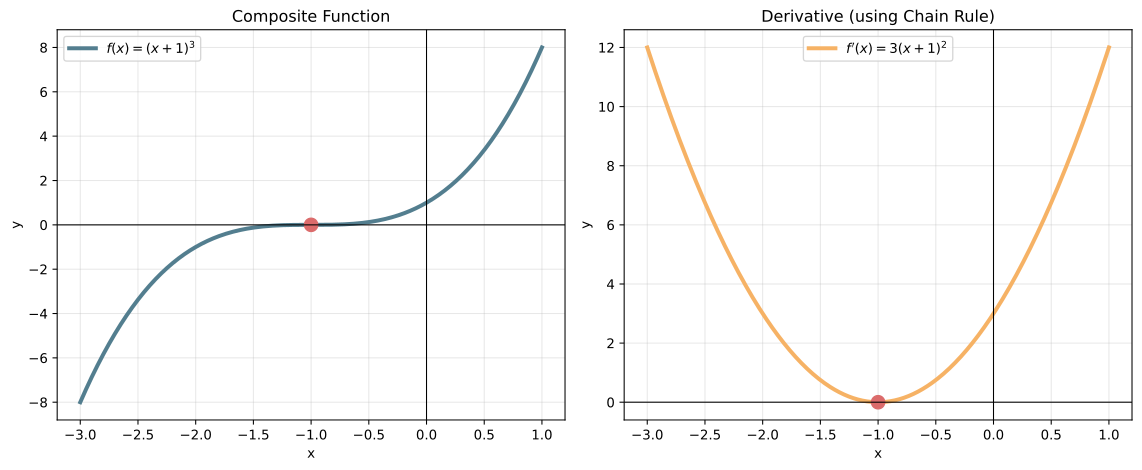
- At \(x = -1\), both the function and derivative equal zero
- The derivative is always non-negative (parabola opening upward)
More Chain Rule Examples
Differentiate \(g(x) = \sqrt{3x^2 + 5}\), rewritten as \(g(x) = (3x^2 + 5)^{1/2}\)
- Outer: \(u^{1/2}\), so derivative is \(\frac{1}{2}u^{-1/2}\)
- Inner: \(3x^2 + 5\), so derivative is \(6x\)
- \(g'(x) = \frac{1}{2}(3x^2 + 5)^{-1/2} \cdot 6x = \frac{6x}{2\sqrt{3x^2 + 5}} = \frac{3x}{\sqrt{3x^2 + 5}}\)
Differentiate \(h(x) = \frac{1}{(2x - 1)^3}\), rewritten as \(h(x) = (2x - 1)^{-3}\)
- \(h'(x) = -3(2x - 1)^{-4} \cdot 2 = \frac{-6}{(2x - 1)^4}\)
Combining Rules
Chain Rule with Product Rule I
Strategy: When you have a product with composite functions:
- Apply product rule first (outer operation)
- Use chain rule for each composite factor
Example: Differentiate \(f(x) = x^2(3x + 1)^5\)
Chain Rule with Product Rule II
Product rule:
- \(u = x^2\), so \(u' = 2x\)
- \(v = (3x + 1)^5\), so \(v' = 5(3x + 1)^4 \cdot 3 = 15(3x + 1)^4\) (chain rule!)
- \(f'(x) = 2x(3x + 1)^5 + x^2 \cdot 15(3x + 1)^4\)
Factor:
- \(= (3x + 1)^4[2x(3x + 1) + 15x^2]\)
- \(= (3x + 1)^4[6x^2 + 2x + 15x^2]\)
- \(= (3x + 1)^4(21x^2 + 2x)\)
Simplified Chain Applications
Example: Differentiate \(h(x) = \sqrt{(2x + 1)^3}\)
Simplify first!
\[h(x) = (2x + 1)^{3/2}\]
\[h'(x) = \frac{3}{2}(2x + 1)^{1/2} \cdot 2\]
\[h'(x) = 3\sqrt{2x + 1}\]
Derivatives of \(e^x\) and \(\ln(x)\)
\[\frac{d}{dx}\left[e^x\right] = e^x \qquad \qquad \frac{d}{dx}\left[\ln(x)\right] = \frac{1}{x} \quad (x > 0)\]
- \(e^x\) is its own derivative: everywhere, the slope equals the height
- \(e^x > 0\) for all \(x\), so \(e^x\) is never zero
With the chain rule (inner function \(g(x)\)):
- \(\left(e^{g(x)}\right)' = e^{g(x)} \cdot g'(x)\), special case \(\left(e^{kx}\right)' = k \cdot e^{kx}\)
- \(\left(\ln(g(x))\right)' = \frac{g'(x)}{g(x)}\)
Example: Sales and Advertising
Weekly sales (thousand units): \(S(t) = (8 + 4t)e^{-0.25t}\), \(t\) in weeks
- Product rule, with \(\left(e^{-0.25t}\right)' = -0.25e^{-0.25t}\) by the chain rule:
\[S'(t) = 4e^{-0.25t} + (8 + 4t)(-0.25)e^{-0.25t} = e^{-0.25t}(2 - t)\]
\(e^{-0.25t} > 0\) for all \(t\): only the bracket can become zero, so \(S'(t) = 0 \iff t = 2\)
Revenue, budget \(a\) (both in thousand EUR): \(R(a) = 30\ln(2a + 5)\)
- \(R'(a) = 30 \cdot \frac{2}{2a + 5} = \frac{60}{2a + 5}\), so \(R'(5) = \frac{60}{15} = 4\)
- At \(a = 5\): 1,000 EUR more budget, ≈ 4,000 EUR more revenue
Quick Practice
Individual Exercise
Work individually for 10 minutes
Differentiate using the chain rule:
\(f(x) = (5x + 2)^4\)
\(g(x) = \sqrt{x^2 - 1}\)
\(h(x) = (x^2 + 1)^3(2x - 1)^2\)
\(k(x) = \frac{x}{(3x + 1)^2}\)
Break
Implicit Derivatives
Two Ways to Find a Derivative
Problem: Revenue constraint \(pq = 10000\). Find \(\frac{dq}{dp}\).
- \(q = \frac{10000}{p} = 10000p^{-1}\) (Solve for \(q\) then differentiate)
- \(\frac{dq}{dp} = -10000p^{-2} = -\frac{10000}{p^2}\)
- \(\frac{d}{dp}[pq] = \frac{d}{dp}[10000]\) (Differentiate both sides with respect to \(p\))
- \(q + p\frac{dq}{dp} = 0\) (Product rule on the left, then solve for \(\frac{dq}{dp}\))
- \(\frac{dq}{dp} = -\frac{q}{p} = -\frac{10000/p}{p} = -\frac{10000}{p^2}\) (Substitute the constraint)
Both methods give \(\frac{dq}{dp} = -\frac{10000}{p^2}\). Method 2 is called implicit differentiation.
Why Learn Implicit Differentiation?
Because sometimes Method 1 is impossible or complex!
Factory produces constant output \(Q = 100\) with labor \(L\) and capital \(K\):
\[L^{0.6} \cdot K^{0.4} = 100\]
When we write \(L^{0.6} \cdot K^{0.4} = 100\), we’re really saying:
\[L^{0.6} \cdot [K(L)]^{0.4} = 100\]
Question: What does this mean?
Every variable is secretly a function!
The Main Idea
\(K\) depends on \(L\), we just don’t know the explicit formula!
\[L^{0.6} \cdot K^{0.4} = 100\]
The Chain Rule applies:
\[\frac{d}{dL}[K^{0.4}] = 0.4 \cdot K^{-0.6} \cdot \frac{dK}{dL}\]
Core Principle
Whenever you differentiate a term containing \(K\), multiply by \(\frac{dK}{dL}\) because \(K\) is a function of \(L\).
Production Example
Step 1: Differentiate both sides with respect to \(L\)
\[\frac{d}{dL}[L^{0.6} \cdot K^{0.4}] = \frac{d}{dL}[100]\]
Step 2: Apply product rule on left side and solve for \(\frac{dK}{dL}\)
\[0.6L^{-0.4} \cdot K^{0.4} + L^{0.6} \cdot 0.4K^{-0.6} \cdot \frac{dK}{dL} = 0\]
\[\frac{dK}{dL} = -\frac{0.6L^{-0.4} \cdot K^{0.4}}{0.4L^{0.6} \cdot K^{-0.6}} = -\frac{0.6}{0.4} \cdot \frac{K}{L} = -\frac{3K}{2L}\]
Interpreting the Result
\[\frac{dK}{dL} = -\frac{3K}{2L}\]
- The negative sign: more labor → less capital needed (trade-off)
- The ratio \(\frac{K}{L}\) matters: if \(K = 20\) and \(L = 10\), then \(\frac{dK}{dL} = -3\)
- Each additional unit of labor saves 3 units of capital
- Marginal Rate of Technical Substitution (MRTS) in economics!
The MRTS tells managers how to substitute between inputs while maintaining the same output level, crucial for cost minimization!
Example: Constant Revenue
A company sells a product with a constant revenue of 5000:
Practice: \(pq = 5000\). Find \(\frac{dq}{dp}\) using implicit differentiation.
Result: \(\frac{dq}{dp} = -\frac{q}{p}\)
Interpretation: At any point on the demand curve, a 1% price increase requires approximately a 1% quantity decrease to maintain revenue.
When to Use Each Method
- Solve first if it’s easy (linear equations, simple fractions)
- Implicit differentiation when solving is messy or impossible
- You need the rate of change without fully solving the equation
Related Rates
Introduction to Related Rates
The Concept: When two or more quantities are related by an equation and both change with time, their rates of change are also related.
General Process:
- Write an equation relating the quantities
- Differentiate both sides with respect to time \(t\)
- Substitute known values
- Solve for the unknown rate
Related rates problems use implicit differentiation with respect to time!
Growing Customer Base
Scenario: A company’s revenue \(R\) depends on its customer base \(C\): \[R = 50\sqrt{C}\]
The company is gaining 100 new customers per month. How fast is revenue growing when \(C = 10000\) customers?
Step 1: Differentiate to time \(\frac{dR}{dt} = 50 \cdot \frac{1}{2}C^{-1/2} \cdot \frac{dC}{dt} = \frac{25}{\sqrt{C}} \cdot \frac{dC}{dt}\)
Step 2: Substitute given: \(\frac{dC}{dt} = 100\) customers/month, \(C = 10000\)
\[\frac{dR}{dt} = \frac{25}{\sqrt{10000}} \cdot 100 = \frac{25}{100} \cdot 100 = 25 \text{ EUR/month}\]
Business Related Rates Example
Scenario: A company’s profit \(P\) and market share \(m\) are related by \(P = 1000m - 20m^2\), where \(P\) is in thousand EUR and \(m\) is market share percentage. Market share is increasing at 2% per month. How fast is profit changing when \(m = 15\)%?
Step1: Differentiate \(\frac{dP}{dt} = 1000\frac{dm}{dt} - 40m\frac{dm}{dt} = (1000 - 40m)\frac{dm}{dt}\)
Step 2: Substitute given \(\frac{dm}{dt} = 2\) %/month, \(m = 15\) %
\[\frac{dP}{dt} = (1000 - 40 \cdot 15)(2) = (1000 - 600)(2) = 800\]
Answer: Profit is increasing at 800,000 EUR per month.
Guided Practice
Practice Set A: Chain Rule
Work in pairs for 15 minutes
Differentiate the following:
\(f(x) = (x^3 - 2x + 1)^{10}\)
\(g(x) = \sqrt{5x^2 + 3x - 1}\)
\(h(x) = \frac{1}{(x^2 + 1)^3}\)
\(k(x) = x(2x - 3)^4\)
Practice Set B: Implicit & Related
Continue working in pairs for 10 minutes
Implicit Differentiation:
A company’s marketing \(M\) and sales \(S\) satisfy \(MS = 5000\). Find \(\frac{dS}{dM}\).
Budget constraint: \(2L + 3K = 120\) where \(L\) = labor, \(K\) = capital. Find \(\frac{dK}{dL}\).
Related Rates:
- Revenue \(R = 100Q - 0.5Q^2\) and quantity grows at 10 units/month. Find \(\frac{dR}{dt}\) when \(Q = 50\).
Coffee Break
Business Applications
Nested Economic Functions
Business Context: A company’s revenue depends on price \(p\), which itself depends on quantity \(x\):
- Price function: \(p(x) = 100 - 0.5x\)
- Revenue from price: \(R(p) = p(200 - 2p)\)
Question: Find \(\frac{dR}{dx}\), rate of change of revenue with respect to quantity.
Any idea how to approach this problem?
Chain Rule for Nested Functions I
Step 1: Express \(R\) in terms of \(p\) with \(R(p) = 200p - 2p^2\) \[\frac{dR}{dp} = 200 - 4p\]
Step 2: Find \(\frac{dp}{dx}\) with \(p(x) = 100 - 0.5x\) \[\frac{dp}{dx} = -0.5\]
Step 3: Apply chain rule: \(\;\frac{dR}{dx} = \frac{dR}{dp} \cdot \frac{dp}{dx} = (200 - 4p)(-0.5)\)
Chain Rule for Nested Functions II
Now just substitute \(p = 100 - 0.5x\) into expression for \(\frac{dR}{dx}\):
\[\frac{dR}{dx} = (200 - 4(100 - 0.5x))(-0.5)\]
\[\frac{dR}{dx} = 100 - x\]
- At \(x\), revenue changes at \((100 - x)\) EUR per unit
- When \(x = 50\): \(\frac{dR}{dx} = 50\) (revenue still increasing)
- When \(x = 100\): \(\frac{dR}{dx} = 0\) (revenue maximized!)
Team Problem-Solving
Challenge: Expanding Retail Chain
Profit \(P\) (in thousand EUR) of a chain with \(n\) stores, opening 4 new stores per year: \(P = 200\sqrt{n} - 5n\)
Write the relationship between \(\frac{dP}{dt}\) and \(\frac{dn}{dt}\).
How fast is profit changing when \(n = 25\) stores?
How fast is profit changing when \(n = 100\) stores?
At how many stores does profit stop growing? What does this mean for the company?
Discussion: Why does profit growth slow as the chain expands?
Think-Pair-Share
Discussion Question
Think individually, then discuss with class
Question: You’re analyzing two companies:
- Company A: Revenue \(R_A = (1000 + 50t)^{1.1}\) where \(t\) is years
- Company B: Revenue \(R_B = 1100 + 50t\)
- Which company’s revenue is growing faster at \(t = 0\)?
- Will this always be the case?
- What does the exponent 1.1 tell you about A’s growth strategy?
Wrap-Up & Takeaways
Today’s Essential Techniques
| Technique | When to Use | Key Idea |
|---|---|---|
| Chain Rule | Composite \(f(g(x))\) | Outer derivative × inner derivative |
| Chain + Product | Product with composites | Product rule first, then chain |
| Implicit Diff | Variables intertwined | Differentiate both, solve for derivative |
| Related Rates | Quantities change over time | Differentiate with respect to \(t\) |
| \(e^x\) and \(\ln(x)\) | Exponential and log models | \(e^{g(x)} \to e^{g(x)} \cdot g'(x)\), \(\;\ln(g(x)) \to \frac{g'(x)}{g(x)}\) |
Never forget the inner derivative! This is the main mistake in chain rule problems.
Final Assessment
Quick Check
Work individually and then we compare
Differentiate \((3x^2 + 1)^4\).
Price \(p\) and quantity \(q\) satisfy \(pq = 800\). Find \(\frac{dq}{dp}\).
Profit \(P = 50\sqrt{Q}\) and production grows at 8 units/month. How fast is profit growing when \(Q = 100\)?
True or False: \(\frac{d}{dx}[f(g(x))] = f'(x) \cdot g'(x)\)
Next Session Preview
Session 05-05
Graphical Calculus Mastery
- From \(f\) to \(f'\): Sketching derivatives from function graphs
- From \(f'\) to \(f\): Determining function properties from derivative
- Second derivatives: Understanding \(f''\) and concavity
- Critical points: Where \(f'(x) = 0\) or doesn’t exist
- Inflection points: Where \(f''(x) = 0\) and concavity changes
- Heavily tested on exams! Visual analysis is crucial
Complete Tasks 05-04!
Session 05-04 - Chain Rule & Implicit Differentiation | Dr. Nikolai Heinrichs & Dr. Tobias Vlćek | Home