Session 03-03 - Quadratic Functions & Basic Optimization
Section 03: Functions as Business Models
Entry Quiz
Review from Session 03-02
Work individually, then we discuss together as group
Find the market equilibrium for:
- Demand: \(Q_d = 200 - 2p\)
- Supply: \(Q_s = 50 + 3p\)
Write the equation of a line passing through points (2, 8) and (5, 20).
For the cost function \(C(x) = 500 + 12x\) and revenue \(R(x) = 25x\), find the profit when \(x = 100\).
Homework Discussion
Discussing Tasks 03-02
Let’s discuss the most difficult tasks from last lecture
- Problem 8: Strawberry market
- Supply function with the point-slope form?
- Problem 9: Beeswax wraps
- What does the contribution margin tell you?
- FSP Problem: Smart door locks
- From maximum price and saturation to \(p(x)\)?
Today we’ll learn the exact method to find the output with the highest profit!
Learning Objectives
Learning Objectives
By the end of this session, you can:
- Interpret the parameters \(a\), \(b\), \(c\) of a quadratic function
- Switch between standard, vertex, and factored form - and know when each helps
- Find the vertex with \(x_v = -\frac{b}{2a}\) and use it to optimize
- Distinguish revenue maximization from profit maximization
- Respect real-world constraints that may override the mathematical optimum
Quadratic Functions
From Linear to Quadratic
Quadratic functions model accelerating change
Linear vs. Quadratic:
- Linear: \(f(x) = mx + b\) → Constant rate of change
- Quadratic: \(f(x) = ax^2 + bx + c\) → Changing rate of change
- Graph shape: Quadratic → Parabola (U-shaped or ∩-shaped)
- Business meaning:
- Linear → Fixed relationships
- Quadratic → Optimization opportunities!
Standard Form
The foundation: f(x) = ax² + bx + c
Key components:
- a: Direction and width
- \(a > 0\): Opens upward (has minimum)
- \(a < 0\): Opens downward (has maximum)
- \(|a|\) larger → Narrower parabola
- b: Affects position of vertex
- c: y-intercept (value when \(x = 0\))
The Role of a
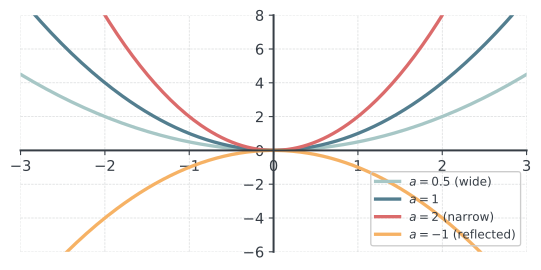
Larger \(|a|\) → narrower parabola; negative \(a\) flips it upside down.
Anatomy of a Parabola
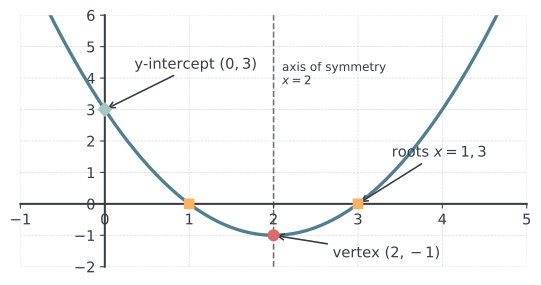
Example: \(f(x) = x^2 - 4x + 3\) - every feature has a business meaning when \(f\) models profit or cost.
Factored Form
Third representation: f(x) = a(x - r₁)(x - r₂)
- Roots: \(r_1, r_2\) - directly visible!
- Direction: \(a\) (same as always)
- Vertex: halfway between the roots, \(x_v = \frac{r_1 + r_2}{2}\)
- Example: \(f(x) = 2(x - 1)(x - 3)\)
- Roots at \(x = 1\) and \(x = 3\), vertex at \(x = 2\)
- Expanded: \(f(x) = 2x^2 - 8x + 6\) (same function, standard form)
For a profit function, the roots are the break-even point (lower) and the profit limit (upper); between them lies the profit zone!
Example: Profit Function
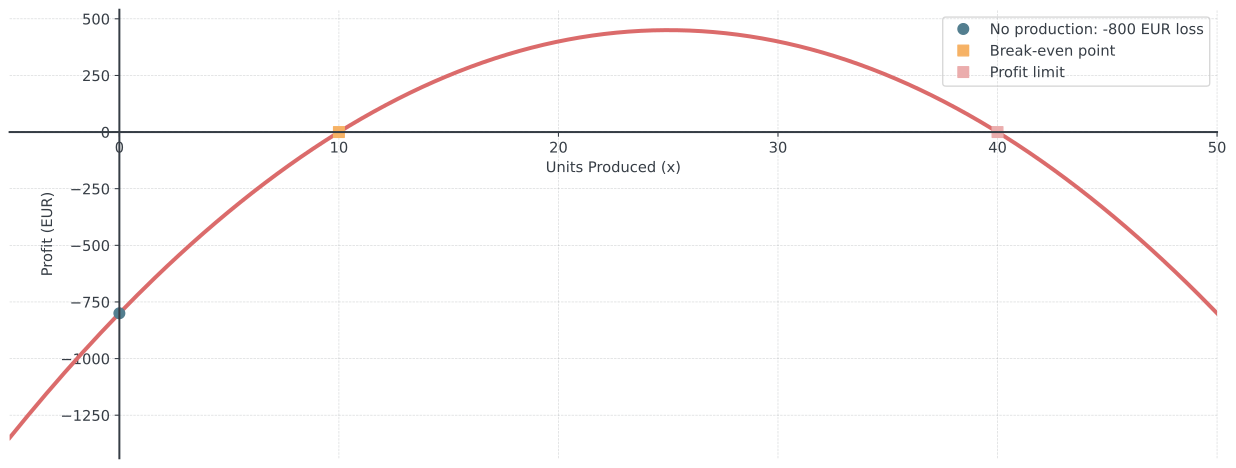
Quadratic Profit Function: \(P(x) = -2x^2 + 100x - 800\)
Quick Practice
Work individually, then we discuss
- Determine: Does it open upward (U) or downward (∩)?
- Determine: Does it have a maximum or minimum?
- Determine: What is the y-intercept?
\(R(x) = -3x^2 + 120x - 500\)
\(C(x) = 2x^2 + 40x + 1000\)
\(P(x) = -x^2 + 50x - 300\)
Challenge: For c. find the break-even points.
Finding the Vertex
The Vertex Formula
The key: x = -b/2a
For \(f(x) = ax^2 + bx + c\):
- Vertex x-coordinate: \(x_v = -\frac{b}{2a}\)
- Vertex y-coordinate: \(f(x_v) = f(-\frac{b}{2a})\)
- Vertex represents:
- Maximum if \(a < 0\) (parabola opens down)
- Minimum if \(a > 0\) (parabola opens up)
- Axis of symmetry: Vertical line \(x = x_v\)
Vertex Example: Optimal Revenue
A company’s revenue depends on price:
\[R(p) = -50p^2 + 2000p\]
- Find optimal price: \(p_v = -\frac{2000}{2(-50)} = -\frac{2000}{-100} = 20\) euros
- Maximum revenue: \(R(20) = 20000\) euros
- Interpretation: Charging 20 EUR maximizes revenue at 20,000 EUR
The axis of symmetry divides the parabola into mirror images. Points equidistant from it have equal revenue!
Visualization
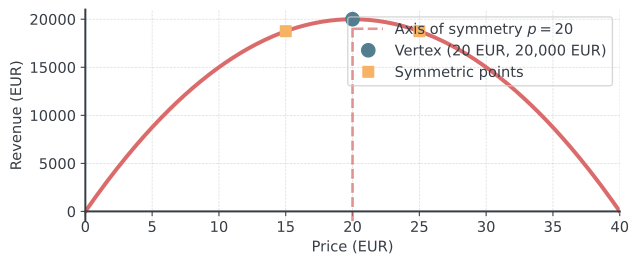
\(R(p) = -50p^2 + 2000p\)
Vertex Form
Alternative representation: f(x) = a(x - h)² + k
- Vertex: \((h, k)\) - directly visible!
- Direction: \(a\) (same as standard form)
- Advantage: Vertex immediately apparent
- Transformation from vertex:
- Horizontal shift by \(h\)
- Vertical shift by \(k\)
- Example: \(f(x) = 2(x - 3)^2 + 5\) → Vertex at \((3, 5)\), minimum
- Example: \(g(x) = -(x + 4)^2 + 10\) → Vertex at \((-4, 10)\), maximum
Recap: Completing the Square
From standard form to vertex form - you know this from Session 02-02
Example: \(f(x) = 2x^2 - 12x + 10\)
- Factor out 2: \(f(x) = 2(x^2 - 6x) + 10\)
- Add and subtract \((\frac{-6}{2})^2 = 9\): \(f(x) = 2((x - 3)^2 - 9) + 10\)
- Simplify: \(f(x) = 2(x - 3)^2 - 8\) → Vertex \((3, -8)\), minimum
The full technique was covered in Session 02-02 (Quadratic, Biquadratic & Cubic Equations) - here we only use it to read off the vertex.
Practice: From Graph to Formula
FSP-style: determine the function from its properties
A parabola has its vertex at \((2, -8)\) and passes through the point \((0, 4)\).
- Write \(f(x)\) in vertex form
- Expand to standard form and give the y-intercept
Think-Pair-Share: Which Form?
3 minutes alone, 2 minutes with your neighbour, then we discuss
Your colleague claims: “Vertex form is always best - I would convert every quadratic immediately.”
- What does each form show at a glance: standard, vertex, factored?
- For which business question would you pick which form?
- When is converting a waste of time?
Standard → y-intercept (fixed costs), vertex → optimum, factored → break-even points. Pick the form that answers your question directly!
Break
Business Applications
Price-Dependent Demand
When price affects quantity: Revenue becomes quadratic!
Basic Scenario:
- Demand function: \(Q = a - bp\) (quantity depends on price)
- Revenue: \(R = p \times Q = p(a - bp)\)
- Expanded: \(R(p) = ap - bp^2 = -bp^2 + ap\)
- This is quadratic in \(p\)!
Remember, we have seen this in the past!
Example: Concert Venue
A venue (capacity: 1000) has ticket demand: \(Q = 1000 - 20p\)
- Revenue function: \(R(p) = p(1000 - 20p) = 1000p - 20p^2\)
- Optimal price: \(p^* = -\frac{1000}{2(-20)} = \frac{1000}{40} = 25\) euros
- Tickets sold: \(Q = 1000 - 20(25) = 500\)
- Maximum revenue: \(R(25) = 25 \times 500 = 12,500\)
- At 0 EUR: Demand = 1000 (full capacity if free)
- At 50 EUR: Demand = 0 (too expensive, no one buys)
Note: This maximizes revenue, not necessarily profit!
Example: Minimizing Unit Costs
Not all optima are maxima - upward parabolas have minima!
A workshop’s cost per unit depends on the batch size \(x\):
\[c(x) = 0.5x^2 - 20x + 350\]
- \(a = 0.5 > 0\) → opens upward → the vertex is a minimum
- Cost-minimizing batch size: \(x_v = -\frac{-20}{2(0.5)} = 20\) units
- Minimum unit cost: \(c(20) = 200 - 400 + 350 = 150\) euros
- Too-small batches waste setup time, too-large batches cause overtime - the parabola captures both
Guided Practice
Spot the Error
Three statements - each contains a mistake. Find them!
“For \(f(x) = x^2 - 6x + 5\), the vertex is at \(x_v = \frac{b}{2a} = \frac{-6}{2} = -3\).”
“Since \(a = 1 > 0\), the vertex of \(f(x) = x^2 - 6x + 5\) is its maximum.”
“The y-intercept of \(f(x) = 2(x - 1)(x - 3)\) is \(-3\), because the constant term is \(-3\).”
Individual Exercise Block
Work alone for 15 minutes, then we compare solutions
- For \(f(x) = x^2 - 8x + 12\):
- Find the vertex using the formula
- Determine if it’s a maximum or minimum and find the y-intercept
- A profit function is \(P(x) = -3x^2 + 240x - 3600\):
- Find the number of units that maximizes profit
- Calculate the maximum profit and the break-even points
Individual Exercise Block II
- Convert \(f(x) = 2x^2 - 12x + 14\) to vertex form by completing the square, then identify the vertex.
Practice: Set Up a Profit Function
FSP-style: from words to optimum
A food stall sells \(x\) portions per day. The price per portion falls with quantity: \(p(x) = 20 - 0.5x\) euros. Daily costs are \(C(x) = 2x + 50\) euros.
- Set up the revenue function \(R(x)\)
- Set up the profit function \(P(x)\)
- How many portions maximize profit, and what is the maximum daily profit?
Projectile Motion
Product Launch Campaign
Marketing models new product awareness like projectile motion
\[A(t) = -2t^2 + 24t\] where \(A\) is awareness score and \(t\) is weeks after launch.
- Peak awareness time: \(t = -\frac{24}{2(-2)} = 6\) weeks
- Maximum awareness: \(A(6) = -72 + 144 = 72\) points
- Campaign ends when \(A(t) = 0\): at \(t = 0\) and \(t = 12\) weeks
Campaign follows symmetric pattern: builds to peak at 6 weeks, then decays at same rate.
Campaign Awareness
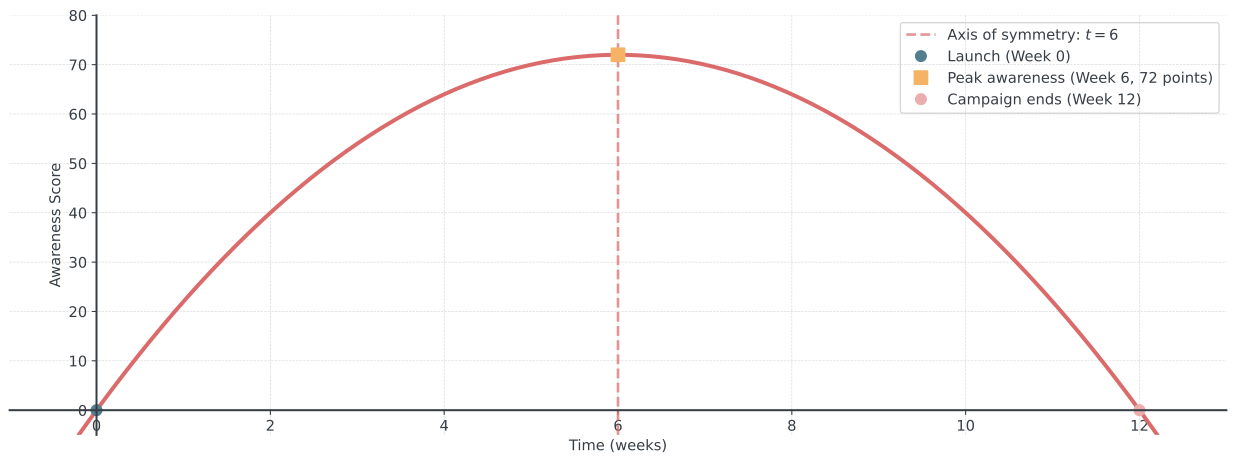
Product Launch Campaign: \(A(t) = -2t^2 + 24t\)
Area Optimization
Maximizing Area with Constraints
Classic problem: Maximum area with fixed perimeter
Rectangular Storage Area with 200 meters of fencing available. One side against a building (no fence). Maximize the storage area.
- Let \(x\) = width, \(y\) = length parallel to building
- Constraint: \(2x + y = 200\) (fencing)
- So: \(y = 200 - 2x\)
- Area: \(A = xy = x(200 - 2x) = 200x - 2x^2\)
- Maximum at: \(x = -\frac{200}{2(-2)} = 50\) meters
- Dimensions: 50m × 100m, Area = 5000 m²
Visualization
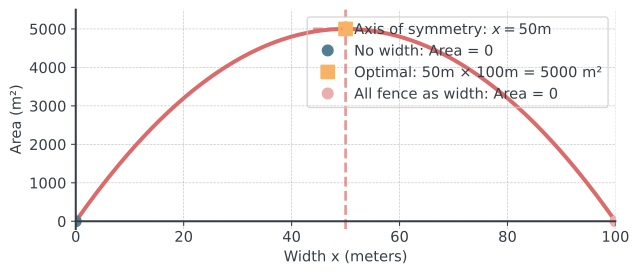
Too narrow or too wide both shrink the area - the optimum sits in the middle!
Team Problem-Solving
Business Optimization
The Scenario: Smart Tech Product Launch
Smart Tech is launching a new tablet. Market research indicates:
- At 200 EUR: would sell 8,000 units per month
- At 400 EUR: would sell 4,000 units per month
- At 600 EUR: would sell 0 units (too expensive)
- Production cost: 150 EUR per tablet
- Fixed monthly costs: 200,000 EUR
Assume linear demand relationship.
Your Tasks:
Work in groups of 3-4 students
Derive the demand function \(Q(p)\) where \(p\) is price
Express revenue \(R(p)\) as a function of price (this will be quadratic!)
Find the price that maximizes revenue
Your Tasks II:
Express profit \(\Pi(p)\) as a function of price
Find the price that maximizes profit (different from revenue-maximizing price!)
If the company can only produce 5,000 tablets per month, should they use the profit-maximizing price? Explain.
Coffee Break
FSP Workshop
Problem 1: Hand-Forged Knives
A small manufactory forges chef’s knives by hand and sells them to kitchen shops. Let \(x\) be the number of knives made per month. Every knife made is sold. The fixed costs are 42,000 EUR per month. In one month, the manufactory sold 240 knives and made a profit of 6,000 EUR. In another month, it sold 360 knives and made a profit of 19,200 EUR. The monthly profit in EUR is a quadratic function \(P(x) = ax^2 + bx + c\).
- Determine \(a\), \(b\) and \(c\). Interpret \(c\) in this context. [4 pts.]
Knives: Maximum and Break-Even
- Compute the maximum profit and prove that it really is a maximum. Give \(P(x)\) in vertex form. Determine the (lower) break-even point and the profit limit (upper break-even point) with the vertex form, and give \(P(x)\) in factored form. [5 pts.]
(for verification: \(P(x) = -0.25x^2 + 260x - 42000\))
Knives: The Hidden Costs
The manufactory is the only supplier of these knives, so it sets the price itself. Market research gives a linear price-demand function \(p(x)\) (price in EUR per knife at a demand of \(x\) knives per month) with a maximum price of 300 EUR per knife and a market saturation at 1,200 knives per month.
- Determine \(p(x)\) and the revenue function \(R(x)\). Determine the total cost function \(C(x)\) from \(R(x)\) and \(P(x)\), and interpret both of its parameters with units. Calculate the price per knife at the profit-maximizing output. [4 pts.]
Knives: Too Small a Machine?
The manufactory’s grinding machine can finish at most 400 knives per month (its capacity).
- Determine the output and the price with the highest profit within this capacity. Justify your choice with the parabola and a test value. [3 pts.]
Knives: Lease a Second Machine?
A second, smaller grinding machine can be leased for 3,800 EUR per month. With both machines, the capacity rises to 600 knives per month. The variable costs per knife stay the same. The workshop manager argues: “With the second machine we sell more knives, and the extra revenue easily pays for the lease.”
- Determine the output with the highest profit with both machines and the monthly profit including the lease. Assess the manager’s argument. [3 pts.]
Wrap-Up & Takeaways
Key Takeaways
- The vertex formula \(x = -\frac{b}{2a}\) is your optimization tool
- Quadratic functions model scenarios with changing rates
- Maximum/minimum depends on sign of \(a\)
- Revenue maximization ≠ Profit maximization
- Completing the square reveals the vertex form
- Real constraints may override mathematical optima
Remember
Every parabola has a minimum or a maximum point!
Final Assessment
5 minutes - Individual work
A small bakery’s daily profit for chocolate cakes is modeled by: \[P(x) = -x^2 + 14x - 33\] where \(x\) is the price in euros.
- Find the price that maximizes profit
- Calculate the maximum daily profit
- Find the break-even prices
Next Session Preview
Session 03-04: Transformations, Composition & Inverses
- Shifting functions horizontally and vertically
- Stretching and reflecting graphs
- Combining functions through composition
- Inverse functions and when they exist
Homework Assignment: Complete Tasks 03-03!
Session 03-03 - Quadratic Functions & Basic Optimization | Dr. Nikolai Heinrichs & Dr. Tobias Vlćek | Home