Session 01-06 - Synthesis & Linear Equations
Section 01: Mathematical Foundations & Algebra
Entry Quiz
Quick Skills Check
Test your readiness
Simplify: \((2x^3)^2 \cdot x^{-5}\)
Factor: \(x^2 - 5x - 14\)
Evaluate: \(\log_2(32)\)
Simplify: \(\sqrt{48}\)
Express in scientific notation: \(0.000425\)
These cover the core skills - let’s review together!
Homework Discussion
Showcase Your Solutions
Comprehensive discussions
- Present your most challenging problem from Tasks 01-05
- Are there any tasks from previous lectures you want to discuss?
- Explain your problem-solving strategy
- Share any connections between topics you discovered
Today we see how all pieces fit together!
Learning Objectives
Learning Objectives
By the end of this session, you can:
- Combine all Section 1 techniques: exponents, factorization, radicals, logarithms
- Translate word problems into equations using the IDEA method
- Solve multi-step linear equations and inequalities systematically
- Apply break-even and mixture analysis to business problems
Key Concepts
Set Theory & Number Systems
Essential foundations
Number hierarchy: \(\mathbb{N} \subset \mathbb{Z} \subset \mathbb{Q} \subset \mathbb{R}\)
Set operations:
- Union: \(A \cup B\) (all elements in either)
- Intersection: \(A \cap B\) (elements in both)
- Difference: \(A \setminus B\) (in A but not B)
Quick practice:
- If \(A = \{1, 3, 5\}\) and \(B = \{3, 4, 5, 6\}\)
- Find \(A \cap B\) and \(A \cup B\)
Exponent Laws
Your main tools for exponents
| Rule | Formula | Quick Example |
|---|---|---|
| Product | \(a^m \cdot a^n = a^{m+n}\) | \(x^3 \cdot x^4 = x^7\) |
| Quotient | \(\frac{a^m}{a^n} = a^{m-n}\) | \(\frac{x^5}{x^2} = x^3\) |
| Power | \((a^m)^n = a^{mn}\) | \((x^3)^2 = x^6\) |
| Negative | \(a^{-n} = \frac{1}{a^n}\) | \(x^{-2} = \frac{1}{x^2}\) |
Quick practice: Simplify \(\frac{(3x^2)^3}{9x^4}\)
Factorization Techniques
- Common factor: Always check first!
- Difference of squares: \(a^2 - b^2 = (a+b)(a-b)\)
- Perfect squares: \(a^2 \pm 2ab + b^2 = (a \pm b)^2\)
- AC method: For \(ax^2 + bx + c\) when \(a \neq 1\)
- Grouping: For 4-term polynomials
- Cubes: \(a^3 \pm b^3 = (a \pm b)(a^2 \mp ab + b^2)\)
- Substitution: Let $u = $ common expression
Quick practice: Factor \(x^4 - 16\)
Radicals & Logarithms
Advanced operations
Radicals: extract perfect powers; rationalize with conjugates: \((a + \sqrt{b})(a - \sqrt{b}) = a^2 - b\)
Logarithms:
- \(\log_a(xy) = \log_a(x) + \log_a(y)\), \(\quad\log_a(x^n) = n\log_a(x)\)
- If \(a^x = b\), then \(x = \log_a(b)\)
Quick practice: Solve \(2^x = 10\)
Practice Block 1
Individual Exercise
10 minutes - repeat the basics
Simplify: \(\frac{x^3 \cdot x^{-5}}{x^{-3}}\)
Factor completely: \(3x^2 - 27\)
Rationalize: \(\frac{6}{\sqrt{3}}\)
Solve: \(|3x - 6| = 9\)
Evaluate: \(\log_3(81) - \log_3(3)\)
Express in scientific notation: 45,600,000
Individual Exercise - A Step Further
10 minutes, same tools, complicated
Simplify: \(\left(\frac{8x^6}{27}\right)^{2/3}\)
Factor completely: \(6x^2 + x - 12\)
Compute and express in scientific notation: \(\frac{(3.2 \times 10^5)(5 \times 10^{-2})}{8 \times 10^3}\)
Solve: \(\log_5(x + 1) - \log_5(x - 1) = 1\)
Solve: \(|x - 4| = 2x\)
Simplify for \(x > 0\): \(\sqrt{50x^3}\)
Break
Practice Block 2
Pair Exercise
15 minutes - work together
Factor using substitution: \(x^4 - 5x^2 + 4\)
Simplify: \(\sqrt{75} + \sqrt{48} - \sqrt{27}\)
If \(2^x = 3\) and \(3^y = 5\), find \(2^{xy}\)
Rationalize: \(\frac{4}{3 - \sqrt{5}}\)
Factor by grouping: \(x^3 + 2x^2 - 9x - 18\)
Mixed Technique Problems
Combine multiple methods
Factor: \(8x^3 - 27y^3\)
Simplify: \(\frac{x^3 - 8}{x^2 - 4} \cdot \frac{x + 2}{x^2 + 2x + 4}\)
If \(|2x - 5| < 7\), find the solution interval
Rationalize: \(\frac{2}{\sqrt{6} - \sqrt{2}}\)
Algebra to Equations
The IDEA Method
A method to help you assess tasks
- Identify: What type of problem are we solving?
- Develop: Create a plan using appropriate methods
- Execute: Carry out the solution carefully
- Assess: Check your answer makes sense
Now we apply IDEA to translating word problems into equations and inequalities!
Translation Fundamentals
Converting words to mathematical expressions
| English Phrase | Symbol | Example |
|---|---|---|
| “is”, “equals”, “is equal to” | = | “The cost is 50” → \(C = 50\) |
| “less than”, “fewer than” | < | “x is less than 10” → \(x < 10\) |
| “at least”, “no less than” | ≥ | “at least 5 units” → \(x ≥ 5\) |
| “at most”, “no more than” | ≤ | “at most 100” → \(x ≤ 100\) |
Translation Fundamentals II
| English Phrase | Symbol | Example |
|---|---|---|
| “increased by”, “plus” | + | “price increased by 5” → \(p + 5\) |
| “decreased by”, “minus” | - | “reduced by 20%” → \(x - 0.2x\) |
| “of”, “times” | × | “30% of sales” → \(0.3S\) |
Business Vocabulary Essentials
- Revenue (R): Total income = Price × Quantity
- Cost (C): Fixed costs + Variable costs
- Profit (P): Revenue - Cost = R - C
- Break-even: When Revenue = Cost (Profit = 0)
- Margin: Profit as percentage of revenue
- Markup: Increase from cost to selling price
- QU, MU: Quantity and monetary units, e.g. 1 QU = 100 pieces
Always define your variables clearly before translating!
Practice IDEA with Tasks
Lets practice this! Try these on your own
Translate each phrase into an equation and solve:
“Seven more than twice a number equals 31”
“The quotient of a number and 4, decreased by 3, is 12”
“40% of a number increased by 25 equals the number itself”
Linear Equations
Solving Multi-Step Equations
A systematic approach
- Clear fractions: Multiply by LCD
- Expand: Remove parentheses using distributive property
- Collect terms: Variables on one side, constants on other
- Isolate variable: Divide by coefficient
- Verify: Substitute back into original equation
Example: Equation with Fractions
Let’s work through this together
Solve: \(\frac{2x - 1}{3} + \frac{x + 2}{4} = 5\)
- Step 1: Find LCD → LCD = 12
- Step 2: Clear fractions → \(12 \cdot \frac{2x - 1}{3} + 12 \cdot \frac{x + 2}{4} = 12 \cdot 5\)
- Step 3: Simplify → \(4(2x - 1) + 3(x + 2) = 60\)
- Step 4: Expand → \(8x - 4 + 3x + 6 = 60\)
- Step 5: Combine → \(11x + 2 = 60\)
- Step 6: Solve → \(11x = 58\), so \(x = \frac{58}{11}\)
Inequalities - The Traps
You have solved these since Session 01-03 - now the pitfalls
- Flip on negative: \(-2x > 6\) gives \(x < -3\), not \(x > -3\)
- “And” vs “or”: \(|A| < c\) joins with and (one interval), \(|A| > c\) with or (two rays)
- Never multiply or divide by a variable of unknown sign: from \(\frac{6}{x} > 2\) you cannot conclude \(x < 3\) - for \(x = -1\) the left side is \(-6\)
- Strict vs inclusive: “at least 300 units” is \(x \geq 300\), but “more than 300” is \(x > 300\)
In business the answer is usually a range of acceptable decisions, not a single number.
Example: Business Application
Profit constraints in action
A company has costs \(C = 5000 + 20x\) and revenue \(R = 50x\).
How many units must they sell to make at least 4000 EUR profit?
- Set up: Profit = Revenue - Cost ≥ 4000
- Equation: \(50x - (5000 + 20x) ≥ 4000\)
- Simplify: \(30x - 5000 ≥ 4000\)
- Solve: \(30x ≥ 9000\), so \(x ≥ 300\)
- Answer: Must sell at least 300 units
Coffee Break
Guided Practice
Individual Exercises
Work independently, then we’ll discuss
To equation: “Three times a number decreased by 7 equals 14”
Solve: \(3(2x - 4) = 2(x + 5)\)
Solve the inequality: \(-3x + 7 < 16\)
A taxi charges 3.50 EUR base fare plus 1.20 EUR per km. If a ride costs 15.50 EUR, how far was it?
A store offers 30% discount. After discount, an item costs 42 EUR. What was the original price?
Business Applications
Break-Even Analysis
Where total revenue equals total cost (profit = 0)
A coffee shop has fixed costs of 2,000 EUR/month (rent, utilities), variable cost of 1.50 EUR per coffee and a selling price of 3.50 EUR per coffee. How many coffees for break-even?
- Let \(x\) = number of coffees
- Cost: \(C = 2000 + 1.50x\)
- Revenue: \(R = 3.50x\)
- Break-even: \(3.50x = 2000 + 1.50x\)
- Solve: \(2x = 2000\), so \(x = 1000\) coffees
Break-Even, Seen Graphically
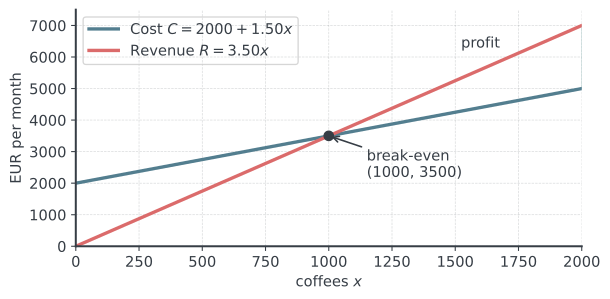
Left of the intersection the cost line is on top → loss. Right of it, revenue is on top → profit.
Mixture Problems
Combining different concentrations or values
An investor has 10,000 EUR to split between bonds (4% return) and stocks (9% return). To earn 650 EUR annually, how much in each?
- Let \(x\) = amount in bonds
- Then \(10000 - x\) = amount in stocks
- Income equation: \(0.04x + 0.09(10000 - x) = 650\)
- Simplify: \(0.04x + 900 - 0.09x = 650\)
- Solve: \(-0.05x = -250\), so \(x = 5000\)
- Answer: 5,000 EUR in bonds, 5,000 EUR in stocks
Financial Growth Problems
Real-world application with compound interest
An investment of 5,000 EUR earns 8% annual interest compounded yearly.
- Write the formula for the amount after \(t\) years
- Calculate the value after 10 years
- When will it triple in value?
Cost-Profit Analysis
Combining algebraic techniques for Manufacturing
A company produces \(x\) units with:
- Cost: \(C = 2x^2 + 100x + 5000\)
- Revenue: \(R = 500x - 3x^2\)
Your tasks:
- How can you compute the profit?
- Factor the profit completely
Team Problem-Solving
Group Task
Work in groups on the following problem
A company produces two products:
- Product A: Costs 15 EUR to make, sells for 25 EUR
- Product B: Costs 20 EUR to make, sells for 35 EUR
- Fixed costs: 5,000 EUR/month
- Production capacity (the maximum possible output): 500 units total
- Must produce at least 100 of each product
The tasks
Work in groups on the following problem
- Set up the profit equation
- Find the break-even point if producing equal quantities
- What mix maximizes profit?
Hint: Compare how much one more unit of A and one more unit of B add to the profit.
Challenge Problems
Test your skills by solving these in pairs
If \(3^x + 3^{-x} = 4\), find \(9^x + 9^{-x}\)
Factor completely: \(x^6 - 7x^3 - 8\)
A bacteria culture triples every 4 hours. Starting with 500 bacteria:
- When will there be 1 million bacteria?
- Express the population after 1 day in scientific notation
Wrap-Up & Takeaways
Key Takeaways
Essential skills from Section 1
- You can factor, simplify, and manipulate any expression type we studied
- Translation from words to equations is systematic - use IDEA
- Inequalities have special rules (flip when multiplying by negative!)
- Break-even analysis is fundamental to business planning
- Most importantly: You can combine techniques to solve complex problems
Common Pitfalls to Avoid
Watch out for these!
- Forgetting to flip inequality signs
- Misinterpreting “less than” in word problems
- Not checking solutions in original equation
- Mixing up revenue and profit
- Forgetting units in final answers
Study Strategy Going Forward
Success in mathematics requires consistent practice
Daily (10-15 minutes):
- Review one concept from past sections
- Solve 2-3 smaller problems
- Check your solutions carefully
Do this in addition to our lecture and the problems we solve together here.
Final Assessment
Individual work
A small business has monthly costs of 3,000 EUR plus 12 EUR per unit produced. They sell each unit for 20 EUR.
- Write the profit equation
- How many units for break-even?
- How many units for 2,000 EUR profit?
Next Session: Mock Exam 02
Session 01-07 is exam only - no lecture
- 90 min + 5 min reading, 50 points, counts toward the 60%
- Covers Section 01: factoring, exponents, logarithms, sets, absolute values, inequalities
- FSP style: business problems whose parts build on each other
- Calculator, drawing instruments, dictionary - no notes, formula sheets or electronic devices
Homework: Tasks 01-06 and FSP Training 01 (sidebar, Section 01 worksheets). Write down every step: the steps earn the points!
Session 01-06 - Synthesis & Linear Equations | Dr. Nikolai Heinrichs & Dr. Tobias Vlćek | Home