Session 01-05 - Logarithms & Substitution
Section 01: Mathematical Foundations & Algebra
Calculator Basics
Your Calculator from Now On
Bring your Casio FX-991DE X to every session from today.
- So far we worked by hand - that stays the foundation
- Today we catch up on what the calculator can do for Sessions 01-01 to 01-04
- From now on, new calculator functions come right after the maths they support
Important: Exams require you to show your work, so use the calculator to check, not replace understanding
Calculator: Getting Started
The MENU Screen
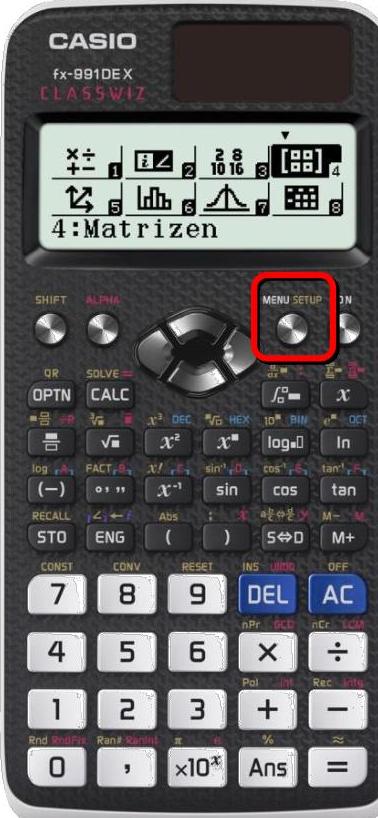
MENU screen showing available applications
- Press MENU to see all applications
- Use arrow keys to navigate the icon grid, press number or = to select
- 1: Berechnungen (Calculate) is your main mode
Calculator: Essential Settings
Before we begin, let’s configure the calculator:
- Press SHIFT MENU (Setup)
- Select 1: Eingabe/Ausgabe → 1: Math –> Math for natural display
- Select 2: Winkeleinheit → 1: Gradmaß (D) for degrees

Settings menu
The natural display mode shows fractions and roots as you write them on paper!
Calculator: Menu Navigation
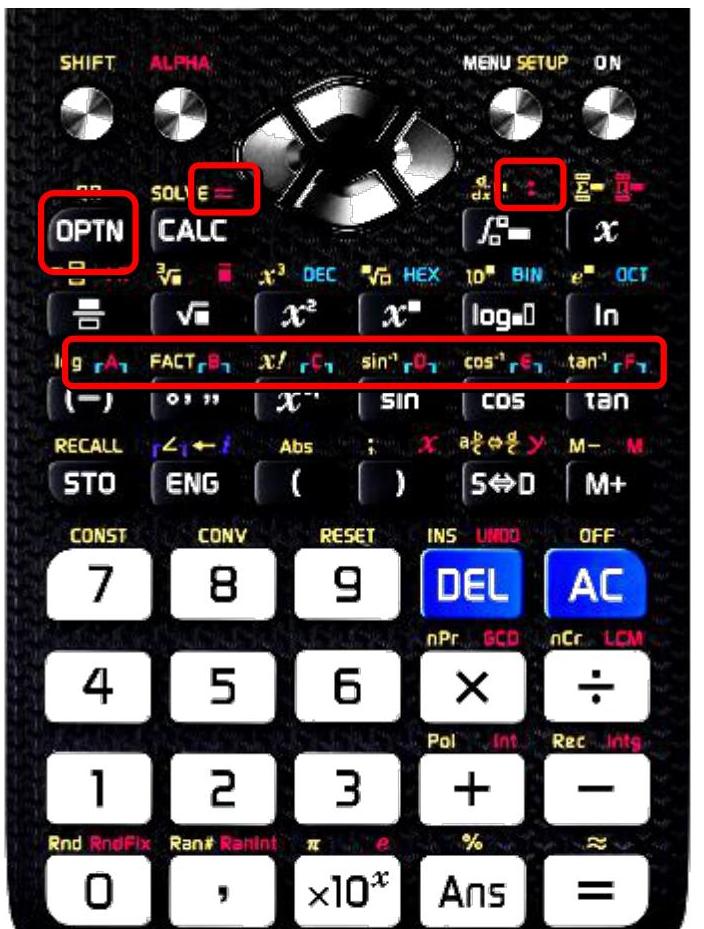
Keyboard layout with key functions
- Use SHIFT + template keys for further templates (Σ, Π and d/dx follow later in the course)
- Press MENU then navigate with arrow keys or press A for Gleichung/Funkt
- CALC button for evaluating expressions with variables
Calculator: Entering Fractions
Two ways to enter fractions:
Mixed fraction: \(3\frac{1}{2}\)
- Press SHIFT + fraction key (for mixed fraction template)
- Enter:
3 → 1 → 2
Improper fraction: \(\frac{7}{2}\)
- Press fraction key
- Enter:
7 → 2
Use the arrow keys to move between numerator and denominator fields.
Calculator: Fraction Calculations
Example: Calculate \(\frac{2}{3} + 1\frac{1}{2}\)

Result: \(\frac{13}{6}\)
To convert between improper and mixed fractions:
- Press S <-> D for conversion
So far, nothing is really new, right?
Calculator: Calculation History
A time-saving feature:
- Press ↑ (up arrow) to recall your previous calculation
- Edit the expression and press = to recalculate
- Navigate through multiple previous calculations with ↑ and ↓
This is very useful when you made a small mistake or want to try different values!
This only works as long as you don’t click the ON button, change the computation mode, or reset the data!
Calculator: Prime Factors (FACT)
Factor integers into prime factors:
- Enter a positive integer and press =
- Press SHIFT + FACT
Example: Find the prime factorization of 84
- Enter:
84 =then SHIFT + FACT - Result: \(2^2 \times 3 \times 7\)
Works for integers up to 10 digits. Useful for simplifying fractions!
Calculator: GCD and LCM
Greatest Common Divisor and Least Common Multiple:
Access GCD and LCM functions via ALPHA + * or ALPHA + /.
| Function | Syntax | Example |
|---|---|---|
| GCD | GCD(a; b) | GCD(24; 36) = 12 |
| LCM | LCM(a; b) | LCM(24; 36) = 72 |
Example: ALPHA + * then GCD(48; 180) = gives 12
Useful for simplifying fractions: \(\frac{48}{180} = \frac{48 \div 12}{180 \div 12} = \frac{4}{15}\)
Calculator: Percentage Calculations
Using the percent function:
Press SHIFT then ANS to access percentage calculations.
Example: What is 15% of 240?
Enter: 240 × 15 SHIFT ANS =
Result: 36
Example: Increase 200 by 8%
Enter: 200 + 200 × 8 SHIFT ANS =
Result: 216
You can always just use 0.08 for 8% as well!
Calculator: Powers and Roots
Powers and roots can also be easily computed using a calculator:
Example 1: Calculate \(5^3 + \sqrt[4]{16}\)
Enter: 5 ^ 3 + SHIFT x^ 4 → 16 =
Result: 127
Example 2: Calculate \((2^3 + \sqrt[3]{27}) \times \sqrt[5]{32}\)
Enter: ( 2 ^ 3 + SHIFT x^ 3 → 27 ) × SHIFT x^ 5 → 32 =
Result: 22
Calculator: Memory Variables
Store values for repeated use:
- Variables available: A, B, C, D, E, F, x, y, M
- Store: Enter value, press STO, then variable letter (no shift/alpha)
- Recall: Press ALPHA + variable letter
Example: Store 3.14159 in A
- Enter
3.14159 → STO → A - Use later:
2 × ALPHA A =gives 6.28318
Ans automatically stores your last result!
Calculator: The Ans Button
Using your last result efficiently:
The Ans button recalls your last calculation result.
- Ans is automatically inserted when you start with an operator
Example: Calculate \(5 + 3\), then multiply by 2:
- Enter:
5 + 3 =→ Result: 8 - Enter:
× 2 =→ Calculator showsAns × 2 = 16
Chain calculations become much faster with Ans!
Calculator: The CALC Button
Evaluate expressions with different values:
The CALC button lets you enter an expression with variables.
- Enter an expression with variables (e.g.,
3A + B) - Press CALC
- Enter values when prompted and press = for the result
Example: Evaluate \(3A + B\) for \(A = 5\), \(B = 10\)
- Enter:
3 ALPHA A + ALPHA B→ CALC →5 = 10 = - Result: 25
Calculator: Scientific Notation
For very large or small numbers:
Use the ×10ˣ button to enter scientific notation.
Example 1: Enter \(6.022 \times 10^{23}\)
Enter: 6.022 10ˣ 23 =
Example 2: Calculate \(\frac{1.5 \times 10^8}{3 \times 10^4}\)
Enter: 1.5 10ˣ 8 ÷ 3 10ˣ 4 =
Result: \(5 \times 10^3 = 5000\)
Calculator vs. When to Show Work
Calculator is useful for:
- Verifying your manual calculations
- Complex arithmetic
- Solving equations to check your work
Exams typically require you to show:
- Differentiation steps (product rule, chain rule, etc.)
- Setting up equations from word problems and manipulating them
- Interpretation of results
Calculator: Common Mistakes
Try to avoid the following if possible.
- Wrong angle mode - Check D/R indicator before trig calculations
- Forgetting parentheses - Use them liberally: \(\sin(30)\) not \(\sin 30\)
- Not closing brackets - Natural display helps avoid this
- Division issues - Use parentheses: \((a+b)/(c+d)\)
- Relying only on calculator - Understand why the answer is correct
Entry Quiz
Quick Review from Last Session
Complete individually, then we discuss
Factor completely: \(x^3 - 27\)
Simplify: \(\sqrt{48} + \sqrt{12} - \sqrt{75}\)
Rationalize: \(\frac{3}{\sqrt{5} - 2}\)
Factor using AC method: \(2x^2 + 7x + 3\)
Let’s review together!
Homework Discussion
Homework Showcase
15 minutes for presentations and discussion
- Present and discuss your solutions from Tasks 01-04
- Share any challenging problems or interesting approaches
- Use this time to clarify concepts before we move forward
Today we build on factorization and radicals with new powerful tools!
Learning Objectives
What You’ll Master Today
- Use your calculator for fractions, powers, roots and memory
- Use substitution to factor expressions with hidden quadratic structure
- Explain logarithms as the inverse of exponentiation
- Apply the logarithm laws to simplify and evaluate expressions
- Solve exponential equations for time and growth questions in business
- Expand binomial powers using Pascal’s triangle
Substitution
What is Substitution?
Making complex expressions simpler with a new variable
Sometimes factorization becomes easier when we substitute part of an expression with a simpler variable.
- Strategy: Replace a repeated expression with a single variable
- Factor the simpler expression
- Substitute back to get the final answer
- Why it works: Reduces cognitive load and reveals hidden patterns
Look for expressions that appear multiple times or have a clear “inner” structure!
When to Use Substitution
Recognize these common patterns
- Quadratic in form: \((x^2)^2 + 5(x^2) + 6\)
- Repeated expressions: \((2x + 1)^2 - 3(2x + 1) - 10\)
- Complex nested terms: \((x + 1) - 2\sqrt{x + 1} + 1\)
- Trigonometric expressions: \(\sin^2(x) + 3\sin(x) + 2\)
The key is identifying what to substitute - look for the “building block” that repeats!
Substitution Examples
Factor \(x^4 - 13x^2 + 36\)
- Step 1: Let \(u = x^2\), so \(x^4 = u^2\)
- Step 2: Substitute: \(u^2 - 13u + 36\)
- Step 3: Factor: \((u - 4)(u - 9)\)
- Step 4: Substitute back: \((x^2 - 4)(x^2 - 9)\)
- Step 5: Factor completely: \((x - 2)(x + 2)(x - 3)(x + 3)\)
Factor \(x + 6\sqrt{x} + 8\)
- Step 1: Notice this involves \(x\) and \(\sqrt{x}\), where \(x = (\sqrt{x})^2\)
- Step 2: Let \(u = \sqrt{x}\), so \(x = u^2\)
- Step 3: Substitute: \(u^2 + 6u + 8\)
- Step 4: Factor: \((u + 2)(u + 4)\)
- Step 5: Substitute back: \((\sqrt{x} + 2)(\sqrt{x} + 4)\)
Factor \(3x^6 - 11x^3 - 20\)
- Step 1: Let \(u = x^3\), so \(x^6 = u^2\) and we have \(3u^2 - 11u - 20\)
- Step 2: Use AC method: \(ac = 3(-20) = -60\)
- Step 3: Find factors of -60 that sum to -11: (4, -15)
- Step 4: Rewrite: \(3u^2 + 4u - 15u - 20\)
- Step 5: Group: \(u(3u + 4) - 5(3u + 4) = (u - 5)(3u + 4)\)
- Step 6: Substitute back: \((x^3 - 5)(3x^3 + 4)\)
Common Substitutions
Simplification tricks
When you see:
- \(3^{2x}\) → Let \(u = 3^x\), then \(3^{2x} = u^2\)
- \(\sqrt{x}\) appearing multiple times → Let \(u = \sqrt{x}\)
- Symmetric expressions → Look for factoring patterns
- Repeating decimals → Use algebraic method to find fraction
Practice with Substitution
Work individually for 8 minutes
Factor: \(x^6 + 8x^3 + 16\)
Factor: \((\sqrt{x} - 2)^2 - 5(\sqrt{x} - 2) + 6\)
Factor: \(16x^4 - 81\)
Factor: \((x^2 + 3x)^2 - 8(x^2 + 3x) + 15\)
Always check if you can factor further after substituting back!
More Advanced Substitution
Sometimes you need to think a little bit more
Example: Factor \(x^{2/3} - 5x^{1/3} + 6\)
- Observation: This involves fractional exponents
- Key insight: Let \(u = x^{1/3}\), so \(x^{2/3} = (x^{1/3})^2 = u^2\)
- Step 1: Substitute: \(u^2 - 5u + 6\)
- Step 2: Factor: \((u - 2)(u - 3)\)
- Step 3: Substitute back: \((x^{1/3} - 2)(x^{1/3} - 3)\)
- Step 4: Can also write as: \((\sqrt[3]{x} - 2)(\sqrt[3]{x} - 3)\)
Break
Logarithm Basics
What is a Logarithm?
The logarithm is the inverse of exponentiation
\[\text{If } a^x = b \text{, then } \log_a(b) = x\]
Think of it as: “What power do I raise \(a\) to get \(b\)?”
- \(2^3 = 8\) means \(\log_2(8) = 3\)
- \(5^x = 125\) means \(x = \log_5(125) = 3\)
Standard notation:
- \(\log\) without a base means \(\log_{10}\) (common logarithm)
- \(\ln\) means \(\log_e\) where \(e \approx 2.718\) (natural logarithm)
The Logarithm is a Mirror Image
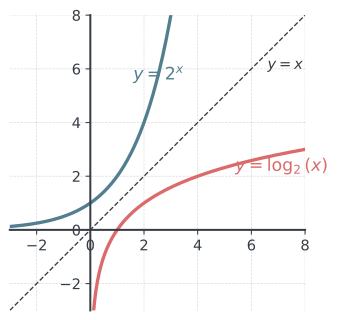
\(\log_2(x)\) undoes \(2^x\) - graphically, a reflection across \(y = x\)
Key Logarithm Properties
These follow directly from exponent laws!
| Property | Formula | Why it works |
|---|---|---|
| \(\log_a(1) = 0\) | Because \(a^0 = 1\) | Any base to the 0 is 1 |
| \(\log_a(a) = 1\) | Because \(a^1 = a\) | Base to the 1st is itself |
| \(\log_a(a^x) = x\) | Direct from definition | Inverse operations |
| \(a^{\log_a(x)} = x\) | Direct from definition | Inverse operations |
Important: Logarithms are transcendental functions - they cannot be expressed using only algebraic operations (unlike polynomials, radicals, and rational functions).
Laws of Logarithms
These transform complex operations into simple ones
| Rule | Example |
|---|---|
| Product: \(\log_a(xy) = \log_a(x) + \log_a(y)\) | \(\log(20) = \log(4) + \log(5)\) |
| Quotient: \(\log_a(\frac{x}{y}) = \log_a(x) - \log_a(y)\) | \(\log(\frac{100}{4}) = \log(100) - \log(4)\) |
| Power: \(\log_a(x^n) = n\log_a(x)\) | \(\log(8^3) = 3\log(8)\) |
Common Mistake
\(\log(x + y) \neq \log(x) + \log(y)\). There’s NO simple rule for \(\log(x + y)\)!
Spot the Error
Can you find the errors? Work with your neighbor
Time allocation: 5 minutes to find errors, 5 minutes to discuss
Student work:
“\(\log_2(8) + \log_2(4) = \log_2(12)\)”
“\(\frac{\log(100)}{\log(10)} = \log\left(\frac{100}{10}\right) = \log(10) = 1\)”
“\(\log_3(9^x) = (\log_3(9))^x = 2^x\)”
Using Logarithms
Evaluating Logarithms
Find \(\log_3(81)\)
- Ask: “3 to what power equals 81?”
- \(3^1 = 3\), \(3^2 = 9\), \(3^3 = 27\), \(3^4 = 81\)
- Therefore: \(\log_3(81) = 4\)
Simplify \(\log_2(32) + \log_2(8) - \log_2(4)\)
- Method 1: Evaluate each
- \(\log_2(32) = 5\), \(\log_2(8) = 3\), \(\log_2(4) = 2\)
- Result: \(5 + 3 - 2 = 6\)
- Method 2: Use laws
- \(= \log_2(\frac{32 \times 8}{4}) = \log_2(64) = 6\)
Change of Base Formula
Convert between different bases
\[\log_a(x) = \frac{\log_b(x)}{\log_b(a)} = \frac{\ln(x)}{\ln(a)} = \frac{\log(x)}{\log(a)}\]
Example: Find \(\log_5(30)\)
- \(\log_5(30) = \frac{\ln(30)}{\ln(5)} = \frac{3.401}{1.609} \approx 2.113\)
- Check: \(5^{2.113} \approx 30\) ✓
Calculator: Logarithms
Your calculator handles all three logarithm types:
| Function | Access |
|---|---|
| \(\log_{10}(x)\) | SHIFT + (-) button |
| \(\ln(x)\) | ln button |
| \(\log_a(b)\) | log (log button) |
Example: Calculate \(\log_2(32)\)
Enter: log 2 → 32 =
Result: 5 (because \(2^5 = 32\))
Individual Exercise 01
Work individually for 5 minutes
Evaluate: \(\log_4(64)\)
Simplify: \(\log_3(9) + \log_3(27)\)
Solve: \(\log_5(x + 4) = 2\)
Express as a single logarithm: \(2\log(x) - \log(y) + \log(3)\)
Logarithms in Practice
Why Logarithms Matter
From protecting your hearing to predicting disasters
- The Challenge: Natural phenomena span enormous ranges
- Human perception: We sense changes proportionally, not linearly
- The Solution: Logarithmic scales compress huge ranges into manageable numbers
- Real Impact: These scales help save lives and advance science
Historical Note: Logarithms were invented in 1614 by John Napier to simplify astronomical calculations. Today, they’re essential for measuring everything from sound to earthquakes!
How Slowly Do Logarithms Grow?
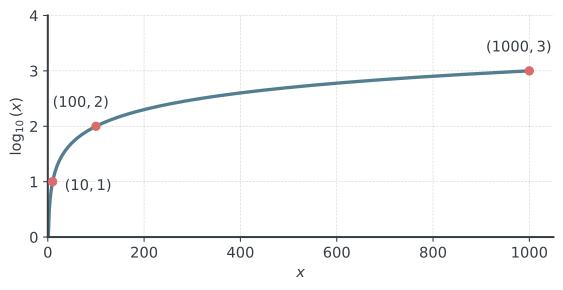
While \(x\) runs from 1 to 1,000, \(\log_{10}(x)\) only climbs from 0 to 3
Scientific Applications
Sound intensity spans 24 orders of magnitude - hence the decibel scale: \(L = 10\log(\frac{I}{I_0})\) dB
- Whisper: 30 dB (1,000× threshold)
- Normal conversation: 60 dB (1,000,000× threshold)
- Rock concert: 110 dB (100,000,000,000× threshold)
Each 10 dB step = 10× intensity - a rock concert is 100,000× a conversation!
The problem with linear scales: Earthquake energy ranges from equivalents of small explosions to thousands of atomic bombs!
Richter scale: \(M = \log_{10}(\frac{A}{A_0})\)
- Magnitude 3: Barely felt (like a large truck passing)
- Magnitude 5: Light damage (100× stronger than Mag 3)
- Magnitude 7: Major quake (10,000× stronger than Mag 3)
- Magnitude 9: Great quake (1,000,000× stronger than Mag 3)
Financial Applications
Why Natural Logarithm for Finance?
The connection to continuous growth
- Any logarithm works: \(t = \frac{\log_{10}(2)}{\log_{10}(1 + r)} = \frac{\ln(2)}{\ln(1 + r)}\)
- But ln is natural because it connects to continuous compounding
- Continuous compounding formula: \(A = Pe^{rt}\) (where \(e \approx 2.718\))
- Why e appears: It’s the limit as compounding frequency → infinity
Compound Interest: Finding Time
How long to double your money?
- Formula: \(2P = P(1 + r)^t\)
- Simplify: \(2 = (1 + r)^t\)
- Take logarithms: \(\ln(2) = t \cdot \ln(1 + r)\)
- Solve: \(t = \frac{\ln(2)}{\ln(1 + r)}\)
Rule of 72: At r% interest, doubling time ≈ \(\frac{72}{r}\) years
Practice: Reaching a Savings Goal
Work individually for 5 minutes
You invest 5,000 EUR at 4% interest per year, compounded annually.
Write down the equation for the value of the investment after \(t\) years.
How long until the investment reaches 8,000 EUR?
Use the Rule of 72 to estimate the doubling time, then compare it with the exact value from logarithms.
Practice: Two Ways to Pay 6%
Work with your neighbor for 3 minutes
Two banks advertise the same headline rate of 6% per year:
- Bank A: credits 6% once at the end of each year
- Bank B: credits 3% every six months
You deposit the same amount at both banks for \(t\) years. Is the advertised rate the whole story? Justify your answer with exponents - no calculator needed.
Bank B credits interest \(2t\) times: compare \((1.06)^t\) with \((1.03)^{2t}\).
Coffee Break
Advanced Algebra
Solving Exponential Equations
Logarithms are the key tool
Binomial Expansion
Pascal’s Triangle
A pattern of binomial coefficients
Row 0:              1
Row 1:            1   1
Row 2:          1   2   1
Row 3:        1   3   3   1
Row 4:      1   4   6   4   1
Row 5:    1   5   10  10  5   1
Row 6: 1 6 15 20 15 6 1- Each number = sum of two above
- Row n gives coefficients for \((a + b)^n\)
- Symmetric pattern
What About a Minus?
Rewrite the subtraction as an addition
\[(a - b)^n = \left(a + (-b)\right)^n\]
Pascal’s triangle still gives the coefficients - only the sign of each term changes:
- Odd powers \((-b)^1, (-b)^3, \dots\) stay negative
- Even powers \((-b)^2, (-b)^4, \dots\) turn positive
- So the signs alternate: \(+ \; - \; + \; -\)
A Minus in Action
Row 2 of the triangle is \(1, 2, 1\)
\[(x - 2)^2 = x^2 + 2x(-2) + (-2)^2 = x^2 - 4x + 4\]
The coefficients \(1, 2, 1\) are unchanged - the minus only flips the sign of the middle term.
Pair Exercise
Work in pairs for 5 minutes
- Expand completely: \((x - 3)^3\)
Individual Exercise
Work individually for 5 minutes
If \(\log_2(x) + \log_4(x) = 3\), find x.
Expand: \((3x - 2y)^3\)
Simplify: \(\log_3(27) - \log_3(3)\)
Solve: \(2^{x+1} = 32\)
Wrap-Up & Takeaways
Key Takeaways
- Substitution is a powerful technique for simplifying expressions
- Logarithms are inverse exponentials
- The logarithm laws simplify complex calculations
- Pascal’s triangle gives binomial coefficients
- These tools are essential for calculus, statistics, and finance
Final Assessment
Quick Check
Work individually then we discuss
Evaluate \(\log_5(125)\).
Solve \(2^{3x} = 64\).
Write \(2\log(x) + \log(5)\) as a single logarithm.
True or False: \(\log(a \cdot b) = \log(a) \cdot \log(b)\).
Next Session Preview
Session 01-06 (Synthesis):
- Integration of ALL Section 1 concepts
- Complex problem-solving strategies
- Business case studies
Start reviewing all Section 1 material - synthesis session next!
Homework Assignment
Complete Tasks 01-05!
Session 01-05 - Logarithms & Substitution | Dr. Nikolai Heinrichs & Dr. Tobias Vlćek | Home