Session 04 - Differentiation
Mathematics for Master Students
Recap, Your Questions
Session 03 in a Nutshell
- The roastery: demand \(D(p) = 1200 - 20p\) bags a week, cost \(C(q) = 200 + 5q\)
- Revenue \(R(p) = 1200p - 20p^2\) peaks at the vertex €30
- Profit \(\pi(p) = R(p) - C(D(p))\) peaks at €32.50; capacity of 500 bags pushes the price to €35
- Composition \(C(D(p))\), the inverse \(D^{-1}(q) = 60 - \frac{q}{20}\), the chord test for convex and concave
- Today: how fast does each of them change?
Common Issues in the Homework
- One restriction forgotten: with \(\frac{\sqrt{x+1}}{x-2}\), both the root (\(x \geq -1\)) and the denominator (\(x \neq 2\)) restrict: collect every red flag, then intersect
- Composition order: \((f \circ g)(x)\) means \(g\) acts first
- The log-inequality flip: dividing by \(\ln 0.85 < 0\) flips the inequality. Dividing by a negative number always does
Which tasks gave you trouble? Bring them up now. We take the time to go through them before we move on to today’s topic.
Warm-Up: Average Cost of a Price
Question
The roastery’s average cost is \(A(q) = \frac{200}{q} + 5\) per bag, demand is \(D(p) = 1200 - 20p\). What is \(A(D(50))\), and which price must be excluded from \(A(D(p))\)? Type both.
- Inside out: \(D(50) = 200\) bags, so \(A(D(50)) = \frac{200}{200} + 5 = 6\), €6 per bag
- The division needs \(D(p) \neq 0\): \(1200 - 20p = 0\) at \(p = 60\), where nobody buys
- The inner function must land where the outer one is defined: \(p = 60\) is out
Today’s Plan
What does a €1 price rise add to the roastery’s revenue at €10, and at €30? Today: measure how steep a curve is at one point, then compute it in one line with the rules.
- Rates of change: from a €1 nudge to the slope at one point
- Differentiation rules: derivatives in one line, no limits needed
- Second derivative: the chord test as a sign check
- Marginal analysis: what the next bag costs and what it earns
Rates of Change
A €1 Price Rise
At price \(p\) the roastery earns \(R(p) = 1200p - 20p^2\) a week, Session 3's revenue parabola.
Question
The price goes up by €1. How much revenue does that add at \(p = 10\)? Guess in the chat.
\[R(11) - R(10) = 10780 - 10000 = 780\]
Now out loud: does a €1 rise at \(p = 30\) add more, less, or the same?
\[R(31) - R(30) = 17980 - 18000 = -20\]
Same €1 nudge, one curve: +€780 at €10, −€20 at €30. Why?
The Same Nudge, Different Effects
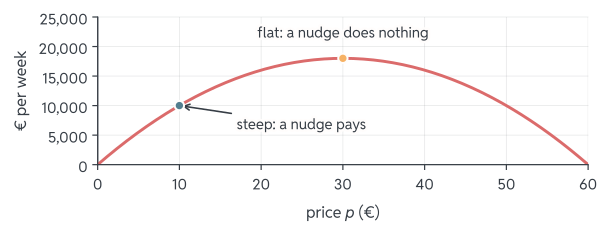
Steep at €10, flat at €30: the answer is the steepness of the curve where we stand.
The Average Rate of Change
The €780 was revenue change per €1 of price; divide by the step \(h\) for the difference quotient (the average rate of change):
\[\frac{R(10 + h) - R(10)}{h} \quad\longrightarrow\quad \frac{f(a+h) - f(a)}{h}\]
- Change in output over change in input
- How much does \(f\) change as the input moves from \(a\) to \(a + h\)?
- A line gives the same slope \(m\) for every \(a\) and \(h\)
- The curve does not: from \(p = 10\), \(h = 1\) gives \(780\). What does \(h = 10\) give?
Geometry: The Secant Line
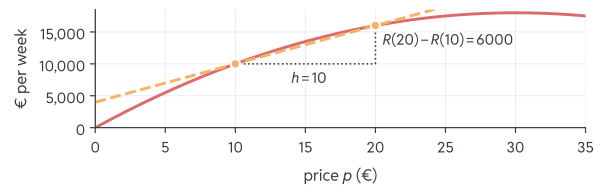
The difference quotient is the slope of the secant line through \((10, R(10))\) and \((20, R(20))\): \(\frac{16000 - 10000}{10} = 600\) euros of revenue per euro of price.
Your Turn: Find the Secant Slope
Question
For \(R(p) = 1200p - 20p^2\), what is the difference quotient from \(p = 10\) to \(p = 15\)? Type the number in the chat.
\[\frac{R(15) - R(10)}{5} = \frac{13500 - 10000}{5} = 700\]
A step of \(10\) gave \(600\) and a step of \(5\) gives \(700\): as the second price closes in on €10, the slope climbs. Where does it stop?
Zoom In Until the Curve Is Straight
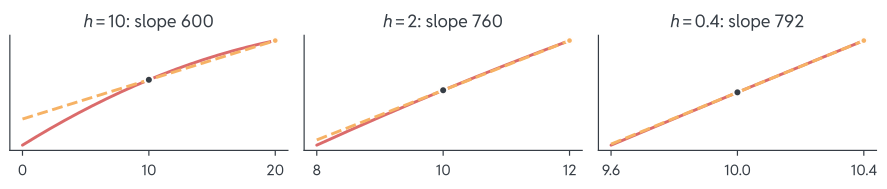
Zoom in on a smooth curve and it turns straight; the secant stops tilting. That straight line is the tangent at \(p = 10\), and its slope is the rate of change right at \(p = 10\).
Letting \(h\) Shrink
The secant slope of revenue, \(\frac{R(p+h) - R(p)}{h}\), at the two prices from the start:
| \(h\) | \(10\) | \(5\) | \(1\) | \(0.1\) | \(0.01\) |
|---|---|---|---|---|---|
| at \(p = 10\) | \(600\) | \(700\) | \(780\) | \(798\) | \(799.8\) |
| at \(p = 30\) | \(-200\) | \(-100\) | \(-20\) | \(-2\) | \(-0.2\) |
- As \(h\) shrinks toward \(0\), the slopes settle on \(800\) and \(0\)
- We write \(\lim_{h \to 0}\) for “the value it settles on as \(h\) shrinks toward \(0\)”
- That is all the limit theory we need in this tutorial
The Derivative
The derivative of \(f\) at \(a\) is the instantaneous rate of change:
\[f'(a) = \lim_{h \to 0} \frac{f(a+h) - f(a)}{h}\]
- Geometric reading: slope of the tangent line at \((a, f(a))\)
- Business reading: \(R'(10) = 800\): at €10, revenue reacts at €800 per euro of price
- Taken at every point: a new function \(f'\), the derivative of \(f\)
- Positive \(f'\): increasing; negative \(f'\): decreasing
- Session 3's revenue: \(R' > 0\) below €30, \(R' < 0\) above
Your Turn: Read the Sign
Question
You are told \(f'(a) = -3\). What does that say?
| (a) \(f\) is falling at \(a\), slope \(-3\) | (b) The value \(f(a)\) equals \(-3\) |
| (c) \(f\) has a minimum at \(a\) | (d) \(f\) drops by exactly \(3\) up to \(a + 1\) |
(a): the derivative is a slope, and a negative slope means the graph falls at \(a\).
(d) is only approximately right, and only for a nearly straight graph: the tangent slope describes the trend at \(a\), not a whole unit further on. (b) confuses the value with the slope.
Notation for Derivatives
All of these mean the same thing:
| Notation | Read as |
|---|---|
| \(f'(x)\) | “\(f\) prime of \(x\)” |
| \(\dfrac{df}{dx}\) | “derivative of \(f\) with respect to \(x\)” |
| \(\dfrac{d}{dx} f(x)\) | “\(\frac{d}{dx}\) applied to \(f(x)\)” |
\(\frac{df}{dx}\) deliberately looks like a difference quotient: it reminds you where the derivative comes from. We mostly write \(f'(x)\); when the letters are not \(f\) and \(x\) (e.g. \(R(p)\)), the \(\frac{dR}{dp}\) form says with respect to what: € of revenue per € of price.
Your Turn: Average vs Derivative
Question
A courier van covers 150 km in 2 hours. Halfway through, a speed camera clocks it at 90 km/h. Which statement is right?
| (a) The camera is wrong: the van averaged 75 km/h | (b) Both hold: 90 km/h is an average, 75 km/h a derivative |
| (c) Both hold: 75 km/h is an average, 90 km/h a derivative | (d) Just one can hold: a van has one speed per trip |
- (c): \(\frac{150}{2} = 75\) km/h is a difference quotient; the camera’s 90 km/h is the instantaneous rate, the derivative of distance
- Both can hold: the average smooths out faster and slower stretches
Where Zooming Fails
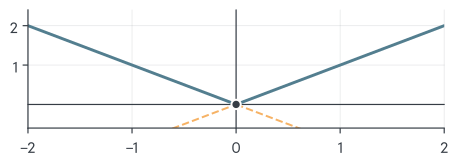
- Zoom into \(|x|\) at \(0\) as far as you like: the corner stays a corner. Secants from the left settle on \(-1\), from the right on \(+1\), so there is no single tangent and no derivative at \(0\)
- A function has a derivative (is differentiable) only where it is smooth: no kinks, no jumps; tiered shipping tariffs jump at their breakpoints
Differentiation Rules
Constants and the Power Rule
For \(x^2\) the difference quotient simplifies:
\[\frac{(x+h)^2 - x^2}{h} = \frac{2xh + h^2}{h} = 2x + h \;\to\; 2x \quad \text{as } h \to 0\]
The pattern holds for every power:
- Power rule: \((x^n)' = n x^{n-1}\), exponent down front, then one less
- Constants: \(f(x) = c\) never changes, so \(f'(x) = 0\)
The Power Rule for All Exponents
One rule decides what negative and fractional powers mean: multiplying adds exponents, \(x^a \cdot x^b = x^{a+b}\).
- \(x^{-1} \cdot x = x^0 = 1\), so \(x^{-1} = \dfrac{1}{x}\) and \(\left(\dfrac{1}{x}\right)' = -1 \cdot x^{-2} = -\dfrac{1}{x^2}\)
- \(x^{1/2} \cdot x^{1/2} = x^1\), so \(x^{1/2} = \sqrt{x}\) and \(\left(\sqrt{x}\right)' = \dfrac{1}{2} x^{-1/2} = \dfrac{1}{2\sqrt{x}}\) (\(x > 0\))
Rewrite as a power, differentiate, translate back. Sanity check: \(\frac{1}{x}\) falls, so its slope must be negative ✓
Your Turn: Apply the Power Rule
Question
Let \(f(x) = x^4\). What is \(f'(2)\)? Type the number.
\[f'(x) = 4x^3, \qquad f'(2) = 4 \cdot 8 = 32\]
Common Mistake
\(f'(2) = 4 \cdot 2^4 = 64\) forgets to reduce the exponent. Exponent down front and one less on top.
Bonus: A Negative Power
Differentiate \(g(x) = \dfrac{1}{x^2}\):
\[g(x) = x^{-2}, \qquad g'(x) = -2x^{-3} = -\frac{2}{x^3}\]
Sums and Constant Multiples
\[(c \cdot f)'(x) = c \cdot f'(x) \qquad (f + g)'(x) = f'(x) + g'(x)\]
- Together: differentiate term by term, constants tag along
- Example, a print shop whose cost bends upward, unlike the roastery’s straight line: \(C(q) = 0.5q^2 + 10q + 200\)
- \(C'(q) = 0.5 \cdot 2q + 10 + 0 = q + 10\)
- The fixed costs \(200\) vanish: they do not react to producing one unit more
Your Turn: Term by Term
Question
A cost function is \(C(q) = 0.1q^2 + 4q + 50\). What is \(C'(20)\)? Type the number.
\[C'(q) = 0.2q + 4, \qquad C'(20) = 4 + 4 = 8\]
At \(20\) units, cost grows at €8 per unit, while the fixed cost \(50\) has disappeared from \(C'\) entirely: it never reacts to output.
Revenue Is a Rectangle
Revenue \(R(p) = p \cdot D(p)\): price along the bottom, bags sold up the side. Raise \(p = 10\) by \(h\):
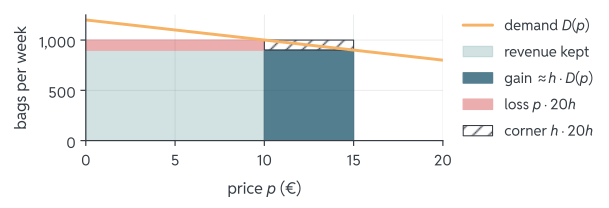
Gains on bags still sold, losses on bags no longer sold, and a corner that shrinks like \(h^2\).
The Product Rule
\[R'(p) = \underbrace{1 \cdot D(p)}_{\text{gain}} + \underbrace{p \cdot D'(p)}_{\text{loss}} = (1200 - 20p) - 20p = 1200 - 40p\]
- The \(1\) is \(p' = 1\): price’s own rate of change with respect to itself
- In general: \((f \cdot g)'(x) = f'(x)\,g(x) + f(x)\,g'(x)\), each factor takes its turn to change
The Quotient Rule
Session 3 saw the roastery’s average cost \(A(q) = (200 + 5q)/q\) settle towards €5. Does it fall with every bag?
\[\left(\frac{f}{g}\right)'(x) = \frac{f'(x)\,g(x) - f(x)\,g'(x)}{\left(g(x)\right)^2}\]
- Like the product rule, but a growing denominator shrinks the quotient: hence the minus, and the order matters
- Here \(f = 200 + 5q\) and \(g = q\), so \(f' = 5\) and \(g' = 1\)
- \(A'(q) = \dfrac{5 \cdot q - (200 + 5q) \cdot 1}{q^2} = -\dfrac{200}{q^2} < 0\): falls with every bag
Machines in a Row: Rates Multiply
The price sets the bags, the bags the cost: \(p \xrightarrow{\;D\;} q \xrightarrow{\;C\;} C(D(p))\)
Question
With \(D(p) = 1200 - 20p\) and \(C(q) = 200 + 5q\), the price rises by €1. How does the weekly cost change? Type the number.
- €1 more: \(20\) bags fewer, each saves €5: cost changes by \((-20) \cdot 5 = -100\), €100 less per week
- Check by composing: \(C(D(p)) = 200 + 5(1200 - 20p) = 6200 - 100p\), slope \(-100\) ✓
- Chain rule: rates multiply, \(\frac{d}{dp}\,C(D(p)) = C'(q) \cdot D'(p)\)
The Chain Rule
When the outer function curves, its rate depends on what the inner one delivers. A warehouse: stock \(q(t) = 30 + 4t\) pallets after \(t\) weeks, storage cost \(H(q) = 0.2q^2\) in €.
- Stock rate \(q'(t) = 4\) pallets per week; cost rate \(H'(q) = 0.4q\) € per pallet, read at the current stock
- At \(t = 5\): \(q = 50\), so cost rises at \(0.4 \cdot 50 \cdot 4 = 80\), €80 per week
- In general: \(\left(f(g(x))\right)' = f'(g(x)) \cdot g'(x)\), outer derivative at the inner value, times the inner derivative
- Bracket to a power: \((x^2+1)^3\): outer \((\cdot)^3\) gives \(3(x^2+1)^2\), inner \(x^2 + 1\) gives \(2x\), so \(\left((x^2+1)^3\right)' = 6x(x^2+1)^2\)
Your Turn: Spot the Missing Factor
Question
What is the derivative of \((3x + 2)^5\)?
| (a) \(5(3x + 2)^4\) | (b) \(15(3x + 2)^4\) |
| (c) \(5 \cdot 3^4\) | (d) \(15x\,(3x + 2)^4\) |
(b): outer derivative \(5(3x+2)^4\), times the inner derivative \(3\).
(a) forgot the inner factor, (c) differentiated the bracket away, (d) invented an \(x\): the inner derivative of \(3x + 2\) is the constant \(3\), nothing more. Forgetting the inner factor is the classic chain-rule slip.
Your Turn: Pick the Rule
Question
Which rules differentiate (i) \((5x+1)^4\), (ii) \(x^3(2x - 7)\), (iii) \(\frac{x}{x^2+1}\), in that order?
| (a) power · product · quotient | (b) chain · chain · quotient |
| (c) chain · product · power | (d) chain · product · quotient |
(d) is right:
- (i) Chain rule, outer \((\cdot)^4\): derivative \(4(5x+1)^3 \cdot 5 = 20(5x+1)^3\)
- (ii) Product rule: \(3x^2(2x - 7) + x^3 \cdot 2 = 8x^3 - 21x^2\), or expand first: same result
- (iii) Quotient rule: \(\left(\frac{x}{x^2+1}\right)' = \frac{1 \cdot (x^2 + 1) - x \cdot 2x}{(x^2 + 1)^2} = \frac{1 - x^2}{(x^2 + 1)^2}\)
Which Base Has Slope 1?
Every \(b^x\) passes through \((0, 1)\). How steep is it there? \(2^x\) has slope \(0.69\), \(3^x\) has \(1.10\): which base has slope exactly \(1\)?
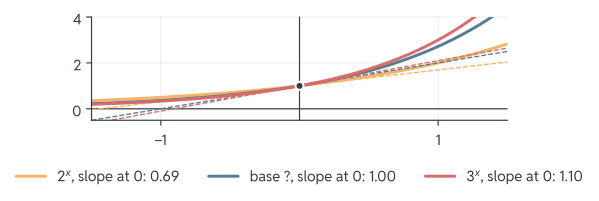
Between base \(2\) (0.69) and base \(3\) (1.10) sits the base with slope exactly \(1\): Euler’s number \(e \approx 2.718\).
Derivatives of \(e^x\) and \(a^x\)
- \(\left(e^x\right)' = e^x\): the slope equals the height, everywhere
- Other bases, chain rule on \(a^x = e^{x \ln a}\): \(\left(a^x\right)' = a^x \ln a\); the 0.69 in the plot is \(\ln 2\)
- With the chain rule: \(\left(e^{3x}\right)' = 3e^{3x}\)
- Growth, Session 3's \(K(t) = K_0 e^{rt}\): the chain rule gives \(K'(t) = r\,K(t)\)
- The €1000 reserve at \(r = 0.05\) grows at 5% of what it holds
- Only base \(e\) makes the factor exactly the rate \(r\): that is why growth models use \(e\)
The Derivative of \(\ln x\)
- \(\ln\) is \(e^x\) mirrored, and a slow climber: \(\left(\ln x\right)' = \dfrac{1}{x}\)
- Sanity check: at \((1, 0)\) the slope is \(1\); by \(x = e\) the curve has climbed just one unit, and the slope is down to \(1/e\)
Your Turn: Exponential and Log
Question
Differentiate \(f(x) = e^{2x}\) and \(g(x) = \ln(5x)\). Which pair is right?
| (a) \(2e^{2x}\) and \(\frac{1}{x}\) | (b) \(2e^{2x}\) and \(\frac{5}{x}\) |
| (c) \(2x\,e^{2x}\) and \(\frac{1}{x}\) | (d) \(e^{2x}\) and \(\frac{1}{5x}\) |
- (a) is right: \(f'(x) = e^{2x} \cdot 2 = 2e^{2x}\): inner derivative \(2\)
- \(g'(x) = \dfrac{1}{5x} \cdot 5 = \dfrac{1}{x}\): the \(5\) cancels
- No surprise: \(\ln(5x) = \ln 5 + \ln x\); \(\ln 5\)’s derivative is zero
- (b) multiplied, not cancelled; (c) invented an \(x\); (d) missed both factors
The Rule Table
Building blocks
| \(f(x)\) | \(f'(x)\) |
|---|---|
| \(c\) | \(0\) |
| \(x^n\) | \(n x^{n-1}\) |
| \(e^x\) | \(e^x\) |
| \(a^x\) | \(a^x \ln a\) |
| \(\ln x\) | \(\frac{1}{x}\) |
Combinations
| Rule | Formula |
|---|---|
| Constant multiple | \((c f)' = c f'\) |
| Sum | \((f + g)' = f' + g'\) |
| Product | \((f g)' = f'g + f g'\) |
| Quotient | \(\left(\frac{f}{g}\right)' = \frac{f'g - f g'}{g^2}\) |
| Chain | \((f(g))' = f'(g) \cdot g'\) |
The Second Derivative
Does the Slope Itself Change?
Session 3's advertising curve: \(S(a) = 100\sqrt{a}\) extra bags from a budget \(a\) (in €1000). Each extra €1000 added \(+100\), \(+41\), \(+32\), \(+27\).
The slope tells the same story, \(S'(a) = \dfrac{50}{\sqrt{a}}\):
| budget \(a\) | \(1\) | \(4\) | \(9\) |
|---|---|---|---|
| slope \(S'(a)\) | \(50\) | \(25\) | \(16.7\) |
Question
The slope falls as the budget grows. How would you measure how fast it falls?
Differentiating Twice
The slope \(f'\) is again a function, so differentiate again:
\[f''(x) = \left(f'\right)'(x) \qquad \text{also written } \frac{d^2 f}{dx^2}\]
- \(f'\) reports how fast \(f\) changes; \(f''\) how fast the slope changes
- Advertising: \(S''(a) = -\dfrac{25}{a^{3/2}} < 0\), so the slope shrinks at every budget: diminishing returns
- A cubic: \(f(x) = x^3 - 3x\), \(f'(x) = 3x^2 - 3\), \(f''(x) = 6x\)
- Third, fourth, \(\dots\) derivatives exist too: for us, two is all we need
Your Turn: Differentiate Twice
Question
Let \(f(x) = 2x^3 - 5x\). What is \(f''(3)\)? Type the number.
\[f'(x) = 6x^2 - 5, \qquad f''(x) = 12x, \qquad f''(3) = 36\]
Positive: at \(x = 3\) the slope is increasing; the graph bends upward, convex there. The next slide makes that reading official.
Convex or Concave? Ask \(f''\)
Session 3's chord test becomes a sign check on an interval:
- \(f''(x) \geq 0\) on the interval \(\Rightarrow\) convex: the slope never falls, every chord lies on or above the graph
- \(f''(x) \leq 0\) on the interval \(\Rightarrow\) concave: the slope never rises, every chord lies on or below the graph
- \(f(x) = x^2\): \(f''(x) = 2 \geq 0\), convex everywhere
- \(S''(a) < 0\): the advertising curve is concave, diminishing returns certified
Reading \(f\), \(f'\) and \(f''\) Together
Same cubic, three views. Watch the sign of the right panel and how the left curve bends.
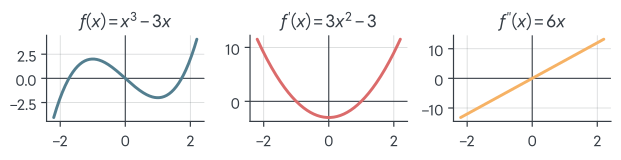
- For \(x < 0\): \(f'' < 0\): slope falling, \(f\) bends downward (concave)
- For \(x > 0\): \(f'' > 0\): slope rising, \(f\) bends upward (convex)
- At \(x = 0\) the bend switches, an inflection point; Session 5 turns these signs into an optimisation tool
Your Turn: What If \(C''(q) > 0\)?
Question
The print shop’s cost \(C(q) = 0.5q^2 + 10q + 200\) has \(C'(q) = q + 10\) and \(C''(q) = 1\). What does \(C'' > 0\) say about the next unit?
| (a) Total cost falls once output is large | (b) Each extra unit costs the same amount |
| (c) Each extra unit costs more than the last | (d) The fixed cost grows with every unit |
(c): the slope \(C'\) keeps rising, so every further unit is dearer. The cost curve is convex.
(b) holds only for a straight cost line such as the roastery’s, €5 per bag. (a) confuses the curvature with the slope: \(C' > 0\) for all \(q \geq 0\), so cost only rises. (d) is wrong because the fixed €200 never changes.
Marginal Analysis
Marginal Cost
The last question already used it. What does the next unit cost?
- Roastery, \(C(q) = 200 + 5q\): bag 401 costs \(C(401) - C(400) = 5\), i.e. €5, at any volume: the slope
- Print shop, \(C(q) = 0.5q^2 + 10q + 200\): the curve steepens, so the answer depends on \(q\)
- With \(h = 1\) in the difference quotient: \(C(q+1) - C(q) \approx C'(q)\)
- One unit is a small nudge next to hundreds produced, so the tangent slope is an excellent stand-in
- Economists call \(C'(q)\) the marginal cost: the instantaneous rate at which cost grows, approximately the cost of one more unit
Your Turn: The 101st Unit
Question
The print shop again, \(C(q) = 0.5q^2 + 10q + 200\). Approximately what does the 101st unit cost? Type the number.
\[C'(100) = 100 + 10 = 110 \qquad \text{so about €110}\]
Exact check: \(C(101) - C(100) = 6310.5 - 6200 = 110.5\). The tangent slope misses by 50 cents, and it is far quicker than the subtraction.
Marginal Revenue
What does the next bag earn? That question asks about bags, so revenue counted in bags gets its own name, \(\tilde R(q)\). Session 3's inverse \(D^{-1}(q) = 60 - \frac{q}{20}\) prices the \(q\)-th bag:
\[\tilde R(q) = q \cdot D^{-1}(q) = 60q - \frac{q^2}{20}, \qquad \tilde R'(q) = 60 - \frac{q}{10} \ \text{(€ per bag)}\]
- At 400 bags, \(\tilde R'(400) = 20\): bag 401 earns about €20 and costs €5, so sell it
- At 600 bags (\(p = 30\)), \(\tilde R'(600) = 0\): revenue’s flat top
Marginal Revenue vs Marginal Cost
- Marginal revenue falls with \(q\): every extra bag needs a lower price
- The next bag pays off while \(\tilde R'(q) > C'(q)\); where the two meet lies the profit-maximal output, Session 5 proves it
- Where do \(60 - \frac{q}{10}\) and \(5\) meet? Hold that thought for Session 5
Closing
Key Takeaways
- A €1 rise at \(p = 10\) adds €780; \(R'(10) = 800\) is the tangent’s slope, the limit of the difference quotient
- Zoom into a smooth graph and it turns straight; kinks and jumps (\(|x|\) at \(0\), tiered tariffs) never do
- Revenue is a rectangle, \(R' = D + p\,D'\); along a chain rates multiply: \(-20\) bags per € times €5 per bag
Key Takeaways: \(e\), \(f''\), Margins
- \(e^x\) is the exponential whose slope equals its height: the reserve grows at exactly \(r\) times itself
- Each extra €1000 of advertising adds less: \(S'' < 0\), concave; \(f'' \geq 0\) convex, \(f'' \leq 0\) concave
- Bag 401 costs €5 and earns about €20; at €30, \(R' = 0\). Is the profit tangent flat at €32.50?
That’s it for today.
Any Questions?
Until the Next Session
- Work through the Tasks: the drilling happens there, with worked solutions
- Check yourself with the Self-Test quiz
- Keep the Cheatsheet next to you: the rule table lives on it: ten lines for every function in Session 3's gallery
- Note down anything unclear: we start next session with your questions
When differentiating, name the structure first: sum, product, quotient or chain? The right rule follows automatically.
Preview: Session 05: Optimisation
- Central question: where is a function largest or smallest?
- Profit slope = revenue slope − cost slope: \(\pi'(p) = 1300 - 40p\). Where is it flat?
- The recipe: set \(f'\) to zero (flat tangent) and ask \(f''\) whether it is a peak or a valley
- Session 3's €32.50 and €35 again, this time from the derivative
- Today’s rules become the toolkit: best price, output, order quantity
See you there, and bring your questions!
Literature & Further Reading
- These sessions cover the essentials: textbooks offer more depth and practice
- Start with Sydsæter et al. (2012) or Jacques (2015); full recommendations on the tutorial’s literature page
Session 04 - Differentiation | Dr. Tobias Vlćek | Home