Session 09-07 - Final Recap: Function Analysis & Probability
Section 09: Exam Preparation
Refresher: Functions
Verifying Extrema (2nd Derivative)
To prove that \(f\) has a maximum or minimum at \(x = a\):
- Show \(f'(a) = 0\) (stationary point)
- Compute \(f''(a)\):
- \(f''(a) < 0\) \(\Rightarrow\) local maximum
- \(f''(a) > 0\) \(\Rightarrow\) local minimum
- \(f''(a) = 0\) \(\Rightarrow\) inconclusive; check sign of \(f'\)
- Compute \(f(a)\) to give the actual extremum value
The exam often asks: “Verify computationally that \(f\) has a maximum at \(x = a\).” All three steps are needed for full points.
Symmetry & Reflections
| Transformation | Formula | Meaning |
|---|---|---|
| Reflection at \(y\)-axis | \(f(-x)\) | Mirror left/right |
| Reflection at \(x\)-axis | \(-f(x)\) | Mirror up/down |
| Vertical shift | \(f(x) + c\) | Move up by \(c\) |
| Horizontal shift | \(f(x - c)\) | Move right by \(c\) |
Quick: If \(f(x) = 2x^3 - x^2 + 4x - 3\), then the reflection at the \(y\)-axis is?
\[f_1(x) = f(-x) = 2(-x)^3 - (-x)^2 + 4(-x) - 3 = -2x^3 - x^2 - 4x - 3\]
Areas Between Curves
Steps:
- Find intersection points: solve \(f(x) = g(x)\)
- Form the difference \(h(x) = f(x) - g(x)\)
- Determine which function is on top in each interval (test a value)
- Integrate \(|h(x)|\) over each region; areas are always positive
\[A = \int_{a}^{b} \big| f(x) - g(x) \big| \, dx\]
If \(h\) changes sign, split the integral at each zero, or positive and negative parts cancel.
Areas Between Curves: Example
Find the area enclosed between \(f(x) = x^2\) and \(g(x) = 2x\) on \([0; 2]\):
Step 1, intersections: \(x^2 = 2x \Rightarrow x(x-2) = 0 \Rightarrow x = 0, 2\)
Step 2, top function: at \(x = 1\): \(g(1) = 2 > 1 = f(1)\); so \(g\) is on top.
\[A = \int_0^2 (2x - x^2) \, dx = \left[ x^2 - \frac{x^3}{3} \right]_0^2 = 4 - \frac{8}{3} = \frac{4}{3}\]
True/False Statements from Graphs
To assess claims about \(f\), \(f'\), \(f''\) from a graph, recall:
- \(f'(a) > 0 \Leftrightarrow f\) is increasing at \(a\)
- \(f''(a) > 0 \Leftrightarrow f\) is concave up at \(a\) (smiley)
- \(f''(a) < 0 \Leftrightarrow f\) is concave down at \(a\) (frowny)
- Tangent slope at \(a\) vs. secant slope \(\frac{f(b) - f(a)}{b - a}\) over \([a; b]\)
Read both slopes from the graph: at \(x = a\) the tangent can be less steep than the secant, as steep, or steeper.
Exponential Function Basics
| Property | \(e^x\) |
|---|---|
| Domain / Range | \(\mathbb{R}\) / \((0; \infty)\) |
| End behavior | \(\to 0\) as \(x \to -\infty\); \(\to \infty\) as \(x \to \infty\) |
Combined with chain & product rule:
\(\big( e^{g(x)} \big)' = e^{g(x)} \cdot g'(x), \qquad \big( (x + p) e^x \big)' = e^x(x + p + 1)\)
End behavior of \((x + p) e^x - q\):
- \(x \to +\infty\): linear \(\times\) exp blows up; \(j \to +\infty\)
- \(x \to -\infty\): exponential decay wins; \((x+p)e^x \to 0\), so \(j \to -q\)
Reading Parameters From a Graph
Strategy:
- Identify readable points (intercepts, asymptote levels, special values)
- Each readable point gives one equation in the unknowns
- Solve the resulting system, then round if instructed
Example with \(j(x) = (x + p) e^x - q\):
- If \(j(0) = -3\) (read from \(y\)-intercept), then \(p - q = -3\).
- One equation, two unknowns; need a second point.
Inflection Points
Recipe:
- Compute \(j''(x)\)
- Solve \(j''(x) = 0\)
- Verify sign change of \(j''\) (or compute \(j'''\))
- Compute \(y\)-coordinate \(j(x_0)\)
For \(j(x) = (x + p) e^x - q\):
\[j'(x) = e^x(x + p + 1), \qquad j''(x) = e^x(x + p + 2)\]
Since \(e^x > 0\) always: \(j''(x) = 0 \Leftrightarrow x = -(p + 2)\).
Integration by Parts
\[\int u \cdot v' \, dx = u \cdot v - \int u' \cdot v \, dx\]
Choosing: pick \(u\) so that \(u'\) is simpler; pick \(v'\) easy to integrate.
Example: \(\int (2x + 5) e^{2x} \, dx\)
Pick \(u = 2x + 5\) and \(v' = e^{2x}\), then \(u' = 2\) and \(v = \frac{1}{2} e^{2x}\):
\[\int (2x + 5) e^{2x} \, dx = \frac{1}{2}(2x + 5) e^{2x} - \int e^{2x} \, dx\]
\[\frac{1}{2}(2x + 5) e^{2x} - \frac{1}{2} e^{2x} + C = (x + 2) e^{2x} + C\]
Refresher: Probability
Contingency Tables
For two events \(A\), \(B\) on a population of size \(N\):
| \(A\) | \(\bar{A}\) | Sum | |
|---|---|---|---|
| \(B\) | \(N \cdot P(A \cap B)\) | \(N \cdot P(\bar{A} \cap B)\) | \(N \cdot P(B)\) |
| \(\bar{B}\) | \(N \cdot P(A \cap \bar{B})\) | \(N \cdot P(\bar{A} \cap \bar{B})\) | \(N \cdot P(\bar{B})\) |
| Sum | \(N \cdot P(A)\) | \(N \cdot P(\bar{A})\) | \(N\) |
Conditional Probability & Bayes
Definition: \(P(A \mid B) = \dfrac{P(A \cap B)}{P(B)}\)
Bayes’ theorem:
\[P(A \mid B) = \frac{P(B \mid A) \cdot P(A)}{P(B)}\]
On the exam, you can usually read \(P(A \mid B)\) directly off the contingency table: \[P(A \mid B) = \frac{\text{count in } A \cap B}{\text{count in } B \text{ row/column}}\]
Binomial Distribution
Setting: \(n\) independent trials, each with success probability \(p\).
\[P(X = k) = \binom{n}{k} p^k (1 - p)^{n - k}\]
Common variants:
- “Exactly \(k\)”: one term
- “At most \(k\)”: sum from \(0\) to \(k\)
- “At least \(k\)”: \(1 - P(X \leq k - 1)\)
Using the complement is often faster: e.g. \(P(X \geq 1) = 1 - P(X = 0)\).
Coffee Break
Function Analysis
The Problem
Consider \(f(x) = 4x^3 - 30x^2 + 48x + 2\) and \(g(x) = 2 - 2x\).
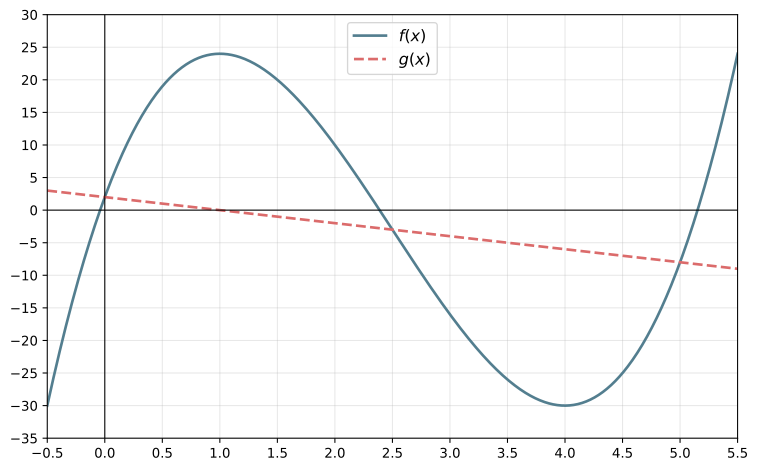
Figure 1: f(x) = 4x³ - 30x² + 48x + 2 and g(x) = 2 - 2x
Verify the Maximum at \(x = 1\)
Given: \(f(x) = 4x^3 - 30x^2 + 48x + 2\)
Step 1: \(f'(1) = 0\)?
\[f'(x) = 12x^2 - 60x + 48 = 12(x - 1)(x - 4) \qquad f'(1) = 0 \quad \checkmark\]
Step 2: \(f''(1) < 0\)?
\[f''(x) = 24x - 60 \qquad f''(1) = -36 < 0 \quad \checkmark\]
Step 3: maximum value: \(f(1) = 4 - 30 + 48 + 2 = 24\)
\[\boxed{\text{Local maximum at } (1, 24)}\]
Mirror Image at the \(y\)-Axis
\[f(x) = 4x^3 - 30x^2 + 48x + 2\]
Replace \(x\) with \(-x\):
\[f_1(x) = f(-x) = 4(-x)^3 - 30(-x)^2 + 48(-x) + 2\]
Reasoning: every point \((a, f(a))\) becomes \((-a, f(a))\), mirroring the graph horizontally about the \(y\)-axis.
\[\boxed{f_1(x) = -4x^3 - 30x^2 - 48x + 2}\]
Find the Intersections
Set \(f(x) = g(x)\):
\[4x^3 - 30x^2 + 48x + 2 = 2 - 2x\]
\[4x^3 - 30x^2 + 50x = 0\]
\[2x \big( 2x^2 - 15x + 25 \big) = 0\]
\[2x^2 - 15x + 25 = (2x - 5)(x - 5) \quad \Rightarrow \quad 2x(2x - 5)(x - 5) = 0\]
Intersections: \(x = 0, \quad x = 2.5, \quad x = 5\)
Show the Two Areas Are Equal
Difference: \(h(x) = f(x) - g(x) = 2x(2x - 5)(x - 5) = 4x^3 - 30x^2 + 50x\)
Sign check: at \(x = 1\): \(h(1) = 2 \cdot 1 \cdot (-3)(-4) = 24 > 0\) (\(f\) above \(g\))
Region 1 (\(0 \leq x \leq 2.5\)) with \(H(x) = x^4 - 10x^3 + 25x^2\):
\[A_1 = H(2.5) - H(0) = 39.0625 - 156.25 + 156.25 = 39.0625\]
Region 2 (\(2.5 \leq x \leq 5\)):
\[A_2 = \left| H(5) - H(2.5) \right| = \left| (625 - 1250 + 625) - 39.0625 \right| = 39.0625\]
\[\boxed{A_1 = A_2 = 39.0625 \quad \checkmark}\]
Exponential Function
The Exponential Problem
Consider \(j(x) = (x + p) \cdot e^x - q\) with parameters \(p\), \(q\) shown below:
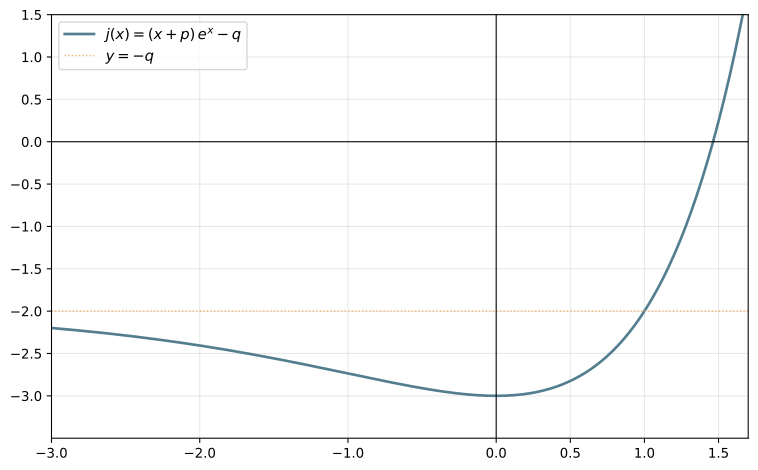
Figure 2: Graph of j(x) = (x + p) eˣ − q
Read \(p\) and \(q\) From the Graph
Two readable points:
- \(y\)-intercept: \(j(0) \approx -3\)
- \(x\)-intercept: \(j(1.5) \approx 0\)
System: \(\; j(0) = p - q = -3 \;\; (I), \qquad j(1.5) = (1.5 + p)\, e^{1.5} - q = 0 \;\; (II)\)
From (I): \(q = p + 3\); in (II): \(p \approx -1.07,\; q \approx 1.93\). Round to whole numbers: \(\;\boxed{p \approx -1, \quad q \approx 2}\)
End Behavior
For \(j(x) = (x - 1) e^x - 2\):
As \(x \to +\infty\): \((x - 1) \to \infty\) and \(e^x \to \infty\):
\[\lim_{x \to +\infty} j(x) = +\infty\]
As \(x \to -\infty\): exponential decay beats linear growth, so \((x - 1)e^x \to 0\):
\[\lim_{x \to -\infty} j(x) = 0 - 2 = -2\]
\[\boxed{j \to +\infty \text{ at } +\infty; \quad y = -2 \text{ horizontal asymptote at } -\infty}\]
Inflection Point
For \(j(x) = (x - 1) e^x - 2\), compute:
\[j'(x) = e^x + (x - 1) e^x = e^x \cdot x \qquad j''(x) = e^x + x \cdot e^x = e^x(x + 1)\]
Set \(j''(x) = 0\): since \(e^x > 0\) always, \(x + 1 = 0 \Rightarrow x = -1\).
\(y\)-coordinate:
\[j(-1) = (-1 - 1) e^{-1} - 2 = -\frac{2}{e} - 2 \approx -2.74\]
\[\boxed{\text{Inflection point at } \left( -1, \; -\tfrac{2}{e} - 2 \right) \approx (-1, -2.74)}\]
The Scenario
A fitness studio offers a workout-tracking app to its members.
Given:
- 18% of random people are members (\(M\)): \(P(M) = 0.18\)
- 70% of members use the app (\(A\)): \(P(A \mid M) = 0.70\)
- 5% of non-members still use such an app: \(P(A \mid \bar{M}) = 0.05\)
Build the Contingency Table
Use \(N = 100{,}000\) people:
- \(M\): \(100{,}000 \times 0.18 = 18{,}000\) and \(\bar{M}\): \(82{,}000\)
- \(M \cap A\): \(18{,}000 \times 0.70 = 12{,}600\) and \(M \cap \bar{A}\): \(5{,}400\)
- \(\bar{M} \cap A\): \(82{,}000 \times 0.05 = 4{,}100\) and \(\bar{M} \cap \bar{A}\): \(77{,}900\)
| \(M\) | \(\bar{M}\) | Sum | |
|---|---|---|---|
| \(A\) | 12,600 | 4,100 | 16,700 |
| \(\bar{A}\) | 5,400 | 77,900 | 83,300 |
| Sum | 18,000 | 82,000 | 100,000 |
Bayes: \(P(M \mid A)\)
A person uses the app. What is the probability they are a member?
Read directly from the table:
\[P(M \mid A) = \frac{|M \cap A|}{|A|} = \frac{12{,}600}{16{,}700} \approx 0.7545\]
\[\boxed{P(M \mid A) \approx 75.4\%}\]
Even though only 18% of people are members, having the app raises the probability of membership to 75%, because the app is much more common among members.
Binomial: Sample of \(n = 11\)
Use \(p = P(M) = 0.18\).
Exactly 2 are members:
\[P(X = 2) = \binom{11}{2} (0.18)^2 (0.82)^9 = 55 \cdot 0.0324 \cdot 0.1676 \approx 0.2987\]
At most 2 are members:
- \(P(X = 0) = (0.82)^{11} \approx 0.1127\), \(\; P(X = 1) = 11 \cdot 0.18 \cdot (0.82)^{10} \approx 0.2721\)
- \(P(X \leq 2) \approx 0.1127 + 0.2721 + 0.2987 \approx 0.6836 \approx 68.4\%\) (sum of the unrounded terms)
Binomial: Range Probability
Between 2 and 4 members (inclusive):
- \(P(X = 2) \approx 0.2987\)
- \(P(X = 3) = \binom{11}{3} (0.18)^3 (0.82)^8 = 165 \cdot 0.005832 \cdot 0.2044 \approx 0.1967\)
- \(P(X = 4) = \binom{11}{4} (0.18)^4 (0.82)^7 = 330 \cdot 0.00105 \cdot 0.2493 \approx 0.0864\)
\[\boxed{P(2 \leq X \leq 4) \approx 0.5818 \approx 58.2\%}\]
Tips & Takeaways
What to Remember
- Verify extrema in 3 steps: \(f'(a) = 0\), sign of \(f''(a)\), value \(f(a)\)
- Areas between curves: find intersections; integrate the absolute difference; split at sign changes
- Reading parameters: every readable point gives one equation; solve the system, then round
- Contingency tables turn conditional info into counts
- Binomial: find \(n\), \(p\) and event type (exact, at most, at least, range)
The tasks file for 09-07 has another exam-style problem set covering the same techniques with different numbers.
Next Session Preview
Next Session: Mock Exam 10
Session 09-08 is exam only, no lecture
- 180 minutes working time plus 5 minutes reading time, 85 points
- Covers graphical calculus, function analysis, and probability
- Allowed: non-programmable calculator, drawing instruments, monolingual dictionary
- Not allowed: notes, formula sheets, any electronic devices
- Counts toward the 60% of test points needed for exam admission
Preparing for Mock Exam 10
Complete Tasks 09-06 and Tasks 09-07, then review the cheat sheets of Sections 05 to 07. Get a good night’s sleep and bring your calculator!
Session 09-07 - Final Recap: Function Analysis & Probability | Dr. Nikolai Heinrichs & Dr. Tobias Vlćek | Home