Session 09-06 - Final Recap: Calculus & Curve Sketching
Section 09: Exam Preparation
Concept Refresher
Domain & Range
| Function type | Domain rule | Range |
|---|---|---|
| Polynomial \(p(x)\) | \(\mathbb{R}\) | By degree and sign of \(a_n\) |
| Rational \(\frac{p(x)}{q(x)}\) | \(\mathbb{R} \setminus \{x : q(x) = 0\}\) | Case by case (e.g. \(\frac{1}{x}\): \(\mathbb{R} \setminus \{0\}\)) |
| \(\ln(g(x))\) | \(g(x) > 0\) | \(\mathbb{R}\) for \(\ln(x)\) |
| \(\sqrt{g(x)}\) | \(g(x) \geq 0\) | \([0; \infty)\) for \(\sqrt{x}\) |
| \(e^{g(x)}\) | \(\mathbb{R}\) | \((0; \infty)\) for \(e^x\) |
Key exam skill: Check division by zero, log/sqrt arguments and context limits (\(t \geq 0\)).
Limits & Asymptotes
Horizontal asymptotes of \(\frac{a_n x^n + \ldots}{b_m x^m + \ldots}\); compare the degrees:
- \(n < m\) (numerator degree smaller): HA is \(y = 0\)
- \(n = m\) (degrees equal): HA is \(y = \frac{a_n}{b_m}\)
- \(n > m\) (numerator degree larger): no horizontal asymptote
Vertical: denominator zeros after cancelling common factors.
- Cancelled factors \(\to\) holes, not asymptotes!
Limits & Asymptotes: Example
Example: Find all asymptotes of \(f(x) = \dfrac{2x^2 - 8}{x^2 - x - 6}\).
Step 1, factor: \(f(x) = \dfrac{2(x-2)(x+2)}{(x-3)(x+2)} = \dfrac{2(x-2)}{x-3}, \quad x \neq -2\)
- Hole at \(x = -2\) (cancelled factor), with \(y = \frac{2(-4)}{-5} = \frac{8}{5}\)
- Vertical asymptote at \(x = 3\) (remaining denominator zero)
- Horizontal asymptote \(y = 2\) (degrees equal, ratio \(\frac{2}{1} = 2\))
End Behavior of Polynomials
The leading term \(a_n x^n\) determines what happens as \(x \to \pm\infty\):
- Even degree, \(a_n > 0\): \(\uparrow\) both ends \(\quad\) | \(\quad\) \(a_n < 0\): \(\downarrow\) both ends
- Odd degree, \(a_n > 0\): \(\downarrow\) left, \(\uparrow\) right \(\quad\) | \(\quad\) \(a_n < 0\): \(\uparrow\) left, \(\downarrow\) right
Example 1: \(f(x) = -3x^4 + 5x^2 - 1\)
Leading term: \(-3x^4\) \(\quad\) (even degree, \(a_n < 0\)) \(\quad \Rightarrow \quad \downarrow\) both ends
Example 2: \(f(x) = \frac{1}{12}x^3 - \frac{7}{12}x^2 + 3\)
Leading term: \(\frac{1}{12}x^3\) \(\quad\) (odd degree, \(a_n > 0\)) \(\quad \Rightarrow \quad \downarrow\) left, \(\uparrow\) right
Even degree = same direction on both sides. Odd degree = opposite directions.
Evaluating Limits
Rational functions as \(x \to \infty\): divide every term by the highest power of \(x\) in the denominator.
\[\lim_{x \to \infty} \frac{3x^2+1}{x^2-x}\]
\[\lim_{x \to \infty} \frac{3 + 1/x^2}{1 - 1/x}\]
\[\frac{3}{1} = 3\]
Derivative Rules
Product rule: \((f \cdot g)' = f' \cdot g + f \cdot g'\)
\[\text{Example: } (x^2 \ln x)' = 2x \cdot \ln x + x^2 \cdot \tfrac{1}{x} = 2x\ln x + x\]
Quotient rule: \(\left(\frac{f}{g}\right)' = \frac{f' g - f g'}{g^2}\)
\[\text{Example: } \left(\frac{x^2}{x+1}\right)' = \frac{2x(x+1) - x^2}{(x+1)^2} = \frac{x^2 + 2x}{(x+1)^2}\]
Chain rule: \((f(g(x)))' = f'(g(x)) \cdot g'(x)\)
\[\text{Example: } (e^{x^2-3x})' = e^{x^2-3x} \cdot (2x - 3)\]
Common Derivative Pitfalls
- Forgetting the chain rule: \((e^{g(x)})' = e^{g(x)} \cdot g'(x)\), not just \(e^{g(x)}\)!
- Product rule has two terms: \((f \cdot g)' \neq f' \cdot g'\)
- Sign in quotient rule: it’s \(f'g \mathbf{-} fg'\) in the numerator; order matters!
- \(\frac{d}{dx}\ln(g(x)) = \frac{g'(x)}{g(x)}\): don’t forget the \(g'(x)\) in the numerator
Angle of Intersection
A line with slope \(m\) meets the \(x\)-axis at angle \(\alpha = \arctan(m)\).
Make sure your calculator is in degree mode if the problem asks for degrees!
Tangent Lines & Curve Sketching
Tangent line at \(x = a\): \(\quad \boxed{t(x) = f'(a)(x - a) + f(a)}\)
- Domain: where is \(f\) defined?
- Zeros & \(y\)-intercept: \(f(x) = 0\); \(f(0)\)
- \(f'(x) = 0\): critical points \(\to\) local max/min
- \(f''(x) = 0\): inflection points, concavity
- Asymptotes / end behavior
- Sketch: combine all information
Even if only asked for the sketch, showing steps 1-5 earns partial credit!
Antiderivatives
Key rules:
- \(\int x^n \, dx = \frac{x^{n+1}}{n+1} + C \quad (n \neq -1)\)
- \(\int \frac{1}{x} \, dx = \ln|x| + C\)
- \(\int e^{kx} \, dx = \frac{1}{k}e^{kx} + C\)
Never forget \(+C\) on indefinite integrals!
Graphical Calculus
Reading \(f'\) from \(f\) (graphical differentiation):
- \(f\) has local max/min \(\Rightarrow\) \(f'(x) = 0\)
- \(f\) is increasing \(\Rightarrow\) \(f' > 0\) \(\quad\) | \(\quad\) \(f\) decreasing \(\Rightarrow\) \(f' < 0\)
Reading \(F\) from \(f\) (graphical integration):
- \(f > 0 \Rightarrow F\) increasing \(\quad\) | \(\quad\) \(f < 0 \Rightarrow F\) decreasing
- \(f\) changes sign \(\Rightarrow\) \(F\) has a local extremum
- \(f = 0\), no sign change (double root) \(\Rightarrow\) \(F\) has an inflection point
- Degrees: \(f\) of degree \(n\) \(\Rightarrow\) \(f'\) has degree \(n-1\), \(F\) degree \(n+1\)
Coffee Break
Exam Problem 2
The Problem
Consider the following third degree polynomial \(f(x)\):
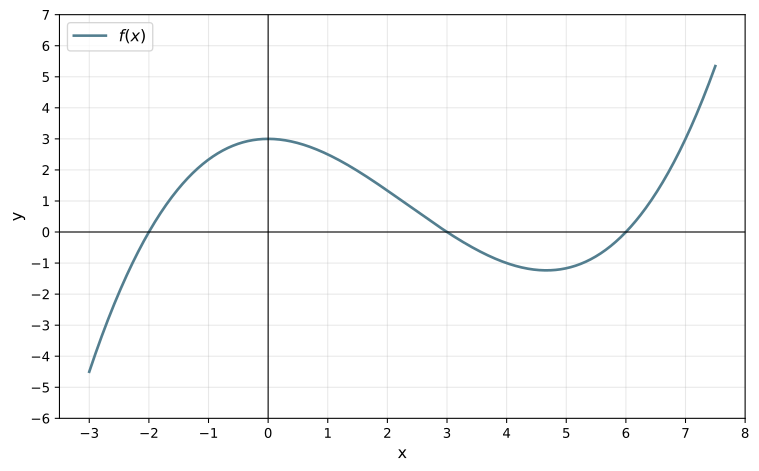
Figure 1: Graph of the third degree polynomial f(x)
What Does This Graph Tell Us?
- Zeros: \(f(-2) = 0\), \(f(3) = 0\) and \(f(6) = 0\)
- At all three zeros the graph crosses the \(x\)-axis \(\Rightarrow\) three single roots
- Local maximum: at \(x = 0\) with \(f(0) = 3\)
- Local minimum: between \(x = 4\) and \(x = 5\), not on a grid point
- \(f\) is increasing for \(x < 0\), decreasing from \(0\) to the minimum, then increasing
Single vs. double root: If the graph crosses the \(x\)-axis, it’s a single root. If it touches and turns, it’s a double root (the factor appears squared).
Part a) Graph the Derivative \(f'(x)\)
Where is \(f'(x) = 0\)? At every local max/min (horizontal tangent):
- \(f'(0) = 0\) (local maximum at \(x = 0\))
- \(f'(x) = 0\) at the local minimum, \(x \approx 4.7\) (exactly \(\frac{14}{3}\) once we know \(f\))
What is the sign of \(f'\)?
- Positive for \(x < 0\), negative on \((0; 4.7)\), positive for \(x > 4.7\)
- \(f\) is cubic with positive leading coefficient \(\Rightarrow\) \(f'\) is a parabola opening upward
Part a) Solution
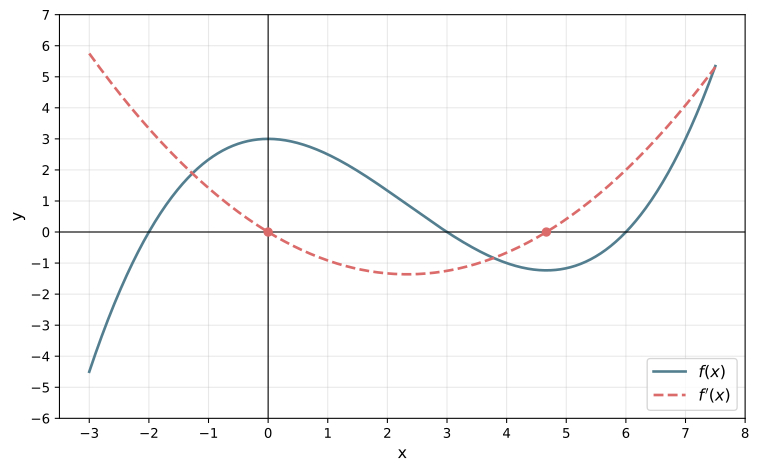
Figure 2: Graph of f(x) with its derivative f’(x)
Part b) Graph the Antiderivative \(F\)
Strategy: \(F\) increases where \(f > 0\) and decreases where \(f < 0\).
- \(f < 0\) for \(x < -2\) and on \((3; 6)\) \(\Rightarrow\) \(F\) is decreasing
- \(f > 0\) on \((-2; 3)\) and for \(x > 6\) \(\Rightarrow\) \(F\) is increasing
- \(f\) changes sign from \(-\) to \(+\) at \(x = -2\) and \(x = 6\) \(\Rightarrow\) \(F\) has local minima there
- \(f\) changes sign from \(+\) to \(-\) at \(x = 3\) \(\Rightarrow\) \(F\) has a local maximum at \(x = 3\)
- \(f\) is degree 3 \(\Rightarrow\) \(F\) is degree 4 (no double root of \(f\), so \(F\) has no saddle point)
Part b) Solution
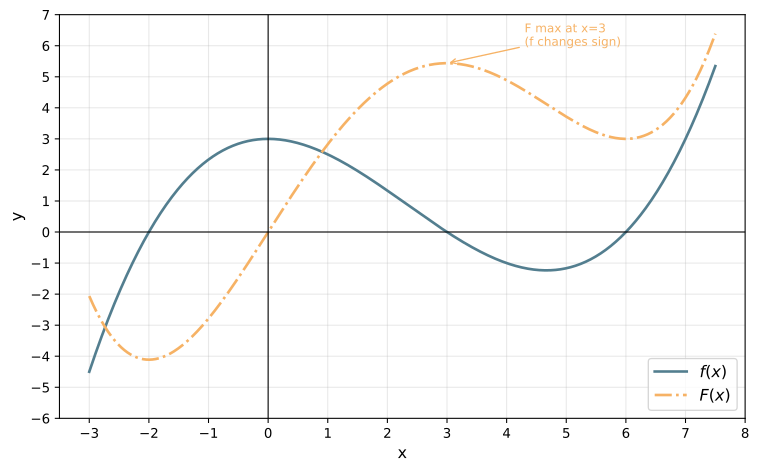
Figure 3: Graph of f(x) with its antiderivative F(x)
Part c) Setting Up the System
We want \(f(x) = ax^3 + bx^2 + cx + d\): that’s 4 unknowns, so we need 4 equations.
What can we read from the graph?
- \(f(0) = 3\) (the \(y\)-intercept) \(\quad \Rightarrow \quad d = 3\)
- \(f'(0) = 0\) (local max; horizontal tangent) \(\quad \Rightarrow \quad c = 0\)
- \(f(3) = 0\) (zero of the function)
- \(f(6) = 0\) (zero of the function)
Look for points where you can read exact values: zeros, \(y\)-intercept, and extrema give the cleanest equations.
Part c) Solving the System
With \(c = 0\) and \(d = 3\), the two remaining equations are:
\[f(3) = 0: \quad 27a + 9b + 3 = 0 \quad \Rightarrow \quad 9a + 3b = -1 \quad (I)\]
\[f(6) = 0: \quad 216a + 36b + 3 = 0 \quad \Rightarrow \quad 72a + 12b = -1 \quad (II)\]
\((II) - 4 \cdot (I)\): \(\; 36a = 3 \Rightarrow a = \frac{1}{12}\). Into (I): \(\; 3b = -1 - \frac{3}{4} \Rightarrow b = -\frac{7}{12}\)
\[\boxed{f(x) = \frac{1}{12}x^3 - \frac{7}{12}x^2 + 3 = \frac{1}{12}(x+2)(x-3)(x-6)}\]
Check with the unused zero: \(f(-2) = -\frac{8}{12} - \frac{28}{12} + 3 = 0 \; \checkmark\)
Part d) Tangent Line at \(x = 6\)
Step 1: function value at the point
- \(f(6) = \frac{216}{12} - \frac{7 \cdot 36}{12} + 3 = 18 - 21 + 3 = 0\) (a zero, as read from the graph)
Step 2: slope (derivative at the point)
- \(f'(x) = \frac{x^2}{4} - \frac{7x}{6} \qquad f'(6) = \frac{36}{4} - \frac{42}{6} = 9 - 7 = 2\)
Step 3: plug into tangent formula \(t(x) = f'(a)(x - a) + f(a)\)
- \(t(x) = 2(x - 6) + 0 = \boxed{2x - 12}\)
Part e) Angle of Intersection
The tangent has slope \(m = 2\).
The angle between the tangent and the \(x\)-axis (here also the angle at which \(f\) crosses it):
\[\tan(\alpha) = m = 2 \qquad \Rightarrow \qquad \alpha = \arctan(2) \approx 63.43°\]
\[\boxed{\alpha \approx 63.4°}\]
Visual
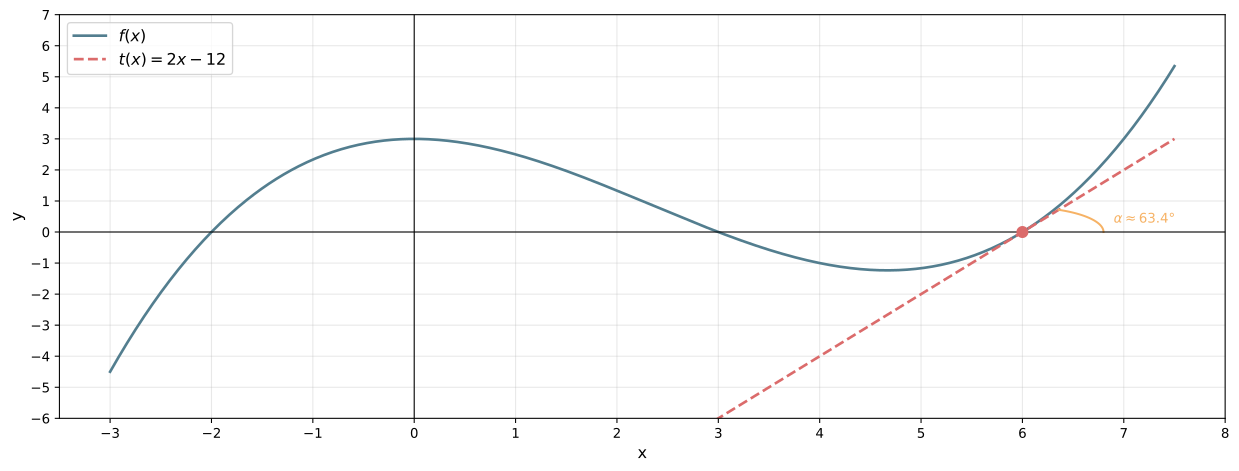
Figure 4: Graph of f(x) with tangent line at x = 6 and angle of intersection
Exam Problem 1
The Problem
A producer of solar garden lamps models its costs with a third degree polynomial. Fixed costs are 448 MU. At 2 QU, total costs are 540 MU. Marginal costs at 4 QU are 36 MU. The lowest increase in costs occurs at 3 QU.
As sole supplier, the firm assumes a linear price-demand function. At 4 QU, revenue is 1040 MU and the slope of the revenue function is 240 MU.
(1 QU = 100 lamps, 1 MU = 100 Euro)
The Tasks
- Cost function \(C(x)\) \(\quad\) b) Revenue function \(R(x)\)
- Profit \(P(x)\), break-even point and profit limit
- Maximum profit and the price to charge
- Sales volume and profit at a price of 250 MU
- Output with lowest unit costs; long-term price floor
Part a) Translating the Conditions
\(C(x) = ax^3 + bx^2 + cx + d\), \(\quad C'(x) = 3ax^2 + 2bx + c\), \(\quad C''(x) = 6ax + 2b\)
| Words in the problem | Equation |
|---|---|
| Fixed costs are 448 | \(C(0) = d = 448\) |
| At 2 QU total costs are 540 | \(C(2) = 8a + 4b + 2c + 448 = 540\) |
| Marginal costs at 4 QU are 36 | \(C'(4) = 48a + 8b + c = 36\) |
| Lowest increase in costs at 3 QU | \(C''(3) = 18a + 2b = 0\) |
“Lowest increase in costs” means the marginal cost \(C'\) is minimal, so its derivative \(C''\) is zero there.
Part a) Solving the System
From \(C''(3) = 0\): \(\quad b = -9a \quad (III)\)
Substitute into the other two (divide \(C(2)\) by 2 first):
- \((I)\): \(\; 4a + 2b + c = 46 \; \Rightarrow \; 4a - 18a + c = 46 \; \Rightarrow \; c = 46 + 14a\)
- \((II)\): \(\; 48a + 8b + c = 36 \; \Rightarrow \; 48a - 72a + c = 36 \; \Rightarrow \; c = 36 + 24a\)
Part a) Solving the System II
Equate both: \(\; 46 + 14a = 36 + 24a \; \Rightarrow \; a = 1, \; b = -9, \; c = 60\)
\[\boxed{C(x) = x^3 - 9x^2 + 60x + 448}\]
Check: \(C(2) = 8 - 36 + 120 + 448 = 540 \; \checkmark\), \(\quad C'(4) = 48 - 72 + 60 = 36 \; \checkmark\)
Part b) Price-Demand & Revenue
Linear price-demand \(p(x) = n - mx\) gives \(\quad R(x) = x \cdot p(x) = nx - mx^2, \quad R'(x) = n - 2mx\)
Conditions at \(x = 4\):
- \(R(4) = 4n - 16m = 1040 \; \Rightarrow \; n - 4m = 260 \quad (I)\)
- \(R'(4) = n - 8m = 240 \quad (II)\)
\((I) - (II)\): \(\; 4m = 20 \; \Rightarrow \; m = 5\), \(\quad n = 260 + 20 = 280\)
\[\boxed{p(x) = 280 - 5x, \qquad R(x) = 280x - 5x^2}\]
Part c) Profit Function & First Root
\[P(x) = R(x) - C(x) = 280x - 5x^2 - x^3 + 9x^2 - 60x - 448\]
\[\boxed{P(x) = -x^3 + 4x^2 + 220x - 448}\]
Break-even: \(P(x) = 0\). A cubic has no formula we can use, so test small integers:
- \(P(1) = -1 + 4 + 220 - 448 = -225 \neq 0\)
- \(P(2) = -8 + 16 + 440 - 448 = 0 \; \checkmark\)
So \(x = 2\) is a root and \((x - 2)\) is a factor.
Part c) Polynomial Division
\[\begin{array}{l} (-x^3 + 4x^2 + 220x - 448) : (x - 2) = -x^2 + 2x + 224 \\ \underline{-(-x^3 + 2x^2)} \\ \phantom{(-x^3}\;\; 2x^2 + 220x \\ \phantom{(-x^3}\;\; \underline{-(2x^2 - 4x)} \\ \phantom{(-x^3 + 2x^2}\;\; 224x - 448 \\ \phantom{(-x^3 + 2x^2}\;\; \underline{-(224x - 448)} \\ \phantom{(-x^3 + 2x^2 + 224x - 44}\;\; 0 \end{array}\]
Part c) The Other Break-Even Point
\[-x^2 + 2x + 224 = 0 \quad \Rightarrow \quad x^2 - 2x - 224 = 0\]
\[x = \frac{2 \pm \sqrt{4 + 896}}{2} = \frac{2 \pm 30}{2}\]
\(x = 16\) or \(x = -14\) (rejected). \(\quad \boxed{\text{Break-even: } 2 \text{ QU}, \quad \text{profit limit: } 16 \text{ QU}}\)
Part d) Maximum Profit
Necessary: \(P'(x) = -3x^2 + 8x + 220 = 0 \; \Rightarrow \; 3x^2 - 8x - 220 = 0\)
\[x = \frac{8 \pm \sqrt{64 + 2640}}{6} = \frac{8 \pm 52}{6} \; \Rightarrow \; x = 10 \; \text{ or } \; x = -\tfrac{22}{3} \; \text{(rejected)}\]
Sufficient: \(P''(x) = -6x + 8\), \(\quad P''(10) = -52 < 0 \; \checkmark\) maximum
\[P(10) = -1000 + 400 + 2200 - 448 = \boxed{1152 \text{ MU}}\]
Price to charge: \(\quad p(10) = 280 - 50 = \boxed{230 \text{ MU}}\)
Part e) Sales & Profit at Given Price
The firm asks for 250 MU. How much does it sell, and what is the profit?
Sales volume: solve \(p(x) = 250\)
\[280 - 5x = 250 \; \Rightarrow \; 5x = 30 \; \Rightarrow \; x = 6 \text{ QU} = 600 \text{ lamps}\]
Profit:
\[P(6) = -216 + 144 + 1320 - 448 = 800 \text{ MU} = \boxed{80{,}000 \text{ Euro}}\]
Only 3 points, but easy ones: solve a linear equation, plug into \(P\), convert the units.
Part f) Lowest Unit Costs
Unit costs = costs per QU:
\[\overline{C}(x) = \frac{C(x)}{x} = x^2 - 9x + 60 + \frac{448}{x}\]
Necessary: \(\overline{C}'(x) = 2x - 9 - \dfrac{448}{x^2} = 0 \quad \Big| \cdot x^2 \quad \Rightarrow \quad 2x^3 - 9x^2 - 448 = 0\)
Test \(x = 8\): \(\; 1024 - 576 - 448 = 0 \; \checkmark\)
Division: \((2x^3 - 9x^2 - 448) : (x - 8) = 2x^2 + 7x + 56\), discriminant \(49 - 448 < 0\), so no other candidates.
Part f) Long-Term Price Floor
Sufficient: \(\overline{C}''(x) = 2 + \dfrac{896}{x^3} > 0\) for all \(x > 0 \; \checkmark\) minimum
Lowest unit costs:
\[\overline{C}(8) = 64 - 72 + 60 + 56 = \boxed{108 \text{ MU per QU}}\]
Check: \(C'(8) = 192 - 144 + 60 = 108 = \overline{C}(8)\); at the minimum of the unit costs, marginal costs equal unit costs.
Long-term price floor = 108 MU. Below this price the firm cannot cover its total costs in the long run, even at its most efficient output of 8 QU.
Visual
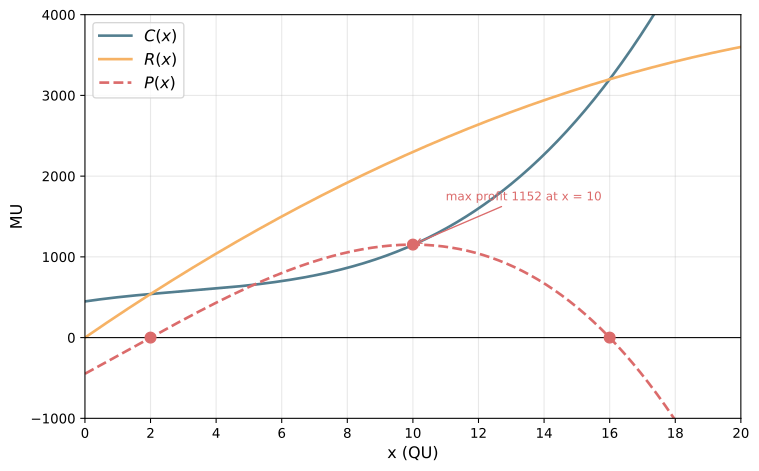
Figure 5: Cost, revenue and profit with break-even points and maximum profit
Exam Tip: Where Points Are (a-c)
| Part | Pts | What earns method points |
|---|---|---|
| a) Cost function | 11 | The four equations written out, \(C''(3) = 0\) named, \(a, b, c, d\) |
| b) Revenue | 4 | \(R = x \cdot p(x)\), both conditions, \(m\) and \(n\) |
| c) Break-even | 6 | \(P = R - C\), tested root, division shown, quadratic solved |
Exam Tip: Where Points Are (d-f)
| Part | Pts | What earns method points |
|---|---|---|
| d) Max profit | 8 | \(P' = 0\), \(P'' < 0\) checked, \(P_{\max}\), price \(p(x^*)\) |
| e) Given price | 3 | \(p(x) = p_0\) solved, profit with units |
| f) Unit costs | 5 | \(\overline{C} = C/x\), \(\overline{C}' = 0\), minimum checked, floor interpreted |
Exam Tip: Start With the Table
Part a) is worth almost a third of the problem: write the translation table first. A wrong \(C(x)\) still earns method points in c) to f) if you carry it through correctly.
Tips & Takeaways
What to Remember
- Read the graph first: zeros, extrema, special points
- 4 unknowns need 4 equations - use readable values
- Show your work - partial credit for correct reasoning
- Verify: plug solutions back in
- Chain rule - the #1 source of derivative errors
- \(+C\) on indefinite integrals - easy points lost
- Calculator mode: degrees vs. radians for \(\arctan\)
What to Remember: Problem 1
- Translate words: fixed costs \(\to C(0)\), marginal \(\to C'\), lowest increase \(\to C'' = 0\)
- Break-even: test small integers, divide by \((x - r)\), solve the quadratic
- Price floor: minimum of \(\overline{C} = C/x\), where \(\overline{C} = C'\)
Practice with the tasks file and mock exams - same structure, different numbers!
Session 09-06 - Final Recap: Calculus & Curve Sketching | Dr. Nikolai Heinrichs & Dr. Tobias Vlćek | Home