Session 07-01 - Descriptive Statistics Essentials
Section 07: Probability & Statistics
Entry Quiz
Quick Review from Section 06
Test your understanding of Integration
Find \(\int x \cdot e^x \, dx\) using integration by parts.
Evaluate \(\int_0^1 (2x + 1) \, dx\)
A company’s marginal profit is \(MP(x) = 60 - 2x\). Find the profit function if \(P(0) = -100\).
Find the area between \(y = x\) and \(y = x^2\) from \(x = 0\) to \(x = 1\).
Homework Discussion
Your Questions from Section 06
Bring up anything unclear from integration and applications.
- Integration by parts setup choices
- Definite integral sign mistakes
- Area between curves setup
- Interpreting marginal functions in business tasks
Today we switch from calculus to data description, but we still need the same habits: clear setup, careful notation, and interpretation in context.
Probability & Statistics
New Section Overview
- Session 07-01: Descriptive Statistics (today)
- Session 07-02: Basic Probability Concepts
- Session 07-03: Combinatorics & Counting
- Session 07-04: Conditional Probability
New Section Overview II
- Session 07-05: Bayes’ Theorem
- Session 07-06: Contingency Tables
- Session 07-07: Binomial & Geometric Distributions
- Session 07-08: Mock Exam 08
Probability accounts for approximately 25% of the Feststellungsprüfung!
Learning Objectives
What You’ll Master Today
- Calculate measures of central tendency: mean, median, mode
- Compute measures of spread: range, variance, standard deviation
- Interpret data distributions using histograms and box plots
- Work with frequency distributions and relative frequencies
- Apply statistical concepts to business scenarios
- Understand the normal distribution and the 68-95-99.7 rule
This is foundational material. Brief coverage to prepare for probability!
Central Tendency
The Three Averages
How do we summarize a data set with a single number?
Three Measures of Center
- Mean (Mittelwert): \(\bar{x} = \frac{\sum x_i}{n}\)
- Median (Zentralwert): Middle value when data is sorted
- Mode (Modalwert): Most frequently occurring value
You probably already know what these are, but let’s do an example
Example: Sales Data
Monthly sales (in thousand EUR) for a store:
\(12, 15, 14, 18, 15, 22, 15, 16, 14, 19\)
Question: What is the mean, median, and mode of the data?
- Mean: \(\frac{12 + 15 + 14 + 18 + 15 + 22 + 15 + 16 + 14 + 19}{10} = \frac{160}{10} = 16\)
- Median: Sort and then the middle values: \(\frac{15 + 15}{2} = 15\)
- Mode: \(15\) (appears 3 times)
Easy, right?
When to Use Each Measure
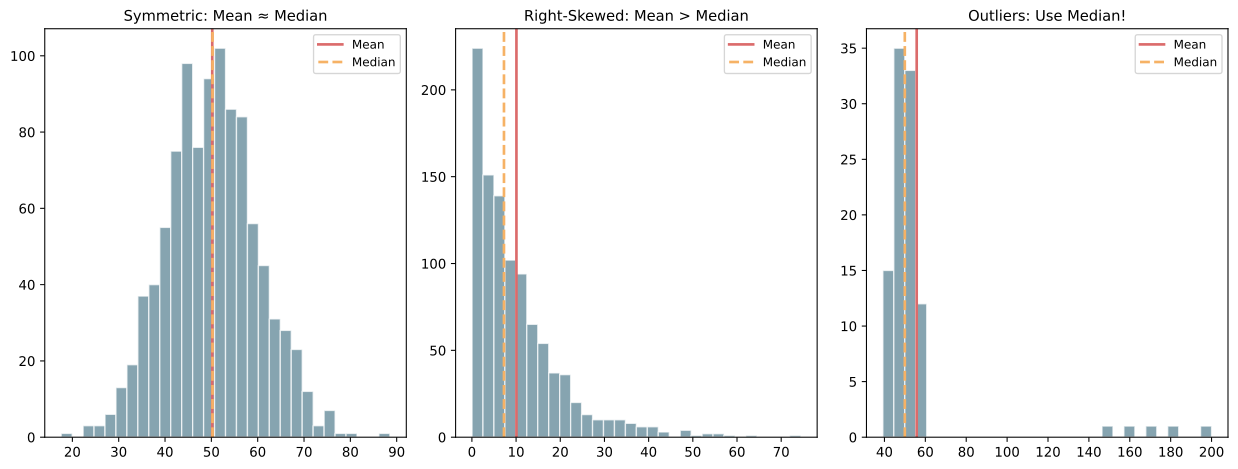
Mean: Best for symmetric data without outliers; Median: Best for skewed data or data with outliers; Mode: Best for categorical data
Measures of Spread
How Spread Out Is the Data?
Two datasets can have the same mean but different spreads:
- Dataset A: \(48, 49, 50, 51, 52\) (mean = 50)
- Dataset B: \(10, 30, 50, 70, 90\) (mean = 50)
- We need measures to quantify this difference!
Question: Do you know any measures of spread?
Range
Simplest measure of spread:
- \(\text{Range} = \text{Maximum} - \text{Minimum}\)
- Dataset A: Range \(= 52 - 48 = 4\)
- Dataset B: Range \(= 90 - 10 = 80\)
Range only uses two values, so it is sensitive to outliers!
Outliers are extreme values that are far from other observations.
Variance and Standard Deviation
Used to measure spread around the mean:
- They tell us how far the data is from the mean
- They are always non-negative
Used to compute the population standard deviation.
\[\sigma^2 = \frac{\sum (x_i - \mu)^2}{N}\]
Used to compute the standard deviation of a sample.
\[s^2 = \frac{\sum (x_i - \bar{x})^2}{n - 1}\]
The standard deviation is the square root of the variance.
\[\sigma = \sqrt{\sigma^2} \quad \text{or} \quad s = \sqrt{s^2}\]
Calculation Example
Data: \(4, 8, 6, 5, 3, 2, 8, 9, 2, 5\) (n = 10)
Step 1: Calculate mean \[\bar{x} = \frac{4+8+6+5+3+2+8+9+2+5}{10} = \frac{52}{10} = 5.2\]
Step 2: Calculate deviations squared \[(4-5.2)^2 + (8-5.2)^2 + ... = 1.44 + 7.84 + ... = 57.6\]
Step 3: Variance and SD \[s^2 = 57.6/9 = 6.4 \quad \Rightarrow \quad s = \sqrt{6.4} \approx 2.53\]
Frequencies
Organizing Data
Raw data: Test scores of 30 students
\(65, 72, 78, 81, 65, 73, 85, 92, 78, 72,\)
\(65, 88, 91, 73, 78, 82, 76, 72, 85, 78,\)
\(65, 73, 82, 79, 88, 73, 78, 85, 92, 78\)
Question: How can we summarize this data effectively?
We can use a frequency table or a histogram!
Frequency Table
A frequency table organizes data into groups (bins):
| Score Range | Frequency | Relative Frequency |
|---|---|---|
| 60-69 | 4 | 4/30 = 13.3% |
| 70-79 | 15 | 15/30 = 50.0% |
| 80-89 | 8 | 8/30 = 26.7% |
| 90-99 | 3 | 3/30 = 10.0% |
| Total | 30 | 100% |
Relative frequency = Frequency / Total = Probability interpretation!
Histogram Visualization
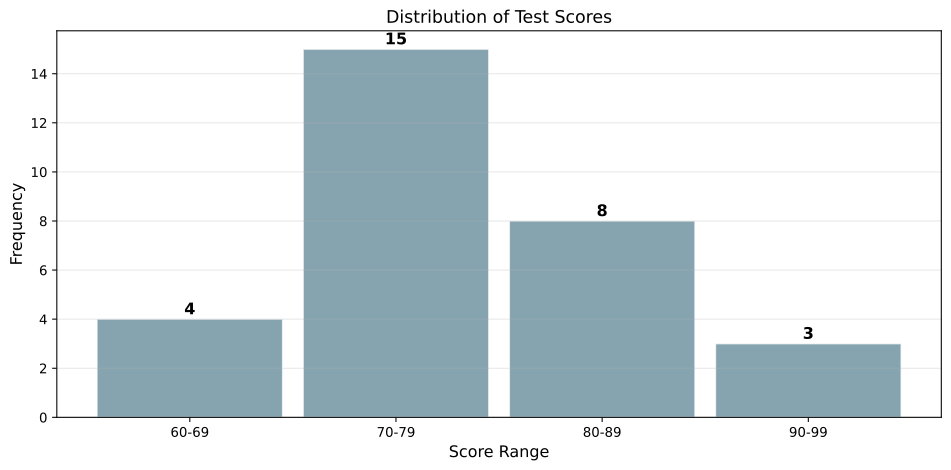
A histogram is a graphical representation of the distribution of data. It is an estimate of the probability distribution of a continuous variable.
Quick Check
Quick Check Before the Break
Work individually
- For data \(4, 5, 6, 6, 7, 20\), compute mean and median.
- Which measure (mean or median) is more appropriate here? Explain in one sentence.
- A class has score frequencies: 50-59: 2, 60-69: 5, 70-79: 9, 80-89: 4. What is the relative frequency of 70-79?
Break
Box Plots
Quantiles and Quartiles
Quantiles divide sorted data into equal-sized groups:
- The median is the quantile that splits data into two equal halves (50%)
- Percentiles divide data into 100 equal parts (e.g., the 90th percentile)
- Quartiles divide data into four equal parts (25% each)
Quantiles and Quartiles II
| Quartile | Percentile | Meaning |
|---|---|---|
| Q1 | 25th | 25% of values fall below Q1 |
| Q2 | 50th | 50% of values fall below Q2 (= Median) |
| Q3 | 75th | 75% of values fall below Q3 |
Q1 and Q3 are the medians of the two halves (odd count: leave the median out).
The Five-Number Summary
Provides a concise overview of a dataset’s distribution:
- Minimum (Min)
- First Quartile (Q1): 25th percentile
- Median (Q2): 50th percentile
- Third Quartile (Q3): 75th percentile
- Maximum (Max)
Interquartile Range (IQR): \(\text{IQR} = Q3 - Q1\), contains the middle 50% of the data!
A box-plot can be used to visualize the five-number summary! Let’s take a look at one.
Box Plot Visualization
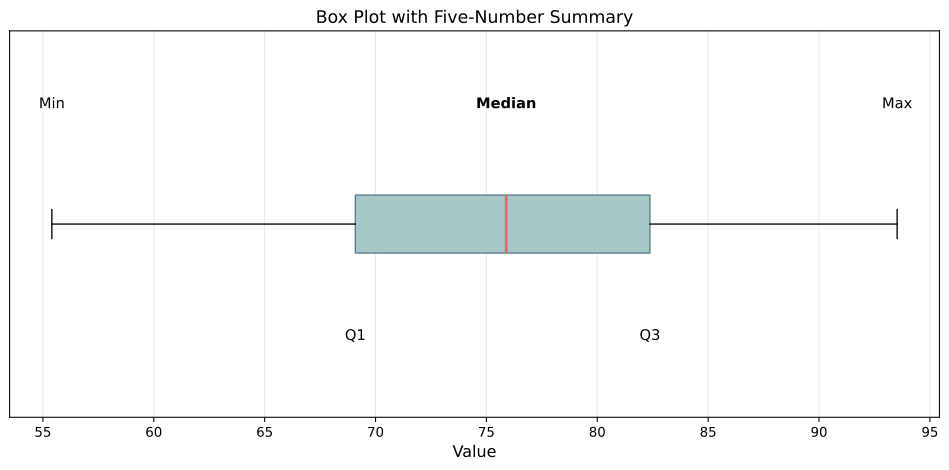
Standardized way of displaying the distribution of data based on the five-number summary!
Detecting Outliers
Outliers are values that fall outside:
- The interquartile range (IQR) is the distance between the first and third quartiles.
- \(\text{Lower fence: } Q1 - 1.5 \times \text{IQR}\)
- \(\text{Upper fence: } Q3 + 1.5 \times \text{IQR}\)
- Example: If \(Q1 = 65\), \(Q3 = 85\), then IQR \(= 20\)
- Lower fence: \(65 - 1.5(20) = 35\)
- Upper fence: \(85 + 1.5(20) = 115\)
Any value below 35 or above 115 would be an outlier.
Normal Distribution
The Bell Curve
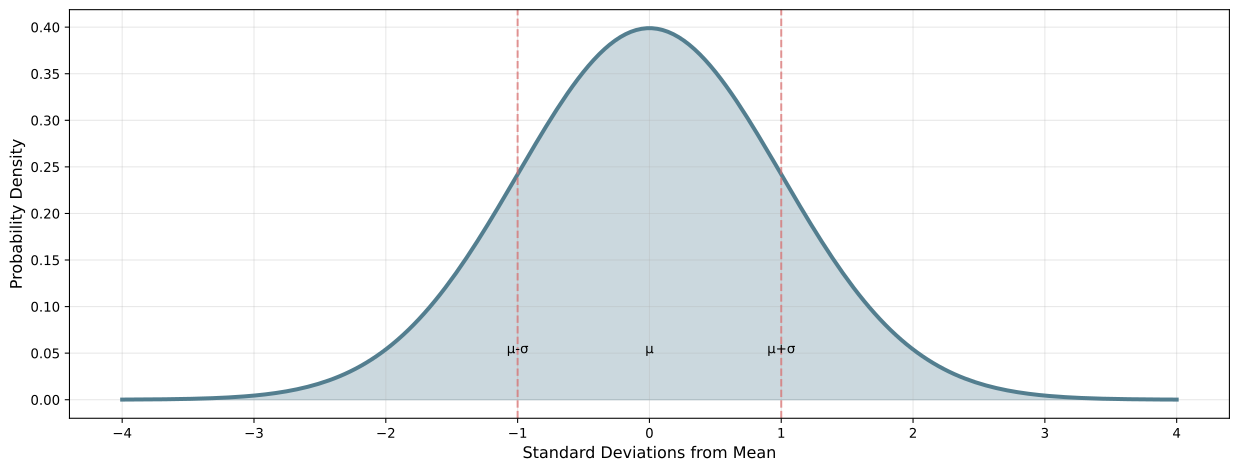
If the data is normally distributed, then: 68% of data falls within \(\mu \pm 1\sigma\); 95% of data falls within \(\mu \pm 2\sigma\); 99.7% of data falls within \(\mu \pm 3\sigma\)
The 68-95-99.7 Rule
Example: Test scores have \(\mu = 75\) and \(\sigma = 10\)
- 68% of students score between 65 and 85
- 95% of students score between 55 and 95
- 99.7% of students score between 45 and 105
Based on the assumption that data is normally distributed, we can make informed guesses about certain things. We’ll see later what this allows us to do in the context of a business application.
Business Applications
Quality Control: Setup
A factory measures the diameter of manufactured bolts (in mm):
\[10.2, \; 10.1, \; 10.0, \; 10.3, \; 9.9, \; 10.1, \; 10.0, \; 10.2, \; 10.1, \; 10.0\]
Target: 10.0 mm, tolerance ±0.3 mm (acceptable: 9.7 to 10.3 mm)
Task: Compute the mean, median, and mode.
- Mean: \(\bar{x} = \frac{10.2 + 10.1 + 10.0 + \ldots + 10.0}{10} = \frac{100.9}{10} = 10.09\) mm
- Median: Sorted middle values: \(\frac{10.1 + 10.1}{2} = 10.10\) mm
- Mode: \(10.0\) and \(10.1\) mm (bimodal, each appears 3 times)
The mean (10.09) exceeds the target (10.0), indicating a slight upward bias in production.
Quality Control: Spread
Same data: \(10.2, \; 10.1, \; 10.0, \; 10.3, \; 9.9, \; 10.1, \; 10.0, \; 10.2, \; 10.1, \; 10.0\)
Task: Compute range, sample variance, and sample standard deviation.
- Range: \(10.3 - 9.9 = 0.4\) mm
- Sample variance: \(s^2 = \frac{\sum(x_i - \bar{x})^2}{n-1} = \frac{0.129}{9} \approx 0.014\)
- Standard deviation: \(s = \sqrt{0.014} \approx 0.12\) mm
The standard deviation (0.12 mm) is small relative to the tolerance (±0.3 mm) and the target (10.0 mm). This suggests the process has low variability!
Quality: Five-Number Summary
Task: Sort the data and find the five-number summary and IQR.
Sorted: \(9.9, \; 10.0, \; 10.0, \; 10.0, \; 10.1, \; 10.1, \; 10.1, \; 10.2, \; 10.2, \; 10.3\)
| Measure | Value |
|---|---|
| Min | 9.9 |
| Q1 | 10.0 |
| Median | 10.1 |
| Q3 | 10.2 |
| Max | 10.3 |
\(\text{IQR} = Q3 - Q1 = 10.2 - 10.0 = 0.2\) mm
Quality Control: Outlier Detection
Task: Compute the fences and check for outliers.
- \(\text{Lower fence} = Q1 - 1.5 \times \text{IQR} = 10.0 - 1.5 \times 0.2 = 9.7 \text{ mm}\)
- \(\text{Upper fence} = Q3 + 1.5 \times \text{IQR} = 10.2 + 1.5 \times 0.2 = 10.5 \text{ mm}\)
- All values fall within \([9.7; 10.5]\)
- → no outliers detected!
The tolerance is \([9.7; 10.3]\) mm. The upper fence is slightly above the upper tolerance limit, but since no values exceed the tolerance, we do not have to worry about outliers.
Quality: Normal Distribution
Task: Assuming normality with \(\bar{x} = 10.09\) and \(s = 0.12\), compute the 68-95-99.7 intervals. Do all fall within the tolerance \([9.7; 10.3]\)?
| Rule | Interval | Within tolerance? |
|---|---|---|
| 68% | \([10.09 \pm 0.12]\) | Yes |
| 95% | \([10.09 \pm 0.24]\) | No, upper end exceeds 10.3 |
| 99.7% | \([10.09 \pm 0.36]\) | No, upper end clearly outside |
About 95% of bolts are expected within tolerance, but the upper tail extends beyond the 10.3 mm limit due to the upward-shifted mean.
We only have \(n = 10\) measurements, with such a small sample, the 68-95-99.7 rule is only a rough approximation. Larger samples give more reliable estimates of \(\bar{x}\) and \(s\).
Quality Control: Business Decision
Task: Should the factory manager be concerned?
Summary of findings:
- Mean is above target: \(10.09 > 10.0\) (upward bias)
- Low variability: \(s = 0.12\) mm (good precision)
- No outliers in the current sample
- But the 95% interval \([9.85; 10.33]\) exceeds the upper tolerance
- Potential cause: the machine is precise but not accurate!
Recommendation: Recalibrate the machine to shift the mean closer to 10.0 mm. The low standard deviation means the process only needs recentering, not reduced variability.
Guided Practice
Practice Problems
Work in pairs for 5 minutes
Problem 1: Customer wait times (minutes): \(3, 5, 2, 8, 4, 6, 3, 7, 2, 10\)
- Calculate mean, median, and mode
- Calculate variance and standard deviation
- Is the mean or median a better measure of center? Why?
Problem 2: Create a frequency table for exam scores:
- \(75, 82, 91, 78, 85, 68, 73, 88, 95, 79, 82, 76, 84, 90, 77\)
Chained Exam Mini-Problem
Work individually, then compare
A shop tracks daily visitors and purchases:
- Of 250 visitors, 65 make a purchase. Estimate purchase probability \(p\).
- Using your result, estimate expected purchases for 400 visitors.
- If actual purchases are 88, compare actual vs expected and interpret in one sentence.
Coffee Break
Team Problem-Solving
Store Performance Dashboard
Think individually, then work in groups of 3-4 and share
A retail manager reports weekly sales (in thousand EUR):
\[41, 44, 43, 45, 46, 47, 44, 90\]
- Compute mean, median, range, and sample standard deviation.
- Identify whether there is an outlier signal and justify using IQR logic.
- Recommend which center measure should be shown on the dashboard.
- Write a two-sentence business interpretation for management.
Link to Probability
From Statistics to Probability
Key connection:
\[\text{Relative Frequency} \approx \text{Probability}\]
Example: If 30% of customers wait more than 5 minutes, then the probability that a randomly selected customer waits more than 5 minutes is approximately 0.30.
This is the frequentist interpretation of probability, which states that probability equals long-run relative frequency!
Final Assessment
Exit Assessment
Work individually
- For data \(2, 4, 4, 5, 100\), should you report mean or median as the typical value?
- Explain the difference between variance and standard deviation in one sentence.
- If 18 out of 60 customers choose option A, what is the relative frequency?
Wrap-Up & Takeaways
Today’s Essential Concepts
- Mean, median, mode measure center differently
- Variance and standard deviation measure spread
- Box plots show distribution shape and outliers
- Normal distribution: 68-95-99.7 rule for bell curves
- Relative frequency connects to probability
- Choose the right measure based on data characteristics
Next Session Preview
Coming Up: Basic Probability
- Sample spaces and events
- Probability axioms and rules
- Complement and addition rule
- Independent vs mutually exclusive events
Homework
Complete Tasks 07-01:
- Calculate descriptive statistics for business datasets
- Interpret measures in context
- Prepare for probability concepts
Session 07-01 - Descriptive Statistics Essentials | Dr. Nikolai Heinrichs & Dr. Tobias Vlćek | Home