Session 06-03 - Area Problems & Basic Applications
Section 06: Integral Calculus
Entry Quiz
Quick Review from Session 06-02
Test your understanding of Definite Integrals
Evaluate \(\int_1^4 (3x^2 - 4x) \, dx\)
If \(\int_0^5 f(x) \, dx = 18\) and \(\int_3^5 f(x) \, dx = 7\), find \(\int_0^3 f(x) \, dx\)
What does \(\int_a^b f'(x) \, dx\) represent geometrically and algebraically?
For \(f(x) = x - 2\) on \([0; 4]\), is the signed area positive, negative, or zero?
Homework Discussion
Your questions from Session 06-02
Focus on FTC and definite integrals
- Evaluating definite integrals with bounds
- Signed area vs. total area distinction
- Properties of definite integrals
- Net change applications
Today we focus on area calculations and introduce exponential and logarithmic integrals!
Learning Objectives
What You’ll Master Today
- Calculate area under a curve above the x-axis
- Handle regions where the function is below the x-axis
- Find total area by splitting at zeros
- Integrate exponential functions \(\int e^{ax} \, dx\)
- Integrate \(\frac{1}{x}\) to get natural logarithm
- Apply area concepts to business problems
- Interpret accumulated quantities from rate functions
Area calculations are one of the most common applications of integration!
Area Under a Curve
When \(f(x) \geq 0\)
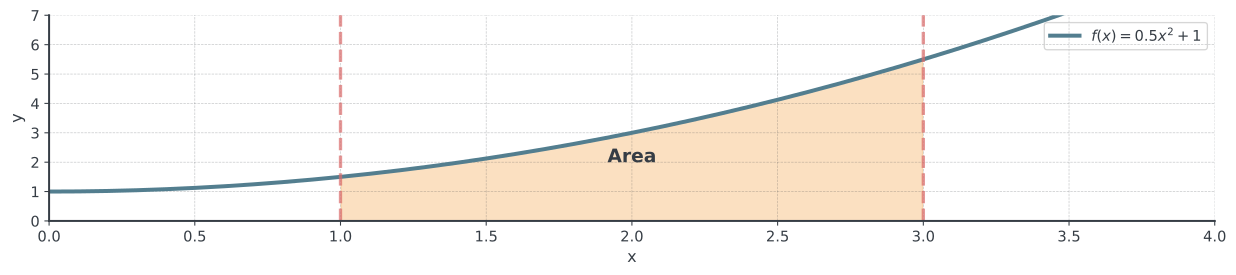
Simple case: When \(f(x) \geq 0\) on \([a; b]\), the definite integral gives the area directly.
\[\text{Area} = \int_a^b f(x) \, dx\]
Example: Area Under a Parabola I
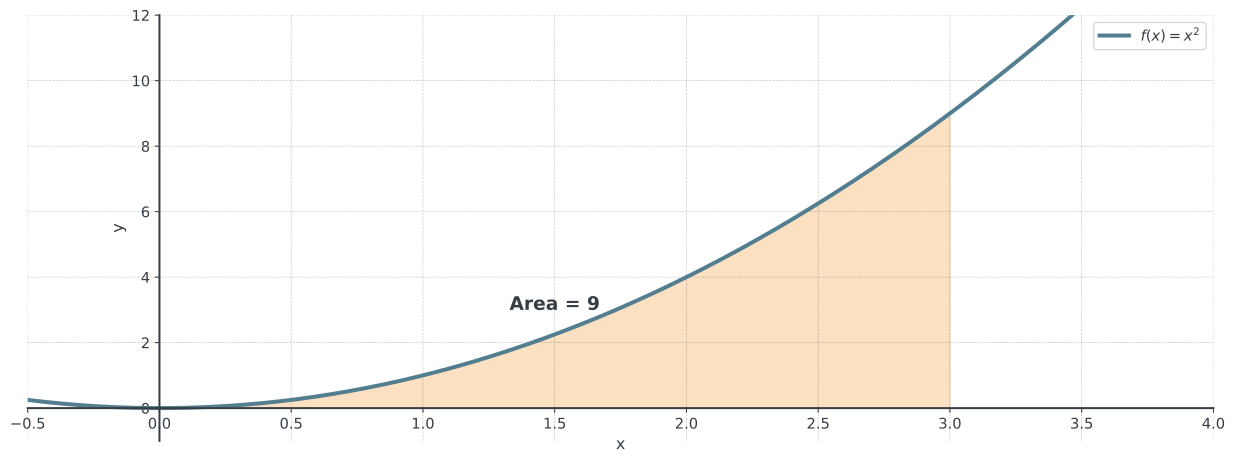
Find the area under \(f(x) = x^2\) from \(x = 0\) to \(x = 3\).
Solution:
\[\text{Area} = \int_0^3 x^2 \, dx = \frac{x^3}{3} \Big|_0^3 = \frac{27}{3} - 0 = 9\]
Example: Area Under a Parabola II
Find the area under \(f(x) = x^2\) from \(x = 0\) to \(x = 3\).
Area When \(f(x) < 0\)
The Sign Problem
When \(f(x) < 0\): The definite integral gives a negative value!
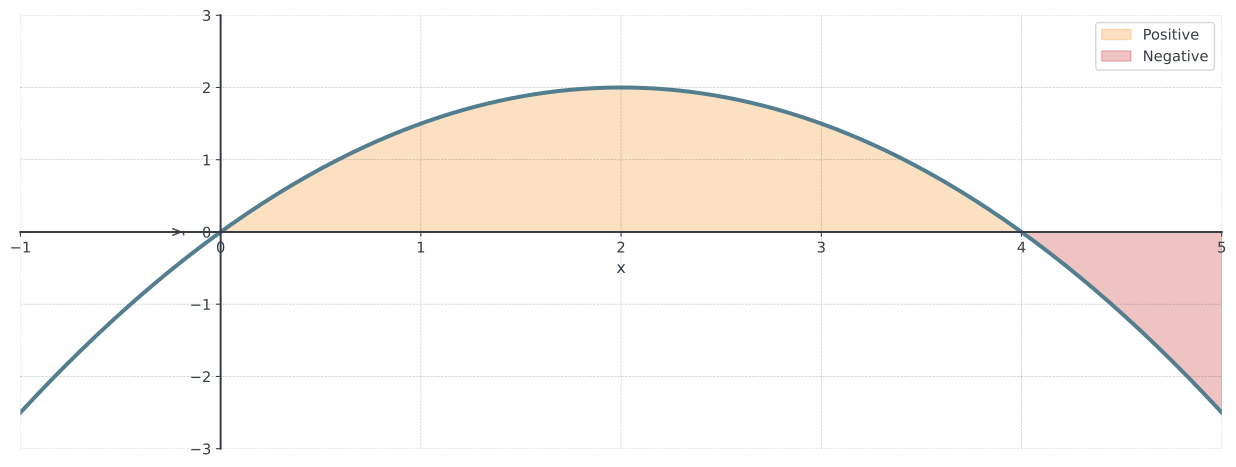
Definite integral ≠ Total area when function crosses the x-axis!
Total Area Strategy
To find total (unsigned) area:
- Find where \(f(x) = 0\) (zeros/roots)
- Split the integral at each zero
- Take absolute value of each piece
- Add all the positive values
\[\text{Total Area} = \sum |\text{each region}|\]
Example: Finding Total Area
Total area between \(f(x) = x^2 - 4\) and x-axis from \(x = 0\) to \(x = 3\)?
Step 1: Find zeros: \(x^2 - 4 = 0 \implies x = \pm 2\)
- Only \(x = 2\) is in \([0; 3]\).
Step 2: Determine signs:
- \(f(1) = -3 < 0\) (below x-axis on \([0; 2]\))
- \(f(3) = 5 > 0\) (above x-axis on \([2; 3]\))
Completing the Calculation
Step 3: Calculate each piece:
\[\int_0^2 (x^2 - 4) \, dx = \left[\frac{x^3}{3} - 4x\right]_0^2 = \frac{8}{3} - 8 = -\frac{16}{3}\]
\[\int_2^3 (x^2 - 4) \, dx = \left[\frac{x^3}{3} - 4x\right]_2^3 = (9 - 12) - (\frac{8}{3} - 8) = -3 + \frac{16}{3} = \frac{7}{3}\]
Step 4: Total area:
\[\text{Total Area} = \left|-\frac{16}{3}\right| + \frac{7}{3} = \frac{16}{3} + \frac{7}{3} = \frac{23}{3}\]
Visualization
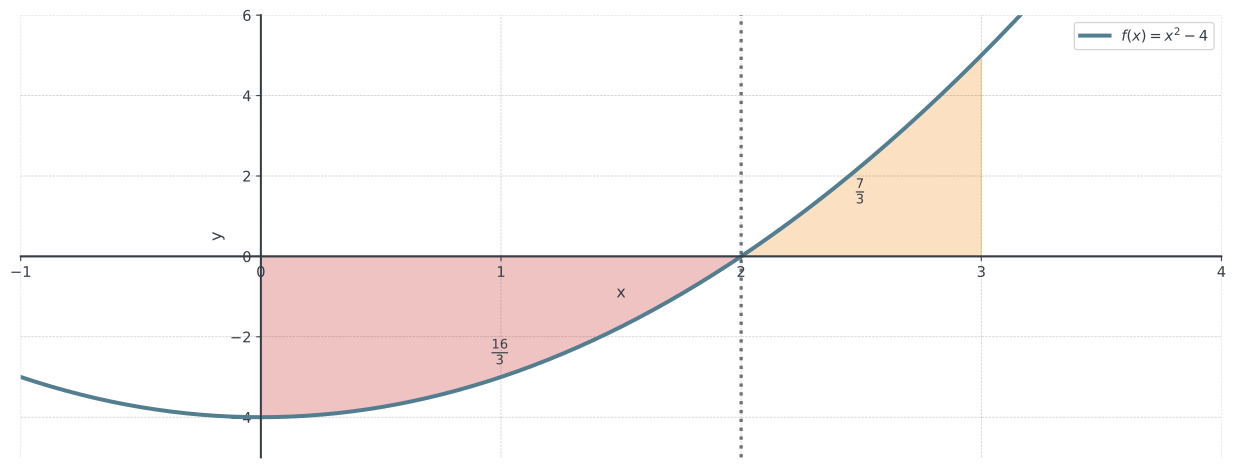
Total Area = \(\frac{16}{3} + \frac{7}{3} = \frac{23}{3} \approx 7.67\)
Break
Exponential Integrals
Integrating \(e^x\)
Recall: \(\frac{d}{dx}[e^x] = e^x\)
Therefore:
\[\int e^x \, dx = e^x + C\]
The exponential function is its own antiderivative!
Integrating \(e^{ax}\)
For \(e^{ax}\) where \(a\) is a constant:
\[\int e^{ax} \, dx = \frac{1}{a} e^{ax} + C\]
Verification: \(\frac{d}{dx}\left[\frac{1}{a}e^{ax}\right] = \frac{1}{a} \cdot a \cdot e^{ax} = e^{ax}\) ✓
Trick: Divide by the coefficient of \(x\) in the exponent.
Examples: Exponential Integrals
Example 1: \(\int e^{3x} \, dx\)
- \(\frac{1}{3}e^{3x} + C\)
Example 2: \(\int e^{-2x} \, dx\)
- \(\frac{1}{-2}e^{-2x} + C = -\frac{1}{2}e^{-2x} + C\)
Example 3: \(\int 4e^{5x} \, dx\)
- \(4 \cdot \frac{1}{5}e^{5x} + C = \frac{4}{5}e^{5x} + C\)
Logarithmic Integral
The Missing Case: \(n = -1\)
Recall the power rule:
\[\int x^n \, dx = \frac{x^{n+1}}{n+1} + C \quad \text{for } n \neq -1\]
Why not \(n = -1\)? Division by zero!
\[\int x^{-1} \, dx = \int \frac{1}{x} \, dx = \text{???}\]
\[\int \frac{1}{x} \, dx = \ln|x| + C\]
Why the Absolute Value?
- Recall: \(\frac{d}{dx}[\ln x] = \frac{1}{x}\) (for \(x > 0\))
- But what about \(x < 0\)?
- For \(x < 0\): \(\frac{d}{dx}[\ln(-x)] = \frac{1}{-x} \cdot (-1) = \frac{1}{x}\)
\[\int \frac{1}{x} \, dx = \ln|x| + C\]
The absolute value handles both positive and negative \(x\).
Examples: Logarithmic Integrals
Example 1: \(\int_1^e \frac{1}{x} \, dx\)
- \(\ln e - \ln 1 = 1 - 0 = 1\)
Example 2: \(\int_1^4 \frac{3}{x} \, dx\)
- \(3(\ln 4 - \ln 1) = 3\ln 4\)
Example 3: \(\int_{-3}^{-1} \frac{2}{x} \, dx\)
- \(2(\ln 1 - \ln 3) = -2\ln 3\)
Summary: Special Integrals
| Function | Antiderivative |
|---|---|
| \(e^x\) | \(e^x + C\) |
| \(e^{ax}\) | \(\frac{1}{a}e^{ax} + C\) |
| \(\frac{1}{x}\) | \(\ln|x| + C\) |
| \(\frac{1}{ax+b}\) | \(\frac{1}{a}\ln|ax+b| + C\) |
These formulas will appear frequently in business applications!
Guided Practice
Set A: Area Calculations
Work individually for 8 minutes
Find the area under \(f(x) = 3x^2\) from \(x = 1\) to \(x = 4\).
Find the total area between \(f(x) = x - 3\) and the x-axis from \(x = 0\) to \(x = 5\).
Find the total area between \(f(x) = x^2 - 1\) and the x-axis from \(x = 0\) to \(x = 2\).
Set B: Exponential & Logarithmic
Work individually for 6 minutes
\(\int e^{4x} \, dx\)
\(\int 5e^{-x} \, dx\)
\(\int_0^2 e^{3x} \, dx\)
\(\int_1^5 \frac{2}{x} \, dx\)
\(\int (e^x + \frac{1}{x}) \, dx\)
Practice Set C: Mixed Problems
Work in pairs for 6 minutes
Find the area enclosed between \(f(x) = e^x\) and the x-axis from \(x = 0\) to \(x = 2\).
The daily downloads of a new app fall according to \(D(t) = 1000e^{-0.1t}\) downloads per day, \(t\) in days. Find the total number of downloads in the first 10 days.
Coffee Break
Business Applications
Total Profit Over Time
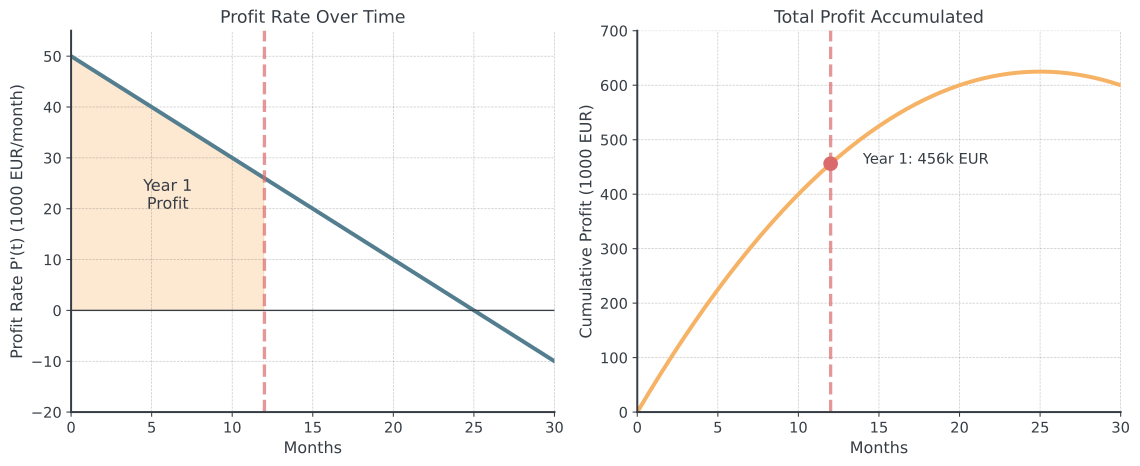
Scenario: A company’s profit rate (profit per month) is:
\[P'(t) = 50 - 2t \text{ thousand EUR per month}\]
where \(t\) is months since launch.
Questions:
- What is the total profit during the first year (\(t = 0\) to \(t = 12\))?
- At what month does profit rate become negative?
Solution: Profit Analysis
Part 1: Total profit
\[\int_0^{12} (50 - 2t) \, dt = [50t - t^2]_0^{12} = 600 - 144 = 456\]
Total profit = 456,000 EUR
Part 2: When profit rate becomes zero
\[50 - 2t = 0 \implies t = 25 \text{ months}\]
The profit rate stays positive for the first 25 months.
Visualizing Profit Accumulation
Exponential Decay in Business
Scenario: Sales of a product decline exponentially after its peak:
\[S(t) = 10000 \cdot e^{-0.2t} \text{ units per month}\]
Question: What are the total sales from \(t = 0\) to \(t = 6\) months?
Solution:
\[\int_0^6 10000e^{-0.2t} \, dt = 10000 \cdot \frac{1}{-0.2}e^{-0.2t}\Big|_0^6\]
\[= -50000(e^{-1.2} - e^0) = -50000(0.3012 - 1) = 34,940 \text{ units}\]
Team Problem-Solving
Group Challenge: Market Analysis
Scenario: An e-commerce company tracks its daily revenue rate:
\[R'(t) = 5000 + 200t - 5t^2 \text{ EUR per day}\]
where \(t\) is days since a marketing campaign started.
The campaign runs for 30 days.
Group Tasks
Work in groups of 3-4
Graph \(R'(t)\) for the 30-day period. When is the revenue rate highest?
Calculate the total revenue for the first 10 days.
Calculate the total revenue for the entire 30-day campaign.
Group Tasks II
On which day does the revenue rate first drop below 4,000 EUR/day?
What share of the total campaign revenue comes in during the first 10 days?
If the campaign costs 80,000 EUR, what is the net profit?
Wrap-Up & Takeaways
Today’s Essential Concepts
- Area under curve when \(f(x) \geq 0\): Use \(\int_a^b f(x) \, dx\) directly
- Total area: Split at zeros and sum absolute values
- Exponential integrals: \(\int e^{ax} \, dx = \frac{1}{a}e^{ax} + C\)
- Logarithmic integral: \(\int \frac{1}{x} \, dx = \ln|x| + C\)
- Business applications: Total quantities from rate functions
Next session: Area between TWO curves and economic surplus!
Final Assessment
Quick Check
Work individually, then compare
Find the total area between \(f(x) = x - 2\) and the x-axis from \(x = 0\) to \(x = 4\).
Evaluate \(\int_0^3 2e^{-x} \, dx\).
A company’s revenue rate is \(R'(t) = 100 + 20t\) thousand EUR per month. Find total revenue for months 1-5.
Next Session Preview
Coming Up: Area Between Curves
- Finding intersection points of two functions
- Determining which function is “on top”
- Setting up \(\int_a^b [f(x) - g(x)] \, dx\)
- Handling multiple regions
- Consumer and producer surplus introduction
Complete Tasks 06-03
- Practice area calculations with sign changes
- Work with exponential and logarithmic integrals
- Focus on business rate-to-total problems
Session 06-03 - Area Problems & Basic Applications | Dr. Nikolai Heinrichs & Dr. Tobias Vlćek | Home