Session 02-03 - Fractional, Radical, Exponential & Logarithmic Equations
Section 02: Equations & Problem-Solving Strategies
Entry Quiz
Quick Review of Previous Methods
10 minutes - individual work, then peer review
Solve by factoring: \(x^2 - 9x + 20 = 0\)
Use the quadratic formula: \(2x^2 + 3x - 1 = 0\)
Solve the biquadratic: \(x^4 - 5x^2 + 4 = 0\)
Find the discriminant of: \(x^2 - 6x + 9 = 0\)
Factor completely: \(x^3 - 8\)
Check your factoring skills - they’re crucial for today!
Homework Discussion
Solution from Tasks 02-02
15 minutes - presentation and discussion
- Share your break-even analysis solutions
- Discuss method selection strategies
- Present any challenging biquadratic equations
- Review discriminant problems with a parameter if time permits
Today we extend our toolkit to handle more complex equation types!
Learning Objectives
Learning Objectives
By the end of this session, you can:
- Identify domain restrictions in fractional equations before solving
- Solve radical equations and detect extraneous solutions
- Solve advanced exponential equations via substitution and logarithms
- Solve logarithmic equations and systems, checking domains
Key Concept Review
Building on What You Know
Your current equation-solving toolkit:
- Zero Product Property: If \(AB = 0\), then \(A = 0\) or \(B = 0\)
- Quadratic methods: Factoring, formula, completing square
- Substitution: Transform complex equations to simpler ones
Today’s additions:
- Domain restrictions for rational equations
- Checking for extraneous solutions
- Solving techniques for exponential and logarithmic equations
Fractional Equations
Understanding Domain Restrictions
Critical new concept
Domain: The set of all valid input values
For fractional equations, we must exclude values that make denominators zero!
Example: \(\frac{1}{x - 3}\) has domain restriction: \(x \neq 3\)
Always Check First!
Before solving any fractional equation, identify ALL domain restrictions.
Solving Fractional Equations
Clear denominators by multiplying by LCD: Solve \(\frac{2}{x} + \frac{3}{x-1} = 1\)
- Find domain restrictions: \(x \neq 0, x \neq 1\)
- Find LCD: \(x(x-1)\)
- Multiply all terms by LCD: \(2(x-1) + 3x = x(x-1)\)
- Expand: \(2x - 2 + 3x = x^2 - x\)
- Rearrange: \(x^2 - 6x + 2 = 0\)
- Solve: \(x = \frac{6 \pm \sqrt{36-8}}{2} = 3 \pm \sqrt{7}\)
- Check domain: Both solutions valid! ✓
Common Fractional Patterns
Recognize these structures
\(\frac{a}{x} + \frac{b}{x} = c\)
- Combine: \(\frac{a+b}{x} = c\)
- Solve: \(x = \frac{a+b}{c}\)
\(\frac{a}{b} = \frac{c}{d}\)
- Cross multiply: \(ad = bc\)
- Much faster than finding LCD!
\(\frac{\frac{a}{x}}{\frac{b}{y}} = c\)
- Simplify: \(\frac{ay}{bx} = c\)
- Then solve normally
Application: Work Rate Problem I
Practical example with domain restrictions
Two teams can complete a project. Their combined work rate equation is: \[\frac{1}{x} + \frac{1}{x+5} = \frac{1}{3}\] where \(x\) is the time (in days) for Team A to complete it alone.
- Domain restrictions: \(x > 0\) (time must be positive)
- Also \(x \neq -5\), but this is already excluded by \(x > 0\)
- Solving: Find LCD = \(3x(x+5)\)
Application: Work Rate Problem II
- Multiply through: \(3(x+5) + 3x = x(x+5)\)
- Expand: \(3x + 15 + 3x = x^2 + 5x\)
- Rearrange: \(x^2 - x - 15 = 0\)
- Using quadratic formula: \(x = \frac{1 \pm \sqrt{1 + 60}}{2} = \frac{1 \pm \sqrt{61}}{2}\)
- Solutions: \(x \approx 4.41\) or \(x \approx -3.41\)
- Check domain: Only \(x = 4.41\) days is valid (positive time)
- Business meaning: Team A takes 4.41 days alone, Team B takes 9.41 days alone
- Together they complete it in 3 days as required
Break
Radical Equations
Solving Strategy
Isolate, square, check!
Key principle: To eliminate a square root, square both sides
Critical warning: Squaring can introduce extraneous solutions!
Example: \(\sqrt{x + 3} = x - 1\)
- Square both sides: \(x + 3 = (x - 1)^2\)
- Expand: \(x + 3 = x^2 - 2x + 1\)
- Rearrange: \(x^2 - 3x - 2 = 0\)
- Solutions: \(x = \frac{3 \pm \sqrt{9 + 8}}{2} = \frac{3 \pm \sqrt{17}}{2}\)
- \(x_1 = \frac{3 + \sqrt{17}}{2} \approx 3.56\), \(x_2 = \frac{3 - \sqrt{17}}{2} \approx -0.56\)
Checking for Extraneous Solutions
Essential verification step
Check \(x_1 \approx 3.56\):
- Left: \(\sqrt{3.56 + 3} = \sqrt{6.56} \approx 2.56\)
- Right: \(3.56 - 1 = 2.56\) ✓
Check \(x_2 \approx -0.56\):
- Left: \(\sqrt{-0.56 + 3} = \sqrt{2.44} \approx 1.56\)
- Right: \(-0.56 - 1 = -1.56\) ✗
Only \(x_1\) is valid! Always check radical equation solutions!
Seeing the Extraneous Solution
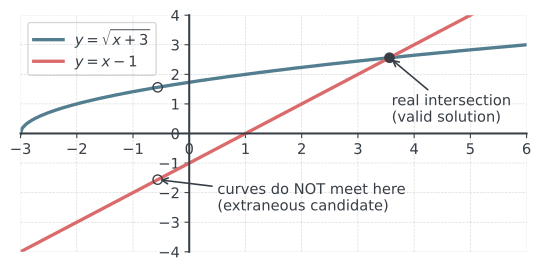
Squaring both sides merges \(y = x - 1\) and \(y = -(x-1)\) into one equation - the second candidate solves the mirrored line, not the original!
Multiple Radicals
More complex scenarios
Solve: \(\sqrt{x + 5} + \sqrt{x} = 5\)
- Isolate one radical: \(\sqrt{x + 5} = 5 - \sqrt{x}\)
- Square: \(x + 5 = 25 - 10\sqrt{x} + x\)
- Simplify: \(5 = 25 - 10\sqrt{x}\)
- Isolate: \(10\sqrt{x} = 20\), so \(\sqrt{x} = 2\)
- Solution: \(x = 4\)
- Check: \(\sqrt{9} + \sqrt{4} = 3 + 2 = 5\) ✓
Calculator: The SOLVE Function I
Newton’s method for solving any equation:
SOLVE (accessed via SHIFT + CALC) uses Newton’s approximation method to find solutions.
- Enter an equation (e.g.,
x² + B = 0) - Press SHIFT + CALC (SOLVE)
- Enter an initial guess for x and values for other variables
- Press = to find the solution
Calculator: The SOLVE Function II
Newton’s method for solving any equation:
Example: Solve \(x^2 - 2 = 0\) (find \(\sqrt{2}\))
- Enter:
ALPHA x² - 2→ SHIFT CALC → initial guess:1 = - Result: \(x = 1.414213562\) (which is \(\sqrt{2}\))
SOLVE uses numerical methods, so:
- Results depend on your initial guess
- Multiple solutions require different starting points
- The closer your guess, the faster and more reliable the result
Exponential Equations
Equations with Different Bases
When you can’t make bases equal
Solve: \(3^x \cdot 5^{x-1} = 45\)
- Rewrite: \(3^x \cdot \frac{5^x}{5} = 45\)
- Simplify: \(\frac{3^x \cdot 5^x}{5} = 45\)
- Combine: \(\frac{(3 \cdot 5)^x}{5} = 45\)
- So: \(15^x = 225 = 15^2\)
- Therefore: \(x = 2\)
Look for ways to combine or separate bases strategically!
Mixed Exponential Systems
Solving simultaneous exponential equations
\(2^x + 2^y = 12\)
\(2^x - 2^y = 4\)
- Let \(u = 2^x\) and \(v = 2^y\) for simplicity
- System becomes: \(u + v = 12\) and \(u - v = 4\)
- Add equations: \(2u = 16\), so \(u = 8\)
- Subtract: \(2v = 8\), so \(v = 4\)
- Therefore: \(2^x = 8 = 2^3\), giving \(x = 3\)
- And: \(2^y = 4 = 2^2\), giving \(y = 2\)
Exponential Inequalities
New territory: solving inequalities
Solve: \(2^{x+1} > 8^{x-1}\)
- Rewrite right side: \(8^{x-1} = (2^3)^{x-1} = 2^{3(x-1)}\)
- Inequality becomes: \(2^{x+1} > 2^{3x-3}\)
- Since base 2 > 1, we can compare exponents directly
- \(x + 1 > 3x - 3\)
- \(4 > 2x\)
- Solution: \(x < 2\)
Logarithmic Equations
Equations with Mixed Bases
Using change of base strategically
Solve: \(\log_2(x) \cdot \log_x(8) = 3\)
- Use change of base: \(\log_x(8) = \frac{\log_2(8)}{\log_2(x)} = \frac{3}{\log_2(x)}\)
- Substitute: \(\log_2(x) \cdot \frac{3}{\log_2(x)} = 3\)
- Simplify: \(3 = 3\) ✓ This is always true for any valid \(x\)!
- Domain restriction: \(x > 0, x \neq 1\) (a log needs a positive argument: \(\log(x - 5)\) needs \(x > 5\))
- Solution: \(x \in (0; 1) \cup (1; \infty)\)
Logarithmic Systems
Multiple equations with logs
\(\log(x) + \log(y) = 2\)
\(\log(x) - \log(y) = 1\)
- Add equations: \(2\log(x) = 3\), so \(\log(x) = 1.5\)
- Therefore: \(x = 10^{1.5} = 10\sqrt{10}\)
- Subtract second from first: \(2\log(y) = 1\)
- So: \(\log(y) = 0.5\), thus \(y = \sqrt{10}\)
- Check: \(\log(10\sqrt{10}) + \log(\sqrt{10}) = 1.5 + 0.5 = 2\) ✓
Think: Which Method?
2 minutes alone, 3 minutes with your neighbour
Match each equation type to the best first move:
\(5^{x+2} = 125\)
\(3^{2x} - 10 \cdot 3^x + 9 = 0\)
\(\log(x) + \log(x-3) = 1\)
\(2^x = 7\)
Guided Practice
Individual Exercises
Work independently
Solve and state domain: \(\frac{3}{x-2} + \frac{1}{x} = 1\)
Solve: \(\sqrt{2x + 1} = x - 2\)
Solve: \(3^{2x} - 4 \cdot 3^x + 3 = 0\)
Solve: \(\frac{x}{x+1} = \frac{2}{x-1}\)
Solve: \(\sqrt{x + 7} - \sqrt{x} = 1\)
Solve: \(\log_2(x) + \log_2(x - 2) = 3\)
Coffee Break
Apply & Extend
Production Rate Problem
Find the individual times.
Machine A can complete an order in \(x\) hours. Machine B takes 3 hours longer. Working together, they complete it in 2 hours.
- A’s rate: \(\frac{1}{x}\) orders/hour, B’s rate: \(\frac{1}{x+3}\) orders/hour
- Combined: \(\frac{1}{x} + \frac{1}{x+3} = \frac{1}{2}\)
- Solve: \(2(x+3) + 2x = x(x+3)\)
- \(x^2 - x - 6 = 0\)
- \((x - 3)(x + 2) = 0\)
- Since \(x > 0\): Machine A takes 3 hours, B takes 6 hours
Investment Growth
Compound interest with radicals
An investment grows according to: \(A = P\sqrt{1 + 0.2t}\)
If 1,000 EUR grows to 1,500 EUR, find the time \(t\).
- Set up: \(1500 = 1000\sqrt{1 + 0.2t}\)
- Simplify: \(\sqrt{1 + 0.2t} = 1.5\)
- Square: \(1 + 0.2t = 2.25\)
- Solve: \(0.2t = 1.25\)
- Time: \(t = 6.25\) years
Do we have to check the domain restrictions?
Team Problem-Solving
Complex Rate Challenge
Work in pairs to solve this problem
A chemical reaction follows the rate equation: \[\frac{C}{t} + \frac{C}{t+2} = 3\]
where \(C\) is concentration and \(t\) is time in hours.
- Find the time when this relationship holds for \(C = 6\)
- Verify your solution makes physical sense
Consider domain restrictions and check all solutions!
Epidemic Modeling Challenge
The infected count in a population of 10,000 after t days: \[I = \frac{10000}{1 + 99e^{-0.5t}}\]
- How many are initially infected?
- When will half the population be infected?
- If a vaccine reduces the spread rate (the factor 0.5 in the exponent) by 40%, modify the model
This is a logistic growth model - different from pure exponential!
Spot the Error
Find and fix the mistake
A student solved \(\sqrt{x + 4} = x - 2\):
Square both sides with \(x + 4 = x - 2\), therefore: \(4 = -2\), which is impossible. So there’s no solution.
What went wrong?
Wrap-Up & Takeaways
Key Takeaways
Master these essential concepts
- Domain restrictions must be checked FIRST in rational equations
- LCD method clears fractions efficiently
- Squaring introduces extraneous solutions - always verify!
- Exponential equations: substitute \(u = a^x\) or take logs
- Logarithmic equations: combine logs, convert, and check domains
- Cross multiplication works for proportion equations
- Real-world rates often involve rational equations
Final Assessment
10 minutes - individual assessment
Solve the following:
\(\frac{2}{x+1} - \frac{1}{x-1} = \frac{1}{2}\)
\(\sqrt{3x - 2} = x\)
Solve: \(4^x - 3 \cdot 2^x = -2\)
Next Session: Mock Exam 03
Session 02-04 is exam only - no lecture
- 90 min + 5 min reading, 50 points, counts toward the 60%
- Covers Section 02: systems, quadratic, fractional, radical, biquadratic and exponential equations
- Calculator, drawing instruments, dictionary - no notes, formula sheets or electronic devices
Practice the chain data points → system → cost function → break-even. Check domains and extraneous solutions!
Homework Assignment
Complete Tasks 02-03!
Then prepare for Mock Exam 03 with FSP Training 02 (sidebar, Section 02 worksheets).
Focus on:
- Domain restriction practice
- Checking all solutions in radical equations
- Exponential and logarithmic equations
- Real-world rate problems
Remember: In fractional equations, always identify restrictions before solving!
Session 02-03 - Fractional, Radical, Exponential & Logarithmic Equations | Dr. Nikolai Heinrichs & Dr. Tobias Vlćek | Home